Freelance statistics for 2026: how many freelancers, what they earn and where AI hits
 By Jan Suski. I go deep on every review, checking every number against its source and digging up details other coverage misses, a habit from six years of SEO and link building for tech companies. Bylines at Surfer, Brand24, and Senuto. How the scoring works.
The numbers U.S. freelance workforce, pay and platforms, checked 4 October 2026
Every U.S. count above 20 million includes people whose freelancing is a side income, which the BLS main-job measure leaves out by design.
Fiverr lost about 700,000 buyers in twelve months while annual spend per buyer rose from $318 to $368, so the platforms are trading headcount for bigger clients.
Generative AI cut 21% of automation-prone writing and coding posts, and the projects that survived were more complex and paid more.
Somewhere between 11.9 million and 74.9 million Americans freelance, and both numbers come from serious publishers. The Bureau of Labor Statistics counted 11.9 million independent contractors on their main job in July 2023. MBO Partners counted 74.9 million independent workers in its State of Independence study released on 28 September 2026.
The 6.3x gap comes from definitions, and this report names every one of them for analysts, hiring managers and freelancers, because the source you pick moves a market estimate by 63 million people.
The page collects freelancing data published between 2023 and October 2026: the size of the freelance workforce in the U.S. and abroad, freelancing income and hourly rates by skill, what Upwork and Fiverr disclose in their earnings releases, who freelances by age and gender, and what generative AI has done to demand for freelancers. Every number links to the statistics office, research house, journal or company filing that produced it, with the report name and date.
It's written for analysts sizing the independent workforce, businesses that hire freelancers for short projects or longer contracts, and freelancers who want to check their hourly rates against published data before they quote clients. Those readers need a number they can defend, and the definitions behind each count decide which one that is.
How many freelancers are there in the U.S.?
Four publishers measure the U.S. freelance workforce on a regular cycle, and their counts differ by a factor of six. The federal numbers sit at the bottom of the range because they count the narrowest population.
- Bureau of Labor Statistics. 11.9 million independent contractors, consultants and freelance workers on their sole or main job in July 2023, or 7.4% of total employment, up from 6.9% in May 2017. Another 1.9 million people were independent contractors on a second job.
- Federal Reserve. 20% of adults did gig activities in the prior month of 2024. 13% made money by selling things, 9% did short-term tasks and 4% found those tasks through an app or websites.
- Upwork. 64 million Americans freelanced in 2023, 38% of the workforce, per Freelance Forward 2023. The company's freelancing stats page, updated 14 July 2026, puts freelancing at 39% of all U.S. workers.
- MBO Partners. More than 72 million independent workers in its 2025 study, and a record 74.9 million in 2026.
The BLS count comes from a supplement to the Current Population Survey, a monthly sample of about 60,000 households, and the supplement hadn't run since May 2017. That six-year gap left the annual private surveys in the driver's seat for most pages on the subject. The July 2023 supplement also asked about app-based platform work, and the BLS said it would publish those estimates separately at a date to be determined.
Full-time freelancing and side gigs
Main-job contractors in the BLS count mostly work full time, and the full-time share is growing. 70.7% of the independent contractors the BLS counted worked full time, and 80.3% preferred the arrangement against 8.3% who wanted traditional employment.
The Federal Reserve's gig workers look different. 96% of adults who did gig activities spent under 35 hours a week on them, 70% spent under five hours, and only 21% called gig work their main work. 51% had other main employment, a portfolio of income that the BLS question can't see. Asked about their reasons, 61% of gig workers said they were their own boss and 55% cited flexible hours.
MBO's 2026 release says full-time independent professionals grew 114% since 2020 and now account for 22% of all full-time U.S. workers, nearly double their 2019 share. 78% plan to stay independent or grow a bigger business, and just 1% described themselves as dissatisfied. In 2025, 42% of MBO's independents were relying on online platforms as their primary way to find work.
Upwork's 2026 index frames freelancing as a career move. 58% of full-time employees said they're considering freelancing, up from 36% a year earlier, and Upwork says workers want more control over how they build expertise, choose projects and earn from their skills. In the index's first year, 2025, only 10% of freelancers wanted to return to traditional employment.
Why the published freelance counts diverge
The gap between 11.9 million and 74.9 million is a gap in definitions, and each publisher states its own. Three choices drive most of it: the reference period (a survey week or any paid work in twelve months), the population (all workers or skilled knowledge workers only), and the activity (selling used clothes counts in one survey and not in another).
Survey mode matters too. The BLS interviews a household sample, while Upwork and MBO run online panels through Edelman Data & Intelligence, Emergent Research and Radius Insights.
| Publisher | Report and date | What it counts | U.S. number |
|---|---|---|---|
| Bureau of Labor Statistics | Contingent Worker Supplement, July 2023 (released November 2024) | Independent contractors, consultants and freelancers on their sole or main job | 11.9M (7.4% of employment) |
| Federal Reserve | SHED 2024, May 2025 | Adults who sold items, rented property or did short-term tasks in the prior month | 20% of adults |
| Upwork | Future Workforce Index 2025, April 2025 | Skilled knowledge workers who freelanced in 2024, extrapolated from 71.5M management and professional workers | 20M+ (28%) |
| Upwork | Future Workforce Index 2026, July 2026 | Same population, 2,400 respondents surveyed March to April 2026 | 38% of skilled knowledge workers |
| Upwork | Freelance Forward 2023, December 2023 | Any U.S. worker who did freelance work in the past 12 months, against a 168M labor force | 64M (38%) |
| MBO Partners | State of Independence 2026, September 2026 | Adults doing independent work, weighted from 4,557 respondents including 2,063 independents | 74.9M |
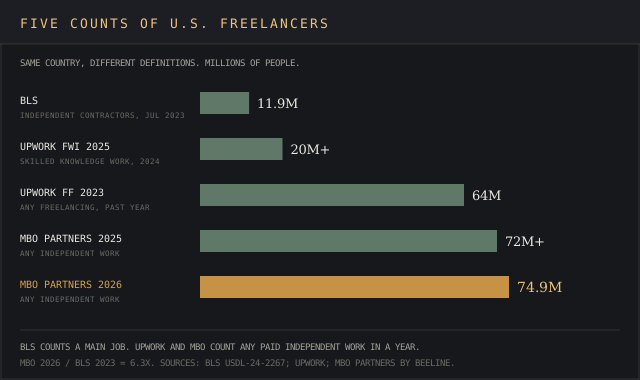
Upwork's own reports show how much the population choice moves the count. Its 2023 survey of all workers found 64 million freelancers. Its 2025 index, which focuses on skilled knowledge workers, found more than 20 million. Both are Upwork data, and the second is roughly a third of the first, because the base fell from a 168 million labor force to 71.5 million management, professional and related workers.
Each publisher's methodology materials state the sample and the dates, and the quality of those notes varies. Sample size differs too, from about 60,000 households in the BLS survey to 2,400 respondents for Upwork's 2026 index and 4,557 for MBO's. Upwork's 2026 index reports a 2% margin at 95% confidence, and its 2023 study reported ±1.7%. MBO weights its 2026 results to U.S. demographics without a margin in the release.
The Federal Reserve is the most open about the measurement problem. 28% of the adults who did gig activities, 6% of all adults, told the survey they weren't working for pay while also saying they earned money through gigs.
The Fed also tested its question architecture in 2024, giving half its sample a new sequence modelled on the Contingent Worker Supplement, and both versions found 9% of adults doing short-term gig work, meaning the Fed's figure holds across wordings. Its 2026 report on 2025 groups labor questions under employment and job quality.
Both private houses sell to the market they measure. Upwork connects businesses with independent talent and had 785,000 active clients at the end of 2025, and MBO Partners says it supports 100+ enterprise organizations representing more than $1 billion in independent workforce spend. It makes sense to read between the lines of the methodology note before quoting the headline.
For a sizing model, the BLS 11.9 million is the floor for people who freelance professionally as their primary work, and the MBO 74.9 million is the ceiling for anyone with independent income in a year. The market sizing template takes either as a starting population, and the survey trade-offs behind each count are covered in market research methods. Mixing the two in one model double-counts side gigs, and the devil's in the details of each definition.
Freelancing income and hourly rates
Hourly rates for freelancers run from $10 to $250 on Upwork alone, and the skill sets the price first. Region and experience come next, and the data below takes them into account where a publisher reports them.
Hourly rates by skill on Upwork
Upwork publishes median hourly rate ranges on its hiring pages for each category of freelancer, read here on 4 October 2026. It doesn't publish one average across all categories, so the medians below are per skill and show what clients pay on the platform.
| Skill | Median hourly rate range on Upwork (USD) |
|---|---|
| Data scientists | $35 to $250 |
| Machine learning engineers | $50 to $200 |
| Web developers | $15 to $50 |
| Copywriters | $19 to $45 |
| Content writers | $15 to $40 |
| Mobile app developers | $18 to $39 |
| SEO experts | $15 to $35 |
| Graphic designers | $15 to $35 |
| Virtual assistants | $10 to $20 |
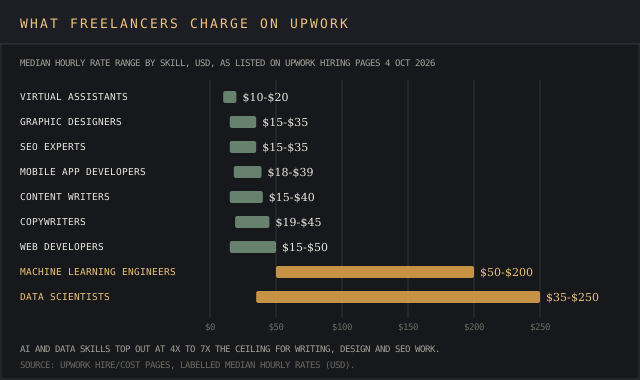
Freelance web developers on Upwork charge a median $15 to $50 per hour, SEO experts $15 to $35, machine learning engineers $50 to $200 and data science consultants $35 to $250. Data science accounts for the widest spread on the list.
Freelancers who write marketing and brand copy, write content for blogs and product pages or handle SEO and link building cluster between $15 and $45. A $250 ceiling against $35 for graphic designers and SEO experts is a 7x gap, and $200 for machine learning against $45 for copywriters is 4.4x.
What freelancers earn in a year
Freelancing income sits below employee pay in federal data and above it in Upwork's. Full-time independent contractors earned a median $949 a week in July 2023, against $1,132 for full-time workers in traditional arrangements, per the BLS. That's 84% of the employee figure.
Upwork's 2025 index reports the opposite for its narrower population. U.S. skilled knowledge freelancers generated $1.5 trillion in annual earnings in 2024, and skilled freelancers who earn only from freelancing reported median annual income of $85,000, ahead of $80,000 for full-time employees. 37% of those freelancers hold postgraduate degrees against 20% of full-time employees, so the two populations differ before pay is compared.
- 5.8 million U.S. independents earn more than $100,000 a year in 2026, nearly double the 2020 number, per MBO Partners.
- 5.6 million crossed $100,000 in 2025, a 19% increase from 2024 and 86% from 2020.
- 31% of Federal Reserve gig workers said that without gig income they'd have trouble making ends meet.
- 49% of gig workers wished the pay was more consistent, rising to 61% of people doing platform tasks through an app.
The Fed data also shows financial stress and less financial security among gig workers. 65% said they were doing okay or living comfortably, against 75% of adults who did no gig work, and 50% had three months of emergency savings against 56%. 28% of gig workers wished they had benefits such as health insurance, and 55% valued the ability to work flexible hours.
Freelance rates in Europe and the UK
Freelancers in the DACH survey charge more per hour than most Upwork medians. The freelancermap Freelancer Study 2026, a survey of more than 5,400 members of the freelance community in Germany, Austria and Switzerland, puts the average hourly rate at €103, down from €104 in 2025 and up from an average of €96 in 2022.
The same study shows weaker prospects. 49% reported a worse pipeline of projects than a year earlier, and 52% named unstable projects as the biggest challenge ahead. Almost every second freelancer reported no confirmed workload for the coming months, so half the market is playing it by ear, and income satisfaction fell from 66% to 55% in one year. 84% would still choose self-employment again.
UK copywriters price by the day. The ProCopywriters 2026 survey of 383 freelance copywriters found most charge between £300 and £1,800 a day, with a median of £440. A fixed project fee for scoped projects is the most common way copywriters who write brand and website copy price their work, so buyers can expect a fixed quote per deliverable.
The top of that range, £1,800 a day and up, belongs to writers with deep sector knowledge or a proven record, per ProCopywriters. Per-word pricing for blog posts is common in content mills and rare among copywriters with that profile, and Upwork lists content writers at $15 to $40 an hour.
Businesses deciding to hire a copywriter or hire salaried staff can benchmark these rates with compensation benchmarking tools.
Upwork and Fiverr: what the platform filings show
The two listed freelance companies both lost buyers through 2025 and the first half of 2026 while each remaining client spent more. Their quarterly results are the only freelancing data published under public-company reporting rules, and they report a narrower thing than the surveys, which is paid work routed through one platform.
| Metric | Upwork | Fiverr |
|---|---|---|
| Buyers, December 2025 | 785,000 active clients, down 6% from 832,000 | 3.1M annual active buyers, down from 3.6M |
| Buyers, June 2026 | 763,000 active clients | 2.7M annual active buyers, down from 3.4M |
| Value per buyer | $5,129 GSV per active client in Q4 2025, $5,230 in Q2 2026 | $342 per buyer at December 2025, $368 at June 2026 |
| Full year 2025 | $4.03B gross services volume, $787.8M revenue | $430.9M revenue, up 10.1% |
| Second quarter 2026 | $966.4M GSV, down 4%, and $191.7M revenue, down 2% | $97.8M revenue, against $108.6M a year earlier |
| Take rate | Not disclosed in the release | 28.0% for the twelve months to June 2026 |
Numbers come from each company's earnings releases, namely Upwork's full year 2025 results of 9 February 2026, Upwork's second quarter 2026 results of 10 August 2026, Fiverr's full year 2025 results of 18 February 2026 and Fiverr's second quarter release.
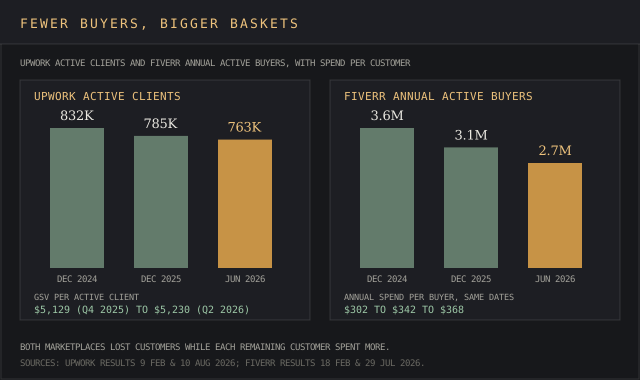
The Fiverr brand still reached 2.7 million buyers, but that count fell 20.6% in the year to June 2026 while the average buyer's annual purchases rose 15.7%, meaning each remaining buyer is bigger.
Its marketplace revenue of $63.1 million accounted for about 65% of second-quarter revenue, and the 28.0% take rate is the share of transaction value Fiverr keeps, which sets the costs of buying and selling there. Upwork's active clients fell 8% from December 2024 to June 2026, while GSV per active client, an average, reached $5,230 as of Q2 2026, up 5% year over year.
Read together, the two filings fit small one-off buyers leaving first and businesses with recurring projects staying, since buyer counts fell while the average buyer grew at both. Upwork guided to 4% to 6% GSV growth for 2026 in February, and the second quarter's 4% decline puts that target against the clock.
Upwork's Business Plus offering for small businesses grew its active clients 49% quarter over quarter in Q4 2025, and enterprise revenue accounted for $104.9 million of Upwork's 2025 total. Upwork runs two brands, the Upwork Marketplace and Lifted, and sells to large clients through Lifted, which it describes as a purpose-built solution to source, contract, manage and pay contingent talent.
Upwork reports more than $30 billion in total transactions since its founding, and it cites a commissioned third-party study that projects the flexible digital knowledge work market at $1.3 trillion by 2028. For analysts tracking the solo businesses on the other side of these transactions, the small business statistics report covers the nonemployer count.
Who freelances: age, gender and education
Age moves the probability of freelancing in federal data, in opposite directions depending on the source. The probability that a worker is an independent contractor rises with age, from 2.2% at 16 to 24, to 6.9% at 25 to 54, to 11.5% at 55 and over. People 55 and older account for 36% of independent contractors against 22% of workers in traditional arrangements.
Gig-style freelancing runs the other way. 26% of adults aged 18 to 29 did gig activities in 2024 against 12% of those 60 and over, per the Fed, and 30% of students did. Upwork found 52% of Gen Z professionals and 44% of millennials freelanced in 2023, while 8.3 million freelancers, 13% of the total, were 59 or older. Gen Z accounts for 28% of the independent workforce in MBO's 2025 study.
- Gender. Men had a higher probability of being independent contractors than women, 8.7% against 5.8%. Full-time female contractors earned a median $857 a week against $1,004 for men, or 85%.
- Race and ethnicity. 7.9% of White workers and 7.4% of Hispanic workers were independent contractors, against 5.4% of Black and Asian workers. Hispanic adults had the highest gig rate in the Fed survey at 24%.
- Education. 37% of Upwork's skilled freelancers hold postgraduate degrees, against 20% of full-time employees.
- Location. One-third of MBO's independents serve clients outside the U.S., nearly three times the 2012 share, and six in 10 online gig workers worldwide live in smaller cities, per the World Bank.
- Retirement. 15% of retirees did some paid work in the prior month of the Fed's 2024 survey, and 19% of working retirees said the money let them support family or friends.
- Referrals. Freelancers who find clients through friends and former colleagues show up in surveys, which count all paid independent work, while platform filings count transactions on one platform alone.
European freelancing comes closer to a level playing field. freelancermap's DACH data shows male freelancers at an average €104 an hour and female freelancers at an average €100, a gap of just under 4%, down from €9 in 2022 to €4. The study credits the ability to set individual rates for part of that shift.
Freelance skills and categories
Broken down by profession, design and IT work lead the counts. Creative and design work has the highest freelancing share of any occupation group in BLS data. 28.1% of workers in arts, design, entertainment, sports and media occupations were independent contractors in July 2023, followed by personal care and service at 19.7% and construction and extraction at 15.1%.
By industry, real estate (24.2%) and construction (18.5%) led. Graphic designers on Upwork charge $15 to $35 an hour, the same band as SEO experts, even though designers sit in the occupation group with the highest contractor share.
Upwork's 2023 survey split U.S. freelancers by service type. Knowledge services took the lion's share and accounted for 47%, nearly 30 million people providing programming, marketing, IT and business consulting. Influencer content accounted for 23%, or 14.7 million people who create livestreams, videos, images and blogs, and the platforms behind that work are profiled in the social media statistics report.
The skills that pay most cluster in data science, software and AI. Data scientists and machine learning engineers top Upwork's rate list, and Upwork's full year 2025 earnings release cites its In-Demand Skills 2026 report of 4 February, which found demand for top AI-enabled skills more than doubled year over year in 2025.
Among more than 400 publicly traded U.S. businesses Upwork studied for its 2025 index, the top 25% by revenue growth were more likely to embed freelancers, at 45%. Upwork lists more than 10,000 skills across AI and machine learning, software development, sales and marketing, customer support and finance. In DACH, 74% of freelancers prioritise AI and automation skills, ahead of data analysis at 32% and agile methods at 24%.
DACH respondents also go beyond delivery work. 79% take on operational tasks in client projects, 74% contribute strategic or consulting input, and nearly half step into project coordination. 71% deliver their projects primarily remotely and 22% in a hybrid environment, so most communicate with clients online.
How AI is changing freelance work
AI has cut demand for the simplest freelancing work and raised pay for complex projects, and the evidence comes from both academic and platform data. Demirci, Hannane and Zhu studied posts on a large global freelancing platform and found a 21% decrease in posts for automation-prone writing and coding jobs within eight months of ChatGPT's release, compared with manual-intensive work. Image-generating AI cut posts for freelancers who create images by 17%.
The hiring environment changed first for freelancers who write code or write simple copy. The same paper found the remaining automation-prone projects were more complex and offered higher pay, while competition for the remaining posts rose. Upwork's 2026 index puts its focus on AI work and reports the same split from its own platform data.
- Freelancers doing AI work earned 34% more per hour than those who don't use AI.
- Generative AI and creative production contract starts grew 90% year over year, while per-contract earnings fell 13%.
- Earnings for complex AI-augmented projects rose 45%, and AI-augmented professional services grew 72% in volume with earnings up 22%.
- GSV from AI-related work passed $300 million annualized in Q4 2025, up more than 50%, and grew more than 22% in Q2 2026.
Upwork calls the emerging role an AI Orchestrator, a professional who connects AI tools to domain expertise and applies human judgment. Freelancers are ahead of the curve on adoption.
In 2023, 20% of freelancers used generative AI multiple times a week against 9% of non-freelancers. By early 2025, 54% of Upwork's skilled freelancers reported advanced AI proficiency against 38% of full-time employees, and MBO found 74% of independents use generative AI. MBO's 2026 generative AI users report an average time saving of nearly 10 hours a week.
Most of that use stops short of automation. 85% of DACH freelancers use AI tools to write, code and create images, but 59% haven't fully automated a single task in their freelancing. The broader adoption picture across companies and consumers sits in the AI statistics report.
Freelancing outside the U.S.
The fastest growth sits off the beaten path, in developing countries. The World Bank estimates online gig work at up to 12% of the global labor market in its September 2023 report Working Without Borders.
The report counted 545 online gig platforms, with workers and clients in 186 countries, and close to three-quarters of the platforms operate regionally or locally, many of them outside the English language. Unlike earlier estimates, the count reached beyond workers who use only one language.
- Postings on the largest platform grew 130% in Sub-Saharan Africa against 14% in North America.
- Almost 60% of businesses surveyed in poorer countries reported more outsourcing to gig workers, against less than half in wealthier ones.
- Low- and middle-income countries account for 40% of traffic to gig platforms.
- Women earned 68% of men's wages on one major platform the report reviewed.
Breaking into platform work is easier said than done. A May 2026 World Bank study of 2,000 refugees and host-community members in East Africa found that a program combining soft skills training, freelance skills development and mentorship produced no statistically significant effect on job applications, hours or earnings, with barriers including payment access, identity checks and the absence of reputation signals for a first contract.
In the EU, Eurostat counted 2.06 million self-employed people aged 20 to 29 in 2025, which it says is 7.9% of self-employed people aged 20 to 64. That share implies about 26 million self-employed Europeans in that age band, though Eurostat's self-employed category also covers business owners with staff.
How freelance labor data is tracked
No single system tracks freelancing, and the federal statistical system publishes its contractor survey years apart. Businesses that need to keep an eye on the market monthly build their read from labor market intelligence vendors, which scrape postings and public profiles continuously and trade survey quality for speed.
Revelio Labs builds workforce data from public professional profiles, and LinkedIn Talent Insights reports supply and demand for skills from LinkedIn's member base. Both build on professional profiles, so LinkedIn data reflects people who keep a LinkedIn profile current. What LinkedIn charges for it, and what its costs scale with, is in the LinkedIn Talent Insights cost report.
For talent teams at businesses deciding when to hire freelancers and when to hire staff, the comparison of workforce intelligence software and talent intelligence tools covers which vendors measure contingent labor at all. The recruitment industry guide shows how agencies use the same data, and the market intelligence analyst guide covers the role that usually owns it, including the case studies analysts write on contingent labor for the business community.
Frequently asked questions
What's a good hourly rate for a freelancer?
It depends on skill and region. On Upwork, median ranges run from $10 to $20 for virtual assistants to $35 to $250 for data scientists. In Germany, Austria and Switzerland, freelancermap's 2026 average is €103 an hour against an average of €96 in 2022, and UK copywriters charge a median £440 a day.
What are 7 high-paying freelance skills?
By Upwork's median hourly ranges, the top seven are data science ($35 to $250), machine learning ($50 to $200), web development ($15 to $50), copywriting ($19 to $45), content writing ($15 to $40), mobile app development ($18 to $39) and SEO ($15 to $35). Graphic design ties SEO at $15 to $35, so writing and design sit at the lower end.
Is freelancing still profitable in 2026?
For the top end, yes. 5.8 million U.S. independents earn more than $100,000 a year, and Upwork's full-time freelancers report median income of $85,000. The middle is under pressure, with DACH income satisfaction down from 66% to 55% and 49% of freelancers reporting a worse pipeline of projects.
Is AI replacing freelancers?
It has replaced some freelance work. Posts for automation-prone writing and coding work fell 21% within eight months of ChatGPT, and image-creation posts fell 17%. Freelancers doing AI work on Upwork earn 34% more per hour, and Fiverr's buyer count fell to 2.7 million while each buyer spent more.
How many people freelance in the U.S.?
Between 11.9 million and 74.9 million, depending on how the publisher defines freelancing. The BLS counts 11.9 million independent contractors on their main job, Upwork counted 64 million people who did any freelancing in 2023, and MBO Partners counts 74.9 million independent workers in 2026.
Bottom line
The U.S. freelance workforce is 11.9 million if you count main jobs and 74.9 million if you count anyone with independent income. Each publisher defines its population in the methodology note, the quality of that note varies, and a headline without it can't be compared. The federal series is the floor, the private surveys are the ceiling, and the Federal Reserve's 20% of adults doing gigs shows how much of the ceiling is a few hours a week.
The money is moving toward complex work. Upwork's data science and machine learning rates top out at 4 to 7 times the ceiling for writing, design and SEO, and Fiverr is keeping bigger buyers while losing small ones. AI took the first cut out of simple writing, coding and image work, and freelancers who create with it on harder projects report the rising earnings.
Who published each freelance figure, when, and the counts nobody has released
Federal and official data: bls.gov (Contingent and Alternative Employment Arrangements, July 2023 supplement, released 8 November 2024, with its table 11 on weekly earnings), federalreserve.gov (Economic Well-Being of U.S. Households in 2024, May 2025), ec.europa.eu (Eurostat news release of 21 April 2026) and worldbank.org (Working Without Borders release of 7 September 2023, and the May 2026 East Africa study).
Company research and filings: globenewswire.com (Upwork Freelance Forward 2023 of 12 December 2023, Future Workforce Index 2025 of 23 April 2025, Future Workforce Index 2026 of 14 July 2026, full year 2025 results of 9 February 2026, second quarter 2026 results of 10 August 2026, and Fiverr full year 2025 results of 18 February 2026).
More company sources: fiverr.com (second quarter 2026 results, 29 July 2026), upwork.com (freelancing stats page updated 14 July 2026, nine hiring-cost pages read 4 October 2026) and prnewswire.com (MBO Partners State of Independence releases of 9 September 2025 and 28 September 2026).
Academic and European surveys: pubsonline.informs.org (Demirci, Hannane and Zhu, Management Science, online 24 January 2025), freelancermap.com (Freelancer Study 2026) and procopywriters.co.uk (Copywriter Survey 2026).
Every figure was checked against its source on 4 October 2026. The BLS asked about app-based platform work in July 2023 and hasn't published those estimates. Upwork's earnings release gives no take rate, MBO's 2026 release gives no margin of error, and the Fed's May 2026 employment and job quality page carries no gig work section. No publisher here has a full-year 2026 headcount yet.