Workforce intelligence software: 10 platforms ranked for 2026
 By Jan Suski. I go deep on every review, checking every number against its source and digging up details other coverage misses, a habit from six years of SEO and link building for tech companies. Bylines at Surfer, Brand24, and Senuto. How the scoring works.
· Prefer this source on Google
Quick comparison of workforce intelligence tools
Ten workforce intelligence platforms with the workforce data each one runs on, its entry price and the buyer it fits. Prices are the vendor's published entry rate or Vendr's anonymised buyer median, linked in each entry, and were checked on 25 September 2026.
| # | Provider | Workforce data it runs on | Entry price | Best fit |
|---|---|---|---|---|
| 1 | Visier | Your HRIS, 2,000+ prebuilt metrics, 20+ connectors | $103,333 a year median* | People analytics at large employers |
| 2 | Revelio Labs | ~2 billion public career profiles, 33.8M companies | $1,250 a month (Terminal) | Competitor benchmarking |
| 3 | Lightcast | 2.5 billion job postings, 34,000+ skills | Quote only | Labor market and location planning |
| 4 | Cornerstone Workforce AI | 1 billion+ profiles, 55,000+ skills | $29,705 a year median* | Cornerstone learning customers |
| 5 | Draup | 1 billion+ professionals, 28,000+ skills | $24,200 a year median* | AI job redesign and reskilling |
| 6 | Phenom | Internal HR records, 33,000 skills surfaced | $98,313 a year median* | Internal mobility |
| 7 | ActivTrak | Computer activity, 9,500+ organizations | $10 per worker a month, free for 3 | Remote and hybrid productivity |
| 8 | ChartHop | 40+ named HRIS, ATS and payroll integrations | $5 per employee a month | Org charts and headcount planning |
| 9 | Microsoft Viva Insights | Outlook and Teams signals, 5-person minimum groups | $4 per user a month | Microsoft 365 businesses |
| 10 | Time Champ | Attendance and app tracking, 1,500+ companies | $3.90 per user a month | Small teams tracking employees' hours |
Medians marked * are Vendr's anonymised buyer-reported contract values. Every other price is the vendor's own published entry rate.
Where these figures come from
Coverage counts are each vendor's own published figure, read on 25 September 2026. Medians marked * come from Vendr's marketplace pages for Visier, Cornerstone OnDemand, Draup and Phenom. Lightcast quotes every contract and Vendr lists no median for it, so its row reads Quote only.
Recruiters picking sourcing tools want the talent intelligence tools ranking, and investors reading hiring as a signal want the alternative data providers ranking, where Revelio Labs ranks #6 as an investment data source.
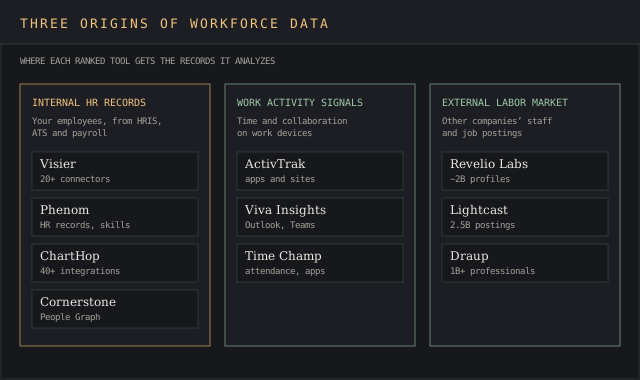
Workforce intelligence software turns records about employees and their work into numbers a manager can act on, such as who's likely to be leaving, which skills are missing and how many positions a plan needs. The category splits three ways by data origin. Some platforms use your HRIS, some track activity on work laptops, and some analyze public profiles & job postings from outside the company, across industries.
This page ranks ten workforce intelligence platforms against five testable criteria, then covers benefits, pricing, use cases and a rollout plan. It's written for HR teams, people analytics leads and the finance leaders who sign.
Workforce intelligence is important today for two dated reasons. Cornerstone launched its Workforce AI platform on 20 May 2026, and five of the ten vendors here now publish a price before any sales call.
Evaluation criteria for workforce intelligence platforms
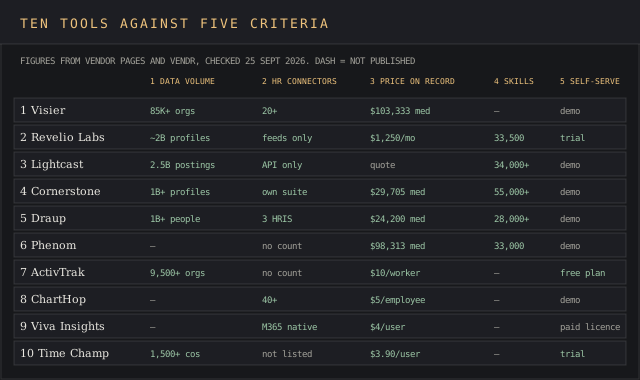
Five criteria decide the shortlist, and the ranking below weighs them in this order. Each returns a yes, a no or a number a buyer can check on the workforce intelligence vendor's own site, and the scoring methodology explains how they're chosen.
1. Published data origin and volume
The vendor names its source and publishes a count of profiles, postings, organizations or benchmark points. A count gives HR teams a figure to validate, and it's the fastest way to find out what the workforce intelligence engine can see.
2. Connectors into your own HR stack
Count the prebuilt HRIS, ATS, payroll or work-app connectors on the integrations page of each workforce intelligence platform. Connectors matter because internal records describe your actual workforce and its existing skills.
3. Price on record
A published list price scores highest, a Vendr median from anonymised buyer data second, and quote-only pricing last, since a business case needs a price to invest against.
Vendors here that publish a price before any sales call: Revelio Labs, ActivTrak, ChartHop, Microsoft Viva Insights and Time Champ.
4. Skills taxonomy size
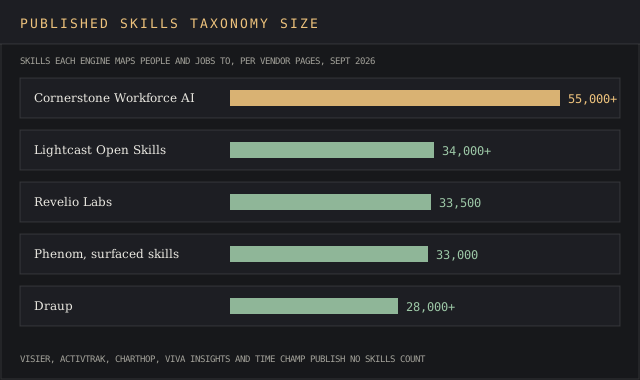
This criterion counts the published number of skills the engine maps employees and jobs to, for example 34,000+ at Lightcast. The devil's in the details here, because a 28,000-skill library and a 55,000-skill library will identify skill gaps at different depths.
5. Self-serve access
A vendor passes with a free plan or a trial that starts without a sales call. Three of the ten workforce intelligence vendors pass.
Top workforce intelligence software, ranked
Visier
Best fit
People analytics teams at large employers who want HRIS, payroll and ATS records from existing systems in one workforce intelligence model.
Visier's homepage claims 85,000+ organizations, 2,000+ prebuilt metrics, 20+ prebuilt connectors and 250M+ HR benchmark points. The 2,000+ prebuilt metrics let a people analytics team hit the ground running.
Its workforce intelligence page says 87% of managers told Visier workforce intelligence can improve their role as people managers, and 30% would use it every day. The page presents those workforce intelligence figures as two headline percentages attributed to managers, so a buyer has to ask Visier for the sample size and survey date.
Key features
- Visier People: Essentials, sold per employee, with the Vee AI assistant.
- Visier Workforce Planning for headcount and cost scenarios against actuals.
- Visier Organization Design for modelling reorgs.
- 2B+ compensation benchmark points from 85K+ organizations.
Pricing
Visier sells on quote. Vendr's anonymised buyer data puts the median at $103,333 a year, from $80,010 to $170,041.
Pros
- 2,000+ published metrics, the largest library here.
- Benchmarks from 85K+ organizations add context.
- Planning and analytics share one model.
Cons
- An $80,010 Vendr floor prices out small HR teams.
- Access to Visier runs through a sales demo and a quoted contract.
- One G2 reviewer reports ticket-only support.
A lead talent acquisition specialist wrote on G2 in January 2026: "I like Visier because it can break down the data into bite-sized pieces, making it easier for everyone to understand." An enterprise reviewer in food & beverages disagreed on service in September 2025:
"They also do not have any sort of direct support line. You have to submit a ticket and wait quite a while to get an answer which can be incomplete, and sometimes just wrong."
Why it's ranked #1. Visier beats Revelio on criterion 2, with 20+ prebuilt connectors pulling your own HRIS and ATS records into 2,000+ metrics against Revelio's feeds-only delivery. The $103,333 median is the cost of that lead.
Revelio Labs
Best fit
Business strategy teams benchmarking hiring, attrition and pay against named competitors.
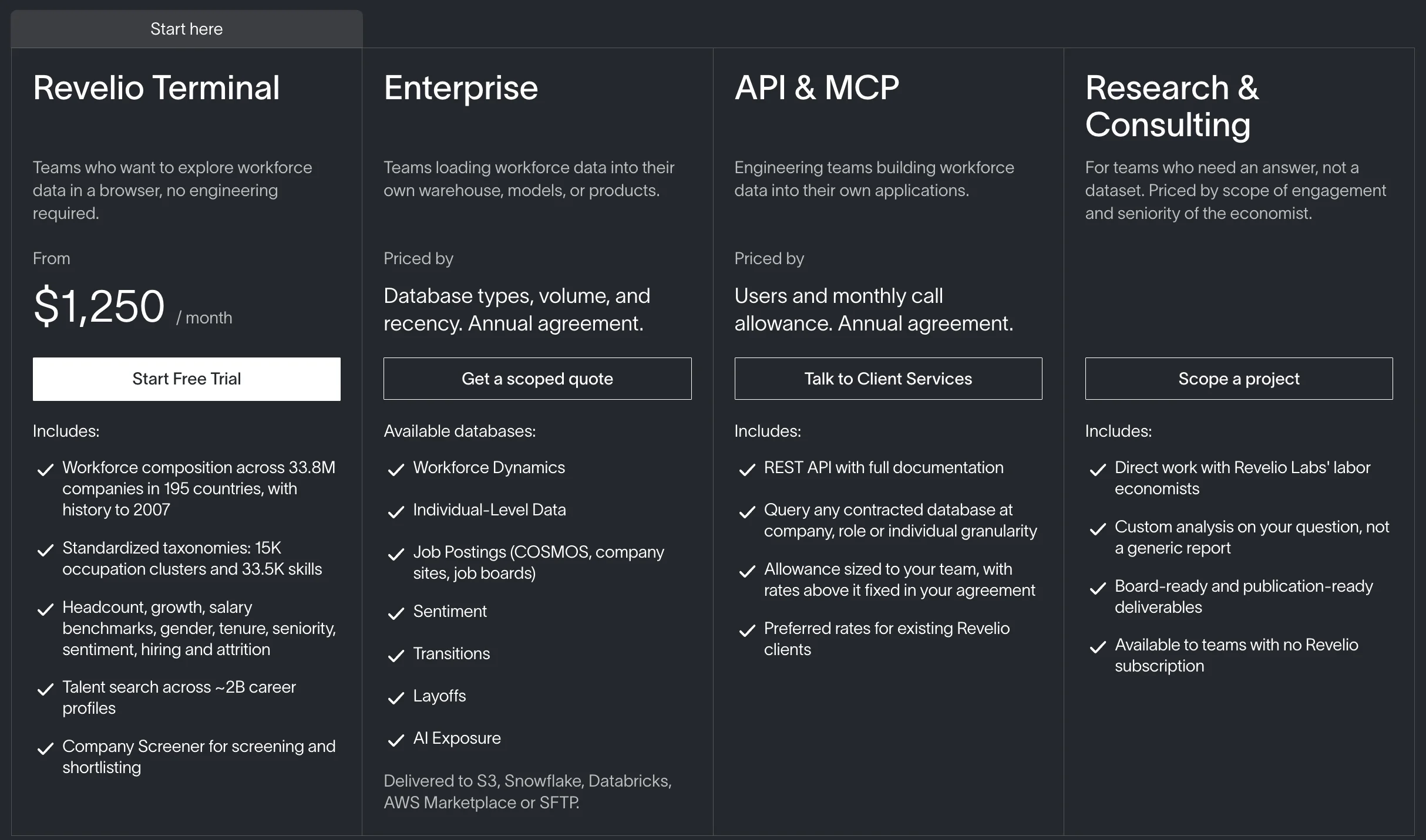
Revelio Labs builds workforce intelligence by analyzing public career profiles and job postings. Its pricing page lists workforce composition across 33.8M companies in 195 countries with history to 2007, 15,000 occupation clusters, 33,500 skills and search across roughly 2 billion career profiles.
Key features
- Revelio Terminal, a browser app with a Company Screener.
- Seven databases, from Workforce Dynamics to Layoffs and AI Exposure.
- Delivery to S3, Snowflake, Databricks, AWS Marketplace or SFTP.
- A REST API and an MCP server on the same contracted scope.
Pricing
The Terminal starts at $1,250 a month on an annual commitment, per the same page, and a free trial gets a team started with no credit card. Revelio quotes Enterprise feeds on database types, volume and recency, and API and MCP access on users and a monthly call allowance, both on an annual agreement. A year of one Terminal seat costs $15,000, a drop in the bucket next to Visier's $103,333 median.
Pros
- The one published entry price among external data vendors here.
- Unlimited queries inside the contracted scope.
- Historical data back to 2007.
Cons
- Revelio's model runs on public career profiles and postings, so HRIS, ATS and payroll analysis needs a second tool.
- Coverage depends on which employees keep a public profile.
- Feeds, API and MCP access are quote-only.
A Hacker News commenter reading a September 2025 paper built on Revelio's LinkedIn-based dataset raised duplicate postings:
"As a tech person, I'm also very used to seeing the same job listing re-listed by what seems to be a large number of low-effort "recruiting" firms on LinkedIn."
Hacker News comment by clusterhacks, 16 September 2025.
Why it's ranked #2. Revelio beats Lightcast on criterion 3 with a $1,250 monthly Terminal price anyone can read. It loses to Visier on criterion 2 because its 2 billion profiles come from outside your HRIS.
Lightcast
Best fit
Planners sizing talent pools against government statistics, the core of labor market intelligence.
Lightcast sells external workforce intelligence. It lists 2.5 billion job postings, 800 million career profiles and 100+ government sources across 160+ countries on its homepage. Its Open Skills taxonomy holds 34,000+ skills.
Key features
- Analyst platform with Talent Analyst and Developer modules.
- Skills Extractor and Job Posting Optimizer for writing jobs around skills.
- Data APIs to integrate postings into other tools.
- Consulting expertise from Lightcast data scientists.
Pricing
Lightcast quotes every contract, par for the course among labor market vendors, and Vendr lists no median for it. Nonprofits can register for the skills library free of charge.
Pros
- 2.5 billion postings, the largest count here.
- Government statistics beside postings.
- Free skills library for nonprofits.
Cons
- Price only after a sales call.
- Wage reports lean on past federal figures.
- Occupation codes miss niche roles.
"Lightcast relies heavily on BLS data for its wage curves & talent supply by compensation reports which can drastically skew the reports towards outdated data."
G2 review, marketing data analyst, mid-market, 28 November 2023.
Why it's ranked #3. Lightcast beats Cornerstone on criterion 1, with 2.5 billion postings and 100+ government sources against 1 billion+ profiles. It trails Revelio on criterion 3, quoting every contract against Revelio's published $1,250 a month.
Cornerstone Workforce AI
Best fit
Cornerstone learning customers who want skills records tied to training and internal moves.
Cornerstone launched Workforce AI in May 2026 with 55,000+ skills and 1 billion+ workforce profiles, per its launch release, so the jury's still out on how the Readiness Agents perform. The company page counts 7,000+ organizations and 140 million users in 186 countries.
Key features
Its workforce intelligence module adds four parts.
- Cornerstone People Graph and Skills Engine, which map skills across the workforce.
- Skills Architect to create role profiles.
- Readiness Agents for mobility, onboarding and coaching, its agentic AI capabilities.
- Labor market data inside the Workforce Intelligence module.
Pricing
Vendr's anonymised buyer data for Cornerstone OnDemand shows a $29,705 median, from $10,445 to $55,268 a year, across the wider suite.
Pros
- 55,000+ skills, the largest taxonomy of the ten.
- Skills link to courses for career advancement.
- 50 languages.
Cons
- Readiness Agents date from the May 2026 launch, and the release cites zero customer results for them.
- Module pricing runs through a sales quote, with the launch page giving no figure.
- Two G2 reviewers flag complex admin screens.
"they tend to have a lot of bugs, and support takes weeks, which is forever when you are implementing a process in a business."
G2 review, verified user in financial services, enterprise, 16 July 2022.
Why it's ranked #4. Cornerstone beats Draup on criterion 4, mapping 55,000+ skills against Draup's 28,000+. It loses to Lightcast on criterion 1, where 1 billion profiles trail 2.5 billion postings.
Draup
Best fit
Transformation leads scoring which tasks AI will absorb in the future and where employees can be redeployed.
Draup sells workforce intelligence for AI job redesign. Its homepage claims 1 billion+ professionals, 28,000+ skills and 1.7 million+ peer companies, refreshed from 1 billion+ data points a day, and it lists Microsoft, PayPal and Pfizer among its clients. Its Etter product has flown under the radar next to the bigger suites.
Key features
- Etter AI Readiness Diagnostic, scoring each task for automation.
- Digital-twin models to explore workforce redesign.
- HRIS connectors for Workday, SAP SuccessFactors and Oracle HCM.
- SOC 2 and ISO 27001 security certification.
Pricing
Vendr's anonymised buyer data shows a $24,200 median, from $22,000 to $175,920 a year.
Pros
- Connectors for the three largest HR suites.
- Lowest Vendr median among external vendors.
- Custom reports inside 1 to 2 days, per one reviewer.
Cons
- Title matching misses some roles.
- The homepage also sells an AI sales-agent line.
- Draup grants platform access after a sales demo.
A sourcing strategist at an enterprise gave both sides on G2 in May 2022: "The Draup team is very responsive to specific talent intelligence report requests. They will follow up with you in 1-2 days and will go in-depth regarding the request." The same review adds, "In the Workforce Planning module, some titles and skillsets do not show up."
Why it's ranked #5. Draup beats Phenom on criterion 1 with 1 billion+ professionals published, a count missing from Phenom's page, and on price at $24,200 against $98,313. Cornerstone's 55,000+ skills keep it above Draup.
Phenom
Best fit
Large employers filling open roles with employees before posting them, and running career development at scale.
Phenom's workforce intelligence product infers employee skills from roles, work history and certifications into a real-time view, then feeds career pathing and succession planning. Phenom reports customer results of 33,000 unique skills surfaced, 27% faster internal hiring and a 30% reduction in turnover in key job families, part of its talent experience platform.
Key features
- Skills inference across HR records, learning platforms and certifications.
- Career Pathing and Succession Planning on the same profile.
- Retention-risk flags from engagement patterns, to retain employees at the right time.
- SOC 2 Type II security, GDPR and CCPA compliance with AES-256 encryption.
Pricing
Vendr's anonymised buyer data shows a $98,313 median, from $37,500 to $112,278 a year.
Pros
- Skills, mobility and succession on one profile.
- Customer results published with percentages.
- Career sites and sourcing from the same vendor.
Cons
- Second-highest Vendr median here.
- One reviewer lists API access to data as a con.
- Frequent releases strain admin teams.
Keep an eye on release cadence during a pilot. An IT project manager at a 10,001+ employee pharmaceutical company wrote on TrustRadius in August 2026: "Releases are bit to often, difficult to absorb all the changes."
Why it's ranked #6. Phenom beats ActivTrak on criterion 4 with 33,000 skills surfaced for one customer, against zero skills mapped by ActivTrak. It loses to Draup on criterion 3, at a $98,313 median against $24,200.
ActivTrak
Best fit
Operations managers who want work patterns and workload figures for remote or hybrid employees.
ActivTrak measures time employees spend in apps and websites on work computers, to continuously monitor workload and workforce performance. Its workforce intelligence guide says 9,500+ organizations use it, and its help center rules out keystroke logging and video, with screenshots off by default.
Key features
- Productivity classifications by app and site.
- AI Insights add-on at $4 per worker a month.
- A Workflow plan for operations teams mapping processes.
- Mouse-jiggler detection, documented in a support article.
Pricing
The pricing page lists annual plans at $10, $15, $17 and $21 per worker a month, and a free plan for 3 people with 30 days of history. Buyers bite the bullet on annual billing, and accounts above 50 licenses need a paid support plan. Vendr's anonymised buyer data shows a $6,900 median.
Pros
- Every plan priced on the site.
- Free plan for 3 people.
- Keystroke capture excluded by design.
Cons
- Annual billing only.
- Paid support above 50 licenses.
- Activity scores can be gamed.
An HR administrator at a small real estate firm wrote on TrustRadius in August 2026: "I can track the hours per week that each person works, this way we can pay the exact time." The same review flagged the weak spot: "I think the team can just move the mouse every 5 minutes, and it will show you the team member's work as productive."
Why it's ranked #7. ActivTrak beats ChartHop on criterion 5 with a free plan for 3 people, and on criterion 1 with 9,500+ organizations published. It loses to Phenom on criterion 4, mapping zero skills against Phenom's 33,000.
ChartHop
Best fit
Mid-size HR teams that want an org chart, headcount planning and people analytics in one tool.
ChartHop builds a live org chart from HR records, a lighter form of workforce intelligence for finance leaders. Its Headcount Planning module puts HR and finance on the same page for open roles. Its integrations page names 40+ connections, from ADP, BambooHR, Deel, Gusto and Workday to Greenhouse, Lever and Ashby.
Key features
- Ask ChartHop, plain-English queries over org, cost and output.
- Headcount Planning, Compensation, Performance and HRIS modules.
- Engagement and Goals modules to track morale and team goals.
- A stated policy keeping customer records out of outside AI model training.
Pricing
The pricing page lists Core at $5 per employee a month, billed annually, with modules at $4 or $3. Vendr's anonymised buyer data shows a $28,761 median across 126 purchases, from $11,895 to $110,577.
Pros
- ChartHop names 40+ integrations on its own page, the highest count of the ten tools ranked here.
- Per-employee list prices.
- Vendr median built on 126 purchases.
Cons
- ChartHop publishes a $5 list price and still routes every new account through a demo.
- Large charts slow the interface.
- Skills mapping sits outside the product.
"When org charts or other visualizations get really big, the UI gets very buggy"
TrustRadius review, owner, media production, 501 to 1,000 employees, 21 January 2025.
Why it's ranked #8. ChartHop beats Viva Insights on criterion 2 with 40+ HRIS, ATS and payroll integrations against Microsoft 365 alone. It loses to ActivTrak on criterion 5, since a $5 list price still needs a demo.
Microsoft Viva Insights
Best fit
Microsoft 365 businesses that want meeting load and focus-time figures from the Microsoft stack they already run.
Viva Insights is Microsoft's workforce intelligence layer. It reads collaboration patterns from Outlook and Teams, stored in each employee's Exchange Online mailbox, per Microsoft's documentation. Admins must set the minimum group size to at least five under the privacy settings.
Key features
- Personal insights on focus time and meeting load.
- Organization insights for leaders and managers in Outlook and Teams.
- Power BI templates for analysts analyzing meeting and focus trends.
- Opt-in configuration for individual employees.
Pricing
The Viva Insights page lists $4 per user a month on an annual commitment, $6 for Workplace Analytics and Employee Feedback, and $12 for the Viva suite.
Pros
- Reads Outlook and Teams signals already stored in Exchange Online.
- Five-person minimum groups.
- $4 published per-user price.
Cons
- Reads Microsoft 365 signals only.
- Feature depth varies by Microsoft 365 plan.
- Some users find the recommendations generic.
"There are times when I already know my schedule is packed, so being told I have too many meetings doesn't really change anything for me."
G2 review, software development engineer in test, mid-market, August 2026.
Why it's ranked #9. Viva beats Time Champ on criterion 2, reading Outlook and Teams natively behind a five-person privacy floor. It loses to ChartHop's 40+ HR integrations on the same criterion.
Time Champ
Best fit
Small teams that need attendance, timesheets and app tracking for employees at the lowest per-user price.
Time Champ is employee monitoring with a workforce intelligence layer for attendance and productivity. Its pricing page cites 1,500+ companies across Starter, Professional and Enterprise plans.
Key features
- Automatic attendance and timesheet reports.
- App and website productivity classifications.
- Screen recording add-on from $3 per user a month.
- Keylogger add-on from $2 per user a month, with 7 days of retention.
Pricing
Plans cost $3.90, $6.90 and $13.90 per user a month on annual billing, with a 7-day free trial that starts without a credit card.
Pros
- Lowest list price here.
- A 7-day trial that starts from the pricing page.
- Attendance in the $3.90 plan.
Cons
- The $2 keylogger add-on is a red flag for employees' trust.
- Silent tracking from the Professional tier up.
- HRIS connectors absent from the pricing page.
An associate team lead in education management praised the basics on G2 in October 2025, "It helps me in logging in the total working hours I have worked for my company," and added "It is not working well in the new update of IOS."
Why it's ranked #10. Time Champ's $3.90 entry price is the lowest of all ten. It ranks last on criterion 2, with zero HR connectors listed against Viva's native Outlook and Teams reading.
What a workforce intelligence platform does
Workforce intelligence is decision support built from workforce data, so business leaders can make informed decisions on hiring, pay, skills and staffing levels, turning workforce data into actionable insights. ActivTrak's guide, a blog post, defines it as "the collection, analysis and interpretation of data related to an organization's workforce."
Buying from one data origin alone means putting all your eggs in one basket, since each origin gives clear visibility into a different slice of the workforce, from your own HR records to time on work devices and other companies' staff and postings.
Strategic workforce planning and the future workforce
Strategic workforce planning compares the headcount and skills a plan needs with the people and skills in place. Visier Workforce Planning and ChartHop's $4 Headcount Planning module model scenarios on internal records, and Lightcast and Revelio add external supply, so planners see skill gaps in the future workforce before a new site opens.
That's resource allocation with predictive analytics behind it, and it sets the workforce strategies a budget cycle funds. Workforce intelligence helps planners understand hiring trends in the areas they're expanding into.
Talent management and talent acquisition
In talent management, workforce intelligence helps organizations weigh skill development against external hiring decisions. The same skills records identify high potential employees for succession planning and point the right talent at growth opportunities.
External talent acquisition data comes from tools such as LinkedIn Talent Insights, with its contract costs tracked separately, and Horsefly Analytics. The recruitment market intelligence guide maps where each fits.
Employee engagement, productivity and well being
Activity tools show employees' work patterns and help managers balance workload. Viva Insights and ActivTrak both surface meeting load and after-hours work, which ties employee engagement, workplace culture and well being to staffing levels and operational efficiency.
Government employees who felt burnt out at work in an Eagle Hill Consulting survey run by Ipsos in April 2022.
Benefits of workforce intelligence
Workforce intelligence helps organizations most where vendors publish the result. These vendor-reported benefits come with numbers, so a buyer can ask for reference interviews.
- Employee retention: Phenom reports a 30% cut in turnover in key job families.
- Internal mobility: Phenom reports 27% faster internal hiring of existing employees.
- Pay benchmarks: Visier offers 250M+ HR benchmark points for pricing roles against peers.
- Planning depth: Revelio's history to 2007 lets planners test a hiring plan against 19 years of peer moves.
Visier's own page claims AI-powered workforce intelligence makes companies "3x more likely to exceed financial targets" and names no study behind it, so treat that figure as marketing. A pilot on one team with one metric over one quarter tests the claim with your own information.
Workforce intelligence vs workforce management
Workforce management (WFM) software runs the schedule for hourly employees. Aspect's guide lists forecasting demand, building schedules, tracking time and attendance, monitoring adherence and reporting performance. Workforce intelligence adds predictive insights and scenario planning on top of that record, responding to demand before it arrives.
Contact-center WFM suites handle agent staffing and capacity, and price per agent seat. It takes two to tango in a contact center buying for service levels & customer wait times, which needs a WFM suite with seat-based scheduling beside any tool ranked here.
Vendr's anonymised buyer data for NiCE shows a $41,417 median, from $2,736 to $77,025 a year.
What workforce intelligence tools cost
Workforce intelligence prices run on four units, per employee, per worker, per seat and per contract, so comparing products takes arithmetic. Normalised to one scenario, a 500-employee company paying list price for a year, the spread runs from $15,000 to six figures.
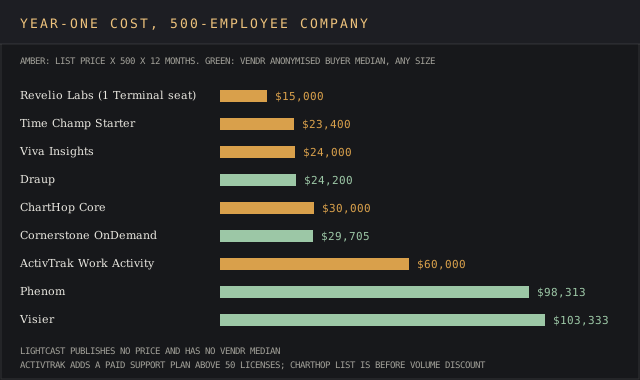
- Time Champ Starter: $3.90 × 500 × 12 = $23,400.
- Viva Insights: $4 × 500 × 12 = $24,000.
- ChartHop Core: $5 × 500 × 12 = $30,000 before volume discounts.
- ActivTrak Work Activity Tracking: $10 × 500 × 12 = $60,000, plus the required paid support plan.
- Revelio Terminal: $1,250 × 12 = $15,000 for one seat, priced by access.
The Vendr medians cover business buyers of every size. Visier's $103,333 and Phenom's $98,313 cost an arm and a leg next to Draup's $24,200, and Lightcast quotes every contract. The market intelligence platform pricing report covers tier structures in more depth.
Set each figure beside the benefits Phenom and Visier publish. For a benchmarking team, a $15,000 Terminal year delivers significant value at about a seventh of Visier's $103,333 median.
A complete guide to implementing workforce intelligence tools
Set business goals and key metrics
Companies face challenges on records, trust and adoption long before the workforce intelligence platform fails, so start small. Name two or three business outcomes first, such as regretted attrition or time to fill, and the key metrics or KPIs that track them.
Visier ships 2,000+ prebuilt metrics, so the goal list decides which few matter.
Fix data quality before the first dashboard
Data quality decides everything downstream, and the guide to market intelligence data covers collection methods. Clean job titles and manager hierarchies across departments in existing systems first. Teams that cut corners here see duplicate records in every answer, and large HR estates may need one of the data intelligence tools first.
Get employee buy-in on what gets tracked
Align the works council, legal and HR leaders, and communicate what gets tracked, before any agent ships to employees' laptops, because transparency on privacy terms matters to all three and drives adoption.
On 1 December 2020 Microsoft removed user names from Productivity Score after its preview showed individual actions over a 28-day period, and moved those measures to organization-level totals.
Tie actionable insights to decision making
Give each dashboard an owner and a decision-making cycle it feeds, like a budget cycle or a succession review. Workforce intelligence plays its part as decision support when people managers act within a quarter, turning meaningful insights into proactive decisions. The payoff is a deeper understanding of workforce performance and more confident decisions at budget time.
Companies wanting modelled recommendations across functions look at decision intelligence platforms.
Workforce intelligence FAQ
What is workplace intelligence?
Buyers use workplace intelligence and workforce intelligence for the same category of software. The name also belongs to a research agency at workplaceintelligence.com. For the wider discipline, see what market intelligence covers.
What is the best workforce planning software?
Visier leads for business-wide internal planning at a $103,333 Vendr median. ChartHop costs $5 per employee a month plus $4 for Headcount Planning of future hires.
Which is the best employee monitoring software?
ActivTrak ranks highest here for employee monitoring, at $10 per worker a month with keystroke logging excluded. Time Champ costs $3.90 and sells a keylogger add-on.
How much does workforce intelligence software cost?
Published entry prices run from Time Champ's $3.90 per user a month and Viva Insights' $4 up to Revelio's $1,250 a month Terminal, and Vendr's anonymised buyer medians run from Draup's $24,200 to Visier's $103,333 a year. At list price for 500 employees, year one runs from $15,000 for one Terminal seat to $60,000 for ActivTrak.
Why is workforce intelligence important?
Workforce intelligence shows where attrition, skill gaps and workload sit before they reach business outcomes. Workforce intelligence helps organizations make informed decisions with more confidence before those numbers reach the board.
How does workforce intelligence use artificial intelligence?
In simple terms, artificial intelligence does the skills inference and the forecasting that feed decision making. Phenom infers skills from work history, Cornerstone's Readiness Agents act on skill gaps, and Visier's Vee assistant answers questions on workforce data. Predictive insights on attrition come from the same models, so workforce intelligence enables organizations to plan hiring against forecast attrition and spot heavy meeting load in Viva Insights.
Bottom line
Visier is the workforce intelligence pick for a people analytics team that wants HRIS, ATS and payroll records for all its employees in one model and can pay a six-figure median. Revelio Labs wins for competitor benchmarking from $1,250 a month, and Lightcast suits planners who need government statistics beside postings.
For skills-led talent management, Cornerstone has the bigger taxonomy at 55,000+ skills and Phenom the stronger internal mobility record at 27% faster internal hiring, with Draup as the low-cost external option at a $24,200 median. ActivTrak, ChartHop, Viva Insights and Time Champ cover activity, org charts and hours for small business teams and HR leaders who want a published price and a small first bill.