Talent intelligence tools: an AI-native buyer's guide for 2026
 By Jan Suski. I go deep on every review, checking every number against its source and digging up details other coverage misses, a habit from six years of SEO and link building for tech companies. Bylines at Surfer, Brand24, and Senuto. How the scoring works.
· Prefer this source on Google
Quick comparison of talent intelligence tools
Columns carry only the dimensions where these five tools measurably differ. Sourcing and contact search sit on all five.
| # | Tool | Primary job | Pricing model | Published pricing | Verified cost benchmark |
|---|---|---|---|---|---|
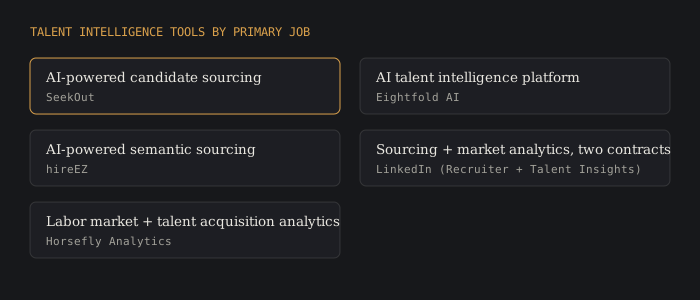
| 1 | SeekOut | AI-powered candidate sourcing | Seat-based | Sourcing Core tier only, $149/mo annual | $20,000 median contract, Vendr ($5,820-$54,920) |
| 2 | Eightfold AI | AI talent intelligence platform | Per employee under management | No | Not published; Utah state funding request, $1,500,000 one-time for licenses and integration |
| 3 | hireEZ | AI-powered semantic sourcing | Solo seat listed; teams by quote | Solo recruiter only, $494/mo | $13,000 median contract, Vendr ($7,000-$25,000) |
| 4 | LinkedIn (Recruiter + Talent Insights) | Sourcing plus market analytics, two contracts | Per-seat + enterprise | No | £37,650 for 5 Talent Insights licenses, UK Ministry of Defence, 2024 |
| 5 | Horsefly Analytics | Labor market and talent acquisition analytics | Not published | No | Not available |
Talent intelligence tools cover two different jobs that buyers often shop for at once: sourcing and contacting candidates, and reading the broader labor market to plan hiring before a role opens. That labor market includes freelancers, and the BLS counted 11.9 million independent contractors on their main job in July 2023, per our freelance statistics. This guide ranks 5 of them, with a full features, pricing, and limits breakdown for each.
Most of these vendors don't publish a price list. SeekOut, Eightfold AI, and hireEZ all sell team contracts through a custom quote, and LinkedIn doesn't publish pricing for either of its two talent products either. Every price figure below comes from a named, disclosed source; where sources disagree, both figures are shown.
What a 10-person talent acquisition team pays
Every row below prices the same buyer: a 10-person talent acquisition team on annual billing. No vendor here publishes a 10-seat price, so each row shows the closest figure from a valid source: a vendor list price, Vendr's median contract across all team sizes, or a public funding record. Eightfold prices per employee under management, so its cost doesn't scale with team size the same way.
| # | Tool | Year-one cost for 10 seats | Basis | Contract minimum |
|---|---|---|---|---|
| 1 | SeekOut | Not published; $20,000 Vendr median contract, all team sizes | Vendr header data, $5,820 to $54,920 range; Sourcing Core lists at $1,788 a year for one seat | None published; self-serve tier exists |
| 2 | Eightfold AI | Not seat-priced; not published | Priced per employee under management; a Utah state funding request seeks $1,500,000 one-time for licenses and integration | Enterprise-only, no self-serve |
| 3 | hireEZ | Not published; $13,000 Vendr median contract, all team sizes | Vendr header data, $7,000 to $25,000 range; a solo recruiter lists at $494 a month | None published |
| 4 | LinkedIn Recruiter | Not published | Vendr's median across all LinkedIn contracts is $38,502 ($8,388 to $166,449) | None published; per-seat pricing |
| 5 | Horsefly Analytics | Not published | No third-party contract data available | Not published |
SeekOut and hireEZ are the only platforms here with a published starting price. SeekOut's Sourcing Core (Recruit Core), a self-serve single-seat tier, runs $149 a month paid annually, $1,788 a year, or $179 a month on monthly billing, and hireEZ starts a solo recruiter at $494 a month. Team and Enterprise tiers above those are custom and seat-based.
Eightfold doesn't fit the per-seat model the other three use. It charges by employee under management company-wide, and the vendor pitches itself at organizations of 10,000-plus employees, a scale mismatch worth flagging before a smaller team requests a quote. Its one public dollar figure is a Utah Department of Workforce Services request to the state legislature for $1,500,000 one-time, covering Eightfold licenses and integration.
How much of that allowance a 10-person team burns through
A dollar figure only tells half the story. The number that decides if a seat contract buys comfortable headroom or runs dry by June is how much of the seat's monthly credit allowance a team's real sourcing volume consumes.
Gem's 2026 recruiting benchmarks report, built from ATS data across more than 140 million applications and 1.2 million hires, puts the average recruiter's open requisition load at 14 at any given time. Scaled to 10 recruiters, that's roughly 140 open roles running at once, the workload this section prices against.
LinkedIn's InMail math
LinkedIn publishes Recruiter Lite's InMail allowance directly: 30 credits a seat a month, purchasable up to 70 more. It doesn't publish the Corporate tier's allowance the same way; third-party recruiting-tool guides put it around 150 credits a seat a month, set by contract.
Pin's 2026 outreach benchmark report puts recruiter send volume at 1,738 InMails and emails a year for typical performers, about 145 a month, and 3,073 a year for top performers, about 256 a month.
- Typical-volume 10-seat Corporate team: roughly 1,450 of the combined 1,500-credit monthly allowance used, close to the full amount already included in the base price.
- Top-performer-volume 10-seat Corporate team: 2,560 credits needed against that same 1,500, a 1,060-credit shortfall every month.
LinkedIn bills overage at $8 to $12 a credit, so that shortfall runs $8,480 to $12,720 a month, $101,760 to $152,640 a year, stacked on top of the seat contract itself.
SeekOut and hireEZ contact credits
SeekOut's own help center confirms contact-info credits reset every month and don't carry over unused. Its Team tier includes 750 contact credits a seat a month, per third-party pricing guides, since SeekOut doesn't publish the Team or Enterprise allotment on its own pricing page.
Recruiterflow's 2026 benchmark, drawn from more than 2,100 recruiting and executive search firms, puts sourcing volume at 213 candidates worked through a pipeline per placement. A contact credit is only spent once a recruiter requests a specific candidate's email or phone number, a shortlisted subset of that sourced pool.
Neither SeekOut nor hireEZ publishes what share of a sourced pipeline typically gets a credit spent on it, so the honest answer is a range: a 10-seat SeekOut Team deployment includes 7,500 contact credits a month combined, comfortable for a team pulling contact info on a few hundred shortlisted candidates, tight for one that reveals contact info earlier and more broadly in its funnel.
hireEZ doesn't publish a monthly credit figure for any tier, so the same math can't be run for it at all.
Eightfold's per-employee pricing sidesteps this question, since nothing in its contract scales with recruiter seat count or credit volume. Horsefly Analytics has no seat- or credit-based allowance published either, consistent with its unpublished pricing overall.
What talent intelligence tools do
Talent intelligence tools analyze data on employee skills, experience, and performance, then combine it with external labor market data to support informed, strategic workforce planning decisions, per SHRM's own research on the category.
Skills gap analysis and skills mapping are the two components that show up across nearly every vendor in this space: identifying which skills a workforce is missing, then mapping internal skills to encourage internal mobility.
Predictive analytics extends the same data to retention, flagging attrition risk early enough to catch a team losing people before it turns into a resignation wave, and labor market analytics adds the external half: competitive intelligence on rival hiring patterns and talent availability by region, the same category our talent market intelligence guide covers from the workforce-planning side.
Artificial intelligence and analytics are what make this practical at scale, per Beamery's and Eightfold's own published research, since manually tracking skills-based workforce data and market signals across a large workforce isn't realistic without automation.
Evaluation criteria for talent intelligence tools
Five factors separate a tool worth a pilot from one that produces a confident-looking dashboard nobody trusts.
- Data freshness and update frequency. How often candidate and market data refreshes, past a one-time import.
- Filter and search precision. Boolean and semantic search accuracy tested on your own real roles, past the vendor's demo search.
- Hiring process integration. Native ATS sync and interview-scheduling support built into your existing hiring process, versus a manual export-import workaround.
- Total cost including hidden fees. The contract price plus every add-on, credit overage, and onboarding fee stacked on top.
- Support and implementation timeline. How long the vendor's own team says rollout takes, and what happens if it runs long.
Test filter and search precision against your own real roles during a trial. A tool tuned to a clean demo query can still miss on the messy, specific version of a role you need filled.
Top talent intelligence tools, ranked
Five tools, ranked by how completely they cover the five criteria above, each with a full features, pricing, and limits breakdown.
SeekOut
·top pick·The widest named customer base of any AI-powered platform in this ranking, with diversity-search filters built into the core product.
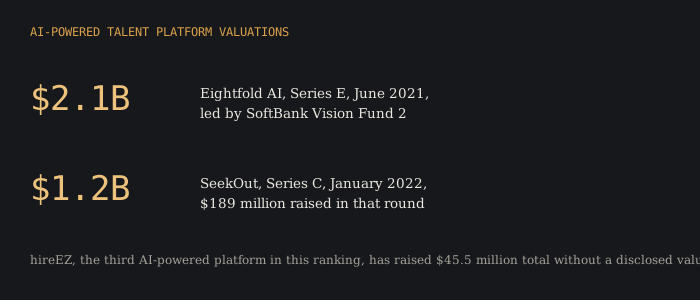
SeekOut, founded in 2017 and based in Bellevue, Washington, raised $189 million through a Series C round in January 2022 that valued the company at $1.2 billion, and lists more than 750 customers including Microsoft, DocuSign, Sony, Thomson Reuters, Atlassian, and Dell on its own site.
Why it's ranked #1. SeekOut discloses the broadest named customer base of any AI-powered platform in this ranking, and its diversity-search filters are a specialization none of the other tools here match directly. It fits a high-volume in-house talent acquisition team sourcing across many open roles at once, particularly one that needs diversity-search filters as a standing requirement.
Features
- AI-driven candidate matching across a 1B+ public profile index.
- Diversity search filters built into the core product.
- ATS, CRM, and HCM integrations, plus a Chrome extension for off-platform sourcing.
- SeekOut Spot, a managed sourcing service layered on top of the platform.
Pricing and limits
SeekOut Sourcing Core (Recruit Core), a self-serve single-seat tier, runs $149 a month paid annually ($1,788 a year) or $179 a month billed monthly.
Team and Enterprise tiers above Core are custom and seat-based; Vendr's aggregated data puts the median annual contract at $20,000 across deals ranging $5,820 to $54,920.
Who should skip it
Teams that need contact-enrichment credits to roll over between billing periods. Reviewers cite credits that expire unused, plus a 2-to-4-week learning curve to full proficiency.
Switching trigger. A buyer whose priority is FedRAMP-authorized deployment for public-sector or regulated hiring needs Eightfold AI instead.
Eightfold AI
The only platform here with FedRAMP Moderate authorization, backed by a $2.1 billion valuation.
Eightfold AI, founded in 2016 by Ashutosh Garg and Varun Kacholia and based in Santa Clara, raised a $220 million Series E in June 2021 led by SoftBank Vision Fund 2 at a $2.1 billion valuation. Named customers on Eightfold's own site include Akamai, Bayer, EY, Vodafone, Citi, and HP.
Why it's ranked #2. Eightfold carries the highest disclosed valuation in this ranking and is the only platform here with FedRAMP Moderate authorization for federal use, a real differentiator for a public-sector buyer. It ranks behind SeekOut because reviewers flag more integration friction with legacy ATS platforms.
It fits a large enterprise or public-sector team that wants sourcing, internal mobility, and workforce planning running on one connected platform, Talent Acquisition, Talent Management, and Workforce Exchange.
Features
- AI-driven talent matching against a 1B+ career-profile index.
- Separate Talent Acquisition, Talent Management, and Workforce Exchange modules.
- AI Interviewer, an agentic screening feature.
- FedRAMP Moderate authorization for federal deployments.
Pricing and limits
No published rate card and no self-serve tier. Eightfold prices per employee under management and pitches itself at organizations of 10,000-plus employees. The only public figure is a Utah Department of Workforce Services funding request for $1,500,000 one-time, covering software licenses and integration.
Who should skip it
Teams without dedicated implementation resources. Reviewers describe a steep learning curve for full platform functionality and friction integrating with older ATS systems.
Switching trigger. A buyer on a smaller budget who needs semantic search past keyword matching, without Eightfold's enterprise scope, needs hireEZ instead.
hireEZ
Semantic, NLP-driven candidate matching sized for a leaner sourcing team's budget than Eightfold or SeekOut.
hireEZ, founded in 2015 by Steven Jiang and Xinwen Zhang under the name Hiretual before rebranding, has raised $45.5 million total, including a $26 million round led by Conductive Ventures. Its own case studies name Poshmark and Apptio as customers.
Why it's ranked #3. hireEZ's semantic, NLP-driven candidate matching is a real differentiator past keyword search alone, but it carries the smallest disclosed funding and the thinnest named customer base of the three AI-powered platforms here.
It fits a leaner sourcing team that wants semantic search without Eightfold's enterprise footprint or SeekOut's larger customer-proven scale, a platform sized closer to a mid-market hiring team's budget and headcount.
Features
- Natural-language processing for semantic candidate matching.
- Automated outreach and follow-up sequencing.
- Candidate data reconciliation across multiple source systems.
- Credit-based contact and enrichment lookups.
Pricing and limits
hireEZ's pricing page lists $494 a month for a solo recruiter with a 7-day free trial and prices enterprise teams by quote. Vendr's aggregated data puts the median annual contract at $13,000 across deals ranging $7,000 to $25,000.
Who should skip it
Teams that need consistent contact-info accuracy at scale. Reviewers cite variable enrichment accuracy and credit-based limits that some buyers find more restrictive than expected.
Switching trigger. A buyer who already runs LinkedIn Recruiter and wants market-level workforce analytics layered on top needs LinkedIn Talent Insights specifically.
LinkedIn (Recruiter and Talent Insights)
Sourcing and market-level workforce analytics sold as two separate contracts under one Talent Solutions umbrella.
Two products, one Talent Solutions umbrella
LinkedIn sells two separate products under one Talent Solutions umbrella. LinkedIn Recruiter finds candidates and contacts them directly; LinkedIn Talent Insights, sold on its own enterprise contract, analyzes talent pools and workforce trends at the market level and can't identify or reach a specific candidate.
Recruiter pricing
LinkedIn doesn't publish LinkedIn Recruiter pricing or a public rate card for LinkedIn Recruiter Corporate, the standard enterprise tier. Vendr's benchmark, built from anonymized contract data, puts the Recruiter Corporate seat at $8,000 to $12,000 a year, with buyers holding five recruiters or more commonly reporting 15% to 30% off list.
- A separate pricing-blog estimate puts Corporate plans at $8,999 to $15,000 a year, sold on annual contracts with no month-to-month option documented anywhere.
- LinkedIn Recruiter Lite runs $140 to $170 a month, a lower tier built for lower hiring volume than Corporate handles.
A single license for one seat pays list price with no room to negotiate. How much LinkedIn Recruiter is worth to a specific team comes down to hiring volume, since a team running multiple recruiters against a constant flow of open roles gets genuine value per seat, while a team hiring for one specific role a quarter on a single license gets far less.
Vendr's median across all LinkedIn contracts it tracks sits at $38,502 a year, in a $8,388 to $166,449 range. Talent Insights and Recruiter Professional Services bill on top of any Recruiter contract.
Network access
Network access is the clearest functional split between the two Recruiter tiers: Recruiter Lite caps network access at your 1st, 2nd, and 3rd-degree connections with 20-plus filters, while higher tier plans on Corporate grant access to every LinkedIn member regardless of connection degree, with 40-plus filters.
InMail credits
InMail credits are the other hidden-cost trap: LinkedIn's own help pages confirm Recruiter Lite starts at 30 InMail credits a month, purchasable up to 70, with unused credits capped at 120 carried over and credits refunded if a candidate replies within 90 days.
LinkedIn doesn't publish the Corporate tier's monthly allowance the same way; third-party recruiting-tool guides put it around 150 credits a seat a month, with the exact figure set by contract, the number the pricing section above runs against real recruiter send volume.
ATS integration and staffing tiers
Most ATS integration comes included with a Recruiter license at no extra cost, per LinkedIn's own documentation, through Recruiter System Connect, currently in beta. A separate product line, Recruiter Professional Services Plus, serves staffing agencies and staffing firms running multiple client searches, distinct from the Corporate tier built for an in-house team.
Team collaboration and AI-assisted messaging
Team collaboration runs through a feature called Projects, where multiple recruiters work from shared projects covering candidate pipelines and conversation history, plus a Recruiting Activity view that stops two recruiters cold-messaging the same person.
AI-assisted messaging drafts personalized InMail messages with one click, which LinkedIn's own materials tie to a 55% higher InMail acceptance rate, and response rates on outreach track closely with how well a saved search matches the actual role.
Saved searches store filter criteria for reuse, cutting the manual work of rebuilding the same search every time a similar role opens, finding candidates faster than starting from a blank search each time.
Talent Insights: reports and pricing
LinkedIn publishes no Talent Insights price. UK public procurement records supply one: the Ministry of Defence awarded a £37,650 contract for 5 Talent Insights licenses in April 2024, per Find a Tender notice 012937-2024, so treat any single figure quoted to you as a starting point.
It runs two reports, the Talent Pool report and the Company Report, drawing on aggregated data from LinkedIn member profiles and real-time supply and demand signals; the Company Report can surface hiring trends early enough that a shrinking function inside a competitor shows up before a public announcement, per one pricing guide's summary of the tool.
Why it's ranked #4. LinkedIn's member-data reach is real, but sourcing and market analytics are split into two separate paid contracts. Stacked InMail overage, Recruiter Professional Services, and Talent Insights are the primary bottleneck buyers run into when a first-year quote turns into a much larger renewal number: add-on costs layered on top of add-on costs.
It fits a team that already leans on LinkedIn's network for outreach and wants both direct sourcing and market-level workforce analytics from one vendor relationship, even split across two contracts.
Features
- AI-assisted messaging with a documented 55% higher InMail acceptance rate on drafted outreach.
- Projects and Recruiting Activity for team collaboration across shared candidate pipelines and conversation history.
- Saved searches that store filter criteria for reuse across similar roles.
- Recruiter System Connect, an ATS integration included with a Recruiter license, currently in beta.
- Talent Pool report and Company Report for market-level workforce and competitor-hiring analytics.
- Network access up to every LinkedIn member with 40-plus filters on Corporate, versus 1st-, 2nd-, and 3rd-degree connections with 20-plus filters on Lite.
Who should skip it
A team that wants one contract and one price to negotiate.
Switching trigger. A buyer who wants a single, more predictable first-year price should shortlist one of the three AI-powered platforms above instead.
Horsefly Analytics
A labor market intelligence platform built around salary benchmarking and talent-demand data down to the town level.
Horsefly Analytics, founded in 2011 by CEO Will Crandle and based in Prescot, England, runs a labor market intelligence platform built specifically around talent acquisition team needs. The company employs 45 people as of 2026 and raised $829,000 in a seed round in August 2013, per PitchBook.
Why it's ranked #5. Horsefly's data footprint rivals the larger platforms above it on raw scope: a skills taxonomy covering 815,000 items across 39 languages, and talent-demand coverage across more than 60 countries and 170,000-plus towns and cities, built from real-time job-posting data.
It ranks last because its named customer base and funding history are thinner and less independently verified than SeekOut, Eightfold AI, or hireEZ. It also competes on labor-market data, and this ranking weighs AI-driven candidate sourcing most heavily.
It fits a talent acquisition or recruitment-process-outsourcing team that needs salary benchmarking and supply-and-demand data down to the town level for workforce planning, the job British financial services company Admiral Group hired it for when building a remote-hiring strategy for hard-to-fill tech roles.
Features
- Skills taxonomy covering 815,000 items across 39 languages.
- Talent-demand data across more than 60 countries and 170,000-plus towns and cities, built from real-time job-posting data.
- Salary benchmarking by job title, experience, skills, background, and location down to the town level.
- Competitor hiring analysis and employee turnover prediction.
- Integration with existing HR systems for data flow across platforms.
Pricing and limits
Not published, and unlike the other four tools in this ranking, no aggregator such as Vendr, G2, or TrustRadius carries third-party contract data for Horsefly either. Horsefly's own pricing page lists separate plans built around hiring, expansion, and workforce-planning use cases, with rates available only through direct contact.
Who should skip it
A team prioritizing AI-driven candidate sourcing and direct outreach over labor-market data; Horsefly doesn't compete on that job, and a buyer evaluating it for direct sourcing should look at SeekOut, Eightfold AI, or hireEZ instead.
Switching trigger. A buyer whose core need is finding and contacting individual candidates needs one of the three AI-powered sourcing platforms above instead.
Job postings and sourcing boards
Paid job-board promotion is the other lever most talent intelligence shortlists eventually compare against a subscription tool: a promoted listing costs per click or per application on most boards, and reach varies enough by role and region that a single board rarely wins every comparison. Treat board spend as a cost line to weigh against a sourcing subscription's per-seat price.
Pricing, contracts, and hidden costs
Request a full, written pricing breakdown before a demo turns into a contract, every module, every credit type, every add-on named with its own price. Calculate the three-year total cost including projected annual increases. First-year quote hides the real cost., since a Corporate LinkedIn Recruiter seat alone has been estimated to climb around 15% a year at renewal.
Hidden fees and hidden costs
Ask specifically about: per-credit overage charges once InMail or contact-enrichment credits run out (roughly $10 a credit on LinkedIn Recruiter, per one pricing estimate), Recruiter Professional Services implementation fees ($6,000 to $10,000 a year), and any analytics or insights module, LinkedIn Talent Insights chief among them, sold as a separate contract.
Contract mechanics
Confirm contract length and the renewal window in writing before signing, along with a written termination and data-export policy, so candidate and search data doesn't get held hostage to a renewal decision.
Auto-renewal
Ask for auto-renewal to be disabled outright, or for a clause requiring your explicit written consent before it triggers. Mark the renewal deadline on a calendar two months before contract expiry, since that's the window vendors expect a renegotiation conversation to start in.
Annual increases
Request a capped annual price-increase clause; one pricing estimate puts LinkedIn Recruiter Corporate's average annual increase around 15%, a specific number worth citing back to a sales rep during renewal. A fixed-price multi-year deal removes the guesswork entirely if the vendor will agree to it.
Add-ons
List every available add-on with its own standalone price before signing, LinkedIn Talent Insights on top of Recruiter is the clearest example in this category. Test any AI-powered add-on against your own real searches during a trial.
Feature checklist for procurement teams
- Advanced filters for skills, seniority, and location, tested against roles you hire for.
- Boolean and semantic search performance, checked for false positives and false negatives.
- Bulk outreach and workflow automation that doesn't require manual export-import to your ATS.
- Candidate privacy and compliance controls that meet the regulations in your hiring regions.
- Candidate experience impact: response times and communication quality a bulk-outreach tool produces at scale.
How to choose based on hiring needs
Prioritize SeekOut, Eightfold AI, or hireEZ when the job is high-volume, AI-powered sourcing across many open roles at once.
Prioritize LinkedIn Talent Insights, TalentNeuron, or Lightcast when the job is strategic workforce planning, market benchmarking, and competitor hiring signals; Lightcast's own platform aggregates data from millions of job postings for exactly this kind of labor market analytics.
Per-seat pricing models fit a small, dedicated talent acquisition team that can forecast its own seat count. Flat-rate or enterprise pricing fits a cross-functional hiring effort where team size swings quarter to quarter and a per-seat model would need constant renegotiation.
Negotiate vendor contracts
Bring competing quotes from at least one alternative vendor to every renewal conversation; a quote from SeekOut or Eightfold AI gives you real bargaining power in a LinkedIn Recruiter renegotiation, even if you don't switch.
Request volume discounts tied to planned seat growth, and demand a usage-based opt-out clause for any add-on or module your team ends up not using. Ask for trial access before committing to an annual deal on any AI-powered add-on specifically.
Negotiating LinkedIn specifically
Ask for bundled pricing across Recruiter and Talent Insights together; LinkedIn sells them as distinct products, but a combined negotiation gives you more room to push.
Push for a cap on both the annual price increase, cited at around 15% for Corporate plans by one estimate, and any add-on module cost in the same conversation, since InMail overage and Talent Insights are the two line items most likely to grow past the number in your first quote.
It's also worth asking directly what LinkedIn's sales team is quoting, Recruiter Professional Services Plus, Sales Navigator, or a bundle of LinkedIn products, since a rep working a renewal sometimes raises Sales Navigator, a separate tool built for sales teams, in the same conversation.
Talent intelligence tools FAQ
What's the difference between LinkedIn Recruiter and LinkedIn Talent Insights?
Recruiter sources and contacts individual candidates directly. Talent Insights analyzes talent pools and workforce trends at the market level and can't identify or reach a specific candidate. They're sold as separate products under LinkedIn's Talent Solutions umbrella.
How much does LinkedIn Talent Insights cost?
LinkedIn doesn't publish pricing. The closest thing to a confirmed number comes from four UK public procurement contracts naming Talent Insights specifically, running £18,850 to £110,000 a year; our LinkedIn Talent Insights cost breakdown covers all four alongside Vendr's LinkedIn Recruiter data.
How much does LinkedIn Recruiter cost?
Estimates put the Corporate seat between $8,000 and $15,000 a year depending on source, with multi-seat buyers commonly reporting 15% to 30% off list price. Annual increases at renewal have been estimated around 15%.
How much do talent intelligence tools cost for a 10-person team?
No vendor here publishes a 10-seat price. Vendr's header data puts the median annual contract at $20,000 for SeekOut and $13,000 for hireEZ across all team sizes, and list prices cover one seat: $149 a month for SeekOut Sourcing Core on annual billing, $494 a month for a solo hireEZ recruiter.
Eightfold AI doesn't price by seat; it charges per employee under management company-wide, and its one public figure is a Utah state funding request for $1,500,000 one-time covering licenses and integration. Horsefly Analytics publishes no pricing and carries no third-party contract data either.
How much of that included allowance a 10-person team uses varies by tool: a LinkedIn Recruiter Corporate team sending InMails at a typical recruiter's volume already uses close to its full monthly credit allowance, and a high-output team pays for overage credits on top of the contract once that allowance runs out.
What's the difference between talent intelligence tools and an ATS?
An ATS tracks candidates already in your own pipeline. Talent intelligence tools read the external labor market and candidate pool, competitor hiring, skills supply, compensation benchmarks, the context an ATS alone doesn't provide.
Which tool is best for high-volume AI-assisted sourcing?
SeekOut, Eightfold AI, and hireEZ are all built around AI-driven candidate matching at scale, each with its own strengths: SeekOut on diversity search and its 1B+ profile index, Eightfold on enterprise-scale talent matching with FedRAMP authorization, and hireEZ on semantic search past keyword matching.
Bottom line
SeekOut, Eightfold AI, and hireEZ compete on the same job, AI-driven sourcing at scale, each sold as one contract with one price to negotiate. LinkedIn's combined Recruiter and Talent Insights reach is real, but buyers pay for it across two separate contracts and at least two additional add-on fees, which is why it ranks fourth here despite the name recognition.
Horsefly Analytics rounds out the list with a labor-market data footprint that rivals the others on scope, though its funding history and customer base are thinner and less independently verified.
SeekOut and hireEZ list a price for one recruiter seat and quote every team contract, which means every team price in this guide is a starting point for a negotiation. Get the full breakdown in writing, calculate the three-year cost with renewal increases included, and cap both the InMail overage rate and the annual increase before signing.
The same job-first logic applies in adjacent categories: see our procurement intelligence and supply chain intelligence rankings for how it plays out there.