Skills Intelligence Platforms: 10 Tools Ranked (2026)
 By Jan Suski. I go deep on every review, checking every number against its source and digging up details other coverage misses, a habit from six years of SEO and link building for tech companies. Bylines at Surfer, Brand24, and Senuto. How the scoring works.
· Prefer this source on Google
Quick comparison of skills intelligence platforms
Ten skills intelligence platforms in ranked order, with each vendor's published scale figure, the entry price a buyer can check today and the buyer each fits.
| # | Provider | Published scale figure | Entry price on record | Best fit |
|---|---|---|---|---|
| 1 | TechWolf | 250k+ HSBC employees mapped in 5 months | Quote only | Enterprises on Workday, SAP SuccessFactors or Oracle HCM |
| 2 | Workday Skills Cloud | 30% of the Fortune 500 | $51,232/yr median* (Workday, 368 deals) | Workday HCM customers |
| 3 | Eightfold AI | 1.6 million skills, 1.6 billion career trajectories | Quote only | Large firms running hiring and mobility on one model |
| 4 | Lightcast | 34,000+ skills, monthly releases | Contract API; free for nonprofits | Teams building their own skills taxonomy |
| 5 | Cornerstone Workforce AI | 28 TB of labor market data a day | $29,704/yr median* | Cornerstone learning customers |
| 6 | iMocha | 10,000+ expert-built assessments | Quote only | Tested proficiency for technical roles |
| 7 | Degreed | Skills+ tier with skill inference | $170,904/yr median* | L&D teams buying learning intelligence |
| 8 | Fuel50 | 5,000+ skills, each with levels | Quote only, 3 published plans | Talent marketplace plus a 5,000-skill library |
| 9 | Workera | 100+ signature assessments | Quote only | AI skills baselines for technical staff |
| 10 | MuchSkills | 70,000+ capabilities, 12,000+ tech skills | Annual platform fee plus per-user price | Consultancies and firms under 100 people |
Medians marked * are anonymized buyer-reported contract values published by Vendr; Workday's is the median for all Workday contracts, which include Skills Cloud. "Quote only" means the vendor routes every buyer to a demo.
Where these figures come from
Skill counts, assessment counts, customer outcomes and plan structures are each vendor's own published figure, read in October 2026. The three medians are Vendr's anonymized buyer data for Workday, Cornerstone and Degreed. TechWolf, Eightfold AI, iMocha, Fuel50 and Workera publish no price and carry no Vendr median, Workday publishes no ontology size, and none of the ten publishes a per-seat list price, so no row claims one.
Three of these vendors appear on sibling rankings framed around a different job. The talent intelligence tools ranking scores Eightfold AI on recruiting against SeekOut, hireEZ, LinkedIn and Horsefly Analytics. The workforce intelligence software ranking scores Lightcast and Cornerstone Workforce AI on headcount and labor market analytics.
A skills intelligence platform builds a record of employee skills across the company, then keeps it current without asking people to fill in forms. The record feeds hiring, internal mobility, learning and workforce planning, and the tools differ most on one point: where the skills evidence comes from.
This page ranks ten skills intelligence software vendors on five tests a buyer can run before signing. It covers skills taxonomies and ontologies, AI skills inference from work data, tested proficiency, and the learning intelligence side that ties training to measured skill gaps.
It's written for talent leaders, HR analytics teams and L&D owners who already know their HRIS and want a skills data layer on top of it.
The timing has a number behind it. In the World Economic Forum's Future of Jobs Report 2025, 63% of employers named skill gaps a major barrier to business transformation over 2025 to 2030, and workers can expect 39% of their existing skill sets to change in the same window.
Evaluation criteria for skills intelligence software
Five criteria decide the shortlist of skills intelligence software, and the ranking below applies them in this order. Each one returns a yes, a no or a number you can write into a vendor evaluation scorecard.
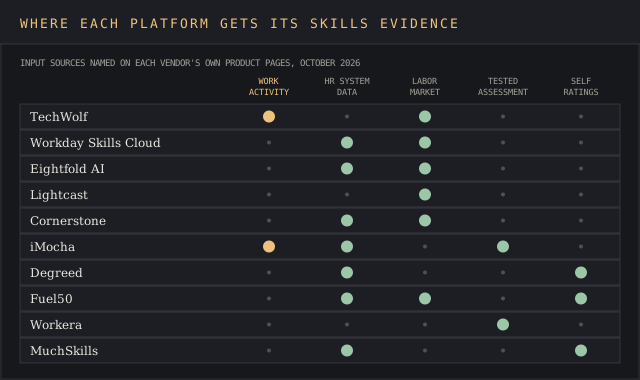
1. Where the skills evidence comes from
Ask the vendor to name every input system its model reads: HR system data, job titles, project tools, learning records, tested assessments or employee self-assessments. Count them. TechWolf infers skills from activity in the systems people already use and mapped 250,000 HSBC employees into one taxonomy in five months. A self-rated profile, the model MuchSkills runs on, changes only when its owner edits it.
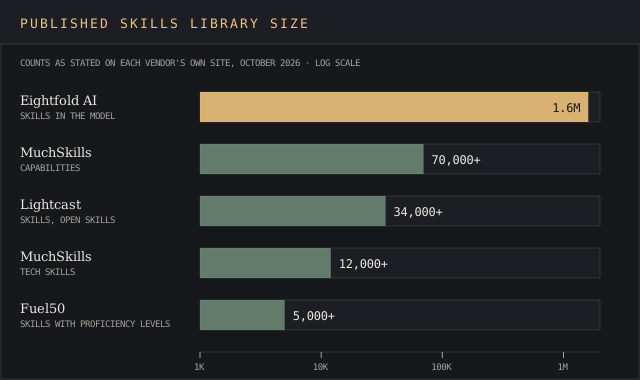
2. Published skills library size and release cadence
A skills taxonomy with a published count and a release schedule can be audited. Lightcast states 34,000+ skills and a monthly release; Fuel50 states 5,000+ skills with proficiency levels attached. Get the number in writing and ask how often new skills, such as AI skills that didn't exist two years ago, get added. Our AI statistics report puts the employment gap for 22 to 25-year-olds in AI-exposed jobs at 19% by June 2026.
3. Native connectors into the HCM of record
Skills data that can't write back into Workday, SAP SuccessFactors or Oracle HCM ends up in a second system that managers have to open separately when making talent decisions.
Ask which HCMs the vendor writes into natively and which only through a file export, then get the list in the contract. TechWolf names 3 native write targets on its product overview.
4. A named customer outcome with headcount and time
A named customer, an employee count and a deployment time can be checked by calling a reference. HSBC's 250,000 employees mapped in five months is the bar here.
5. Price on record
A published price or a Vendr median beats a demo form. Three of the ten vendors here have a Vendr median. The other seven quote by deal, and MuchSkills at least publishes its fee structure.
Top 10 skills intelligence platforms, ranked
TechWolf
Best fit
Large enterprises that run Workday, SAP SuccessFactors or Oracle HCM and want skills profiles filled from work data.
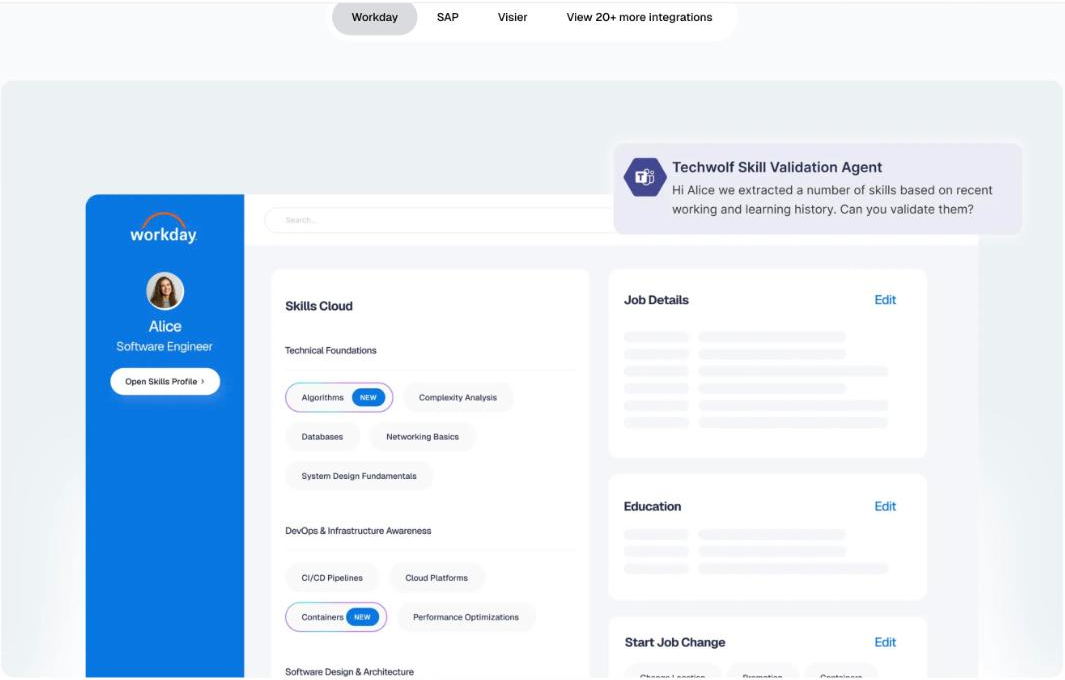
TechWolf is an AI-powered skills intelligence engine that reads activity in the systems people already use and writes inferred skills into the HCM, so it runs under the radar inside screens employees already open.
HSBC employees mapped into one unified skills taxonomy in five months, with 30,000+ technology employees holding granular skills profiles, per TechWolf's own site.
The product overview says the model infers proficiency levels and skill clusters "from actual system activity" and lists native writes into Workday Skills Cloud, SAP SuccessFactors and Oracle HCM Dynamic Skills, plus Visier and 20+ other integrations.
Key features
- Skill Engine, the inference model that builds skills profiles from system activity.
- Native writes into 3 HCMs: Workday Skills Cloud, SAP SuccessFactors, Oracle HCM Dynamic Skills.
- Work Intelligence Index, a task-level view of which work is automatable.
- Market Intelligence module.
- ISO/IEC 27001 and ISO 42001 certification.
Pricing
TechWolf sells annual enterprise contracts by quote. Its site routes every buyer to a demo request, and Vendr carries no TechWolf median.
Pros
- Ericsson gave 100,000+ employees personalised skills signatures, per TechWolf.
- Writes into the HCM, so employees see skills where they already work.
- Workday itself runs TechWolf, reporting 15% faster time-to-hire.
Cons
- Pricing sits behind a demo request on techwolf.ai.
- Capterra and TrustRadius list 0 written reviews, so buyer evidence comes from vendor references.
- Profiles display inside the HCM's own screens, so the employee experience is Workday's, SAP's or Oracle's.
Rob Etheridge, Global Head of Workforce Strategy and Insights at HSBC, described the setup on the Digital HR Leaders podcast on 4 November 2025:
"If you embed this agenda into AI and LLMs, then what you have is a perpetual way of keeping on top of that data"
Rob Etheridge, HSBC, myHRfuture, 4 November 2025
Why it's ranked #1. TechWolf writes natively into 3 HCMs where Workday Skills Cloud serves 1, and its named outcome, 250,000 HSBC employees in five months, is the largest dated deployment here. That beats Workday on criteria three and four.
Workday Skills Cloud
Best fit
Companies already on Workday HCM that want employee skills inside recruiting, learning and talent management without a new vendor.
Skills Cloud is the skills intelligence layer and skills ontology inside Workday HCM. Workday's product page says 30% of the Fortune 500 use it.
Higher internal hire rate, plus a 5% reduction in voluntary turnover, averaged across Skills Cloud customers with data from July 2023 to June 2025, per Workday's product page.
That turnover figure is the cleanest answer on this page to the employee retention question buyers ask. Skills Cloud reads from Workday Recruiting, Learning, Talent Optimization, People Analytics and Prism Analytics, and from external market data, so Workday customers hit the ground running with records already in the tenant.
Key features
- AI job recommendations from connections between skills.
- Skill gaps surfaced against roles inside Workday Talent Optimization.
- Personalised learning suggestions through Workday Learning.
- Prism Analytics for actionable insights on workforce capabilities.
- Workforce skills data shared across Recruiting and Learning.
- Third-party inference inputs, TechWolf among them.
Pricing
Skills Cloud is bought as part of Workday. Vendr's anonymised buyer data puts the Workday median at $51,232 a year across 368 deals, ranging from $19,476 to $543,504, with buyers saving 15.24% on average.
Pros
- 26% higher internal hire rate and 5% lower voluntary turnover, the employee retention figure to quote internally.
- Workday shops skip the integration project.
- Gartner Peer Insights lists 4.2 out of 5 across 40 ratings.
Cons
- The product page gives adoption and outcome figures, with the ontology's skill count missing.
- Runs only inside a Workday HCM tenant.
- Profile quality depends on how much data the tenant already holds.
A Data Analyst at a telecom company wrote on Gartner Peer Insights on 14 July 2026:
"A helpful skills platform for career planning and employee development, but it works best with strong setup and organization."
Data Analyst, telecommunications, Gartner Peer Insights, 14 July 2026
Why it's ranked #2. Workday has a Vendr median of $51,232 over 368 deals, a price on record Eightfold lacks. It ranks below TechWolf because it writes into 1 HCM, its own, against TechWolf's 3.
Eightfold AI
Best fit
Large employers that want one AI model running talent acquisition, internal talent marketplaces and resource management.
Skills intelligence is one layer of Eightfold AI's talent platform. Its homepage claims a model trained on 1.6 billion career trajectories and 1.6 million skills, the largest skills vocabulary on this page by a wide margin. It holds SOC 2 Type II, ISO/IEC 42001 and FedRAMP Moderate authorisation, which matters for US federal buyers.
Applicants filed Kistler and Bhaumik v. Eightfold AI in Contra Costa County Superior Court on 20 January 2026, alleging the platform scored candidates from third-party data in ways that amount to consumer reports under the FCRA, as Fisher Phillips summarised.
Key features
- Talent Management module.
- Workforce Exchange module.
- Resource Management module.
- AI Interviewer and Candidate Agent for talent acquisition.
- TalentForge agent builder.
Pricing
Eightfold sells by quote, and Vendr's Eightfold page shows no sample contract data.
Pros
- 1.6 million skills in the model.
- FedRAMP Moderate, rare in this category.
- Softtek reported 30% faster time-to-fill.
Cons
- Open FCRA class action filed January 2026; keep an eye on the ruling.
- Match quality complaints recur across G2 reviews.
- Quote-only, with zero sample contracts on Vendr's Eightfold page.
On G2, an enterprise reviewer in telecommunications wrote on 18 September 2026, "I mostly don't trust the match scores because the matches feel mostly irrelevant." A financial services reviewer flagged the same pattern back in November 2022: "Also gives Product Manager suggestion for a data scientist and vice versa."
Why it's ranked #3. Eightfold's 1.6 million skills dwarf Lightcast's 34,000, and it ships employee-facing profiles Lightcast leaves to the buyer. It trails Workday on price, with no median against Workday's $51,232, and on an open lawsuit.
Lightcast
Best fit
HR analytics and data teams that want a standard skills taxonomy and labor market skills supply and demand data to build on.
Lightcast publishes a skills taxonomy other vendors plug into for skills intelligence. Its Open Skills library lists 34,000+ skills, the API access page adds 75,000+ job titles and 1,800+ specialised occupations, and the FAQ confirms a new library version every month. Each release adds new skills, which is how future skills reach the library.
Without a shared taxonomy, finding one skill across 75,000+ titles is a needle in a haystack. iMocha lists Lightcast as an integration on its own skills page, which tells you how far the taxonomy travels.
Key features
- Open Skills taxonomy, 34,000+ skills, monthly releases.
- Skills Extractor that pulls skills from free text.
- Job Posting Optimizer.
- Titles API covering 75,000+ job titles.
- Labor market data on skills demand by region.
Pricing
API access runs on a contract basis per the Lightcast FAQ, and nonprofits get full access free of charge. Vendr's Lightcast page carries no median.
Browse the full Open Skills library before the first sales call, and check the job titles your HRIS already uses against the 75,000+ in the Titles API.
Pros
- Published skill count and monthly release cadence.
- Free browsing of the full library.
- G2 lists 4.6 out of 5 from 30 reviews.
Cons
- Ships a taxonomy and labor market data, and employee profiles are the buyer's build.
- Coverage outside the US trails, per G2 reviewers.
- Commercial API terms only on request.
A semiconductor-industry reviewer on G2 wrote in June 2023 that the product "lacks the coverage in other regions and most features only available in US." Another enterprise user, Tim J., called it a "very strong and reliable data platform and top-notch customer support" in the same month.
Why it's ranked #4. Lightcast's 34,000+ skills are free to browse one by one and versioned monthly, an auditable library where Cornerstone's 55,000+ is a count in a launch press release. It ranks below Eightfold because it ships zero employee-facing skills profiles.
Cornerstone Workforce AI
Best fit
Cornerstone learning customers that want skills inference and labor market data inside the platform they already pay for.
Cornerstone bought SkyHive's skills intelligence technology, announced on 22 May 2024. The Skills Optimization page now claims 28 TB of global labor market data processed daily to compare workforce capabilities with demand, 150 trillion computations against 1 billion profiles and 5 billion job roles, 190+ countries and 7,000+ organisations.
The Workforce AI launch release of 20 May 2026 adds a taxonomy of more than 55,000 skills and over 1 billion workforce profiles behind the People Graph and Skills Engine.
Key features
- Cornerstone Skills Engine for skills intelligence and inference.
- Skills Architect for role-to-skill mapping.
- People Graph linking workforce data on employees, roles and skills.
- Skill Passport, a skills record each employee holds.
- Dynamic workforce planning module for workforce decisions.
Pricing
Vendr's anonymised buyer data puts the Cornerstone median at $29,704 a year, ranging from $10,445 to $55,268.
Pros
- Lowest Vendr median of the three vendors with one.
- Learning and skills on one contract.
- Labor market model refreshed daily across 190+ countries.
Cons
- The 55,000+ skill count sits in a press release, outside the Skills Optimization product page.
- Admin interface draws repeat complaints on G2.
- Skills features sold into Cornerstone's learning platform.
Michael A., a Training Portfolio Manager, called it a "Great platform when you want to demonstrate compliance" on G2 in July 2025, then listed a "Horrible end-user interface" as the downside.
Why it's ranked #5. Cornerstone has a $29,704 Vendr median, a price on record iMocha lacks. It ranks below Lightcast because its 55,000+ skill count comes from a press release, against Lightcast's 34,000+ skills open to browse with a monthly release.
iMocha
Best fit
IT services firms and technical employers that want proficiency tested, with skills inference as a second layer.
iMocha sells its AI-powered skills intelligence platform under the name Skills Intelligence Cloud, launched on 26 July 2023. The product page lists 10,000+ expert-built assessments, 2M+ assessments conducted, 10M+ skills signals and 300+ customers.
iMocha puts a test behind each profile. The inference layer reads resumes, certificates, learning history and work data, then assessments and AI-powered interviews validate the result.
Key features
- Skills Intelligence Cloud with skills inference from resumes and learning history.
- 10,000+ assessments, including coding simulators and live coding interviews.
- Skills Architecture for role-based skills matrix design.
- Work Intelligence for task analysis.
- Connectors for Workday, SAP SuccessFactors and Lightcast.
Pricing
The iMocha pricing page is a demo booking form, and Vendr has no iMocha listing.
Pros
- Proficiency levels come from test scores.
- G2 lists 4.4 out of 5 from 276 reviews.
- Proctoring and plagiarism detection built in.
Cons
- Learning curve during onboarding, per G2 reviewers.
- Reporting gaps at the account level.
- A price arrives only after a booked demo.
An HR Analyst at an enterprise wrote on G2 on 27 June 2025:
"The initial learning curve is a bit steep, and clearer step-by-step guidance or an improved user interface would make onboarding smoother."
HR Analyst, enterprise, G2, 27 June 2025
Why it's ranked #6. iMocha validates skills against 10,000+ assessments, while Degreed leans on ratings and learning activity. It sits below Cornerstone because Cornerstone has a $29,704 Vendr median and iMocha has none.
Degreed
Best fit
L&D teams that want learning intelligence: training spend tied to measured skill gaps.
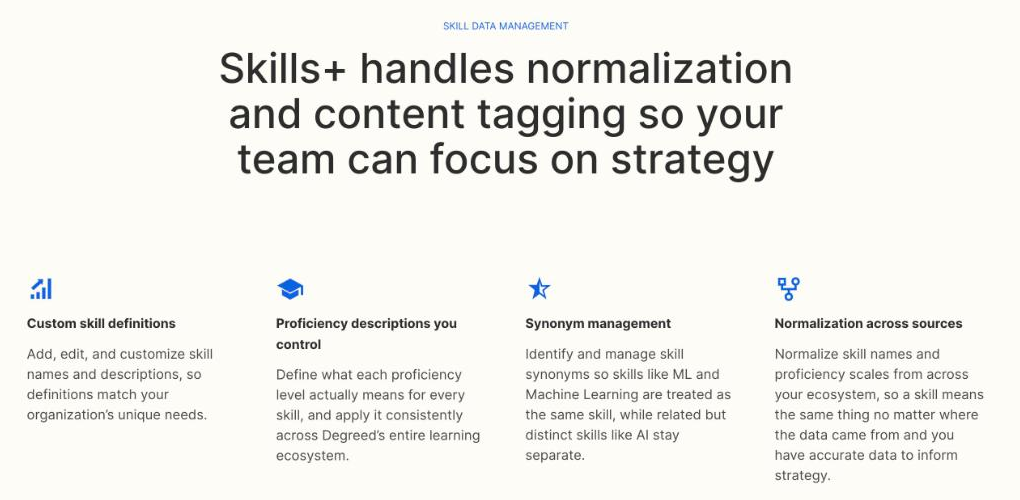
Degreed sells a learning experience platform and puts its skills intelligence in an upper tier. Its pricing page lists Skills+ with skill data analysis, taxonomy customisation, skill gap analysis, proficiency-based learning, workforce forecasting and skill inference.
The skills page lets each company define what every proficiency level means, and Maestro reviews employee skills against those definitions. That's the learning intelligence loop: targeted learning tagged to a skill and a level, enabling targeted training on the gaps Maestro finds.
Key features
- Skills+ tier with skill inference and gap analysis.
- Maestro AI skill reviews.
- Custom level definitions per skill.
- Content auto-tagged by skill and level.
- Degreed Academies for cohort-based learning.
Pricing
Degreed prices by company, headcount and modules. Vendr's anonymised buyer data puts the Degreed median at $170,904 a year, in a $149,042 to $173,457 range.
Pros
- Learning and skills data in one record.
- Maestro reviews skills against company-defined levels.
- Price on record via Vendr.
Cons
- Highest Vendr median on this page at $170,904; it can cost an arm and a leg next to Cornerstone's $29,704.
- Skill inference sits behind the Skills+ upgrade.
- Navigation complaints recur on G2.
Gabriel O., a Senior Product Designer, wrote on G2 in May 2023:
"The user experience is horrible. Information architecture is a mess: I can't find anything, the menus don't make any sense."
Gabriel O., Senior Product Designer, enterprise, G2, May 2023
Why it's ranked #7. Degreed has a $170,904 Vendr median, a price on record Fuel50 doesn't have. It ranks below iMocha because its evidence comes from ratings and learning activity, against iMocha's 10,000+ tested assessments.
Fuel50
Best fit
Mid-size and large employers that want a skills ontology and an internal talent marketplace under one contract.
Fuel50's skills intelligence page states an ontology of 5,000+ skills, each with proficiency levels, development actions and market trend data. It connects to Workday, SAP SuccessFactors, learning systems and ATS platforms, and adds governance workflows with duplicate detection.
Key features
- Skills Ontology of 5,000+ skills with proficiency levels.
- Skills Inventory and skill harmonisation.
- Task Intelligence to sort tasks for automation.
- Gigs, Mobility and Succession modules for internal mobility.
- Connectors for Workday and SAP SuccessFactors.
Pricing
The pricing page names three plans, Skills Intelligence, Talent Marketplace and Ultimate Fuel50, with all prices on request. Vendr's Fuel50 page has no median.
Pros
- Published ontology size, 5,000+ skills.
- Talent marketplace for enhanced internal mobility.
- Plan structure published, modules named.
Cons
- SuccessFactors sync errors reported on G2.
- Manager reporting limits.
- All three published plans are priced on request.
Amy S., a Global Learning Operations Manager, wrote on G2 in April 2026 that the "Skill Inventory and Skill Harmonization feature have been especially useful." Maisy H., a Skills Transformation Analyst, reported "integration errors with SuccessFactors that can pause the data flow" in June 2026.
Why it's ranked #8. Fuel50 covers 5,000+ skills, against Workera's 100+ signature assessments. It sits below Degreed because Degreed has a $170,904 Vendr median and Fuel50 has no price on record.
Workera
Best fit
Technical organisations that need a verified AI skills baseline before funding an upskilling program.
Workera measures skills with adaptive tests and calls its scoring layer the Skills Intelligence Engine. The homepage lists 100+ signature assessments and a ServiceNow rollout to 28,000 employees.
Average skill growth in 60 days across the ServiceNow rollout, which produced 54,000 verified baselines, per Workera's homepage.
The customers page adds Siemens Energy: 4,923 completed assessments and 97% of learners certified in under 90 days.
Key features
- 100+ signature assessments with benchmarks.
- Adaptive question sets.
- AI Readiness Index across five proficiency bands.
- Curated learning tied to each measured gap.
- Hiring, skills assessment and ambient coaching agents.
Pricing
Workera sells by demo, and Vendr's Workera page shows no pricing data.
Pros
- Tested baselines, 54,000 at ServiceNow.
- Learning recommendations tied to each gap.
- G2 lists 4.6 out of 5 from 26 reviews.
Cons
- Assessment library centred on AI readiness.
- Timed tests draw realism complaints.
- Each contract is priced after a demo, per deal.
Travis V. wrote on G2 in December 2025 that Workera offers "curated learning to aid in skill enhancement and gap closure. This feature saves me time." The same reviewer added that the "timing does not feel realistic to real-world scenarios."
Why it's ranked #9. Workera tests skills directly, 54,000 baselines at ServiceNow, while MuchSkills relies on self-ratings. It ranks below Fuel50 because 100+ assessments cover far fewer skills than Fuel50's 5,000+.
MuchSkills
Best fit
Consultancies and firms under 100 people that need a skills matrix and project staffing view on a self-serve plan.
MuchSkills is a skills management and skills intelligence tool built on employee self-assessments. The homepage lists 70,000+ capabilities, 12,000+ tech skills and 9,000+ certifications, and cites Nigeria's Federal Civil Service mapping 55,000 civil servants across 45 ministries in 3 months.
Key features
- Employee skills matrix built from ratings against 12,000+ tech skills.
- Certification tracking with renewal reminders.
- CV Inventory and Team Builder for proposals and team assembly.
- Connectors for Workday, SAP SuccessFactors, Personio, HiBob, BambooHR and Dayforce.
- Project data from Jira, Tempo, Harvest and Smartsheet.
Pricing
The pricing page describes one annual platform fee plus one price per user, billed yearly. Starter covers up to 100 people, and its self-serve setup gets the ball rolling; figures come on request.
Pros
- 70,000+ capabilities, the largest published library after Eightfold's 1.6 million skills.
- Self-serve Starter plan up to 100 people.
- 55,000 civil servants mapped in 3 months.
Cons
- Skills come from self-assessments, the input criterion one ranks lowest.
- One review on G2.
- Web app only; a G2 reviewer asked for mobile apps in January 2023.
Frank W., a Senior Software Engineer, wrote on G2 in January 2023 that "MuchSkills has a pretty straightforward sign up process" and added, "I would love that there are mobile apps for this solution."
Why it's ranked #10. MuchSkills lists 70,000+ capabilities, but every skill on a profile is self-reported by the employee. It ranks below Workera, whose 54,000 ServiceNow baselines came from tests.
Eight of the ten entries quote G2 reviewers. Read them with one eye on how they're collected: our reports asking if G2 is legit and if Capterra is legit cover how each site verifies reviewers, and G2 rejected 36.7% of the 244,078 reviews submitted in Q1 2026.
How skills intelligence works
Skills intelligence works in three layers. A skills taxonomy names the skills and gives the company a common language; a skills ontology maps how those skills relate and which ones sit next to each other; an inference model attaches workforce skills to named people from evidence.
The taxonomy is where projects stall. Building one from scratch "can take months," according to TechWolf's own guide, and a licensed library like Lightcast's 34,000+ skills shortens that. HSBC needed five months with TechWolf for 250,000 employees, and that was with an inference engine doing the heavy lifting.
The ontology carries the adjacent skills logic. When Workday Skills Cloud recommends a job to a data analyst, it's reading the distance between that person's skills and the role's, and that distance is what drives internal mobility and the 26% higher internal hire rate Workday reports.
Inference closes the loop. Machine learning reads job titles, project tickets, course completions or resumes, assigns skills and proficiency levels, and updates skills profiles as the evidence changes. The skills intelligence approach lives or dies on that last step. Skills management on manual input alone means a skills inventory that employees and managers update by hand, which is how MuchSkills rates people against its 12,000+ tech skills.
Where skills data comes from
Every skills intelligence vendor on this list draws on a different mix of evidence, and the mix decides how far you can trust a profile. Two platforms can both claim skills inference by artificial intelligence while reading entirely different inputs, and the devil's in the details of that input list.
- Work-system activity: TechWolf infers skills from activity in existing systems, and iMocha lists work data among its inputs. It's the one source that updates as people work. Mining the same system logs for process steps is a separate category, covered in our process intelligence software ranking.
- HR system data: Workday Skills Cloud and Cornerstone read organizational data already in the HCM or LMS: job history, courses, certifications.
- External labor market data: Lightcast and Cornerstone compare internal capability data with what the market posts and hires for.
- Tested assessments: iMocha and Workera measure proficiency directly, which costs employee time.
- Self-assessments: MuchSkills and parts of Fuel50 and Degreed ask employees to rate themselves, with manager checks.
Self-ratings run on a form and a deadline: Nigeria's Federal Civil Service mapped 55,000 civil servants across 45 ministries in 3 months on MuchSkills. A skills matrix built from self-ratings shows knowledge gaps people admit to, which is a smaller set than the knowledge gaps they have.
Skills intelligence versus talent intelligence and workforce intelligence
The three categories share vendors and get confused in RFPs. Talent intelligence points outward, at candidates and the external talent pool, the territory our recruitment market intelligence guide covers and the job SeekOut, hireEZ and LinkedIn Talent Insights are built for.
Workforce intelligence points at headcount, cost and productivity. Visier, Revelio Labs and ActivTrak are the analytics tools that answer how many people you have and what they cost.
The skills category covers the existing workforce and its workforce capabilities. The skills intelligence system answers where skills exist, where skill gaps sit and which internal talent can fill a role before external hiring starts. Pay benchmarking is a separate purchase, ranked in our compensation benchmarking tools list, and the market-side data lives on our labor market intelligence guide.
Learning intelligence and skills development
Learning intelligence is the L&D half of skills intelligence: it ties each course, cohort or coaching hour to a measured skill and checks the skill moved afterwards. Degreed's Skills+ tier and Workera's assessment-then-learn loop are the two clearest examples on this list.
The test of a learning intelligence product is a before-and-after number. Workera's ServiceNow figure, 10% average skill growth in 60 days across 28,000 employees, is the format to ask every vendor for. Completion counts are a drop in the bucket next to that.
Targeted training also cuts spend. Skills insights show which new skills and future skills a function lacks, and what skills intelligence makes possible is a training budget aimed at those skills, with the rest of the catalogue no longer absorbing licence fees. Employee development and talent development programs get measured against the same skills data the rest of HR uses.
Pricing across skills intelligence software
Skills intelligence vendors on this page have no price on record at all, which is par for the course in enterprise HR software.
The three Vendr medians span almost 6x: $29,704 for Cornerstone, $51,232 for Workday and $170,904 for Degreed.
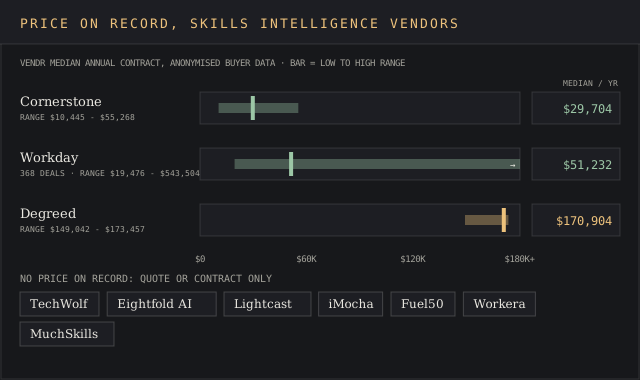
- Workday: $51,232 median over 368 deals, $19,476 to $543,504, per Vendr. Skills Cloud comes inside the Workday contract.
- Cornerstone: $29,704 median, $10,445 to $55,268, per Vendr.
- Degreed: $170,904 median, $149,042 to $173,457, per Vendr.
- MuchSkills: annual platform fee plus a per-user price, billed yearly.
- Lightcast: contract API access, free for nonprofits.
Two costs sit outside the licence. Inference products need read access to the HCM and work tools, so security review and integration work land on IT. Assessment products cost employee hours: Siemens Energy completed 4,923 assessments on Workera, and each one took a person off the job.
Talent intelligence seats on the recruiting side price on a different scale. Our LinkedIn Talent Insights cost report puts the median LinkedIn buyer at $38,458 a year across 2,348 tracked deals.
How to implement skills intelligence
A company-wide launch on day one puts all your eggs in one basket. A skills intelligence implementation that works starts with one function, gets measured, then scales, and that's easier said than done when the demo ran on the vendor's sample data.
- Pick one function and 50 people. Software engineering or sales work well, because managers can say who knows what.
- Write the answer key first. Managers list each person's top skills, including soft skills, before the vendor runs anything.
- Run the skills intelligence vendor's inference or assessment. Compare its skills profiles with the answer key, skill by skill.
- Count the hits. The share of manager-confirmed skills the platform found is your accuracy number.
- Check the write-back. Confirm the skills land in the HCM screen employees use.
- Tie it to business objectives. Pick one decision, such as project staffing or a promotion slate, use the data for it and track the business outcomes on an OKR tracker.
Teams that implement skills intelligence this way get a number before the contract is signed. That pilot turns a demo into data analysis you can show finance in whatever BI tool it already runs, and an accuracy number from your own data gives you a competitive advantage at the negotiating table. It also gives talent leaders evidence for workforce decisions and talent decisions drawn from their own staff.
Skills intelligence FAQ
What is a skills intelligence platform?
A skills intelligence platform is software that builds and maintains a record of employee skills, maps them to roles and compares them with what the business needs. Buyers also search for a skill intelligence platform or for skill intelligence; the product is the same. The record feeds talent management, talent acquisition, learning and workforce planning.
Why is skills intelligence important?
A Gartner survey of 190 HR leaders in June 2024 found 41% agree their workforce lacks required skills. The cost line is what makes skills intelligence important to a CFO: IDC, as reported by CIO Dive on 17 May 2024, estimated tech talent shortages will cost organisations $5.5 trillion by 2026, from a survey of 811 IT leaders.
How does skills intelligence differ from talent intelligence?
Skills intelligence covers your own employee capabilities. Candidates and competitors' staff belong to talent intelligence. The problem skills intelligence solves is internal: who already has the skills, and where the growth opportunities and development opportunities sit for everyone else, so the business can close skills gaps from inside.
What is the best platform for skill learning?
For an organisation, the answer depends on the evidence it trusts. Degreed fits a learning-led program with a $170,904 Vendr median, and Workera fits a tested baseline of AI readiness scores. Both connect each learning recommendation to a measured gap.
What is an intelligence platform?
An intelligence platform collects data from several sources, structures it and answers a business decision with it. A skills intelligence platform does that for employee skills, a talent intelligence platform for candidates, and a workforce intelligence platform for headcount and cost.
How much does skills intelligence software cost?
Three of the ten have a Vendr median: Cornerstone at $29,704 a year, Workday at $51,232 and Degreed at $170,904. TechWolf, Eightfold AI, iMocha, Fuel50 and Workera quote every deal, Lightcast sells API access by contract, and MuchSkills charges an annual platform fee plus a per-user price.
Which skills intelligence platform works best with Workday?
TechWolf and Workday Skills Cloud. Skills Cloud comes inside the Workday contract, and TechWolf writes inferred skills into it natively, the setup Workday itself runs, reporting 15% faster time-to-hire. Fuel50, iMocha and MuchSkills also list Workday connectors.
Bottom line
TechWolf wins for enterprises running Workday, SAP SuccessFactors or Oracle HCM that want skills intelligence to fill itself in from work activity. Workday Skills Cloud wins for Workday shops that want talent decisions and skills data with one vendor and a price on record. Eightfold fits large employers that want hiring and mobility on one model and can live with an open lawsuit.
Lightcast is the pick for data teams building their own taxonomy, and Cornerstone for companies already on its learning platform. iMocha and Workera win when proficiency has to be tested, Degreed when learning intelligence is the brief, Fuel50 when a talent marketplace and internal mobility matter, and MuchSkills for a fast skills matrix under 100 people.