Process Intelligence Software: 10 Platforms Ranked (2026)
 By Jan Suski. I go deep on every review, checking every number against its source and digging up details other coverage misses, a habit from six years of SEO and link building for tech companies. Bylines at Surfer, Brand24, and Senuto. How the scoring works.
· Prefer this source on Google
Quick comparison of process intelligence software
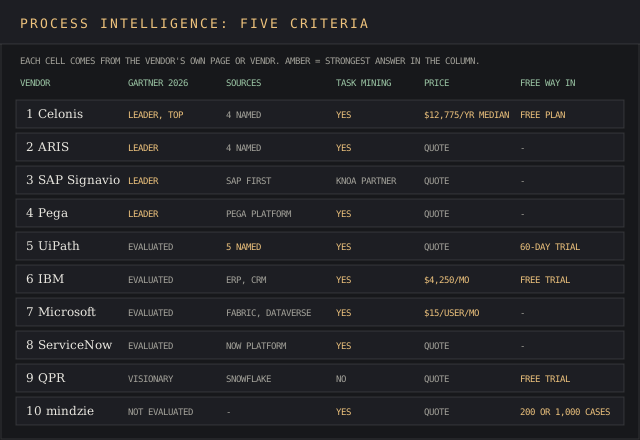
Ten process intelligence platforms in ranked order, with each vendor's 2026 Gartner placement, its answer on native task mining, the entry price and the buyer each fits.
| # | Provider | 2026 Gartner placement | Native task mining | Entry price | Best fit |
|---|---|---|---|---|---|
| 1 | Celonis | Leader, top on execution | Yes | $12,775/yr median* | Multi-ERP enterprises |
| 2 | ARIS | Leader, 4th year | Yes | Quote | Process improvement teams |
| 3 | SAP Signavio | Leader, 4th year | Via Knoa | Quote | SAP S/4HANA shops |
| 4 | Pega | Leader | Yes | Quote | Pega Platform users |
| 5 | UiPath | Evaluated | Yes | Quote, 60-day trial | Intelligent automation teams |
| 6 | IBM | Evaluated | Yes | $4,250/month | On-premises buyers |
| 7 | Microsoft Power Automate | Evaluated | Yes | $15/user/month | Microsoft 365 tenants |
| 8 | ServiceNow | Evaluated | Yes | Quote | ITSM teams |
| 9 | QPR ProcessAnalyzer | Visionary | No | Free trial | Process analytics on Snowflake |
| 10 | mindzie | Not evaluated | Yes | Free, 1,000 or 200 cases† | Analysts, small teams |
Medians marked * are anonymized buyer-reported contract values published by Vendr. Everything else is the price the vendor publishes itself. † mindzie's pricing page says 1,000 free cases and its desktop edition page says 200; the mindzie entry prints both.
Where these figures come from
Gartner placements come from each vendor's own 2026 announcement and Automation Today's list of the vendors evaluated, read on 27 September 2026. Prices, task mining answers and free tiers are each vendor's own published figure. Celonis's median is Vendr's anonymized buyer data. ARIS, SAP, Pega and ServiceNow publish no price, and the sources disagree on how many vendors Gartner evaluated, 13 or 16.
Platforms that recommend or automate the business decision itself are ranked on the decision intelligence platforms ranking, which also scores Gartner's 2026 standing. This page ranks tools that rebuild how a process runs from its event logs.
Process intelligence software reads the event logs your ERP, CRM and ticketing systems already write, rebuilds the path each case took, and shows where business processes stall. Gartner renamed the category to match: its Magic Quadrant for Process Intelligence Platforms replaced the process mining report on 5 May 2026.
This page ranks ten process intelligence tools for operations, finance and IT leads, usually spending a digital transformation budget. Prices run from Microsoft's $15 per user a month to IBM's $4,250 a month.
Enterprise leaders funding artificial intelligence are the new buyers: Gartner's definition, quoted in Pega's release, says the tools show "the best areas to deploy AI agents."
Evaluation criteria for process intelligence software
Five criteria decide the shortlist, and the ranking below applies them in this order. Each tests process intelligence capabilities a buyer can check on the vendor's own pages.
2026 Gartner Magic Quadrant placement
Gartner named four Leaders: ARIS, Celonis, Pega and SAP Signavio, per Automation Today, which names 13 evaluated vendors. "Evaluated" in the table means one of the other nine.
The sources disagree on how many vendors Gartner evaluated. Pega's Gartner page, Pega's release and Automation Today say 13, and Automation Today names all 13. SAP's release says 16.
We rechecked all of them on 27 September 2026 and couldn't settle it: Gartner's report is paywalled. SAP's 16 matches the 16 vendors Gartner assessed in its 2025 process mining report, which points to a carried-over figure, so this page counts 13.
Source-system reach
Count the enterprise systems the vendor names as native extraction sources for business data. More named systems score higher.
Native task mining
Desktop capture fills the gaps system logs leave, and it rounds out a process intelligence stack. The answer is yes, via partner, or no.
A published price
A list price for the process intelligence software scores highest, a Vendr median next, "contact sales" last.
A free way in
A free process intelligence plan or dated trial lets a team load one set of process data. Count the days or the case limit.
The 10 best process intelligence software platforms, ranked
Celonis
Best fit
Enterprises running business processes across two or more ERPs.
Celonis says more than 1,400 companies run its process intelligence platform, which builds a digital twin from Oracle, Infor, Salesforce and ServiceNow data, among other systems. By its own account it placed highest on Ability to Execute in 2026.
Key features
- Object-centric process mining for complex processes spanning several documents.
- A desktop capture application with browser extensions.
- What-if simulation for process optimization.
- Camunda and Appian integrations for intelligent automation.
Pricing
Quote, with a free plan. Vendr's anonymised buyer data puts the median at $12,775 a year, range $6,000 to $130,277.
The gap between the cheapest and the dearest Celonis contract in Vendr's buyer data: $130,277 at the top against $6,000 at the bottom, so the median alone says little about your quote.
Pros
- Top on both 2026 Gartner axes
- Documented object-centric model
- Free plan for a first process
Cons
- Vendr range tops out at $130,277
- Data modeling is easier said than done without a partner
- Needs a centre of excellence to act on process improvement findings
A Baker Hughes automation engineer wrote on TrustRadius in March 2026: "Celonis license is expensive, they need to reduce the license cost."
Why it's ranked #1. Celonis is the only one of the four 2026 Leaders to place highest on execution, and it pairs native desktop capture with a $12,775 Vendr median. ARIS at #2 matches the capture but publishes no price.
ARIS
Best fit
Operational excellence and continuous improvement teams that already model business processes in ARIS.
ARIS went standalone from Software AG on 7 January 2025 and was a Leader for the fourth consecutive year in 2026. Its product page cites Alicorp cutting order-to-cash time by 5.5 days.
Key features
- Native connectors for SAP, Oracle, Salesforce and Microsoft.
- Object-centric process discovery and integrated task mining.
- Conformance checks against ARIS business process management models.
- Simulation for process transformation plans.
Pricing
Quote; the aris.com pricing URL redirects to the platform page.
Pros
- Four named native connectors
- Process modeling and mining in one repository
- Documented object-centric support
Cons
- No public price or free tier
- Only 6 TrustRadius reviews
- One reviewer flags slow mining
A research and development reviewer wrote on TrustRadius in February 2020: "Reporting is relatively slow. Mining is relatively slow."
Why it's ranked #2. ARIS names four native source systems and ships its own desktop capture, where SAP Signavio at #3 relies on a Knoa product. It loses to Celonis on Gartner placement and on price, with 0 figures published.
SAP Signavio Process Intelligence
Best fit
SAP S/4HANA customers wanting process insights on business processes inside an SAP contract.
SAP says SAP Signavio Process Intelligence can connect to an SAP system and deliver insights in under 24 hours, and it marked a fourth year as a Gartner Leader. Other enterprise resource planning systems come in through value accelerators.
Key features
- Prebuilt SAP ERP extraction.
- Value accelerators for process analysis on non-SAP systems.
- Part of the SAP Signavio Process Transformation Suite.
- Desktop capture through SAP User Experience Management by Knoa.
Pricing
Quote, par for the course among the Leaders; the rendered SAP page shows no price.
Pros
- SAP teams hit the ground running in 24 hours
- Four years as a Gartner Leader
- Bundles into an SAP contract
Cons
- Desktop capture needs a second Knoa product
- Non-SAP coverage relies on accelerators
- Reviewers rate it below Celonis
A telecommunications program manager wrote on Capterra in January 2022: "Process Intelligence is not that great compared to Celonis." A May 2026 TrustRadius reviewer who connected the sister Process Insights tool to 6 ERPs wrote that "the value estimates are completely unrealistic".
Why it's ranked #3. SAP Signavio reaches first insight on SAP data inside 24 hours and holds a fourth Gartner Leader year, beating Pega on source reach. It trails ARIS, which ships desktop capture natively.
Pega Process Mining
Best fit
Pega Platform customers fixing the business processes they built on Pega.
Pega built the product on its 2022 Everflow acquisition, was a 2026 Leader among what Pega counts as 13 vendors, and says its process intelligence product "works with the Pega Platform."
Key features
- Process maps, KPIs and desktop capture in one product.
- An assistant that answers natural language questions about delays.
- Continuous process monitoring for bottlenecks and rework loops.
- Generative AI-ready APIs since May 2023.
Pricing
Quote, sold with the Pega Platform.
Pros
- 2026 Gartner Leader
- Native desktop capture
- Findings feed Pega's workflow automation builder
Cons
- Tied to the Pega Platform
- No published non-Pega connectors
- Only 9 Gartner Peer Insights ratings
A banking credit risk analyst told Gartner Peer Insights in July 2025 that "the system has been very easy to navigate for me and user friendly."
Why it's ranked #4. Pega is a 2026 Leader with native desktop capture, a placement UiPath at #5 doesn't hold. It sits under SAP Signavio because its product page names 0 non-Pega source systems.
UiPath Process Intelligence
Best fit
Automation teams already running UiPath robots.
UiPath Process Intelligence names native extraction from SAP, Oracle, Salesforce, ServiceNow and Workday. İşbank analysed 26 processes on it and saved 116,000 hours.
Business value Orange France reports over 4 years on UiPath, alongside 500 days of labor saved and a 15% rise in customer retention, per UiPath's own customer figures.
Key features
- Process discovery from system logs and desktops in one product.
- Five named ERP, CRM and HR connectors.
- Conformance monitoring with audit trails.
- Maestro Orchestrate, which turns a finding into an automated process.
Pricing
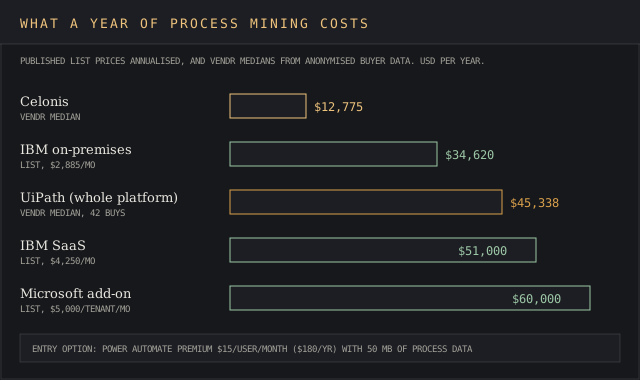
Standard and Enterprise tiers are "contact sales," with a 60-day Standard trial. Vendr shows a $45,338 median across 42 UiPath purchases, platform-wide.
Pros
- Five named sources, the most of the ten
- The only dated trial here, 60 days
- Direct path to robotic process automation (RPA)
Cons
- No price outside a sales call
- A 2022 reviewer calls setup complex
- Older reviews flag Citrix and SAP gaps
An IT project manager wrote on TrustRadius in April 2020: "UiPath compatibility with Excel, integration with Citrix and SAP is not perfect."
Why it's ranked #5. UiPath names five native source systems and offers a 60-day trial, both ahead of IBM at #6. It falls below Pega because Gartner didn't place UiPath among the four 2026 process intelligence Leaders.
IBM Process Mining
Best fit
Banks and insurers whose risk management rules keep process data on-premises.
IBM was a Leader in the 2025 process mining report. Its process intelligence product bundles prescriptive mining, simulation, advanced analytics and a watsonx assistant.
Key features
- SaaS on AWS, or on-premises on Red Hat OpenShift.
- Two desktop capture agents in the on-premises tier.
- Decision mining and bot generation for automated process steps.
- What-if simulation before process changes.
Pricing
SaaS starts at $4,250 a month for 20 GB, 3 business users and 1 analyst. On-premises starts at $2,885 a month.
Pros
- Two published list prices
- On-premises tier
- Free trial
Cons
- $51,000 a year at SaaS entry
- Three business users, a red flag for wide rollouts
- Slowdowns on large datasets
A data analyst wrote on Capterra in September 2022: "the technology is highly pricey and out of reach for some small enterprises."
Why it's ranked #6. IBM publishes a $4,250 monthly SaaS price plus an on-premises tier; Microsoft at #7 lists cloud plans only. It trails UiPath, which names five native source systems against IBM's generic ERP and CRM.
Microsoft Power Automate
Best fit
Microsoft 365 and Dynamics tenants.
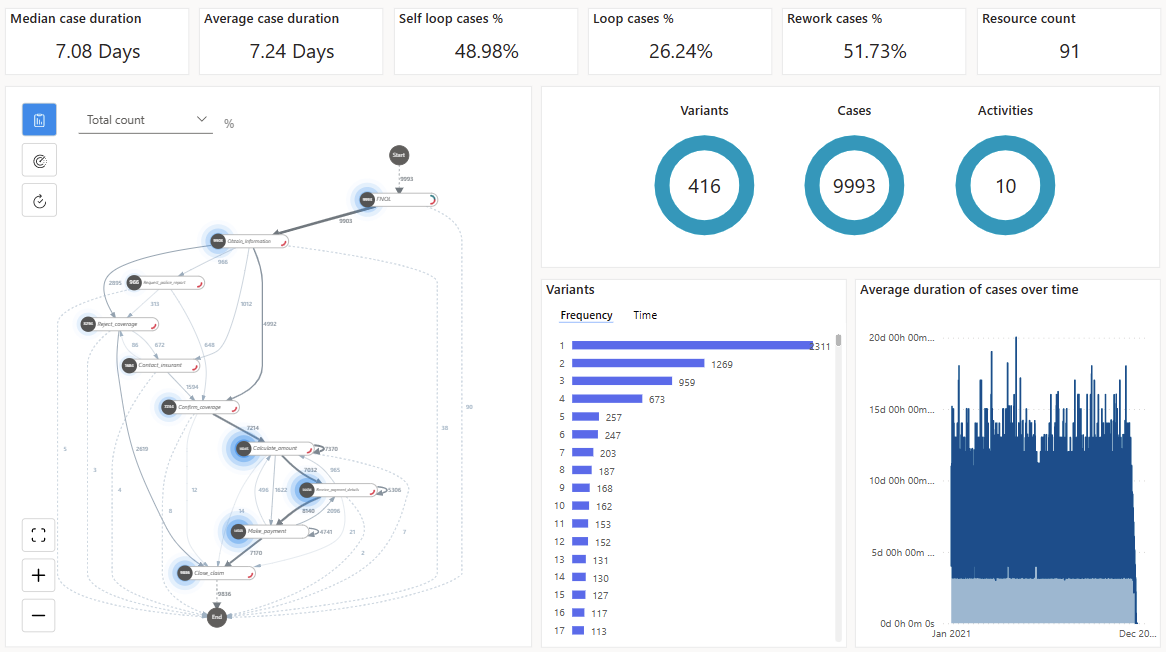
Microsoft bought Minit on 31 March 2022 and folded it into Power Automate, its process automation suite. The capability ingests data from Fabric OneLake, and Microsoft's overview pitches it to improve operational efficiency.
Key features
- System-log and desktop capture in Power Automate Premium.
- Ingestion from Fabric OneLake, Azure Data Lake Storage Gen2 and Dataverse.
- A Minit-based desktop app for analysts.
- KPI dashboards, variant views and time analysis.
Pricing
Premium costs $15 per user a month, paid yearly, with 50 MB of process data. The add-on costs $5,000 per tenant a month for 100 GB.
How much more process data the $5,000-a-month add-on stores than one Premium seat: 100 GB against 50 MB. That monthly fee also buys 333 Premium seats at $15.
Pros
- Lowest published entry, $15
- Desktop capture in Premium
- Uses Fabric and Dataverse data
Cons
- 50 MB of process data is too small for an ERP log
- $60,000 a year for the 100 GB add-on
- No named SAP or Oracle connector
An IT consultant wrote on TrustRadius in April 2022 that Power Automate's "cost is still high" for its AI components.
Why it's ranked #7. Microsoft publishes the cheapest entry, $15 per user a month, with desktop capture included, where ServiceNow at #8 quotes. It trails IBM, whose published on-premises tier has no Power Automate equivalent.
ServiceNow Process Mining
Best fit
ITSM teams mining the business processes behind incident tickets.
ServiceNow mines Now Platform workflows with no ETL and reads external audit logs through Workflow Data Fabric. One customer story there reports a 26% cut in incident volume.
ServiceNow also bought UltimateSuite for desktop capture and intelligent automation.
Key features
- Native mining of ServiceNow tables.
- Multidimensional mining across linked tables.
- Work-note analysis that explains delays in process execution.
- Desktop capture across email, Excel and browsers.
Pricing
Quote, inside ServiceNow packages.
Pros
- Zero ETL for ServiceNow data
- 4.2 on 56 Gartner Peer Insights ratings
- Native desktop capture
Cons
- Built around ServiceNow data first
- No published price
- One reviewer calls the design dated
An IT associate wrote on Gartner Peer Insights in March 2026: "I find it useful how it is integrated with other internal applications like Performance Analytics.."
Why it's ranked #8. ServiceNow mines its own tables with 0 ETL and adds desktop capture, which QPR at #9 lacks. It trails Microsoft, which publishes a $15 entry price where ServiceNow quotes.
QPR ProcessAnalyzer
Best fit
Data teams whose event data lives in Snowflake.
QPR calls ProcessAnalyzer the first process mining software running natively in Snowflake, a Visionary for the fourth straight year. Its guide lists 1,000+ built-in KPIs.
Key features
- Snowflake-native, plus cloud, hybrid and on-premises.
- Object-centric and case-based mining.
- 1,000+ KPIs for process performance.
- AI agent access through the Model Context Protocol.
Pricing
No list price; a free trial runs through Snowflake Marketplace.
Pros
- Mines data in Snowflake at enterprise scale
- 1,000+ KPIs out of the box
- Four Visionary placements
Cons
- No desktop capture product
- Most G2 reviews date from 2021
- No public price
An enterprise IT analyst praised on G2 in June 2021 the "Out of the Box Key Performance indicator through dashboard."
Why it's ranked #9. QPR holds a 2026 process intelligence Visionary placement and 1,000+ KPIs, which mindzie at #10 can't show. It sits below ServiceNow because it lists 0 desktop capture products.
mindzie
Best fit
Analysts who want to mine a log on a laptop, under the radar, before any contract.
mindzie's pricing page offers a free desktop edition for up to 1,000 cases. Every mindzie process intelligence plan includes mining, desktop capture, dashboards, BPMN 2.0 process modeling and an AI Copilot.
mindzie's own pages disagree on the free limit. The pricing page says the free desktop edition takes "up to 1,000 cases". The desktop edition page, which offers the software free, lists a Basic tier at "200 Cases Maximum" for 1 user.
We rechecked both pages on 27 September 2026 and neither explains the gap, so it couldn't be settled. Size a pilot to 200 cases and treat 1,000 as the upside.
Key features
- Free desktop edition with data stored locally, capped at 1,000 or 200 cases depending on the mindzie page.
- Cloud, on-premises and desktop editions.
- Data Designer for ETL.
- Templates for business processes like order to cash.
Pricing
Paid editions are quoted on users, case volume and data sources.
Pros
- The only free desktop edition here
- Desktop capture in every tier
- Three deployment options
Cons
- Not among the vendors in Gartner's 2026 report
- A free cap of 1,000 or 200 cases, and mindzie's pages disagree on which
- A crowded interface, per one reviewer
A CFO wrote on G2 in July 2021: "we were able to begin analyzing our processes within weeks." A healthcare procurement manager on Gartner Peer Insights disagreed in October 2024: "Too many buttons and interfaces makes it confusing."
Why it's ranked #10. mindzie gives away a desktop edition, capped at 200 or 1,000 cases depending on the page, with desktop capture included. It loses to QPR because it isn't among the 13 vendors Automation Today names from Gartner's 2026 report.
What is process intelligence
ABBYY defines process intelligence as "a combination of data-driven capabilities dedicated to the analysis and enhancement of business operations." A process intelligence solution stacks process mining on system logs, task mining on desktops, and machine learning or other artificial intelligence on top.
It provides actionable insights on organizational processes that workshops miss, and it tells process automation teams where to start.
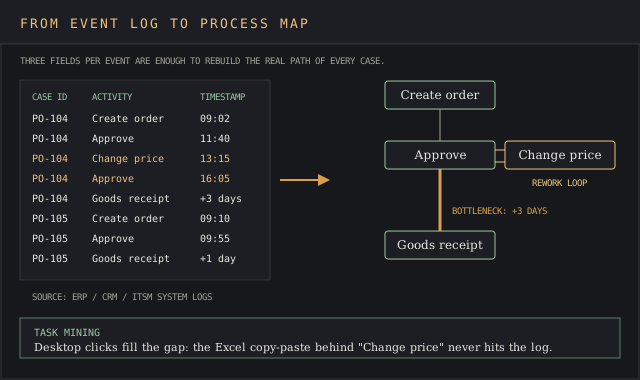
How does process intelligence work? Process intelligence works in four steps: extract event logs from existing systems, draw process maps, compare them with the designed flow, and monitor the gap. Those maps visualize business process data and surface process variations, skipped approvals and process bottlenecks, so analyzing processes yields valuable insights without interviews.
Columns an event log needs before any mining starts: case ID, event type and timestamp, per QPR's process mining guide. Everything else on a process map is derived from those three.
Salesforce calls the result a digital twin of the organization, queried for real time data on process execution.
How does process intelligence differ from BI? BI counts late orders; process analysis shows the steps behind each one. Simulation tests changes first, and predictive analytics uses historical data to flag cases likely to breach an SLA.
See our guide to market intelligence versus business intelligence, the business intelligence market report, and our data mining tools and data intelligence tools rankings.
Benefits of process intelligence
The benefits of process intelligence below each name their publisher:
- Operational efficiency: KYP.ai reports 15 to 25% lower operating costs and 20 to 30% shorter process times, from its own research, with measurable returns in 90 days.
- Adoption: KYP.ai, citing Deloitte, says 51% of large enterprises use process intelligence solutions.
- Expectations: ARIS, citing Deloitte's 2025 survey, reports 59% of users expect cost savings, up from 46%.
- Compliance: conformance checks flag skipped approvals as they happen, which feeds risk management and a risk assessment matrix.
- Business outcomes: each bottleneck carries a cost, so teams rank fixes by business performance and optimize processes in that order.
The Deloitte Global Process Mining Survey 2025 figures that ARIS quotes sit in the chart below. Read them as users' self-reported results.
Process intelligence enables data-driven decision making where each case carries a clean ID, so order to cash and procure to pay, the business processes our procurement intelligence rankings cover, pay off first.
What vendors say customers got vendor-published case figures
Each figure is the vendor's own claim about its best customers, with no independent audit behind it.
ServiceNow's page prints its 26% with no customer name beside it, which makes it the hardest of the four to check.
Process intelligence enables intelligent automation to target high-volume, rules-based steps, so robotic process automation (RPA) lands on proven process inefficiencies. Continuous process optimization then runs as a loop of process monitoring and fixes, which continuous improvement teams use to improve process performance and improve operational efficiency.
What process intelligence software costs
Only IBM and Microsoft publish list prices, and they bracket the process intelligence market: $180 a year per Premium user at the bottom, $60,000 a year for Microsoft's 100 GB add-on at the top.
A process intelligence licence is a drop in the bucket next to data work. mindzie's cost guide puts licensing at $10,000 to $150,000 and one process analysis at $50,000 to $100,000 more.
Digital transformation buyers should note that Salesforce agreed to buy Apromore in October 2025. Before you put all your eggs in one basket, score vendors with our vendor evaluation scorecard, and read why vendors hide quotes in the market intelligence platform pricing report.
How to run a process intelligence pilot
- Pick one of your business processes nobody can draw from memory, with a clean case ID and three months of history.
- Load its event logs into a free process intelligence tier: Celonis's free plan, mindzie's desktop edition or UiPath's 60-day trial.
- Zero in on the top three bottlenecks, then run our root cause analysis report template on the worst.
- Price the process improvement, then set a continuous monitoring alert on that KPI to track process efficiency.
Without the alert, the bottleneck returns within a quarter, and continuous process improvement stalls on existing processes once the digital transformation consultants leave.
Before trusting the star ratings quoted above, read how G2 collects reviews and how Capterra sources them.
Process intelligence software FAQ
What does process intelligence mean?
Mining system and desktop data to rebuild how business processes and process workflows run, then using AI to gain insights and predict delays. Process intelligence works on any system that writes an event log.
Is Celonis a process mining tool?
Yes. Celonis started in process mining and now sells a process intelligence platform for process optimization and process automation, with desktop capture, object-centric models and AI agents on top.
Does Palantir do process mining?
Yes. Palantir Foundry includes Machinery, though Palantir isn't among the 13 vendors Automation Today names from Gartner's 2026 process intelligence report.
What are business process discovery tools?
Process mining tools and process intelligence tools used for process discovery, rebuilding the as-is process from data. For customer journey mapping, pair them with our customer journey map.
Bottom line
Celonis wins as process intelligence software for business processes spread across several ERPs: top Gartner execution, native desktop capture and a free plan. SAP shops should shortlist SAP Signavio, and ARIS suits teams that run process improvement from ARIS models.
Microsoft and IBM are the two with list prices, the fastest for enterprise leaders to budget and to start data-driven decision making. mindzie's free desktop edition is the cheapest process intelligence starting point.