ProBors review: is $30 a month enough for congressional trade tracking?
 By Jan Suski, six years working in digital. How the scoring works.
Best for
A solo retail investor or newsletter writer who wants Congress, Form 4 insider, and whale trades in one workspace instead of three browser tabs.
Not for
Anyone who needs a one-click link from a filing straight to the original SEC or PTR document; ProBors doesn’t surface that link in the interface yet.
What it costs
$30/month launch price (regular $75/month), or $180/year ($15/month effective). Both include 700 AI research credits a month.
- Disclosure surfaces
- Congress (House and Senate), Form 4 insider filings, whale-sized trades, politician portfolios
- Filing lag window
- up to 45 days under the STOCK Act
- Filing-lag transparency
- gap between trade date and filing date shown per row, not hidden
- Signal score
- 0 to 100 per filing, based on size, lag, and ticker clustering
- Score label
- every panel reads "Research priority," not a prediction
- Platforms
- web app plus a BETA iOS app (iOS 15.1+), one shared membership
- Monthly
- $30/mo launch price (regular $75/mo), non-refundable, cancel anytime
- Yearly
- $180/yr ($15/mo effective), 14-day refund window minus one month’s fee
- AI credits
- 700/month on either plan, resets each billing cycle
- Credit top-ups
- 100 credits for $5.99, 250 for $12.99, 700 for $34.99, roll over until used
- Former AppSumo lifetime deal
- Tier 1 $49 one-time (100 credits/mo), Tier 2 $129 one-time (700 credits/mo), sold out
- Founder engagement
- Pier replies personally to nearly every AppSumo review
- Developer access
- REST API and MCP on both paid plans, one API key, shared credit quota
- Watchlist alerts
- follow a member, officer, or ticker; email or in-app notifications, resets with billing cycle
- AppSumo rating
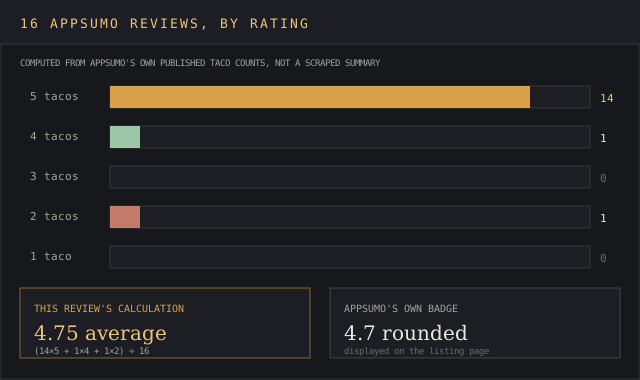
- 4.75 stars average across 16 reviews (14 five-taco, 1 four-taco, 1 two-taco)
- Trustpilot
- 2 reviews, split 5-star and 4-star
- App Store
- too new for a public rating
Capitol Trades
Not forA user who wants Form 4 insiders, whale trades, or an AI research layer, since Capitol Trades stops at congressional disclosures.
Quiver Quantitative
Not forA user who wants a polished dashboard and AI chat over building against an API, since Quiver’s consumer pricing isn’t independently verifiable the way its API is.
Try it yourself
Start a ProBors trial
Monthly or yearly, cancel anytime.
We may earn a commission if you sign up through this link, at no extra cost to you. Full affiliate disclosure.
This review contains an affiliate link. If you sign up for ProBors through it, we may earn a commission at no extra cost to you. See our full affiliate disclosure.
ProBors is a web and iOS research tool that pulls congressional stock disclosures, Form 4 insider filings, and large "whale" trades into one dashboard, then scores each filing for how much research attention it deserves. It launched through AppSumo in mid-2026 and has since moved to a standard monthly or yearly subscription on its own site, with the original lifetime deal sold out.
This review covers what the product shows a user: the trade feed, the politician portfolios, the signal score, the filing-lag math, the AI research chat, and the REST API. It draws on sixteen AppSumo reviews, two Trustpilot reviews, and a Reddit thread, plus ProBors’ own plans and FAQ pages checked on 24 August 2026.
It’s written for the person ProBors is built for: a retail investor, newsletter writer, or RIA doing client research who wants congressional and insider disclosure data without paying for an institutional terminal in a broader financial market intelligence stack. It is not written for someone hunting free data alone. Capitol Trades already covers the congressional half of this for nothing, and that comparison shows up later in this review.
↑ FACT SHEETWhat ProBors tracks: Congress, Form 4, and whale trades
The core of ProBors is a live trade table pulling from House Clerk, Senate eFD, and SEC EDGAR filings. Each row is tagged with member name, party, chamber, ticker, buy or sell side, and an amount range. Federal disclosure rules only require a range, not an exact dollar figure; that’s true of the underlying government filings, not a ProBors limitation.
A separate insider Form 4 tab covers company officers and directors, such as a chief executive or chief financial officer, disclosing their own buys and sells, filed within two business days by law.
Both the monthly and yearly tier include 700 AI research credits a month, the layer that powers the chat, summaries, and stock-analysis features described further down this review.
"Whale trades" is ProBors’ label for the large end of that Form 4 feed: filings above a size threshold ProBors treats as move-the-needle, such as an open-market purchase in the seven figures. The distinction matters for research. A $2,000 trade from a low-level officer and a $2.1 million open-market buy from a chief executive are both technically insider filings, but only one is worth a research session.
ProBors’ entire premise rests on public disclosures already required by law, not proprietary data, the same secondary-research model covered in our secondary market intelligence guide. Members of Congress, company insiders, and large investors already have to put their trades on the public record; ProBors makes that public record faster to search than the raw House, Senate, and SEC filings alone.
A politician-portfolio view sits alongside the trade feed, aggregating a member of Congress’s disclosed holdings into a single profile: portfolio value estimated from disclosed amount ranges, trade history, and sector concentration.
AppSumo reviewer rifede, a verified purchaser who runs a registered investment advisory, called the underlying data collection "impressive". Rifede asked ProBors to extend the same portfolio-tracking approach to other public figures, naming "past congress people or people like previous and current presidents."
Founder Pier’s reply confirmed that expansion is on the roadmap, gated on finding a reliable disclosure source for each additional figure, since congressional, SEC, and 13F filings all carry different sourcing rules.
Politician portfolios and signal scoring, explained
Signal scoring is ProBors’ attempt to triage the flood of routine disclosures, the same kind of collection-to-analysis step our market intelligence analysis guide walks through more generally. A sample filing on the homepage, a Pelosi buy of NVDA in the $250,001 to $500,000 range, carries a signal score of 91 out of 100. It’s broken down into "Size + lag: High" and "Cluster: NVDA," with a "Prediction?" field that reads "No."
That last field is doing real work. ProBors’ own marketing copy states plainly that scores "are not predictions," and the FAQ repeats that the product is "a research tool for reviewing public filings, market context, and AI summaries," not investment advice.
In practice the score is a size-and-timing heuristic, not a model of what the trade means. A high score tells a user "this filing is worth fifteen minutes," not "this stock will move." That’s a defensible design choice for a disclosure-research tool.
But it puts the burden of judgment back on the user. That’s the trade-off AppSumo reviewer scooterwilliams flagged when asking for a dedicated briefing page that would surface unusual clusters automatically, instead of making users scan the feed themselves.
Politician portfolios use the same clustering logic across a member’s full disclosed history, so a user can see if a member’s Congress trades concentrate in a sector their committee oversees. A member buying one sector while selling another is exactly the kind of pattern the portfolio view is built to surface, and the signal score exists to help a user prioritize which of the resulting filings deserve a closer look first.
Filtering by sector is supported. A year-by-year performance-versus-benchmark view is not part of the current product, though it’s the kind of feature request AppSumo reviewer rifede raised directly with the founder.
Filing lag: why "real-time" doesn’t mean instant
ProBors’ own homepage leads with a filing-lag example instead of hiding it: a trade dated June 8, 2026 wasn’t filed until July 10, a 32-day gap inside the STOCK Act’s 45-day disclosure window. During that gap, the underlying stock moved +11.4%. The panel is labeled "Why it matters: Trade first, public later," and a separate field states outright "Not a tip. Research only."
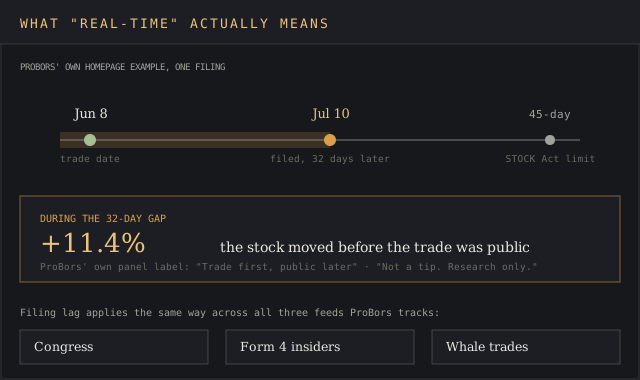
That transparency shows up again in the FAQ: "Some filings are reported late by the filer, so we show filing lag and context instead of hiding it." AppSumo reviewer magicmike, who added ProBors to an existing research stack in July 2026, echoed the same caution independently, instead of repeating ProBors’ marketing: "info from the congress can be delayed up to 45 days, so it’s not a live update. It’s just a way to see if a move was smart."
That’s a useful gut check for anyone who assumes a "LIVE" badge in the interface means the underlying trade is fresh. It means the disclosure record is fresh, which is a different thing. Our real-time market intelligence guide covers the same distinction across other data categories.
For a research workflow, filing lag is arguably the whole point of a tool like this: knowing how stale a signal is changes how much weight it deserves. A trade filed on day 44 of a 45-day window is a different signal than one filed within 48 hours, even at the same dollar size.
The same math applies across recent trades in all three categories ProBors tracks: Congress, Form 4, and whale activity. ProBors is one of the few tools in this category that surfaces that gap by default, instead of treating every disclosure as equally current.
Public filings and the missing source links
The most substantive criticism of ProBors, and the one this review weighs most heavily in the score bars, comes from a two-star AppSumo review titled "poorl developed and a money grab...dead project soon," posted by a verified purchaser on 25 June 2026. The reviewer’s central complaint: "nowhere is there a link to the actual PTR document or SEC filing the data came from. The ‘Source’ field just says ‘Senate’ or ‘House.’"
For a product whose entire pitch rests on public filings, that’s a real gap. A user who wants to verify a claim before acting on it currently has to go find the underlying document independently, the same tracing problem our data source attribution guide is built around.
The same review caught a concrete data-quality bug: a John Boozman filing for Accenture (ticker ACN) appeared twice on the first page of results, once correctly labeled and once with the ticker shown as "--" and flagged "Invalid ticker symbol." That broken row still carried a signal score of 9 out of 15 on ProBors’ scoring scale in that section, the highest "Worth watching" tier visible on the page.
Founder Pier’s reply is worth reading in full, because it’s an unusually specific and checkable response. The Senate’s own disclosure site sometimes lists the same filing twice: once with a clean ticker, once as "--" alongside the asset name written out in text. ProBors’ ingestion pipeline had been treating those as two separate trades, with the scoring model incorrectly reading "--" as a real ticker.
Pier confirmed the duplicate rows were removed, and that surfacing a direct link to the original House, Senate, or SEC filings was the team’s "top priority" as of that reply.
The same review also flagged that the Politicians directory briefly rendered raw internal API documentation as visible page text, and showed at least one profile with only a first name ("David") and no chamber or party. Pier’s reply confirmed both were fixed.
A user still has to verify directly if that fix has held. That’s not something to take on the strength of one review thread. But the specificity of both the complaint and the response says more about how ProBors handles data-quality bugs than either side’s star rating does.
↑ FACT SHEETMarket data, charts, and the AI research chat
Every filing detail panel in ProBors pairs the disclosure with a price chart overlaying the trade date against the filing date, so a user can see at a glance what the stock did during the gap described above. The same market-context view backs a per-ticker page combining quotes, a chart, and news, without leaving the disclosure workflow to open a separate market-data tab.
The AI research chat is the credit-metered layer on top of the raw tables. It’s a natural-language interface: a user can ask about a specific filing, ticker, or politician and get plain-language, structured answers back, instead of a plain data export. AppSumo reviewer AISIMPLIFY, a verified purchaser, called it out directly: "The AI assistant makes understanding all the info so much simpler."
ProBors positions the chat as a source of quick research briefs, instead of a general-purpose chatbot. It belongs to a small set of AI tools built specifically for disclosure research: aimed at turning raw filing market intelligence data into insights a user can act on, not a full market-analytics platform.
It draws on ProBors’ own dataset, not the open web, which keeps answers scoped. That also means it can only ever be as good as the underlying filing data discussed above.
ProBors also supports watchlist alerts: a user can follow a specific member, officer, or ticker and get email or in-app notifications when the public record updates. Alert volume and API rate limits both reset with the billing cycle, the same as AI credits.
Every paid plan includes 700 AI credits a month. Browsing the trade tables, portfolios, and market data doesn’t touch that balance; only the chat, summaries, and stock-analysis features draw credits down.
AppSumo reviewer johnwpg, a verified purchaser who gave the product five stars overall, still flagged the credit allowance directly: "I barely did anything and more than 1/3 of the monthly credits are already used up. I would have preferred having a higher tier with a much more reasonable amount of monthly credits."
Pier’s reply conceded the point directly: "the monthly amount on the deal is on the conservative side." Pier pointed to the per-credit top-up packs as the current workaround, while the team looks at reducing what each chat question costs.
↑ FACT SHEETPricing, AI credits, and what’s left of the AppSumo deal
ProBors’ current pricing lives entirely on its own plans page: $30/month on what the page calls a launch discount against a $75/month regular price, or $180/year, which works out to $15/month if paid annually. Both tiers carry the same 700 monthly AI credits, the same Congress, Form 4, whale, and politician coverage, market data, and REST API and MCP access.
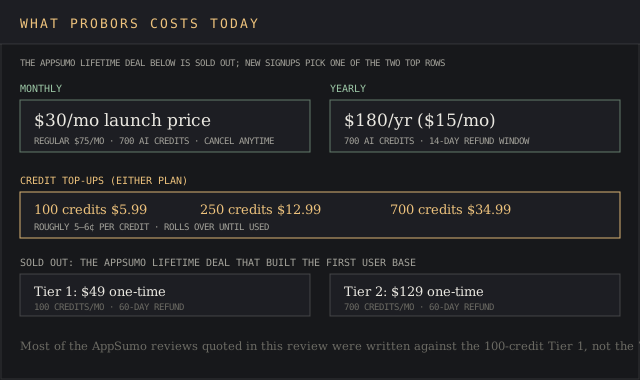
The yearly plan adds priority support and a 14-day refund window that the monthly plan doesn’t get. ProBors’ FAQ states monthly plans are "flexible by default and non-refundable."
The product’s first real user base came through a different door: an AppSumo lifetime deal offering Tier 1 at $49 one-time for 100 AI credits a month, or Tier 2 at $129 one-time for 700 credits a month, with a 60-day refund window. That deal is marked "Sold out" on AppSumo as of this review, so a new user today is choosing between the two subscription tiers above, not the lifetime option most of the AppSumo reviews quoted in this piece were reviewing.
That distinction matters when reading those reviews. Several of the credit complaints above, from johnwpg and scooterwilliams, were written against the $49 Tier 1’s 100-credit allowance, not the 700 credits every current subscriber gets by default.
Credit top-ups are priced the same regardless of plan: 100 credits for $5.99, 250 for $12.99, or 700 for $34.99, each roughly 5 to 6 cents per credit. AppSumo reviewer docdano’s review specifically praised that top-ups "are dirt cheap and they roll over forever," meaning unused purchased credits don’t reset with the billing cycle the way the monthly plan allowance does.
What users complain about most
Beyond the source-link and credit-allowance complaints already covered, the most repeated theme across the sixteen AppSumo reviews is UI friction, not data problems. AppSumo reviewer DanDalal, reviewing the product on 1 July 2026, gave it five stars overall but spent most of the review on confusing interface choices: "the website is in dark mode and hard to read for me. How does a user switch to light mode? There’s no way to tell or figure out how from the UI."
The same review flagged an unlabeled bell icon that opens settings, and a stock-analysis response that returned raw technical text instead of a plain-language answer: "None of those NAV/expense metrics are included in the JSON, so no further valuation conclusion can be drawn." Pier’s reply confirmed light mode had since been added under Settings, with icon labeling and plain-language output both flagged as in-progress fixes.
A verified-purchaser review on Trustpilot dated 14 March 2026 raised a narrower but more consequential concern about the underlying data itself, not the UI: "The inside trading seems to be relatively accurate but in some cases i have seen opposite of reporting and you need to do your due diligence with accuracy and timing of the trade."
That’s a second, independent voice pointing at the same weak spot the AppSumo two-star review raised in more detail. Verification against the original source, not presentation alone, is what ProBors’ most engaged critics keep asking for.
Filter and load speed is the third recurring complaint. The same two-star review clocked "a 4-8 second loading skeleton" on every filter change, calling the whole workflow slow compared to the product’s real-time pitch. Pier’s reply attributed that to connection quality, server load, and user region, adding that response times "should return in under a second" under normal conditions, and that additional regional servers were planned.
↑ FACT SHEETWhat users praise most
Support responsiveness is the single most repeated compliment, and it’s corroborated across reviewers, not resting on one account. AppSumo reviewer bpj520 called out "extremely responsive support and adding API and MCP less than 24 hrs of requesting the feature."
Separately, AppSumo reviewer docdano, who wired ProBors into Claude Code as an MCP server, described the same responsiveness from the developer side: "Wiring ProBors into Claude Code as an MCP was seamless. No debugging, no broken endpoints, no auth header fights." The same review continued: "Within minutes I had 16 working tools surfacing Congressional STOCK Act trades, Form 4 insider activity, politician portfolios, and signal scoring."
Founder Pier personally replies to close to every review on the AppSumo page under his own name, an unusual density of founder engagement for a product at this stage, and part of what reviewers are responding to.
Data breadth is the second theme. AppSumo reviewer ahmedoom, giving the product four stars, praised having "House, Senate, and insider transaction data in one workflow," and separately pointed to extensive historical coverage as a reason the product saved research time. That specific historical-depth figure comes from a reviewer’s own account of the dataset, not a number ProBors states on its own site, so treat it as one user’s experience, not a verified spec.
On the casual end, a short Reddit comment in r/insidertraders summed up the same sentiment more bluntly, saying they’d "recomend probors" as "pretty easy to use and very helpful" after a free-trial run.
↑ FACT SHEETProBors vs Capitol Trades and Quiver Quantitative
Here’s how ProBors’ two closest alternatives compare on data breadth, coverage, and price, both listed among alternative data and financial data providers.
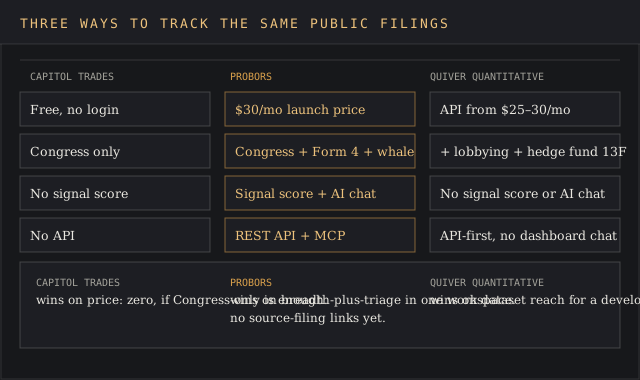
Capitol Trades covers exactly one of ProBors’ four surfaces, congressional trades, and covers it for nothing. There’s no login wall and no subscription. By its own description, Capitol Trades is used as a citation source by outlets including the Wall Street Journal and the New York Times.
It wins outright for a user who only wants to browse what members of Congress disclosed, with no interest in Form 4 insiders, whale trades, signal scoring, or an AI chat layered on top. It loses the moment a user wants any of ProBors’ other three surfaces, an alert system tied to a personal watchlist, or an API.
Quiver Quantitative is the closer comparison on data breadth, not price. Quiver’s consumer site gates its Premium subscription price behind account creation, so this review can’t independently verify that number the way ProBors’ own plans page can be checked without logging in, a transparency point in ProBors’ favor by default.
What is verifiable is Quiver’s separate developer API, priced at $30/month (or $25/month billed annually) for a "Hobbyist" tier, and $75/month (or $62.50/month annually) for a "Trader" tier that adds insider trading, hedge fund 13F activity, and executive compensation data on top of congressional trades, lobbying, and government contracts.
That’s a wider dataset than ProBors covers: Quiver reaches into hedge fund filings and lobbying spend that ProBors doesn’t track at all, at a comparable or lower price point for a developer who mainly wants API access, instead of a polished dashboard and an AI chat layer.
The honest way to frame the choice: Capitol Trades if congressional trades are the entire job and the price has to be zero. Quiver Quantitative if the job is broader than Congress and insiders, and includes lobbying or institutional 13F data.
ProBors if the job is specifically Congress, Form 4, and whale trades with signal scoring, an AI research chat, and an MCP server built for exactly that dataset, and the missing source-links problem covered above isn’t a dealbreaker for how the tool gets used.
FAQ
Is ProBors financial advice?
No. ProBors states directly that it’s "a research tool for reviewing public filings, market context, and AI summaries," not a broker and not investment advice. Its FAQ tells users to verify important details against the original sources, advice this review echoes given the source-link gap covered above.
Can I try ProBors for free?
ProBors’ current plans page doesn’t list a free tier. Pricing starts at $30/month on the launch discount, or $180/year. The original $49 to $129 AppSumo lifetime deal is sold out.
Is ProBors better than Capitol Trades or Quiver Quantitative?
Neither is a strict upgrade. Capitol Trades is free but covers congressional trades only. Quiver Quantitative’s API reaches further into lobbying and hedge fund data at a comparable price. ProBors wins for a user who wants Congress, Form 4 insiders, and whale trades merged into one workspace with signal scoring, an AI chat, and MCP access built in.
What happens if I run out of AI credits?
Per ProBors’ own FAQ, the AI assistant pauses until the next billing cycle or a top-up purchase. Browsing Congress, insider, politician, and market data views keeps working regardless of credit balance.
Verdict
ProBors is worth the $30/month launch price for someone whose research already lives in these three data sources: Congress, Form 4, and whale trades. Someone who wants them merged into one dashboard with a signal score doing the first pass of triage. It is not for someone who wants a single free congressional feed, or someone who needs institutional-grade lobbying and hedge fund data alongside it.
It is not for anyone who plans to act on a filing without checking the source document first. As of this review, ProBors doesn’t link straight to that document, and its own most detailed critical reviewer treated that gap as the reason not to pay for the product yet.
It might suit a middle case: a user who wants the AI chat and REST API or MCP access specifically, where the sourced-link gap matters less because the workflow (an automated research brief, a newsletter draft, an agent tool call) already treats every output as a starting point for further verification, instead of a final answer. Both AppSumo reviewers who built on the API, instead of only browsing the dashboard, rated the experience five tacos.
Ready to see it for yourself?
Start a ProBors trial
See the signal scores and filing-lag view firsthand.
We may earn a commission if you sign up through this link, at no extra cost to you. Full affiliate disclosure.