B2B data providers: rankings and buying guide for 2026
 By Jan Suski. I go deep on every review, checking every number against its source and digging up details other coverage misses, a habit from six years of SEO and link building for tech companies. Bylines at Surfer, Brand24, and Senuto. How the scoring works.
· Prefer this source on Google
Quick comparison of B2B data vendors
Eleven providers with the coverage claim each one makes, what it costs to start, and the buyer it fits. Coverage figures are vendor-reported.
| # | Provider | Published coverage | Entry price | Best fit |
|---|---|---|---|---|
| 1 | ZoomInfo | 500M+ verified contacts | $33,500 median* | Enterprise teams wanting one system of record |
| 2 | Cognism | Phone-verified mobiles | $36,000 median* | European teams calling decision makers |
| 3 | Apollo.io | 240M+ contacts | From $49 per user a month | Startups wanting data and outreach together |
| 4 | UpLead | 95% accuracy guarantee | From $99 a month | Cold email teams paying for deliverability |
| 5 | Lusha | 280M+ contacts | $15,999 median* | US reps prospecting from LinkedIn |
| 6 | BookYourData | 250M+ contacts, 97% guarantee | From $99 for 250 credits | Small teams buying one list at a time |
| 7 | Breeze Intelligence | Enrichment and visitor ID | Bundled into HubSpot tiers | HubSpot-native revenue teams |
| 8 | Demandbase | Account intent and ABM | $68,591 median* | Teams running account based marketing |
| 9 | 6sense | Predictive intent modelling | $62,440 median* | Teams with a defined target account list |
| 10 | LinkedIn Sales Navigator | Member-declared data | From $119.99 per seat a month | Relationship-led sellers |
| 11 | Crunchbase | Private company and funding | $20,000 median* | Teams targeting recently funded companies |
Medians marked * are anonymized buyer-reported contract values published by Vendr. Everything else is the price the vendor publishes itself.
B2B data providers collect, aggregate and verify business information so sales teams stop researching accounts by hand.
What you are buying is not a database. It is a promise about how much of that database is still true.
B2B contact data decays at roughly 2.1% per month. 28% of B2B email addresses go stale every year, and in some databases annual decay reaches 70%.
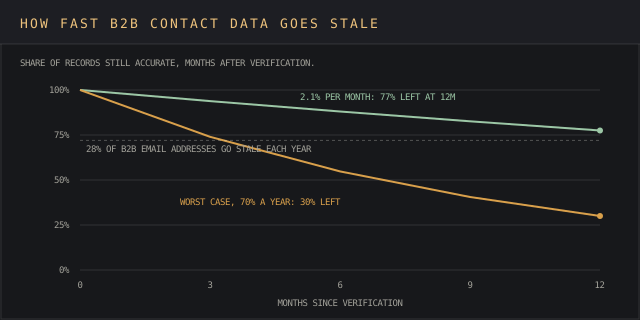
That is why database size is the worst way to choose a data provider, and why every entry below is judged on accuracy, coverage and compliance first.
This is one of ten categories in our data providers guide. Six of these vendors also appear on our sales intelligence platforms ranking. That page judges them as workflow tools; this one judges them as data vendors, which produces a different order. You can't have your cake and eat it too on this one. Buy from one framing or the other.
The attribute layers underneath have their own rankings: firmographic data providers for company attributes, technographic data providers for what they run, and intent data providers for who is looking now.
How to evaluate B2B data providers
Top providers compete on accuracy, compliance, verification method and support. A contact database with 100 million records can carry a large share of dead entries and still advertise the headline number.
Data accuracy and data freshness
Ask for the accuracy rate and the verification method behind it, in writing. Providers should disclose both, and the ones that decline are telling you something.
Real-time verification at the moment of export is the strongest signal on data freshness. Quarterly batch cleaning is the weakest, because at 2.1% monthly decay a record verified in January is meaningfully worse by April.
Estimated annual cost of poor data quality to an organisation. Cleansing outdated records is what keeps deliverability up, and the licence is rarely the expensive part of bad data. Next to that number, the subscription itself is a drop in the bucket.
Data coverage and contact database depth
Coverage is regional and role-specific. A provider strong on US enterprise IT directors can be thin on European mid-market finance leads, and the aggregate count hides that entirely.
Test it. Pull a data sample against 50 accounts you already know, then check fill rate on the fields you use: verified email addresses, direct dials, mobile numbers, job title, company size.
Data compliance
Providers should comply with GDPR and CCPA, and must verify against Do Not Call lists before handing you phone numbers. Compliant data is not a feature; it is the difference between a campaign and a fine.
GDPR compliance is decisive for anyone prospecting in Europe. CCPA protects consumer data privacy in California, and data privacy regulations elsewhere are converging on the same expectations.
Integration and workflow fit
CRM integration turns a data provider into daily infrastructure. Skip it, and you're back to a monthly export. That's back to square one, with a spreadsheet nobody maintains and a rep who stops trusting the list. Check that it writes into Salesforce and your marketing automation platform natively, and find out if API access sits behind an enterprise tier.
A chrome extension matters more than it sounds. Reps prospect where they browse, and a browser extension that surfaces contact data on a company website removes the tab-switching that kills adoption.
Never buy on the first data sample the vendor picks. Give them your own list of 50 known accounts and compare fill rate against what you can verify yourself. The gap between a curated sample and your ICP is where most disappointment lives.
Top B2B data providers, ranked
Ranked on accuracy and verification method, coverage depth against a defined ICP, compliance posture, and integration reach.
ZoomInfo
Best fit: enterprise sales teams that want one contact database as the system of record, with the budget to make it the default everywhere.
ZoomInfo publishes over 500 million verified contacts alongside firmographic and technographic data, org charts and intent signals. It is the broadest single source here, and priced accordingly.
Key features
- Contact and company records with direct dials and mobile numbers.
- Technographic data on the tech stack a company runs.
- Buyer intent signals bundled into the base plan.
- Org-chart mapping to find decision makers inside an account.
- CRM integration with Salesforce and HubSpot, plus API access and a chrome extension.
Pricing
Quoted per seat with credit allocations, and there's no free plan. Vendr's buyer-reported data puts the median contract at $33,500 across 1,567 purchases, spanning $7,200 to $155,460, with 22% knocked off list on average. At this level, ZoomInfo can cost an arm and a leg before a single email goes out.
Credit overage is the most common budget surprise, because exploratory prospecting consumes credits fastest.
Pros
- Largest verified contact database in the category.
- Technographic and intent data included in the base price.
- Deepest integration surface of any provider here.
Cons
- Expensive, with credit models that penalise exploration.
- European coverage and compliance posture trail Cognism.
- Annual contracts only.
Why it's ranked #1. No other provider matches its combination of coverage, data types and integration depth. It loses on price and on European compliance, which is exactly where the next entry beats it.
Cognism
Best fit: teams prospecting into Europe by phone, where GDPR exposure and mobile connect rates both matter.
Cognism sells GDPR-compliant data with phone-verified mobile numbers. Its Diamond Data tier is the differentiator: numbers a human has called and confirmed.
Key features
- Phone verified mobile numbers under the Diamond Data label.
- GDPR and CCPA compliance with DNC list screening built in.
- European contact coverage beyond the US-first vendors.
- Intent data through partner feeds.
- CRM integration and a chrome extension, with unrestricted-view pricing on some plans.
Pricing
Quoted per seat, no free plan. Vendr records a $36,000 median across 107 deals, from $18,300 to $94,563, with buyers negotiating 25.91% off on average. That's the deepest average discount in this list. Our Cognism pricing report tracks the two plan renamings since launch and which older tier names are still misquoted elsewhere. It's worth knowing the ropes here before a rep quotes a plan name that no longer exists.
Pros
- Strongest compliance position of any provider here.
- Phone-verified mobiles lift connect rates in a way inferred numbers don't.
- European coverage beats every US-first vendor on this list.
Cons
- US coverage is thinner than ZoomInfo's.
- Diamond Data volumes are a subset of the wider database, so verify availability for your ICP.
- Technographic depth is limited.
Why it's ranked #2. It beats everything below it on accurate contact data for phone outreach, and beats ZoomInfo on compliance. It ranks second because total coverage across data types is narrower.
Apollo.io
Best fit: startups and small sales teams that want a contact database and sales engagement tools in one subscription.
Apollo provides a database of 240 million+ contacts with sequencing, dialling and email built alongside it. The bundle is the product: data plus the outreach that consumes it. For a small team, paying one bill for both is the best of both worlds.
Key features
- 240M+ contact records with advanced search filters.
- Built-in email sequencing and dialler.
- Buyer intent signals on higher tiers.
- Chrome extension and CRM integration with Salesforce and HubSpot.
- A genuine free plan with monthly credits, plus API access on paid plans.
Pricing
$49 per user a month at the entry paid tier, on top of a Free plan that grants 900 credits per seat a year.
Pros
- Free plan makes evaluation trivial.
- Data and sales tools in one place removes an integration.
- Published pricing at every tier.
Cons
- Accuracy trails ZoomInfo and UpLead on verified emails.
- Mobile number fill rate is weaker than Cognism's.
- Deliverability suffers if you send from the raw list without a verification pass.
Why it's ranked #3. Best value in the category on cost per usable record, and the only top-three entry with a free plan. It ranks below Cognism because accuracy and compliance are both a step behind.
UpLead
Best fit: cold email teams whose deliverability depends on bounce rate.
UpLead guarantees 95% accuracy and verifies emails in real time at the point of export. That verification model is what it sells.
Key features
- Real-time email verification before a record is exported.
- 95% accuracy guarantee stated at the point of download.
- Advanced search filters across firmographic and technographic fields.
- Technographic data on tech stack.
- Chrome extension, CRM integration and API access.
Pricing
Essentials is $99 a month for 170 credits, Plus $199 for 400, and Professional is quoted annually. Extra credits run $0.60 each, dropping to $0.50 on the higher tier.
Pros
- Puts a number on accuracy and refunds against it, a policy only BookYourData below matches.
- Real-time verification beats batch cleaning outright.
- Published pricing with no sales process.
Cons
- Smaller total database than the three providers above it.
- Mobile number coverage is limited.
- Few intent or predictive capabilities.
Why it's ranked #4. On verified email addresses it is the most trustworthy source in this ranking. It sits below Apollo.io because coverage across data types and regions is narrow by comparison, and above Lusha because its accuracy comes with a guarantee and its compliance record carries no pending class action.
Lusha
Best fit: individual reps in North America prospecting from LinkedIn and company websites who need a contact in seconds.
Lusha holds a database of over 280 million contacts and leads with the browser extension. It is built around single-record lookup.
Key features
- 280M+ contact records.
- Browser extension surfacing contact data on LinkedIn and company websites.
- Bulk enrichment on higher tiers.
- Job change tracking on saved contacts.
- CRM integration and a free plan with monthly credits.
Pricing
Free tier, then published paid plans from Starter through Scale. Buyer-reported contracts on Vendr sit at a $15,999 median across 143 purchases, spanning $6,000 to $68,946. Our Lusha pricing report breaks down the credit system across all five tiers and the fees the sticker price leaves out. Lusha's terms renew plans automatically at the then-current price, need 14 days' notice to cancel, and make every payment non-refundable.
Pros
- Fastest single-record workflow of any provider here.
- Free plan and published pricing lower the barrier to testing.
- A rep can prove value before asking for budget.
Cons
- Weaker for building large segmented lists.
- Firmographic and technographic depth is limited.
- Credit models make heavy use expensive relative to Apollo.
- The 98% email and 86% phone accuracy figures are an internal benchmark with no independent audit.
- Two pending US class actions over its contact data and a €2 million Italian fine that Lusha is contesting in the Court of Rome; the Lusha review lists every case.
Why it's ranked #5. It wins on speed of lookup and loses on everything involving scale. UpLead beats it on the first criterion, a 95% accuracy guarantee against Lusha's unaudited internal benchmark, and on the third, compliance, where Lusha carries two pending class actions and a contested EU fine. It stays above BookYourData on integration: a working Chrome extension and native CRM sync.
BookYourData
Best fit: founders, two-rep teams and agencies that buy 250 to 10,000 contacts per campaign and refuse an annual contract.
BookYourData sells contacts from a 250M+ record database one credit at a time, with no subscription and an 8-step verification run at the moment of export. The pricing model is the product: 25 published packs, a balance that never expires, and a 97% deliverability guarantee that pays out in credits. BookYourData charges no subscription fee, which means no strings attached and nothing to cancel later.
Key features
- 250M+ B2B contacts across 30M+ companies and 200+ countries, per the vendor's own count.
- Real-time 8-step email verification at export, catch-all domains included.
- Up to 100 data points per record, with SIC and NAICS codes, technographics and funding fields.
- Unlimited seats inside one account, so an agency and its clients draw on one balance.
- BeSpoke hand-built lists from $499 per 1,000 records for titles no filter expresses.
Pricing
Pay as you go only, and BookYourData publishes all 25 packs. 250 contacts cost $99 ($0.40 each), 10,000 cost $999 ($0.10) and 2,500,000 cost $24,999 ($0.01), with a free pack of 10 that needs no card. Credits never expire, and a hard-bounce rate above 3% triggers an automatic credit refund toward the 97% you paid for.
Pros
- Every one of the 25 packs carries a published per-contact rate; no sales call needed.
- One credit buys email and mobile together, where Lusha charges five credits for a phone reveal.
- Capterra rates support 4.9 of 5, and a reviewer paid $2,000 for a list ZoomInfo quoted at $24,000.
Cons
- Buyer intent signals appeared as a filter in July 2026 with no published source or refresh rate.
- The homepage lists the API and Chrome extension as coming soon while the help center claims 1,000+ CRM integrations.
- Seven of eleven critical reviews flag thin coverage in niche industries such as cannabis and industrial automation.
Why it's ranked #6. It wins on price transparency and cost of leaving outright: $0.01 to $0.40 a contact with no contract, against seat subscriptions everywhere above it. It sits below Lusha because integration and workflow fit is the weaker criterion here, with the API and extension still unshipped and intent data unproven. The jury's still out on those unshipped features closing before the discount stops mattering.
Try it yourself
Sign up for BookYourData
Pay-as-you-go from $99 for 250 credits, plus a free 10-credit pack with no card and no subscription.
 Visit BookYourData →
May earn a commission if you sign up through this link, at no extra cost to you. Full affiliate disclosure.
Breeze Intelligence
Best fit: HubSpot-native revenue teams who want enrichment to happen inside the CRM without a second platform.
Breeze Intelligence, formerly Clearbit, is now HubSpot's enrichment layer. It leads on real time data enrichment and website visitor tracking.
Key features
- Real time data enrichment on form fill and record creation.
- Visitor identification resolving anonymous traffic to named companies.
- Firmographic and technographic data appended automatically.
- Native HubSpot integration with no connector work.
- API access for product-side enrichment.
Pricing
Credit-based and bundled into HubSpot tiers, with custom pricing above the included allowance. Value depends heavily on already running HubSpot. Our Clearbit pricing report puts the entry point at a $7 HubSpot Starter seat on a limited-time annual rate.
Pros
- Enrichment happens without anyone remembering to do it.
- Visitor tracking turns anonymous traffic into named target accounts.
- No integration work at all inside HubSpot.
Cons
- Weak as a standalone contact database.
- Little value outside HubSpot.
- Contact-level coverage trails the dedicated providers above.
Why it's ranked #7. Best automated enrichment on the list, held back by needing an existing platform to plug into. For a Salesforce shop it would rank lower still.
Demandbase
Best fit: marketing teams running account based marketing who need intent signals attached to a defined account list.
Demandbase sells account intelligence: which companies are researching your category, and how that changes week to week.
Key features
- Buyer intent data across a publisher network.
- Account identification on anonymous web traffic.
- ABM advertising activation against target accounts.
- Firmographic and technographic account data.
- Predictive analytics on account fit, with CRM and marketing automation platform integration.
Pricing
Quoted, $18,000 to $250,000 a year across the platform. Vendr's median lands at $68,591 over 184 purchases, ranging $24,000 to $164,379. Even at the median, that's enough to cost an arm and a leg for a mid-market marketing budget.
Pros
- Intent data tied to accounts.
- Advertising activation in the same platform as the signal.
- Good for aligning sales and marketing strategies on one account list.
Cons
- Not a contact data source; you still need one of the five above.
- Enterprise pricing with a long sales cycle.
- Intent methodology is opaque, as it is across this sub-category.
Why it's ranked #8. It answers a question the contact vendors can't, but it doesn't replace any of them, and that dependency caps it here. See the full Demandbase vs ZoomInfo comparison for pricing and coverage detail.
6sense
Best fit: revenue teams with a defined target account list who want buying-stage prediction.
6sense models intent into a predicted buying stage per account, which is a different claim from reporting that activity happened.
Key features
- Predictive analytics scoring accounts by buying stage.
- Buyer intent signals from first and third-party sources.
- Anonymous visitor identification.
- Contact data available as an add-on.
- Segment orchestration across sales and marketing teams.
Pricing
Quoted, with no published rate card. Vendr logs a $62,440 median across 381 purchases, from $11,566 to $175,022, and 17% average savings.
Pros
- Buying-stage prediction is more actionable than a raw intent score.
- Combines first-party and third-party signals in one model.
- Contact data bundling available if you want a single vendor.
Cons
- Expensive, and the model needs enough pipeline history to calibrate.
- Bundled contact data is thinner than a dedicated provider's.
- Long implementation.
Why it's ranked #9. Stronger modelling than Demandbase, weaker activation. It sits below because more buyers get value from Demandbase's advertising layer than from a better score they can't act on. No pain, no gain applies here too, since the scoring only gets sharper as more pipeline history feeds into it. See the full 6sense vs ZoomInfo comparison for how the two handle contact data versus intent.
LinkedIn Sales Navigator
Best fit: relationship-led sellers whose next move depends on who they know.
Sales Navigator runs on member-declared professional data, which makes job title and job change tracking more reliable here than anywhere else. It exports nothing.
Key features
- Advanced search filters across role, seniority, company size and geography.
- Job change tracking on saved leads.
- Shared-connection paths into target accounts.
- Account and lead alerts.
- CRM sync on higher tiers.
Pricing
Published per-seat plans, with a trial: Core at $119.99 a month or $1,079.88 a year, Advanced at $159.99 or $1,799.88. Predictable and modest against the enterprise entries above.
Pros
- The freshest job title data available, because members maintain it themselves.
- Job change tracking surfaces the single best outbound trigger there is.
- Published pricing.
Cons
- No email addresses or phone numbers.
- No export, so it can't feed a sequence directly.
- Coverage skews to LinkedIn-active roles and regions.
Why it's ranked #10. Indispensable and incomplete. It is a research surface, which is why it can't rank above anything that delivers contact data.
Crunchbase
Best fit: teams targeting recently funded companies, where the trigger is a funding round.
Crunchbase covers company data on private businesses: funding rounds, investors, acquisitions and headcount movement that filings-based sources never see. A funding round shows up here close to hot off the press, often before the company's own announcement goes out.
Key features
- Funding round history with investors and amounts where disclosed.
- Headcount and hiring trends as a growth signal.
- Acquisition and exit records.
- Saved searches with alerts on funding events.
- Company size and industry firmographics, with API access on the enterprise tier.
Pricing
Free search sits under paid Pro and Business tiers. Vendr's average negotiated contract is $20,000 across 73 deals.
Vendr records a $20,000 median annual contract across 70 purchases, ranging from $4,396 to $51,639, with buyers saving 21% on average. Those Vendr figures are unofficial, buyer-submitted data. Our Crunchbase pricing report has the Business tier's $199-a-month starting rate and the annual-discount math.
Pros
- Only source here for private-company funding events.
- Funding alerts are a clean outbound trigger.
- Cheapest published entry point of any provider on this list.
Cons
- No contact data at all.
- Self-reported company records age without correction.
- Coverage varies by geography.
Why it's ranked #11. It is a company data source with no contact-level data, and it earns its place only because the funding trigger has no substitute.
Entries eight to eleven aren't substitutes for one to seven. Intent platforms, Sales Navigator and Crunchbase all assume you already have contact data from somewhere else. Shortlists that mix the two groups are usually two purchases wearing one budget line. Treat one as a replacement for the other and you're barking up the wrong tree.
Types of B2B data
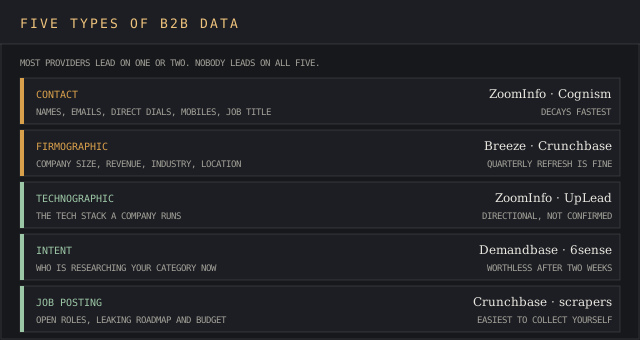
B2B data covers five distinct types, and providers rarely lead with more than two. Knowing which one your problem needs prevents most of the wasted spend in this category.
Contact data
Contact data consists of names, emails and phone numbers, plus job title and seniority. It is the most perishable type and the one every outbound motion depends on.
The distinctions inside it matter. A verified email address has been checked against a mail server; an inferred one has been guessed from a naming pattern. Direct dials reach a desk; phone verified mobile numbers reach a person.
Firmographic data
Firmographic data includes company size, revenue and industry classification, plus location and corporate structure. It is what segmentation runs on. Data Axle sells households and new movers next to company records, from $99 a month on Salesgenie.
Accurate segmentation means grouping target accounts by firmographics and technographics. That grouping is what makes a campaign measurable.
Technographic data
Technographic data reveals the technology a company uses. Knowing a prospect runs a competitor's product, or the platform yours integrates with, changes the opening line and the qualification.
Coverage here is patchier than vendors imply, because detection relies on public signals from company websites and job posts. Treat tech stack fields as directional.
Intent data
Intent data indicates companies actively researching solutions in your category. Buyer intent signals come from publisher networks, review-site behaviour, search activity and your own website.
Buyer intent data is the most oversold type in B2B. The signal is real, the attribution is probabilistic, and no vendor will show you the methodology in detail. Some of what gets marketed as intent data is closer to pie in the sky than a repeatable signal. Treat it as a prioritisation input.
Job posting data
Job posting data shows current open positions at target companies, which leaks roadmap and budget earlier than any announcement. A company hiring six data engineers has decided something.
Hiring trends also work as a proxy for growth when revenue is private, which is why the funding-triggered plays lean on them.
Getting accurate contact data out of a provider
Accurate contact data takes ongoing verification. A purchase alone doesn't get you there. The providers that deliver it verify at the point of export; the rest verify on a schedule and hope.
Waterfall enrichment
The strongest approach is a hybrid strategy called waterfall enrichment: query one provider, then fall through to a second and third for the records the first could not fill or verify.
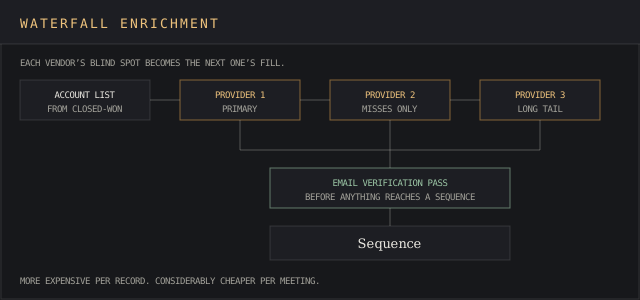
High-performing outbound teams combine multiple data sources with email verification tools. That is more expensive per record and considerably cheaper per meeting.
The mistakes that cost the most
Buying on database size. A provider advertising 100 million records is describing acquisition. Accuracy is a separate number, and the two move independently.
Skipping the compliance check. This is the one with legal consequences. Ask specifically how DNC screening works before phone numbers change hands.
Underestimating credit costs. Credit models make exploratory prospecting expensive, and teams that budget for the licence without modelling consumption run out in month four.
Not testing. A data sample against accounts you can verify yourself costs a week and settles the argument. It's a stitch in time, since skipping that week just means the argument resurfaces in month four.
Data enrichment and CRM workflows
Data enrichment appends missing fields to records you already hold, which is a different purchase from list building and usually a better first one.
Most CRMs contain thousands of half-complete records a rep will not call because the phone number field is empty. Enriching those costs less than buying new contacts and converts better, because someone already engaged.
Where enrichment should run
Three places, in rising order of maturity. On form fill, so an inbound lead arrives with company size and tech stack attached. On record creation, so nothing enters the CRM bare. On a schedule against the existing database, so decay gets corrected before it accumulates.
Real time data enrichment on form fill is the highest-return version, because it also shortens the form. Ask for a work email and infer the rest.
Integration reality
CRM integration is where these purchases succeed or quietly fail. A provider that writes directly into Salesforce or your marketing automation platform becomes infrastructure. One that exports CSVs becomes a task nobody owns.
Three questions before signing. Is the integration native or routed through a middleware layer. Can field mapping be configured without engineering. Does API access sit behind a tier you were not planning to buy.
Data coverage by region and role
Coverage is where vendor marketing and buyer experience diverge most, because a global database and global coverage are not the same claim. As always, the devil's in the details, and here the details live at the country level.
Every provider here has a home region where collection is strongest. ZoomInfo is US-first. Cognism built for Europe. Coverage outside the home region comes from licensed feeds and partner data, thinner and refreshed less often.
Where coverage breaks down
Geography. Ask for fill rate country by country. DACH and Nordics coverage often lags the UK badly inside a vendor that calls itself European.
Seniority. C-suite records are easier to collect and more likely to be stale, because turnover at that level is public and frequent. Mid-level operational buyers are harder to find and better bets.
Company size. Enterprise firmographics are near-complete everywhere. Sub-50-employee coverage is where databases thin out, and where B2B teams focused on SMB discover the gap after signing.
Testing coverage properly
Build the test list from your closed-won accounts. Those are your ICP by definition, and you can verify every field independently.
Run 50 records and score three things: how many accounts the provider found at all, how many contacts per account at the right job title, and how many had a direct mobile number.
Providers that decline to run that test on your list are pricing on hope. The ones that run it and report honestly on their gaps are worth negotiating with.
Building a sales pipeline from purchased data
Purchased data creates a sales pipeline only after two things happen: verification, and sequencing that treats each record as a hypothesis to verify.
Accurate data at the point of purchase is not accurate data at the point of send. Even a real-time verified export ages between export and campaign, which is why teams running weekly sends verify weekly. Every list starts racing against the clock, and every day of delay costs accuracy.
The order of operations
Define the ICP from closed-won data first. Segment target accounts by firmographics and technographics second. Only then pull contacts, because a list built before the segmentation is a list you will re-pull.
Fresh data beats complete data on every outbound metric that matters. A smaller list verified this week outperforms a larger one verified last quarter, and it protects sender reputation while doing it.
Key factors in the buying decision
Four key factors decide which provider fits, and they rank in this order for almost every team: accuracy on the fields you send to, coverage on your specific ICP, compliance posture in the regions you prospect, and integration into the tools your reps already open.
Pricing plans come fifth, and they still matter. Published pricing lets you model consumption before committing; custom pricing means a negotiation where you hold less information than the vendor does. RocketReach is one of the few vendors on this list publishing per-seat rates; our RocketReach pricing report breaks down what each published tier gates.
Ask what happens at renewal. Credit rollover, seat reduction rights and a cap on annual increases are all negotiable at signature and almost never negotiable afterwards.
Buying B2B data against building it
Teams with engineering capacity ask why they are paying a provider at all, when public web sources are public. The answer is maintenance. Building it yourself sounds easier said than done once the ongoing engineering cost gets counted.
Scraping company websites and job boards yields firmographic and job posting data at reasonable quality. It yields contact data poorly, because email patterns need verification against a mail server and mobile numbers are not published anywhere.
The recurring cost is upkeep. Every site redesign breaks a scraper, and the work of fixing them never finishes. Providers absorb that cost across every customer, which is most of what the licence buys.
The middle path is common and works: license contact data, collect the signals specific to your product yourself, and join the two in the warehouse.
B2B data providers FAQ
What is a B2B data provider?
A company that collects, aggregates and verifies business information, then sells access to it. The data spans contact records, firmographics, technographics, intent signals and job postings, delivered through a web app, a browser extension, a CRM integration or an API.
What is a B2B database?
A structured collection of records on companies and the people who work at them, used for prospecting, segmentation and enrichment. Size is the least useful thing to know about one, because accuracy and regional coverage determine how much of it is usable for your ICP.
How do B2B data providers collect their data?
Public web sources including company websites and job boards, licensed third-party datasets, customer submitted data contributed by platform users, partner networks, and direct human verification for premium phone tiers. Most large providers combine all five.
How often should B2B data be updated?
Continuously for contact data, given 2.1% monthly decay and 28% annual email turnover. Firmographic data tolerates quarterly refresh. Intent signals are worthless more than a couple of weeks old, which is why they arrive as a live feed. That's why the data needs to stay hot off the press. Once it ages past that window, it no longer reflects live buying behavior.
Is using B2B data legal?
Yes, within the rules of the jurisdiction you are prospecting into. GDPR governs European personal data, CCPA covers California, and phone outreach requires DNC screening. Legality depends on your provider's compliance posture and on your own use, and both need checking.
Which B2B data provider is most accurate?
UpLead is the only provider here that publishes an accuracy guarantee, at 95%, backed by real-time verification at both ingestion and export. For phone-verified mobile numbers specifically, Cognism's Diamond Data tier is the stronger claim.
What is the best B2B data provider for small businesses?
Apollo.io, on the free plan first. It needs no sales call to evaluate, and the bundled sequencing removes a second purchase. Lusha is the alternative if reps prospect one contact at a time from LinkedIn and the team is comfortable with a non-refundable, auto-renewing plan.
Try it yourself
Sign up for Lusha
Free plan available, credit-based pricing after that.
 Visit Lusha →
May earn a commission if you sign up through this link, at no extra cost to you. Full affiliate disclosure.
Can I use more than one B2B data provider?
Most teams past their first year do, through waterfall enrichment. One primary provider, one fallback for the records it misses, and a verification tool before anything reaches a sequence.
Bottom line
Pick on the data type you are short of, then verify the claim before you sign.
ZoomInfo for coverage across every data type at enterprise scale. Cognism for compliant, phone-verified mobiles into Europe. Apollo for value and a free plan. UpLead for guaranteed email accuracy. Lusha for single-record speed, with its legal record read first. BookYourData for pay as you go packs with no contract.
Breeze Intelligence if you run HubSpot, Demandbase or 6sense for intent, Sales Navigator for job changes, Crunchbase for funding triggers.
Then run the test that matters. Fifty accounts you already know, checked against what the provider returns. Coverage claims are marketing; fill rate on your own ICP is the number. Actions speak louder than words in this category, and the fifty-account test is the only action that counts.
Disclaimer
This page includes one or more affiliate links. If you sign up for a product through one of them, this site may earn a commission at no extra cost to you.