6sense vs ZoomInfo
 By Jan Suski. I go deep on every review, checking every number against its source and digging up details other coverage misses, a habit from six years of SEO and link building for tech companies. Bylines at Surfer, Brand24, and Senuto. How the scoring works.
· Prefer this source on Google
| WHAT EACH ONE DOES | 6SENSE | ZOOMINFO |
|---|---|---|
| Core job | Predicts in-market accts | Supplies contact data |
| Scoring unit | Account, 0 to 100 | Contact, confidence |
| Buyer profiles | 481M+ published | 500M+ claimed |
| Direct dials | 98M+ published | 135M+ published |
| Intent volume | 1T signals a day | 4,500+ topics |
| Custom keywords | Unlimited, 40+ langs | Fixed topic list |
| Own ad platform | Native DSP | DSP partners only |
| Call recording | None | Chorus transcripts |
| MCP server | None published | Published |
| Skip it if | No target list yet | You need ABM ads |
| WHAT YOU GET | 6SENSE | ZOOMINFO |
|---|---|---|
| Median contract | $62,440 tracked | $33,500 tracked |
| Tracked range | $11,566 to $175,022 | $7,200 to $155,280 |
| Purchases tracked | 204 to 381 on Vendr | 1,569 on Vendr |
| Average discount won | 16.77% | 21.81% |
| Free tier | 50 credits a month | Lite, 10 at signup |
| Vendor's own setup time | 4 to 6 weeks | Under three weeks |
| API rate limits | None published | 25/sec, 35 Scaling |
| Ownership | Private, $426M raised | Nasdaq: GTM |
| 2026 events | New CEO, Sep 2025 | 600 cut, $651M w/down |
| G2 score | 4.2, 1,480 reviews | 4.5, 12,882 reviews |
StrongerWeakerNo edge
This block scores heavily to ZoomInfo on rows, and the verdict does not follow the row count: 6sense's native ad platform is worth more to an ABM buyer than three coverage rows. Test scenario is a mid-market to enterprise revenue team comparing first quotes for one platform.
Capability figures from 6sense.com and zoominfo.com's own pricing, data and comparison pages; commercial figures from Vendr's marketplace header stats, both marked “Last updated: February 2026.” Neither vendor publishes a rate card. Every figure is sourced in the section its row links to.
| 6sense | WHAT IT DOCUMENTS |
|---|---|
| Signals processed | 1 trillion daily, 500B+ a month |
| IP addresses tracked | 4.2 billion+ |
| Company and IP records | 25B signals update 1.1B details |
| Job changes | 70,000 processed daily |
| Buyer profiles captured | 750M+ captured, 481M+* published |
| Company coverage | 75M+* profiles, 200+ countries |
| Contact refresh | Every 45 to 60 days |
| Firmographic refresh | Daily |
| Technographic validation | Every two weeks, 43,000+* techs |
| Intent languages | 40+ |
| Second-party sources | Bombora, G2, TrustRadius, PeerSpot |
| ICP readiness claim | 5% to 10% in market at any time |
| Anonymous research | First 60% of a 10-month journey |
| Free plan | 50 credits a month, Sales Intel only |
| APIs published | Firmographic, people, enrichment, scoring |
| Certifications | SOC 2 Type 2, ISO 27001, ISO 42001 |
| Security programme | Annual CREST pen tests, HackerOne VDP |
| ZoomInfo | WHAT IT DOCUMENTS |
|---|---|
| Search attributes | 300+ company attributes to filter on |
| Job posting data | 281M postings, 6.5 years deep |
| Earnings signals | 250,000+ calls, Copilot Enterprise |
| Marketing credits | 75,000 Demand, 150,000 ABM Ent. |
| Display Network caps | 10 campaigns, 10,000 accts on Lite |
| Chorus | Call recording and transcripts |
| API rate limit | 25 requests a second, 35 Scaling |
| Uptime published | 99% platform, 99.9% API |
| Domains scanned | 28 million site domains daily |
| Keyword pairings | 6 trillion a month, device-level |
| IP to org graph | 210 million pairings |
| Context Graph throughput | 1.5 billion+ data points daily |
| Lite user base | 200,000+ claimed |
| Research team | 300+ human researchers |
| Email deliverability | 96% claimed |
| Mobile accuracy | 87% claimed |
| Technographics refresh | 30,000+ products, 60-day cycle |
| WebSights scope | United States only |
*6sense states one figure in the hero block of its buyer-data page and a lower one in the FAQ further down the same page: 481M+ against 450M buyer profiles, 75M+ against 65M companies, 43,000+ against 40,000 technologies. The hero-block figure is used above because it's the current marketing claim; the FAQ figure is what ZoomInfo's own comparison page argues against.
Sources and the rest of what 6sense states two ways
Every row comes from a vendor property.
- 6sense: the pricing, signalverse, buyer-data, intent-data and trust pages on 6sense.com.
- ZoomInfo: the data, products, copilot and trust-center pages on zoominfo.com, plus pipeline.zoominfo.com's comparison page against 6sense.
ZoomInfo publishes 500 million contacts on its data page, 420 million on its sales product page and 300 million on its Copilot page, and lists both 100 million and 122 million companies on the data page itself.
Neither vendor publishes seat counts, contract lengths, renewal uplift terms, an audited accuracy figure, or, in 6sense's case, any API rate limit.
6sense and ZoomInfo get compared constantly and compete on one narrow overlap. 6sense predicts which companies are in market and orchestrates account based marketing against them. ZoomInfo sells the extensive contact database underneath outbound, plus the tools to work it. Both claim intent data and both sell to revenue leaders, which is where the confusion starts.
Buy 6sense when the problem is timing: knowing which target accounts are researching now. Buy ZoomInfo when the problem is reach: names, direct dials and accurate data on people, at volume, fast. Priced against each other, 6sense and ZoomInfo answer different questions about the same pipeline.
This 6sense vs ZoomInfo comparison covers the predictive model, intent signals, database counts, implementation time, pricing and review scores, drawn from each vendor's own pages, Vendr procurement data and G2 listings with their sample sizes.
It's written for sales and marketing teams holding two quotes, and it matters because both products are priced against the same budget and solve different halves of one pipeline problem. Sales and marketing rarely agree on which half is binding. Vendor pages accessed 8 August 2026.
↑ COMPARISONAccount based marketing against outbound prospecting
The category labels hide the split. 6sense is an ABM platform: it scores accounts, predicts buying stage, runs automated ad campaigns and hands marketing operations a prioritised list. ZoomInfo is a sales intelligence platform built on a company database and a contact database, with engagement, conversation intelligence and recruiting layered on top.
6sense and ZoomInfo each concede the point in writing. 6sense's own comparison page notes that “Many 6sense customers continue using ZoomInfo for contact data while leveraging 6sense for ABM intelligence” (6sense.com, 9 March 2026). ZoomInfo's counter-page, bylined chief product officer Dominik Facher and updated 14 June 2026, calls 6sense's native demand-side platform “a genuine differentiator that ZoomInfo does not replicate natively”.
That's an unusual amount of agreement between two vendors attacking each other, and it's the most useful fact on either page. Plenty of enterprise companies run both.
The buying problem each one addresses differs by funnel position. 6sense works the anonymous stretch: it cites an average of 10 months to research and choose a vendor, with the first 60% of that buying journey spent researching anonymously, and states that only 5% to 10% of accounts in an ICP are ready to buy at any moment. ZoomInfo works the named stretch, once you know who to call.
↑ COMPARISONWhat sales teams and marketing operations get from each platform
Three key differences decide most evaluations of 6sense and ZoomInfo: what the platform ranks, which team uses it daily, and what it costs to keep running. Both vendors sell to the same revenue leader against the same business objectives, and the seat lands in different departments.
Marketing teams get more from 6sense. It can identify accounts showing buying intent before anyone fills a form, rank them for ad spend, and report marketing efforts against account progression, the shape marketing goals take inside an account based marketing programme. Lead generation volume plays a smaller role in that scorecard.
Sales teams get more from ZoomInfo. Lead generation runs on names, phone numbers and verified emails, and the extensive contact database supplies that at the volume an SDR desk burns through in a week. ZoomInfo data arrives in the CRM as records a rep can dial today, and the actionable insights sit at contact level.
Running cost is the third split. 6sense needs someone maintaining the model; ZoomInfo needs someone policing credit spend. Sales and marketing leadership should agree which of those two jobs their operations team can absorb before either contract is signed.
↑ COMPARISONHow each platform decides who to work next
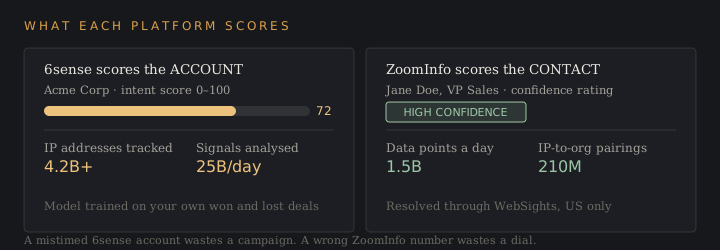
6sense scores accounts and ZoomInfo scores contacts, and that mechanical difference drives everything downstream. 6sense assigns each account a buying stage and an intent score from 0 to 100, with models trained on a customer's own historical won and lost opportunities, per ZoomInfo's write-up of the product. Predictive analytics is the product itself.
The predictive capabilities depend on data the account never submitted. 6sense identifies accounts through IP resolution and web deanonymization: it tracks 4.2 billion+ IP addresses and says it analyses 25 billion signals to keep 1.1 billion company and IP details up to date, plus 70,000 job changes a day (6sense.com/signalverse). Account identification of anonymous website visitors is the input; predictive insights are the output.
ZoomInfo's equivalent is Copilot, which surfaces accounts and recommends actions using its GTM Context Graph, processing what it calls 1.5 billion data points a day. It resolves visitors through WebSights, matched against 210 million IP-to-organisation pairings, and its ML scans 28 million site domains daily. Visitor identification resolves down to named contacts where the match is strong enough.
Neither model is auditable from outside. 6sense reviewers on G2 describe the scoring as a black box, a complaint ZoomInfo quotes on its comparison page; ZoomInfo's own scoring is equally closed, so sales teams take both sets of data points on trust. The practical question is what a wrong score costs: a mistimed 6sense account wastes a campaign, a wrong ZoomInfo phone number wastes a dial.
↑ COMPARISONIntent signals: volume claims and where they come from
6sense claims more intent signals than anyone else in the category and publishes the number everywhere. It's the loudest claim in any 6sense vs ZoomInfo pitch and the hardest to check.
- Signalverse, its rebranded signal layer, processes over 1 trillion buying signals daily and analyses 500 billion+ intent signals a month.
- Coverage runs across 40+ languages, with unlimited custom keywords in place of a fixed topic list.
- Second-party feeds come from Bombora, G2, TrustRadius, PeerSpot and TechTarget alongside its own network.
ZoomInfo publishes a smaller, more specific set of intent signals: 4,500+ intent topics, 85 million signals a week, 6 trillion keyword-to-device pairings a month, all first-party through Guided Intent. Third party intent data reaches ZoomInfo through fewer routes by design, which it sells as a control advantage over intent data assembled from co-operatives.
Volume comparisons across those units are meaningless. A trillion raw intent signals and 4,500 curated topics measure different things, and neither vendor publishes precision or recall on identifying high intent accounts.
Feed each platform 50 closed-won accounts from last year and ask it to score them retrospectively, then check how many intent signals fired before the deal opened.
Coverage of anonymous buying signals is where 6sense earns its price. Web deanonymization, third-party research behaviour and ad engagement roll into one account score covering multiple channels. That score times marketing efforts to a stage, and intent data reaches sales teams as a ranked queue over a topic report.
ZoomInfo's WebSights BuyerID does the visitor half, though ZoomInfo states it “operates exclusively in the United States” with GDPR markets out of scope, which is a real limit for teams with European buying journeys.
↑ COMPARISONContact data counts, and 6sense contradicting itself on one page
ZoomInfo's contact data volume is the reason it appears on this shortlist, and 6sense's counts sit below it on every measure. The complication is that 6sense and ZoomInfo each publish more than one figure for the same thing.
6sense states one set of numbers in the hero of its buyer-data page and a different set in the FAQ further down the same page. The table shows the split, accessed 8 August 2026.
| Metric | 6sense hero block | 6sense FAQ, same page | ZoomInfo |
|---|---|---|---|
| Buyer profiles | 481M+ published | 450M | 500M+ on /data, 420M+ on /products/sales |
| Company profiles | 75M+ | 65M | 100M+ and 122M+, both on /data |
| Verified emails | 111M+ | 100M+ | 300M+ on /data, 174M on /products/sales |
| Direct dials | 98M+ | 55M+ | 135M+ on /data, 70M on /products/sales |
| Technologies tracked | 43,000+ | 40,000 | 30,000+ products, 60-day refresh |
ZoomInfo's comparison page cites the FAQ figures, 415M profiles and 65M companies, so it is arguing against numbers 6sense's own hero block has already raised. Neither vendor has corrected the page it disagrees with.
On data quality the two publish different things: 6sense a refresh cadence and no accuracy rate, ZoomInfo an accuracy rate and a thinner cadence.
- 6sense: contact records every 45 to 60 days, firmographic data daily, technographic validation every two weeks.
- ZoomInfo: up to 95% on first-party data, 96% email deliverability, 87% mobile accuracy, verified by 300-plus human researchers, with a 60-day technographics cycle.
Only ZoomInfo marks accurate contact data with a confidence score; 6sense does not, so its data quality can only be judged by sampling.
ZoomInfo's accuracy claim covers the thing sales teams touch every hour. 6sense's users make the same point unhappily: ZoomInfo quotes a G2 reviewer reporting “out of 5 contacts 2 are good, the rest are obsolete”, and outdated contact information is the most repeated 6sense complaint across review sites. Teams that buy 6sense for prioritisation often keep ZoomInfo data, or another source, for dialling.
↑ COMPARISONImplementation time, where the two vendors flatly disagree
Both companies publish a number for how long 6sense takes to deploy, and they don't match. 6sense says “Most enterprise implementations take 4-6 weeks, with dedicated customer success support throughout onboarding”. ZoomInfo says “6sense implementations typically require 60+ days and dedicated administrators”, against its own claim of under three weeks.
Neither figure is auditable, and the gap between 4 weeks and 60+ days is roughly the whole argument about which platform costs more to own.
What both descriptions agree on is that 6sense needs an administrator: predictive models train on your CRM data, so someone maps opportunity history before scores mean anything. A dedicated customer success manager comes with enterprise contracts on both sides, and will tell you exactly which integration slows a rollout if asked before signature.
The claims each vendor makes about the other are worth reading against the current record.
| Claim | Published by | What the current record shows |
|---|---|---|
| 6sense deployments take 60+ days | ZoomInfo, 14 June 2026 | 6sense publishes 4 to 6 weeks for enterprise rollouts |
| 6sense holds 415M profiles and 65M companies | ZoomInfo, 14 June 2026 | 6sense's own hero block says 481M+ and 75M+ |
| 6sense scores 4.4 on G2 from 1,028 reviews | ZoomInfo, 14 June 2026 | G2's live listing reads 4.2 from 1,480 reviews |
| ZoomInfo gained advertising through the Chorus.ai acquisition | 6sense, 9 March 2026 | Chorus is conversation intelligence; ZoomInfo runs ABM ads through DSP partners |
| ZoomInfo's data advantage has been commoditised | 6sense, 9 March 2026 | ZoomInfo's Q2 2026 revenue grew 1.2% year over year to $310.4M |
| 6sense's native DSP is a real differentiator | ZoomInfo, 14 June 2026 | Conceded by ZoomInfo; it buys ad inventory through partners |
The Chorus error is the telling one. A vendor comparison page that misidentifies the rival's best-known acquisition was written from a positioning brief. Whoever wrote it never touched the actual product.
↑ COMPARISONWhat each one costs
Neither vendor publishes a price. 6sense's pricing page sells three bundles built from Sales Intelligence, data credits and predictive AI, with no figures and a demo booking on every button; credits unlock and export emails, phone numbers and enriched records. Its free plan carries 50 credits a month. ZoomInfo quotes custom too, metering exports through credits, with a free Lite tier granting 10 reveal credits at signup and a claimed 200,000+ Lite users.
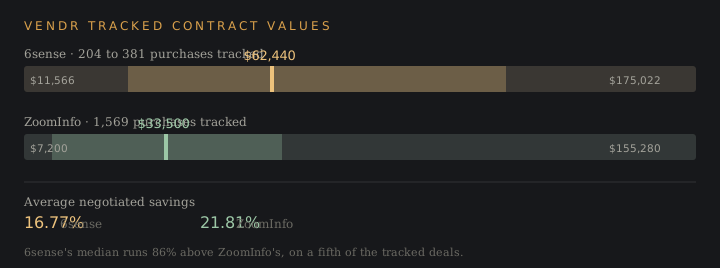
Procurement data is the only public pricing either one has. Both figures below come from Vendr's header stats, accessed 8 August 2026.
| Vendr figure | 6sense | ZoomInfo |
|---|---|---|
| Median annual contract | $62,440 | $33,500 |
| Tracked range | $11,566 to $175,022 | $7,200 to $155,280 |
| Purchases tracked | 204 to 381 | 1,569 |
| Average negotiated savings | 16.77% | 21.81% |
| Free tier | 50 credits a month | Lite, 10 credits at signup |
How much higher 6sense's tracked median contract runs against ZoomInfo's, on a fifth as many tracked deals: $62,440 against $33,500 across 1,569 purchases on Vendr.
The purchase count is a range because Vendr's own page states 204 deals handled in its header and 381 purchases in the block beneath it, which is why the row cites both, and it means lead generation budget buys roughly half as much platform at 6sense's price. Vendr marks the page “Last updated: February 2026”.
Discounting differs as much as the sticker. Vendr tracks 21.81% average savings on ZoomInfo against 16.77% on 6sense, so the ZoomInfo quote has more give in it. Budget for the 6sense administrator too, because a model nobody maintains scores accounts on stale CRM data within two quarters. Our market intelligence platform pricing report covers how this category quotes generally.
↑ COMPARISONWhat each platform ships that the other doesn't
Three capabilities exist on one side only, and each is a genuine reason to pick a platform.
6sense runs its own demand-side platform. Automated ad campaigns target accounts by buying stage across display and social from one canvas, with retargeting and personalised web experiences, and ZoomInfo concedes it operates through DSP partners. Marketing teams that want ad spend driven by the same score that ranks the pipeline get that only from 6sense.
ZoomInfo runs conversation intelligence. Chorus records and transcribes calls, and no equivalent exists in the 6sense suite; ZoomInfo's page states the gap plainly and 6sense's page doesn't contest it. ZoomInfo also publishes an MCP server so AI agents can query its data directly, which 6sense has not matched.
The third split is engagement. ZoomInfo sells the dialer and the sequencer beside the data, so sales reps prospect without leaving the platform; 6sense ships AI Email Agents, previously branded Conversational Email, which reply to inbound interest. Cold sequences aren't part of the job. Different jobs, and teams running both usually let 6sense pick the account and ZoomInfo supply the person.
↑ COMPARISONIntegration capabilities and CRM data flow
Both platforms sit downstream of a CRM and their integration capabilities look similar on paper.
- 6sense connects natively to Salesforce and Microsoft Dynamics, and to marketing automation platforms including Marketo, Eloqua, HubSpot and Pardot.
- 6sense exposes company firmographic, people search, people enrichment, company identification and lead scoring APIs.
- ZoomInfo publishes 40+ native integrations and an App Marketplace, with documented API rate limits at 25 requests a second, 35 on its Scaling tier.
6sense publishes no numeric rate limits or credit quotas on its API pages, which matters for marketing operations teams planning a sync. Where ZoomInfo tells you the ceiling before you sign, 6sense tells you after.
Data flows in opposite directions. 6sense reads CRM data to train its models and writes scores and stages back; ZoomInfo reads little and writes records, enriching company attributes like company size, annual revenue and firmographic data onto existing objects. A stack running both pushes ZoomInfo records into the CRM and lets 6sense score the accounts those records belong to.
↑ COMPARISONWhich platform fits which revenue team
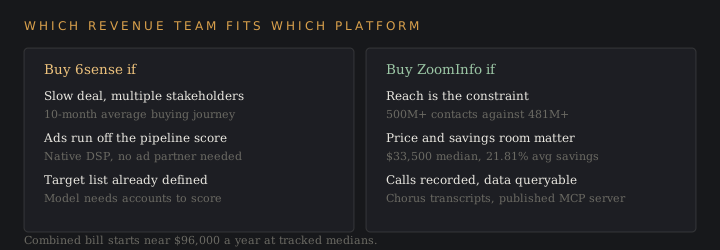
Choose 6sense when marketing and sales both have a stake in the deal and the sales cycle runs long. Complex buying groups, six-figure contracts and a budget to run ads are the conditions its advanced predictive analytics pays back in, because intent signals only earn their cost where a deal is slow enough to intercept; account based marketing programmes with a defined target audience get deep account intelligence and one score the entire revenue team argues from.
6sense is built to target high value accounts; working a long list of high value leads is the other platform's job. Buying intent at account level is what you're paying for.
Choose ZoomInfo when the constraint is reach. High-velocity outbound, sales teams needing volume, recruiting, or a stack that already runs account based marketing elsewhere all point at the vast contact database and the sales intelligence tools around it. It's also the cheaper entry: Vendr's tracked low of $7,200 is a fifth of 6sense's median, and filters on company size, annual revenue and other company attributes turn the database into a workable list in an afternoon.
Two structural cases decide the rest. A team without a defined target list can't use 6sense properly, because the model needs accounts to score; a team whose sales cycle closes in three weeks won't recover the cost of predicting a buying journey that short.
Run both when the numbers justify it, and be honest about the order. 6sense scores accounts to identify in market accounts worth working, ZoomInfo supplies the contacts inside them, and the combined bill starts near $96,000 a year at tracked medians. Neither one will improve lead generation on its own if the target list is wrong.
Below roughly $2 million in new ARR targets, most teams should pick one, prove the motion works, and add the second when the first is saturated. Running multiple tools before either one is producing pipeline buys complexity.
Before signing either, ask each vendor to target high value accounts you have already closed and score them blind, ask 6sense for its match rate against the target accounts already in your CRM, ask ZoomInfo for the export credit count in writing, and get the renewal uplift capped in the first contract. Both hold Gartner Magic Quadrant Leader placements in their category and both will negotiate; neither turns into actionable data without someone owning it internally.
↑ COMPARISONReview scores and the sample sizes behind them
Review averages on these two platforms sit close together while the volumes differ by an order of magnitude, so the counts matter more than the scores.
| Platform | 6sense | ZoomInfo |
|---|---|---|
| G2 | 4.2 across 1,480 reviews | 4.5 across 12,882 reviews, seller-level |
| Capterra | 4.6 across 30 reviews | 4.1 across 315 reviews |
| Gartner Peer Insights | Listed, ABM Platforms market | 4.2 across 439 ratings |
| Analyst position | Gartner MQ Leader, ABM 2025 | Gartner MQ Leader, ABM 2025 |
Capterra's 30 reviews for 6sense are too few to read as a rating; G2's 1,480 are not. Data quality and data accuracy dominate the one-star themes on both listings, which is the complaint sales and marketing leaders should probe in a trial. Note that ZoomInfo's comparison page still cites 4.4 from 1,028 reviews, a figure G2's live listing has moved past in both directions.
Both vendors carry analyst credentials.
- Gartner named 6sense and ZoomInfo Leaders in its 2025 Magic Quadrant for ABM Platforms.
- Forrester made 6sense a Leader in Revenue Marketing Platforms for B2B in Q1 2026 and in Intent Data Providers in Q1 2025.
- ZoomInfo cites a Forrester Total Economic Impact study claiming 316% ROI with payback under six months, which is vendor-commissioned research and should be read as such.
Our 6sense review and ZoomInfo review cover the complaint themes in more depth.
↑ COMPARISONOwnership, leadership and stability
6sense is private, founded in 2013 and headquartered in San Francisco. It raised a $200 million Series E in January 2022 at a $5.2 billion valuation, co-led by Blue Owl and MSD Partners, taking total funding to $426 million. Chris Ball became chief executive on 9 September 2025, with Jason Zintak, CEO since 2017, moving to chairman; the announcement credits Zintak with taking revenue from $5 million to more than $250 million.
ZoomInfo is public, trading on Nasdaq as GTM, and its 2026 disclosures are harder reading. Second-quarter revenue was $310.4 million, up 1.2% year over year, alongside a $651 million non-cash goodwill impairment and a $35 million restructuring charge, following a May 2026 program that cut roughly 600 roles, about 20% of headcount. Market capitalisation sat near $1.2 billion on 7 August 2026, down about 63% in a year. Founder Henry Schuck remains CEO.
A public company's difficulties are visible because securities law forces them into the open; a private one at a 2022 valuation publishes nothing comparable, and $5.2 billion was set in a different funding market.
On security both are credentialed: 6sense holds SOC 2 Type 2 across all five trust criteria, ISO 27001 and ISO 42001 for AI management, with a public status page and a HackerOne disclosure programme; ZoomInfo claims SOC 2 Type II, ISO 27001 and ISO 27701. Neither has disclosed a breach.
6sense vs ZoomInfo FAQ
How does 6sense compare to ZoomInfo?
6sense predicts which accounts are in market and runs campaigns at them; ZoomInfo supplies contact data and the sales intelligence tools to act on it. 6sense scores at the account level with predictive analytics trained on your own won and lost deals; ZoomInfo indexes contacts with confidence scores and up to 95% claimed first-party accuracy. The overlap is intent data, and 6sense and ZoomInfo both acknowledge that customers run them together.
Is 6sense similar to ZoomInfo?
Only at the edges. Both sell buyer intent data and both identify website visitors, so demos look alike. 6sense's job is prioritising high value accounts inside a defined target list; ZoomInfo's job is finding and reaching people at any company, which is why its company database and contact volumes run several times larger. A 6sense vs ZoomInfo shortlist usually means one of the two jobs hasn't been decided yet.
Which is more expensive?
6sense, by a wide margin on tracked data. Vendr records a $62,440 median annual contract for 6sense against $33,500 for ZoomInfo, with ranges of $11,566 to $175,022 and $7,200 to $155,280. Add an administrator's time for 6sense, since its predictive insights degrade without someone maintaining the CRM mapping.
Who are 6sense's main competitors?
Demandbase first, which competes directly on account based marketing and publishes its own comparison against both platforms, then Terminus, RollWorks and ZoomInfo's own marketing products. Several sales intelligence vendors circle the same lead generation budget from below, including Apollo.io and Clay, part of the wider field of ZoomInfo alternatives ranked separately by buyer demand.
Is ZoomInfo outdated?
The product line kept shipping through 2025 and 2026: Copilot, GTM Workspace, GTM Studio and an MCP server, with revenue still growing slightly. The business carries real risk, though, between a $651 million write-down, 600 roles cut and a share price down about 63% in a year. Weigh that against 6sense's own unknown, a private company whose last public valuation was set in January 2022.
Can a team use both?
Yes, and many do. The usual division has 6sense identifying in market accounts and timing marketing and sales efforts, with ZoomInfo providing actionable insights at contact level once an account surfaces, which is how 6sense and ZoomInfo end up in the same stack. They rarely land in the same evaluation to begin with.
Watch for double payment on intent: both bills include a signal layer, and only one of them will drive your sales strategies. Teams that map sales and marketing goals to one platform each rarely regret it; teams that buy both to hedge usually do.
Sources: 6sense.com pricing, signalverse, buyer-data, intent-data, trust and comparison pages; zoominfo.com data, products, copilot and trust-center pages; pipeline.zoominfo.com's 6sense comparison, bylined Dominik Facher and updated 14 June 2026.
Also: Vendr marketplace listings for both vendors; 6sense newsroom releases on funding and leadership; ZoomInfo Q2 2026 results and its 11 May 2026 8-K; G2, Capterra and Gartner listings. Accessed 8 August 2026.
Demandbase, mentioned above as 6sense's closest ABM competitor, is not included in this pricing comparison.