Cognism vs ZoomInfo
 By Jan Suski. I go deep on every review, checking every number against its source and digging up details other coverage misses, a habit from six years of SEO and link building for tech companies. Bylines at Surfer, Brand24, and Senuto. How the scoring works.
· Prefer this source on Google
| WHAT EACH ONE DOES | COGNISM | ZOOMINFO |
|---|---|---|
| Core job | EU prospecting data | AI GTM platform |
| DNC screening | 15 lists, automatic | No count published |
| Verified phones | 10M+ human verified | 135M+ verified claim |
| Contact total | Not published | 500M+, three counts |
| Director refresh | 30-day cycle | None published |
| Intent source | Bombora, 12 topics | Own ML, 4,500+ topics |
| Visitor tracking | None | WebSights, US only |
| Engagement tools | None built in | Dialer, email, Chorus |
| AI per seat | AI search, all seats | Copilot, extra credits |
| Skip it if | US-only pipeline | EU-first cold calling |
| WHAT YOU GET | COGNISM | ZOOMINFO |
|---|---|---|
| Median contract | $36,000 tracked | $33,500 tracked |
| Tracked range | $18,350 to $93,886 | $7,200 to $155,280 |
| Purchases tracked | 108 on Vendr | 1,569 on Vendr |
| Average discount won | 25.91% | 21.81% |
| Free tier | None, demo only | Lite, 10 at signup |
| Billing unit | Seats plus credits | Credits plus add-ons |
| Seats listed | 5 per package | Not published |
| Ownership | Private, VC-funded | Nasdaq: GTM |
| 2026 events | New CEO, Sep 2025 | 600 cut, $651M w/down |
| G2 score | 4.6, 2,415 reviews | 4.5, 12,882 reviews |
StrongerWeakerNo edge
Thirty-three further documented limits sit behind the button below: DNC country registers, credit mechanics, API access rules and both vendors’ security certifications. Test scenario: an outbound team with European accounts in pipeline comparing first quotes.
Capability column from cognism.com and zoominfo.com product, data, pricing and compliance pages; commercial column from Vendr marketplace header stats (Cognism page marked “Last updated: February 2026”). Neither vendor publishes a rate card. All vendor pages accessed 8 August 2026.
| Cognism | WHAT IT DOCUMENTS |
|---|---|
| Credit unit | 1 credit per revealed contact |
| Credit re-use | Re-billed only on job change |
| Diamonds-on-Demand | Requested mobile verified in under 48 hours |
| Verification engine | 5 steps, human validation before publish |
| Intent topics active | 12 selected from a library of 11,000+ |
| Intent plan gate | Pro package only |
| Mobile verification gate | On-demand verification, Pro only |
| Browser extension | LinkedIn, Sales Navigator, Salesforce, HubSpot, Outreach |
| Native integrations | 8 named, included in all packages |
| DaaS delivery | Snowflake, S3, Google Cloud, Databricks, SFTP |
| API access | Requires a Prospecting seat |
| Legal basis | GDPR Art. 6.1(f) legitimate interest, notified database |
| Breach notification | 72 hours to clients |
| CCPA | Registered data broker, California AG |
| DNC registers named | 12 countries enumerated in the compliance FAQ |
| Certifications | ISO 27001, ISO 27701, SOC 2 Type II |
| Contract buy-out | ZoomInfo buy-outs offered to switchers |
| ZoomInfo | WHAT IT DOCUMENTS |
|---|---|
| Search attributes | 300+ company attributes to filter on |
| Job posting data | 281M postings, 6.5 years deep |
| Earnings signals | 250,000+ calls, Copilot Enterprise only |
| US traffic resolved | 50-60% of US business visits |
| Marketing credits | 75,000 Demand, 150,000 ABM Enterprise |
| Display Network caps | 10 campaigns, 10,000 accounts on ABM Lite |
| Chorus | Call recording and transcripts, 14 patents |
| API rate limit | 25 requests a second, 35 on Scaling |
| Uptime published | 99% platform, 99.9% API |
| Intent volume | 85M signals a week |
| Research team | 300+ human researchers |
| Lite community | 200,000+ Lite users claimed |
| Email deliverability | 96% claimed |
| Mobile accuracy | 87% claimed |
| EU privacy notices | Millions of notices monthly, claimed |
| MCP server | Published for AI agents |
Where every figure above comes from, and what neither vendor puts in writing
Every row traces to a vendor property.
- Cognism: cognism.com's pricing, our-data, diamond-data, data-as-a-service and compliance pages, plus its cognism-vs-zoominfo comparison page for the contract buy-out row.
- ZoomInfo: zoominfo.com's data, pricing and compare pages, docs.zoominfo.com for the API rate limit, and pipeline.zoominfo.com for the Lite community and research team figures.
Neither vendor publishes a seat count for ZoomInfo, a contract length, Cognism's API rate limit, or an independently audited accuracy figure. No row above claims one.
Cognism and ZoomInfo sell the same core product, B2B contact data for outbound prospecting, and the decision between them turns on geography and compliance mechanics. Cognism, founded in London in 2015, screens phone records against 15 Do Not Call lists and holds its data inside the EEA by default. ZoomInfo runs the larger North American database and surrounds it with built in engagement tools, website visitor tracking and an AI assistant.
Teams selling into Europe with sellers on the phone get more from Cognism. Teams working the US market at enterprise scale get more from ZoomInfo's reach and platform scope.
This Cognism vs ZoomInfo comparison covers data quality, pricing, intent data and compliance, using each vendor's own published pages, procurement data from Vendr, and review scores with their sample sizes shown. It's written for revenue teams choosing a sales intelligence platform, and every number below names its source, accessed 8 August 2026.
Key differences between Cognism and ZoomInfo
Four key aspects separate Cognism and ZoomInfo: where the data runs deepest, how compliance is handled, what the platform does beyond lead generation, and what shape of company you're buying from.
Cognism's European data focus is structural. The company builds for sales teams selling into EMEA, verifies mobile numbers by hand & treats GDPR compliance posture as a sales argument. ZoomInfo is a data platform first and a workflow suite second: contact records feed sales tools, sales automation, recruiting products and its own intent data engine, a breadth Cognism doesn't attempt.
The company shapes differ too. Cognism is private, venture-funded and led since September 2025 by a new chief executive. ZoomInfo trades on Nasdaq under the ticker GTM, so its financial condition is public four times a year.
↑ COMPARISONGDPR compliance and Do Not Call screening
Cognism processes business contacts under legitimate interest, Article 6.1(f) of the GDPR, states that people are notified of their inclusion in the database, and sells the result as GDPR compliant data (cognism.com/compliance). The same page commits to breach notification within 72 hours and lists a data broker registration with the California Attorney General.
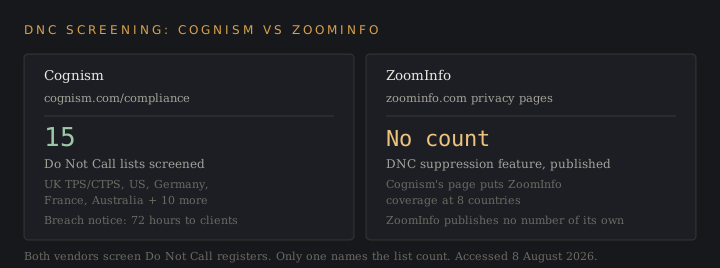
Do Not Call screening is the sharper divide. Cognism advertises screening against 15 DNC lists, with its compliance FAQ naming the UK's TPS and CTPS registers, the US, Germany, France, Australia and seven more countries, the registers sales teams hit daily when calling Europe.
ZoomInfo documents a DNC suppression feature on its privacy pages without publishing a country count. Cognism's comparison page puts ZoomInfo's coverage at 8 countries, and ZoomInfo's counter-page answers with no number of its own, conceding that "Where Cognism does stand out is its Do-Not-Call list focus".
ZoomInfo's privacy record includes a settled class action. Ramos v. ZoomInfo Technologies, a right-of-publicity case over the use of people's names to market subscriptions, resolved 21 November 2024 for $29.55 million. It wasn't a data breach, and neither vendor has disclosed one.
Both publish security certifications. Cognism holds ISO 27001, ISO 27701 and SOC 2 Type II attestation with a trust centre at trust.cognism.com. ZoomInfo's data page claims SOC 2 Type II, ISO 27001 and ISO 27701, though its trust-center page shows an AICPA SOC badge without naming the report type.
Neither runs a consent based data model; both rely on legitimate interest plus notice, which is why compliance tools like DNC screening carry so much of the data privacy argument.
↑ COMPARISONContact data coverage: European depth against global scale
Cognism's current data pages publish no headline contact data total. The figure it puts weight behind is Diamond Data, over 10 million phone verified mobile numbers checked by a human caller (cognism.com/diamond-data). Director-level contact details are refreshed on a 30-day cycle, the platform tracks 20,000+ technologies, and coverage spans Europe, North America and Asia-Pacific per its comparison page.
ZoomInfo's counts depend on which ZoomInfo page you read. Its data page claims 500 million+ professional profiles; its sales product page says 420 million+; its Copilot page says 300 million+. Verified emails are 300 million+ on the data page and 174 million on the sales page, which also lists 70 million phone numbers against the data page's 135 million+.
The table shows where Cognism and ZoomInfo publish each figure, accessed 8 August 2026.
| Metric | Cognism | ZoomInfo |
|---|---|---|
| Contacts claimed | No published total | 500M+ on /data, 420M+ on /products/sales, 300M+ on /copilot |
| Phone-verified records | 10M+ Diamond Data contacts | 135M+ phones on /data, 70M on /products/sales |
| Verified emails | No published total | 300M+ on /data, 174M on /products/sales |
| Company records | No published total | 100M+ and 122M+, both on /data |
| European coverage | EMEA-first build | 66M+ EU contacts, 20.5M+ EU companies, per its compare page |
| Technographics | 20,000+ technologies | 30,000+ products, 60-day refresh |
Only ZoomInfo publishes totals, so the scale comparison is one-sided by design. Its data page counts 34 million international companies out of 100 million+, which places roughly two thirds of its company records in the US. Org charts, company details and email data at volume sit on the ZoomInfo side; detailed company profiles are its strongest asset. Cognism's bet is that a smaller pool of accurate contacts sales teams can legally call beats headline scale.
↑ COMPARISONData accuracy and the verification process behind it
Cognism's headline claim is 85% data accuracy on phone verified data, with Diamond Data as the layer of human verified mobile numbers above it. A study on its own pages, 1,000 contacts called, found the right person picked up 45% of the time on verified records against 18% on standard ones, and wrong phone numbers fell from 27% to 10% (cognism.com/diamond-data).
Its five-step engine of scoring, verification, compliance checks, human validation and customer feedback is the rigorous verification process behind those figures, and a requested mobile gets verified in under 48 hours.
ZoomInfo claims up to 95% data accuracy on first-party data, 96% email deliverability and 87% mobile accuracy on its data page, with 300-plus human researchers and confidence scores on contact profiles. ZoomInfo and Cognism both publish percentages that don't share a denominator, so neither claim audits the other. No vendor delivers universally accurate data; accuracy varies by region and by industry.
Data quality also decays, which is why refresh cadence matters as much as the headline rate. Cognism commits to a 30-day refresh on director-level records; ZoomInfo publishes a 60-day technographics cycle and no overall cadence.
For sales calls into Europe, Cognism's phone-first checks target the exact failure mode; for US email volume, ZoomInfo's deliverability figure is the one that matters. High quality contact data shows up as connected calls and delivered emails, and sales teams can measure both in a two-week trial.
↑ COMPARISONIntent data and intent signals compared
Cognism and ZoomInfo source intent data in opposite ways. Cognism resells Bombora powered intent data: admins pick up to 12 intent topics from a library of over 11,000, per its pricing FAQ, while its comparison page rounds the same library up to 12,000+ topics. Bombora's signal data comes from a co-operative of B2B publisher sites that Cognism counts at 5,000 and ZoomInfo counts at 4,000. Intent data sits in the Pro package only.
ZoomInfo builds its own. Guided Intent runs on ZoomInfo's machine learning across 4,500+ intent topics, 210 million IP-to-organisation pairings and, by its own count, 6 trillion keyword-to-device pairings a month.
Cognism's page describes ZoomInfo intent as "Believed to rely on bidstream data"; ZoomInfo describes it as first-party. Neither publishes an audit, so both descriptions are marketing until tested on your accounts, where intent signals either predict meetings or don't.
The intent signals gap that matters for this pair is geographic. WebSights, ZoomInfo's website visitor tracking product, states that BuyerID matching "operates exclusively in the United States" and that GDPR markets are out of scope (zoominfo.com/data).
Marketing teams timing campaigns at European target accounts are choosing between a US-weighted first-party feed from ZoomInfo and a 12-topic Bombora feed from Cognism, and lead generation lists built from either need the same regional sanity check. Marketing strategies keyed to topic surges work best where the signal coverage is.
What ZoomInfo and Cognism say about each other
Each vendor runs a comparison page aimed at the other, and each page describes a rival that has since moved on. Read side by side, they say as much about the author as the target.
| Claim | Published by | What the current record shows |
|---|---|---|
| ZoomInfo checks DNC lists in 8 countries | cognism.com | ZoomInfo publishes no count; its counter-page credits Cognism's DNC focus instead |
| Cognism has 440M contacts | ZoomInfo's compare page | The cited Cognism page carries no contact total today |
| Cognism sells Grow and Elevate tiers | ZoomInfo's compare page | Cognism's pricing page sells Standard and Pro |
| ZoomInfo sells SalesOS, MarketingOS and TalentOS | cognism.com | ZoomInfo's own navigation sells Copilot, GTM Workspace and GTM Studio |
| Cognism imposes no credit ceilings | ZoomInfo's compare page | Cognism's pricing FAQ defines 1 credit per revealed contact, allocated per seat |
| ZoomInfo gates global data behind add-on licences | cognism.com | ZoomInfo's public pages don't price the add-on; Cognism includes global data in every package |
Cognism and ZoomInfo each contradict themselves too.
- Cognism's comparison page sells freedom from "the friction of traditional credit-based systems" while its own pricing page documents a credit per revealed contact.
- ZoomInfo's contact count moves between 500, 420 and 300 million depending on the page.
Most cognism vs zoominfo write-ups repeat one side's numbers; before repeating any claim from either page, check the page it cites. Cognism's stale "SalesOS, MarketingOS and TalentOS" naming for ZoomInfo's lineup is one entry in our report on software still described under names it no longer uses.
↑ COMPARISONPricing structure, credit usage and contracts
Neither vendor publishes a price. Cognism sells two packages, Standard and Pro, each listing 5 seats included, with credits where one credit reveals one contact and a spent credit is only charged again if that person changes jobs (cognism.com/pricing). Advanced features like intent data, on-demand mobile verification and the premium mobile filter sit in Pro. Cognism also advertises ZoomInfo contract buy-outs for switchers.
ZoomInfo quotes custom and meters data exports through credits, with add-ons for Copilot and its marketing products. Its free Lite tier grants 10 reveal credits at signup, with further monthly credits only for accounts that join the ZoomInfo Community and contribute data. Credit usage is the number for sales teams to model before signing either contract, because overage is where quotes grow.
Vendr's procurement data is the closest thing to public pricing for Cognism and ZoomInfo, accessed 8 August 2026.
| Vendr figure | Cognism | ZoomInfo |
|---|---|---|
| Median annual contract | $36,000 | $33,500 |
| Tracked range | $18,350 to $93,886 | $7,200 to $155,280 |
| Purchases tracked | 108 | 1,569 |
| Average negotiated savings | 25.91% | 21.81% |
| Free tier | None, demo only | Lite, 10 reveal credits at signup |
The medians sit close together, which surprises buyers who expect the European challenger to cost less. The difference is spread: ZoomInfo's tracked contracts run from $7,200 to $155,280, so a small team can land far below Cognism's $18,350 floor and an enterprise far above its ceiling. Vendr marks its Cognism page "Last updated: February 2026". Our Cognism pricing report breaks down the $15,000 to $25,000 platform fee sitting underneath that per-seat rate.
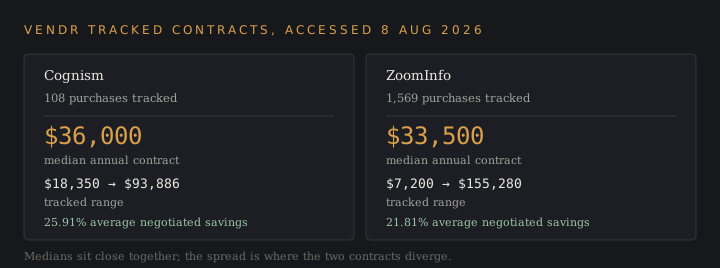
Cognism is not tracked on Vendr as widely as ZoomInfo, 108 purchases against 1,569, which is itself informative. A smaller sample makes Cognism's $36,000 median softer than it looks next to ZoomInfo's deeper, more heavily negotiated purchase history.
Data enrichment and data quality in daily workflows
Cognism ships CRM Enrichment as an add-on and Data-as-a-Service for bulk delivery, pushing records over API or scheduled batch into data warehouses: Snowflake, S3, Google Cloud, Databricks or SFTP (cognism.com/data-as-a-service). Real time data enrichment on inbound leads draws from the same credits as prospecting, and API access requires a Prospecting seat.
ZoomInfo's equivalent is its enrich and operations layer, which it says processes 1.5 billion data points a day across its GTM Context Graph. Lead enrichment, list cleaning and data management sit natively in the platform, delivered through an App Marketplace with 40+ native integrations including Salesforce, HubSpot and Microsoft Dynamics.
For data quality over time, the workflow question beats the database question: stale contact details re-enter your CRM from every source, so real time data enrichment and dedupe policy decide what reps see. Records slot into existing workflows either way; Cognism's job-change rule means a refreshed record doesn't bill twice until the person moves.
↑ COMPARISONAdvanced features inside an existing tech stack
ZoomInfo's advanced features run wide.
- Built in engagement tools for calling and email sequencing.
- Chorus conversation intelligence.
- A recruiting product.
- An MCP server for AI agents.
- Copilot, its AI assistant, sold on consumption credits.
That breadth is the pitch, allowing sales teams to run prospecting through engagement on one platform. It's also the complexity Cognism sells against: reviewers who want a user friendly interface over extensive features tend to land on the Cognism side.
Cognism keeps the surface smaller. Its Sales Intelligence product favours a user friendly interface over breadth.
- Search, plus a browser extension that works inside LinkedIn, Sales Navigator, Salesforce, HubSpot and Outreach.
- Integrations included across all packages: Salesforce two-way sync, HubSpot, Microsoft Dynamics, Pipedrive, Salesloft, Bullhorn and Zapier.
The Sales Companion branding that ZoomInfo's page references has been folded into Sales Intelligence in Cognism's current navigation. Either tool plugs into existing systems in days; ZoomInfo asks more of existing workflows because it wants to replace several of them.
On analytics, ZoomInfo layers advanced analytics tools and AI driven insights across its GTM products, while Cognism includes AI search in every seat. Sales productivity gains are claimed by both vendors and audited by neither.
↑ COMPARISONOwnership and financial condition
Cognism is a private London company founded in 2015. It raised an $87.5 million Series C in January 2022 led by Viking Global Investors, part of roughly $130 million in total funding per Tracxn. Founder James Isilay stepped aside in February 2025, and Dominic Allon, previously Pipedrive's chief executive, became CEO on 9 September 2025.
ZoomInfo is public, and its 2026 numbers describe a company under pressure. Second-quarter 2026 revenue was $310.4 million, up 1.2% year over year; the same quarter carried a $651 million non-cash goodwill impairment and a $35 million restructuring charge, after a May 2026 program cut roughly 600 roles, about 20% of headcount, per its 8-K filing. The stock traded near a $1.2 billion market cap on 7 August 2026, down about 63% in a year. Founder Henry Schuck remains CEO.
The fairness note cuts both ways. A public vendor's trouble is visible because disclosure forces it into the open; a private vendor's condition can't be checked by the same method. Cognism discloses no revenue, and ZoomInfo discloses everything quarterly.
↑ COMPARISONReview scores and the sample sizes behind them
Cognism and ZoomInfo collect review volumes an order of magnitude apart, so read the counts before the averages, starting with G2.
| Platform | Cognism | ZoomInfo |
|---|---|---|
| G2 | 4.6 across 2,415 reviews | 4.5 across 12,882 reviews, seller-level |
| Capterra | 4.7, about 240 reviews | 4.1 across 315 reviews |
| Gartner Peer Insights | 4.5 across 756 ratings | 4.2 across 439 ratings, Revenue Data Solutions |
Cognism's own site badges both 4.5 and 4.6 for its G2 score on different pages; the 4.6 across 2,415 figure appears on ZoomInfo's comparison page. Each vendor quotes the other's worst reviews selectively: ZoomInfo links one G2 review about Cognism email bounces, and Cognism cites a case study claiming a 98% match rate against ZoomInfo's 72%.
ZoomInfo carries five times the review volume on G2, 12,882 reviews against Cognism's 2,415, which makes its 4.5 the steadier estimate even though the star rating sits a tenth below Cognism's 4.6.
A single review is an anecdote; a counted cluster is data quality evidence. On data accuracy, the one-star themes tell you more than either average, and reviewers on both sides praise a user friendly interface while complaining about renewals.
↑ COMPARISONWhich platform fits which revenue team
Businesses focused on European B2B pipeline should shortlist Cognism first. Human verified mobile numbers, DNC screening across 15 lists and GDPR compliant data handling are the exact features a compliance-heavy cold-calling motion needs, and sales and marketing teams get intent and data enrichment in the same seat.
Revenue teams working the US market at scale should shortlist ZoomInfo first. The database runs deeper on US business contacts, the platform carries lead generation through built in engagement tools and recruiting, and Vendr's 1,569 tracked purchases mean a buyer walks in knowing the median price and the going discount.
Sales teams selling into global markets end up comparing quotes. Model credit consumption, ask each vendor for its match rate on your CRM, and run both trials against 100 known-good records. High quality data proves itself in a bake-off within a week; marketing strategies built on bad records fail quietly for months.
Cognism vs ZoomInfo FAQ
Is Cognism better than ZoomInfo?
For European prospecting under GDPR compliance, yes; for North American scale and platform breadth, no. Cognism verifies phone numbers by hand and screens 15 DNC lists, while ZoomInfo's extensive features cover lead generation, engagement and recruiting from one vast database. Neither vendor's data accuracy claim is independently audited, so run both against your own accounts before deciding which delivers accurate data for your region.
Is ZoomInfo or Cognism better for Europe?
Cognism. Its database is built EMEA-first, with European data quality and GDPR compliance as the default, and ZoomInfo's own compare page counts 66 million+ EU contacts against a 500 million+ global total, which makes Europe about 13% of its published scale. ZoomInfo's visitor tracking product excludes GDPR markets outright, and accurate contacts in EU registers are the whole reason this pair gets compared.
How much do Cognism and ZoomInfo cost?
Vendr's tracked medians are $36,000 a year for Cognism across 108 purchases and $33,500 for ZoomInfo across 1,569, with ranges of $18,350 to $93,886 and $7,200 to $155,280. Neither publishes a rate card, so the pricing structure you get depends on negotiation; Vendr tracks average savings of 25.91% and 21.81%.
What is the lawsuit against ZoomInfo?
Ramos v. ZoomInfo Technologies, a data privacy class action over using people's names to market subscriptions, settled for $29.55 million, resolved 21 November 2024. It concerned right of publicity claims; ZoomInfo and Cognism have both avoided any disclosed data breach.
Who competes with Cognism and ZoomInfo?
On the contact data side: Apollo.io, Lusha, UpLead and LinkedIn Sales Navigator, several of which sell reliable contact information at lower entry prices for lead generation. On the intent-led side: 6sense and Demandbase, which lead with intent data and buying signals over records. Most revenue teams pair one database vendor with one sales intelligence platform for signals, a pattern easy to see across the full list of ZoomInfo alternatives.
Try it yourself
Sign up for Lusha
Free plan available, credit-based pricing after that.
 Visit Lusha →
May earn a commission if you sign up through this link, at no extra cost to you. Full affiliate disclosure.
Is ZoomInfo outdated?
The product isn't standing still: Copilot, GTM Workspace and an MCP server shipped through 2025 and 2026, and Q2 2026 revenue still grew 1.2%. The business is under pressure, though: a $651 million goodwill write-down, 600 roles cut and a share price down about 63% in a year. Market trends in AI prospecting will decide which reading wins, and buyers should weigh that risk against Cognism's own unknown, a private company that discloses no financials.
Sources: cognism.com pricing, compliance, our-data, diamond-data and data-as-a-service pages; zoominfo.com data, products, copilot, trust-center, global-coverage and compare pages; both vendors' comparison pages aimed at each other.
Also Vendr's marketplace listings for both vendors; Cognism's newsroom; ZoomInfo's Q2 2026 results and 11 May 2026 8-K; G2, Capterra and Gartner Peer Insights listings. Accessed 8 August 2026.
Neither vendor publishes a rate card, seat counts for ZoomInfo, contract lengths, Cognism's API rate limits, database totals for Cognism, a DNC country count for ZoomInfo, or an audited accuracy figure.
Disclaimer
This page includes one or more affiliate links. If you sign up for a product through one of them, this site may earn a commission at no extra cost to you.