UpLead vs ZoomInfo
 By Jan Suski. I go deep on every review, checking every number against its source and digging up details other coverage misses, a habit from six years of SEO and link building for tech companies. Bylines at Surfer, Brand24, and Senuto. How the scoring works.
· Prefer this source on Google
| WHAT EACH ONE DOES | UPLEAD | ZOOMINFO |
|---|---|---|
| Core job | Prospecting tool | AI GTM platform |
| Contacts claimed | 200 million+ | 500 million+ |
| Companies covered | 19 million+ | 100 million |
| Verified phones | Not published | 135 million+ |
| Direct dials | Mobile direct dials | 120 million+ |
| Intent source | Bombora, licensed | Guided Intent, own ML |
| Visitor tracking | None | WebSights module |
| Zapier | 1,500+ apps | None published |
| Skip it if | You need visitor data | You want a price today |
| WHAT YOU GET | UPLEAD | ZOOMINFO |
|---|---|---|
| Entry tier, monthly | $99, 170 credits | Not published |
| Entry tier, yearly | $890, $74 a month | Not published |
| Second tier | $199, 400 credits | Nothing in between |
| Top tier | Professional, on ask | Custom quote |
| Tracked median | Not tracked | $33,500 a year |
| Tracked range | Not tracked | $7,200 to $155,280 |
| Average discount won | Not tracked | 21.81% on 1,569 deals |
| Free access | 5 credits, 7 days | Lite, no cost |
| Accuracy guarantee | 95%, guarantee stated | Up to 95%, no guarantee |
StrongerWeakerNo edge
Thirty-one further documented features sit behind the button below: search-filter counts, credit mechanics, API rate limits, the suppression cap and both vendors’ certifications. UpLead’s figures are its own published list prices. ZoomInfo publishes no rate card, so its column carries Vendr’s tracked purchase data across 1,569 deals, and UpLead is not tracked there at all. Every figure is sourced in the section its row links to.
| UpLead | WHAT IT DOCUMENTS |
|---|---|
| Search filters | 50+, all of them Professional only |
| Technographics | 16,000* technologies, Plus tier up |
| Data enrichment | 50+ appended points, Plus tier up |
| Email verification | Real time at export, 95% accuracy |
| Bulk verification | From $0.003 each, pay as you go |
| Credit model | One credit unlocks one contact |
| Overage credits | $0.60 Essentials, $0.50 Plus |
| Bulk lookup | 40+ attributes per record at once |
| API rate limit | 500 requests a minute on v2 |
| API credit rule | One credit a record, never charged twice |
| Suppression lists | 200,000 excluded items, hard cap |
| CRM integrations | 15 named tools, Essentials up |
| Two-way CRM sync | Professional; support docs say Salesforce alone |
| Chrome extension | Included on the free tier |
| Multiple seats | Professional is the only tier with them |
| ZoomInfo | WHAT IT DOCUMENTS |
|---|---|
| Search attributes | 300+ company attributes to filter on |
| Verified emails | 300 million+*, 96% deliverability claimed |
| Intent topics | 4,500+, 85 million signals a week |
| IP to org graph | 210 million IP-to-company pairings |
| Technographics | 30,000+ products, 60-day refresh |
| Job posting data | 281 million postings, 6.5 years deep |
| Earnings signals | 250,000+ calls, Copilot Enterprise |
| Traffic resolved | 50% to 60% of US business visits |
| Credit model | One credit a contact or company export |
| Marketing credits | 75,000 Demand, 150,000 ABM Enterprise |
| Display Network | 10 campaigns, 10,000 accounts on ABM Lite |
| Chorus | Call recording and transcripts, 14 patents |
| API rate limit | 25 requests a second, 35 on Scaling |
| Daily processing | 1.5 billion data points a day |
| Uptime published | 99% platform, 99.9% on the API |
| Certifications | ISO 27001, ISO 27701, SOC 2 Type II |
*A marked figure is one the vendor states two ways on its own domain. UpLead's technologies page claims 27,000 technology data points while the plan table on its pricing page says 16,000; the plan-table figure is used above because it's the one attached to a tier a buyer can purchase. ZoomInfo's data page claims 300 million verified emails and its sales product page claims 174 million. Neither vendor has corrected either page.
Sources and the rest of what each vendor states two ways
Every row comes from a vendor property: uplead.com pricing, our-data, email-verifier, technologies and data-enhancement pages, docs.uplead.com and support.uplead.com; zoominfo.com data, pricing, features and products pages plus docs.zoominfo.com.
The contact counts drift the same way the marked figures do.
- ZoomInfo publishes 500 million contacts on its data page, 420 million on its sales product page and 300 million on its Copilot page.
- ZoomInfo lists both 122 million and 100 million companies on the data page itself.
- UpLead's technologies page carries both 16 million and 85 million companies in duplicate blocks of one section, against 19 million on its our-data page.
Neither vendor publishes a seat count, a contract length or a data refresh cadence outside ZoomInfo's 60-day technographics cycle, so no row claims one.
UpLead vs ZoomInfo comes down to a size gap and a philosophy gap that happen to point the same direction. UpLead is a bootstrapped, 200-million-contact prospecting tool sold month-to-month from $99, with a 95% accuracy guarantee stated at the point of download. ZoomInfo is the largest contact database in the category, sold through a sales consultation with no public price list, mid-rebrand into what it now calls an "AI GTM platform."
This page is for the person who has to pick a lead generation tool this quarter and wants the real pricing, the real database counts, and the real accuracy claims. Two marketing pages repeating each other won't settle it.
Both vendors answer the same buyer question, verified contact data at the moment a rep needs it, with almost opposite tradeoffs on price transparency, database scale, and company stability. A small sales team and a four-hundred-rep enterprise floor should not read the same recommendation here, and they don't.
Every UpLead vs ZoomInfo write-up ends up comparing the same three things: data quality, database scale, and price. This one adds a fourth, since UpLead and ZoomInfo now diverge on company stability too, and that gap is new for 2026.
Two rows above decide most evaluations before a demo ever gets booked: the billing model, since annual-only versus month-to-month changes who can even trial ZoomInfo properly, and the accuracy claim, since a published guarantee and a first-party verification claim are different promises with different recourse when the data is wrong.
↑ COMPARISONUpLead and ZoomInfo name each other directly
Most vendor comparison pages avoid naming the rival's specific claims. These two don't. UpLead's own page, written by founder Will Cannon and last updated 24 April 2026, argues UpLead is the superior lead generation tool: cheaper, more flexible, and more affordable than ZoomInfo.
ZoomInfo's own page, published under Chief Data Officer Brandon Tucker and updated 12 June 2026, goes further than most vendor rebuttals. It quotes UpLead's own comparison page back at readers, pointing out that even UpLead concedes ZoomInfo's intent data layer is more deeply integrated for account-based marketing.
Ask ZoomInfo's rep to show you the exact line on UpLead's page they're citing. A vendor quoting a competitor's own words back is rare enough that it's worth confirming on the record before you build a business case around it.
Treat both pages as marketing, since both are written by the company selling the product. The useful signal is the shape of the argument: UpLead leads with cost and flexibility, ZoomInfo leads with intent depth and database scale. Neither claim is false. They're each optimizing for a different part of the lead generation process.
↑ COMPARISONPricing plans, and what they buy
UpLead's pricing plans are public and simple. Essentials runs $99 a month, or $74 a month billed annually at $890 a year, for 170 monthly credits. Plus runs $199 a month, or $149 a month billed annually at $1,790 a year, for 400 monthly credits. Professional is priced on inquiry for teams that need volume beyond that. Every tier includes the 95% accuracy guarantee and the 90-day refresh.
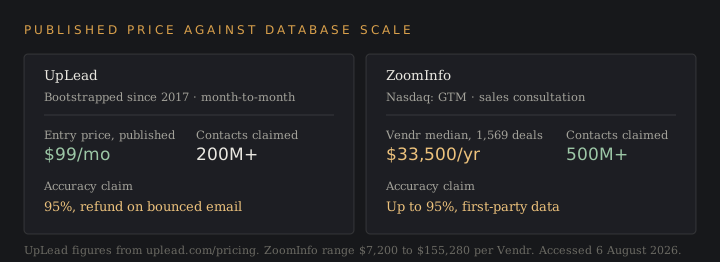
ZoomInfo publishes nothing. Getting a number means a sales consultation, and the number that comes back depends heavily on seats, modules, and negotiating position. Vendr's tracked purchase data is the closest thing to a real benchmark: a $33,500 median annual contract across 1,569 purchases, ranging from $7,200 to $155,280, with an average negotiated savings of 21.81%.
Older estimates of an entry-level Professional plan around $14,995 a year circulate from pre-2026 packaging and third-party blogs, not from zoominfo.com itself; they're worth knowing but shouldn't be treated as current.
Median annual ZoomInfo contract across 1,569 purchases tracked by Vendr, ranging $7,200 to $155,280, with 21.81% average negotiated savings.
UpLead is not tracked on Vendr at all, which is itself informative. A company selling to small teams on a credit-card checkout doesn't generate the negotiated-enterprise-deal data Vendr exists to capture. That absence, alongside the published pricing plans, is consistent with UpLead's own positioning: a self-serve lead generation tool over an enterprise sale.
↑ COMPARISONDatabase scale: 200 million against 500 million
Each vendor publishes its own coverage counts, and neither set comes from an audit.
- UpLead's own data page claims "+200M" B2B contacts with email addresses, "+19M" global company profiles and "+27K" technologies tracked.
- ZoomInfo's own data page states over 500 million contacts, 100 million companies, more than 135 million verified phone numbers, and more than 200 million verified business emails.
That puts ZoomInfo at roughly two and a half times the contacts and five times the companies.
Company coverage is the wider gap of the two, and it decides different things than the contact count does. Prospecting one named account at a time barely touches it. Building a total addressable market list against a firmographic filter runs into it on the first query, because a company absent from the database can't produce a contact however many verified B2B contacts sit behind it.
Scale alone doesn't answer which lead generation tool fits a given sales team. A four-person outbound function chasing forty named accounts gets no benefit from a database sized for enterprise account-based marketing across a whole vertical. The database scale question only matters once you know how many accounts your sales process needs to reach in a quarter.
UpLead's Chrome extension pulls contact and company data directly from LinkedIn profiles during a prospecting session, which matters more to a rep working named accounts one at a time than the size of the underlying database. ZoomInfo's advantage shows up at the other end: bulk list-building against a target market defined by firmographic and technographic data, where 500 million contacts gives more room to build a list before running out of matches.
↑ COMPARISONData accuracy: a published guarantee against a first-party claim
UpLead guarantees 95% data accuracy and refreshes its entire database every 90 days.
Its homepage promises Friendly Credits and says it will refund bounces, and no terms page sets out how. Its help centre documents the opposite default: choosing All Available Emails consumes a credit for every address returned, invalid ones included, and avoiding that means selecting Valid Only before downloading. The one refund UpLead does document is for enrichment, where an unmatched contact has its credit returned.
UpLead describes its process as an 8-step verification pipeline, including real time verification at both ingestion and the point of export.
ZoomInfo's own claim is up to 95% accuracy on first-party data, using what it calls multi-source verification. Older figures citing a 75% to 99% accuracy range by data segment trace back to UpLead's own comparison blog. ZoomInfo has never published that range itself. That range should be read as one competitor characterizing another's product. It isn't ZoomInfo's stated number.
The practical difference is what each vendor commits to in writing. UpLead attaches 95% to a stated moment, the point of download, and its help centre then narrows that to verification at a moment in time. That is not a standing promise.
ZoomInfo publishes hit rates by field instead: 96% business email, 87% mobile, 72% direct dial, 94% LinkedIn URL. A hit rate measures how often a field is populated. Neither vendor documents a make-good when a record turns out wrong.
↑ COMPARISONBuyer intent data comes from two different places
The UpLead vs ZoomInfo intent question splits along data source more than raw volume.
UpLead layers buyer intent signals on top of more than 50 advanced search filters, sourced through a Bombora integration available on the Plus and Professional plans. That means UpLead's intent data reflects Bombora's third-party content-consumption panel, the same intent data source a number of other sales intelligence platforms license.
ZoomInfo built its own machine learning system for buyer intent, branded Guided Intent and layered into what the company calls its GTM Context Graph. That's proprietary modeling on ZoomInfo's own dataset, over a licensed third-party feed, which in principle lets it correlate intent topics against ZoomInfo's own firmographic and technographic data more tightly than a bolt-on integration can.
A sales team already running Bombora elsewhere gains little from paying twice for the same underlying intent signals through UpLead. A team with no existing intent data source is choosing between a shared industry data set and one vendor's proprietary model. That's a real, if unresolved, tradeoff. Neither side gets a clean win.
↑ COMPARISONDirect dials, org charts, and reaching the right contact
UpLead's Mobile Direct Dials give a rep a phone number that rings a specific decision-maker directly, bypassing a company's front desk, layered on the same org chart data used to map who reports to whom before a call.
That pairing, a job title mapped to a reporting line with a phone number attached, is what UpLead's advanced search filters are built around: filter by job title, seniority, and department, then pull the direct dial and email for the exact contact the filter surfaced.
ZoomInfo's version runs at a larger scale. Its database includes more than 120 million direct-dial phone numbers, verified by a stated 300-plus human researchers, past algorithm-only checks, according to zoominfo.com.
Org charts and buying-committee mapping are built into the platform too, tied to the WebSights identification layer, so a rep researching one account sees the reporting structure alongside verified contact information for each person in it.
Neither company publishes a side-by-side accuracy figure specific to direct dials against general phone numbers. A sales team prioritizing cold-call connect rates over email should ask each vendor for that number directly. Don't accept the blended data accuracy claim at face value.
↑ COMPARISONWebsite visitor tracking: one platform has it, one doesn't
Website visitor tracking, identifying the anonymous companies browsing a site and matching them to contact data, is not a plan feature on UpLead. ZoomInfo sells it as WebSights, a separate module using a JavaScript cookie on a company's site to capture visitor signals and match them against ZoomInfo's contact database, surfacing the visiting company and, where the match is strong enough, specific website visitor data down to a named contact.
A marketing team wanting visitor data as part of its lead generation process has to look outside UpLead entirely, either to ZoomInfo's WebSights add-on or to a dedicated visitor-identification tool such as RB2B or Visual Visitor, both of which show up regularly in the same comparison searches as UpLead and ZoomInfo.
That's a real gap in UpLead's lead generation platform, and it's worth weighing before assuming the two tools are interchangeable outside pricing and database scale.
Buyers already running LinkedIn Sales Navigator alongside either tool should note neither replaces it outright. Sales Navigator's InMail and network-based prospecting solve a different part of the sales process than a contact database does. UpLead lists it among its own comparison points, and ZoomInfo positions its platform as a broader replacement for a Sales Navigator plus spreadsheet workflow.
Data quality, enrichment, and what happens when a record goes stale
Data quality is the whole pitch for both companies, and both attach a specific number to it: UpLead's 95% guarantee at the point of download, ZoomInfo's up-to-95% first-party claim with no guarantee attached to it.
What differs is what each company does with data enrichment once a contact already sits inside a CRM. UpLead's enrichment runs through the same verification pipeline as new records, refreshing company data and contact data on the same 90-day cycle. It isn't a separate accuracy tier.
Outdated data compounds silently. A contact that was accurate data at import and goes stale six months later produces the same inaccurate data problem as a record that was wrong from day one, and neither vendor publishes an independent, audited figure for how often that decay produces incorrect data inside a live CRM.
Users exporting data in bulk should treat both accuracy claims as ceilings measured at the point of verification. They aren't guarantees that hold indefinitely afterward, so maintain data accuracy with periodic re-checks, without assuming either database stays reliable data forever.
UpLead gathers data from public documents, business filings, and its own crawling and verification process, layering built in email verification and real time verification at export. ZoomInfo's data platform draws on a similar mix of public documents, proprietary research, and its 300-plus-person verification team, at a scale that produces the larger, if less individually guaranteed, global database.
ZoomInfo pitches its size as a massive global dataset; UpLead counters that a smaller, verified global database beats a large global database full of stale rows. Both UpLead and ZoomInfo treat data enrichment as an ongoing process. Neither treats it as a one-time import, and both tie their data enrichment claims back to the same data quality guarantee.
Fitting into an existing technology stack
Neither UpLead nor ZoomInfo is an all in one tool covering outreach, CRM, and data in a single system; both are built to sit inside a technology stack sales and marketing teams already run. UpLead leans toward workflow automation through its Zapier and CRM integrations, letting a smaller team wire prospecting into whatever sales automation tool already handles sequencing, including direct sales outreach through its Outreach and SalesLoft integrations.
That single, user friendly interface is part of why smaller teams pick UpLead over stitching together ZoomInfo's multiple modules.
ZoomInfo leans toward owning more of that stack directly through its GTM Workspace and GTM Studio modules and advanced features like Copilot account scoring, reducing the number of separate tools a mid market team or enterprise teams have to stitch together, at the cost of the flexibility UpLead's broader integration list provides.
That difference matters most for marketing teams running lead generation alongside demand generation, where ZoomInfo's bundled modules can replace two or three point tools against UpLead staying a single, focused data platform feeding whatever automation already exists.
↑ COMPARISONIntegrations and where each fits a stack
UpLead connects to Salesforce, Zoho, Pipedrive, HubSpot, Outreach, SalesLoft, Mailshake, Reply, Insightly, Woodpecker, Lemlist, Close, Copper, Nimble, and Microsoft Dynamics directly, plus more than 1,500 apps through Zapier. That breadth suits a small sales team stitching together its own workflow automation across several point tools.
ZoomInfo integrates with Salesforce, HubSpot, and Microsoft Dynamics natively and sells its own bundled modules, historically branded SalesOS and MarketingOS and, following the product rebrand, folded into GTM Workspace for sellers and GTM Studio for marketing and revenue operations teams.
The integration story here favors depth inside a smaller number of core systems over breadth of third-party apps, for a mid-market or enterprise team that already runs on those systems.
Marketing teams weighing this pair alongside broader research needs should check our sales intelligence tools ranking for how UpLead and ZoomInfo compare against the wider field.
Review scores across three platforms
Sample size changes how much weight a review score deserves, and the two tools carry different sample sizes on the same platforms. G2, Capterra, and Gartner Peer Insights all rate UpLead and ZoomInfo, but not at comparable sample sizes.
| Platform | UpLead | ZoomInfo |
|---|---|---|
| G2 | 4.7 from 821 reviews | 4.5 from 12,882 reviews (spans multiple ZoomInfo products) |
| Capterra | 4.6 from 76 reviews | 4.1 from 315 reviews |
| Gartner Peer Insights | 4.5 from 42 reviews | 4.2 from 439 reviews (Revenue Data Solutions market) |
ZoomInfo's G2 figure is a seller-level aggregate across its whole product line. That's not a single-product listing comparable to UpLead's one-product score, so it's the softest number in the table even though it carries the largest sample. Capterra and Gartner both compare more directly, and both put UpLead ahead on the star rating despite the much larger review count sitting on ZoomInfo's side.
A 4.1 built on 315 Capterra reviews and a 4.6 built on 76 are both real, but they carry different confidence. Neither is wrong; they're answering slightly different questions about how many buyers weighed in.
ZoomInfo's product rebrand and a real restructuring
ZoomInfo changed its Nasdaq ticker from ZI to GTM on 13 May 2025, timed to the launch of GTM Studio and a broader repositioning from "B2B data provider" to "AI GTM platform."
The company also settled a privacy class action, Ramos et al. v. ZoomInfo Technologies, for $29.55 million, resolved 21 November 2024 over allegations it used people's names and likeness to market subscriptions without consent across several states.
That's a right-of-publicity dispute over unauthorized use of names and likeness; no customer data was exposed or stolen in it. Worth distinguishing the two when a buyer's security team asks about ZoomInfo's history.
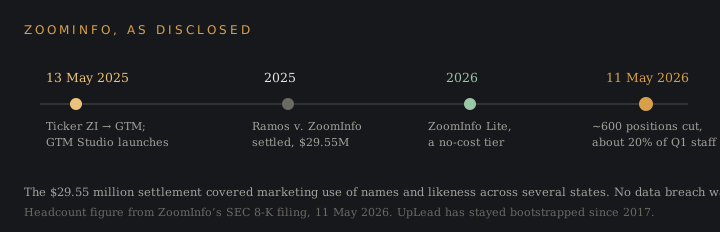
More current: on 11 May 2026, ZoomInfo disclosed a restructuring program cutting roughly 600 positions, about 20% of its first-quarter headcount, according to its own SEC 8-K filing. A cut of that size on a company mid-restructure is a fair thing to raise with a ZoomInfo rep directly, particularly for a buyer weighing a multi-year contract and wanting to know which teams and support functions survive the reorganization.
UpLead, by contrast, is still fully bootstrapped, founded in 2017 by Will Cannon and never having taken outside venture funding. That's a smaller company by headcount, roughly 33 to 100 employees depending on the source, but it also means no investor pressure driving a restructuring cycle.
Both companies publish live status pages, status.uplead.com and status.zoominfo.com, and ZoomInfo maintains a public trust center with SOC 2 Type II, ISO 27001, ISO 27701, and TRUSTe certifications.
↑ COMPARISONWhich lead generation tool fits which team
The ZoomInfo UpLead decision splits along team size. Choose UpLead when the sales team is small, the budget owner wants UpLead's transparent pricing over a sales call, and a published rate and a stated accuracy figure matter more than raw database scale. Startups, agencies, and SMB sales teams get the most from UpLead's model: buy a month at a time, at a price you can read before the call.
Choose ZoomInfo when the target market spans an entire vertical or region, the buying team needs proprietary intent signals layered on a large first-party dataset, and there's a procurement process built to negotiate an annual contract down from list. Mid-market and enterprise teams running account-based marketing at scale are the intended buyer, and the Vendr data confirms real negotiating room exists off any initial quote.
A sales and marketing team already running Bombora elsewhere should weight that fact heavily. Paying for UpLead's Bombora-sourced buyer intent data on top of an existing Bombora subscription adds cost without adding a new data source, while ZoomInfo's proprietary intent model is the only place to get that specific signal.
Running the same free trial and free tier against ten target accounts is the fastest ZoomInfo UpLead gut check available before signing anything longer.
Quick numbers to re-verify before signing
Pricing and packaging shift more often than a comparison page can track, so the tier structure in this ZoomInfo UpLead comparison is worth confirming directly with each vendor.
- UpLead's Professional plan, its advanced plan tier, sits above Essentials and Plus, priced on inquiry for mid market companies and mid market teams outgrowing the credit limits below it.
- ZoomInfo has no advanced plan in the traditional sense; its free tier, ZoomInfo Lite, sits below a fully custom enterprise quote with no published mid-tier step between them.
Buyers chasing high data accuracy above all else have three things to get in writing before signing.
- The current data accuracy methodology from each vendor, beyond the headline percentage.
- If buyer intent data and buyer intent signals are bundled or sold as an add-on at the tier being bought.
- How much advanced search filters coverage comes with that tier.
UpLead's pricing transparency extends to accurate contact information and verified contact data guarantees that ZoomInfo, selling through a sales consultation, doesn't publish in the same form.
Teams whose outreach efforts and prospecting efforts depend on connect rates as much as contact data volume should weight direct dials and org charts coverage above database size alone. Map the sales process each rep runs before comparing tools.
Whichever way this ZoomInfo UpLead evaluation lands, the accuracy guarantee and the direct-dial database are the two line items worth re-checking against the vendor directly, and the team that does that homework tends to gain deeper insights and report higher user satisfaction with whichever tool they pick.
FAQ
UpLead vs ZoomInfo: what is the difference?
UpLead is a self-serve, month-to-month lead generation tool, one of several ZoomInfo alternatives ranked by buyer demand, with published pricing from $99 and a 95% data accuracy guarantee stated at the point of download. ZoomInfo is a much larger, publicly traded contact database sold through a sales consultation, with no published price list and a Vendr-tracked median contract of $33,500 a year.
How much does UpLead cost compared to ZoomInfo?
UpLead's Essentials plan runs $99 a month or $890 a year, and Plus runs $199 a month or $1,790 a year. ZoomInfo publishes no price list; Vendr's tracked data shows a $33,500 median annual contract across 1,569 purchases, ranging $7,200 to $155,280.
Which has better data accuracy, UpLead or ZoomInfo?
UpLead guarantees 95% accuracy at the point of download, refreshing its database every 90 days. ZoomInfo states up to 95% accuracy on first-party data using multi-source verification, without a published refund policy comparable to UpLead's.
Is UpLead or ZoomInfo better for enterprise sales teams?
ZoomInfo. Its 500 million-plus contact database, proprietary intent modeling, and native modules for sales and marketing operations suit an enterprise team running account-based marketing across a large target market. UpLead is built for smaller teams prioritizing transparent pricing and accuracy guarantees over raw scale.
Do UpLead and ZoomInfo offer a free trial?
UpLead offers 5 credits free for 7 days, and its own signup documentation requires card details that bill on day eight unless cancelled. ZoomInfo states a 7-day trial with no card and unquantified usage limits, alongside ZoomInfo Lite's 10 signup credits.
Is UpLead or ZoomInfo easier to use?
UpLead's user friendly interface and shorter setup suit a team that wants to start prospecting the same day, which lines up with its higher scores on Capterra and Gartner Peer Insights despite ZoomInfo's larger review volume.
ZoomInfo's broader module set lets an enterprise team gain deeper insights across sales and marketing operations at once, at the cost of a steeper learning curve most reviewers attribute to the number of bundled products. Teams that map their own sales process before the demo report higher user satisfaction with whichever tool they choose.
What plans do UpLead and ZoomInfo offer beyond the entry tier?
UpLead's Professional plan is its advanced plan, sitting above Essentials and Plus, priced on inquiry for mid market teams outgrowing standard credit limits, with fuller advanced search filters and buyer intent signals included at that tier. ZoomInfo has no professional plan or advanced plan between its free ZoomInfo Lite tier and a fully custom enterprise quote; every meaningful upgrade runs through the same sales consultation as the base contract.
How do UpLead and ZoomInfo handle direct dials and phone numbers?
UpLead pairs direct dials with org charts so a rep can call a named decision-maker directly, skipping the switchboard, included across its pricing plans. ZoomInfo's direct dials draw on a database of more than 120 million direct-dial phone numbers, verified by a stated 300-plus human researchers, layered under its own org charts and buying-committee mapping.
Do UpLead and ZoomInfo publish security or trust information?
Both UpLead and ZoomInfo publish live status pages. ZoomInfo also runs a formal trust center listing SOC 2 Type II, ISO 27001, and ISO 27701 certification; UpLead's site states GDPR and CCPA compliance without an equivalent third-party audit page. Neither has disclosed a security breach. ZoomInfo's $29.55 million settlement concerned marketing use of personal data. It wasn't a hack.
A team weighing lead generation needs beyond raw contacts should also compare each vendor's transparent pricing over time, beyond the entry number: UpLead's transparent pricing stays fixed across the contract, while a ZoomInfo quote can move at renewal.
Both vendors sell sales automation and advanced features as the account grows, and both frame their intent data as a data quality upgrade over a static list, backed by the same data enrichment claims. Sales teams weighing outreach efforts against data cost should treat the intent data comparison as live, since the same intent data question resets every time either vendor changes packaging, before comparing final numbers.
Whichever the final call, this UpLead vs ZoomInfo evaluation should end with both platforms' current pricing pages open side by side. Last year's number doesn't count anymore.
Sources: uplead.com/pricing; uplead.com/uplead-vs-zoominfo (updated 24 April 2026); pipeline.zoominfo.com/sales/uplead-vs-zoominfo (updated 12 June 2026); zoominfo.com/data; vendr.com/marketplace/zoominfo; vendr.com/marketplace/uplead; G2, Capterra and Gartner Peer Insights listings for both products; ir.zoominfo.com ticker-change and restructuring disclosures; SEC 8-K filing, 11 May 2026. Accessed 6 August 2026.