ZoomInfo Competitors: 18 Alternatives Ranked by Buyer Demand
 By Jan Suski. I go deep on every review, checking every number against its source and digging up details other coverage misses, a habit from six years of SEO and link building for tech companies. Bylines at Surfer, Brand24, and Senuto. How the scoring works.
· Prefer this source on Google
Eighteen ZoomInfo competitors, ordered by how often buyers compare them 7,200 monthly US searches across 36 measured pairs · Ahrefs, August 2026
ZoomInfo: what it bundles
Reference card: the six functions ZoomInfo sells in one contract. Open any row below to see how much of this bundle that challenger covers: an empty bar is a function it doesn't sell at all.
| # | Challenger | Pair volume | Replaces ZoomInfo | What the choice turns on | Entry price | Go deeper | ||||||||||||||||
|---|---|---|---|---|---|---|---|---|---|---|---|---|---|---|---|---|---|---|---|---|---|---|
| 01 | Apollo.io | 1,410 | Fully | Sequencing & dialer sit in the seat price. Ten seats run $9,480 a year. | $49/seat/mo, Basic annual | Duel | ||||||||||||||||
Contact recordsFull
Company dataFull
Buyer intent dataPartial
Data enrichmentFull
SearchFull
Sales engagementFull
Features
Pricing
Sourced from Apollo's pricing page. Full Apollo vs ZoomInfo breakdown → | ||||||||||||||||||||||
| 02 | LinkedIn Sales Navigator | 900 | No | Sells relationship access. No verified emails or phone numbers at any tier. | $119.99/mo, Core | Duel | ||||||||||||||||
Contact recordsNone
Company dataPartial
Buyer intent dataNone
Data enrichmentNone
SearchPartial
Sales engagementNone
Features
Pricing
Sourced from LinkedIn's own pages. Full Sales Navigator vs ZoomInfo breakdown → | ||||||||||||||||||||||
| 03 | Seamless.AI | 650 | Fully | Free plan carries 50 credits. Every paid tier routes to contact sales. | Free, then quote | Duel | ||||||||||||||||
Contact recordsFull
Company dataPartial
Buyer intent dataNone
Data enrichmentNone
SearchPartial
Sales engagementNone
Features
Pricing
Sourced from Seamless.AI's own pages. Full Seamless.AI vs ZoomInfo breakdown → | ||||||||||||||||||||||
| 04 | D&B Hoovers | 600 | Fully | Ships KYB and sanctions screening. ZoomInfo sells no compliance-risk product. | $49/mo, Essentials | Duel | ||||||||||||||||
Contact recordsPartial
Company dataFull
Buyer intent dataNone
Data enrichmentNone
SearchPartial
Sales engagementNone
Features
Pricing
Sourced from D&B's pricing page. Full D&B Hoovers vs ZoomInfo breakdown → | ||||||||||||||||||||||
| 05 | RocketReach | 470 | Fully | Published rate card from $19/mo. No dialer and no intent data. | $19/mo annual, Essentials | Duel · Review | ||||||||||||||||
Contact recordsFull
Company dataPartial
Buyer intent dataNone
Data enrichmentNone
SearchPartial
Sales engagementNone
Features
Pricing
Sourced from RocketReach's pricing page and Vendr. Full RocketReach vs ZoomInfo breakdown → | ||||||||||||||||||||||
| 06 | LeadIQ | 450 | Fully | A phone number costs 10 credits against an email's 1. | $200/mo, Pro | Duel | ||||||||||||||||
Contact recordsFull
Company dataPartial
Buyer intent dataNone
Data enrichmentPartial
SearchPartial
Sales engagementNone
Features
Pricing
Sourced from LeadIQ's pricing page and Vendr. Full LeadIQ vs ZoomInfo breakdown → | ||||||||||||||||||||||
| 07 | Clay | 400 | No | Orchestrates other providers, and can call ZoomInfo as one of its sources. | $167/mo annual, Launch | Ranking | ||||||||||||||||
Contact recordsNone
Company dataNone
Buyer intent dataNone
Data enrichmentNone
SearchNone
Sales engagementNone
Orchestrates other providers for all six, without owning any of them natively. Features
Pricing
Sourced from Clay's own documentation and Vendr. Where Clay ranks → | ||||||||||||||||||||||
| 08 | UpLead | 350 | Fully | States a 95% accuracy guarantee. ZoomInfo publishes hit rates by field instead. | $99/mo, Essentials | Duel · Review | ||||||||||||||||
Contact recordsFull
Company dataFull
Buyer intent dataNone
Data enrichmentNone
SearchPartial
Sales engagementNone
Features
Pricing
Sourced from UpLead's pricing and help centre pages. Full UpLead vs ZoomInfo breakdown → | ||||||||||||||||||||||
| 09 | 6sense | 350 | Partly | Predicts which accounts are in market. Supplies no contact record. | $62,440 median* | Duel | ||||||||||||||||
Contact recordsNone
Company dataPartial
Buyer intent dataFull
Data enrichmentNone
SearchNone
Sales engagementNone
Features
Pricing
Sourced from Vendr's tracked contract data. Full 6sense vs ZoomInfo breakdown → | ||||||||||||||||||||||
| 10 | Lusha | 300 | Fully | Self-serve stops at five seats. Above that it becomes a quoted contract. | $49.90/mo, Starter | Duel | ||||||||||||||||
Contact recordsFull
Company dataPartial
Buyer intent dataNone
Data enrichmentFull
SearchPartial
Sales engagementNone
Features
Pricing
Sourced from Lusha's pricing page and Vendr. Full Lusha vs ZoomInfo breakdown → | ||||||||||||||||||||||
| 11 | Cognism | 260 | Fully | Phone-verifies mobiles by calling them. ZoomInfo documents no such step. | Quote only | Duel | ||||||||||||||||
Contact recordsFull
Company dataPartial
Buyer intent dataNone
Data enrichmentFull
SearchPartial
Sales engagementNone
Features
Pricing
Sourced from Cognism's commissioned study and Vendr. Full Cognism vs ZoomInfo breakdown → | ||||||||||||||||||||||
| 12 | Wiza | 250 | Fully | Runs the lookup live at reveal time and bills only on a valid result. | $49/mo, Starter | Review | ||||||||||||||||
Contact recordsFull
Company dataNone
Buyer intent dataNone
Data enrichmentNone
SearchNone
Sales engagementNone
Features
Pricing
Sourced from Wiza's own pricing page. Full Wiza pricing breakdown → | ||||||||||||||||||||||
| 13 | Crunchbase | 230 | No | Sells the funding record. Contacts cap at 10 reveals a month. | $99/mo, Pro | Ranking | ||||||||||||||||
Contact recordsPartial
Company dataFull
Buyer intent dataNone
Data enrichmentNone
SearchPartial
Sales engagementNone
Features
Pricing
Sourced from Crunchbase's own documentation and Vendr. Where Crunchbase ranks → | ||||||||||||||||||||||
| 14 | Demandbase | 200 | Partly | Runs a first-party DSP and buys media directly. ZoomInfo runs none. | $68,591 median* | Duel | ||||||||||||||||
Contact recordsNone
Company dataPartial
Buyer intent dataFull
Data enrichmentNone
SearchNone
Sales engagementNone
Also runs a first-party DSP and buys media directly, a function outside these six. Features
Pricing
Sourced from Vendr's tracked contract data. Full Demandbase vs ZoomInfo breakdown → | ||||||||||||||||||||||
| 15 | Bombora | 150 | Partly | Scores intent at company level only, and sells no contact data at all. | $25,000 median* | Ranking | ||||||||||||||||
Contact recordsNone
Company dataNone
Buyer intent dataFull
Data enrichmentNone
SearchNone
Sales engagementNone
Features
Pricing
Sourced from Bombora's own site and Vendr. Where Bombora ranks → | ||||||||||||||||||||||
| 16 | Lead411 | 90 | Fully | Views are unlimited. Exports are the meter, from 200 a month. | Quote only | |||||||||||||||||
Contact recordsFull
Company dataPartial
Buyer intent dataPartial
Data enrichmentNone
SearchPartial
Sales engagementNone
Features
Pricing
Sourced from Lead411's own pricing page. Not yet reviewed on this site. | ||||||||||||||||||||||
| 17 | Amplemarket | 70 | Fully | Annual contracts only, with no monthly billing at any tier. | $600/mo, Startup | Review | ||||||||||||||||
Contact recordsFull
Company dataPartial
Buyer intent dataNone
Data enrichmentNone
SearchPartial
Sales engagementFull
Features
Pricing
| ||||||||||||||||||||||
| 18 | Gong | 70 | No | Records calls. Reveals contacts by querying Cognism & LeadIQ under your licence. | $55,346 median* | Ranking | ||||||||||||||||
Contact recordsNone
Company dataNone
Buyer intent dataNone
Data enrichmentNone
SearchNone
Sales engagementNone
Records and analyzes sales calls, and reveals contacts by querying Cognism & LeadIQ under your licence -- a function outside these six. Features
Pricing
Sourced from Vendr's tracked contract data. Where Gong ranks → | ||||||||||||||||||||||
* Vendr median annual contract from anonymised buyer data, never a vendor-published price. ZoomInfo publishes no price at all: section 5.2 of its License Terms classifies pricing as confidential information, and its Vendr median reads $33,500 across 1,574 purchases.
Eighteen ZoomInfo competitors have measurable search demand as a comparison, and they don't do the same job as each other. Eleven could take over a ZoomInfo contract outright. Three get bought alongside it. Four do something else that buyers confuse with it.
The order above is the order buyers put them in. Each row's position comes from the monthly US search volume for that pair, 7,200 across all eighteen. Apollo.io alone carries 1,410 of it.
This page is for a sales team holding a ZoomInfo renewal quote that wants to know which ZoomInfo alternatives clear the same bar & what leaving costs. It gives one decisive difference per tool, then routes to the page that argues it at length.
Anyone still choosing a category wants the ranked buying guide at lead intelligence software, which sorts on merit against stated criteria and answers a different question.
The prices below are list prices where a vendor publishes one and Vendr medians where none exists.
Every figure traces to a vendor document, a court filing, Vendr's tracked contract data, or the Ahrefs keyword pull, and sourcing matters here more than usual: this SERP cites itself in a circle, and several pricing claims repeated across it come from B2B data vendors attacking rivals in their own blogs. Six of the nine pages Surfer ranks for zoominfo competitors are vendor-owned.
How these eighteen ZoomInfo competitors were chosen
Volume gated the roster, and nothing else did. The Ahrefs matching-terms pull for zoominfo, filtered to vs at 50 searches a month or above, produced 36 directional query sets across eighteen named tools.
Strict pair volume sums x vs zoominfo, zoominfo vs x and spelling variants, and excludes the reddit, pricing, features, data and comparison modifiers, which are separate intents.
Three rows sit below the 150-search floor and are in for stated reasons. Lead411 carries four of the 36 facts Surfer's AI-search analysis attaches to this keyword, more than any tool outside the roster. Amplemarket has a published review on this site and Gong is ranked on a live page here, so both already have coverage to route to.
Ten more ZoomInfo competitors clear 50 searches without clearing 150, so they get a mention: ListKit at 100, Highperformr at 100, Promptloop at 90, Upcell at 90, Kaspr at 80, Scalelist at 70, Go4database at 70, SalesIntel at 60, Upland at 50 and SalesRipe at 50.
Hunter.io has no measured pair volume against ZoomInfo at all, and sells email lookup for small-scale outreach.
Cognism's shape is unusual enough to name. It carries only 260 in strict pairs, but another 400 sits in the features, data, pricing and reddit modifiers at 100 each, giving it a 660 cluster, the third largest of the eighteen.
Why sales and marketing teams leave ZoomInfo: contract terms, credit metering and data quality
ZoomInfo's contract structure generates more complaint volume than its data does. Its Better Business Bureau file records 209 complaints closed in three years, 64 of them in the last twelve months, against an A+ rating and accredited status. Two of those complaints, resolved on 2 June 2026 and 30 April 2026, turn on auto-renewal.
The 1 May 2025 License Terms explain why. Section 3.1 reads that the agreement "is not cancellable and shall remain in effect until it expires or is earlier terminated according to its terms," and no notice window appears anywhere in the document.
Section 5.2 classifies the business terms, "including, but not limited to, pricing and access," as ZoomInfo's confidential information.
A securities suit puts the auto-renewal question in front of a court. State Teachers Retirement System of Ohio v. ZoomInfo Technologies Inc., No. 3:24-cv-05739-TMC, filed in the Western District of Washington on 4 September 2024, alleges the company "had used manipulative and coercive auto-renew policies and threats of litigation to force customers into remaining with ZoomInfo for an additional contractual term even though such customers did not want to."
Metering is the second complaint. ZoomInfo bills exports as credits, and one credit covers one exported contact or company record however the export happens, through the platform, the ReachOut Chrome extension, or an API call.
A sales team that runs the same list twice pays twice unless the record falls inside its re-pull window, and the length of that window is stated as one year on the pricing FAQ and six months in My Lists.
Data quality complaints are harder to pin down, because ZoomInfo publishes hit rates. Its data page states 96% for business email, 87% for mobile phone, 72% for direct dial and 94% for the LinkedIn URL. A hit rate measures how often a field is populated. It says nothing about how often the populated value is correct.
What the company does contradict is its own coverage. Its data page claims 500 million professional profiles, its sales product page says 420 million, and its Copilot page says 300 million. Verified emails read 300 million on the data page against 174 million on the sales page, which also lists 70 million phone numbers where the data page lists 135 million.
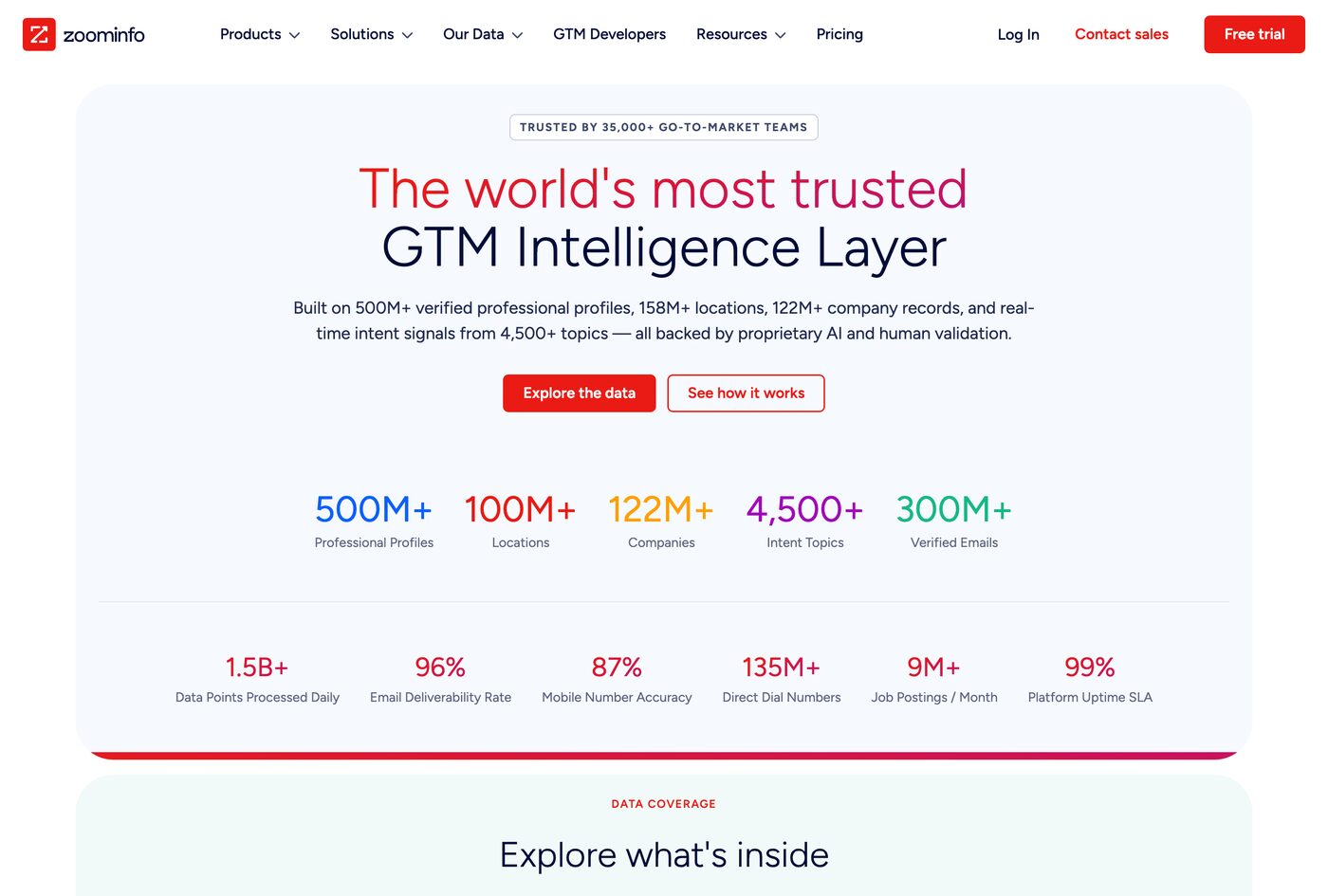
zoominfo.com's own homepage: 500M profiles, 300M verified emails, matching the data-page figures above. Its sales and Copilot pages state the other two counts.
Outdated data is the industry's shared problem. B2B contact records go stale as people change jobs, change numbers and change companies, which is why the refresh cadence a vendor publishes is worth more than the record count it advertises.
None of that makes ZoomInfo the wrong buy for everyone. It's the only vendor here shipping a data licence, a dialer, a call recorder & intent data under one contract, and for a sales and marketing organisation of a few hundred seats the consolidation is the point.
The complaints above describe how the contract is written & how the lead data is metered. Reach isn't what buyers dispute.
What a ZoomInfo replacement has to cover
ZoomInfo bundles six functions that most of these eighteen sell separately. Pricing an alternative to ZoomInfo means pricing only the ones your team touches, which is where the $33,500 median stops being the right comparison.
- Contact records. Name, job title, business email, direct dials and mobile phone numbers, plus the LinkedIn URL. Accurate contact details are what every full replacement claims and what's hardest to test from outside.
- Company data. Firmographic and technographic data, company size, revenue band, company websites & the corporate hierarchy above each entity.
- Buyer intent data. Third party data on which accounts are researching a category, delivered as intent signals scored against a historical baseline. Behavioral data on potential customers arrives as sales triggers: a funding round, a hiring spike, a technology change.
- Data enrichment. Scheduled backfill of missing fields in CRM data, plus lead scoring against your own closed-won pattern.
- Search. Advanced search filters over the database, saved as lists and re-run on a schedule.
- Sales engagement tools. Sequencing, dialling & the handoff into marketing automation tools.
Most challengers cover three of the six. Apollo.io and Amplemarket carry contact records & sales engagement in one subscription. Bombora & 6sense carry buyer intent signals and nothing else. Clay carries none of the six as first-party B2B data and orchestrates all of them.
The combination decides the group, and the group decides the price. Outbound sales teams buying contact data alone can spend under $1,500 a year per seat. A team that also wants in market accounts scored and media bought against them is in the $60,000 range before the first call.
Revenue operations usually owns this decision even though the sales team feels it. The data collection question, meaning where each vendor's records come from and under what consent, sits with legal, and the lead generation question sits with marketing teams. Sales professionals get a vote on the interface and rarely on the contract.
An intuitive user interface is the one attribute here nobody publishes a measure for. Review scores get used as the proxy and don't survive scrutiny: G2 shows Seamless.AI at 4.4 out of 5 across 5,356 reviews, while ZoomInfo's own comparison blog cites 4.2 across 1,215 for the same product.
Eight B2B data providers that publish an entry price
Each of these eight sells contact data you can buy without a sales call, at a rate you can read before the call. That is the sharpest break from ZoomInfo, whose own terms make its pricing structure confidential. What follows is one decisive difference per tool, then the page that argues it in full.
Apollo.io
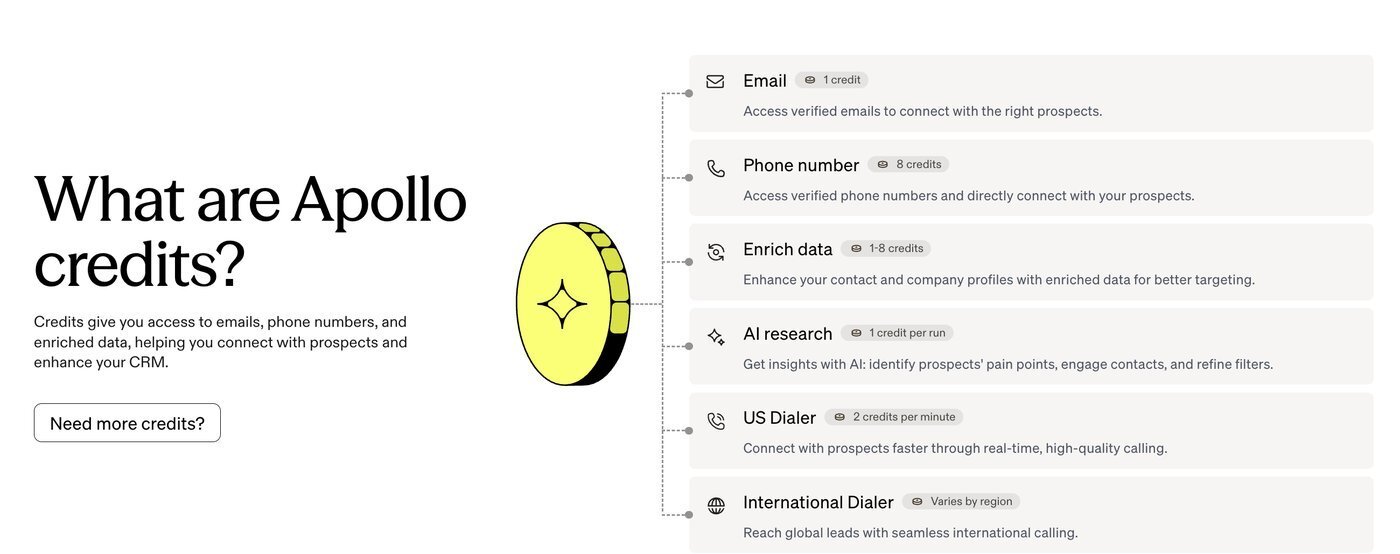
Apollo's own credit explainer, apollo.io/pricing.
Apollo's seat price bundles the send/dial step; ZoomInfo's median doesn't.
Apollo puts email sequencing and a native dialer inside the same subscription. ZoomInfo routes both to separate products. Ten Professional seats at $79 each land at $9,480 a year with 48,000 credits per seat, against ZoomInfo's $33,500 tracked median. Credits are one pool across actions: an email costs 1, a phone number costs 8.
Advanced filters, buying intent and waterfall data enrichment are all paid-only. Cognism's comparison blog calls Apollo's data accuracy weaker than ZoomInfo's, a vendor's claim about a rival with no published test behind it. Apollo vs ZoomInfo
D&B Hoovers
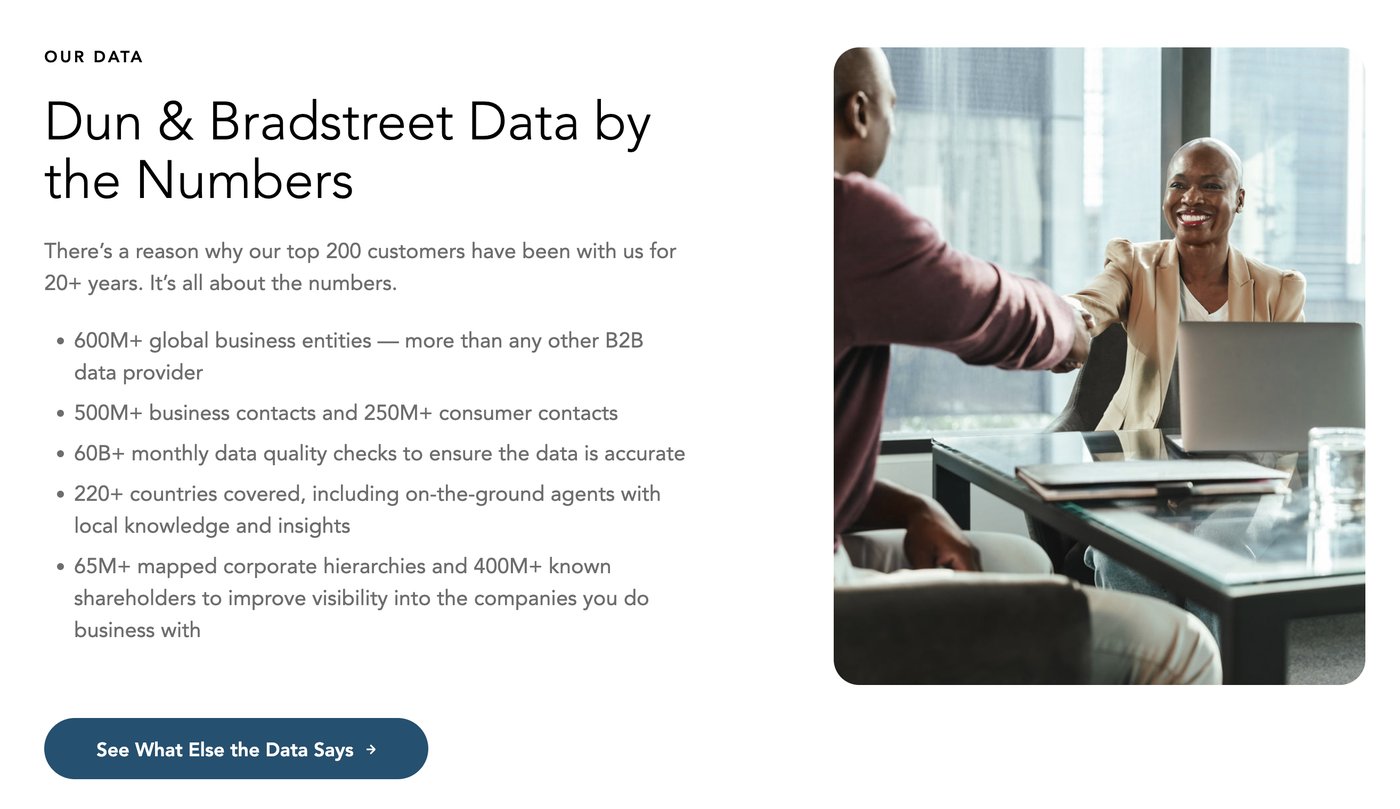
dnb.com's own data-scale page: the numbers behind its KYB/sanctions coverage.
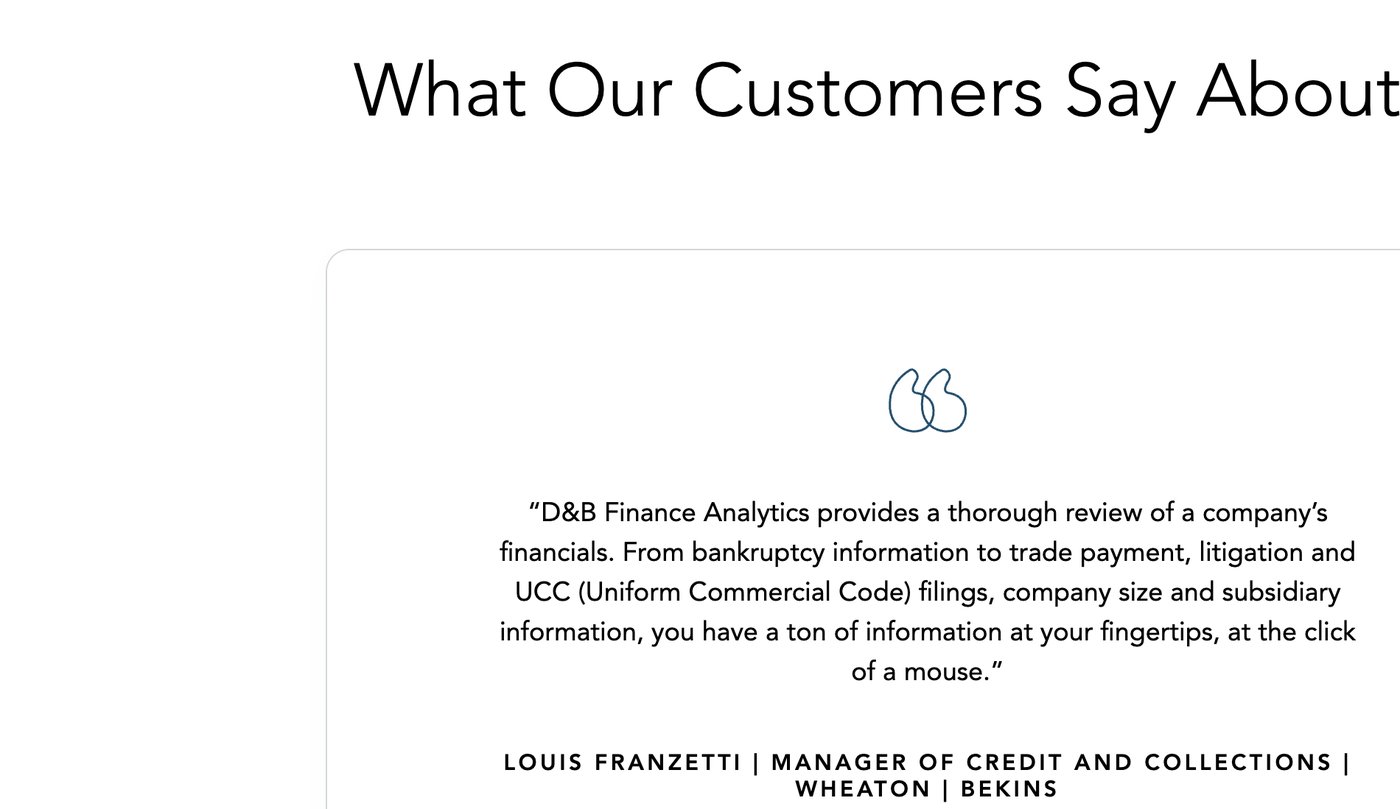
A named customer on exactly the compliance-risk data ZoomInfo doesn't sell, dnb.com.
Dun & Bradstreet ships a compliance-risk product. ZoomInfo ships none, so KYB checks & sanctions screening decide this one before contact counts do. Essentials runs $49 a month for 150 company credits and 150 contact credits, or $529 a year for 1,800 of each, with the first month free and no card required.
D&B maps 65 million parent-subsidiary relationships through the DUNS Number, which is the part outbound tools don't carry. D&B Hoovers vs ZoomInfo
RocketReach
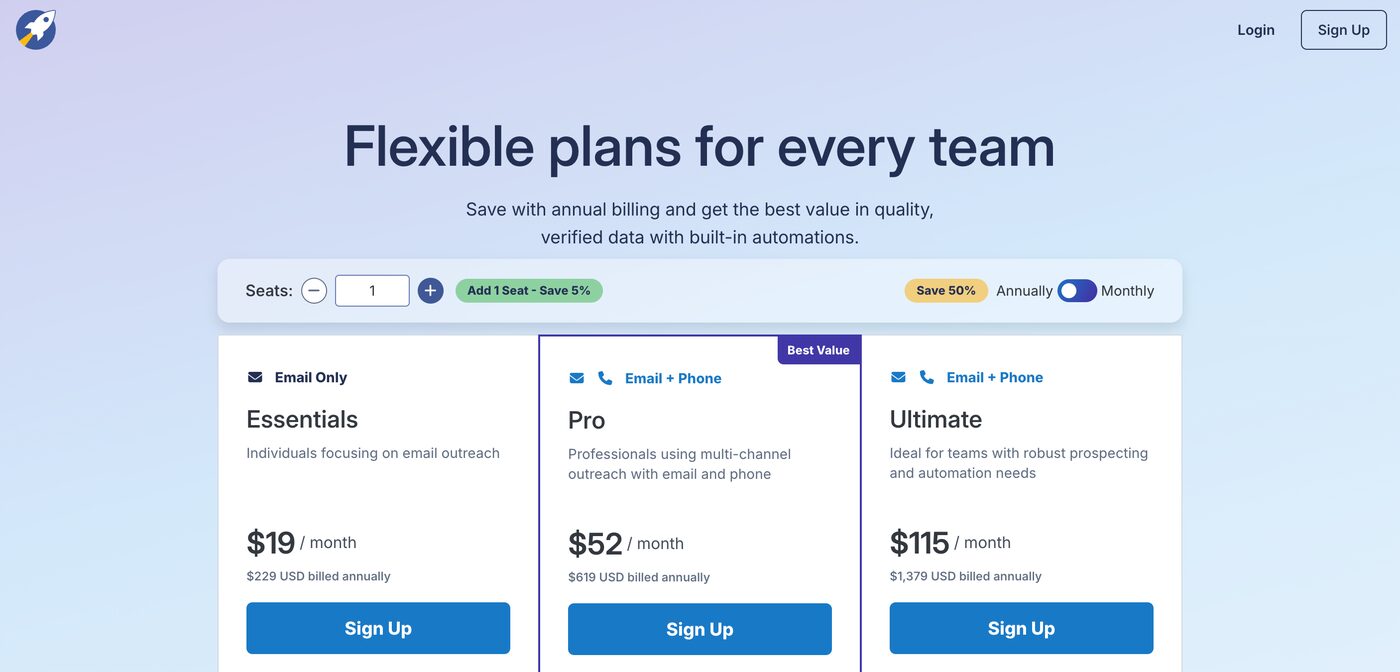
rocketreach.co/pricing, with the exact annual totals.
RocketReach states 21 million users on its current page.
RocketReach publishes the only full rate card among the large challengers: Essentials $19 a month billed annually, Pro $52, Ultimate $115, with a $6,000 annual floor on Custom. It carries no dialer and no intent data, so a team that wants both stays where it is. The API caps at 10 requests per second on every plan, including Ultimate.
Credits are charged only when a verified email or phone number comes back. RocketReach vs ZoomInfo
UpLead
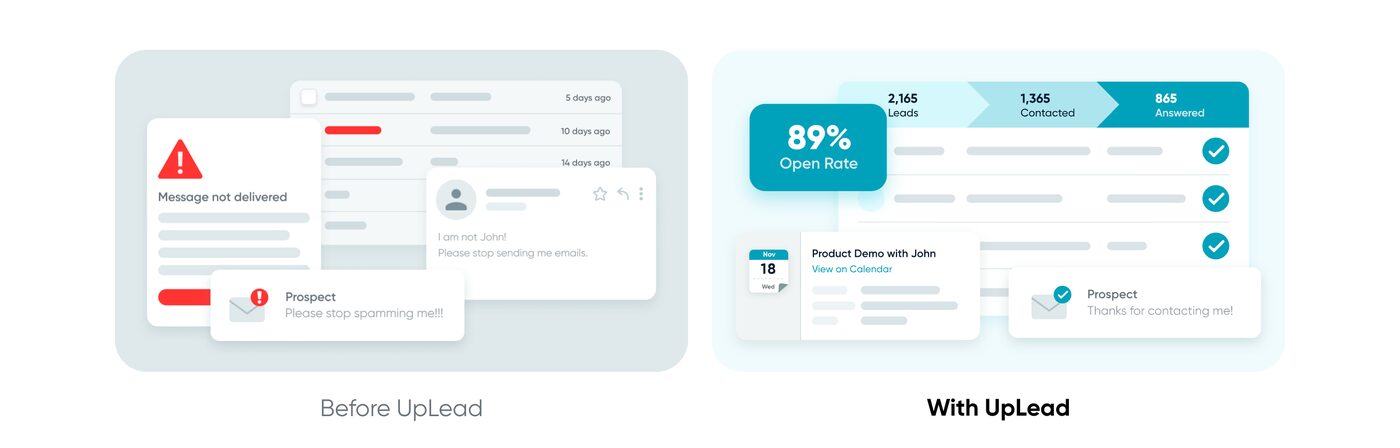
UpLead's own before/after framing of bad contact data versus its 89% open-rate claim.
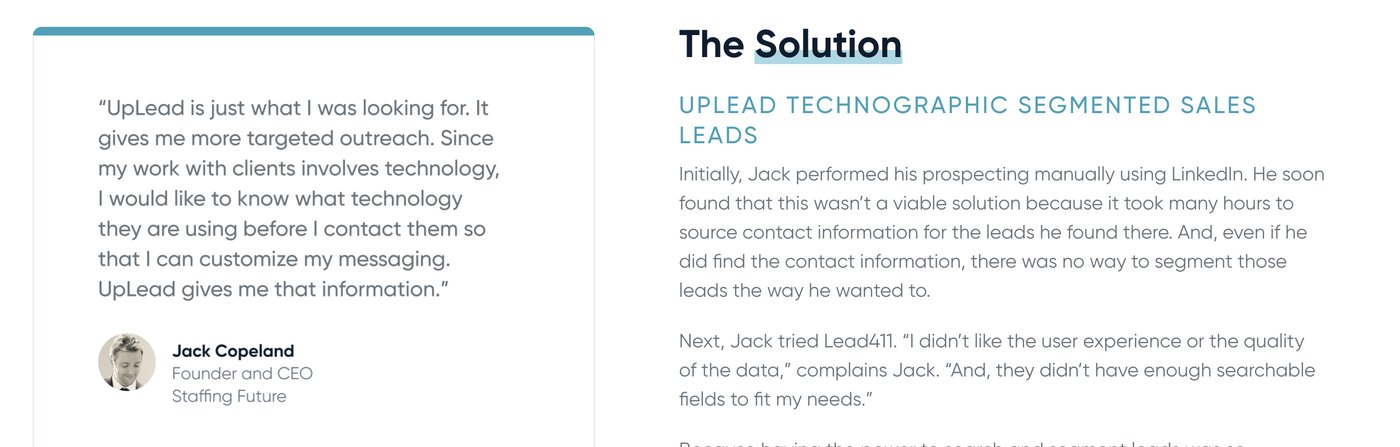
A named customer case study, uplead.com: more than 50 search criteria, per the same page.
UpLead attaches a number to its accuracy claim where ZoomInfo attaches one to its fill rate. Its own data page states 95% accuracy at the point of download, and its help centre qualifies that as verification at a moment in time. Essentials runs $99 a month for 170 credits.
The free trial is seven days and five credits, and UpLead's signup documentation requires card details that bill on day eight unless cancelled. UpLead vs ZoomInfo
LeadIQ
LeadIQ's credit denomination is the whole decision. A phone number costs 10 credits, an email costs 1, both together cost 11, and an account enrichment costs 3. The free plan's 50 credits therefore buys five mobile numbers a month. Pro starts at $200 a month and caps at five users.
Records already exported by anyone on the team cost nothing for a year, which is the deduplication rule ZoomInfo's per-export metering doesn't offer. LeadIQ vs ZoomInfo
Lusha
Lusha's self-serve path stops at five seats. Free carries 40 credits a month, Starter $49.90, Pro $69.90 with two seats included and extra seats at $49.90 each, Premium $399.90 with five. Above that, Scale is a quoted contract and Vendr tracks a $15,999 median across 147 purchases.
Credits roll over to twice the monthly allowance on monthly billing and not at all on annual, which is the trap in taking the annual discount. Lusha vs ZoomInfo
Wiza
Wiza runs the lookup at the moment you ask for it. Work emails resolve in 0 to 380 seconds, averaging about 25, and phone numbers in about four. The billing follows the mechanism: one credit buys one valid email, risky addresses are free, and unmatched profiles are never charged.
Annual plans run $990 for email and $1,990 for email plus phone per user, with fair-use caps of 2,500 exports a month and 500 reveals per 24 hours that Wiza states cannot be raised. Our Wiza pricing breakdown covers the overage rates and the Starter tier's monthly-only structure in full.
Amplemarket
Amplemarket sells one published price and no monthly billing. The Startup plan is $600 a month on an annual contract; Growth and Elite are quoted. For a team leaving ZoomInfo because of a twelve-month commitment, that structure reproduces the thing it was leaving, which is why the published rate matters less here than the term does. Amplemarket review
Try it yourself
Sign up for Amplemarket
Startup Plan is $600 a month, published upfront, on an annual contract.
May earn a commission if you sign up through this link, at no extra cost to you. Full affiliate disclosure.
Three vendors sold only by quote
These three replace ZoomInfo's function and reproduce its pricing model. None publishes a rate card you can act on, so the entry price is a Vendr median or a sales call.
Cognism
Cognism phone-verifies mobile numbers by calling them, and describes the process in those words: "we have a routine process in place that calls the numbers and confirms that it is the right person who picks up the phone." The product was branded Diamond Data and now appears as phone-verified contacts, gated behind its own package.
An independent study Cognism commissioned reached the right person on 45% of 1,000 verified mobiles against 18% for standard numbers. Vendr's Cognism marketplace page returns a 404, so this page cites no buyer-reported median for it. Cognism vs ZoomInfo
Seamless.AI
Seamless.AI is the only tool here with a genuine free plan and no purchasable next step. The free tier grants 50 credits with no card, and Pro and Enterprise both read "Contact sales" on the pricing page. Its own blog says outright that "there's no fixed pricing rate," which retires the $147 a month figure still circulating.
Credit Back Protection refunds a credit automatically on a bounced email. Vendr tracks no Seamless.AI contracts at all. Seamless.AI vs ZoomInfo
Free tier, no card
Sign up for Seamless.AI
50 credits a month free. Pro and Enterprise are both quote-only, "Contact sales."
 Visit Seamless.AI →
May earn a commission if you sign up through this link, at no extra cost to you. Full affiliate disclosure.
Lead411
Lead411 meters exports, and its pricing page carries plan names, export counts and overage rates without a single dollar figure for a plan. Basic Plus Unlimited allows 200 exports a month; only the top custom Unlimited package is described as unlimited exporting. Overages run $0.50, $0.44 and $0.40 by tier.
Coverage is 450 million contacts across 20 million companies in 13 named countries, and its intent data is licensed from Bombora at $2,500 per seat a year.
Three tools bought alongside ZoomInfo: intent data and account selection
These three answer which accounts to work, and none of them answers who to call. A team that swaps ZoomInfo for one of them loses the contact record entirely. That is why they show up in comparison searches and almost never in replacement decisions.
6sense
6sense predicts which accounts are researching a category and scores them into buying stages. It supplies no contact record, so it sits on top of a data provider.
Vendr tracks a $62,440 median across 385 purchases, roughly double ZoomInfo's median, with a $11,376 to $176,809 spread and 16.77% average savings. 6sense vs ZoomInfo
Demandbase
Demandbase is the only tool on this page running a first-party demand-side platform and buying media directly. ZoomInfo runs none, so an account-based advertising programme is the reason to hold both. Vendr tracks $68,591, low $24,000, high $164,037, at 13.27% average negotiated savings, which makes it the most expensive median in the roster.
Demandbase also publishes the comparison page Surfer ranks second for this keyword, so treat its roster as one vendor's view of its own market. Demandbase vs ZoomInfo
Bombora
Bombora states its own limit plainly: "Bombora does not provide contact data, therefore we encourage a conversion process using tools like LinkedIn Campaign Manager, or engaging with a contact provider." Company Surge scores run 0 to 100 and regenerate weekly over the weekend, with 60 and above marking a spike.
The co-op collects consented events from more than 5,000 B2B sites, and the live taxonomy file dated 7 August 2026 carries 21,632 topics. Bombora sells no free tier and publishes no price. Where Bombora ranks
Four tools that do a different job, from conversation intelligence to funding records
Each of these four appears in ZoomInfo comparison searches because of an adjacency. Naming the mechanism is more useful than naming the category.
LinkedIn Sales Navigator
Sales Navigator sells access to a network. It holds no verified business emails and no phone numbers at any tier, so a Sales Navigator seat and a data licence are two different purchases. Core runs $119.99 a month or $1,079.88 a year, Advanced $159.99 a month.
The Sales Navigator Social Selling Index scores four components from 0 to 100, and LinkedIn is discontinuing free access to it while also writing that "a high SSI score doesn't always represent the efficacy of a sales person." Sales Navigator vs ZoomInfo
Clay
Clay orchestrates other providers, and ZoomInfo can be one of them. Its documentation says so: "If you already subscribe to data providers (ZoomInfo, Apollo, Clearbit, etc.) ... connecting your API keys to Clay will eliminate the Data Credit cost. Note that an Action will still be consumed." Two currencies run in parallel: Actions for orchestration and Data Credits for the data itself, from $0.05 each, with a fully enriched record costing 6 to 20.
Launch starts at $167 a month annually, with unlimited seats at every tier. Where Clay ranks
Crunchbase
Crunchbase sells the funding record. A Pro seat at $99 a month returns no contact data at all; contacts arrive on Business, metered at 10 reveals a month that expire monthly, over roughly 18 million contacts at 400,000 organisations.
Its own contact-data documentation adds that "Crunchbase is not ultimately responsible or liable for the accuracy of contact information." Search results cap at 1,000 per query on both Pro and Business. Where Crunchbase ranks
Gong
Gong records and analyses calls, and holds no contact database of its own.
Where it surfaces a prospect, it queries someone else's: "Gong partners with contact data providers such as Cognism and LeadIQ," and "you may need a paid active license with a provider to further reveal someone's phone number and email." The recommendation engine needs at least 100 closed deals before it runs.
Gong publishes no price, charges a platform fee on top of per-user licences, and Vendr tracks a $55,346 median across 1,144 purchases. Where Gong ranks
What each vendor claims about itself, and who published the claim
Most accuracy and fit claims circulating for these tools originate on a rival's blog or in the vendor's own marketing, and this SERP rarely separates the two. Here they are with the publisher named.
Apollo.io now lists 240M+ global contacts and 30M+ companies on its own B2B data page, while Demandbase's and RB2B's comparison posts still repeat the 275 million prospects Apollo used to advertise. Apollo's pricing page sells credits, and neither count comes with a stated method.
Demandbase & Cognism both file Apollo under startups and small businesses, which is a category placement published by two of its competitors.
Cognism claims a 90% accuracy rate for contact data on its own blog, and 200 million European contacts across its site. It screens numbers against do-not-call registers automatically, naming the UK's TPS and CTPS alongside the US, Germany, France and Australia, and sells GDPR posture as the reason to pick it over a US-first database.
The accuracy figure is Cognism's own. The phone-verification study behind it is the part with a published method.
Lead411 states that it triple-verifies email addresses and double-verifies direct dials. Its own FAQ then publishes the components: a 99% confidence rating where an SMTP server allows verification, 87% on catch-all servers, and pattern-appended addresses at roughly 87% for contacts where it holds no email at all. Both numbers are Lead411's.
Seamless.AI describes itself as a real-time search engine for leads, running a 10-step verification at the moment of lookup. Kaspr's blog, a rival's, reports the outcome as high bounce rates.
Seamless publishes 90% accuracy, and its own pages carry 1.3 billion contacts on the Prospector page against 1.8 billion verified emails on the homepage.
Demandbase sells AI-driven insights for account engagement and calls itself an alternative for enterprise B2B teams. That sentence sits on demandbase.com, in the post ranking second for this keyword. The checkable part is the first-party DSP, which no other vendor here operates.
UpLead sells a pay-as-you-go model with no-commitment monthly plans, and that one holds up: Essentials bills monthly at $99 and cancels without a term. Its 95% guarantee is a homepage promise with no terms page behind it, and its own help centre documents credits being consumed on invalid emails unless you filter to valid-only before downloading.
LeadIQ is positioned for small to mid-sized sales teams by both Kaspr and Cognism, and its own five-user cap on Pro agrees with them. Lusha gets the same treatment as the simpler platform for small teams, repeated across four vendor blogs. Hunter.io is filed under small-scale email outreach by both. None of those placements comes from the vendor being placed.
Budget, data type and regional compliance are the three axes these positioning statements run on, and the three a buyer can test. Everything above is a claim with a publisher. The pricing table and the exit-cost section are the parts with a document behind them.
Six names in these searches that you can no longer buy
790 monthly searches sit on six query sets where the thing being compared has been acquired, retired, or was never a competitor. Four of the six are acquisitions inside this same category, which is the pattern worth noticing.
Zoom. Zoom Communications Inc. and ZoomInfo Technologies Inc. are unrelated companies. Zoom dropped "Video" from its legal name on 25 November 2024 and sells meetings, phone, contact centre & AI tools, with no B2B contact database in the product line. Neither company's most recent annual report mentions the other.
ZoomInfo kept its legal name and changed its Nasdaq ticker from ZI to GTM before the open on 13 May 2025.
Clearbit. HubSpot agreed to acquire Clearbit on 1 November 2023 and closed on 1 December 2023 for $140.4 million in cash net of cash acquired, per HubSpot's own 10-K. The product now ships as Breeze Intelligence and requires a paid HubSpot subscription.
HubSpot sunset the free Clearbit platform, the weekly visitor report, the TAM calculator & Clearbit Connect on 30 April 2025, and the Logo API on 1 December 2025. Clearbit.com now offers a customer login and no purchase path.
RainKing. DiscoverOrg announced the acquisition of RainKing on 28 August 2017, in a cash transaction with no disclosed amount. The related query pairs RainKing with Unomy, which went a different way: WeWork acquired Unomy on 10 August 2017, eighteen days earlier, and folded it into WeWork's own sales tooling. The unomy.com domain no longer serves the product.
DiscoverOrg. This query asks a company to compete with its own former self. DiscoverOrg acquired Zoom Information, Inc. on 4 February 2019, then merged the two brands on 10 September 2019 and took the ZoomInfo name for the combined business. The company priced its IPO at $21.00 a share on 3 June 2020 and began trading on the Nasdaq Global Select Market the following day.
Data.com. Salesforce acquired Jigsaw, the crowd-sourced contact database that became Data.com, for roughly $142 million in cash plus an earn-out of up to 10% of the purchase price, announced 21 April 2010 and completed 10 May 2010. Salesforce lists Data.com on its official Past Product & Feature Retirements page. The product cannot be bought.
InsideView. Demandbase announced the acquisition of InsideView, alongside DemandMatrix, on 4 May 2021, with terms undisclosed, and folded both into its Data Cloud and Sales Intelligence Cloud. Insideview.com now redirects to demandbase.com, and InsideView appears nowhere in Demandbase's product or pricing navigation. A buyer searching this pair is comparing Demandbase to Demandbase.
What it costs to leave ZoomInfo
No page in this SERP prices the exit, which is the part a renewal quote makes urgent. ZoomInfo's published License Terms & Conditions, version 1 May 2025, answer most of it directly.
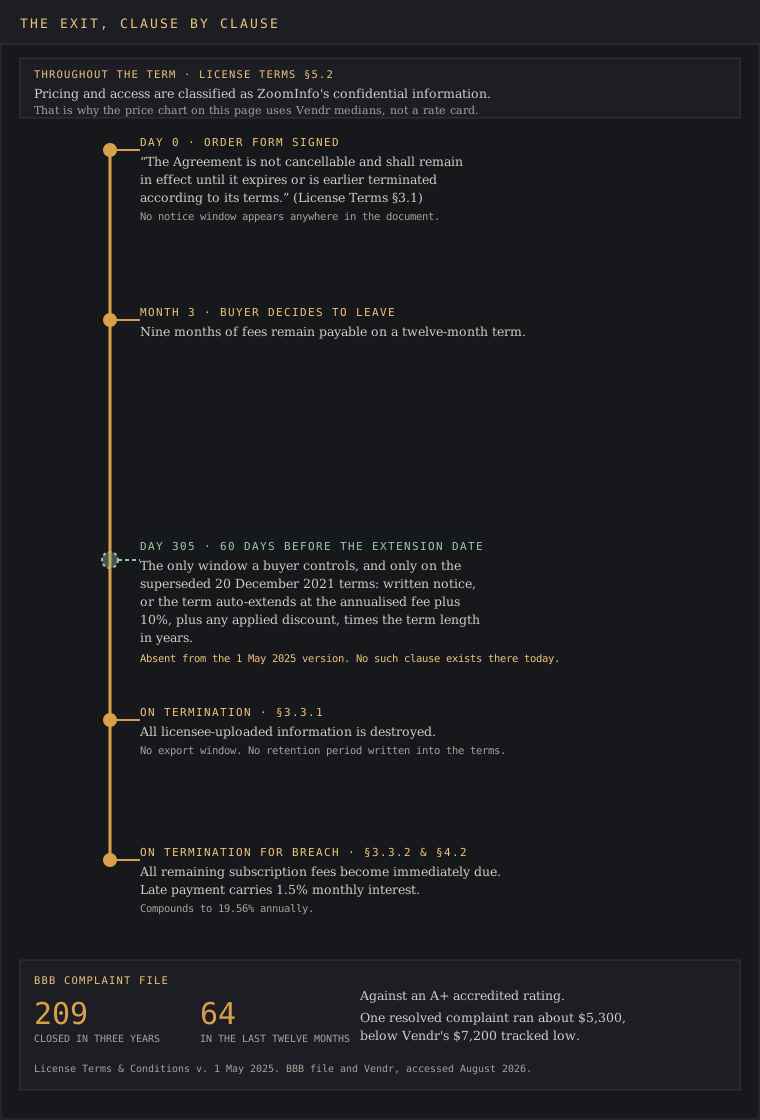
Every clause pinned at the point in the term it binds, License Terms & Conditions v. 1 May 2025.
The agreement "is not cancellable and shall remain in effect until it expires or is earlier terminated according to its terms," per section 3.1. No notice window appears in the document. A buyer who decides in month three of a twelve-month term owes the remaining nine months.
On termination, section 3.3.1 requires that "all information that has been uploaded into ZoomInfo's systems by Licensee" be destroyed. There's no export window and no retention period written anywhere in the terms. Suppression lists, uploaded account lists & enrichment inputs all fall inside that sentence, which means the work of rebuilding them is part of the switching cost.
Breach accelerates the bill. If ZoomInfo terminates for a licensee's breach, section 3.3.2 makes every remaining subscription fee immediately due. Section 4.2 charges 1.5% monthly interest on late payment, which compounds to that rate.
Vendr medians fill the price column above because of section 5.2. It classifies the business terms, "including, but not limited to, pricing and access," as ZoomInfo's confidential information, so a customer who benchmarks a renewal against a peer's contract is disclosing something the agreement says they can't.
The superseded 20 December 2021 version of the terms is still live at its own URL, and it's harsher on renewal. The term auto-extended unless written notice arrived 60 days before the extension date, and the renewal fee was the annualised subscription fee plus 10%, plus any applied discount, multiplied by the term length in years.
The 1 May 2025 version contains no automatic renewal clause at all, so a customer's obligations depend on which version their order form incorporates.
That clause is what the Ohio complaint puts in front of a court, and it's what the two resolved BBB complaints from April and June 2026 describe. One of them concerned a deal of roughly $5,300, which is well under the $7,220 low Vendr records, so the auto-renewal question isn't limited to enterprise contracts.
Two costs sit outside the contract. Records exported under a ZoomInfo licence stay usable, but the enrichment stops the day access ends, so a CRM enriched from ZoomInfo begins decaying at whatever rate contacts change jobs.
And any workflow wired to ZoomInfo's API, its Chrome extension or its CRM sync has to be rebuilt against a different schema, which is engineering time nobody quotes in the renewal conversation. Sales efforts stall while that happens, because reps work a decaying list until the new provider's backfill lands.
The practical answer is to start the replacement test before the notice window. Vendr's tracked spread of $7,220 to $155,730 across ZoomInfo contracts, at 21.81% average negotiated savings, also says the quote in hand still has room to move.
Pricing across the eighteen: what an alternative to ZoomInfo costs
Eight of the eighteen publish a list price. Three publish nothing and route every enquiry to contact sales. The rest sit somewhere between, publishing an entry tier and quoting everything above it. Vendr medians come from anonymised closed contracts, so they describe what buyers paid.
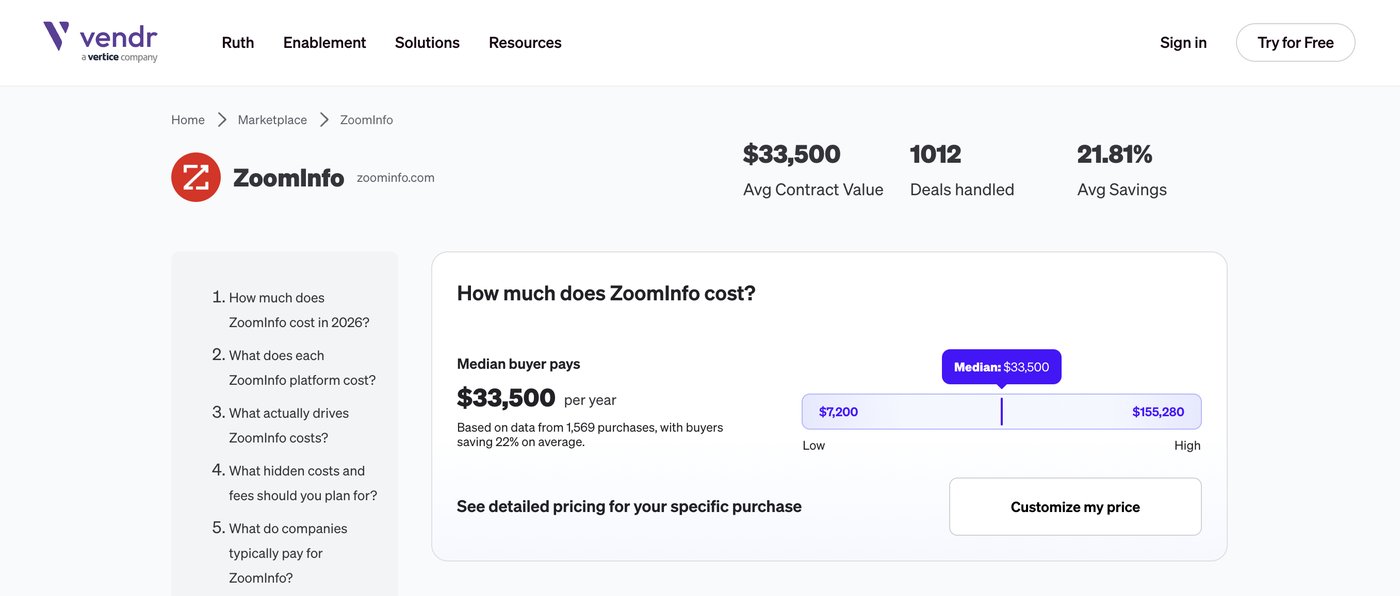
vendr.com/marketplace/zoominfo: the primary source every Vendr figure on this page traces to.
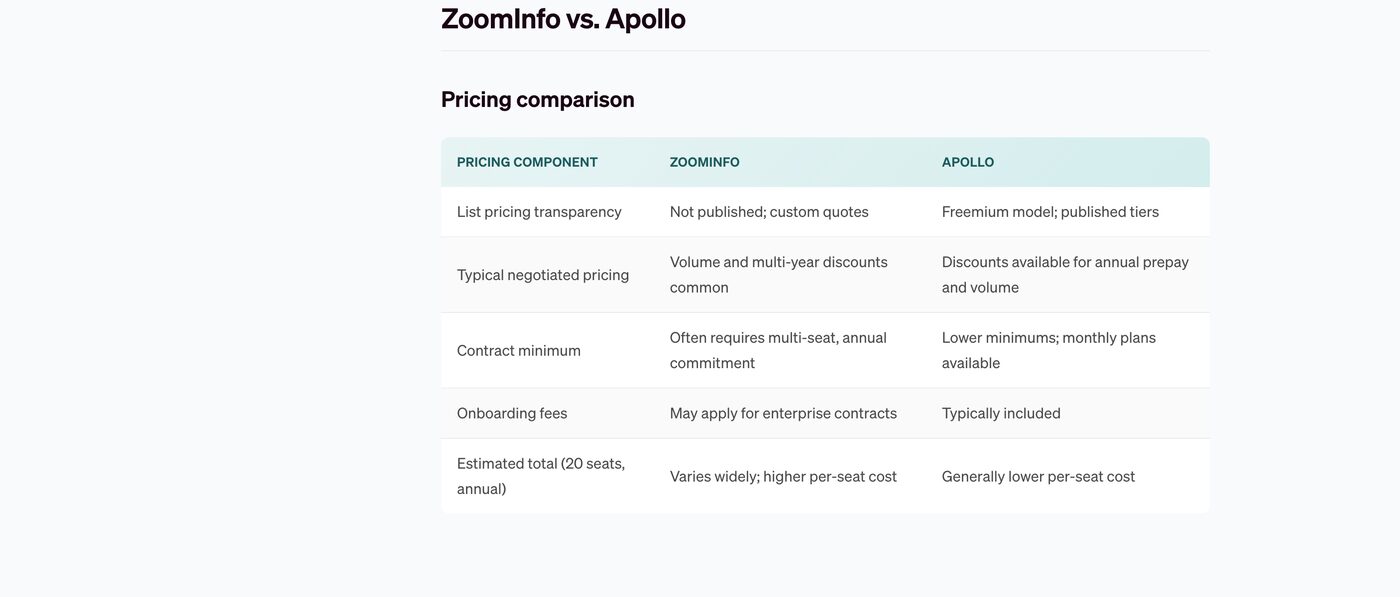
The same Vendr page's section-by-section ZoomInfo vs Apollo comparison.
Vendr's own page also states four negotiation levers with real percentages attached: 15–30% off for a multi-year commitment, 20–35% off for 50+ seats combined with multi-year terms, 10–20% off for annual prepayment, and 25–35% lower per-seat pricing when negotiating at fiscal quarter-end (March, June, September, December).
Four real percentages, one source.
| Tool | Published list price | Vendr median | Purchases tracked | Average saving |
|---|---|---|---|---|
| ZoomInfo | None on any of six packages | $33,500 | 1,574 | 21.81% |
| Apollo.io | $49 / $79 / $119 per seat, annual | $19,000 | 101 | 30.17% |
| LinkedIn Sales Navigator | $119.99 or $159.99 per month | Not tracked | · | · |
| Seamless.AI | Free tier only | No listing | · | · |
| D&B Hoovers | $49/mo or $529/yr Essentials | Not tracked | · | · |
| RocketReach | $19 / $52 / $115 per month, annual | $6,750 | · | · |
| LeadIQ | $200/mo Pro, to five users | $26,400 | 86 to 112 | 22% |
| Clay | $167 / $446 per month, annual | $40,500 | 80 | Not published |
| UpLead | $99/mo Essentials | Not tracked | · | · |
| 6sense | None | $62,440 | 385 | 16.77% |
| Lusha | $49.90 / $69.90 / $399.90 per month | $15,999 | 147 | 10.93% |
| Cognism | None | No listing | · | · |
| Wiza | $990 or $1,990 per user, annual | Not tracked | · | · |
| Crunchbase | $99/mo Pro | $20,000 | 70 to 73 | 21% |
| Demandbase | None | $68,591 | 187 | 13.27% |
| Bombora | None | $25,000 | 35 | 12% |
| Lead411 | None on the pricing page | No listing | · | · |
| Amplemarket | $600/mo Startup, annual only | Not tracked | · | · |
| Gong | None; platform fee plus per-user | $55,346 | 1,144 | 14% |
Vendr figures for ZoomInfo, Apollo.io, 6sense, Lusha, Demandbase, Bombora and Gong were re-read from each Vendr header stat block on 1 October 2026, and their purchase counts are the stat-block counts. The other Vendr figures date from August 2026, and where a count is a range, Vendr stated two sample sizes on the same page: a banner count and a stat-block count.
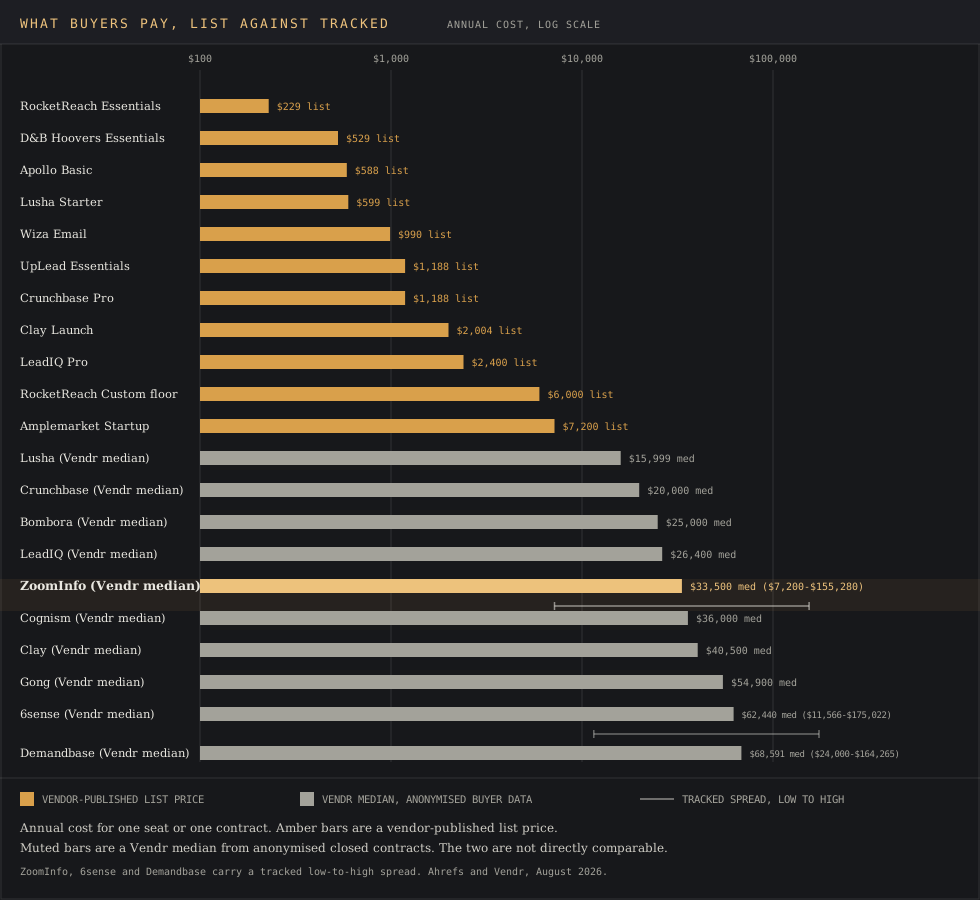
Amber bars are a vendor-published list price; muted bars are a Vendr median from anonymised closed contracts. The two are not directly comparable. ZoomInfo, 6sense and Demandbase also carry a tracked low-to-high spread.
The gap between the cheapest and the most expensive way to solve the same problem is the finding here. Ten RocketReach Ultimate seats cost $13,790 a year at list. ZoomInfo's tracked median is $33,500 and Demandbase's is $68,591, and all three sell access to company and contact records.
Custom pricing is the norm at the top of this market, and it isn't neutral. A vendor that quotes can price the same product differently by company size, and ZoomInfo's own spread of $7,200 to $155,280 shows the range that produces.
Free plan limits across the roster
Two of the most-searched questions about ZoomInfo alternatives ask about free options, and the answers are smaller than the marketing suggests. A free plan here means a permanent allowance; a free trial means a dated window that usually converts.
- ZoomInfo Lite: 10 reveal credits granted at signup, with further monthly credits conditional on joining the ZoomInfo Community and sharing data. The monthly figure isn't published. Requires a verified business email domain.
- Apollo.io: 900 credits per seat per year, granted monthly, so 75 a month. An email costs 1 credit and a phone number costs 8, capping the free plan at 112 phone numbers a year. Two sequences per team, 250 daily email sends, one mailbox.
- Clay: 500 Actions and 100 Data Credits a month, unlimited seats, 200 rows per table. Waterfall enrichment and bring-your-own-key are both included; phone enrichment and job-change tracking aren't.
- Seamless.AI: 50 credits, one user, no card. A one-time allowance, covering emails, mobiles & the Chrome extension.
- Lusha: 40 credits a month, one seat, Chrome extension & CRM integration included. Phone reveals draw on the same pool as emails.
- LeadIQ: 50 credits a month, one seat, all feature rows enabled. At 10 credits a phone number, that's five mobiles.
- Wiza: 20 valid emails and 5 phone numbers, no card, marketed site-wide as 25 free credits.
- RocketReach: five lookups total, no card, a one-time allowance.
- Crunchbase: unlimited profile views, but two search filters and five results per search, no export and no API.
Free trials run differently. ZoomInfo's is stated as typically seven days with no card and unquantified usage limits. UpLead's is seven days and five credits and requires card details that bill on day eight. Lead411's is seven days and 50 exports. D&B Hoovers gives the first month of Essentials free with no card, which is the most generous entry point in the roster. Bombora and Gong publish no free tier and no free trial at all.
Every free plan here exists to sell paid plans, and the shape of that path matters more than the credit count. Apollo, Lusha, RocketReach, Wiza and Crunchbase all run free to paid without a call. Seamless.AI, Lead411 and Cognism move from free or free trial straight to a custom plan, so the evaluation ends in a sales conversation regardless of what the test showed.
Two vendors gate what looks free. LeadIQ's pricing page shows database search enabled on the free plan while its help centre says search "is a feature that is only enabled for our annual Pro and Enterprise subscribers." Crunchbase disables export entirely during its seven-day trial, and exporting any data during a trial voids refund eligibility.
How to test contact data and data accuracy before switching
Vendor accuracy claims aren't comparable, because the vendors aren't measuring the same thing. UpLead states 95% accuracy at the point of download. Cognism runs a manual call to confirm the person answers. ZoomInfo publishes fill rates by field. Wiza defines a valid email as one verified to 97% deliverability and gives risky ones away free.
Four verification methods produce four percentages that can't be ranked against each other. None of them measures data depth, meaning how many fields come back populated per record, and none measures your territory. An extensive database carrying poor data quality in your segment loses to a smaller one carrying reliable data in it. High-quality data is a per-territory finding, and it doesn't transfer between segments.
Kaspr's comparison blog, published by a rival, says users report high bounce rates on Seamless.AI. Seamless publishes a 90% self-reported figure and refunds a credit automatically on any bounced email, which is the only bounce remedy in this roster stated as a documented policy.
Build the test list from your own closed deals
Take 200 to 500 records you already have verified outcomes for, ideally contacts your sales reps have reached in the last ninety days, and hold back the fields you're testing. Every vendor on this list will run a sample enrichment during evaluation. Run the same list through each one, in the same week, and compare the returned values against what you already know is true. A vendor's own sample list proves nothing about your segment.
Ask for the sample drawn through your own filters. A detailed contact database looks identical to a thin one until you constrain it by territory, company size & job title at the same time, which is the query your reps run every day.
Score four things on the returned file: match rate, field completeness, bounce rate on a live send & connect rate on dials. Verified contact data means a value that survives contact.
Testing direct dials and phone numbers
Phone data is where the spread is widest and where the credit cost is highest. LeadIQ charges 10 credits for a phone number, Apollo charges 8, and Lusha's own pages state 10 in the pricing FAQ and 5 in the documentation.
Measure two things separately: the match rate, meaning how often a number comes back at all, and the connect rate, meaning how often that number reaches the named person. ZoomInfo's 72% direct dial figure is the first of those, and no vendor on this page publishes the second.
Data enrichment against a live CRM
Run the enrichment in a sandbox before it touches production CRM data. Check what happens to a field the vendor has no value for, because some providers overwrite with nulls and some skip.
Check the refresh cadence in writing: Crunchbase's own pages say contact data refreshes monthly in one article and bi-weekly in another, and LeadIQ says "refreshed every month" on the pricing page against "more than 60% refreshed in the last 6 months" on the enterprise page.
Check international coverage against your actual territory
Global data claims collapse under a territory test. Lead411 names 13 countries and covers no others. LeadIQ states an 85% global phone match rate and puts EMEA at 70% on its pricing page against 50% in its own February 2025 release notes. Cognism sells against European coverage and reports 200 million European contacts. If half your pipeline is EMEA, a US-weighted database of 450 million records is worth less than a European one with a tenth of that.
Read the contract at the start of the evaluation
Ask for the order form and the master terms at the start of the evaluation. The clauses that matter are the term length, the notice window, what happens to uploaded data on termination & how credits behave at renewal. Gong's terms require 60 days' written notice and reprice at renewal for any account that reduces volume. Clay's Actions don't roll over at all. Wiza's credits expire and can't be extended.
Questions buyers ask about the best ZoomInfo alternatives
Who is ZoomInfo's biggest competitor?
Apollo.io, measured by how often buyers compare the two. Its pair queries carry 1,410 monthly US searches, 19% of the 7,200 across all eighteen pairs and more than the next two tools combined. On revenue and enterprise contract size the answer is different, and Demandbase's $68,591 Vendr median is the closest competitor there.
Is there a free version of ZoomInfo?
Yes. ZoomInfo Lite grants 10 reveal credits at signup and further monthly credits only to accounts that join the ZoomInfo Community and contribute data. There's no self-serve path from Lite into a paid tier without a sales call.
Is there a free alternative to ZoomInfo?
Apollo.io's free plan is the largest at 900 credits per seat per year. Clay's free tier carries 500 Actions and 100 Data Credits a month with unlimited seats. Seamless.AI grants 50 one-time credits. None of the three is a working substitute for a paid contract at volume; they're evaluation allowances.
Is RocketReach or ZoomInfo better?
They stop being comparable above a certain contract size. RocketReach publishes $19 to $115 per seat per month and carries no dialer and no intent data. ZoomInfo's tracked median is $33,500 and includes Engage, Chorus & Copilot. A sales intelligence budget under five figures lands on RocketReach almost every time.
Is ZoomInfo better than LinkedIn?
They sell different things. Sales Navigator sells access to LinkedIn's network and holds no verified emails or phone numbers at any tier. ZoomInfo sells the contact record. Teams that run both are buying a data licence and a relationship tool, and teams that pick one are usually deciding what their sales outreach depends on.
Is Lusha or ZoomInfo better?
Lusha wins on price and loses above five seats, which is where its self-serve path ends. Vendr tracks $15,999 for Lusha against $33,500 for ZoomInfo. Lusha states 98% email and 86% phone accuracy on its data page and 95 to 98% email and 90%+ phone on its about page, which is worth knowing before you quote either figure back to a rep.
Try it yourself
Sign up for Lusha
Free plan available, credit-based pricing after that.
 Visit Lusha →
May earn a commission if you sign up through this link, at no extra cost to you. Full affiliate disclosure.
What is the lawsuit against ZoomInfo?
State Teachers Retirement System of Ohio v. ZoomInfo Technologies Inc., No. 3:24-cv-05739-TMC, filed in the Western District of Washington on 4 September 2024. The complaint alleges the company used "manipulative and coercive auto-renew policies and threats of litigation" to keep customers in contracts they wanted to leave.
Is ZoomInfo outdated?
Its record counts are stated three ways on its own pages, at 500 million, 420 million and 300 million professional profiles. That's a documentation problem. Every contact database in this category decays as people change jobs, and the meaningful question is the published refresh cadence, which ZoomInfo doesn't state in the same place as its hit rates.
Who are the best ZoomInfo competitors for small sales teams?
The published-price tier. Apollo.io at $49 a seat, UpLead at $99 a month, RocketReach at $19 a seat annually and Wiza at $49 a month all sell without a contract minimum. Lusha runs to five seats self-serve. Every quote-only vendor in this roster prices for a larger buyer, and the Vendr medians in the pricing table show what that means for outbound teams running lean.
Which ZoomInfo alternatives include buyer intent data?
Bombora and 6sense sell intent data as the product. Demandbase, Cognism, Apollo.io and ZoomInfo all bundle a version of it into higher tiers. Lead411 licenses Bombora's feed, at $2,500 per seat a year on top of the subscription, which is worth knowing before comparing intent signals between the two.
Do any of these replace ZoomInfo's data enrichment?
Clay is the closest, and it works differently: it calls other providers, and a customer can plug in an existing ZoomInfo, Apollo or Clearbit key to skip the data charge. Apollo, Lusha & Cognism all run enrichment against CRM data on their own B2B data. The question to settle first is what your provider does with a field it has no value for.
How should a team compare data accuracy across vendors?
Run one list through every finalist in the same week and check the returns against outcomes you already have. Ignore the headline percentages, since UpLead's 95%, Cognism's call-verification and ZoomInfo's 96% business email hit rate measure three unrelated things.
Test the match rate and the connect rate on phone numbers separately, and read the refresh cadence out of the documentation.
Disclaimer
This page includes one or more affiliate links. If you sign up for a product through one of them, this site may earn a commission at no extra cost to you.