ZoomInfo pricing in 2026: what the $33,500 median contract buys
 By Jan Suski. I go deep on every review, checking every number against its source and digging up details other coverage misses, a habit from six years of SEO and link building for tech companies. Bylines at Surfer, Brand24, and Senuto. How the scoring works.
The numbers ZoomInfo pricing, checked 4 October 2026
The median buyer pays about $2,792 a month, so the answer to how much is ZoomInfo per month sits near $2,800 before add ons.
An 89% retention rate means revenue from ZoomInfo's existing customers shrank 11% in a year, and every renewal negotiation happens against that number.
The dearest tracked contract costs 21.6 times the cheapest, which means seats, credits and modules move the ZoomInfo cost more than the plan name does.
ZoomInfo's pricing page lists six plans and no seat prices. Checked on 4 October 2026, zoominfo.com/pricing shows three sales tiers (ZoomInfo Professional, Copilot Advanced and Copilot Enterprise) and three marketing tiers (Marketing Demand, ABM Lite and ABM Enterprise). Every card ends in a free-trial button, a demo request or a "Get Pricing" form, so each price is set in a sales conversation.
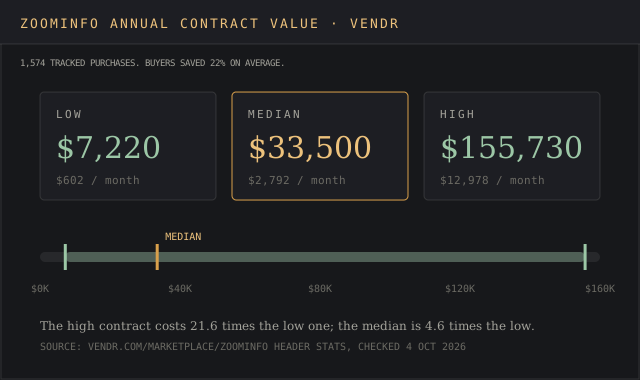
So the useful answer to how much does ZoomInfo cost comes from buyers. Vendr's marketplace tracks a median ZoomInfo contract of $33,500 a year across 1,574 purchases, with a low of $7,220 and a high of $155,730 (Vendr, header figures checked 4 October 2026). ZoomInfo does print one dollar rate card, on its GTM AI pricing page: credits from $0.45 down to $0.25 each, AI credits at $0.05 and top-ups from $20.
This report is written for sales ops & revenue teams scoping a first contract or a renewal; the product itself is covered in our ZoomInfo review.
How much does ZoomInfo cost per year and per month
ZoomInfo pricing is quote-only on every seat-based plan. The FAQ on the pricing page names three inputs: "Features and functionality", "Number of licenses" and "Credit usage". More advanced features, such as technographics, department budgets, org charts and funding alerts, sit behind richer credits that cost more than basic firmographic ones.
The $33,500 median works out to $2,792 a month. The $7,220 floor is $602 a month. At the $155,730 top end, ZoomInfo costs an arm and a leg: $12,978 a month.
ZoomInfo sells paid plans as annual contracts, so the monthly cost is a division exercise. ZoomInfo offers "multiple payment options depending on your package", per its pricing FAQ, and its first-quarter 2026 10-Q says its "standard billing terms typically require payment at the beginning of each annual, semi-annual, or quarterly period." Its own pricing guide is blunter: "Monthly billing is not standard."
A ZoomInfo price quoted per month is an annual commitment divided by twelve.
ZoomInfo pricing tiers for sales teams
ZoomInfo offers three sales tiers, and they stack: each tier includes everything in the one below it. ZoomInfo lists the features of each and the price of none. Third-party guides such as this August 2026 one still label the three tiers Professional, Advanced and Elite.
ZoomInfo Professional
The ZoomInfo Professional card on zoominfo.com/pricing carries a feature list and a "Start free trial" button, so the professional plan starts wherever the quote does; the lowest yearly contract Vendr tracked across every tier is $7,220. The professional plan is the entry tier for sales teams that need contact data and company data with exports:
- Contact and company profiles, with quick and advanced search filters and exporting
- Mobile numbers and business email
- Prospect lists, alerts and tagging, plus territory filters with CRM match insights
- CRM integration with HubSpot, Salesforce and others
- Chrome extension and mobile app
- AI email generation, AI-assisted dialing and standard support
Intent signals start one tier up.
Copilot Advanced
The Copilot Advanced plan starts where the professional plan stops and adds the signal layer:
- Location and hierarchy data: a company's geographical location and its parent-subsidiary tree
- Account prioritization with breaking alerts, plus an Account Fit Score
- Social links, funding and tech data
- Email exports to Outreach or Salesloft
- Buyer intent signals and clusters, website visitors and champion tracking
- Job-posting changes, buying-group filters and automated outreach workflows
This is the first tier where ZoomInfo's intent data appears in a sales package, the layer that lets reps zero in on accounts already researching a purchase.
Copilot Enterprise
Copilot Enterprise, the top tier and the one those guides call the Elite plan, adds real-time buyer intent, custom intent signals, earnings-call signals, competitor alerts, custom integrations, advanced workflows, advanced reporting and analytics, AI account summaries, AI ideal-customer-profile creation, Copilot chat, a dedicated customer service manager and white-glove onboarding.
A quote that says Elite plan, advanced plan or professional plan should list the features above line by line, since ZoomInfo's page, as of October 2026, uses the names ZoomInfo Professional, Copilot Advanced and Copilot Enterprise.
Marketing plans for account based marketing
The marketing cards carry the only hard numbers on zoominfo.com/pricing, and they're credit and campaign counts. Intent topics set how much intent data a plan tracks, and that data flags which accounts are in market. Marketing teams buying for account based marketing pick between three packages:
| Plan | Included credits | Intent topics | Display Network |
|---|---|---|---|
| Marketing Demand | 75,000 | 25 | 0 campaigns |
| ABM Lite | 75,000 (all Demand features) | 100 | 10 campaigns, 10,000 accounts |
| ABM Enterprise | 150,000 | Unlimited | Unlimited campaigns and accounts |
Marketing Demand bundles AirCover, WebSights and FormComplete audiences plus CRM and MAP integrations. ABM Lite adds Facebook, LinkedIn and Google retargeting plus a dedicated campaign manager, so campaign management is a tier decision. Comparable ABM pricing sits in our ABM platforms ranking.
GTM AI: the one ZoomInfo rate card with dollar figures
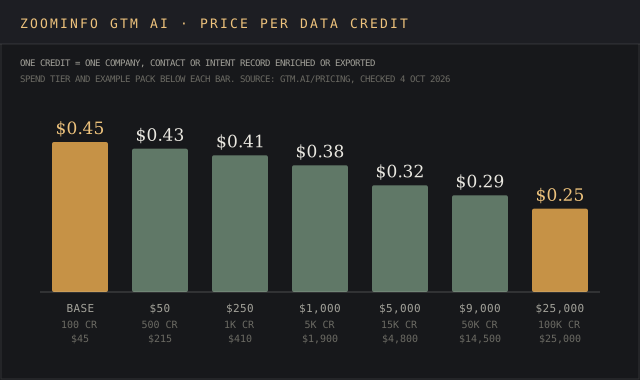
ZoomInfo prints prices in one place: gtm.ai, its headless product that sells contact data, company data and intent data through API access, MCP and CLI. Sign-up includes 1,000 data credits and 1,000 AI credits with no strings attached, then pay-as-you-go top-ups from $20. The page sums it up as "One tier, no contract, no seat fees."
| Spend tier | Price per credit | Example pack |
|---|---|---|
| Base | $0.45 | 100 credits for $45 |
| $50 | $0.43 | 500 credits for $215 |
| $250 | $0.41 | 1,000 credits for $410 |
| $1,000 | $0.38 | 5,000 credits for $1,900 |
| $5,000 | $0.32 | 15,000 credits for $4,800 |
| $9,000 | $0.29 | 50,000 credits for $14,500 |
| $25,000 | $0.25 | 100,000 credits for $25,000 |
Every price in this table is ZoomInfo's published GTM AI list price, read off gtm.ai/pricing on 4 October 2026.
One data credit covers one company, contact or intent record "enriched or exported", and ZoomInfo "charges once per data point, per 12 months". AI credits cost a flat $0.05 and pay for research agents and drafted outreach. The Enterprise column is custom and adds mobile phone data, SSO/SAML and SLA-backed support.
For a data team that only needs data enrichment or verified contact information through an API (our data enrichment tools ranking covers the rest of the field), 50,000 records for $14,500 is the cheapest documented way into ZoomInfo's database. A $20 top-up is a drop in the bucket next to a $33,500 seat contract.
ZoomInfo Lite: the free tier and its price in data
ZoomInfo is free to use at one level. ZoomInfo Lite, per the company's pricing guide, includes 10 monthly credits (25 with Community Edition), advanced contact and company search for contact information, the ReachOut Chrome extension, the mobile app, email sending, a HubSpot CRM integration and WebSights Lite, a visitor identification tool capped at 10 reveals a day.
The fee is your inbox. The ZoomInfo Lite Community Terms of Use (updated 13 March 2025) say ZoomInfo may read signature blocks, header metadata and "your contacts in your email directory and email contact book." The same terms state: "In exchange for your access to ZI Lite, you are contributing data from your connected email account to ZoomInfo for ZoomInfo to use for its own purposes, including supplementing the ZoomInfo database."
How ZoomInfo credits work
ZoomInfo credits are the meter on every paid plan, and the pricing model has three dials: seats, credits and modules. The pricing page defines a credit as "the consumption (export) of a professional or company profile": one credit per export, from the web platform, the ReachOut extension or an API call made by a CRM integration. Credit usage occurs only on export, so contact searches and browsing lead data cost nothing.
Scheduled CRM data refreshes do cost: every API call from an integration draws on the same balance. Each package carries "a predetermined number of monthly credits," which sets the credit limits for the term, and "credits can be added to any package as needs change." That's how credit overages show up: per the same page, a team whose consumption runs past plan "can purchase additional credits" mid-contract.
Pre-packaged integrations "typically have a base cost to use and install and require a minimum purchase of bulk credits."
Credit limits cap high-volume campaigns. ZoomInfo's own sizing example puts a five-person SDR team, where each sales rep exports 50 potential clients a day, at "roughly 1,000 credits per week", or about 52,000 credits a year.
The guide also tells buyers to ask if unused credits roll over to the next period or expire at the end of each billing cycle, so rollover is a clause to negotiate against your business needs. On GTM AI the answer is printed: "Credits never expire while your account is active." On a seat plan, keep an eye on monthly credit burn from the first invoice.
Add ons ZoomInfo bills outside the platform fee
ZoomInfo's pricing guide lists the add ons to budget for and tells buyers to ask "which require separate line items":
- Streaming Intent, real-time intent data priced on "the volume of keywords and account universe" a customer tracks
- Engage, the sequencing and dialer module
- International data for records outside North America
- Additional seats beyond the included user count
- API and MCP access for custom integrations and AI agents
- Integrations, each with an install cost and a bulk-credit minimum
Ask for each one as a priced line before signing, or these add ons surface as hidden fees at renewal.
Conversation intelligence sits in the same bucket. Chorus, which ZoomInfo bought for about $575 million in July 2021 (8-K exhibit), records and analyses sales calls and is sold beside the core plans with website chat, neither with a published price. Premium support and other professional services run on service-specific terms in the order form, per ZoomInfo's License Terms & Conditions.
What drives a ZoomInfo quote
ZoomInfo's guide names five factors behind zoominfo pricing on a quote, and each one moves the number:
- Team size. "Paid plans include a minimum number of seats and scale with headcount."
- Credit volume, "typically the primary cost lever for high-volume prospecting teams."
- Features. Intent data, technographics and WebSights sit at paid capability levels.
- Integrations and API access, included at higher capability levels.
- Contract length. "Multi-year agreements typically carry better rates than single-year deals." Multi-year terms are optional: the guide calls paid plans annual subscriptions.
ZoomInfo also quotes by product. The 10-K lists Sales, Marketing, Operations and Talent, which Vendr's page still calls SalesOS, MarketingOS, OperationsOS and TalentOS, sold individually or bundled. Company size sets the seat count in ZoomInfo's pricing model, and the geographic location of target accounts decides if international data goes on the order form.
Hidden costs in a ZoomInfo contract
The largest of the hidden costs is the exit, and the devil's in the details. ZoomInfo's License Terms state: "The Agreement is not cancellable and shall remain in effect until it expires or is earlier terminated according to its terms."
A buyer can leave early only for an uncured material breach (21 days after written notice), for availability under 99.9% twice within three months, if ZoomInfo can't restore 95% data accuracy within 30 days, or by mutual agreement.
Late payment carries its own hidden fees. The same terms allow interest of 1.5% a month on overdue invoices, suspension of access, and acceleration so that "all unpaid Subscription Fees shall be immediately payable."
Renewal is the line item buyers miss. ZoomInfo's paid plans are annual contracts that auto-renew unless notice is given, and its own guide warns that "Renewal pricing can increase from the initial contract rate," tells buyers to "cap renewal increases in the contract," and to confirm the notice period before auto-renewal triggers.
A renewal clause with no cap is a red flag, and buyers who miss the boat on the notice window renew for another year. The CEO of Opsgility, an 11-to-50-person e-learning firm, posted a 1-out-of-10 review on TrustRadius:
"ZoomInfo is a very expensive product (over $50,000/year) for a very small team. I was OK trying the software, but where they are bad is their auto renewal feature in their contract."
Michael Washam, CEO, Opsgility, TrustRadius, 4 November 2020
Another TrustRadius reviewer scored ZoomInfo 1 out of 10 in May 2020 over the same clause:
"ZoomInfo used misleading language in the contract to auto-renew and pushed us for more payment even though we do not log in anymore and we verbally agreed that this would not auto-renew."
Taylor Davis, TrustRadius, 20 May 2020
Expiry has a cost too. Exported records stay usable, but platform access ends and "all information that has been uploaded into ZoomInfo's systems by Licensee" may be destroyed. Calendar the renewal date and the notice window on the day the order form is signed.
What buyers pay against ZoomInfo's opening quote
Across 1,574 purchases the median is $33,500, the floor $7,220 and the ceiling $155,730, and Vendr's buyers saved 21.81% on average against the quotes they started with.
The median contract costs 4.6 times the floor, and the quote factors above (seats, credit volume and modules) fill that gap. With intent, engagement and conversation intelligence add ons stacked on seats, contracts climb toward the $155,730 ceiling.
How to negotiate ZoomInfo pricing
ZoomInfo's own pricing guide says "the first number you receive is a starting point," then lists the levers to bring to the sales calls:
- Bring a competitor quote. The guide names Apollo, Clay and Cognism as rivals that "all offer transparent starting prices."
- Time it to quarter-end, when ZoomInfo's "sales teams are most motivated to close deals."
- Ask for multi-year rates, after modelling one-year against two-year total cost.
- Rewrite the auto-renewal clause: a longer notice window or a renewal price cap.
- Negotiate credit volume directly, since credits are the main cost lever for prospecting teams.
Once a competing quote and a redlined clause are in hand, the ball is in your court. Get the clause changes in writing. A CFO in computer software described what a verbal promise was worth on Capterra:
"We specifically asked over the phone to not have auto renewal in our contract. They snuck it in anyhow and held us to it. Costing us thousands of dollars."
Jonathan B., CFO, Computer Software, Capterra, 8 November 2021
Buyers who negotiate ZoomInfo pricing against Apollo have the comparison ready-made: Apollo charges $49 to $119 per seat a month on annual billing. An AI solutions architect at a small business wrote on G2 on 17 September 2026 that "The pricing feels extremely steep compared to platforms like Apollo, which makes it less viable for mid-market and smaller sales teams." Our Apollo vs ZoomInfo comparison prices the pair seat for seat.
A sales manager at a mid-market company wrote on G2 on 2 November 2023: "I would also like to see more flexibility around pricing as usage grows."
Data quality, data management and the 2024 privacy settlement
ZoomInfo puts its data quality in the contract. Section 1.5 of the License Terms gives ZoomInfo 30 days to bring licensed records back to "at least 95% accurate" after a buyer complains; if it can't, the buyer may terminate with a prorated refund. Maian Tran wrote on TrustRadius in a review last updated 6 May 2020: "Some contact information is out of date. I would say like 20% of the time the person isn't at that same job or has a different title".
Operations teams buy ZoomInfo Operations for data management and data enrichment: enriching CRM records already in place, which ZoomInfo's guide says "uses fewer credits" than re-exporting them. The company says its company information database of 100M+ companies and 500M+ contacts comes from multiple data sources, combining "machine learning, third-party partners, and 300+ human researchers."
The privacy bill arrived in 2024. Ramos v. ZoomInfo Technologies (N.D. Ill., No. 21-cv-02032) settled right-of-publicity claims under California, Illinois, Indiana and Nevada statutes for $29,557,612.50, per the motion for final approval, which set the final approval hearing for 21 November 2024.
Who ZoomInfo is priced for: enterprise sales teams
In the second quarter of 2026, 76% of ZoomInfo's contract value (ACV) came from Upmarket customers and 1,891 customers paid $100,000 or more a year, up nine from a year earlier. Quarterly revenue was $310.4 million, up 1.2%.
Subscriptions carry the lion's share of ZoomInfo's revenue generation: in the first quarter they brought in $303.5 million of $310.2 million, against $5.4 million from usage-based fees, per the same 10-Q.
ZoomInfo's own sizing example assumes 50 exports per sales rep per day. A Selling Partner Support Associate at an enterprise put the small-team problem plainly on G2 on 5 December 2023: "the rigid pricing blocks smaller teams or startups from getting a foot in the door."
For a team of one to three, the cheapest contract in Vendr's dataset, $7,220, still buys a full year of commitment. Lite and GTM AI reach the same database without one.
ZoomInfo pricing against alternatives with transparent pricing
On pricing transparency, the sales intelligence rivals below publish what ZoomInfo won't. Prices below were read from each vendor's own site on 4 October 2026; the Vendr medians come from Vendr's header stat blocks. Our Lusha pricing report and Cognism pricing report break down the two closest rivals.
| Tool | Entry paid plan, a month (annual billing) | Top published plan, a month (annual billing) | Vendr median a year |
|---|---|---|---|
| ZoomInfo | $20 GTM AI top-up | Quote only | $33,500* |
| Apollo | $49 per seat (Basic) | $119 per seat, 3-seat minimum (Organization) | $19,000* |
| Lusha | $37.45 (Starter) | $299.95 (Premium) | $15,999* |
| RocketReach | $19 (Essentials) | $115 (Ultimate) | $6,750* |
| Cognism | Quote only | Quote only | No live Vendr page |
| Seamless.AI | Quote only | Quote only | No median published |
Entry and top plan prices are each vendor's published list price, read off its own pricing page on 4 October 2026. Figures marked * are Vendr median annual contract values from buyer-reported data.
Each pairing has its own breakdown: Cognism vs ZoomInfo, Lusha vs ZoomInfo, RocketReach vs ZoomInfo and Seamless.AI vs ZoomInfo. The full field of 18 challengers sits on our ZoomInfo alternatives page.
Narrower lead generation tools undercut ZoomInfo on single jobs, and each lists a lead generation plan under $100 a month. Salespanel identifies companies visiting your website in real time from $99 a month billed annually. IGLeads pulls emails from social media platforms such as Instagram, Facebook and LinkedIn from $49 a month on annual billing. Gojiberry runs signal-based outreach for $99 a month and lets users cancel anytime.
Clearbit, the AI enrichment and data activation tool, became a wholly owned HubSpot subsidiary in December 2023 and is being integrated into HubSpot's customer platform.
What to budget for ZoomInfo
A realistic first-year budget has five lines:
- Platform: plan around the $33,500 median; the smallest tracked contract is $7,220.
- Credits: ZoomInfo's own example puts five SDRs at about 52,000 exports a year. As an outside benchmark, GTM AI sells 50,000 record credits for $14,500.
- Add ons: Streaming Intent, Engage, international data and Chorus each price separately.
- Renewal: a written cap on the increase, plus the notice date in the calendar.
- Exit: the full term, since the License Terms make the agreement "not cancellable."
Our intent data pricing report prices the Streaming Intent line across vendors, and the B2B data providers ranking covers the contact database side.
Frequently asked questions
Who is ZoomInfo's biggest competitor?
Among sales intelligence vendors, ZoomInfo's own pricing guide names Apollo, Clay and Cognism as the competitors buyers quote against it. For intent-led ABM, buyers also shortlist 6sense and Demandbase; see our 6sense vs ZoomInfo comparison and Demandbase vs ZoomInfo. For company credit and firmographic research, the comparison is D&B Hoovers vs ZoomInfo.
Will ZoomInfo have layoffs in 2026?
Yes. A May 2026 8-K announced a cut of about 600 employees, roughly 20% of first-quarter headcount, with $45 million to $60 million in charges and about $60 million in annual savings.
Is ZoomInfo worth the money?
Is ZoomInfo worth $33,500 a year? Divide the contract by the closed deals that started from a ZoomInfo record. At the median price, 10 such deals a year puts the data cost at $3,350 per deal; two deals put it at $16,750. For business growth evidence, ZoomInfo's guide cites Seismic, which attributed 39% of its pipeline to ZoomInfo signals; that pipeline growth figure is the vendor's case study.
How much does the CEO of ZoomInfo make?
ZoomInfo's 2026 proxy statement reports $33,297,747 in 2025 Summary Compensation Table pay for its principal executive officer, founder and CEO Henry Schuck, against $1,024,960 for 2024.
What is the lawsuit against ZoomInfo?
Ramos v. ZoomInfo Technologies, a class action in the Northern District of Illinois, brought right-of-publicity claims under California, Illinois, Indiana and Nevada statutes. It settled for $29,557,612.50, of which $14,228,617.50 went to the California class.
How accurate is ZoomInfo data?
ZoomInfo contractually guarantees 95% accuracy on licensed records and promises a fix within 30 days. Its GTM AI page claims 99.8% of its emails are name-corroborated to the target contact; that figure is ZoomInfo's own benchmark.
What is ZoomInfo used for?
Prospecting, CRM enrichment, intent data targeting, conversation intelligence on sales calls and ABM ads. The 2025 10-K lists ZoomInfo Copilot, Sales, Marketing, Operations and Talent as the paid products, with ZoomInfo Lite as the free edition.
Is ZoomInfo free to use?
ZoomInfo Lite is free, with 10 credits a month, but it's paid for in data: the Lite terms let ZoomInfo extract contacts from your connected email account.
Is there a cheaper alternative to ZoomInfo?
Yes. Apollo, Lusha and RocketReach all publish entry plans under $50 a month on annual billing, and Lusha's Vendr median is $15,999 a year against ZoomInfo's $33,500.
Is ZoomInfo an Israeli company?
No. ZoomInfo is headquartered in Vancouver, Washington, and has traded on Nasdaq under the ticker GTM since 13 May 2025. Its Israeli link is Chorus, the conversation intelligence firm it bought in 2021, which had offices in San Francisco and Tel Aviv per ZoomInfo's 2021 deal announcement.
Bottom line
In a nutshell, ZoomInfo pricing comes down to a quote, a credit meter and a contract that can't be cancelled. The $33,500 Vendr median is the best single planning number, the $7,220 floor is the cost of entry, and the 22% average saving is what negotiation is worth on the first quote.
On ZoomInfo pricing, the vendor's own documents hand buyers most of their bargaining power: a guide that tells them to cap renewal increases, a 95% accuracy clause, a free Lite tier to test the data, and a GTM AI rate card that prices one verified record at 25 to 45 cents. Enterprise sales teams that export at volume get value from it; small teams pay for a lead generation machine they can't keep busy.
Sources, and the ZoomInfo prices only a quote reveals
Plan names, features, credit definitions and the pricing FAQ were read off zoominfo.com/pricing on 4 October 2026. The GTM AI credit ladder comes from gtm.ai/pricing, the Lite terms from zoominfo.com/legal/ce-terms-conditions (updated 13 March 2025), and the contract terms from ZoomInfo's License Terms & Conditions at zoominfo.com/legal/ltc. Sizing examples and negotiation advice are from ZoomInfo's pricing guide on pipeline.zoominfo.com.
Contract values are the header figures on vendr.com/marketplace/zoominfo, checked 4 October 2026. Company figures come from ZoomInfo's filings on sec.gov (the 2025 10-K, the first-quarter 2026 10-Q, the 2026 proxy statement and a July 2021 8-K exhibit) and from ir.zoominfo.com (second-quarter 2026 results and a May 2026 8-K).
Buyer quotes are verbatim from named reviewers on trustradius.com, capterra.com and g2.com, each linked to the page it appears on and read there on 4 October 2026. The Ramos settlement figures come from the motion for final approval hosted on docs.simpluris.com. Rival prices were read off apollo.io, lusha.com, rocketreach.co, salespanel.io, igleads.io and gojiberry.ai; the tier labels in third-party guides come from leadgenjay.com, and the Clearbit deal from hubspot.com.
ZoomInfo prints no dollar figure on any of its six sales and marketing plans, and no price for Chorus, Engage, Streaming Intent or international data. Cognism and Seamless.AI publish no plan prices either.