Intent data pricing in 2026: what 15 providers charge, from €0 to $95,292
 By Jan Suski. I go deep on every review, checking every number against its source and digging up details other coverage misses, a habit from six years of SEO and link building for tech companies. Bylines at Surfer, Brand24, and Senuto. How the scoring works.
· Prefer this source on Google
The numbers Intent data pricing, checked 1 October 2026
Third party intent data bought on its own starts near a $25,000 median, and the ABM suites that bundle it sit at $62,440 and up.
First party signals from your own website cost €0 to $10,000 a year on published plans.
The widest spread belongs to TechTarget, whose tracked deals run from $27,000 to $593,267.
Bombora's median contract runs $25,000 a year across 35 deals in Vendr's tracked Bombora purchases. TechTarget's median runs $95,292. Apollo sells a seat with six intent topics for $49 a month, and Leadfeeder hands out 100 identified companies a month for €0.
I checked the pricing page of 15 providers and Vendr's purchase data on 1 October 2026, then sorted them by the unit each one bills: seats, credits, identified companies, topics or a flat platform fee. Every price links to its publisher. Where a vendor quotes privately, Vendr's tracked contracts stand in, header figures only.
It's written for demand gen leads, sales teams, revenue teams and founders setting a first B2B intent data budget. The intent data providers ranking scores the same vendors on signal quality. This page sticks to what they cost.
How intent data is billed across 15 providers
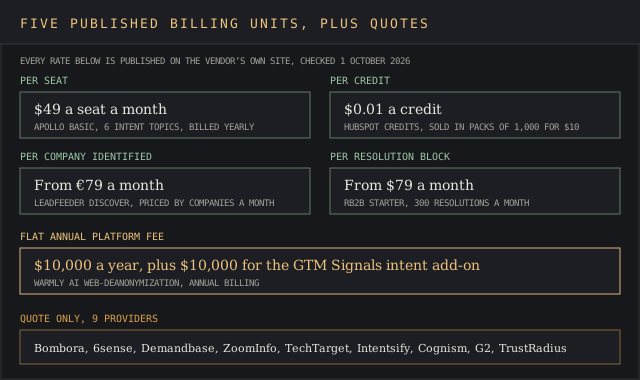
Each provider meters a different input. A $49 seat and a $25,000 topic license can describe the same buying signals bought from opposite ends, and five published billing units plus private quotes cover all 15 B2B intent data vendors on this page.
- Per seat. Apollo's pricing page lists Basic at $49, Professional at $79 and Organization at $119 per seat a month on annual billing, with 6, 6 and 12 intent topics. Apollo labels the feature Buying Intent, and intent tracking on the Free plan covers 1 topic.
- Per credit. HubSpot credits cost $0.01 each, sold in packs of 1,000 for $10, and tracking a company for intent is a monthly credit charge. Lusha meters contact reveals in credits too.
- Per identified company. Leadfeeder prices Discover from €79* a month by the number of companies it reveals.
- Per resolution. RB2B starts at $79 a month for 300 monthly resolutions.
- Flat annual fee. Warmly starts at $10,000 a year.
- Per topic and account volume. Bombora, ZoomInfo, 6sense, Demandbase, TechTarget, Intentsify, Cognism, G2 and TrustRadius quote intent privately.
Most teams end up paying on two units at once. ZoomInfo's plan grid names three inputs, features, licenses and credit usage, and Apollo pairs its seat price with 30,000 to 72,000 credits per seat a year. Custom pricing hides the mix until the order form arrives, and the devil's in the details of each credit table.
First party, second party and third party intent data
The source of the signal sets most of the price. Bombora's own intent data explainer defines first party intent data as "Data signals collected from prospects and customers engaging with a company's owned or paid experiences," and third party as "purchased or licensed data signals collected from outside" those experiences.
First party signals are the cheapest to buy because you already own the traffic. Website visits to your pricing and company pages, form fills, demo requests and content downloads are buying signals you already own, and visitor identification tools charge for matching that first party activity to a company. Leadfeeder Lite does it for €0 on 100 companies a month.
Second party data comes from a partner's site. TrustRadius sells what it calls "second-party, downstream intent data" on accounts researching pricing, comparing competitors and watching product demos on its review pages, late in the buying journey. G2 sells the same kind of signal from its own traffic.
Third party signals cost the most because someone else has to collect them, reading behavioral patterns across sites you don't own. Bombora's data page lists 5,000+ B2B sites in its co-op, 4.7 million unique domains, 15.8 billion interactions a month and 21,600+ B2B topics. It says 86% of the co-op's websites are exclusive to Bombora, and those publisher networks are the asset behind the price.
Account level signals cost less than person level ones. Informa TechTarget's October 2024 Priority Engine release describes intent at the market, account, buying group and prospect levels, drawn from 150 technology websites and 32M+ opted-in contacts for B2B go-to-market teams. Naming the decision makers inside a buying committee is the expensive part.
Third party intent data contracts on Vendr: $25,000 to $95,292 medians
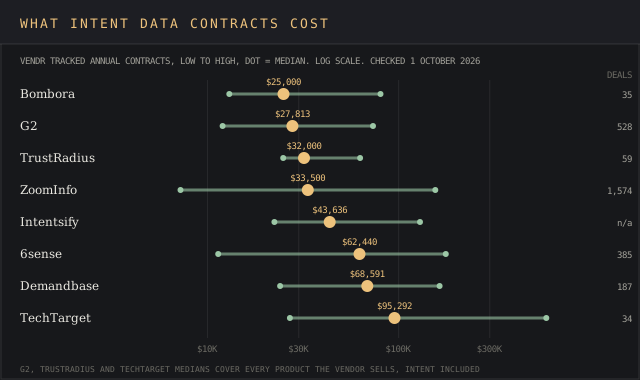
Eight intent data providers sell by quote and have enough tracked purchases on Vendr to show a median. The table below takes Vendr's header block for each one, checked 1 October 2026. G2, TrustRadius and TechTarget medians cover every product those vendors sell, intent included, so their figures sit above an intent-only deal.
| Provider | Median a year | Tracked low | Tracked high | Purchases | Average savings |
|---|---|---|---|---|---|
| Bombora | $25,000 | $13,000 | $80,450 | 35 | 12.41% |
| G2 | $27,813 | $12,000 | $73,517 | 528 | 17.71% |
| TrustRadius | $32,000 | $24,900 | $62,896 | 59 | 20.53% |
| ZoomInfo | $33,500 | $7,220 | $155,730 | 1,574 | 21.81% |
| Intentsify | $43,636 | $22,397 | $129,540 | Not shown | Not shown |
| 6sense | $62,440 | $11,376 | $176,809 | 385 | 16.77% |
| Demandbase | $68,591 | $24,000 | $164,037 | 187 | 13.27% |
| TechTarget | $95,292 | $27,000 | $593,267 | 34 | Not shown |
Every figure in this table comes from the header stat block on each provider's Vendr marketplace page, checked 1 October 2026. They are anonymized buyer contract values, and none of these eight providers publishes a list price for intent data.
Bombora Company Surge: $25,000 median, licensed by topic
Bombora sells account level intent direct and through resellers. Cognism's intent data page calls its signals "Bombora-powered," so the same raw intent data reaches buyers as a data feed inside other platforms. Buying direct costs a median $25,000 across 35 Vendr deals, with tracked contracts from $13,000 to $80,450 for research activity on licensed topics.
The license is metered by topic, and the cap shows up in reviews. A chief financial officer at a small business described the cheapest tier in a G2 review dated 7 July 2020:
"The lowest priced version (which is cheaper than ZoomInfo, Terminus, TechTarget, or Dun & Bradstreet BUT still expensive) only allows for 25 topics, and the topic database is very specific."
Lisa G., Chief Financial Officer, small business, G2 review, 7 July 2020
A senior marketing manager at a mid-market company gave Bombora 3.5 out of 5 on G2 in May 2026 and wrote that it was "Very expensive and too much learning curve compared to other tools like apollo". Apollo's 12-topic Organization plan lists at $119 a seat.
G2 Buyer Intent and TrustRadius review-site signals
Review sites sell bottom of funnel buying signals from their own pages. G2's Buyer Intent page lists product and category page views, competitor comparisons, pricing page engagement and review activity as the intent signals it tracks. G2 claims 100M buyers on G2.com, and its documentation covers sending the Buyer Intent data feed into Demandbase.
Neither review site prices intent publicly. G2's plans page lists Starter at $299 a month or $2,999 a year and places Buyer Intent under add-ons with no figure. The G2 pricing report breaks down what each plan gates, and is G2 legit covers how its review data is collected.
TechTarget Priority Engine: $95,292 median for purchase intent
TechTarget sells its buying signals as purchase intent, and it carries the top median here. Vendr's 34 tracked deals land at $95,292, from $27,000 to $593,267. That high end is 7.4 times Bombora's tracked ceiling, so a full program can cost an arm and a leg. A director of sales enablement at a mid-market company wrote in a November 2020 G2 review that "This is a very expensive tool even though it gives a lot of leads."
Intentsify: $43,636 median, no purchase count shown
Intentsify's Vendr page shows a $43,636 median with a $22,397 low and a $129,540 high, and it doesn't display how many purchases sit behind those figures. Treat it as the thinnest benchmark in this table.
ABM platforms that bundle intent: 6sense and Demandbase
ABM suites roll third party intent into a larger account based marketing platform, so the intent line never shows up on its own. 6sense's package page lists three Sales Intelligence packages with no prices, and its feature grid includes 3rd Party Intent, Web Visitor Identification and Job Postings.
Vendr's 385 tracked 6sense purchases put the median at $62,440, from $11,376 to $176,809, with 16.77% average savings. The 6sense pricing report walks through the packages, and the 6sense review scores the platform itself.
Reviewers say the cost lands hardest on small teams. An enterprise business development representative at a mid-market company wrote in a G2 review dated 5 May 2026:
"It can be expensive, and smaller teams may find it hard to justify the cost compared to simpler marketing tools."
Pallavi S., Enterprise Business Development Representative, mid-market, G2 review, 5 May 2026
A full stack developer at a mid-market company added in an April 2026 G2 review that "6sense is expensive and doesn’t offer transparent pricing". Vendr's spread backs that up, with a tracked high 15.5 times the tracked low.
Demandbase prices on two lines. Its own site describes "a clear platform fee that covers all the essential software and services" plus "a flat fee per user." Vendr's 187 tracked purchases put the median at $68,591, from $24,000 to $164,037. The Demandbase review and the ABM platforms ranking cover the rest of the suite.
Sales intelligence platforms with intent built in
Contact data vendors sell intent as a filter of intent signals on the contact database you already pay for. The price sits inside the seat or the credit, and the topic count changes by plan.
ZoomInfo: 25 to unlimited intent topics
ZoomInfo's plan grid shows no dollar amounts. Its marketing plans step from 25 intent topics on Marketing Demand to 100 on ABM Lite and unlimited on ABM Enterprise, and Copilot Advanced adds "Buyer Intent signals and clusters." Vendr's 1,574 tracked purchases put the median at $33,500, from $7,220 to $155,730, the lion's share of the 2,802 deals in the contract table above.
Renewal terms deserve a red flag. A product manager at a mid-market manufacturer gave ZoomInfo 2.5 out of 5 in a G2 review dated 24 November 2025 and wrote that "The contract includes an automatic renewal clause that you must actively request to have removed."
The data itself has been litigated. On 21 September 2023 the Ninth Circuit let Kim Martinez's right of publicity claim against ZoomInfo proceed, over profiles that used her name to sell subscriptions. The ZoomInfo review and 6sense vs ZoomInfo cover the platform side.
Cognism, Apollo, HubSpot and Lusha
- Cognism sells Standard and Pro with 5 seats included in each, and intent data appears on Pro only, on top of the contact database Pro already includes. Neither plan shows a price. The Cognism pricing report covers the quote process, and the Cognism review covers the data.
- Apollo publishes every tier, and Vendr still logs a $19,000 median across 101 purchases, from $4,284 to $45,000, with 30% average savings. The Apollo.io review covers its contact data.
- HubSpot's buyer intent page lists research intent across 200,000+ third-party websites, plus company news such as executive hires and funding rounds, next to the marketing activity already in its CRM. Its knowledge base places research intent in Starter and above, with credits needed to add net-new companies.
- Lusha charges 1 credit to reveal an email and 5 credits for a phone number, so direct dial numbers burn contact data credits five times faster.
Apollo's own numbers put the lesson in a nutshell. A $49 Basic seat costs $588 a year, so Vendr's $19,000 median buys about 32 of them. The sales intelligence ranking compares the contact side of these vendors.
Website visitor identification with first party signals from €0
Website visitor identification carries two free plans on this page, Leadfeeder Lite and RB2B Free. These first party signal tools turn anonymous website visits into named companies or people, and the price climbs with the share of visitors they can name.
Leadfeeder's pricing page lists four published tiers. Dealfront became Leadfeeder on 24 March 2026, and Vendr's page for it shows an $8,628 median, from $5,144 to $10,588.
- Lite costs €0 for the last 100 companies a month and 7 days of visitor history, with no strings attached.
- Discover starts at €79* a month billed annually and adds CRM sync.
- Activate starts at €369* a month billed annually and adds verified emails, phones and "Filter by intent signals."
- Scale starts at €599* a month and is billed annually only.
The free tier hasn't silenced cost complaints. A head of marketing at a small business wrote in a July 2025 G2 review that "For the price point, I’d expect even broader company coverage." The Leadfeeder review tests its match quality and data accuracy.
Match rates vary widely, and RB2B prints them on its own plan table. RB2B runs Free at $0 for 150 resolutions, Starter at $79 a month, Pro at $149 and Pro+ at $199. Contact-level coverage is 15-20% on Starter and Pro and 35-45% on Pro+, for US visitors only.
Warmly's pricing page starts at $10,000 a year for AI Web-Deanonymization, then $20,000 for Inbound Chat and $30,000 for AI Inbound Autopilot with unlimited AI agents. Intent signals from outside your site sit in a $10,000 GTM Signals add-on covering intent data, hiring activity and funding events, sold to identify in-market accounts. Vendr's Warmly median is $14,550.
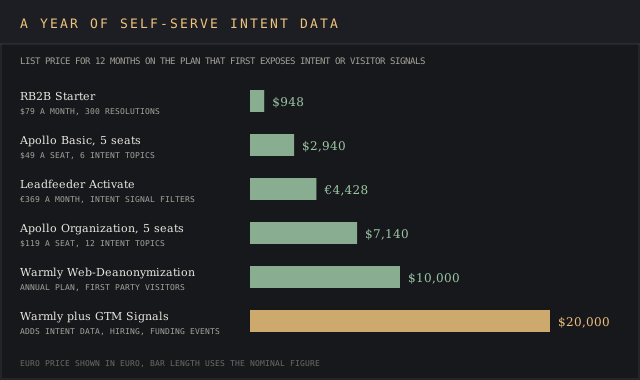
* Leadfeeder lists its prices in euros, so they're quoted as published, and the chart's €4,428 is twelve months of Activate at €369. At the European Central Bank reference rate of 1 EUR = 1.1403 USD, published 25 September 2026 and refreshed weekly, EUR 79 is about $90.08, EUR 369 is about $421, EUR 599 is about $683 and EUR 4,428 is about $5,049.
The visitor intelligence software ranking compares these signal tools on coverage.
Try it yourself
Start a Leadfeeder trial
Discover, Activate and Scale come with a 14-day free trial, and Lite stays free at 100 identified companies a month.
 Visit Leadfeeder →
May earn a commission if you sign up through this link, at no extra cost to you. Full affiliate disclosure.
Pricing claims that don't match the source
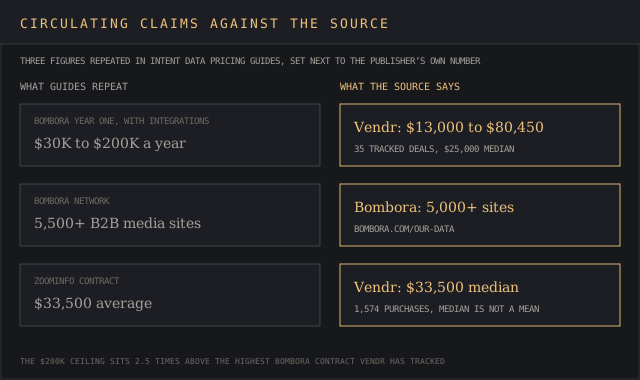
Several figures repeat across intent data provider guides without matching the publisher they cite. Three are worth checking before a negotiation.
Derrick's Bombora review, updated September 2026, puts year-one cost with topics and integrations at $30K-$200K and credits Bombora with 5,500+ B2B media sites. Vendr's highest tracked Bombora contract is $80,450, and Bombora's own data page claims 5,000+ sites.
A widely shared roundup from Salesmotion lists ZoomInfo's $33,500 as an average contract. Vendr labels it a median across 1,574 purchases, and half of those buyers paid less.
Warmly's $10,000 starting price holds up. It's printed on Warmly's own site, straight from the horse's mouth, and it buys first party visitor data only.
Hidden costs in intent data contracts
The real cost of intent data sits in the limits printed beside the price, so keep an eye on each one. Every item below comes from the vendor's own page.
- Topic caps. Apollo's 6 topics on Basic and ZoomInfo's 25 on Marketing Demand cap how many specific solutions you can watch for buying signals.
- Seat minimums. Apollo's Organization plan needs 3 seats, and Cognism bundles 5 seats into each plan.
- Credit metering. HubSpot charges a monthly credit fee for each tracked company and a one-time fee for each net-new company added.
- Add-ons. Warmly sells GTM Signals separately for $10,000 a year, and G2 lists Buyer Intent as an add-on.
- Billing terms. Leadfeeder Scale is annual only, and Apollo's annual billing saves 24% over monthly.
- Renewal clauses. The ZoomInfo reviewer above had to ask for the auto-renewal clause to be removed, so read the notice window before signing.
Staff time is the cost no vendor prints. Bombora's raw intent data arrives as a data feed and needs a scoring model and a CRM sync before sales reps see it, and a team without a data team pays for that in hours. Bombora's 21,600+ topics make it easy to bite off more than you can chew.
Where intent data fits in the sales cycle
Intent data earns its fee when sales teams spend their selling time on accounts that are actively researching. Salesforce's State of Sales research, built on 7,775 responses and released 8 December 2022, found reps spend 28% of their time selling.
Vendors now charge for the timing call itself. 6sense's top Sales Intelligence package adds a Predictive AI model, scores and AI recommended actions on top of the data credits, so the AI layer that tells reps when to engage is a priced tier.
Signal stacking combines several buying signals on the same account to raise confidence that it's in market. A practical stack pairs research activity from a third party source with website visits, then layers public signals such as leadership changes, job postings, hiring surges, funding rounds and earnings reports to zero in on high intent accounts.
Warmly's GTM Signals add-on bundles hiring activity and funding events with intent data, and HubSpot pairs research intent with executive hires and funding rounds. Leadership changes and job changes inside a buying committee are the person level buying signals outbound teams act on first.
Behavioral signals only pay off for revenue teams once they reach sales activities. Most teams route intent signals for high intent accounts into existing CRM and sequencing workflows, then send personalized outreach that names the topic the account researched. Third party signals without that routing sit on the back burner.
The aim is to identify potential buyers before they reach out. TrustRadius pitches its data as access to "accounts that are actively researching your and your competitors' products," and that timing advantage sits at the center of the business case for B2B intent data.
What to budget for intent data by team
Company size and target list length set the budget band for revenue teams more than anything a vendor says on a sales call. These three bands come from the published prices and Vendr medians above.
| Team | Typical stack | Annual range, published or tracked |
|---|---|---|
| Founder or small team | Leadfeeder Lite or RB2B plus Apollo Basic | €0 to $2,940 |
| Mid market teams | One of Warmly, Bombora, G2 Buyer Intent or ZoomInfo | $10,000 list to $33,500 median |
| Enterprise sales | 6sense, Demandbase or TechTarget Priority Engine | $62,440 to $95,292 medians |
The founder row uses list prices from Leadfeeder, RB2B and Apollo, and its $2,940 buys five Apollo Basic seats for a year. Warmly's $10,000 is also list price, and every other figure is a Vendr median.
Small teams should start with first party intent data and hit the ground running. Leadfeeder Lite and RB2B Free cost nothing, and a self serve trial on Leadfeeder (14 days) or RB2B (7 days) shows which accounts already visit before any third party contract.
Mid market teams buying third party coverage for high intent accounts sit where the $25,000 Bombora median and the $33,500 ZoomInfo median meet. Average savings of 12.41% to 21.81% are par for the course on Vendr, so use them as the opening ask.
Enterprise sales teams buying 6sense or Demandbase should budget against the median, with room toward Vendr's tracked highs of $176,809 and $164,037. Lead generation teams that only need demand gen alerts rarely need that tier.
Frequently asked questions
How much does intent data cost?
Intent data costs €0 to $30,000 a year on published self-serve plans and a $25,000 to $95,292 median on quoted contracts. Bombora sits at $25,000, ZoomInfo at $33,500, 6sense at $62,440 and TechTarget at $95,292 on Vendr.
What does intent data mean?
Intent data is a record of the buying intent a company shows through the content its employees read and the pages they visit while researching a purchase. Bombora defines it as data that "reveals when buyers (accounts and buying-group members) are actively researching topics across the internet, based on the content they consume."
What is intent data in Bombora and how does it work?
Bombora's Company Surge collects content consumption from its co-op of 5,000+ B2B sites, 15.8 billion interactions a month, and maps it to 2.8 million businesses across 21,600+ topics. Buyers license topics, and Vendr's median contract is $25,000 a year.
What does B2B data mean?
B2B data is information about businesses and the decision makers who work there, such as industry, revenue, technology used and contact data like emails and direct dials. B2B intent data is the behavioral layer on top, showing which of those companies show research activity on a purchase now.
What is G2 intent?
G2 Buyer Intent is G2's second party, account level signal feed, built from activity on G2.com such as product and category page views, competitor comparisons and pricing page engagement. G2 sells it as an add-on with no published price, and Vendr's G2 median across all products is $27,813.
Bottom line
Intent data spans three price bands, from first party buying signals to licensed research. Published self-serve plans cost €0 to $30,000 a year, intent built into contact data costs a $19,000 to $33,500 median, and standalone or ABM-bundled third party intent runs a $25,000 to $95,292 median.
The spread bites hardest on quoted vendors, with TechTarget's tracked deals reaching $593,267 and 6sense's high at 15.5 times its own low. Start from Vendr's median, ask for its average savings, and read the topic cap and renewal clause before signing.
For the tools themselves, the intent data providers ranking scores coverage and accuracy, and the competitive intelligence pricing report prices the neighbouring category the same way.
Sources, and what intent data vendors keep off their pricing pages
Every price, contract figure and review quote on this page was checked against its origin on 1 October 2026, and each links to its source on first use.
Sources in order of first use are vendr.com, apollo.io, hubspot.com, leadfeeder.com, rb2b.com, warmly.ai, zoominfo.com, bombora.com, solutions.trustradius.com, informatechtarget.com, cognism.com, g2.com, sell.g2.com, documentation.g2.com, 6sense.com, demandbase.com, law.justia.com, knowledge.hubspot.com, lusha.com, derrick-app.com, salesmotion.io and salesforce.com.
Tracked-contract figures are the header stat blocks on vendr.com/marketplace. Salesforce released its State of Sales research on 8 December 2022, Informa TechTarget published its Priority Engine release in October 2024, and Derrick last updated its Bombora review in September 2026.
Bombora, ZoomInfo, 6sense, Demandbase, TechTarget, Intentsify, Cognism, G2 and TrustRadius print no price for intent data on any page I checked, and Intentsify's Vendr page shows no purchase count.