ABM Platforms: 11 Account-Based Marketing Platforms Ranked (2026)
 By Jan Suski. I go deep on every review, checking every number against its source and digging up details other coverage misses, a habit from six years of SEO and link building for tech companies. Bylines at Surfer, Brand24, and Senuto. How the scoring works.
Quick comparison of the top ABM platforms
Eleven platforms with the account-data figure each vendor publishes, the lowest price a buyer can verify before a sales call, and the buyer each fits. Rows link to the full entry below.
| # | Provider | Published account data | Entry price | Best fit |
|---|---|---|---|---|
| 1 | Demandbase | 113M companies, 2.1T intent signals/mo | $68,360 median* | Enterprise ABM with a native DSP |
| 2 | 6sense | 75M companies, 500B intent signals/mo | $62,440 median* | Predictive buying-stage scoring |
| 3 | ZenABM | LinkedIn API engagement, no reverse IP | $59/mo, 37-day free trial | LinkedIn-led ABM on a small budget |
| 4 | ZoomInfo GTM Studio | 203M company records, 410M contacts | $33,500 median* (all ZoomInfo) | Teams that already buy ZoomInfo data |
| 5 | AdRoll ABM | 1.2B digital identities, 8 ad channels | Quote; retargeting tier pays media only | Ad-led ABM with Salesforce write-back |
| 6 | Madison Logic | 500M+ engagement signals/mo | Quote only | Content syndication plus ads |
| 7 | N.Rich | 18,000+ intent topics | From $34,830/yr plus ad spend | Mid-market teams wanting a rate card |
| 8 | Influ2 | Contact-level ads on 6 channels | $60,000 median* | Ads aimed at named buyers |
| 9 | Foundry ABM | 80M+ intent signals/week | Quote only | Tech vendors selling to IT buyers |
| 10 | HubSpot Marketing Hub | 200M+ company and buyer profiles | $800/mo plus $3,000 onboarding | HubSpot CRM shops starting ABM |
| 11 | Metadata.io | 8 paid channels, 26 integrations | $60,000 median* | Paid-media teams automating tests |
Medians marked * are anonymized buyer-reported contract values published by Vendr. Every other price is the one the vendor publishes itself; account data figures are each vendor's own counts and aren't measured the same way.
Where these figures come from
Account data counts, channel lists and plan prices are each vendor's own published figures, read 24 September 2026. Medians marked * come from the header stats on each vendor's Vendr marketplace page, last updated February 2026, and ZoomInfo's covers the whole company, sales products included.
G2 scores are G2's own aggregates on the same date. Madison Logic, AdRoll ABM and Foundry ABM publish no price and have no usable Vendr benchmark, and none of the eleven publishes an identification accuracy rate with its method, so no row claims one.
Bombora, 6sense, Demandbase and ZoomInfo also sit on our intent data providers ranking, which scores them on where the signal comes from. This page scores them as ABM platforms, on ad buying and CRM write-back as well as data, so the order differs.
ABM platforms, the software behind account-based marketing (ABM), pick a list of target accounts, find out which of them are researching your category, and put ads, web pages and sales alerts in front of the people inside them. The category's price range runs from ZenABM at $59 a month to Demandbase deals Vendr has tracked as high as $164,151 a year.
This ranking covers eleven account-based marketing platforms. Every figure links to the vendor's own page or to Vendr's anonymised purchase data, and every entry carries at least one quote from a named review platform.
It's written for marketing and sales teams running account based marketing against a defined list of high value accounts, usually B2B companies with long sales cycles, and for the revenue teams that fund ABM campaigns out of one budget.
Timing matters this year. Terminus merged into DemandScience in November 2024, RollWorks became AdRoll ABM in August 2025, and 6sense shut its free plan on 12 August 2026. Comparison lists written before those dates still describe Terminus and RollWorks as standalone products, so this ranking is built from each vendor's current pages.
Evaluation criteria for ABM platforms
Five criteria decide the shortlist, and each entry's closing line names the criterion that places it above or below its neighbours. Each one is a test a buyer can run during a trial and get a number or a yes or no back, whatever the ABM strategy behind the purchase.
Account identification and intent data volume
Count the companies the vendor publishes and the intent signals it processes a month, then run 50 of your own target accounts through the platform and record how many it matches. Ask how the match is made too: reverse-IP lookups infer the company behind a visit, while ad-platform data such as LinkedIn's reports the employer a member lists.
Send every shortlisted vendor the same 50 accounts, including ten you know are researching your category right now. The share of those ten each platform flags is a faster accuracy test than any demo dashboard.
Account identification draws on first party data (your site visits, your CRM data) and third party data (publisher co-ops, the ad bidstream); a platform that can't name its sources will struggle to identify target accounts outside the US. Account intelligence at this depth is what lets sales teams prioritize accounts before outreach campaigns start, and finding the right accounts without it is like finding a needle in a haystack.
Native ad buying against the account list
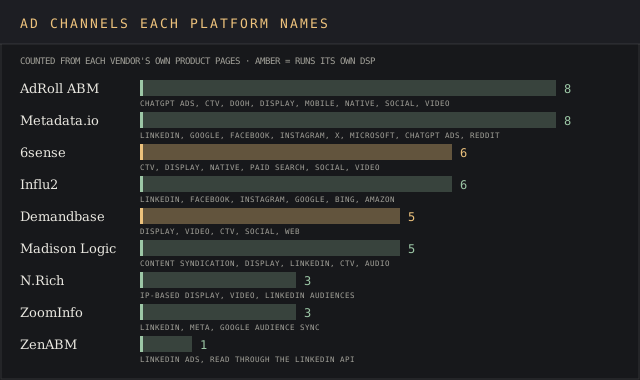
Ask if the vendor runs its own demand-side platform and count the channels it buys from one audience. A platform with its own DSP bids on display, video and connected TV against your account list; one without it syncs audiences to LinkedIn ads, Meta and Google and lets those platforms do the buying. Multi channel advertising from one audience keeps frequency and campaign performance reporting consistent across multiple channels.
Two-way CRM write-back
Read the vendor's help-center article for Salesforce and HubSpot and check the sync direction. Two-way sync pushes engagement data, fit grades and buying stages back into customer relationship management records, where sales teams work; one-way export leaves the scores stranded in the ABM tool. Good write-back lets reps prioritize target accounts based on the engagement data marketing sees, which is how ABM platforms align sales and marketing efforts in practice.
Price evidence
A published rate card beats a Vendr median, and a Vendr median with a purchase count beats a quote. The test is simple: can you estimate year-one cost, including onboarding and ad spend, before the first sales call? A marketing strategy built on an unknown number stalls at procurement.
Platforms here that publish a price a buyer can check without a sales call: ZenABM, N.Rich and HubSpot. Five more can be estimated from Vendr medians; Madison Logic, AdRoll ABM and Foundry ABM leave you with a quote.
Reviewer and analyst evidence
Record the G2 rating with its review count and the vendor's status in Gartner's 6 November 2025 Magic Quadrant for ABM Platforms, which evaluated eight vendors. A 4.7 from 115 reviews carries less weight than a 4.4 from nearly 2,000.
The 11 best ABM platforms, ranked
Each entry follows the same shape: who it fits, what it does with a figure attached, key features, pricing, pros and cons, a user quote, and the line that defends its position.
Demandbase
Best fit
Mid-market and enterprise marketing teams with a defined target account list, a budget near the $68,360 Vendr median, and a plan to run ads, website personalization and sales alerts from one contract.
Demandbase One is the full-suite account based marketing tool for sales and marketing teams, and the Demandbase review covers it in depth. Its data layer lists 113 million companies, 200 million contacts and 865,000 intent keywords, and its intent engine claims 2.1 trillion intent signals a month from 70 billion daily page views.
The differentiator is the B2B-native DSP, which runs digital advertising on display, video, CTV, social and web placements against the account list. Gartner named it a Leader for the fifth consecutive year in its 2025 ABM Magic Quadrant, positioned furthest for completeness of vision among the eight vendors evaluated.
Key features
- Native B2B DSP buying display, video, CTV and social against account lists
- Bidirectional sync with HubSpot CRM and Microsoft Dynamics, plus Salesforce and connectors to marketing automation platforms such as Marketo
- LinkedIn Ads integration that sends person-based audiences and pulls campaign reporting back
- Account scoring on first-party engagement and third-party intent across 865,000 keywords
- Mojo, a marketing agent launched 15 September 2026 that works across Google Ads, LinkedIn Ads, Marketo and Salesforce
Pricing
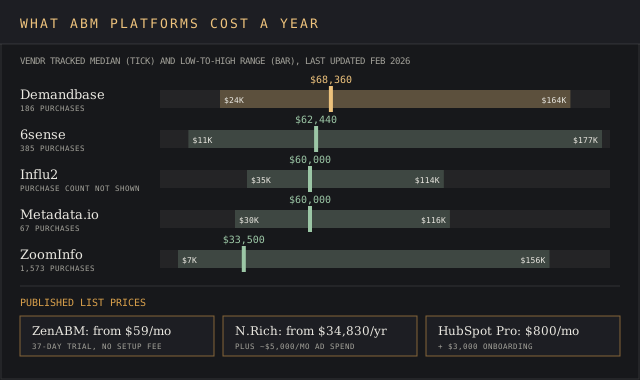
Demandbase publishes no rate card. Its pricing page describes a platform fee plus "a flat fee per user." Vendr's tracked median is $68,360 a year across 186 purchases, with a range of $24,000 to $164,151 and average negotiated savings of 13.27%.
Pros
- Largest published monthly intent-signal count in this ranking, 2.1 trillion
- Owns its ad buying, so CTV and display run on the same audience as scoring in one unified platform
- G2 lists 4.4 across 1,992 reviews, ahead of 6sense's 4.2 across 1,534
Cons
- Highest Vendr median of any tool ranked, $68,360
- Intent accuracy draws recurring complaints from sales users
- No self-serve tier or published entry price
- One contract for data, ads and web puts all your eggs in one basket at renewal
The complaint that shows up most in recent reviews is intent that doesn't match what reps hear on the phone. A BDR at an enterprise company wrote on G2 in September 2026:
"Some of the intent I receive is inaccurate. When I call the appropriate prospects, more often than not they were not researching what Demandbase said they were."
Matt P., BDR, Enterprise, G2 review, 18 September 2026
Why it's ranked #1. Demandbase wins the heaviest criterion outright: 113 million companies and 2.1 trillion monthly intent signals against 6sense's 75 million and 500 billion, plus a 4.4 G2 score against 4.2, for $5,920 more at the Vendr median.
6sense
Best fit
Enterprise sales and marketing teams that want predictive analytics on buying stage to prioritize accounts for budget, and have the operations staff to tune the model.
6sense Revenue Marketing scores accounts by predicted buying stage, and the 6sense review and 6sense pricing report go deeper on both. Its data page claims 500 billion intent signals analysed monthly, 481 million published buyer profiles, 75 million company profiles and 4.2 billion tracked IP addresses, and it matches anonymous traffic to accounts, pulling in intent from G2 and Bombora alongside its own account intelligence.
Gartner placed 6sense highest for ability to execute in the 2025 ABM Magic Quadrant. Chris Ball took over as CEO on 9 September 2025, with Jason Zintak moving to chairman after taking revenue from $5 million to more than $250 million.
Key features
- Native DSP covering CTV, display, native, paid search, social and video
- Audience sync to LinkedIn, Meta and Google Ads from the same segment
- 4.2 billion tracked IP addresses for matching anonymous traffic to accounts
- Predictive scoring on fit plus buying stage, built on 6AI, feeding campaign management for each segment
- Third-party intent intake from G2 and Bombora
Pricing
The 6sense pricing page lists three Sales Intelligence bundles and no dollar figures, and the free plan ended on 12 August 2026. Vendr tracks a $62,440 median across 385 purchases, a range of $11,376 to $176,809, and 16.77% average savings.
Pros
- Six ad channel types through its own DSP, one more than Demandbase names
- Deepest Vendr sample of the enterprise suites, 385 purchases
- Lower tracked floor than Demandbase: $11,376 against $24,000
Cons
- G2 score of 4.2 across 1,534 reviews, lowest of the three Leaders here
- Reviewers describe months of manual overriding before the scores earn trust
- Customer success quality draws specific complaints
Teams hoping to hit the ground running should plan for tuning time. A senior performance marketer running 6sense at enterprise scale described the reporting gap on G2 in July 2026:
"Reporting is clunky. Getting a clean view of influenced pipeline requires more setup than it should. Most teams end up exporting to a BI tool anyway."
Deepak K., Senior Performance Marketing Specialist, Enterprise, G2 review, 24 July 2026
The same reviewer credits the core product: "Knowing which accounts are actively researching before they fill out a form changes how you prioritize budget."
Why it's ranked #2. 6sense loses to Demandbase on published data, 75 million companies against 113 million, and beats ZenABM because its native DSP buys six channel types where ZenABM works on LinkedIn alone.
ZenABM
Best fit
B2B teams whose ABM program runs on LinkedIn ads and who want account scoring and CRM sync for under $500 a month.
ZenABM turns LinkedIn ad engagement into account-level intent, and the ZenABM review covers its scoring math in depth. It reads which employees at your target accounts saw and clicked your ads straight from the LinkedIn API, and its homepage puts the method plainly: "No unreliable reverse-IP lookups, no guesswork." It scores those accounts, builds ABM campaign dashboards and pushes the results into HubSpot, Salesforce or Attio.
There's no markup on ad spend, and ZenABM's pricing "does not depend on your ad spend either." Its Zena AI agent and MCP server let a team create LinkedIn campaigns, change bids and budgets, pause weak ads and pull reports from inside Claude or ChatGPT.
Key features
- Company engagement and intent read from LinkedIn API data, from 1 ABM campaign on Starter to unlimited on Pro
- Account scoring, default on Starter and customizable from Growth
- HubSpot sync on every plan; Salesforce, Attio and webhooks from Growth
- Zena AI agent, 10 chats a day on Starter up to unlimited on Pro
- MCP server for managing LinkedIn campaigns from Claude and ChatGPT
Pricing
The full rate card is public. The pricing page lists Starter at $59 a month, Growth at $159, Pro at $399 and Agency at $479 from three client accounts, with annual billing worth two months free. Every plan starts with a 37-day free trial, no setup fees and cancel-anytime terms, so year one on Starter costs $708.
Pros
- Lowest published price in this ranking, $59 a month
- No markup on LinkedIn ad spend, and the fee doesn't scale with it
- Engagement comes from LinkedIn's own member data, with no reverse-IP matching
Cons
- One channel: its feature list covers LinkedIn ads only, with no display, CTV or website personalization module
- G2 lists 5.0 from six reviews, the smallest sample ranked
- Starter caps you at one ABM campaign and 10 AI chats a day
A growth marketing manager running LinkedIn ABM described the core use on G2 in June 2026:
"seeing an account move from impressions to clicks to engagement over time, and using that progression to time BDR outreach. LinkedIn's native dashboard doesn't come close to this level of account-level visibility."
Kamila I., Growth Marketing Manager, Mid-Market, G2 review, 26 June 2026
Her complaint in the same review was that "Filtering the data to specific ranges was challenging before," which ZenABM's Claude connector has since eased.
Why it's ranked #3. ZenABM wins price evidence outright, $59 a month published with a 37-day trial against ZoomInfo's $33,500 Vendr median, and reads intent from LinkedIn's API, but it trails 6sense, whose DSP buys six channel types to ZenABM's one.
ZoomInfo GTM Studio
Best fit
Teams already paying for ZoomInfo contact data who want account targeting and ad audiences without a second vendor.
ZoomInfo's marketing product, renamed GTM Studio on G2, is the data-first entry here; the ZoomInfo review covers the full platform. ZoomInfo lists 203 million company records, 410 million contact profiles and more than 300 targeting filters, the largest published company count in this ranking.
ZoomInfo was named a Leader in the 2025 ABM Magic Quadrant, its second year in a row, and says it serves 35,000 customers. Its ad workflow builds audiences and launches campaigns on LinkedIn, Meta and Google. For ZoomInfo customers, GTM Studio is the best of both worlds only if three-channel ad reach covers the plan. For the head-to-heads, see Demandbase vs ZoomInfo and 6sense vs ZoomInfo.
Key features
- Audience builder to target prospects with 300+ firmographic and technographic filters
- Social ad campaigns on LinkedIn, Meta and Google from ZoomInfo audiences
- Waterfall enrichment across 25+ vendors, per G2's product description
- Contact-level sales data for follow-up on engaged accounts
Pricing
No rate card. Vendr's median for ZoomInfo as a whole is $33,500 a year across 1,573 purchases, ranging $7,213 to $155,820, with 21.81% average savings, the most negotiating room of any vendor here.
Pros
- 203 million company records, the largest published count ranked
- Lowest Vendr median of the three Gartner Leaders, about half Demandbase's
- G2 lists GTM Studio at 4.5 across 3,512 reviews
Cons
- Ad activation named on its own pages covers three channels
- Vendr's figures blend sales and marketing products
- Pricing reads high to smaller teams in recent reviews
A business development rep wrote on G2 in January 2026 that "Pricing is also on the higher side, which can be a barrier for smaller teams, and it requires some onboarding time to fully unlock its value" (Deva D., Mid-Market). A healthcare marketer's 2024 review is more positive:
"ZoomInfo Marketing's Audience Builder tool allowed us to target the right prospects in the HCP space with precision, leading to more effective marketing campaigns."
Verified User, Hospital & Health Care, Mid-Market, G2 review, 3 June 2024
Why it's ranked #4. ZoomInfo's 203 million company records and $33,500 median across 1,573 purchases beat AdRoll ABM, which publishes no ABM price; it trails ZenABM, which publishes $59 a month where ZoomInfo quotes every deal.
AdRoll ABM (formerly RollWorks)
Best fit
Salesforce-based B2B teams whose account based marketing strategies lean on advertising, and who want the widest channel mix from one audience.
NextRoll folded RollWorks into the AdRoll brand on 27 August 2025, and existing customers kept their plans unchanged. The platform lists eight channels for ABM campaigns, from ChatGPT Ads and connected TV to digital out-of-home, and says its packages include audiences, integrations and measurement where "most ABM platforms tack on additional fees."
Its InIQ model is built on 1.2 billion digital identities, claims 90% company-domain match rates, and layers Bombora and G2 intent on top.
Key features
- Bi-directional Salesforce sync pushing ICP Fit Grades (A to F), surging keywords and new accounts
- HubSpot write-back to company records, daily at 12 pm UTC
- LinkedIn campaigns launched in-platform, with a 300-profile match minimum
- Account scoring and audience matching on ICP fit plus journey stage, with campaign management across every channel from one list
Pricing
The AdRoll pricing page shows four ABM packages without dollar figures; the Account-Based Retargeting tier carries "No fee to get started and pay only for media." Contract media credits can't be spent on LinkedIn campaigns, so LinkedIn spend is a separate line.
Pros
- Eight ad channels, tied for the widest reach ranked
- Documented two-way Salesforce sync with named custom objects
- G2 lists 4.3 across 655 reviews
Cons
- No price on the page and no ABM-only Vendr benchmark
- HubSpot sync writes to company records only, never contacts
- Two brand changes in two years confuse reviewers
A growth marketing manager flagged the list-type limits on G2 in April 2026: "For example, you can export account lists to LI but not contact lists. You also can't run an ad playbook with a contact list." (Melissa G., Mid-Market). A small-business digital marketing manager explained why the inventory costs stay worth it:
"Despite the ad inventory costs being a bit on the higher side, we stick with this platform because of the relevant publisher apps and websites our ads show on"
Amit Y., Digital Marketing Manager, Small-Business, G2 review, November 2025
Why it's ranked #5. AdRoll ABM names eight channels and syncs Salesforce both ways, beating Madison Logic's five channels, but trails ZoomInfo, which backs its price with a $33,500 Vendr median over 1,573 purchases where AdRoll publishes nothing.
Madison Logic
Best fit
Demand generation teams that want content syndication leads and ABM campaigns bought from the same vendor.
Madison Logic calls itself the only ABM solution combining content syndication, display, LinkedIn ads, CTV and audio on one platform. It says 500 brands use it to reach 415 million decision-makers, and its ML Insights intent layer claims 500 million monthly engagement signals and 16.2 billion monthly content consumption events.
BC Partners agreed to buy a majority stake in December 2022. On 9 September 2026 it launched AI Planner, which turns strategy into audiences, channel mix and budget.
Key features
- Content syndication delivering leads from target accounts
- Targeted advertising campaigns on display, CTV and audio
- MLI Score ranking accounts by research activity
- Integrations with Salesforce, LinkedIn, Gong, Convertr and Adobe Journey Optimizer
Pricing
Madison Logic publishes no pricing, and its Vendr listing shows no contract data. Budget it as a quote, and ask how content syndication leads are priced against the media.
Pros
- Only platform here selling syndicated leads and ads together
- Five channels, audio included
- G2 lists 4.3 across 275 reviews
Cons
- No price evidence at all before a call
- Reach claims differ by page: 415 million on the homepage, 485 million on ML Insights
- Reviewers report separate logins for leads and insights
"The MLI Score is something I check regularly now because it gives us a clear signal on which accounts are actively in research mode versus just passively existing in our target list."
Harshal D., Senior Performance Marketing Manager, Mid-Market, G2 review, 29 April 2026
A healthcare reviewer in July 2026 disliked "having to log into 2 different platforms to get the leads and then see the insights with the leads" (G2).
Why it's ranked #6. Madison Logic buys five channels and publishes 500 million monthly engagement signals, beating N.Rich's three channels, but loses to AdRoll ABM's eight channels and documented two-way Salesforce sync.
N.Rich
Best fit
Mid-market B2B teams that want an ABM platform with a price on the website and engagement-based ad billing.
N.Rich bundles intent data, ICP account lists, visitor identification and IP-based digital advertising, and says it serves 250 GTM teams. It tracks intent across 18,000 topics and reports an average 85% match rate on LinkedIn audiences, which it refreshes every 24 to 48 hours through Salesforce and HubSpot syncs.
Key features
- IP-based display advertising and video ads across the web
- LinkedIn Matched Audiences sync
- Intent based targeting on up to 50 topics on the Enterprise plan
- Salesforce and HubSpot integrations with attribution
Pricing
The N.Rich pricing page lists Growth from $34,830 a year and Enterprise from $58,050. Ad spend is a separate line committed for 12 months, and the page puts the realistic starting point at $5,000 a month, so year one runs near $95,000 at that level.
Pros
- Published rate card, rare in this category
- Unlimited sales seats on both plans
- G2 lists 4.7 across 115 reviews
Cons
- Ad spend commitment roughly doubles year-one cost
- Three ad channels, against Madison Logic's five and AdRoll's eight
- Turning intent into action takes manual work, per reviewers
A VP of Marketing summed up the gap on G2 in June 2026: "The intent data is powerful, but turning it into action takes more manual orchestration than I'd like." (Chris C., Mid-Market). Another mid-market reviewer on G2 wrote in May 2026: "Within the first quarter, we saw a 35% increase in pipeline from target accounts." A February 2026 G2 reviewer wrote that the platform "offers good quality data but lacks the media or placement performance."
Why it's ranked #7. N.Rich publishes a $34,830 floor and tracks 18,000 topics, beating Influ2's quote-only $60,000 Vendr median, but its three ad channels lose to Madison Logic's five.
Influ2
Best fit
Teams selling to small buying committees at high-value accounts who want ads served to named people, and contact-level engagement data for sales follow-up.
Influ2 targets individual contacts inside accounts across six channels: LinkedIn, Facebook, Instagram, Google, Bing and Amazon. Its homepage reports pipeline conversion 2.18 times higher for buying groups with at least one ad click. In March 2026 it launched Audiencescope, a paid contact-level intent add-on.
Key features
- Person-based ad targeting across six channels from one interface
- Contact-level engagement reporting, names and titles included
- Integrations with Salesforce, HubSpot and Marketo, plus Outreach and Salesloft for sales engagement
- SOC 2 Type II and ISO 27001 certification
Pricing
Influ2 publishes no price. Vendr's median is $60,000 a year, with a tracked range of $34,800 to $113,520.
Pros
- Reaches named buyers, the narrowest targeting ranked
- Shows sales which people engaged, down to title
- G2 lists 4.6 across 161 reviews
Cons
- Credit pricing per engaged contact draws complaints
- $34,800 tracked floor, above N.Rich's published Growth price
- Agency seats can't move between clients
"The pricing per reach is too high. Be it impressions or clicks, Influ2 charges $5 for each contact engaged called a credit."
Amit D., Account Executive, Enterprise, G2 review, 25 July 2025
A September 2026 G2 reviewer in IT services credited the same data: "it provides clear visibility into account engagement and behaviors, including actual contact names and titles."
Why it's ranked #8. Influ2 reaches named buyers on six channels with a 4.6 G2 score, beating Foundry ABM's quote-only pricing with a $60,000 Vendr benchmark, but loses to N.Rich, which buys programmatic display against the account list itself and publishes a $34,830 floor.
Foundry ABM
Best fit
Technology vendors selling to IT buyers, who want intent on target accounts from the publisher network behind CIO, Computerworld and InfoWorld.
Foundry, formerly IDG Communications, bought Triblio in June 2020 and runs its ABM platform on that product. Its intent layer claims 80 million intent signals a week, 150 million audience members and 7,600 targeting dimensions, drawing on editorial brands with 28 million monthly visitors.
Key features
- Display ads, website personalization and 1:1 Smart Pages
- Human-verified intent with AI account scoring
- CRM syncs with Salesforce, HubSpot, Microsoft Dynamics 365 and SugarCRM
- Connectors to marketing automation platforms, Marketo included, for automated buyer journeys
Pricing
Foundry's page says "Pricing and packaging is dependent on your use case." Expect a quote tied to the modules and intent topics you license.
Pros
- First-party intent from Foundry's own IT publications
- Web personalization and landing pages bundled with ads
- Four CRM integrations, SugarCRM included
Cons
- No price evidence before a call
- Reviewers report a steep learning curve
- G2 score of 4.2 across 206 reviews, tied for lowest here
A higher-education reviewer on G2 in May 2026 praised that "Once it's configured, programs run reliably at scale and keep sales and marketing aligned without constant manual intervention," then added the catch:
"The interface can feel cluttered, which makes the learning curve steeper than you'd expect for day to day campaign work."
Verified User, Higher Education, Mid-Market, G2 review, 4 May 2026
Why it's ranked #9. Foundry ABM's 80 million weekly intent signals and ad buying beat HubSpot, whose ABM tools run no DSP of their own, but it loses to Influ2's six-channel contact-level reach and $60,000 Vendr benchmark.
HubSpot Marketing Hub
Best fit
Companies already on HubSpot CRM that want target accounts, buying roles and account scoring for their high value accounts without a second contract.
HubSpot's ABM tools come with Marketing Hub Professional and Enterprise: target accounts, ICP tiers, buying roles and ABM workflow templates. Buyer intent helps identify target accounts by connecting anonymous visitors to companies by IP address, and Breeze Intelligence enrichment draws on 200 million company and buyer profiles. The Breeze Intelligence review covers that layer.
Key features
- Target accounts home with ICP tiers and buying roles
- Buyer intent from reverse-IP visitor matching, on Starter and up
- LinkedIn Ads integration on all plans
- ABM workflow automation that triggers on account engagement inside the CRM
Pricing
Marketing Hub Professional starts at $800 a month with three core seats and a required $3,000 onboarding fee. Enterprise starts at $3,600 a month with five seats and $7,000 onboarding. Tracking a company in buyer intent costs 10 HubSpot Credits.
Pros
- Cheapest entry here with a CRM included, $12,600 in year one on Professional
- ABM data lives in the CRM, so there's no sync to break
- G2 lists 4.4 across 15,935 reviews
Cons
- No DSP; ads run through connected ad accounts
- Intent tracking burns credits, 10 per company
- Account overview needs a Sales Hub Professional seat
A TrustRadius reviewer in October 2025 called it "a great way to build target account lists and track progress with sales" (Verified User, Marketing, 51-200 employees). A small-company marketing executive rated it 3 out of 10 on TrustRadius a day later: "It has a huge learning curve and it's quite complex to use."
Why it's ranked #10. HubSpot's $800 monthly entry with the CRM included beats Metadata.io's demo-only pricing and $60,000 Vendr median, but it loses to Foundry ABM, which buys display ads against account lists through its own platform.
Metadata.io
Best fit
Paid-media teams spending heavily on LinkedIn and Meta who want AI agents running experiments on ABM campaigns against account and persona audiences.
Metadata.io automates B2B paid campaigns with seven AI agents handling audiences, creative, experiments, bids, budgets and attribution, and says those agents carry more than $1 billion in managed ad spend. Its integrations page lists 26 connections, including eight ad platforms and Bombora and G2 intent.
Key features
- Tests across eight marketing channels: LinkedIn, Google, Facebook, Instagram, X, Microsoft Advertising, ChatGPT Ads and Reddit
- Automated multivariate testing across creative and audiences
- CRM integrations with Salesforce, HubSpot and Pipedrive
- Intent inputs from Bombora and G2
Pricing
Metadata's pricing is "scoped per team on a demo." Vendr tracks a $60,000 median across 67 purchases, a range of $30,000 to $115,941, and 14% average savings.
Pros
- Eight ad platforms, tied with AdRoll for the most channels
- Pipeline attribution through Salesforce and HubSpot
- G2 lists 4.6 across 300 reviews
Cons
- Buys through platform APIs, no DSP of its own named
- No published price
- Email match rates on Meta have disappointed some buyers
"After $250k in ad spend and multiple experts trying to debug Metadata's email match rates, the best we've been able to achieve is a 6% match on Facebook."
Verified User, Computer Software, Mid-Market, G2 review, 24 May 2022
A demand generation manager at an enterprise company wrote in June 2026 that "The CRM integrations with hubSpot and Salesforce gave us deep visibility into which ads were driving MQLs, SQLs, Opportunities, and closed-won deals."
Why it's ranked #11. Metadata.io runs eight ad platforms from one test engine, but its $60,000 Vendr median over 67 purchases and demo-only pricing lose to HubSpot, which publishes $800 a month with the CRM included.
What ABM platforms do
ABM stands for account-based marketing, and its origins lie in the early 1990s, when Salesforce's ABM guide traces it to The One to One Future's prediction of 1-to-1 marketing. An ABM program flips the funnel: an ABM strategy picks the key accounts first, then markets to the buying committee inside each one with personalized engagement at every step of the buyer journey.
ABM platforms enable that at scale through four jobs. Account identification matches traffic and intent to companies. Account targeting builds segments by industry, revenue and geography.
Multi channel orchestration pushes ads, web personalization and sales alerts to the same list. Measurement reports account engagement, pipeline and sales outcomes in place of clicks and form fills. The output is actionable insights for sales teams: which high value accounts are in-market and which contacts engaged.
The alignment claim is concrete. Marketing and sales teams share one account list, one set of engagement data and one definition of an engaged account, so marketing and sales efforts aim at the same key accounts and nobody has to align marketing and sales by spreadsheet.
For sales and marketing teams, the shared unit becomes the account: marketing reports accounts engaged, sales reports meetings with those same key accounts. A platform that scores accounts but can't push the score to where reps work gets you back to square one.
ABM platform types and when each fits
The category splits six ways, and most buying mistakes come from picking a type that doesn't match the ABM strategy or the marketing strategy around it.
- Full suites (Demandbase, 6sense): intent, scoring, native DSP and website personalization in one unified platform, at $60,000 to $70,000 medians.
- Ad-led platforms (AdRoll ABM, Madison Logic, N.Rich): account based advertising first, running multi channel advertising and ABM campaigns with intent and scoring built around the media.
- Person-level ads (Influ2): ads on LinkedIn, Meta, Google and Bing aimed at named contacts inside high value accounts, for personalized engagement with each buyer.
- LinkedIn-native ABM (ZenABM): account scoring and intent built from LinkedIn ad engagement, at a published $59 to $479 a month.
- Paid-media automation (Metadata.io): AI testing across LinkedIn ads, Meta and Google, with account audiences as one input to targeted campaigns.
- CRM-native ABM (HubSpot): target accounts and scoring inside the customer relationship management system you already run, with its marketing automation on the same records.
Two adjacent types are worth knowing. Tofu generates personalized emails, landing pages and ads per account and integrates with HubSpot, Marketo and Salesforce; Vendr tracks a $16,500 median. Mutiny, once sold as account-based web personalization, rebuilt itself as an AI agent for microsites and decks, connected to sales engagement tools such as Outreach and Salesloft, with Enterprise from $40,000 a year.
Many enterprise companies run two of these ABM tools side by side. HG Insights says its technographic data shows 85% of enterprise B2B technology companies deploy two or more ABM platforms, a figure it publishes without a sample size. Kill two birds with one stone only if the suite you buy covers both jobs well.
Where ABM account data comes from
Every ABM software product here combines first party data with third party data, and the mix decides accuracy. First-party sources are your own site visits, form fills and CRM data. Third-party sources include publisher co-ops, review-site traffic and the ad bidstream.
Bombora is the co-op most platforms plug into. Its co-op spans hundreds of publishers and thousands of B2B sites, added 1,765 sites in the last two years, and shares 86% of its data exclusively with Bombora; 6sense, AdRoll ABM and Metadata.io all name it as an intent input. The Bombora review and the intent data providers ranking cover the standalone option.
G2 sells a second kind of intent: which companies read category pages on its review site. See the G2 review and the G2 pricing report. Ad-platform engagement, the source ZenABM reads from LinkedIn's API, is a fourth. Reverse-IP matching, the third source, is what visitor intelligence software such as Leadfeeder sells on its own.
The devil's in the details on match rates. N.Rich reports 85% on LinkedIn audiences and AdRoll claims 90% on company domains, while one Metadata buyer got 6% on Facebook email matching after $250,000 in spend. Test with your own list.
What ABM platforms cost
How much ABM typically costs depends on the type, and the spread is wide: $708 a year for ZenABM Starter and $9,600 for HubSpot Professional's subscription, against Vendr medians above $60,000 for the full suites.
Three costs sit outside the platform fee. Ad spend takes the lion's share: N.Rich puts a realistic floor at $5,000 a month, committed for 12 months. Onboarding comes next, at $3,000 on HubSpot Professional and $7,000 on Enterprise. Credits are the third, from HubSpot's 10 credits per tracked company to Influ2's $5 per engaged contact, as one reviewer reported.
N.Rich year one at its Growth plan plus the $5,000-a-month ad spend its pricing page calls a realistic start. The platform fee is about 37% of the bill.
Contract terms are the red flag to read closely. Most enterprise ABM deals are annual, and Vendr's average savings, from 13.27% on Demandbase to 21.81% on ZoomInfo, show how much give sits in a first quote. Negotiate before signing, since a renewal is a bitter pill to swallow once the platform is wired into your CRM.
For broader budget context, the B2B data providers ranking covers the contact data ABM platforms lean on, and the sales intelligence ranking covers the tools reps use once an account lights up.
The ABM statistics vendors quote
Most ABM statistics in circulation trace back to one page. Salesforce's ABM guide says B2B companies with ABM programs report a 38% higher sales win rate, 91% larger deal sizes and 24% faster revenue growth, and that 87% of B2B marketers say ROI is higher with ABM.
The same page also says more than 79% of marketers report higher ROI from ABM than any other marketing effort, and that behavior scoring has led to "as much as a 2,500% ROI." It names no study, sample or year for any of these figures. Treat them as Salesforce's marketing claims and benchmark your own ABM efforts against a control group.
The 38%, 91% and 24% figures appear on most ABM vendor pages, usually without a link. When a sales deck quotes them, ask for the study behind the number.
Vendors publish their own numbers too. 6sense's CEO cited 4x higher conversion rates, 27% faster sales cycles and 46% larger deal sizes in its Gartner announcement, and Influ2 reports 2.18x pipeline conversion for buying groups that clicked an ad. Straight from the horse's mouth is still the vendor's own mouth.
Consolidation and rebrands in the ABM market
Terminus merged into DemandScience on 12 November 2024 and now operates under that brand. Its email signature ads, web personalization and multi-channel campaigns live on in the DemandScience help center, where Chat Experiences carries an end-of-life date of 31 December 2025, and Gartner Peer Insights lists the product as Terminus (Legacy), rated 4.5 from 73 ratings. Buyers still on a legacy Terminus contract can cross that bridge when they come to it, at renewal.
RollWorks became AdRoll ABM in August 2025. 6sense ended its Sales Intelligence free plan on 12 August 2026. Jabmo, the European pick for manufacturers, sits under Expandi Group and made the 2025 Magic Quadrant for the fourth time.
The practical lesson: check a vendor's current product page before building account based strategies on any comparison older than six months, including this one, and keep an eye on renewal notices from vendors that have changed owners.
How to start account-based marketing and run a platform trial
- Build the target account list first: 50 to 500 high value accounts, tiered by fit, agreed with sales teams before any tool is bought; align sales on the tiers and align marketing spend to them. That list is the whole ABM strategy in one file.
- Define the metrics: account engagement, meetings, pipeline and win rate on the list, measured against a control group, so you track engagement at account level and see where the sales process speeds up.
- Run the 50-account test on every shortlisted platform and record match rate, intent coverage and which contacts it surfaces.
- Check CRM write-back in a sandbox: which fields land in Salesforce or HubSpot, how often, and on which object.
- Price year one in full, platform fee, ad spend, onboarding and credits, before the first negotiation call.
- Launch ABM campaigns on one tier of accounts across multiple channels, compare the platform's engagement numbers with Google Analytics for the same companies, review campaign performance at 90 days, then expand sales efforts to the next tier.
Put the renewal notice window in the first contract draft. A 60-day clause on a $60,000 platform is the date that decides your year-two price.
Easier said than done, and teams that cut corners on step one end up buying intent data for accounts nobody on the sales team will call. Many programs also add direct mail campaigns for tier-one accounts; ask each vendor which direct mail tools it connects to. The technographic data providers ranking helps when fit depends on the tech stack, and the B2B market intelligence guide covers list-building data more broadly.
Free and cheap ABM tools
A few ABM tools sell below $1,000 a month, and each covers one slice of the job.
- ZenABM, ranked third above, turns LinkedIn ads engagement into account scores from $59 a month on Starter.
- Primer syncs account audiences to LinkedIn, Meta and Google, with a free plan and Grow at $800 a month billed yearly.
- HubSpot's buyer intent reaches Starter plans, with credit limits on how many companies you track.
None of these buys display or CTV media against an account list or scores buying stage across the web, which is where the five-figure platforms earn their price. For a team with 50 target accounts, a cheap tool plus disciplined outbound keeps early ABM efforts and marketing and sales efforts focused before a five-figure contract.
ABM platforms FAQ
What does ABM stand for?
ABM stands for account based marketing (ABM), a B2B approach that treats each high value account as a market of one, concentrating marketing efforts and personalized campaigns on its buying committee.
What is an ABM platform?
An ABM platform is software that identifies target accounts, measures their intent, and runs coordinated multi-channel marketing campaigns to the buying committee inside each account, with reporting at the account level written back to customer relationship management records.
Which ABM platform is the best?
Demandbase ranks first here on published data volume and native ad buying; 6sense is the closest alternative, ZenABM is the pick for LinkedIn-led programs on a small budget, and HubSpot fits marketing and sales teams already on its CRM.
What are examples of account-based marketing?
Running LinkedIn and CTV ads only to 200 named accounts, personalizing your homepage by visiting company, and alerting a rep when a target account's research on your category spikes are all account-based marketing, run jointly by marketing and sales.
How much does ABM typically cost?
An account based marketing tool costs from $59 a month on ZenABM Starter and $800 a month on HubSpot Professional to Vendr medians of $60,000 to $68,360 a year for Influ2, Metadata.io, 6sense and Demandbase, before ad spend.
How does ABM work with marketing automation?
ABM platforms feed account scores and engagement into marketing automation platforms such as Marketo and HubSpot, which then trigger emails and workflows for contacts at those accounts. The marketing automation layer handles the sends; the ABM layer decides who gets them.
Bottom line
Demandbase is the pick for enterprise teams that want the largest published intent volume and their own DSP in one contract, and 6sense is the closer match for teams that prize predictive buying stages and the deeper Vendr sample. ZenABM is the value pick for teams running ABM on LinkedIn ads, and ZoomInfo fits marketing and sales teams already buying its data.
AdRoll ABM and Madison Logic suit ad-led account based marketing strategies, N.Rich suits mid-market buyers who want a price on the page, and Influ2 suits teams targeting named people. Foundry ABM fits vendors selling into IT, HubSpot fits companies already on its CRM, and Metadata.io fits paid-media teams running constant experiments.