ZenABM review: a LinkedIn ABM tool priced from $59 a month
 By Jan Suski. I go deep on every review, checking every number against its source and digging up details other coverage misses, a habit from six years of SEO and link building for tech companies. Bylines at Surfer, Brand24, and Senuto. How the scoring works.
· Prefer this source on Google
Best for
A marketer or small growth team running LinkedIn ad campaigns who wants account-level engagement scoring without an enterprise ABM contract.
Not for
A revenue team needing coordinated multi-channel orchestration across email and display, or third-party predictive intent beyond a company's own ads.
What it costs
$59 to $479 a month across four published tiers, plus a 37-day free trial. No rate card hides behind a sales call.
Account scoring and ABM stages
- Current engagement score
- Active engagements divided by impressions in the period
- All-time engagement score
- Same ratio applied to the account's full history
- Intent tagging
- Manual campaign or creative labels, auto-assigned to any company that engages
- ABM stage triggers
- User-defined thresholds mixing engagement windows, CRM lifecycle stage and custom properties
- API base
- app.zenabm.com/api/v1, bearer token auth, 100 requests a minute
- Endpoints
- Roughly 35, across companies, campaigns, deals, contacts and ABM stages
- Event history
- The /sources endpoint caps at the 500 most recent records
- Native CRM sync
- HubSpot and Salesforce, bi-directional
- Webhook destinations
- Clay, Attio, Pipedrive, custom endpoints
- MCP server
- Described for Claude Code connections; no published connection string or auth docs
- Starter
- $59/mo, 1 ABM campaign, 10 Zena chats a day
- Growth
- $159/mo, 3 ABM campaigns, 50 Zena chats a day
- Pro
- $399/mo, unlimited campaigns and Zena chats
- Agency
- $479/mo, unlimited campaigns, 3+ client accounts
- Free trial
- 37 days, full plan features, no setup fee
- G2 aggregate
- 5.0 of 5.0 across 6 published reviews
- Capterra reviews
- Zero written reviews as of this review
- Common praise
- The account warming signal, the Clay integration, a responsive team
- Common complaint
- Slow data loads at scale, an unfinished AI chat, no Pipedrive integration
- Channels tracked
- LinkedIn Ads, Google Ads, Reddit Ads, organic traffic, AI chatbot referrals (ChatGPT, Perplexity, Claude)
- Historical data
- 90 days of company-level engagement pulled within a few minutes of connecting a LinkedIn Ads account
- Website-visitor deanonymization
- Listed as "currently implementing," no ship date given
- Data source
- LinkedIn Ads API, refreshed live on every Campaign Manager sync call
Fibbler
Not forA team that bought ZenABM for its ABM stage thresholds, since Fibbler's G2 reviewers report date filtering capped at 30, 90 days or last quarter, which is a short memory for a stage model built on engagement windows.
6sense
Not forThe buyer ZenABM is built for, a marketer or small growth team, because four to eight weeks of implementation and a five-figure contract price out anyone who came in wanting to test a LinkedIn campaign this week.
Pairs well with ZenABM
What a rival's comparison claims, and what ZenABM's own docs don't confirm
A rival's comparison page states ZenABM runs on an older LinkedIn API tier capped at 15,000 exported rows and lacks native lift analysis for isolating incremental campaign impact. ZenABM's own docs don't confirm the row cap; the only published limits are 100 requests a minute and a 500-event cap on the /sources endpoint.
Nothing on zenabm.com claims lift analysis either, so that gap is real even if the framing comes from a competitor. Figures as of the 13 August 2026 review.
ZenABM is a LinkedIn ABM tool built for one job: turning ad impressions into a list of companies worth calling. As a LinkedIn ABM platform it competes less with generic marketing suites than with other LinkedIn ABM point tools built around the same ad account.
It watches a connected LinkedIn Ads account, matches engagement to company records, and pushes a score into whatever CRM the team already runs. The pricing page lists four tiers, from a single-campaign Starter plan at $59 a month to an unlimited Agency plan at $479, with a 37-day trial ahead of the first charge.
This review covers what the platform tracks, how account scoring and ABM stages get calculated, what the API and the "Zena" AI chatbot can and can't do, and what the six people who left G2 reviews said once they had it running. It compares ZenABM against five alternatives marketers name in the same breath: Fibbler, 6sense, Demandbase, Ampy and Factors.ai.
It's built for a marketer or small growth team running LinkedIn ad campaigns who wants account level visibility into which target accounts engage, without a six-figure predictive-intent contract. A B2B revenue team running coordinated campaigns across email, display and web personalization, or one that needs third-party intent data beyond its own ads, will hit ZenABM's ceiling fast.
ZenABM restructured its pricing sometime between April and August 2026, moving Pro from $149 to $399 a month and adding the Growth tier. A number pulled from an older listicle or a cached Capterra page is likely stale.
↑ FACT SHEETWhat the ABM tool tracks and how ad engagement becomes a company record
ZenABM's core claim is account-level ad engagement: it scores whole companies while most ad platforms default to individual-lead tracking. Connect a LinkedIn Ads account and the tool pulls the LinkedIn Ads data behind 90 days of historical company-level engagement within a few minutes, according to the vendor, using the LinkedIn Ads API to keep that account level engagement data current.
Beyond LinkedIn it tracks Google Ads, Reddit Ads, organic traffic and, unusually, referrals from AI chatbots: ChatGPT, Perplexity and Claude are named sources on the vendor's own explainer.
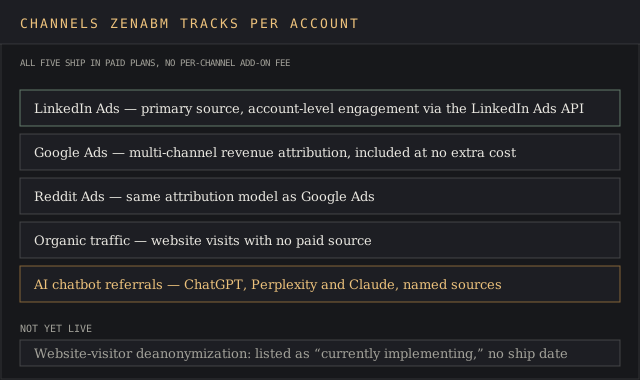
Every multi channel signal ships in paid plans at no extra cost, per the same page, and every engaged company shows up with the ad exposure that triggered it: impressions, clicks and, where a campaign carries one, form fills. Where a channel is genuinely single channel, LinkedIn alone with no paid Google or Reddit spend, ZenABM still reports the same account scoring; the extra channels just add more data to the same accounts.
"The core value is the account warming signal, seeing an account move from impressions to clicks to engagement over time, and using that progression to time BDR outreach. LinkedIn's native dashboard doesn't come close to this level of account-level visibility."
G2 review, Kamila I., Growth Marketing Manager, Mid-Market, June 26, 2026. Read the review
↑ FACT SHEETAccount scoring and ABM stages: how the intent signals get built
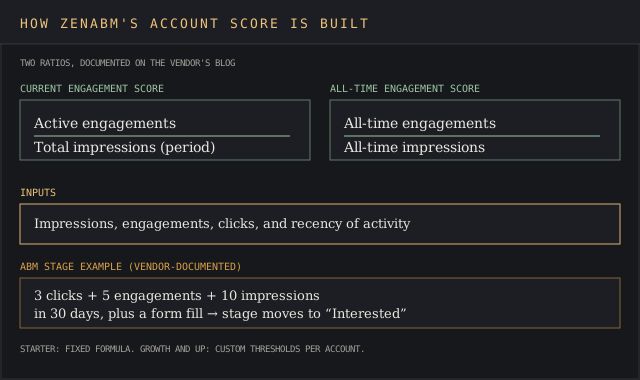
Account scoring runs on two ratios, documented on the vendor's blog: a current engagement score, active engagements divided by impressions in the period, and an all-time score using the same math over the account's full history. Starter plans get a fixed version of that formula; Growth and above let the team set custom thresholds.
Intent tagging works differently from most vendors selling "intent data." A user manually labels a campaign or creative with a topic, "Analytics" or "Security" for example, and any company that engages with that tagged content is auto-assigned the label. That's first-party signal from a company's own ads. Third-party keyword-surge intent data bought from a co-operative works on a different premise entirely.
ABM stages, which double as funnel stages once a lead moves from ad exposure to sales conversation, are fully user-defined. The documented example: a company needs three clicks, five engagements and ten impressions in the last 30 days plus a form submission to move into "Interested." Triggers can mix LinkedIn engagement windows with CRM lifecycle stage and any custom property already in the system.
A dashboard of top engaged companies ranks target accounts by that same engagement score, giving a rep better visibility into which accounts engage before a call.
The gap between raw engagement signals and a usable account list is where most ABM tools lose buyers, and it's the gap ZenABM is built to close: the platform replaces a spreadsheet of impressions with a ranked, CRM-synced list a rep can manage directly.
Campaign Manager sync and account-level ad engagement
ZenABM reads live campaign settings from LinkedIn Campaign Manager on every API call, which the API docs confirm returns an HTTP 502 if LinkedIn's own API is briefly unreachable. That's a real dependency: the tool's numbers are only as current as LinkedIn's uptime.
The Ad Library search endpoint pulls from LinkedIn's own public archive for competitor research, but impression and targeting stats only populate for EU/EEA advertisers, since that data comes from the EU's Digital Services Act transparency requirements. A US-only advertiser gets a null response for those fields, which matters for a team trying to benchmark a domestic competitor's spend.
"The team is sharp, responsive, and easy to work with. They bring structure, but they don't overcomplicate things."
G2 review, Igor K., Head of Revenue, Information Technology and Services, Mid-Market, June 12, 2026. Read the review
A rival's comparison page claims ZenABM runs on an older LinkedIn API capped at 15,000 exported rows. ZenABM's docs don't confirm that ceiling. An export-heavy team should ask ZenABM directly which number governs its account.
↑ FACT SHEETCRM sync, the API and the "Zena" AI chatbot
CRM sync is native and bi-directional for two platforms: HubSpot and Salesforce integration ships out of the box, no middleware required. Everything else routes through webhooks, with Clay, Attio and Pipedrive named as common destinations.
"The most important feature for me is the integration between ZenABM & Clay... first I DMed people who hadn't seen my campaigns, and in the second test [based on signals from ZenABM] I ran DM campaigns only for engaged accounts. Results? 63% higher acceptance rate."
G2 review, Aleksandra R., Small-Business, June 9, 2026. Read the review
The API sits at app.zenabm.com/api/v1, authenticated with a bearer token, capped at 100 requests a minute. It covers roughly 35 endpoints across companies, campaigns, deals, contacts and ABM stages. The /sources endpoint caps event history at the most recent 500 records, worth knowing before building a reporting pipeline that assumes deeper history.
Zena, the built-in AI chatbot and AI assistant, answers questions against both raw LinkedIn engagement data and ZenABM's processed scores, surfacing insights a marketer would otherwise pull manually from three dashboards. The vendor's roadmap points toward more AI agents beyond Zena, though none of the other ZenABM features on the public roadmap carry a ship date.
"ZenABM allows me to quickly query my LinkedIn ad performance data with AI, understand performance differences for different ad formats, and also attribute revenue to ABM campaigns."
G2 review, Emilia K., VP of Marketing, Mid-Market, May 30, 2026. Read the review
Not every reviewer found the chat finished: "The AI chat is not working well yet, but I see the progress over time and hope to get more value from it over time. Also some functionalities take time to load like exclusions of titles and companies from campaigns" (G2 review, Andrija ., Small-Business, May 30, 2026).
The MCP server claim is where documentation falls short. The vendor's blog describes connecting "directly to any LLM that supports the Model Context Protocol, most notably Claude Code," with use cases like custom dashboards and threshold-triggered outreach agents.
Neither the blog nor the API docs page publishes a server URL, connection string or authentication method, so a technical buyer evaluating that feature needs to ask ZenABM directly before assuming it works out of the box.
↑ FACT SHEETABM campaigns, ABM programs and where the pricing bites
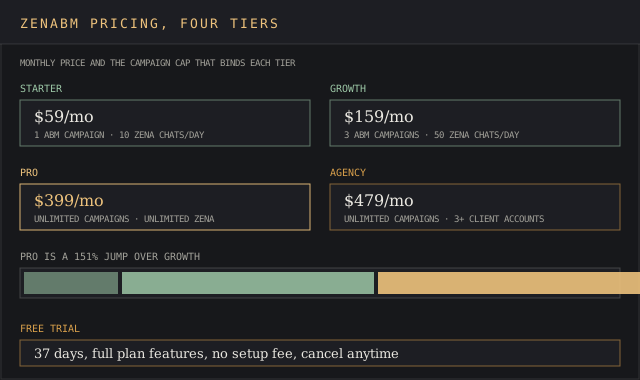
| Plan | Monthly | Annual | The limit that binds |
|---|---|---|---|
| Starter | $59 | Save $120/yr | 1 ABM campaign, 10 Zena chats/day |
| Growth | $159 | Save $480/yr | 3 ABM campaigns, 50 Zena chats/day |
| Pro | $399 | Save $1,200/yr | Unlimited campaigns, unlimited Zena |
| Agency | $479 | Save $1,440/yr | Unlimited campaigns, 3+ client accounts |
All four figures are vendor list prices from zenabm.com/pricing, verified 13 August 2026.
The campaign cap is the plan's real lever, and price alone doesn't explain the jump between tiers. Starter's single-campaign limit forces a team into Growth the moment it wants to run more than one program at a time, and Pro's jump to $399 a month for unlimited campaigns is a 151% increase over Growth.
"Most importantly, they've built a good API and MCP that we can build stuff on top of. They've even built some skills, so really good."
G2 review, Verified User, Small-Business, May 19, 2026. Read the review
The same reviewer also flagged the platform's biggest structural constraint: "There's some restriction from the LinkedIn side, which is not their fault, but it's still annoying" (G2 review, Verified User, May 19, 2026). Because engagement data flows through LinkedIn's own API, ZenABM inherits every rate limit and outage LinkedIn imposes.
The vendor states no setup fee and cancellation at any time on both the homepage and pricing page. Annual billing on every tier is framed as "2 months free," which checks out arithmetically: Starter's $120 annual saving equals two months at $59.
↑ FACT SHEETCompanies engaged: what six G2 reviewers said
ZenABM carries a 5.0-of-5.0 aggregate on G2 from six published reviews, all five stars, as this review went to press. Capterra's listing shows zero written reviews despite carrying pricing and feature detail. That's a thin sample for a tool this specific, and every "dislike" quote in this review comes from those same six positive write-ups.
Two of the six flagged slow data loads under specific conditions: "Sometimes the companies data loads slowly" (G2 review, Emilia K., May 30, 2026), and filtering large ranges was described as painful before a recent fix: "Filtering the data to specific ranges was challenging before, although with the current Claude connector it's easier now" (G2 review, Kamila I., June 26, 2026).
One reviewer's only complaint was a missing CRM: "I use Pipedrive, not HubSpot, so a future integration with Pipedrive could be a good solution. For now, though, it's only a minor issue for me" (G2 review, Aleksandra R., June 9, 2026).
"If I had to mention one thing, it would be that ABM takes time to compound, so results are not always immediate. But that is more about the nature of ABM than ZenABM specifically."
G2 review, Igor K., Head of Revenue, June 12, 2026. Read the review
ZenABM vs Fibbler, 6sense, Demandbase, Ampy and Factors.ai
Every alternative below competes for the same market: teams that want more out of LinkedIn ABM than a spreadsheet of impressions, ranked by revenue attribution. Sales outreach teams weigh these five differently depending on how much of the buying motion sits inside LinkedIn versus a wider sales intelligence stack.
| Tool | Starting price | Wins on | Loses on |
|---|---|---|---|
| Fibbler | $89/mo* | Documented lift analysis | Costs more per dollar of campaign headroom than ZenABM Starter |
| 6sense | $55,000/yr* | Predictive scoring, third-party intent, Sales Copilot | Sales-driven onboarding, no self-serve trial |
| Demandbase | $24,000/yr* | Unified GTM platform, own ad network | No published self-serve price |
| Ampy | Custom | Thought Leader Ads automation | No multi-channel attribution, no published pricing |
| Factors.ai | $199/mo | Website-visitor deanonymization (75%+ claimed) | Basic tier alone costs more than ZenABM Pro |
*Fibbler's price is its own published rate; 6sense's and Demandbase's are third-party contract medians because neither vendor publishes a rate card.
Fibbler positions itself directly against ZenABM as the revenue-attribution specialist, publishing an $89-a-month starting price on its own site, $30 above ZenABM's Starter tier. It wins on documented lift analysis, the incremental-impact measurement ZenABM's own pages don't claim.
6sense publishes no rate card on its own pricing page; third-party contract trackers put its median deal near $55,000 a year. It wins on predictive account scoring pulled from a large third-party intent dataset and a Sales Copilot that drafts outreach, suiting an enterprise team needing more than LinkedIn-only signal.
It loses on speed and cost for a team that just runs LinkedIn ads: ZenABM's $59 entry point and 37-day trial beat 6sense's sales-driven onboarding on any self-serve buying situation.
Demandbase is a full GTM platform with its own B2B ad network and buying-group mapping, priced on its own site as "a platform fee plus a flat fee per user," fully custom; third-party contract data puts a typical starting deal near $24,000 a year. It wins for a company that wants marketing and sales unified in one system across multiple ad channels.
Ampy builds specifically around sequenced LinkedIn Thought Leader Ads, automating detection of a good organic post through to TLA setup and account-level tracking. It wins for a team whose entire ABM motion runs through executive Thought Leader Ads. It loses on breadth: no published pricing, and no multi-channel attribution across Google, Reddit or AI-chatbot referrals the way ZenABM ships by default.
Factors.ai starts a Lite tier at $199 a month, then jumps to $6,000 a year for Basic, before adding a dedicated MCP server as a paid add-on. It wins on website-visitor deanonymization, claiming to unmask more than 75% of anonymous visitors, a capability ZenABM only lists as "currently implementing." It loses on price once a team needs more than the entry tier.
Who should choose ZenABM
Choose ZenABM if the ABM program lives mostly on LinkedIn Ads, the team wants a published price before a sales call, and someone on staff can manage custom API or MCP integrations to fill the documentation gaps. The $59 Starter tier and 37-day trial make it cheap to test against a real campaign before committing to Growth or Pro.
Skip it if the buying motion needs third-party predictive intent beyond a company's own ad engagement, coordinated multi-channel orchestration across email and display, or an enterprise procurement process with a named account manager. 6sense and Demandbase serve that buyer better.
It might suit a growing agency running ABM for multiple clients, given the Agency tier's per-client dashboards starting at $479 a month. That fit depends on three-plus client workspaces covering the roster; anything larger needs a direct conversation with ZenABM about scaling past the published tiers.
Frequently asked questions
How much does ZenABM cost?
Plans start at $59 a month for Starter, $159 for Growth, $399 for Pro and $479 for Agency. Pricing scales by campaign volume, with ad spend left out of the formula, and annual billing pays for 10 months while getting 12.
Is ZenABM a LinkedIn-only tool?
Mostly. LinkedIn is the primary data source and most accounts engage there first, but the platform also tracks Google Ads, Reddit Ads, organic website traffic and AI chatbot referrals, so calling it strictly LinkedIn-only undersells the multi-channel reporting.
Does ZenABM replace vanity metrics with something more useful?
That's the pitch: raw impression counts let a campaign inflate its numbers just by buying more reach. Account scoring divides engagement by impressions, so that trick doesn't work.
Does ZenABM control impression capping?
No. Impression capping and frequency settings live inside LinkedIn Campaign Manager itself. ZenABM reads the resulting engagement data but doesn't set the cap.
How complex is the setup?
Low, on paper. The vendor claims about three minutes total: connect the LinkedIn ad account, sync HubSpot or Salesforce, launch or import a campaign. Configuring custom account scoring thresholds and ABM stage triggers by hand takes longer and real thought to get right.
Does ZenABM have a free trial?
Yes, 37 days with full plan features and no setup fee, longer than the 14-day trials common among competitors.
Bottom line
ZenABM earns its price for the buyer it's built for: a marketer or small growth team that runs LinkedIn ad campaigns and wants an account-level engagement score without a six-figure predictive-intent contract. The published pricing, the 37-day trial and the native HubSpot and Salesforce sync remove most of the friction a self-serve buyer would otherwise hit.
It falls short for anyone who needs more than LinkedIn as the primary channel, third-party predictive intent, or an enterprise buying process with a named account manager. The documentation gaps around the MCP server and the disputed API row cap are real enough that a technical buyer should confirm both directly before committing budget.
Against Fibbler, 6sense, Demandbase, Ampy and Factors.ai, ZenABM's edge is transparency and speed to first campaign. That's a fair trade for the buyer it targets, and a bad one for anyone shopping a bigger ABM stack.