Attio review: what the AI-native CRM gates behind Pro
 By Jan Suski. I go deep on every review, checking every number against its source and digging up details other coverage misses, a habit from six years of SEO and link building for tech companies. Bylines at Surfer, Brand24, and Senuto. How the scoring works.
Best for
Growing sales and GTM teams of 5 to 50 people who need a self-designed data model, custom objects linking Deals to Contracts or Subscriptions, and API or MCP access from day one.
Not for
Enterprise buyers who need SSO or SCIM now, or teams that need mature reports and a deep third-party integration catalog out of the box.
What it costs
$0 for up to 3 seats; $44 to $99 per user monthly (about 20% less billed annually) once a team needs more seats or any custom object; Enterprise is custom.
- Free plan
- $0 for up to 3 seats, 3 objects, 50,000 records, 50GB storage
- Plus plan
- $44/user/mo monthly, $35 billed annually; 10 seats, 5 objects, 250,000 records
- Pro plan
- $99/user/mo monthly, $79 billed annually; unlimited seats, 12 objects, 1,000,000 records
- Enterprise plan
- Custom pricing, unlimited seats, objects and records, billed annually
- Free trial
- 14 days of the full Pro plan, no credit card required
- Custom objects
- Pro or Enterprise only, whatever standard-object headroom sits unused
- AI attributes
- Summarize, Prompt completion, Classify, Web agent (10 credits per run)
- Formula attributes
- Pro and Enterprise only
- App SDK
- TypeScript and React, in beta, on every plan
- MCP server
- On every plan, for every workspace member
- Workflow automations
- No-code, trigger-based builder on every plan, Free included
- Email sequences
- Pro and Enterprise; one reviewer cites a 10-contact enrollment cap
- Outreach rate limit
- 12 emails per hour per a G2 reviewer, under 300 sends a day
- Email & calendar sync
- Gmail and Outlook, on every plan
- Granola integration
- Native app built by Granola, syncs per note or per folder
- Mobile apps
- Native iOS and Android, both linked from attio.com
- Series A
- $23.5 million, March 2023, led by Redpoint Ventures
- Series B
- $52 million, August 2025, led by GV (Google Ventures)
- Total raised
- $116 million
- Paying customers
- 5,000, per the Series B post
- Total customer base
- 30,000+, per a separate hiring post; never reconciled with 5,000
Folk
Not forA team that already needs custom objects linking Deals to Contracts or Subscriptions.
HubSpot CRM
Not forA team that wants a flat, predictable per-seat price and its own object schema.
Attio is a customer relationship management platform built around a data model a team configures itself. Companies, People and Deals ship as standard objects on the CRM platform, and everything else, Projects, Subscriptions, Invoices, gets built as a custom object on top of them.
This Attio review covers what the Attio CRM plans gate, the automation and AI attributes Attio ships, and what real users on G2 and Capterra say about contact management and data entry once the free trial ends. It also covers how Attio stacks up against Folk, HubSpot and Pipedrive as CRM tools on setup time, per-seat cost, and what happens once the free tier's limits bind.
The company behind it has raised $116 million across two rounds: a $23.5 million Series A in March 2023 led by Redpoint Ventures, and a $52 million Series B in August 2025 led by GV, Google's venture arm, with Redpoint, Balderton Capital, Point Nine and 01A returning.
Co-founder and CEO Nicolas Sharp wrote the Series B announcement himself, citing 5,000 paying customers and 4x annual recurring revenue growth; his co-founder and CTO, Alexander Christie, runs the platform's technical side. A separate Attio blog post about hiring graduates cites a "30,000+ customer base," a gap this review states plainly, without picking whichever number reads better.
This review is for a team choosing between Attio and a lighter competitor like Folk, or a heavier incumbent like HubSpot or Salesforce: a team of 3 to 50 people where the free tier's 3-seat cap or Plus's 10-seat cap will bind within a year. It's written for small teams and larger teams alike, short of an enterprise buyer who needs SSO and SCIM on day one; Attio gates both behind Enterprise pricing.
Everything below traces to Attio's own pricing page, blog posts and help documentation, or a named reviewer on G2, Capterra or Hacker News, linked at the point it's used.
↑ FACT SHEETPricing: what each Attio CRM plan unlocks
Attio runs four tiers, and the object cap on the pricing table is misleading on its own. Free: $0, up to 3 seats, 3 objects, 50,000 records, 50GB storage. Plus: $44/user monthly ($35 annually), 10 seats, 5 objects, 250,000 records. Pro: $99/user monthly ($79 annually), unlimited seats, 12 objects, 1,000,000 records. Enterprise: custom, unlimited everything, billed annually.
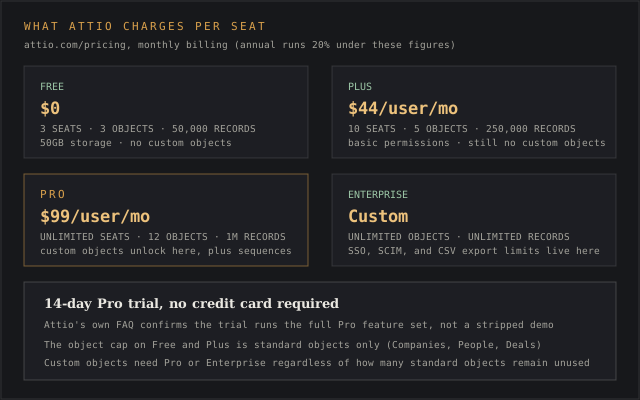
Here's the catch the object-count row hides: those "3 objects" and "5 objects" caps on Free and Plus refer to standard objects only. Attio's own help documentation confirms custom objects require Pro or Enterprise, regardless of how much standard-object headroom sits unused.
A 4-person team on Plus paying $35 to $44 a seat cannot build the one custom object its sales process needs without moving to Pro at $79 to $99 a seat, more than double the per-seat cost.
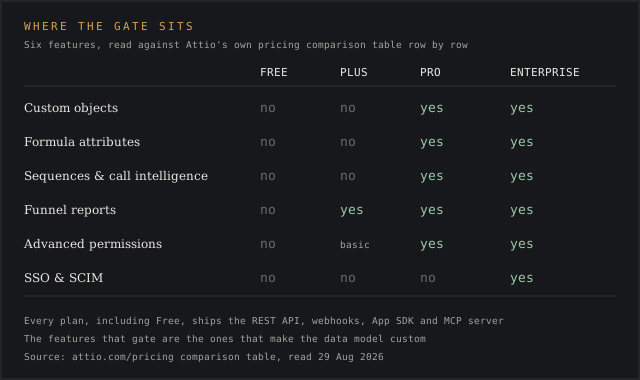
The rest of the gate follows the same logic: formula attributes, funnel reports past the basic tier, sequences, call intelligence and advanced permissions all sit on Pro or above. Single sign-on and SCIM are Enterprise-only, the wall a real procurement team hits.
Every plan, including Free, ships the REST API, webhooks, the App SDK and the MCP server. A solo founder gets full programmatic access free, while a 4-person team wanting one custom object pays for all of Pro to get it.
Attio offers a 14-day trial of the full Pro plan, no credit card required, confirmed on Attio's pricing page, which lets a team test its custom-object workflows before committing to one.
↑ FACT SHEETKey features: custom objects, AI attributes, and the integrations that connect them
Custom objects and the data model
Every record in Attio, standard or custom, is an entry in a workspace-wide data model that supports arbitrary attributes and two-way relationships between objects. A Deal record can reference a custom Contract object, which references a Subscription object, and each carries its own attribute schema, no generic template involved. Nick J., a marketing manager at a small business, put it plainly in a G2 review from July 2026:
Attio's biggest strength is how flexible the underlying data model is. You can create custom objects and build real relationships between them without fighting the tool.
G2 review, marketing manager at a small business, July 2026
That flexibility drives the learning curve complaints below, too. A CRM platform that lets a team design its own schema is one where nobody designed the schema for it, and a team that skips the planning step ends up with three overlapping objects doing the same job six months later. Attio makes that tradeoff explicit; it doesn't hide behind a generic "contact management" label.
AI attributes and unstructured data
Attio ships four AI attribute types, per its developer and platform documentation. Summarize record condenses notes into a short field. Prompt completion runs a custom prompt against a record's data. Classify record sorts a record into categories a team defines.
Web agent, one of several AI agents in the product, researches a company against the open web and writes structured fields back, at 10 credits per run. None trigger automatically; each runs on a manual click or inside a workflow a team builds. The artificial intelligence behind them cuts repetitive tasks like manual research, and the AI powered label on Attio's homepage describes a toolkit a team wires up itself before anything runs.
The unstructured-data pitch, turning a forwarded email thread or a pasted meeting transcript into structured company data and contact data, works through the same Web agent and Prompt completion attributes. Attio has no separate ingestion pipeline for it, and no bulk CSV files importer built for that specific job.
It's a real capability, and it's also the same credit-metered system as everything else AI powered in the product, so a team running it at volume needs to budget seat credits the way it would budget API calls anywhere else. Teams that want enrichment at volume often keep a dedicated tool from the data enrichment ranking upstream of the CRM.
Integrations, the App SDK, and the MCP server
Email and calendar sync to Gmail and Outlook ships on every plan and populates contact data and company data automatically as a team sends and receives mail, cutting the manual work of data entry after meetings. Granola, the AI meeting-notes tool, has a native Attio integration built by Granola itself, syncing per note or per folder and giving reps context a plain calendar sync misses.
The MCP server, on every plan for every workspace member, lets AI agents such as Claude or ChatGPT search, create and update Attio records, notes and tasks over OAuth, scoped to the connecting user's permissions. It's one of the servers tracked in the MCP tools list. The App SDK, in beta, is TypeScript and React based, letting a team build record actions, widgets and text-selection tools directly inside the Attio interface, no separate app required.
The third-party integration catalog is where the product thins out. A G2 reviewer who evaluated Attio against older platforms found the integration list shorter than what Salesforce or HubSpot carries after a decade of app-marketplace partnerships; someone on the team has to build the missing connector, and import contacts by CSV files in the meantime.
Prospecting tools reviewed on this site connect at different depths. G2 lists Attio among the native integrations for Clay, lemlist runs a native Attio sync, Wiza lists Attio as an Alpha-stage CRM connection, and ZenABM reaches it only through webhooks.
↑ FACT SHEETAutomation, follow-up sequences, and where the caps bite
Workflow automations, trigger-based record creation and no-code builders ship on every Attio plan: a team can create a Deal record when a form submits, or route leads to a rep by territory, no engineer needed. These workflows extend to lead scoring and meeting reminders, but the sequences and call intelligence a rep uses to follow up on leads automatically sit on Pro and Enterprise only.
The caps inside sequences are where the complaints concentrate. Francisco O., founder at an IT services company that switched from Folk, wrote in a Capterra review from March 2026:
Due to system limitations, we cannot enrol more than 10 people in our email sequences at a time, that does not make any sense for an outreach tool.
Capterra review, founder, IT services, switched from Folk, March 2026
Sam W. hit a related ceiling and rated the outreach feature 0.5 out of 5 in a May 2026 G2 review:
The outreach feature is terrible. Being limited to 12 emails per hour just isn't usable at all. Also, the initial setup was very difficult.
G2 review, small-business user, May 2026
Twelve emails an hour is a hard limit: it caps a rep at under 300 sends a day even running the sequence tool around the clock, per the May 2026 G2 review above. That's enough to shift a high-volume outbound team's evaluation before pricing does.
A team whose pipeline depends on call recordings and deal-risk scoring will also want to compare Attio's Pro-tier call intelligence against the dedicated platforms in the revenue intelligence ranking.
↑ FACT SHEETWhat users complain about most
Reliability shows up in the lowest-rated reviews more than feature gaps do. Vincent J., a small-business founder, gave Attio 0.5 out of 5 in a December 2025 G2 review titled "Clean UI, But Unreliable Service and No Compensation for Downtime":
No SLA. Lost leads because their servers went down and they won't even try to fix the problem. They don't even offer compensation for the loss.
G2 review, founder, small business, December 2025
A mid-market reviewer's complaint, from a July 2026 G2 review titled "A CRM for Small Businesses not Scaling," lists specific gaps in the reports system:
Attio is missing several standard features, such as field permissions, validation rules, and currencies with conversions.
G2 review, verified user, computer software, mid-market, July 2026
roland S., Head of Finance at a private equity firm that switched from HubSpot, raised a similar gap in a November 2025 Capterra review titled "not yet a CRM":
missing attribute options such as formula fields. missing reporting functionality. missing mandatory fields by stage in pipelines.
Capterra review, Head of Finance, private equity, switched from HubSpot, November 2025
Attio has since shipped formula attributes on Pro and Enterprise, narrowing that gap. Report depth is the complaint that survives across every review here: several reviewers call Attio's reports thinner than an established CRM's, built up one report type at a time over years.
↑ FACT SHEETWhat users praise most
The interface draws the most consistent praise; reviewers independently call it a user friendly interface unlike traditional CRMs. Ann B., a co-founder at a software company, wrote in a March 2025 Capterra review:
If Notion and Apple decided to build a CRM, this is what it would be like.
Capterra review, co-founder, computer software, March 2025
Ben J., a founder who now implements Attio for other companies (a commercial interest worth noting, though independent reviews echo his point), called out the browser extension in an August 2025 Capterra review:
My favourite feature by far is the chrome extension, so fast and easy to work with. Attio fits into my day to day activities so well across linkedin, gmail and video calls.
Capterra review, founder, August 2025
Chris G., a founder in marketing and advertising, framed the pricing itself as the selling point against a specific competitor in a September 2024 Capterra review:
I'd rather pay $60 or so per month now and feel safe with it, than fall into Hubspot's $20 per month trap which quickly becomes $800 per month once you're hooked.
Capterra review, founder, marketing and advertising, September 2024
On Hacker News, a commenter identified as rhubarbtree weighed Attio against traditional CRMs built for an earlier generation of GTM teams, in a January 2026 thread on alternatives to American CRM vendors: "Attio is better than every American CRM at SME/early stage startup stage." Review platforms carry their own incentives, and Capterra's own numbers on review reliability are worth a read before weighting any single star rating.
↑ FACT SHEETCompany stability: funding, growing teams, and the customer-count gap
Attio raised a $23.5 million Series A in March 2023, led by Redpoint Ventures, per Attio's own announcement, and a $52 million Series B in August 2025 led by GV, Google's venture arm, per the Series B post under CEO Nicolas Sharp's byline, framed there as entering a new era for the CRM space. Total funding: $116 million.
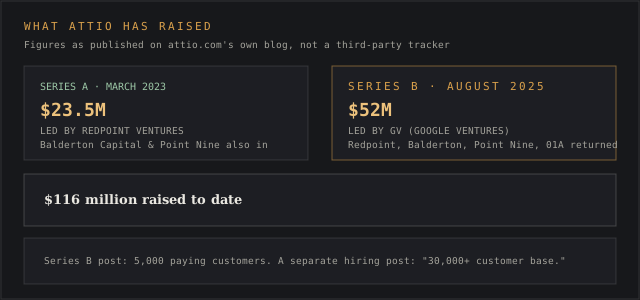
That same post states 5,000 paying customers and 4x annual recurring revenue growth for the year. A separate post on Attio's own blog about hiring graduates cites a "30,000+ customer base."
Attio never reconciles the 5,000 and 30,000+ figures on its own site. The likeliest read is that 30,000 counts every signup and 5,000 counts paying companies, but that reading is this review's inference; Attio hasn't stated it. A buyer weighing this company data should treat the gap as unexplained.
Attio markets itself toward growing teams: per-seat price scales linearly through Pro, with no volume discount, and unlimited seats arrive well before SSO or SCIM show up on Enterprise. A team of 15 to 40 people, the team size scaling past its first CRM, is the buyer the pricing ladder is built for.
↑ FACT SHEETAttio vs other CRMs
Folk is the closest direct competitor on flexibility. Its data model is lighter, with fewer relationships between objects, but its price starts lower and its learning curve is shorter for a 2 to 5 person team that doesn't need custom objects yet. A team that outgrows Folk's simplicity is the team Attio's Pro tier targets.
HubSpot is the incumbent Attio positions against most directly, and Chris G.'s quote above captures the complaint: entry price is lower, and cost climbs fast once a team needs the features that were free-tier bait. Attio's flat per-seat price is more predictable, but HubSpot ships a mature report suite and integration marketplace that roland S. and the mid-market G2 reviewer above say Attio still lacks.
Pipedrive sits below both on complexity, built around a visual pipeline with no general-purpose data model. Fredrik S., a head of growth who switched from Pipedrive, put the tradeoff plainly in a Capterra review: "Attio has a higher engineering quality and isn't too expensive." A team that only needs a pipeline gets there faster on Pipedrive; a team that needs the data model gets more for the same money on Attio.
Capsule CRM covers the simplest end of the range: a free plan for two users and 250 contacts, one pipeline on its lower tiers, and no custom objects to design at all.
Folk wins on speed for a tiny team, HubSpot on report maturity for a team that's outgrown a lightweight CRM tool, Pipedrive on price for a pipeline-only team. Attio wins the team in between: past Folk's simplicity, short of HubSpot's rates, willing to build its own data model.

No data model to design
Try Capsule CRM
Capsule's Free plan covers 2 users and 250 contacts with one pipeline and no custom objects to set up, the simplest end of the range.
 Start free on Capsule →
May earn a commission if you sign up through this link, at no extra cost to you. Full affiliate disclosure.
↑ FACT SHEETAttio CRM: frequently asked questions
What is Attio used for?
Sales teams, GTM teams and revenue operations use it as a system of record for companies, contacts and deals, and as an automation layer for lead scoring, follow-up sequences and meeting notes once Gmail, Outlook or Granola are connected.
Is Attio a good CRM?
For growing teams building a custom data model, reviewers rate it well on interface and flexibility, and mark it down on reports and reliability. It's the right tool for that buyer, and a weaker one for enterprise procurement.
What are the key differences between Attio and Salesforce?
Salesforce serves a large, established org with a mature report system and thousands of integrations. Attio is a next generation CRM for smaller teams that design their own objects, at a fraction of the per-seat cost below Enterprise.
Does Attio have a mobile app?
Yes, native iOS and Android apps, both linked from attio.com.
↑ FACT SHEETVerdict
Attio is for a growing sales or GTM team, 5 to 50 people, that has outgrown a spreadsheet or a lightweight CRM tool and needs a data model it controls, plus API and MCP access from day one. Chris G.'s $60-a-month framing against HubSpot's escalating tiers is the argument that lands for this buyer.
Attio is not for a team that needs enterprise controls now: SSO and SCIM sit behind Enterprise pricing, reports run thinner than HubSpot's or Salesforce's, and the third-party integration catalog is shorter than either incumbent's.
A team in between, past Free's 3-seat cap but not ready for Enterprise pricing, should budget for two costs up front: the Pro-tier jump required for even one custom object, and the setup time a self-designed data model demands before it pays off.