Folk CRM review: pricing, the new mobile app, and what each tier locks away
 By Jan Suski. I go deep on every review, checking every number against its source and digging up details other coverage misses, a habit from six years of SEO and link building for tech companies. Bylines at Surfer, Brand24, and Senuto. How the scoring works.
Best for
A small business, agency, or founder-led sales team that lives in Gmail, LinkedIn, and WhatsApp and wants contacts, notes, and follow-ups in one workspace without configuring a database first.
Not for
A team that needs stage-triggered deal automation, single sign-on beyond Google, or dashboards on day one without paying for the $48 Premium seat.
What it costs
$24 to $80 per seat per month billed yearly, or $30 to $100 billed monthly, with a 14-day trial and no permanent free plan.
- Standard
- $24/seat/mo billed yearly, $30 billed monthly
- Premium
- $48/seat/mo billed yearly, $60 billed monthly
- Enterprise
- From $80/seat/mo billed yearly, from $100 monthly, custom quote
- Free trial
- 14 days on Premium features, no card required
- Free plan
- None; the account is blocked if nobody upgrades after the trial
- Deals & custom objects
- Premium and up only
- Email sequences
- Premium and up only
- Interaction history
- Standard shares the last 30 interactions; Premium and up keep all of it
- Single sign-on
- Google only, on every tier including Enterprise
- Enrichment sources
- People Data Labs for contact data, Perplexity for research insights
- Enrichment credits
- 500 a month on Standard, 1,000 on Premium
- AI Assistants
- Four live by January 2026: Follow-up, Recap, Research, Workflow
- G2
- 4.5/5 from 339 reviews, as of 28 Aug 2026
- Capterra
- 4.5/5 from 46 reviews, ease of use 4.6/5
- Mobile app
- Contacts by folk CRM, iOS and Android, launched 16 July 2026
- Android build
- v1.0, 100+ Google Play downloads at review time
- Funding
- $4.5M seed round led by Accel, per Folk's own blog
- Compliance
- SOC 2 Type I certified, GDPR compliant
Attio
Not forA two-person team that wants contact capture on day one and has no data model to design yet.
HubSpot CRM
Not forA founder who called its setup "too complicated and dense and big" and wants to be selling within the first hour.
Folk CRM is a browser-native contact management tool built around a Chrome extension, a LinkedIn sidebar, and email sync, with no standalone data model for a sales team to configure from scratch. A CRM connected to Gmail, LinkedIn, and WhatsApp out of the box, with no import step required on day one, is the whole pitch behind the folkX extension.
Folk, Inc. is based in Paris and Wilmington, Delaware, founded by Simo Lemhandez, and closed a $4.5M seed round led by Accel and a group of operator angels, according to the company's own account of the raise. The company frames its product as a lightweight CRM built around relationships: rows of contacts, drag-and-drop pipeline views, and AI that drafts follow-ups so a rep can sell without leaving Gmail or LinkedIn to close deals.
This review covers what the Standard, Premium, and Enterprise seats include, what changed with the July 2026 mobile launch, and where reviewers still find gaps six weeks after that launch. It draws on Folk's own pricing page, help center, and changelog, plus 25 verified Capterra reviews and Folk's public G2 profile (4.5/5 across 339 reviews as of August 28, 2026).
The timing matters because Folk spent three years being reviewed against a missing mobile app. That gap closed on July 16, 2026, six weeks before this review, with Contacts by folk CRM landing on the App Store and Google Play. The Android build sat at 100+ downloads and v1.0 when this review was written, a small enough number that the app is still closer to launch day than to years of real use.
Folk fits teams under roughly 20 seats: agencies, recruiters, consultants, and startup founders managing fundraising or partnerships. A 200-rep enterprise floor sits outside what it was built for. The comparison section below sets it against HubSpot CRM, Pipedrive, and Attio, three tools Folk names as its own competitors on its own site.
↑ FACT SHEETWhat Folk's contact management covers, and where the data comes from
The core object in Folk is a person or company record, built from whatever the folkX Chrome extension captures off LinkedIn, Gmail, or a business-card scan on mobile. Pipeline views sit on top of that contact base as drag-and-drop boards a sales team customizes per workflow: sales, recruiting, or fundraising, according to Folk's own pricing page.
Deals became a distinct object on November 14, 2024, per the changelog, so a Folk account that predates that release was tracking pipeline stage on the contact record itself.
Folk pitches itself as a simple, integrated CRM, and its own homepage calls it "one beautifully simple CRM" where "AI Assistants learn from this data to automate busywork." In practice a rep can manage contacts, deals, and follow-ups from a single view: folkX captures leads from LinkedIn Sales Navigator in one click, enrichment fills in email addresses and phone numbers automatically, and a drag on the pipeline board keeps deals moving forward without a second tool open.
Workspaces can build custom fields to track whatever a process needs beyond Folk's defaults. CRM context, notes, history, and every logged interaction stay attached to the record in one place.
Importing contacts from a CSV, Notion export, or another CRM takes minutes, per several Capterra reviewers who migrated from Notion and Airtable, though that's also the moment duplicate records tend to appear. Enrichment runs through People Data Labs for company and contact data, with Perplexity generating the research insights the Research Assistant attaches to a profile, both named directly on Folk's own product page.
That's a change from the enrichment sources some earlier third-party reviews describe, and it puts Folk's built-in lookup in the same data-supplier family as several dedicated data enrichment tools. Standard seats get 500 enrichments per workspace per month; Premium doubles that to 1,000. Steven K., an engineer writing on Capterra in August 2025, called the record-merge tool his favorite part of the product:
Not only will it merge the contacts but it lets you select which portions of each contact to use for the final record without smashing it together willy-nilly.
Capterra review, engineer, August 2025
That merge tool works well by hand, but it doesn't stop duplicates from forming on its own. Dimitar M., a COO writing on Capterra in April 2025, ran into the gap directly:
When we use folk on Sales Navigator for example, it takes all the leads even though some leads are already in the system. And we have to check for every lead if it's a duplicate or not manually.
Capterra review, COO, April 2025
The auto-merge feature Folk documents in its help center catches exact matches. A re-scraped LinkedIn profile with a slightly different title field slips past it.
↑ FACT SHEETFolk CRM cost: what $24, $48, and $80 a seat unlock
Folk prices per seat, calculated on the number of members in the workspace, and the yearly rate runs about 20% under the monthly one. Standard is $24/seat/month yearly ($288/seat/year) or $30 billed monthly. Premium is $48/seat/month yearly ($576/seat/year) or $60 monthly. Enterprise starts at $80/seat/month yearly ($960/seat/year) or $100 monthly, with a custom quote past that floor, per Folk's own pricing page.
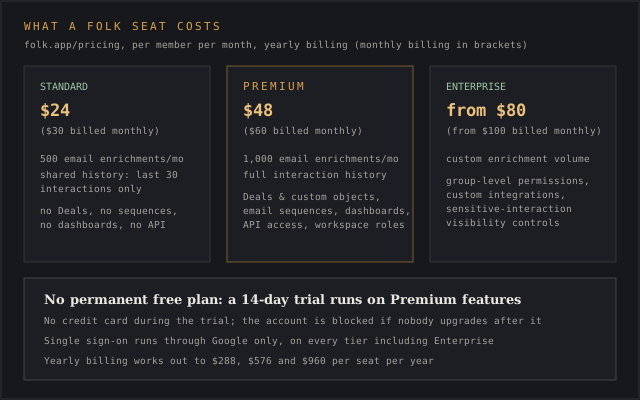
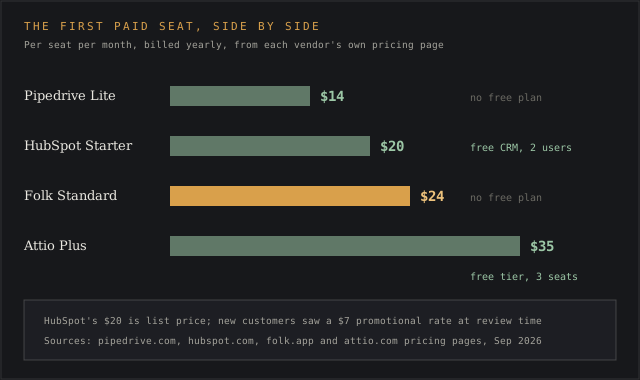
There is no permanent free plan. The 14-day trial runs on Premium features with no card required, and an account that doesn't upgrade afterwards is blocked, though its data isn't deleted straight away. Against the most affordable CRM options in this piece's comparison section, Pipedrive's $14 Lite seat and HubSpot's $20 list-price Starter seat both undercut Folk's Standard price before any add-ons.
The gap between Standard and Premium runs through the features a sales team touches daily. Custom objects and Deals, email sequences, dashboards, API access, and workspace roles all sit behind the Premium plan's $48 seat.
A Standard seat shares only the last 30 team interactions on a record in-app. Premium and up carry the full history, per Folk's own pricing page.
William L., a partner at an HR consultancy, wrote on Capterra in March 2025 that the one thing missing on his plan was email sequences, the exact line that splits Standard from Premium.
Folk's own cancellation FAQ, in the help center, still tells a user to click "downgrade" on the free plan to cancel a subscription. The live pricing page and the June 2026 pricing help article both list only Standard, Premium, and Enterprise.
Either a free tier still exists somewhere the public pricing page doesn't show, or that FAQ line is a leftover from a plan Folk has since retired. A buyer canceling by that instruction should confirm which is true before assuming the account stops billing on its own.
↑ FACT SHEETThe mobile app that took three years to arrive
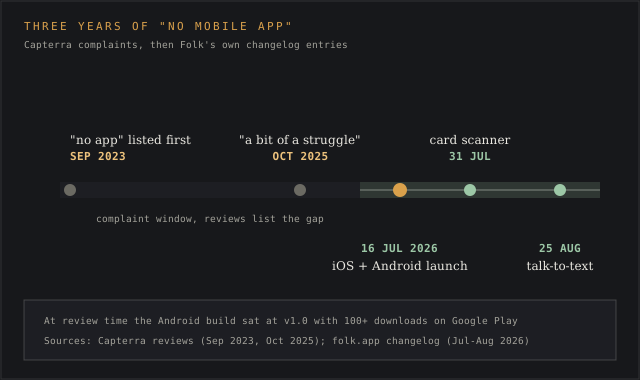
For most of Folk's public review history, "no mobile app" was the single most repeated complaint. jihad K., writing on Capterra in September 2023, listed it first among the product's rough edges. Mike S., a founder in health and wellness, wrote in October 2025, nine months before Folk shipped one:
The price is right but not having an app is a bit of a struggle for me... Lacking an app. Not a fan of using a web browser all the time as I use it at different times of the day.
Capterra review, founder, health and wellness, October 2025
Contacts by folk CRM answered that on July 16, 2026, with a business-card scanner added July 31 and full talk-to-text voice capture on August 25, per Folk's own changelog. The app syncs contacts, notes, calendar events, and interaction history across mobile, web, and desktop, and Folk's own store listing states plainly that customer data is never used to train AI models and is not shared with third parties.
The app's search finds a contact by name, company, or note in a second, built for capturing context from a client visit so the team back at the office can act on it right away.
Adoption is early. The Android listing on Google Play showed 100+ downloads at v1.0 as of this review, a number that reads like a fresh release still finding its first users. Folk gets credit for closing a three-year gap; how the app holds up at scale is still an open question six weeks in.
↑ FACT SHEETThe AI Assistants, and the automation gap they don't close
Folk shipped its first Assistant in October 2025 and had four live by January 2026. Follow-up scans email and WhatsApp conversations for a stalled thread and drafts the next message. Recap pulls notes, emails, and meetings into a full-context summary of a contact or deal's history on demand, so a rep has context before a call without scrolling a thread.
Research enriches a company profile and writes an insights note using People Data Labs and Perplexity. Workflow triggers an AI-personalized email when a record is created or a field changes.
Workflow is the closest thing Folk has to native automation, and it's scoped narrowly to trigger-based email sending. A general if/then rule engine across pipeline stages doesn't exist yet. That narrowness shows up directly in a Capterra review. Cullom W., a finance director, wrote in June 2025:
Lack of visibility into number of opens and clicks on email sequences, as well as timestamps. Also, no ability to automate follow-up emails based on email clicks/opens. It's my understanding that this data is already tracked, so why not make available to the user?
Capterra review, finance director, June 2025
Workflow can send a triggered email; it doesn't yet act on an email-engagement signal the way that reviewer wanted. Teams that need that loop today tend to run sequencing in a dedicated outreach tool; the sales intelligence ranking covers the ones that pair prospect data with engagement tracking.
The dashboards a Premium seat unlocks are still catching up too. Tracy M., a director of custom training, wanted "more customizeable dashboards to fit our group" in a September 2025 review, the same one where she credited Folk's enrichment feature as a real time-saver for her team.
↑ FACT SHEETWhat Capterra and G2 reviewers say, on both sides
Teams that rely on LinkedIn for prospecting get the most from folkX, and Folk's minimal design is the first thing new users notice, echoed in the "no learning curve" language repeated across Capterra reviews. Positive reviews cluster around one word: simplicity. Dimitar M. put it directly: "folk is different from other CRMs because it's as simple as a blank page."
Thomas B., a cofounder who moved off HubSpot, wrote in September 2025 that Folk was "much easier to configure, to track clients and deals" than the HubSpot setup he found "too complicated and dense and big." Jessica L., an owner in marketing, praised the support team's hands-on approach during a Notion migration in December 2024: "they actually did the work for me instead of giving me a to do list."
Complaints run narrower and more specific than "it's missing things." Sophie D., a VC/PE partner, flagged a broken sync in March 2025: "the gmail integration that does not work for us just yet." Marshal C., a freelance cinematographer, raised currency friction in May 2025: "I am Canadian so the dollar really hurts me," with no localized pricing or first-year discount on offer.
Across the 25 most-helpful Capterra reviews sampled for this piece, ease of use scores 4.6/5 and customer service 4.5/5, both at or above the 4.5/5 overall rating. That pattern lines up with a product reviewers say is easy to start and inconsistent to scale. Both platforms deserve the usual caution: Capterra's own review-collection numbers and how G2 ranks vendors shape which reviews surface first.
↑ FACT SHEETSecurity, compliance, and how stable the company looks
Folk carries SOC 2 Type I certification and states GDPR compliance on its own trust page, alongside a Google security certification badge. Single sign-on runs through Google only on every tier, including the $80 Enterprise seat.
A buyer standardized on Okta or Microsoft Entra gets no native SSO path into Folk today. What the Enterprise tier adds is group-level permissions, custom integrations, and internal or sensitive-interaction visibility controls.
On funding, Folk's own blog describes a $4.5M seed round led by Accel and a group of operator angels, following an earlier bridge the company has also written about publicly. Folk's own homepage claims "5,000+ companies around the world" use the product, and its G2 profile describes it as "like the sales assistant your team never had."
The company states it is used by "over 5,000 companies" and "over 3,000 award-winning service businesses" on separate marketing pages. The two figures describe different populations: workspaces overall, and a smaller subset the company calls award-winning.
Folk's reach into other tools is still filling in from the outside, too. FullEnrich, an email-finding tool, lists Folk among the CRMs marked "Soon" on its integrations page, next to Salesforce and Pipedrive, a status the lead intelligence software ranking also records.
↑ FACT SHEETFolk against HubSpot CRM, Pipedrive, and Attio
Folk names these three as its main points of comparison on its own site, and reviewers back that up: HubSpot and Pipedrive show up again and again in Capterra's "alternatives considered" field on Folk's own review page, and Attio shows up almost as often.
HubSpot CRM
HubSpot's free CRM covers up to 2 users, and its Starter Customer Platform lists at $20/seat/month on HubSpot's own pricing page, with new customers offered a $7 promotional rate at review time. HubSpot wins on scale: a genuine free floor and a marketing and service suite Folk doesn't attempt to replicate.
It loses on configuration weight. Thomas B. called it "too complicated and dense and big" for a small business and switched to Folk to shed that specific cost.
Pipedrive
Pipedrive's Lite plan starts at $14/seat/month billed yearly, cheaper than Folk's Standard seat, and Pipedrive built its whole product around pipeline-stage automation from the start, the exact gap Cullom W. hit inside Folk's Workflow Assistant.
Pipedrive loses ground on contact capture. It has no LinkedIn-native extension comparable to folkX, so a sales team that prospects on LinkedIn first does more manual data entry on Pipedrive than on Folk.
Attio
Attio is the closest like-for-like competitor: a relationship-first CRM with real-time enrichment and a free tier for up to 3 seats, something Folk doesn't offer at all. Attio's Plus plan runs $35/seat/month yearly and its Pro plan $79/seat/month yearly, both on Attio's own pricing page, putting Attio's paid tiers close to Folk's Standard and Enterprise.
Pete T., a managing partner who switched from Attio to Folk in April 2025, said Folk was "more suited to my needs with a simple CRM and email management," while Racine G. and Cullom W. both weighed Attio against Folk without switching. For a team that wants contact records plus a simple pipeline and nothing heavier, Capsule CRM is the third option in this set, with a free plan for two users.

Third option in this set
Try Capsule CRM
Capsule's Free plan covers 2 users and 250 contacts with one pipeline, for a team that wants contact records and a simple pipeline before paying anything.
 Start free on Capsule →
May earn a commission if you sign up through this link, at no extra cost to you. Full affiliate disclosure.
↑ FACT SHEETVerdict
Folk suits a founder-led or small business team of two to fifteen people that runs its outreach through Gmail, LinkedIn, and WhatsApp and wants a CRM that looks like the Notion database that team already uses. 25 Capterra reviews and dozens more on G2 call it fast to start with close to no learning curve.
Calling any single product the best CRM ignores how differently HubSpot, Pipedrive, Attio, and Folk price and scope their tiers. Folk doesn't suit a team that needs deal automation on day one, SSO beyond Google, or a permanent free tier to test with a full roster before paying; those gaps sit behind the $48 Premium seat, or outside Folk entirely.
It might suit a mid-size team willing to budget for Premium from the start and accept that the mobile app, six weeks old at review time, is still short on a track record.