Best lead intelligence software in 2026: 12 tools ranked
 By Jan Suski. I go deep on every review, checking every number against its source and digging up details other coverage misses, a habit from six years of SEO and link building for tech companies. Bylines at Surfer, Brand24, and Senuto. How the scoring works.
· Prefer this source on Google
Quick comparison of the best lead intelligence tools
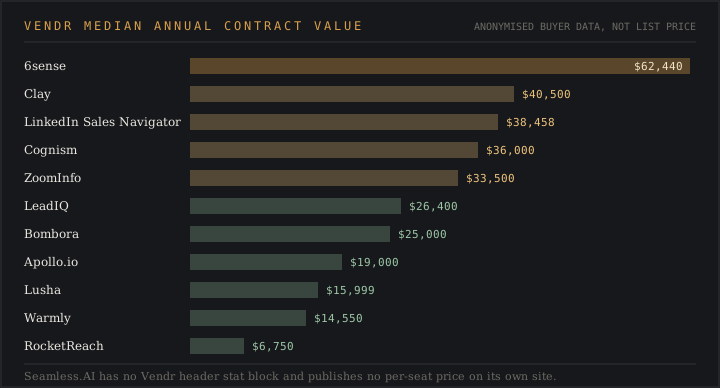
Published coverage is each vendor's own database-size claim; entry price is the lowest published rate, or Vendr's anonymized median for vendors that require a sales call and publish no rate of their own.
| # | Provider | Published coverage | Entry price | Best fit |
|---|---|---|---|---|
| 1 | ZoomInfo | 500M+ profiles | Vendr median $33,500/yr* | US enterprise, person-level visitor ID |
| 2 | Apollo.io | 240M+ contacts matched | $0 free; $49/seat/mo annual | Buyers who want a published rate card |
| 3 | Cognism | No count published; 15 DNC lists | Vendr median $36,000/yr* | EMEA outbound and DNC screening |
| 4 | Clay | No first-party database | $0 free; $167/mo Launch | RevOps chaining several data vendors |
| 5 | Woodpecker | No first-party database; 100 free Lead Finder credits | $0 free; $7/100 contacted prospects | Outreach teams paying per contacted prospect |
| 6 | 6sense | 481M+ buyer profiles | Vendr median $62,440/yr* | ABM teams buying predictive analytics |
| 7 | LeadIQ | 750M+ profiles | $0 free; $200/mo Pro | SDR teams, published verification method |
| 8 | FullEnrich | No first-party database; 20+ providers | $0 trial; $29/mo for 500 credits | Bulk enrichment with unlimited users |
| 9 | Lusha | 290M+ contacts, 26M+ companies | $0 free; $49.90/mo Starter | Small North American teams starting on a free plan |
| 10 | Bombora | 21,600+ intent topics | Vendr median $25,000/yr* | Marketing teams layering intent |
| 11 | RB2B | 35-45% person-level, US only | $0 free; $79/mo Starter | US sites wanting visitor IDs in Slack |
| 12 | LinkedIn Sales Navigator | 1B+ members | $119.99/mo per license | Sellers working accounts inside LinkedIn |
Medians marked * are anonymized buyer-reported contract values published by Vendr: ZoomInfo, Cognism, 6sense and Bombora. Everything else is the vendor's own list price: Apollo.io, Clay, Woodpecker, LeadIQ, FullEnrich, Lusha, RB2B and LinkedIn Sales Navigator. RB2B and Woodpecker have no Vendr header stat block.
Where these figures come from
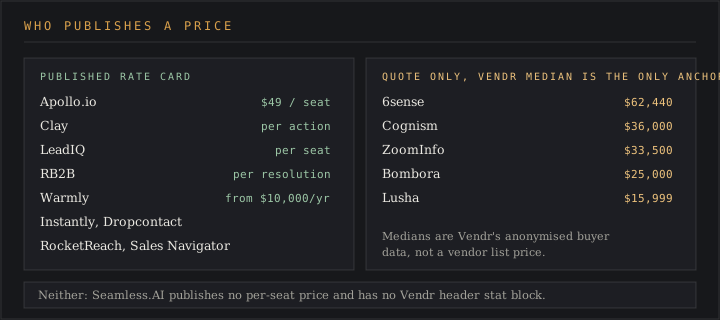
Coverage and pricing figures are each vendor's own published number, read on 11 August 2026. Medians marked as Vendr's are anonymized buyer-reported contract values from vendr.com/marketplace, used where the vendor quotes a custom price. Neither Cognism nor 6sense publishes a per-seat price, so both rows carry a Vendr median instead.
Lead intelligence software does three jobs. It fills in the contact and company data you don't have, it watches for buying signals, and it tells you which accounts moved. ZoomInfo says it handles 1.5B+ data points daily.
This page ranks twelve lead intelligence tools on figures their own sites publish. Where a vendor publishes no price, the entry uses Vendr's anonymized buyer data and says so.
The buyer here runs outbound, demand generation, or both, and wants the entry price before booking a call. That range runs from a free plan with 40 credits a month to a Vendr median of $62,440 a year.
Rate cards moved, which is why lead intelligence software for 2026 needs re-checking. 6sense replaced four Sales Intelligence plans with a single license on May 22, 2025, and five of the fifteen vendors researched publish no dollar figure.
Two sibling rankings rank overlapping vendors from a different angle: sales intelligence platforms covers ZoomInfo and 6sense alongside conversation and outreach tools, and B2B data providers ranks the contact-database layer these lead intelligence tools sit on top of. Construction bid leads from Dodge Construction Network, which tracks 700K+ projects a year, are covered in our construction intelligence platforms ranking.
Evaluation criteria for lead intelligence software
Five criteria decide the shortlist, and the ranking below applies them in this order.
Published match rate and data accuracy method
A percentage without a method is marketing. LeadIQ publishes an 85% global mobile match-rate, 70% in EMEA, plus a five-source verification process. ZoomInfo publishes 87% mobile number accuracy with no method.
Entry price you can read without a call, plus seat minimums
Eight of these twelve publish a number. Apollo charges $49 per seat per month billed annually, with a three-seat minimum on Organization alone. Cognism includes 5 seats in both packages and prices neither.
DNC screening and GDPR compliant contact data
Two vendors name their registries. Cognism cross-checks against 15 DNC lists globally; LeadIQ lists 13 country registries, with the US in beta.
Documented API rate limits and CRM integration gating
6sense enforces 100 requests per minute; RocketReach publishes 10 requests per second across all APIs. Then check the gate. LinkedIn puts CRM sync on Advanced Plus alone.
Vendr median contract value from anonymized buyer data
Vendr's header block records what buyers paid, & sample size matters as much as the median. ZoomInfo's $33,500 median rests on 1,569 purchases; Clay's $40,500 median rests on 80.
The 12 best lead intelligence tools ranked
ZoomInfo
Best fit: US enterprise revenue teams that need person-level website visitor identification on the same platform as their contact database.
ZoomInfo publishes the largest counts here: 500M+ verified professional profiles, 122M+ company records and 4,500+ intent topics, while the same page claims 158M+ locations in prose against a tile reading 100M+. Visitor ID is person-level and US-only, with GDPR markets out of scope. Our ZoomInfo review covers the credit model, and the ranked list of ZoomInfo alternatives covers how it stacks up against 18 competing tools.
Key features
- 500M+ profiles, 135M+ direct dials and 300M+ verified emails
- WebSight BuyerID returns name, title, direct phone and business email for US visitors
- 4,500+ intent topics, with Streaming Intent sold as a separate add-on
- Website visitors and buyer intent signals gated to Copilot Advanced and above
Pricing
No dollar figure appears anywhere; pricing runs on features, licenses and credit usage, one credit per export. Vendr's anonymized buyer data puts the median at $33,500 a year across 1,569 purchases, low $7,200, high $155,280.
Pros
- Largest published contact database in this ranking
- Person-level visitor ID that recognises returning form-fillers across devices
- SOC 2, ISO 27001 and ISO 27701 certifications with a 99% uptime SLA
Cons
- No published price, no free plan, every CTA is a sales contact
- Intent is a separate SKU and integrations carry a base cost plus bulk credits
- The 87% mobile accuracy claim has no stated method
"They are charging $13,000 but their product does not work properly and their support model falls way short of what was sold to me."
Srikanth M., Managing Partner, Small-Business, rated 0.0/5 on G2, January 29, 2024.
Why it's ranked #1. ZoomInfo wins on the Vendr criterion: a $33,500 median drawn from 1,569 purchases against Apollo's 99, plus 500M+ profiles against Apollo's 240M+ match set. The cost is a $7,200-to-$155,280 spread.
Apollo.io
Best fit: Small and mid-sized sales and marketing teams that want a published per-seat rate card and sequencing in the same tool as the lead data.
Apollo publishes the clearest ladder in the category: Basic $49, Professional $79 and Organization $119 per seat per month, billed annually, over a free Starter plan with 900 credits per seat per year. Accuracy comes with a named process, 7-step email verification producing a 98% email accuracy rate. Our Apollo.io review works through the credit maths.
Key features
- 65+ filters over a contact database refreshed at 150M contacts monthly
- Visitor identification matched against 240M+ contacts and 30M+ companies
- Contact-level resolution for US traffic; company-level identification available globally
- Published API rate limits for Free, Basic, Professional and Organization, contradicting the pricing page's Custom-plans-only claim
Pricing
Free, then $49, $79 and $119 per seat per month on annual billing. An email costs 1 credit and a phone number costs 8. Vendr's anonymized buyer data records a $19,000 median across 99 purchases, low $4,284, high $42,442.
Pros
- Full rate card published, credit allowances included
- Free plan that includes company-level visitor identification
- Published API rate limits on every tier, including Free at 50 per minute
Cons
- Export credits burn whenever enriched data leaves Apollo, CRM sync included
- Cancellations take effect only at term end, with no mid-term refunds
- Free and trial accounts can connect Gmail mailboxes only
"The switch from ZoomInfo to Apollo.io was mainly due to cost efficiency, as ZoomInfo was considerably more expensive."
Vatsal N., Founder, Internet, Small-Business, review #39 rated 4.0/5 on G2, April 30, 2026.
Why it's ranked #2. Apollo loses to ZoomInfo on sample depth, 99 Vendr purchases against 1,569, and beats Cognism on transparency: $49 per seat is on the page, while Cognism prices neither of its 5-seat packages.
Cognism
Best fit: EMEA outbound teams that need do-not-call screening and notification mechanics they can name in a procurement review.
Cognism makes the strongest compliance claim in the set, filtering against 15 DNC lists globally, more than any other B2B data provider, and it names all of them.
The counts are the weak point. No contact total appears anywhere, and the only phone accuracy figure sits inside a customer card, where an IT Director calls Diamond Data phone verified mobile numbers with 87% accuracy. Our Cognism review covers the seat floor.
Key features
- Standard and Pro packages, each with 5 seats included
- One credit reveals one contact, with no charge for re-viewing a revealed record
- Bombora Company Surge bundled into Pro, up to 12 topics from over 11,000
- CRM Enrichment sold standalone or as an add-on to an existing setup
Pricing
No dollar figure. Each seat carries a credit allocation whose size is never stated. Vendr's anonymized buyer data records a $36,000 median across 108 purchases, low $18,350, high $93,886, the highest floor here.
Pros
- 15 screened DNC registries, named individually
- Notification emails sent to business contacts within GDPR timeframes
- Director-level and above records refreshed on a 30 day basis
Cons
- No contact count, no company count, and counters that render as zero
- No published price and a 5-seat floor on both packages
- No website visitor identification product
"I am a fully outbound SDR, so need to import 200+ contacts from Sales Navigator to Hubspot and SalesLoft per week. Cognism is great at this, rarely duplicates contacts and is easy to use."
Verified User in Computer Software, Small-Business, review #18 rated 2.5/5 on G2, July 29, 2025.
Why it's ranked #3. Cognism trails Apollo because no per-seat price and no record count are published, and beats Clay on compliance: 15 named DNC registries and a 72-hour breach commitment against Clay's zero published claims.
Clay
Read the full Clay review for the pricing overhaul breakdown and the reviewer quotes behind the scores below.
Best fit: RevOps teams that already buy from several data vendors and want waterfall enrichment across all of them in one table.
Clay runs two meters. The Launch card reads $167/mo annual and $185/mo monthly, the sum of a $54 actions rung and a $113 data-credit rung.
Clay works as an orchestration layer over third-party providers, which is why it publishes no coverage count and no accuracy rate. Gating follows the ladder: web intent signal tracking and CRM auto-sync arrive at Growth, at $446/mo.
Key features
- Actions ladder from 180K a year at $54/mo to 2.4M at $486/mo
- Data-credit ladder from 30K a year at $113/mo to 600K at $1,913/mo
- Multi-provider waterfalls and Claygent on the free plan, capped at 50 rows per table
- Unlimited seats on every tier, with billing on usage
Pricing
Free, then $167/mo Launch and $446/mo Growth on annual billing. Vendr's anonymized buyer data shows a $40,500 median from 80 purchases, low $16,044, high $117,900. Our Clay pricing breakdown covers the Data Credit math and the March 2026 overhaul in full.
Pros
- Every rung of both ladders is published, so the bill is predictable
- No per-seat charge and no seat minimum on any tier
- Job change and signal tracking arrives at the $167 rung
Cons
- No first-party data, so accuracy depends on the providers you connect
- No published DNC screening, GDPR claim or verification method
- Conditional logic and formula chains create a steep learning curve
"The UI looks like a friendly spreadsheet, but when you need conditional logic and formula chains, it's basically programming. The phone number coverage is really weak, with mobile matches only around 30-35%."
Chris J., PMM, Mid-Market, review #11 rated 4.0/5 on G2, May 04, 2026.
Why it's ranked #4. Clay ranks below Cognism because it publishes no accuracy rate and no DNC claim, and above Woodpecker because its data-credit ladder scales to 600K credits a year against Woodpecker's 100 free Lead Finder credits, the only lead-sourcing allowance Woodpecker publishes.
Woodpecker
Best fit: Founders, small sales teams and lead-gen agencies running cold email and LinkedIn outreach who want to pay per contacted prospect.
Woodpecker rewrote its pricing page on June 18, 2026 around a single usage unit: $7 per 100 contacted prospects, with unlimited seats and unlimited email accounts included free. It sells no contact database of its own; the entry tier's 100 Lead Finder credits are the only lead-sourcing allowance it publishes. Our Woodpecker review covers the pricing calculator and the deliverability record in full.
Key features
- Live pricing calculator scales from $0 at 16,000 emails and 4,000 stored prospects to $7 per additional 100 contacted prospects
- Unlimited team members and unlimited email accounts included free at every usage level
- Mailivery warm-up engine bundled free for 4 email accounts, plus unlimited catch-all email verification on every plan
- LinkedIn outreach add-on at $29 a month per connected account, combining email steps, LinkedIn touchpoints and manual call tasks through Aircall
Pricing
Free up to 16,000 emails and 4,000 stored prospects, then $7 per 100 contacted prospects, pay-as-you-go, with no seat charge. API access, webhooks, the MCP server and the CLI sit behind a separate $20/month add-on. Woodpecker has no Vendr header stat block.
Pros
- No per-seat charge, so a five-person team shares one account free
- Unlimited catch-all email verification included on every plan, with no per-check credit cost
- 4.5/5 on G2 across 105 reviews and 4.5/5 on Capterra across 33 reviews
Cons
- No first-party contact database, no DNC screening claim and no published match-rate method
- API access, webhooks, the MCP server and the CLI cost an extra $20 a month
- Support quality splits sharply: a "45-minute walkthrough call" review sits beside a "zero technical support" one
"We use it to manage and send cold email campaigns in the Sales Development Department. That is also a great tool to monitor mail deliverability."
Kacper Buba, Outbound Team Coordinator, Just Join IT, on TrustRadius, April 2023.
Why it's ranked #5. Woodpecker trails Clay on lead-sourcing volume, 100 free Lead Finder credits against Clay's 30,000-a-year data-credit floor, and beats 6sense on price transparency: a public calculator charging $7 per 100 contacted prospects against three bundles gated behind a demo call with no published figure anywhere.
6sense
Best fit: Account-based marketing teams that want predictive analytics and account level intent data across a defined target account list.
6sense publishes scale figures and contradicts them on the same page, claiming 481M+ published buyer profiles, 75M+ companies and 98M+ direct dials while its own FAQ there says 65 million companies. Deanonymization stops at the account: the Company Identification API matches IPs to accounts. Our 6sense review tracks that gap.
Key features
- Data Packs bought à la carte, with intent from Bombora, TechTarget, TrustRadius and G2
- Signalverse processing 500B+ intent signals monthly and 70,000 job changes daily
- Sales engagement tools covered by extensions for Salesloft, Outreach, Dynamics and Salesforce
- People Enrichment API at 20 queries per second and 25 queries per call
Pricing
Three bundles, no prices, a demo CTA. Credits are set by contract terms and don't carry over. Vendr's anonymized buyer data shows the highest median here: $62,440 a year across 381 purchases, low $11,566, high $175,022.
Pros
- Documented API rate limits and published per-API package gating
- Intent sourced from four named providers
- Individualized Article 14 notice, with a UK ICO registration number published
Cons
- Profile and company counts contradict the FAQ directly below them
- No dollar figure, and the free tier is described only on a community subdomain
- No person-level resolution of website traffic
"We've had to purchase additional tools to help with this layer, which means we can't launch ads through 6sense either."
Verified User in Computer Software, Mid-Market, review #38 rated 3.0/5 on G2, October 16, 2024.
Why it's ranked #6. 6sense sits behind Woodpecker on published price and ahead of LeadIQ on intent, pulling from 4 named providers against LeadIQ's none, though its $62,440 median runs 2.4 times LeadIQ's $26,400.
LeadIQ
Best fit: SDR teams of up to five users that want verified contact data with the verification method written down.
LeadIQ is the only vendor here publishing a match rate, an accuracy rate, a bounce rate and the process behind all three. It claims accuracy above 90% on numbers passing AI-driven carrier checks and an 85% global mobile match-rate, reports 2.5% bounce on Verified emails against 14% on Verified-Likely, and runs five sources including a research team that cold calls numbers.
Key features
- 750 million+ profiles refreshed monthly, up to 200 million records re-verified
- Credit costs published: 1 per email, 10 per phone number, 3 per company export
- DNC screening across 13 country registries, with live and pending status marked
- Public API at 60 requests per minute, with 50 free test calls on every plan
Pricing
Free covers 1 user and 50 credits. Pro starts at $200 a month for 200 credits and caps at 5 users, with 25% off on annual billing. Vendr's anonymized buyer data records a $26,400 median across 112 purchases, low $5,201, high $66,780.
Pros
- Match rate, accuracy, bounce rate and connect rate all published with method
- Credits not recharged for the same record for a year, across the whole team
- Free plan includes API access, job change tracking and CRM enrichment
Cons
- Pro caps at five users, pushing growth into an annual Enterprise contract
- No company count and no visitor identification product
- Duplicate detection and custom CRM field mappings are Enterprise-only
"I find great value in its role as a lead-generating tool, particularly noting its reliable performance when other services like ZoomInfo fall short of providing accurate data."
Dren J., Enterprise BDR, Mid-Market, rated 4.5/5 on G2, October 28, 2025.
Why it's ranked #7. LeadIQ loses to 6sense on intent, which it doesn't sell, and beats Lusha by publishing an 85% match rate with a 5-source method against Lusha's 86% phone figure with no process described. See the full ZoomInfo vs LeadIQ comparison for the seat cap that reverses LeadIQ's price advantage above five reps.
FullEnrich
Best fit: Sales teams and agencies that already own a list source and want emails and mobile numbers filled in by a 20-provider waterfall, charged per verified hit with no seat fee.
FullEnrich publishes both halves of the first criterion: an 89% email and 86% mobile find rate in the US and Canada, 84% and 71% across EMEA, and a three-method verification article that states the bounce rate it expects per status: about 2% on valid addresses, 9% on probably-valid, 40% on catch-all. It owns no database of its own; every lookup runs live across 20-plus providers, ContactOut, Hunter and RocketReach among them per the changelog.
Try it yourself
Sign up for FullEnrich
Free trial: 50 credits, no credit card required; Pro from $29 a month for 500 credits.
 Visit FullEnrich →
May earn a commission if you sign up through this link, at no extra cost to you. Full affiliate disclosure.
Key features
- Waterfall enrichment across 20-plus providers, queried in sequence until a verified hit returns
- Triple email verification with a published bounce rate per status; failed lookups, landlines and invalid addresses cost 0 credits
- Owner-name phone verification through telecom partners in the US and Canada since November 2024
- People & Company Search on 800M people and 50M companies, exported at 0.25 credit a record
- HubSpot push, Zapier, Make, n8n and Clay live; an MCP server documented 7 May 2026
Pricing
The rate card lists eleven monthly Pro tiers from $29 for 500 credits to $3,500 for 100,000, with a 50-credit free trial and no credit card. A work email costs 1 credit, a personal email 3, a mobile number 10. Unlimited users come with every plan, and credits roll over 3 months on monthly billing and 12 on annual.
Cancel and any unused balance expires at the end of the cycle, per the credits article. Enterprise, above 100,000 credits a month, is quoted.
Pros
- $29 entry with unlimited users, against Apollo's $49 a seat and Lusha's five-seat self-serve cap
- Match rate and verification method both published, the only tool ranked below LeadIQ that does both
- 0 credits charged on failed lookups, landlines and invalid addresses
Cons
- No LinkedIn extension since June 2024; the workflow is a Sales Navigator CSV upload
- HubSpot is the only live CRM; Salesforce, Pipedrive, Folk and Zendesk sit at "Soon"
- No DNC screening claim, and enriched contacts are deleted after 3 months
"I uploaded list of 2000 leads - Fullenrich found 473 "valid" emails, 259 "perhaps" emails, 273 catch all emails - so 1005 emails in total. Out of that after veryfying catch all with another tool, as well as removing emails from companies that are not current ones I was left with 347 valid emails out of 2000 leads."
Verified user in staffing and recruiting, Small-Business, rated 1/5 on G2, January 01, 2026.
Why it's ranked #8. FullEnrich beats Lusha on the first criterion, an 89% email find rate with a three-method verification article against Lusha's 98% claim with no method, and loses to LeadIQ on compliance and CRM gating: LeadIQ names 13 DNC registries and syncs Salesforce natively, while FullEnrich names no registry and lists Salesforce as "Soon".
Lusha
Best fit: Small North American sales teams that want a free plan and contact details inside a browser extension, and don't sell into the EU.
Lusha publishes prices for four of its five tiers, plus coverage claims of 290M+ verified contacts and 26M+ companies with 32 contact attributes and 70 firmographics including employee count, at 98% email and 86% phone accuracy. Self-serve stops at Premium and five seats; teams larger than 5 users must contact sales.
Try it yourself
Sign up for Lusha
Free plan available, credit-based pricing after that.
 Visit Lusha →
May earn a commission if you sign up through this link, at no extra cost to you. Full affiliate disclosure.
Key features
- 290M+ contacts across North America, EMEA, LATAM and APAC
- Company-level identification that identifies companies visiting your site before a form fill
- 24 real-time signals plus lookalike matching, via API, MCP or Workspace
- Integrations with Salesforce, HubSpot, Claude, ChatGPT, n8n and Make
Pricing
The free plan gives up to 40 credits per month with the extension and CRM integrations. Starter is $49.90 a month for 400 credits, Pro $69.90 for 600 credits and two seats, Premium $399.90 for 3,400 credits. Extra Pro seats cost $49.90 per user per month.
Rollover runs to twice the monthly cap on Pro and Premium monthly billing; Free and Starter get none, and annual plans grant credits upfront and reset the unused ones at cycle end. A SUMMER SALE promotion cuts yearly billing by 25%, 30% and 35% by tier. Vendr's buyer data shows a $15,999 median, low $6,000, high $68,719, on a page giving the purchase count as both 85 and 144.
Pros
- 40 free credits a month, against Apollo's 900 per seat per year
- Holds ISO 27701, ISO 27001 and SOC 2 Type II, and sends people an Article 14 notice with 14 days to opt out
- Contact records marketed across four regions
Cons
- Extra Pro seats cost $49.90 each, so ten seats on Pro runs $469.10 a month
- Accuracy claims carry no verification method
- No DNC screening claim
- GDPR and CCPA compliance is self-declared; Italy's Garante fined Lusha €2 million in July 2026 and ordered Italian residents' data deleted, a decision Lusha is contesting in the Court of Rome
- Two pending US class actions over its contact data, one of them backed by Colorado's Attorney General; the Lusha review lists every case
- Plans auto-renew at the then-current price, and the terms make every payment non-refundable
"Does not offer a cancellation option and forces you to contact someone from their team; tremendously unsatisfied with their services"
Cecillia W., Marketing Consultant, Small-Business, review #6 rated 0.5/5 on G2, April 01, 2025.
Why it's ranked #9. Lusha beats Bombora on reach, 290M+ contacts against zero published contact records, though the third criterion counts against it: no DNC claim, and a GDPR position Italy's regulator has fined. It loses to FullEnrich because its 98% and 86% accuracy claims carry no method and its self-serve plans stop at five seats.
Bombora
Best fit: Marketing teams buying buyer intent data to layer onto a CRM and an ad stack they already run.
Bombora sells one thing and sells it wide. The taxonomy runs to 21,600+ B2B topics organised by NLP, and the co-op behind it covers 200+ publishers and brands across 5,500+ B2B media sites. Resolution stops at the business: signals resolve to 2.8 million businesses through a patented fusion of deterministic, behavioral and IP-to-company data. The Bombora review here is still a stub.
Key features
- 21,600+ Company Surge topics, layerable on any custom audience
- 6,350 firmographic, demographic and behavioral attributes plus 600+ pre-built audiences
- 100+ integrations across ad tech, martech and CRM platforms
- IAB Transparency and Consent Framework v2.2, with consent collected on 100% of events
Pricing
There is no rate card. Both bombora.com/pricing and the get-pricing URL 301-redirect to the data page. Vendr's anonymized buyer data records a $25,000 median across 35 purchases, low $13,000, high $80,450, the smallest Vendr sample here.
Pros
- Widest published topic taxonomy in the category at 21,600+
- Co-op scale of 4.7 million domains and 15.8 billion monthly interactions
- Business-level profiling that sidesteps most individual-privacy exposure
Cons
- No price, no free plan, every path is a demo request
- No contact records, so it can't replace an enrichment vendor
- Company size and industry fields are sourced from third parties
"The upsides of using Bombora are the surging topics it provides to our Sales team. Sales is able to facilitate and hone in on these topics the accounts are surging on during their conversations."
Mike Y., Manager, Sales Development, Enterprise, review #3 rated 3.0/5 on G2, November 19, 2020.
Why it's ranked #10. Bombora ranks below Lusha because it sells no contact data at all, and above RB2B on scope: 21,600 topics and 4.7 million tracked domains against RB2B's single US-only resolution product.
RB2B
Best fit: US-only B2B websites that want person-level visitor identification pushed into Slack for under $200 a month.
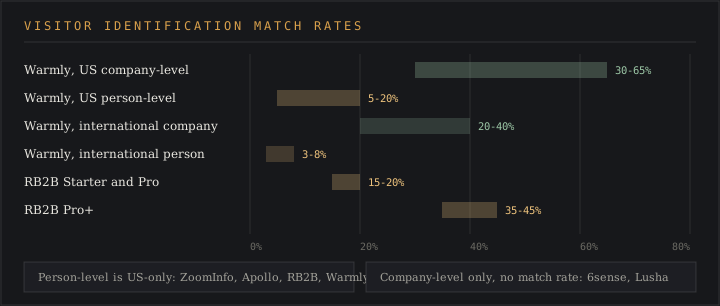
RB2B is the cheapest person-level identification here, running $0 with 150 monthly resolutions, $79 Starter, from $149 Pro and from $199 Pro+. Coverage is where it gets messy: the pricing table lists 15-20% contact-level coverage on Pro, while another RB2B page claims up to 80% of US anonymous visitors and a support article says 40-45% individual plus 30-35% company.
Key features
- Person-level identification restricted to US soil, with VPN and proxy traffic excluded
- Demandbase partnership giving paying customers unlimited global company-level resolution
- One credit per unique visitor per 30-day window, capped at 12 per visitor per year
- Clay, HubSpot, Salesforce, Zapier and Apollo gated to Pro and Pro+; Slack on all plans
Pricing
Free at 150 resolutions, then $79/mo Starter, from $149/mo Pro and from $199/mo Pro+, with additional domains at $99/mo for up to five and a 7-day trial on all four plans. RB2B has no Vendr header stat block.
Pros
- Person-level resolution at $149 a month, an order of magnitude under the enterprise medians
- Free plan with 150 company-level resolutions and Slack delivery
- Delete Act disclosure showing 23,323 requests in 2025, all complied with, median one day
Cons
- Four different coverage figures published across the company's own pages
- RB2B states it doesn't enforce consent for you and can't exclude regions from tracking
- Free and Starter exclude email addresses and every integration except Slack and Teams
"I'm finding that visitor emails that R2B is providing can bounce, or LinkedIn profile URLs are empty/lead to a 404 linkedin page. We burn through our credits on non-ICP traffic."
Verified User in Information Technology and Services, Mid-Market, rated 2.0/5 on G2, June 11, 2024.
Why it's ranked #11. RB2B beats Sales Navigator on entry price, $79 a month against $119.99, and loses to Bombora because its own pages publish four coverage figures for one product, from 15-20% up to 80%.
LinkedIn Sales Navigator
Best fit: Sellers who research and message accounts inside LinkedIn and don't need to export records into a CRM.
LinkedIn publishes one price list. Its compare-plans page, updated 27 September 2026, puts Core at US$119.99 per month and Advanced at US$159.99, and the older sales-solutions URL that once listed $99.99 and $179.99 now redirects to it.
Gating puts it last here: CRM integration and lead creation are Advanced Plus features alone. Our LinkedIn Sales Navigator review notes the same split.
Key features
- Search across more than 1 billion members using 50+ advanced filters
- Buyer intent signals, Account IQ and Lead IQ on Advanced and Advanced Plus
- Real-time alerts on job changes and posted content across all three tiers
- CRM sync with Salesforce, HubSpot Smart CRM, Dynamics 365 and Zoho on Advanced Plus
Pricing
Core at US$119.99 per month or US$1,079.88 per year, Advanced at US$159.99 or US$1,799.88, Advanced Plus quoted by a rep, all excluding VAT and GST. No Sales Navigator Vendr page exists; the parent LinkedIn page bundles Recruiter and Learning. Our LinkedIn Sales Navigator pricing report covers the InMail caps, trial and refund terms tier by tier.
Pros
- 1 billion+ member network refreshed by members themselves
- 50 InMails a month included on the $119.99 tier
- A Forrester study cited by LinkedIn reports 312% ROI over three years
Cons
- Core costs US$1,439.88 a year paid monthly, against US$1,079.88 billed annually
- CRM integration locked to Advanced Plus, which carries no list price
- No exportable contact database and no visitor identification
"It is priced way too high, especially now that tons of other alternatives are on the market (Lusha, Clay, etc.)."
Luca B., Co-Founder, Consulting, Small-Business, rated 2.5/5 on G2, May 09, 2026.
Why it's ranked #12. Sales Navigator ranks last because 50 InMails is the cap on all 3 tiers, CRM sync costs an unquoted Advanced Plus upgrade, and nothing exports, though 1 billion+ members beats every count above it.
What lead intelligence software does, and how the three types differ
A lead intelligence platform gathers and analyses data about potential customers, then pushes it where reps work. Three product types sit under that description, and buying the wrong one is the expensive mistake here.
Data enrichment
Enrichment fills gaps in records you hold. Apollo runs 65+ filters and refreshes 150M contacts monthly; Dropcontact holds no database, working from a first name, last name and company website. Dynamic lead enrichment keeps enriched contact data alive: LeadIQ re-verifies up to 200 million records as people change roles, removing the manual data entry behind it.
Real-time enrichment matters at the refresh line. Dropcontact puts real-time enrichment notifications on its Enterprise tier alone, and Warmly says its average data age is under 90 days. Ask when a record was last touched.
Intent data
Intent tells you which accounts research your category elsewhere on the internet. Bombora's co-op captures 15.8 billion interactions a month across more than 5,000 sites and scores each account 0-100 per topic. Because it's account-level, it won't name who to call.
Signal-based intelligence
Signals are events: a hire, a page view, a job change. Warmly sells advanced signals covering intent data, hiring activity, funding events and competitive intelligence as a $10,000-a-year add-on. The three types together produce actionable lead intelligence; sales intelligence is the same work aimed at open opportunities.
Where contact and company data comes from
How vendors verify contact data
Apollo describes a seven-step process handling catch-all domains, producing 98% email accuracy across 72M emails verified monthly. Seamless.AI describes a 10-step process with no percentage attached. Maintaining data accuracy is a recurring cost, and vendors that describe the process publish the number too.
Company data, contact details and employee count
Lusha publishes 26M+ companies with 70 firmographics including industry, employee count and funding status; ZoomInfo publishes 122M+ company records. Those company details drive list building. Check job titles and headcount bands in a sample export against LinkedIn profiles.
Firmographic, technographic and behavioral data
Technographics come from crawling stacks: Cognism tracks over 20,000 technologies, 6sense tracks 43K+. Behavioral signals come from content consumption. Lusha says it takes business-only contacts from professional communities and never scrapes professional networks; other vendors build records from LinkedIn and company websites.
Intent data, buying signals and how to use them
Intent monitoring tracks digital behaviour that suggests a purchase is coming, then ranks accounts by it. The scoring is the useful part: Bombora treats 60 and above as spiking, which gives reps a threshold.
Topic count is the second lever. Apollo gives 1 intent topic on Free and 12 on Organization; ZoomInfo gives 25 on Marketing Demand and unlimited on ABM Enterprise. Seamless.AI marks intent as an add-on on all three tiers while publishing no price for it.
Used well, buying intent signals narrow a 5,000-account territory to the 200 worth a sequence. That's how teams prioritize high intent leads and work warm leads first.
Ad audience targeting and buying committees
Intent topics feed ad audiences as well as rep queues. Bombora layers its 21,600+ Company Surge topics onto any custom audience, alongside 600+ pre-built B2B audiences and 6,350 attributes. ZoomInfo caps the Display Network on ABM Lite at 10 active campaigns and 10K accounts.
Segment the audience before the ad budget goes out. Clay pushes audiences to ads platforms only from Growth at $446/mo, so an ICP list built on a Launch plan leaves through a CSV.
B2B deals rarely have one buyer. A Forrester study from October 2023, cited on LinkedIn's own enterprise page, reports up to 11 decision-makers involved in a single deal. Account-level intent flags the account without naming any of them.
Website visitor identification and its geographic limits
Bombora reports that about 97% of visitors who land on your website remain anonymous. Company-level resolution matches an IP to an account globally; person-level resolution names the individual and stops at the US border, as Apollo states: contact-level is currently available for US-based visitors.
Demand a match rate. Warmly's benchmark table reports around 65% company-level and 15% person-level on US traffic, dropping to 20-40% and 3-8% internationally, and its providers can't match individual contacts inside the EU. European traffic gets you a company name.
Pricing across the category, seat minimums and auto-renewal
Published entry prices span two orders of magnitude, from RB2B at $79 a month to a 6sense median of $62,440 a year. Paid plans split into three billing models: per seat, per credit, and per resolution.
Seat floors are the trap. Cognism includes 5 seats in both packages, Apollo applies a 3-seat minimum on Organization, LeadIQ caps Pro at 5 users, and Lusha sends teams over 5 users to sales.
Auto-renewal is the second trap. One G2 reviewer writes that "Cognism hide their auto-renewal policy through a hyperlink on the contract you'll sign" (Simon S., Small-Business, 0.0/5, July 04, 2023).
"My contract autorenewed with 20% increase and i got one email at 60 days with a subject line: your subscribtion is set to autorenew automatically."
Shelby B., Director of Business Development, Small-Business, review #29 on G2, April 28, 2023.
Discounts are real. Vendr's anonymized buyer data records average savings of 30% on Apollo and 22% on ZoomInfo. Ask for non-auto-renewal in writing.
GDPR and DNC compliance mechanics
Three questions decide it: the lawful basis, the notification method, the DNC screening. Cognism answers all three, processing under legitimate interest as allowed under Section 6.1(f) GDPR. 6sense provides individualized Article 14 notice.
RB2B says it's US-only, then warns that anyone using its global IP-to-company identification must use a consent management solution. Dropcontact runs its algorithms on EU-based servers with no database.
CRM integration and keeping CRM data fresh
Every vendor here integrates with Salesforce and HubSpot. What differs is the tier and the cost. ZoomInfo notes its pre-packaged integrations have a base cost to install and require a minimum purchase of bulk credits. Clay gates CRM auto-sync to Growth at $446/mo, LinkedIn gates sync to Advanced Plus.
Refresh cadence is the recurring value: 6sense refreshes contact data every 45-60 days, Cognism refreshes director-level records on a 30 day basis.
The named CRMs repeat across the category. Apollo lists Salesforce, HubSpot, Outreach, SalesLoft and Marketo; Cognism sells CRM Enrichment standalone or as an add-on; 6sense ships Sales Intelligence extensions for HubSpot CRM, Salesforce, Dynamics, Salesloft and Outreach, and needs that connection before its dashboards render.
Up to date data is what makes lead scoring and automated lead routing behave, & data enrichment tools that write into the CRM, like LeadIQ enriching 40+ firmographics in Salesforce, settle most arguments between sales and marketing over lead quality.
AI powered scoring and predictive analytics
Predictive scoring ranks leads by likelihood to convert, using the firmographic, technographic and behavioral inputs above. 6sense sells this as its core product. LeadIQ applies AI to a narrower job, running carrier checks that produce numbers with accuracy above 90%.
AI-powered writing is priced by volume: Apollo grants 5,000 AI writing words a month on Free and 1,000,000 on Organization. A vendor claiming the highest match rates without publishing one has given you a sentence.
Free plans and what they exclude
Six vendors run a free tier, and the exclusions show what the paid product is for.
- Apollo Starter: 900 credits per seat per year, Gmail-only mailboxes, 25-record selection limit
- Lusha: 40 credits a month with the browser extension and CRM integrations
- Clay: 100 Data Credits and 500 Actions a month, 50 rows per table
- LeadIQ: 1 user and 50 credits, API access and job change tracking included
- RB2B: 150 monthly resolutions, company-level only, no email addresses
- Seamless.AI: 1 user and 50 credits, excluding data enrichment and buyer intent data
Warmly's free tier identifies 500 accounts a month. Treat a free plan as a data sample: run your ICP through it and count the usable records.
Common buying mistakes
Paying for seats nobody logs into is the first. Cognism's 5-seat floor and Apollo's 3-seat Organization minimum mean small teams buy capacity they don't use, and the credit allocation is attached to those seats.
Prioritizing database size over coverage of your segment is the second. Seamless.AI advertises 1.3B+ verified contacts, which says nothing about how many CFOs at 200-person manufacturers in Belgium it holds.
Ignoring credit mechanics is the third: Apollo charges 8 credits for a phone number against 1 for an email, and Clay bills failed enrichments. The fourth is leaving compliance until legal asks.
Seat adoption, cost per record and cycle time
Seat adoption is measurable, and vendors gate the measurement. LinkedIn puts Usage Reporting on Advanced and Advanced Plus; LeadIQ keeps team analytics dashboarding and reporting on Enterprise. An unused seat still carries the credit allocation the team paid for.
Company size follows the seat floor. Cognism's 5 seats in both packages and 6sense's contract-set credit allowance point at mid-market buyers and up, while Seamless.AI's free tier of 1 user and 50 credits starts with one person.
Cost per usable record is what acquisition cost comes down to. Apollo charges 8 credits for a phone number against 1 for an email; RB2B bills overage at 25c per resolution on Pro and 45c on Starter. Dropcontact re-credits an email it can't find.
Cycle-time gains come from the vendors themselves, so read the attribution. LinkedIn's enterprise page reports a 29% lift in sales opportunities and a 45% lift in deal size, sourced to LinkedIn data from April 2026, plus up to 65 hours per rep a year saved in tool switching. Its own body copy puts that deal-size figure at 43%.
Connect rates move the same way. LeadIQ reports customers averaging 5-10% connects across all numbers, and up to 15% when they filter for Verified phones, which is the warm-lead effect priced at 10 credits a number.
How to test a shortlist
Hand each vendor 200 accounts you already sell to and 20 job titles you target. The match counts measure data quality against your segment faster than any demo, and they show how many qualified leads the tool would produce.
Then get the bill mechanics in writing: seat minimum, credit cost per phone number, credit expiry, renewal notice. Apollo states that cancellations take effect at term end with no mid-term refunds.
Frequently asked questions
What is the best lead intelligence software?
ZoomInfo, on published coverage: 500M+ professional profiles, 122M+ companies, and a Vendr median of $33,500 from 1,569 purchases. For teams that need a price before a call, Apollo at $49 per seat is the better lead intelligence solution.
Which is the best lead generation tool?
It depends on the motion. For outbound list building, Apollo's 65+ filters and 98% email accuracy cover most cases. For inbound, RB2B at $79 a month identifies companies visiting your site. For account-based work, Bombora's 21,600+ topics.
What is the best CRM for lead generation?
None of these tools is a CRM; they write into one. Salesforce and HubSpot are the two every vendor here integrates with, so check which tier of the sales intelligence tool unlocks the sync.
What is lead scoring software?
Lead scoring software ranks prospects by engagement and fit so reps work key leads first. Bombora scores each account 0-100 per topic. Predictive scoring ranks by likelihood to convert from firmographic, technographic and behavioral inputs.
Is there free lead tracking software worth using?
Yes. LeadIQ's free tier gives 1 user and 50 credits with job change tracking, and Clay's free plan carries 100 Data Credits with unlimited seats. Both let you track leads and test lead intelligence data before paying.
How accurate is B2B lead intelligence data?
Published claims run from Lusha's 86% phone accuracy to LeadIQ's above-90% verified numbers, with 2.5% bounce on LeadIQ's Verified emails against 14% on Verified-Likely. Only LeadIQ and Apollo publish the method.
Bottom line
ZoomInfo wins for US enterprise buyers who need the largest published database and person-level visitor identification in one place, and who can absorb a $33,500 median contract. Apollo wins for everyone who wants a published price, a free start, and $119 seats without procurement.
Cognism is the pick for European outbound, on 15 named DNC registries and GDPR notification emails. Clay suits RevOps teams already paying three data vendors; 6sense suits ABM programmes above $60,000.
At the small end, LeadIQ gives the most published verification detail for $200 a month, FullEnrich gives bulk enrichment with unlimited users for $29, and RB2B gives US person-level identification for $79. Sales Navigator stays useful for research inside LinkedIn & little else, since nothing exports below Advanced Plus.
Disclaimer
This page includes one or more affiliate links. If you sign up for a product through one of them, this site may earn a commission at no extra cost to you.