Construction Intelligence Platforms: 9 Tools Ranked & Priced (2026)
 By Jan Suski. I go deep on every review, checking every number against its source and digging up details other coverage misses, a habit from six years of SEO and link building for tech companies. Bylines at Surfer, Brand24, and Senuto. How the scoring works.
· Prefer this source on Google
Quick comparison of construction intelligence platforms
Coverage is each vendor's own published scale figure. Entry price is the lowest figure on the vendor's domain, or the pricing basis where none is printed.
Every price is the figure the vendor publishes on its own domain. "Quote" marks a vendor that prints no dollar figure for a construction plan.
Where these figures come from
Coverage figures and entry prices are each vendor's own published figure, read in October 2026. Buildots' customer count comes from its 14 September 2026 funding release, and FARO's 59% share is FARO's own claim on the HoloBuilder site. OpenSpace, Buildots, Cupix, Oracle, Procore and FARO publish no dollar figure for a construction plan, so their rows name the pricing basis and no number.
None of the nine products appears on another ranking on this site. The visual intelligence platforms ranking covers general-purpose image recognition from Google Cloud Vision and Amazon Rekognition, the risk intelligence software ranking covers incident alerting from Everbridge and Dataminr, and the operational intelligence platforms ranking covers machine-data monitoring from Splunk and Datadog. This page ranks all nine on what they measure on a jobsite.
A construction intelligence platform turns jobsite evidence into numbers a project team can act on. 360 cameras, drones, schedules, BIM models & daily logs go in. Percent complete per trade, a forecast of which activity will finish late, or a weekly ranking of which project carries the highest incident risk comes out.
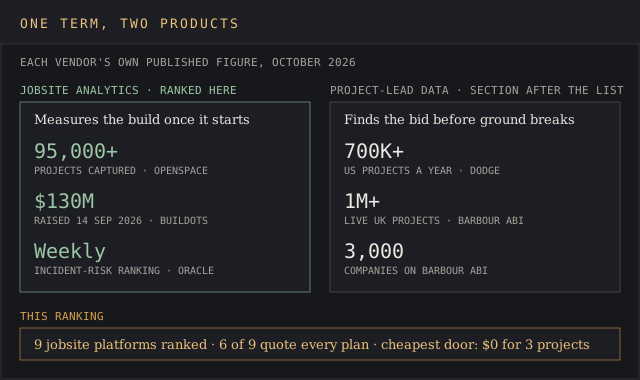
The term has two readings in the construction industry. Barbour ABI and Dodge Construction Network sell project-lead data, the planning applications and bid invites a supplier chases before ground breaks. Buildots, OpenSpace and Oracle sell jobsite analytics that measure the build once it starts.
The second reading now owns the search results. Buildots made construction intelligence the name of a category launch on 15 April 2026 and raised $130 million on 14 September 2026. This ranking covers jobsite analytics; the lead-data vendors get a section of their own after the list, and the wider market sits in the construction market intelligence guide.
It's written for general contractors running several active jobs at once, owners paying for progress they can't walk every week, and VDC leads who already hold a model and want the site checked against it. A three-person remodeler needs none of the nine. Trimble ProjectSight's free tier covers 3 projects at $0 and is the cheapest door in.
Finding a price is like looking for a needle in a haystack. Six of the nine vendors quote every construction plan, so the table leads with the coverage figure each one publishes, and the pricing section maps what a buyer can read before the first sales call. This article ranks the nine on five checkable criteria and carries a user's comment from G2 or Capterra on every entry.
Evaluation criteria for construction intelligence platforms
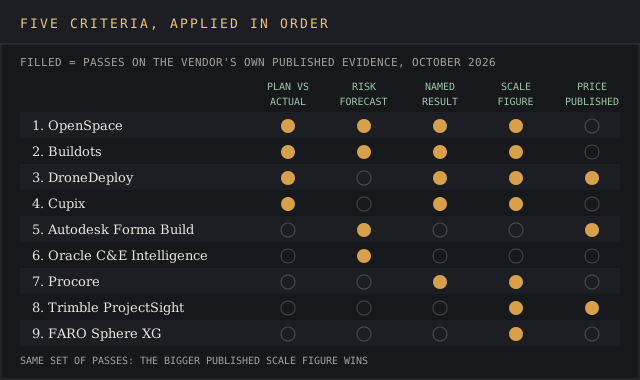
Five criteria decide the shortlist, and the ranking applies them in this order. A platform that passes the first criterion beats one that fails it; ties go to the next criterion, and where two platforms pass the same set, the bigger published scale figure wins.
Scope: software whose job is measuring or forecasting the build from site and project data. Lead databases sit outside it.
Nine platforms are ranked, one short of a round ten. Doxel runs the same hardhat-camera progress tracking as Buildots, but its public record is 1 Capterra review, written in French and filed under the computer games industry, plus 2 on G2, and every entry here is checked against a user's own account.
Plan-versus-actual from site imagery
The test: the platform compares captured images against the schedule or BIM model and reports percent complete per activity with no person keying it in. Ask for the number of tracked components and the turnaround from capture to report.
OpenSpace Track prints both figures: 700 visual components across 200+ schedule tasks, with reports in 24 to 48 hours.
Risk forecasting with a stated cadence
A forecast flags a late activity, a schedule disruption or a jobsite hazard before it lands, on a schedule a buyer can check. Ask what the model watches: Oracle's incident model reads observations, incidents, workforce counts, schedules & weather, and ranks every project by risk each week. A dashboard that only reports what already happened fails this test.
A named customer result with a number
The vendor's own domain has to tie a figure to a named contractor or owner. Intel avoiding four weeks of delay per project passes. A percentage with no project or customer attached fails.
A published scale figure
Projects, sites, square feet or users, printed by the vendor. The figure tells a buyer how many peers already sit on the system and how much history any model behind it has seen.
Price published before a sales call
Yes or no, and the number if yes. Three of the nine print one. The other six price on annual construction volume, company type or a custom quote, and the first number arrives by email after a demo.
The 9 best construction intelligence platforms, ranked
OpenSpace
Best fit
A general contractor that wants every floor of every job documented with 360 capture and progress measured against the schedule, without building a BIM model first.
OpenSpace sells a visual record of the site: a worker walks the floor with a 360 camera, a drone or a smartphone, and the platform pins each frame to the drawing. The company reports 77 billion square feet captured across 95,000+ projects in 132 countries, the largest square-foot figure on this list.
The intelligence layer is Track. Site imagery is ready in 15 minutes on average, and Track's hybrid method pairs AI with human reviewers to check progress against P6, MS Project, Asta and Excel schedules. BIM is optional, so a job running from 2D drawings can still be tracked. Suffolk credits the platform with delivering one project a month early, per OpenSpace's customer results.
Key features
- Track: 700 visual components across 200+ schedule tasks, reports in 24 to 48 hours
- Field: AI Voice Notes fill in assignee, due date and priority on an issue; AI Search tuned to construction terms
- Two-way sync with Procore & Autodesk, so issues created in the field land in the project system
- Capture from 360 cameras, drones or smartphones, plus walk and pilot services
- SSO and API access on the Enterprise tier
Pricing
OpenSpace prices on annual construction volume and the chosen tier, Core or Enterprise, with unlimited capture across projects on Core. The page rules out per-user and per-project pricing. Track is a separate add-on, and every dollar figure comes from a sales conversation.
Pros
- Published scale of 95,000+ projects and 77 billion square feet captured
- Track works without BIM, so a 2D-only job can still measure progress
- T&H Investments cut inspection time from 3 to 4 hours to 30 minutes using Field, per OpenSpace
- Insurer Shepherd offers underwriting credits based on OpenSpace usage, a partnership announced 22 June 2022
Cons
- Price set by annual construction volume, with Track billed on top of the base tier
- SSO and API access sit behind Enterprise
- Exterior and sitework capture works poorly off the drawing, per a 2024 G2 review
- Only 14 reviews on G2, thin for a platform this size
A small-business reviewer left this comment on G2 on 15 January 2026, summing up the remote-access case.
"I can see what's happening on the job sites in real time from anywhere, and I can request a 360° view."
Small-business reviewer, G2, 15 January 2026
The sitework gap shows up in the same listing.
"Viewing areas off of the drawing like outdoors did not work well. Sitework needs to be tracked separate than the first floor."
Verified user in construction, small business, G2, 10 October 2024
Why it’s ranked #1. OpenSpace and Buildots both pass criteria one through four, and OpenSpace wins on the fourth, publishing 95,000+ projects and 77 billion square feet captured against Buildots' 100+ customer firms.
Buildots
Best fit
A builder of data centers, semiconductor fabs or hospitals that needs a forecast of which trade will finish late, weeks before it shows on the schedule.
Buildots, founded in 2018, compares site imagery with the BIM model & the schedule to measure what's built. Intel's semiconductor fab program avoided four weeks of delay per project, and contractor NCC completed 2.3 times more tasks on time each week, measured by percent plan complete.
Money has followed. A $45 million Series D in May 2025 came before a $130 million round in September 2026, and the customer list runs to 100+ large-scale firms, including Turner Construction, JE Dunn and Mortenson. CEO Roy Danon described a shift from project-by-project adoption to long-term enterprise agreements in the 2025 announcement.
Total funding after the September 2026 round, per Buildots' $130 million funding release.
Key features
- Progress tracking by computer vision against BIM and schedule
- Delay-risk prediction and deviation detection per trade
- Buildots Field: workforce location data showing which workers were in which zone, built on the Genda acquisition of 16 October 2025
- Payment applications backed by verified progress, so authorization of a pay claim rests on measured work
- Capture Services: fully managed site captures for teams without a dedicated walker
Pricing
Buildots sells through its sales team, starting from a demo form on its platform page. Its CEO cited "multiple seven-figure deals" in the Series D announcement, which tells a buyer where enterprise contracts land.
Pros
- Named results with numbers: Intel's four weeks, NCC's 2.3x
- Progress and workforce data in one system since the Genda deal
- $297 million raised across rounds, per the September 2026 release
Cons
- Enterprise contracts in the seven figures, per the CEO
- Sales-led access: the first step is a demo form, and a 2023 G2 reviewer flagged the missing trial
- G2 holds 2 reviews averaging 3.5 out of 5
- Needs a BIM model to compare against
Solution architect Vishal H. wrote on G2 in March 2023 that the "AI powered product offers unique capabilities like real-time analysis of projects progress." The same comment named the buying friction: "There is no trial version available directly to test drive product."
Why it’s ranked #2. Buildots beats DroneDeploy on delay forecasting, with Intel's fab program avoiding four weeks of delay per project, and loses to OpenSpace on published scale: 100+ firms against 95,000+ projects.
DroneDeploy
Best fit
Civil and sitework teams that fly drones over earthworks and want the same platform to walk 360 routes inside the building.
DroneDeploy sells aerial and ground capture and reports 3 million sites in 180 countries. Its construction plans split into Aerial and Ground, and Ground adds 360 Walks, BIM overlays, Safety AI and sync with Procore and Autodesk. A team buying both kills two birds with one stone: drone maps of the earthworks outside and 360 routes inside.
Progress AI, launched on 22 July 2025, turns drone and 360 camera data into progress reports within minutes. A digital documentation specialist at Wharton-Smith uses it to support over 90 projects without visiting each one.
The accuracy DroneDeploy states for Progress AI reports, a vendor figure from its July 2025 launch announcement.
Key features
- Progress AI: progress reports from drone and 360 data, with questions answered by voice or text
- Ground plans: 360 Walks, BIM overlays, Safety AI, Procore and Autodesk sync
- Aerial Pro: survey-grade data, automated ground control point tagging, cut and fill analysis
- Dock Automation and Robotic Automation add-ons
Pricing
The Flight & Analysis plan costs $4,188 a year for a single admin user and up to 3,000 images per map. Every construction team plan, Aerial through Ground Pro, is quoted, and Progress AI & Safety AI are priced as add-ons.
Pros
- Published price on the individual plan
- Aerial and interior capture in one account
- 124 reviews on G2 at 4.6 out of 5
Cons
- Progress AI stops at progress reports and answers by voice or text, so delay forecasting needs a second tool
- The construction plans that carry 360 Walks are quote-only
- Small-contractor reviewers cite a rising membership cost
Two G2 comments mark the trade-off. BIM specialist Chase G. wrote in April 2026 that "DroneDeploy puts all of our captured data on one unified platform." A construction owner, Jack D., posted the cost side in September 2024.
"The increasingly steep cost of membership. Unfortunately, I believe this next year I won't be able to remain a user after 4 years"
Jack D., owner, construction, G2, 18 September 2024
Why it’s ranked #3. DroneDeploy loses to Buildots on forecasting, since Progress AI stops at percent complete, and beats Cupix on price: $4,188 a year is published, where Cupix quotes every plan.
Cupix
Best fit
A VDC or BIM team that wants 360 video turned into a 3D map and checked element by element against the model.
Cupix converts 360 video into a navigable 3D view of the site and lays BIM on top of it. The company reports 20,000+ project sites captured since 2023 and says 70% of the ENR Top 30 general contractors use it. Tutor Perini reports 8 times more efficient progress reporting, and BN Builders captures sites 16 times faster than with laser scanning.
Key features
- CupixWorks: 360 video to 3D map, with 4D documentation over time
- SiteInsights add-on: progress analysis and BIM deviation detection
- CupixField for augmented reality in the field
- Integrations with Autodesk Forma, BIM 360, Procore, Revizto, Oracle and ArcGIS
Pricing
Cupix quotes every plan, and SiteInsights is sold as an add-on to CupixWorks.
Pros
- Tutor Perini and BN Builders both attach a multiple to their result: 8x and 16x
- Six named integrations, Procore and Autodesk Forma among them
- Rudolph & Sletten runs 440+ active users on it
Cons
- Quote-only pricing, with progress analysis as a paid add-on
- Capterra rating of 3.9 across 12 reviews
- Older reviews describe panoramas that fail to align
A smart construction team leader, Kyojoon S., wrote on Capterra in January 2022: "Without CupixWorks, it is almost so stupid to use BIM in the construction field." An August 2020 comment on the same listing reported uploading "181 panos" of a factory and that the software "doesn't align them all."
Why it’s ranked #4. Cupix beats Autodesk Forma Build because SiteInsights measures as-built work against BIM from imagery, and it trails DroneDeploy on published pricing, where a $4,188 plan on DroneDeploy's site beats a quote-only rate card.
Autodesk Forma Build
Best fit
A contractor whose design partners already deliver Revit and Autodesk files, and who wants risk flags inside the same project system.
Autodesk renamed Autodesk Construction Cloud to Forma in March 2026, and Autodesk Build became Forma Build, grouping Autodesk's construction products under one name; projects and data stayed where they were. Account admins became Hub Admins in the same change.
The intelligence piece is Construction IQ, which analyzes project data and prioritizes risks across design, quality, safety and project management. Around it sit AI tools for paperwork: AutoSpecs generates submittal logs, a Sheets tool reads sheet numbers and titles out of multi-page PDFs, and Autodesk lists 400+ integrations.
Forma Takeoff and Forma Estimate, the renamed Autodesk Takeoff and Estimate, cover quantity takeoff and cost estimation.
Key features
- Construction IQ risk prioritization across design, quality, safety and project management
- Autodesk Assistant for search, data checks and summaries
- AutoSpecs and Specifications AI for submittal logs and spec books
- Autotags on project photos
- 400+ integrations
Pricing
Forma Build starts at $117 a month, with a 30-day return window on annual and multi-year subscriptions. An older Autodesk purchase page still lists $1,625 to $1,740 per user a year with unlimited sheets.
Pros
- A price on the vendor's own page
- Risk flags inside the system that holds RFIs, submittals and drawings
- 400+ integrations
Cons
- Construction IQ scores project records, so imagery-based progress tracking needs a camera vendor on top
- Reviewers report sync lag on large projects
- A poor fit for small jobs, per users
Two comments on Capterra bracket the size problem from both ends. Draftsman Tim K. wrote in January 2026 that it "does struggle to be useful with smaller projects," and civil engineer Om Prakash P. reported in July 2025 that "occasional syncing issues or slow performance may occur with large projects."
Detailer Garrett U. gave the positive case: "Being able to keep track of RFIs from our GC's is invaluable."
Why it’s ranked #5. Forma Build trails Cupix on imagery-based measurement and beats Oracle on price transparency: $117 a month sits on Autodesk's own page, while Oracle's forecast starts with a sales call and a 12-week implementation step.
Oracle Construction and Engineering Intelligence
Best fit
An owner, EPC firm or large contractor already running Aconex, Primavera P6 or Unifier, with years of incident and observation records to feed a model.
Oracle's intelligence layer sits across Primavera P6 EPPM, Unifier, Aconex and Primavera Cloud. Anyone in the organization can ask questions in plain language and get charts and summaries back, the natural-language feature the self-service BI tools ranking scores outside construction.
The Construction and Engineering Advisor for Safety ranks all projects by risk each week.
The share of projects that typically account for 80% of incidents, per Oracle's safety advisor brief, and the weekly ranking puts the focus on that top 20%.
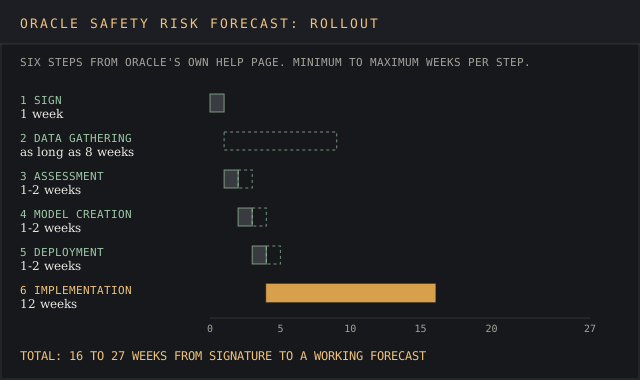
Switching the forecast on takes months. Oracle's incident forecast rollout runs six steps: 1 week to sign, as long as 8 weeks of data gathering, three steps of 1 to 2 weeks each, then 12 weeks of implementation.
Where the data can't support prediction, Oracle builds a benchmark model, which its own help page says "isn't predictive."
Key features
- Weekly incident-risk ranking of every project, with prioritized actions such as raising supervision ratios or focusing observations on work-at-height zones
- Natural-language questions answered with visualizations and summaries
- AI narratives added to existing dashboards
- Runs on data already held in Aconex, Unifier and Primavera
Pricing
Oracle routes every pricing path for the intelligence products and for Aconex to a demo request.
Pros
- The only platform here that forecasts incidents on a weekly cadence
- Works on years of data a large owner already holds
- Aconex holds 231 reviews on G2 at 4.5 out of 5
Cons
- 16 to 27 weeks from signature to a working forecast, by Oracle's own step list
- Quote-only, through a demo request
- Aconex reviewers report browser and design complaints
A planning engineer, Umer I., wrote on G2 in March 2026: "The switch from email communication to Aconex has been great, especially for sharing large files." Two days earlier, a construction reviewer on the same listing posted a blunter comment, listing "Poor browser support (won't work with Chrome or Brave)" and "Bad design, not intuitive" among its dislikes.
Why it’s ranked #6. Oracle beats Procore on forecasting, ranking every project by incident risk each week, and loses to Forma Build on price: Oracle quotes, while Autodesk lists $117 a month.
Procore
Best fit
A general contractor already running RFIs, submittals and budgets in Procore that wants AI agents to cut document work.
Procore runs project management for 3M individual users and holds 4,339 reviews on G2 at 4.6. Its AI sells as a set of named agents: Deep Search, Submittal Review, RFI, Daily Log and Contract Review. Haskell cut submittal review cycles from one week to 10 minutes, and Crest Industries took bid preparation from weeks to as little as 20 minutes.
Key features
- Five named AI agents for search, submittals, RFIs, daily logs and contracts
- Agents inherit existing Procore permissions, and Procore states customer data isn't used for third-party model training
- Budgeting and forecasting for project financials
- Unlimited users and unlimited data on every contract
Pricing
Procore quotes by company type with unlimited users, unlimited data and fixed annual pricing. Field Productivity is the exception, priced per full-time equivalent. Reviewers on G2 describe the basis as annual construction volume.
Pros
- Haskell and Crest Industries put minutes on their results: 10 and 20
- The largest review base here, 4,339 on G2
- Unlimited users on every contract, so adding subcontractors and owners costs $0 in seat fees
Cons
- None of the five agents forecasts delay or incident risk
- Price rises with construction volume, a frequent renewal complaint
- A June 2026 reviewer rated the drawing interface below Bluebeam's from 15 years earlier
Renewal is a bitter pill to swallow for some smaller customers.
"Their pricing is ridiculous, and we plan to leave once our contract expires."
Michael L., construction manager, small business, G2, 5 June 2026
Project manager Chris H. left the opposite comment on the same platform in September 2026: "The budgeting and forecasting tools also make it easy to maintain accurate financial reporting."
Why it’s ranked #7. Procore beats ProjectSight on named results, with Haskell's submittal reviews falling from a week to 10 minutes, and loses to Oracle because none of its five agents forecasts delay or incident risk.
Trimble ProjectSight
Best fit
A small or midsize contractor that wants project management with an AI assistant and 360 video capture at a price it can see first.
ProjectSight is Trimble's project management product, used by 800+ companies. Its 360 Capture add-on maps 360 video walkthroughs onto architectural drawings, and an AI assistant ships on the Go and Enterprise plans. Every license includes Trimble Connect, which links ProjectSight to other Trimble products, per the pricing page.
Key features
- RFIs, submittals, specifications and AI-assisted drawings
- 360 Capture add-on for video walkthroughs pinned to drawings
- AI assistant on Go and Enterprise
- Vista and Spectrum integrations on Enterprise
Pricing
The Free plan gets the ball rolling at $0 for up to 3 projects and 2 GB. Go costs $29 per user a month, billed annually, with unlimited projects and 15 GB. Enterprise is custom for 30+ users, and the separate pricing page promises no charge based on how many users work on a project.
Pros
- The only free tier on the list
- A $29 per user Go price printed up front
- 51 reviews on Capterra
Cons
- 360 Capture is an add-on, outside the base plans
- Capterra average of 3.8
- Two recent reviewers cite slow loading
Reviewer comments on Capterra split. Luke, in September 2025, called it a "Super slow program - back-end coding architecture must be bloated." Angie, in June 2025, praised "the cost management parts" and the ability to collaborate with "the onsite team more efficiently."
Why it’s ranked #8. ProjectSight beats FARO Sphere XG on price, with a $0 tier for 3 projects and $29 per user on Go, and loses to Procore, which publishes a named customer result with a number.
FARO Sphere XG
Best fit
A team that captures 360 photos and laser-scan point clouds and wants both managed in one place.
FARO Sphere XG is the product formerly sold as HoloBuilder, and FARO says 59% of top general contractors rely on it. The product sits under FARO, and AMETEK completed its acquisition of FARO on 21 July 2025 at $44 a share, about $920 million net of cash.
Key features
- 360 photo capture and management on mobile and desktop
- Point cloud processing and management
- 3D design data overlay
- Project, Enterprise and Point Cloud Management tiers
Pricing
The pricing page lists three tiers, Project, Enterprise and Point Cloud Management, with every package quoted by size and duration.
Pros
- 360 photos and point clouds in one system
- Owned by AMETEK since July 2025, after a deal valued at about $920 million
- Capterra rating of 4.8 across 13 reviews
Cons
- Capture and storage only: the product page lists 360 photos, point clouds and design overlays, with AI progress tracking absent
- Quote-only pricing
- Most Capterra reviews date from 2018
A construction reviewer's comment on Capterra named the fit in February 2018: "HoloBuilder is better for smaller projects." Another, Brad, wrote in June 2018 that "[t]he user experience, sheet setup, importing functionality and tour navigation are great."
Why it’s ranked #9. FARO Sphere XG passes one criterion, a published claim that 59% of top general contractors use it, and loses to ProjectSight on price, since every plan is quoted.
What a construction intelligence platform does
Each of the nine platforms runs the same loop: capture, compare, flag. Data integration comes first, pulling schedules, models, photos & logs into one system. Analytics come second. Workflow automation closes the loop by routing a flagged issue to the person who has to act on it, so a project executive can keep an eye on every active job from one screen.
The comparison step depends on what the site is compared against. The software uses a 2D drawing to place each photo on the floor plan, and a BIM model to check that photo against what the building should contain on that date. Buildots and Cupix's SiteInsights need the model. OpenSpace Track works with or without it, which opens progress tracking to jobs that never had a model.
AI agents in construction software
AI agents handle the paperwork side. Procore's Submittal Review Agent and Autodesk's AutoSpecs read documents and produce logs, which is where the admin hours sit: Haskell's week-long submittal cycle dropping to 10 minutes is a document-analysis result.
Autodesk's Sheets tool pulls sheet numbers out of PDFs, a first step in automated blueprint analysis, and Forma Takeoff & Forma Estimate carry that into cost estimation.
Predictive analytics handle the risk side, and the challenge is data quality. Oracle's model ranks projects by incident risk weekly, and Buildots flags trades heading for a late finish, so superintendents make better decisions on crew moves.
Both rely on machine learning trained on historical project data to spot emerging issues before they escalate, the same pattern decision intelligence platforms apply to credit and supply decisions. Both need clean inputs: Oracle's data-gathering step alone runs as long as 8 weeks.
Collaboration is the quieter benefit. The platform keeps a dated, real-time record of every captured floor, and the owner, GC and trade contractor all share one understanding of what was installed on which date.
Shepherd's underwriting credits for OpenSpace users put an insurer's price on that record. Supply chain delays sit mostly outside these tools; a buyer worried about material lead times needs a supply chain risk management platform or a supply chain intelligence suite alongside, and a buyer pricing materials needs procurement intelligence tools.
Project-lead data for the construction industry
The other reading of construction intelligence is commercial market intelligence: who is building what, where, and when the bid closes. Barbour ABI has sold construction market leads and intelligence for more than 80 years, and its UK database lists 1 million+ live projects used by 3,000 companies.
Dodge Construction Network covers the US. It tracks 700K+ unique projects a year, keeps 50+ years of construction starts data and publishes 7,000+ updates a day. Suppliers and subcontractors buy this data to find bids before they close, the job lead intelligence software does for B2B sales teams.
A buyer searching for the term should know which half a vendor sells before booking a demo. The market sizing behind both is in the construction market report.
Pricing across construction intelligence platforms
Three of the nine platforms print a price. ProjectSight starts at $0 and $29 per user a month, Forma Build starts at $117 a month, and DroneDeploy's Flight & Analysis plan costs $4,188 a year. The other six quote, which puts two vendors in three behind a demo, the same pattern that runs through market intelligence platform pricing.
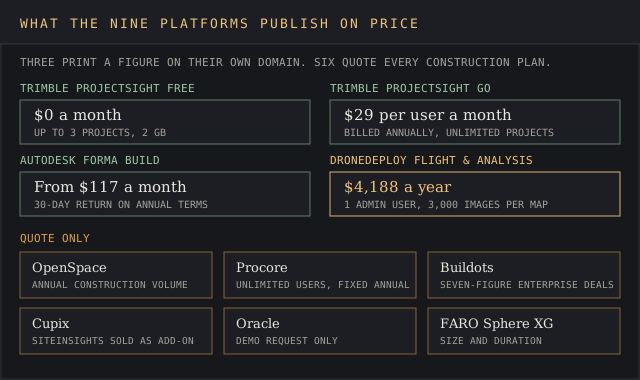
The billing unit decides who pays most. OpenSpace and Procore price on annual construction volume, so a contractor's bill rises with revenue even when headcount stays flat; Procore's G2 reviewers tie their renewal price to ACV.
ProjectSight's Go plan and Autodesk's older Build price list bill per user, which punishes a firm that wants every trade partner to have access.
Ask which billing unit applies, by email, before the demo, because the unit sets how the bill grows in year two.
Add-ons are where the devil's in the details. OpenSpace sells Track separately, Cupix sells SiteInsights separately, DroneDeploy sells Progress AI and Safety AI separately, and ProjectSight sells 360 Capture separately.
The intelligence layer is the add-on in four of the nine cases, so the base price quoted in a first meeting covers the camera and leaves out the analysis.
Implementation time is a cost too. Oracle's safety forecast takes 16 to 27 weeks from signature by its own step list, and OpenSpace's Track reports arrive 24 to 48 hours after each capture. Ask every vendor to name its onboarding steps in weeks, in writing.
How to run a trial before you sign
The real-world test is one live project. Pick it and run two platforms on it for the same four weeks, on the same floor zone, and measure three numbers: hours from capture to report, the share of schedule activities the tool tracks, and how many of its flagged risks your superintendent agrees with.
Keep a transcript of every number the sales team promises and send that transcript back by email, because a figure said on a call stays out of the contract until someone writes it down.
Test exports in week one. Ask for the raw capture files you'd share with an owner, the progress data as CSV and the issue history with comments attached, and check that the account lets you continue to read them after a cancellation. Bite the bullet on this early; a platform that holds four years of site video is hard to leave.
Bring the field team in from the first step, and agree who will continue the capture walks after the vendor's onboarding team leaves. A camera route that lengthens the daily walk gets skipped, and a tool with half-captured floors forecasts from half the data. Ask each vendor for a reference customer on a job your size, call them yourself, and ask what the vendor's case study leaves out.
Construction intelligence platform FAQ
What is a construction intelligence platform?
A construction intelligence platform is software that turns jobsite evidence into numbers a project team can act on. 360 cameras, drones, schedules, BIM models and daily logs go in; percent complete per trade, delay forecasts or a weekly incident-risk ranking come out. OpenSpace, Buildots and Oracle sell jobsite analytics of this kind.
How are AI agents used in construction?
AI agents in construction software read documents and produce logs. Procore sells five named agents: Deep Search, Submittal Review, RFI, Daily Log and Contract Review. Haskell cut submittal review cycles on Procore from one week to 10 minutes, and Autodesk's AutoSpecs generates submittal logs inside Forma Build.
How much does construction intelligence software cost?
Three of the nine ranked platforms publish a price. Trimble ProjectSight starts at $0 for 3 projects and $29 per user a month on Go, Autodesk Forma Build starts at $117 a month, and DroneDeploy's Flight & Analysis plan costs $4,188 a year. The other six quote, and Buildots' CEO cited seven-figure enterprise deals.
Does AI progress tracking need a BIM model?
Buildots and Cupix's SiteInsights need one, since both compare site imagery against the model. OpenSpace Track works with or without BIM, checking progress against P6, MS Project, Asta and Excel schedules, so a job running from 2D drawings can still be tracked.
How accurate is AI progress tracking on a construction site?
DroneDeploy states its Progress AI reports are 95% accurate, a vendor figure. OpenSpace Track pairs AI with human reviewers and delivers reports 24 to 48 hours after capture. To test accuracy yourself, run two platforms on one live project for four weeks and count how many flagged risks your superintendent agrees with.
How long does a construction risk forecast take to set up?
Oracle's incident forecast takes 16 to 27 weeks from signature, across six steps that include as long as 8 weeks of data gathering and 12 weeks of implementation. Where the data can't support prediction, Oracle builds a benchmark model that its help page says "isn't predictive."
Is construction intelligence the same as construction market intelligence?
The two share a name and sell different things. Project-lead data is a type of market intelligence: Dodge tracks 700K+ US projects a year and Barbour ABI lists 1 million+ live UK projects for suppliers chasing bids. Jobsite analytics such as OpenSpace and Buildots measure the build once it starts.
Which construction intelligence platform has a free plan?
Trimble ProjectSight is the only ranked platform with a free tier: $0 for up to 3 projects and 2 GB. Its Go plan costs $29 per user a month, billed annually, with unlimited projects and 15 GB.
Bottom line
OpenSpace wins for a general contractor that wants 95,000+ projects of published track record and progress tracking that works without BIM. Buildots wins for data center and fab builders who need delay forecasts per trade and can sign an enterprise contract. DroneDeploy wins where most of the job is outdoors and the drone is already flying.
Contractors already inside Autodesk or Procore should put Construction IQ or Procore's five agents to work before adding a camera vendor. Owners on Aconex and Primavera with years of safety records get the only weekly incident forecast here from Oracle. A small contractor starts with ProjectSight's free tier and pays nothing until project four.