Risk Intelligence Software: 7 Platforms Ranked (2026)
 By Jan Suski. I go deep on every review, checking every number against its source and digging up details other coverage misses, a habit from six years of SEO and link building for tech companies. Bylines at Surfer, Brand24, and Senuto. How the scoring works.
· Prefer this source on Google
Quick comparison of risk intelligence platforms
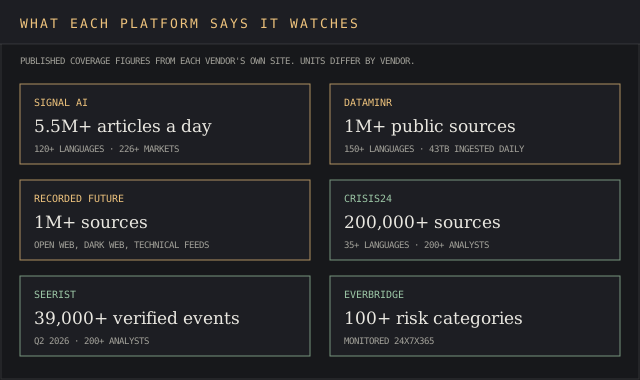
Seven risk intelligence platforms in ranked order, with each one's score out of 10 on the five criteria below, its own published coverage figure, the entry price on record and the buyer it fits.
| Rank | Risk intelligence platform | Score | Published coverage figure | Entry price | Best fit |
|---|---|---|---|---|---|
| 1 | Everbridge 360 | 8/10 | 100+ risk categories, 24x7x365 monitoring center | $21,493/yr Vendr median* | Teams that alert and protect staff from one screen |
| 2 | Recorded Future | 7/10 | 1M+ sources in the Intelligence Graph | $72,703/yr Vendr median* | Threat and cyber risk teams with a budget |
| 3 | Dataminr | 7/10 | 1M+ public sources, 150+ languages | $22,000/yr Vendr median* | Corporate security that needs the first signal |
| 4 | Signal AI | 7/10 | 5.5M+ articles a day, 120+ languages | $12,335/yr Vendr median* | Reputation, ESG and media-driven risk |
| 5 | Crisis24 Horizon | 6/10 | 200,000+ sources, 200+ analysts | Quote only | Duty of care for travelling and remote staff |
| 6 | Seerist | 5/10 | 39,000+ verified events in Q2 2026 | Quote only | Geopolitical and security analysts |
| 7 | Factal | 4/10 | Journalist-verified incidents | 30-day free trial, then quote | Smaller teams that want verified alerts fast |
Medians marked * are anonymised buyer data from closed contracts, published by Vendr. Every vendor here sells by quote.
Where these figures come from
Coverage counts are each vendor's own published figure, linked from its entry below. Prices marked * are Vendr's anonymised buyer data from closed contracts. Scores add up five criteria worth 0 to 2 points each. Crisis24, Seerist and Factal publish no rate card and carry no Vendr buyer pricing, so their rows print no figure.
If you need to score suppliers or vendors, the third-party risk management tools ranking covers security ratings and vendor questionnaires, and the supply chain risk management software ranking covers sub-tier supplier mapping. This page covers event, geopolitical, security and threat risk intelligence, so none of those 18 vendors appear here.
Risk intelligence software watches public and licensed sources for events that can hurt people, sites, travel and operations, then pushes targeted alerts to the team that has to act. MetricStream defines risk intelligence as continuously collecting, analyzing and interpreting risk data to anticipate threats. The platforms below do that collection at a scale no analyst desk can match by hand.
This page ranks seven risk intelligence platforms on five tests a buyer can check in a week: published source coverage, a named analyst team, a price on record, built-in staff alerting and independent review volume. Vendr's anonymised buyer data puts the median contract between a $12,335 median for Signal AI and a $72,703 median for Recorded Future.
It's written for corporate security teams, global security operations centres, travel risk managers and the business continuity leads who sit next to them.
Timing matters because the risk intelligence companies are consolidating fast. Mastercard paid $2.65 billion for Recorded Future, Thoma Bravo took Everbridge private for about $1.8 billion, and Dataminr signed a $318 million, five-year contract with the U.S. Department of War in August 2026.
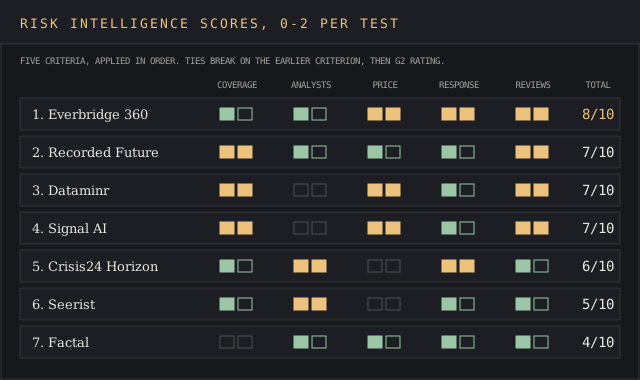
Evaluation criteria for risk intelligence software
Five criteria decide the shortlist, and the ranking below applies them in this order. Each one tests something that changes decision making in a security operations team. Each scores 0, 1 or 2 points, so the maximum is 10. Ties break on the earlier criterion, then on G2 rating. Run them yourself and you'll make informed decisions before a contract, with no vendor slide deck in the way.
Only seven platforms clear the fifth test with any public user reviews on G2 or TrustRadius, so this ranking stops at seven. Maritime, travel and geopolitical specialists with no public reviews get their own section further down.
1. Published source coverage
A published count of at least 1 million sources or 5 million documents a day earns two points, with one point for any smaller published count of sources, categories or verified events, zero for none. Coverage sets the ceiling on risk identification, so ask the vendor for the number in writing before the demo.
2. Human analysts who turn alerts into actionable intelligence
Two points for a published analyst headcount of 100 or more, one for a named analyst or editorial team with no headcount, zero for machine-only detection. Analysts turn a keyword feed into actionable intelligence.
3. A price on record
A Vendr median under $25,000 a year earns two points, a higher median or a free trial earns one, and quote-only with no buyer data earns zero. A number before the first call saves a procurement cycle and lets you cut to the chase on budget.
4. Emergency response tooling attached to the alert
Two points for native mass notification with two-way replies, one for alerts pushed into email, apps or a partner system, zero for a read-only feed. Detection without emergency response tooling means a second contract.
5. Independent review volume
Forty or more G2 reviews at 4.3 or higher earn two points, 10 to 39 G2 reviews or any TrustRadius reviews earn one, and anything less earns zero. Our review of how G2 moderates reviews explains why volume beats a perfect score from five users.
The 7 best risk intelligence platforms, ranked
Everbridge 360
Best fit
A corporate security or business continuity team that wants detection and staff alerting in the same contract.
Everbridge 360 is the risk intelligence platform with the deepest notification stack here. Everbridge built its name on mass notification, which sends 5 billion messages a year to 600 million people for more than 6,500 organizations. Its Risk Intelligence Monitoring Center analyzes over 100 risk categories around the clock and feeds them into Everbridge 360 AI Risk Stream and Protective Intelligence.
Visual Command Center is the map layer for situational awareness in real time. It pulls risk data from over 100 sources, with data sources such as International SOS and Dataminr as named partners, and correlates each event to your assets and employees. A security operations centre keeps that shared operating picture on screen all day.
Key features
- Risk Intelligence Monitoring Center staffed 24x7x365
- Visual Command Center with Dataminr, International SOS, NC4 and Anvil feeds
- Role-based targeting, geofencing and severity thresholds to cut alert fatigue
- Mass notification with two-way communications and configurable escalation workflows
- Over 160 patents, per Everbridge's own count
Pricing
Everbridge sells by quote. Vendr's anonymised buyer data shows a $21,493 median a year, with contracts from $9,734 to $69,374. Thoma Bravo paid $35.00 a share in a deal that closed on 2 July 2024.
Pros
- Detection, maps and staff alerting in one platform
- 352 G2 reviews at 4.5, the deepest review base here
- Vendr median under $22,000
Cons
- Sources described as thousands, with no exact count published
- Notification rules take tuning, per several reviewers
- Owned by a buyout fund since July 2024
"My one criticism is that setting up the workflow to reach particular groups for particular events can occasionally take some fiddling. The logic behind who gets notified when is not always as direct as I would like."
Edie J., system administrator, logistics and supply chain, G2 review, 7 August 2026
A human resources manager on G2 asked for "more options with messaging people via geofencing or location" in June 2026, so test location-based messaging in the trial.
Why it's ranked #1. Everbridge scores 8 of 10 and beats Recorded Future on criteria three and four, with a $21,493 Vendr median against $72,703 and native mass notification. It also carries the deepest review base on this page, 352 G2 reviews at 4.5.
Recorded Future
Best fit
A threat intelligence group with budget that wants geopolitical, third-party and cyber risk in one graph.
Recorded Future comes to risk intelligence from threat intelligence, so its intelligence risk management view starts with cyber indicators and feeds decision making in security operations.
Its Intelligence Graph indexes over a million sources, including the open web, dark web, technical feeds and customer telemetry. Mastercard announced the purchase on 12 September 2024, when Recorded Future served more than 1,900 clients in 75 countries, including the governments of 45 countries and over 50% of the Fortune 100.
The deal closed on 20 December 2024. Its research arm, Insikt Group, writes the analysis behind the platform, though the company publishes no headcount for it. It also sits at number nine in our open source intelligence tools ranking.
Key features
- Intelligence Graph across 1M+ open, dark web and technical sources
- Insikt Group research reports
- Risk scores with linked evidence for each indicator
- Paid add-on modules on top of the core platform
Pricing
Recorded Future carries the highest median here. Vendr's anonymised buyer data covers 48 purchases at a $72,703 median a year, from $27,000 to $215,038, with buyers saving 10% on average. Reviewers say the add-on modules can cost an arm and a leg.
Pros
- 1M+ sources, the joint-widest published coverage
- 245 G2 reviews at 4.5
- Mastercard's balance sheet behind the roadmap
Cons
- $72,703 median, 3.4 times Everbridge's
- Core features split into paid modules
- Insikt Group headcount unpublished, against Crisis24's 200+ analysts
"licensing costs are steep, and essential features are often split into separate add-on modules that drive the bill up quickly."
Small-business reviewer, G2 review, 22 September 2026
Marta J., a security specialist, wrote on G2 in September 2026 that "Some risk scores are hard to interpret without opening the evidence behind them".
Why it's ranked #2. Recorded Future scores 7 of 10 and beats Dataminr on criterion two, because Insikt Group is a named analyst team. It loses to Everbridge on price, a $72,703 median against $21,493, and on built-in notification.
Dataminr
Best fit
A corporate security function that measures itself on how early it hears about emerging threats.
Dataminr is the risk intelligence company other platforms plug in, and it runs AI across 1M+ public data sources in 150+ languages and ingests 43TB of text, images and video a day. Half of the Fortune 100 use it to stay ahead of the news cycle, along with 100+ U.S. government agencies and 20+ international governments. It has built 50+ proprietary LLMs for real-time detection, per its ThreatConnect announcement of 21 October 2025.
Two 2026 deals show a vendor on a roll. Dataminr won a $318 million contract running to 2031 on 26 August 2026, then put its feed inside Crisis24 Horizon on 14 September 2026.
Key features
- Dataminr Pulse for Corporate Security with proximity alerts around venues
- ReGenAI live briefs that update as an event develops
- Intel Agents for agentic corroboration and context
- Feeds into Everbridge Visual Command Center and Crisis24 Horizon
- ThreatConnect, which connects hundreds of client data sources
Pricing
Dataminr sells by quote. Vendr's anonymised buyer data shows a $22,000 median a year, with a $15,000 low and a $62,500 high.
Pros
- 1M+ sources and 150+ languages, the widest public-data reach
- $22,000 median, $507 above Everbridge
- 48 G2 reviews at 4.5
Cons
- Analyst headcount unpublished, against Recorded Future's named Insikt Group
- Notification volume needs filtering
- Setup takes real time from the user
"Using Dataminr has really helped us see incidents around the world and help increase the speed in which we measure direct or indirect impact."
Verified user, apparel and fashion, enterprise, G2 review, 5 April 2024
"I sometimes experience information overload with Dataminr, as there are too many notifications that need to be filtered out."
Arnab Kumar C., assistant vice president, G2 review, 18 November 2025
Why it's ranked #3. Dataminr scores 7 of 10 and ties Signal AI, winning the tie on G2 rating, 4.5 against 4.3. It loses to Recorded Future on criterion two, because it publishes no analyst team behind its alerts.
Signal AI
Best fit
A communications, ESG or risk team whose exposure shows up first in the news.
Signal AI reads 5.5M+ articles a day in 120+ languages across 226+ markets, about 2.6 billion documents a year. Teams gain insights from paywalled coverage, since it licenses premium content from Dow Jones Factiva, LexisNexis, Moody's NewsEdge, the Financial Times and The Washington Post. It counts 800+ enterprise clients and 40% of the Fortune 500.
It sells a Risk Intelligence Platform next to its Reputation Intelligence Platform, both queried through Ask AIQ. Licensed text comes straight from the horse's mouth, the publishers themselves. The media monitoring tools ranking covers the PR side of the same market.
Key features
- Licensed premium news from five named publishers
- Direct readership data from 5,000+ publishers
- Ask AIQ for questions across the archive
- Managed insight reports, newsletters and briefings
Pricing
Signal AI has the cheapest median here. Vendr's anonymised buyer data shows $12,335 a year, with a high of $32,867.
Pros
- $12,335 median, the lowest on this page
- Licensed paywalled sources most rivals can't show
- 189 G2 reviews at 4.3
Cons
- Licensed content limited to a 90-day window
- Coverage built on news and media sources
- Sentiment scoring misreads some articles, per one G2 reviewer
"The licenses covering Signal AI searches only allow them to share the content of media coverage during the last 90 days."
Warren M., mid-market reviewer, G2 review, 4 May 2026
Why it's ranked #4. Signal AI scores 7 of 10, ahead of Crisis24's 6 thanks to a $12,335 Vendr median and 189 G2 reviews. It ties Dataminr on points and loses the tie on G2 rating, 4.3 against 4.5.
Crisis24 Horizon
Best fit
An HR or security department with a duty of care for employees who travel or work in high risk locations.
Crisis24 sells risk intelligence as part of a duty-of-care service. The GardaWorld company runs 200+ analysts worldwide who monitor 200,000+ sources in 35+ languages. It rates 200+ countries, 800+ provinces and 400+ cities across 27 threat categories on a 0.25-increment scale, so each location risk assessment is comparable and potential risks for situational awareness across sites line up on one scale.
Horizon launched on 11 September 2023 with street-level alerts, two-way mass notification and in-app medical assistance requests. Dataminr announced its feed and agentic AI inside Horizon on 14 September 2026. The former OnSolve notification product now sells as Crisis24 CEM, so buyers who need assistance and alerting kill two birds with one stone.
Key features
- 200+ analysts monitoring in real time, 24/7
- Location ratings for 200+ countries and 400+ cities
- Two-way mass notification and wellness checks
- Dataminr real-time alerts inside Horizon
- Medical assistance requests from the mobile app
Pricing
Crisis24 sells Horizon by quote, and Vendr lists it without buyer pricing.
Pros
- The largest published analyst team on this page
- Assistance, alerting and notification under one vendor
- 27 threat categories scored per location
Cons
- Quote-only price, and Vendr lists Horizon without buyer data
- Three TrustRadius reviews and none on G2
- Review evidence dates from the OnSolve era
"I continue to find it easy to use, quick to edit and send alerts, and love that the user experience in mobile remains simple to use when I am out of the office."
Reviewer of the OnSolve module now sold as Crisis24 CEM, TrustRadius review, 10 November 2021
The same reviewer listed one con on TrustRadius, writing that they "Would love to see message library updated with smarter examples of threats".
Why it's ranked #5. Crisis24 scores 6 of 10 and beats Seerist on criterion four, with native two-way mass notification against Seerist's app alerts. It loses to Signal AI on criterion three, with no price on record against a $12,335 median.
Seerist
Best fit
A geopolitical or security risk analyst team that wants a consultancy's expert analysis inside the software.
Seerist is the risk intelligence platform built around a consultancy's analysts. It launched in August 2022 from Geospark Analytics and Control Risks. It counts 400+ customers in 50+ countries, 120 employees and eight offices. It pitches itself as a way to identify emerging risks, and its homepage claims 25% of the Fortune 100 and 50,000 hours of expert intelligence a year produced for the platform.
The analyst layer is the selling point. Seerist publishes 4,000+ analyst notes a year, 200+ forecasts on evolving threats and 12+ years of verified event history.
In Q2 2026 Seerist's team verified 39,000+ global security events, including 6,094 war events in Lebanon since March.
Key features
- Verified Events checked by analysts before they alert
- AskAnna, PulseAI, DiscoverAI and ExploreAI
- Asset Profiles, an asset tracker and mobile app
- Bloomberg and Janes content partnerships
- API access
Pricing
Seerist sells by quote, and with no Vendr listing the cost stays under the radar until a sales call.
Pros
- 200+ analysts and 4,000+ notes a year
- G2 rating of 4.7, the second-highest here
- Event history running back 12+ years
Cons
- Quote-only, and absent from Vendr's marketplace
- 11 G2 reviews against Everbridge's 352
- Bulk asset upload still runs through Seerist staff
A non-profit reviewer on G2 wrote in July 2026 that "Seerist brings together threat intelligence, alerting, incidents and geospatial context in a single platform".
"Still unable to bulk add assets onto asset tracker without having to email the asset list to Seerist first. This should've been amended a long time ago."
Haroon F., public affairs specialist, enterprise, G2 review, 14 July 2026
Why it's ranked #6. Seerist scores 5 of 10. It beats Factal on criterion two, 200+ named analysts against an editorial team with no headcount, and loses to Crisis24 on criterion four, with no mass notification of its own.
Factal
Best fit
A lean security or comms team that wants verified alerts within a week of signing.
Factal treats risk intelligence as a newsroom job. Founded in 2018 in Seattle with a London office, it has journalists verify each critical event before it alerts.
Factal claims customers cut incident response time by 28 minutes and save 108 team hours a week, with editor chat replies averaging under three minutes. Those are vendor figures with no published method.
Setup takes about an hour, and a 30-day free trial covers the full platform, so a team can hit the ground running. Factal gives the service free to humanitarian aid NGOs and fact checkers. Named customers include Target, Marriott, Salesforce and Direct Relief.
Key features
- Journalist verification on each critical event
- Live chat with Factal editors
- Alerts sent into the tools your team already uses
- AI reports grounded in Factal's verified data
Pricing
Factal quotes its price after a 30-day free trial of the full platform. That trial length is the only pricing figure on record, since Factal's site and Vendr both stop short of a contract value.
Pros
- 5.0 on G2 across 25 reviews
- 30-day trial with no sales gate
- Free for humanitarian NGOs
Cons
- Source count unpublished, where Dataminr publishes 1M+
- Thin coverage where social media isn't used to report news
- Alerts go into the tools you already run, so mass notification needs a second product
"The combination of speed and accuracy is Factal's killer combination. Knowing that alerts are independently verified helps build confidence in the product, but when you pair it with the speed of verification, it turns the product from a nice to have to a must have security and intelligence tool."
"sometimes the geographic coverage can be thin in markets where social media is not used as widely or consistently to report breaking news."
Verified user, leisure, travel and tourism, enterprise, G2 review, 13 July 2026
Why it's ranked #7. Factal scores 4 of 10. Its 5.0 G2 rating across 25 reviews is the best here, but it loses to Seerist on criterion two, with editors and no headcount against 200+ analysts.
What risk intelligence platforms do for operational resilience
Risk intelligence operates as one loop on every platform above, running risk identification, then risk assessment, then risk mitigation. People sit at different points in it. Dataminr and Signal AI put machine learning first and leave judgement to you. Crisis24 and Seerist put 200+ analysts between the signal and your phone.
Risk assessment still borrows old tools. MetricStream names risk matrices, heat maps and simulation models as the way teams rank identified risks, and our 5x5 risk assessment matrix template is a free starting point. Score each risk assessment on likelihood, impact and how critical the affected site or process is to the business.
Good risk monitoring gives the whole organization one situational awareness picture. A Dataminr reviewer on G2 described the gain as information reaching the crisis management team directly, past departmental silos. That cross-functional view turns risk data into data-driven decision making.
The output feeds business continuity, enterprise risk management and emergency preparedness. A flood alert near a warehouse should trigger the contingency plans already written for that site, so the team can nip the problem in the bud. Risk intelligence collected without a link to those plans is a news feed with a bigger invoice.
- Proactive risk management: alerts on emerging risks and potential threats near your assets, sorted by distance and severity
- Situational awareness: one map of people, sites and events, so the whole team can manage potential threats
- Operational planning: location ratings that tell travel teams where to allocate resources
- Organizational resilience: a record of earlier events to identify trends and leading indicators
- Risk mitigation: a playbook per event type, so teams address risks before they become incidents
Types of risk intelligence platforms
Risk intelligence solutions come in five product types sold under one label. Matching the type to the question you're answering cuts the shortlist in half before a demo. Buying the wrong type is barking up the wrong tree.
- Event detection: Dataminr and Factal, built to spot an incident in minutes
- Analyst-led security and geopolitical intelligence: Seerist and Crisis24, built on 200+ analyst teams
- Threat intelligence: Recorded Future, built on cyber indicators and dark web sources
- Media and reputation risk: Signal AI, built on licensed news
- Critical event management: Everbridge 360 and Crisis24 Horizon, which attach emergency response to the alert
Maritime security and travel risk sit beside these as specialist niches, and risk monitoring there runs on vessel tracks and itineraries. The providers there sell data feeds and advisory services more often than self-serve software.
Maritime, travel and geopolitical specialists outside the ranking
Four risk intelligence providers appear in searches without enough public user reviews to score on criterion five. They're worth a call for the use cases below.
Risk Intelligence A/S: maritime security and global sanctions
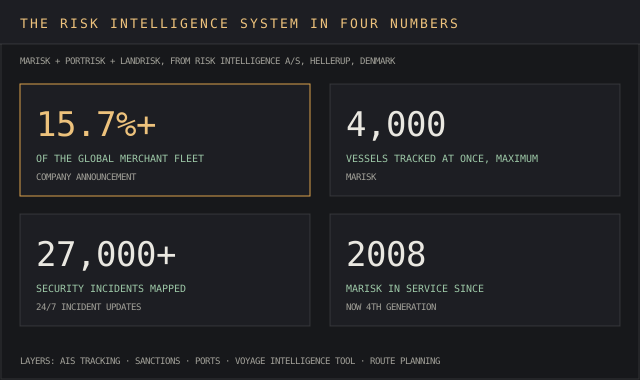
Maritime security is the one niche where a specialist outranks the general platforms on depth. Risk Intelligence A/S, based in Hellerup, Denmark, sells the Risk Intelligence System, which combines MaRisk, PortRisk and LandRisk.
Its own company announcement says the Risk Intelligence System is used by more than 15.7% of the global merchant fleet.
MaRisk has been a maritime security platform since 2008, now in its fourth generation. It tracks up to 4,000 vessels at once and maps over 27,000 security incidents with 24/7 incident updates.
- MaRisk layers: AIS tracking, sanctions, ports, cruise terminals and a voyage intelligence tool
- LandRisk: truck parking assessments, route planning and incident reports for land logistics
- Port security and maritime security threat assessments through PortRisk
- The Risk Intelligence System serves commercial shipping, logistics, energy, insurance, and government and defence
The analyst bench shows in the press. Risk Intelligence senior analyst Thomas Timlen covered sanctions enforcement, insurgency and armed robbery across Asia in a recent Seatrade Maritime article on the second quarter of 2026, published 24 July. Senior advisor Robin Häggblom spoke to Newsweek on 25 August 2026 about U.S. Arctic capabilities and icebreaking.
CEO Hans Tino Hansen has discussed piracy in the Gulf of Aden with Al-Nahar, and analysts track attacks on vessels in the Black Sea, so commercial shipping and maritime operations teams there should keep an eye on this one. The platform's pitch is protecting vessels and crews.
Riskline: travel risk data by API
Riskline monitors 220+ countries and territories and 260+ cities 24/7/365 and serves 100+ organisations. It sells mostly through APIs and widgets embedded in travel platforms, with products named TripReady and Realtime Alerts. Travel managers sizing that market can start with our business travel market report.
Dragonfly and Oxford Analytica under Dow Jones
Dow Jones bought both from FiscalNote and completed the acquisition in March 2025. Dragonfly covers security intelligence and Oxford Analytica covers geopolitical shifts and strategic analysis for boards. Pair either with a PEST analysis template when the question is a market entry.
Control Risks advisory services
Control Risks sells consulting, crisis response and security risk management as advisory services, and publishes the RiskMap 2026 forecast. Its analysts are the 200+ inside Seerist. Buy the consulting when you need people on the ground, and Seerist when you need the software.
Where risk intelligence ends and TPRM or supply chain risk begins
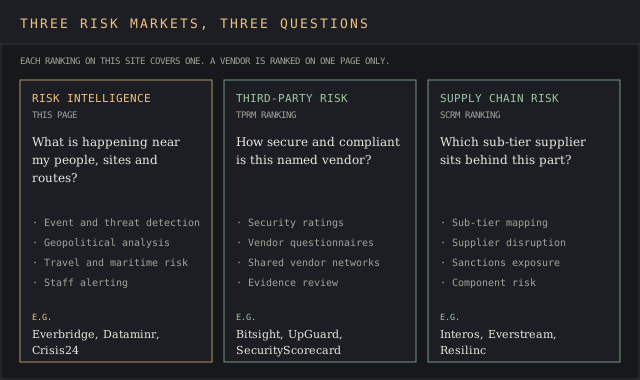
Buyers searching for risk management intelligence often mean one of three markets. Risk intelligence helps organizations monitor third-party and supply chain risks, but those markets answer three different questions. Event risk intelligence asks what is happening near my people and sites. Third-party risk management asks how secure and compliant a named vendor is. Supply chain risk management asks which sub-tier supplier sits behind a part.
- Security ratings vendors such as SecurityScorecard and Bitsight belong in the TPRM ranking, which scores shared vendor networks of 10,000 or more.
- Supplier mapping vendors such as Everstream Analytics, Interos and Exiger belong in the supply chain risk management ranking.
- Compliance risks tied to regulatory requirements fit the regulatory intelligence software ranking, where audit logs and regulatory mapping are the core test.
Overlap exists at the edges. Silobreaker, a security intelligence engine, cites one financial services client analyzing 70,000 suppliers, and Seerist lists supply chain risk among its solutions. A team whose daily question is what's happening near its offices and staff should buy from this ranking. A team whose daily question is a named supplier's security posture or sub-tier exposure should buy from the TPRM or supply chain ranking.
Pricing across risk intelligence companies
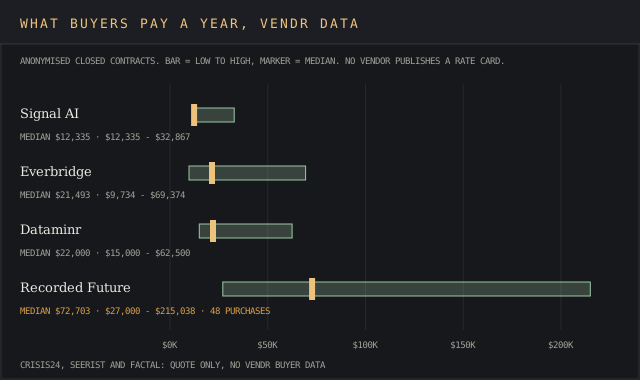
Risk intelligence solutions are sold by quote, and no vendor on this page publishes a rate card. Vendr's anonymised buyer data covers four of them and shows a spread of nearly six times between medians.
- Signal AI: $12,335 median, high $32,867
- Everbridge: $21,493 median, range $9,734 to $69,374
- Dataminr: $22,000 median, range $15,000 to $62,500
- Recorded Future: $72,703 median over 48 purchases, range $27,000 to $215,038
Quote-only pricing is par for the course here. Seat count, modules and the number of monitored locations drive the quote. Recorded Future's reviewers name add-on modules as the bill driver. Our market intelligence platform pricing report covers the same quote-only pattern in adjacent categories.
Alert fatigue, data overload and actionable insights
Data overload is the first complaint about risk intelligence tools. MetricStream names sifting through overwhelming amounts of data as a core challenge, along with integrating diverse sources and the people needed to run the program. Dataminr's own reviewer on G2 reported "too many notifications". That's the cry wolf problem. After the tenth irrelevant alert, the eleventh gets ignored.
Everbridge lists its fix in five parts: role-based targeting, geofencing, severity thresholds, AI prioritization and escalation workflows. Ask every vendor for the same list, then count alerts per day during the trial.
- Geofence alerts to a radius around each office, hotel and route
- Set severity thresholds per team, so security teams see more than HR
- Route by role, so a travel risk manager gets travel alerts only
- Review dismissed alerts weekly to tune the rules
Machine learning, advanced analytics and analyst verification
AI shortens collection time, and every risk intelligence vendor here sells it. Feeds get increasingly complex as video, images and 150+ languages pile in. Dataminr runs 50+ proprietary LLMs, Seerist has AskAnna, Signal AI has Ask AIQ, and Factal writes AI reports from verified data. Machine learning algorithms identify patterns across complex data faster than a person reading feeds.
Advanced analytics still needs a human check. MetricStream warns that relying on these tools without human oversight can lead to blind spots. Crisis24's 200+ analysts and Seerist's 39,000+ verified events in one quarter exist for that reason. Predictive analytics, such as the near-term predictive intelligence Dataminr announced for Crisis24 Horizon in September 2026, is new, so ask for measured accuracy on your own incident history before you rely on it.
Sigma360 lists audit trails and explainable decision histories as expected features, so each risk score traces back to its sources. The devil's in the details here, because a score you can't trace can't be defended to an auditor.
From alert to mitigation strategies
Of the seven platforms, two carry an alert through to the people it affects. Everbridge and Crisis24 turn an alert into a message to affected staff with a two-way reply. The rest push targeted alerts into existing systems, a partner platform or a GSOC map.
- The alert lands with a location, a severity and a source.
- An analyst or rule confirms it and matches it to people and assets nearby.
- Incident response starts from a playbook written for that event type.
- Staff get targeted alerts and a wellness check, and replies roll up to the GSOC.
- The incident is logged for the next risk assessment.
Mitigation strategies written in advance make step three take minutes. Teams that skip them end up on a wild goose chase through email threads, the email-to-email delay a Dataminr reviewer on G2 described before the crisis team got alerts directly.
How to run a risk intelligence trial
A two-week trial tells you more than five demos. Talk is cheap in a demo, so replay your own incidents. Factal offers 30 days without a sales gate, and most others will run a pilot on request.
- Read customer feedback on G2 and TrustRadius before you shortlist.
- List ten past incidents from the last year that affected your sites or staff.
- Replay them, record which platform would proactively identify each one, and note when it alerted against when your team first heard.
- Count alerts per day at your real geofences, then count how many were relevant intelligence for a risk assessment.
- Test integrations with existing systems and data sources: HR, travel booking, the GSOC map and chat.
- Score the results on a vendor evaluation scorecard, weighted to the five criteria above.
Get the entire company on the same page before the pilot. Security, HR, travel and communications each want different alerts, and the vendor has to configure all four to show its real value.
ROI claims and what the evidence supports
ROI figures for risk intelligence are marketing until proven otherwise. Ethico, a compliance hotline vendor, says organizations typically see 200-400% ROI within three years, 150-200% more reporting volume in year one and 40% lower compliance costs in healthcare. The page cites no study for any of the three, and an ROI range with no study behind it is a red flag.
Ethico's guide also frames effective programs around four pillars: proactive identification, data integration, predictive analytics and adaptive response. That's a fair checklist. Treat any vendor's proven strategies as a claim to test against your own incident history, and build the business case with a risk-benefit analysis template.
Time is the number worth measuring yourself. Factal's claimed 28 minutes is a vendor figure, and your replay test gives you your own.
Risk intelligence FAQ
What is risk intelligence?
Risk intelligence is the continuous collection and analysis of risk data to spot emerging threats and potential risks early enough to act. It covers security risk, geopolitical, operational, travel and reputational events. The software above automates the collection and alerting, and real-time market intelligence applies the same idea to commercial signals.
What is a risk intelligence platform?
A risk intelligence platform combines data collection, AI filtering, analyst review and alert delivery in one product. Everbridge 360 and Crisis24 Horizon add mass notification, so the same platform that detects an event also warns staff.
What does a risk intelligence analyst do?
An analyst verifies events, writes each risk assessment and forecast, and briefs the people who make decisions. At Seerist that output runs to 4,000+ notes and 200+ forecasts a year. The job needs a thorough understanding of a region plus the judgement to drop false alarms.
How does risk intelligence support informed decisions?
It gives decision makers a sourced, located and scored view of an event while there's still time to mitigate threats. Travel teams reroute, security teams lock down a site, and executives get key insights before the press does. That's how teams stay ahead of disruptions and make informed decisions under pressure. Faster decision making only helps when the alert is right. Criterion two tests that.
What are the top threat intelligence companies?
Recorded Future is the largest pure threat intelligence vendor here, with 1,900+ clients. Dataminr moved into the space with its ThreatConnect acquisition, and Silobreaker sells a cyber threat intelligence product. Our OSINT ranking covers the investigation tools used alongside them.
Which AI is best for risk management?
For early detection, Dataminr's AI runs across 1M+ sources and 150+ languages. For analyst-checked output, Seerist pairs AI tools with 200+ analysts. General chat assistants have no live risk feed, so they can't replace either one.
What are the 7 steps of RMF?
NIST's Risk Management Framework, SP 800-37 Revision 2, runs seven steps: Prepare, Categorize, Select, Implement, Assess, Authorize and Monitor. Risk intelligence feeds the Monitor step for physical and geopolitical threats to a system's operations.
Do risk intelligence platforms cover government and defence?
Yes. Dataminr serves 100+ U.S. government agencies, Seerist names NATO among its customers, and Risk Intelligence A/S sells to government and defence. Our public sector market intelligence guide covers the wider buying process.
Bottom line
Everbridge 360 is the pick for a team that has to detect and warn from one contract, at a $21,493 Vendr median. That combination shortens decision making from alert to staff message. Dataminr is the pick when the first signal matters most. Recorded Future fits a threat intelligence budget that can carry a $72,703 median.
Signal AI fits media and reputation risk at the lowest price on record. Crisis24 Horizon and Seerist fit teams that want 200+ analysts to verify events before they reach a phone. Factal fits a smaller team that wants verified risk intelligence and a 30-day trial.
Maritime operators who need maritime security data at vessel level should call Risk Intelligence A/S, and travel platforms should look at Riskline's API. Both feed the same operational resilience goal with narrower data. For vendor and supplier risk, go to the TPRM and supply chain rankings linked at the top.