
The numbers Business travel, checked 5 August 2026
Scope decides the headline. The $1.8 trillion global total and the $319 billion US figure count different populations, so neither divides cleanly into the other.
Costs are climbing faster than budgets. Per-trip costs are up 35% in some regions against the roughly 5% budget increase travel managers expect.
Demand holds anyway. 86% of surveyed travelers say the trip was worth it, and spending still grows 6% to 9% this year.
Check which definition an analyst firm used, managed only or managed plus unmanaged, before you put its number in a board deck.
Travel management companies and booking platforms quote the $1.8 trillion figure in every pitch. Send the market and I'll source a version you own.
The Global Business Travel Market in Numbers
This business travel market report opens where every buyer conversation does: what is the market worth. The honest answer is that it depends which analyst firm you ask, and by how much. Grand View Research, Morgan Stanley, and a Yahoo Finance summary of industry data put the global business travel market on track to exceed $1.8 trillion in 2026.
IMARC Group puts the global business travel market at $1.2 trillion in 2025, growing to $2.1 trillion by 2034 at a 6.08% compound annual growth rate. Market Research Future and DataBridge Market Research, working from a narrower definition of the business travel market, size it at $2.779 billion in 2024, projected to reach $10.15 billion by 2035 at a 12.5% compound annual growth rate over that forecast period.
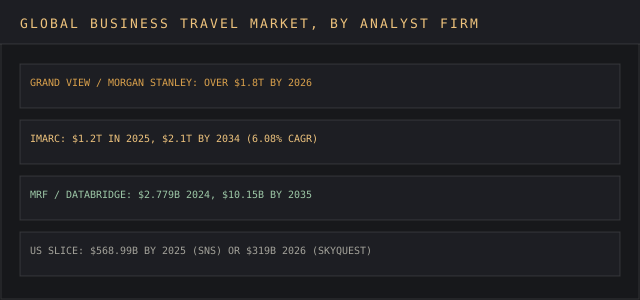
On the US-specific slice of the business travel market, SNS Insider and a Yahoo Finance report project the US business travel market to reach $568.99 billion by 2025, while market.us, SkyQuest, and the US Travel Association put 2026 US business travel spending at $319 billion.
Neither figure is wrong; they measure different things, spend by US-headquartered travelers against spend inside the United States, and reconciling that gap is the first job of anyone doing real market research on this business travel market.
Why Estimates of the Business Travel Market Diverge
Every business travel market size figure rests on a scope decision the analyst firm makes upfront: does managed business travel count alone, or does unmanaged business travel count too; does the business travel market include only airfare and hotel spend, or expense management, meals, and ground transport; does bleisure spending split between business and leisure travel get allocated to this business travel market or excluded entirely.
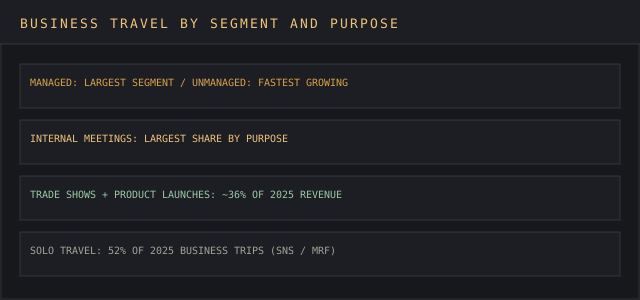
Market Research Future and IMARC both note that managed business travel remains the largest segment of the market by revenue, while unmanaged business travel is the fastest-growing segment, a combination that alone can shift a total by tens of billions depending on how a research house draws the line.
The forecast period matters as much as the scope. A model ending in 2030 undercounts the compounding the 2034 and 2035 models capture, and currency assumptions, a dollar-denominated global business travel market restated at different exchange-rate years, move the number further.
Buyers using any single figure in a board deck should cite the analyst firm, the forecast period, and the segment definition in the same breath, because the business travel market size headline travels faster than its footnotes.
Business Travel Market Segmentation
Every business travel market segmentation scheme analyst firms publish slices the same total a handful of ways: by traveler type, by trip purpose, by region, and by expense category. The expense-category cut is the one finance teams read first, since it separates airfare and lodging from the food and lodging segment specifically, ground transport, and the fees a travel management platform itself charges.
Business travel expenditures tracked this way let a corporate segment compare its own cost mix against the wider business travel industry, showing if a rising hotel bill is a company problem or a market-wide one.
World travel patterns feed directly into corporate travel demand: a multinational corporation opening a new regional office generates a predictable spike in business trips as staff rotate through for setup, training, and internal meetings trade between headquarters and the new site.
Business travel demand of this kind is more forecastable than consumer world travel demand, because it follows a company's own expansion calendar, which is why managed travel services providers build headcount-linked forecasting models.
Business travel market size and business travel market share figures both roll up from this segmentation layer, and a buyer who understands how their own trip mix, more internal meetings trade or more client-facing business events, compares with the global business travel industry average can bring that trip-mix data into a rate negotiation to push for a lower corporate rate than the standard rate card offers.
Managed vs. Unmanaged Business Travel
Copy these lines into an email, fill them in and send. I reply with scope and a price within 2 to 3 business days.
Open the emailManaged business travel, trips booked and reconciled through a corporate travel management program with negotiated rates and policy compliance built in, is the largest segment of the business travel market today.
Unmanaged business travel, booked directly by employees or through consumer channels outside the corporate program, is growing faster. Several travel management companies attribute that to remote and hybrid staff booking trips without going through a central booking desk.
The gap between the two segments is where most corporate travel management platforms are competing hardest, since capturing unmanaged spend back into policy compliance is the fastest lever available to a travel manager without cutting trip volume.
Multinational corporations with mature programs report the highest share of managed business travel. Smaller and mid-market buyers skew unmanaged; they never built the travel management solutions layer larger companies did.
Increasing corporate globalization is pulling more of the market into formal travel management platforms as international travel volume grows, which is why managed business travel keeps its lead even while unmanaged grows faster in percentage terms.
Business Travel by Purpose: Meetings, Trade Shows, and Client Visits
Internal meetings hold the largest share of the business travel market by purpose, ahead of client meetings, trade shows, and product launches, per Market Research Future and IMARC. Frequent corporate meetings between distributed teams are the steadiest source of demand in the business travel market because they recur on a fixed calendar independent of the broader economy, unlike discretionary trade-show attendance that companies cut first in a downturn.
Marketing-related travel, trade shows and product launches bundled together, accounted for nearly 36% of business travel market revenue in 2025, a share IMARC attributes to emerging markets driving fresh demand for trade-show attendance as multinational corporations expand distribution into new regions.
Client meetings remain a smaller line item by dollar volume than internal meetings, and a disproportionately important one strategically. Companies prioritize client-meeting travel to protect relationships that internal videoconferencing can't replace.
Rising demand for in-person client meetings after several years of remote-first selling is one of the more consistent trends analysts cite across firms. Internal meetings still hold the larger absolute share of spend.
Who Travels: Age, Solo Travel, and Group Travel
Business travelers below 40 represent the largest demographic segment of the business travel market, while travelers above 40 are the fastest-growing group, an inversion of the usual growth pattern that Market Research Future and IMARC both flag as a shift in where buyers should focus travel policy updates.
In 2025, business travelers below 40 were projected to spend around $5.5 billion within the segments these two research firms track, spending that skews toward digital booking platforms and mobile-first expense management over the phone-and-agent model older business travelers still favor.
Solo travel accounted for 52% of business travel in 2025, the dominant format for individual business trips, while group travel is expected to reach approximately $3.15 billion in 2025, smaller in dollar terms but organizationally heavier since group travel bookings involve more approvals and more exposure to traveler safety obligations at once.
Work life balance considerations increasingly shape both formats: companies report business professionals resisting itineraries that stack solo travel trips back to back, which is pushing more flexible travel arrangements into standard corporate travel management policy.
International travel adds another layer on top of both solo travel and group travel formats, since a single international trip can combine a solo travel outbound leg with a group travel conference segment, and traveler safety planning has to account for both halves of that itinerary at once.
Regional Business Travel Market Share
Want a regional share chart like this for the markets you sell into? Send the regions.
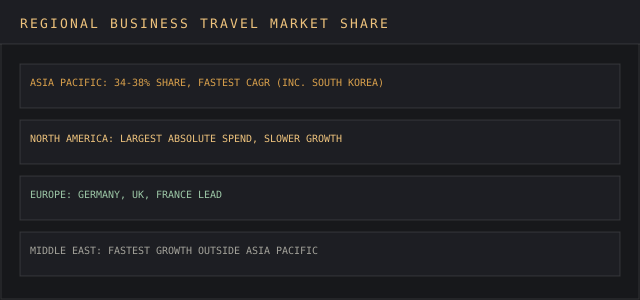
Email a briefAsia Pacific is projected to lead growth in the global business travel market, though the exact share depends on the source: market.us and SkyQuest put the Asia Pacific region at 38% of global share in 2025 and 2026, while IMARC and SNS Insider put Asia Pacific closer to 34%.
Both sets of firms agree Asia Pacific is expected to grow at the fastest compound annual growth rate through the back half of this forecast period, and China's corporate travel volume rose 22% in 2023 on the back of broader economic growth, per SNS Insider and DataBridge, a single-country swing large enough to move the whole Asia Pacific market's regional total.
The other regions tracked split along different lines.
- North America, a large mature slice, competes with Europe for the second-largest regional position depending on the year and the analyst firm's currency assumptions. Most North America forecasts show slower percentage growth than Asia Pacific even while North America books more total business trips today.
- Europe leans on strong economic ties among member countries, with Germany, the UK, and France named repeatedly by IMARC and DataBridge as the region's key players.
- South Korea shows up in several breakdowns as a fast-growing Asia Pacific market in its own right, distinct from the China-driven headline figure, with corporate travel demand expected to keep outpacing the wider Asia Pacific average through this forecast period.
- The Middle East is climbing fastest among the smaller markets, with foreign direct investments into the region's hospitality and meetings infrastructure cited as a structural tailwind. Several analyst firms expect it to post some of the fastest regional growth rates outside Asia Pacific.
North America-based multinational corporations increasingly route new-market entry travel through Middle East hubs on the way to South Asia.
Corporate Travel Management Companies and Market Players
- The segment, region or traveler group to cover
- Regions, years and segments
- Where it runs: blog, white-label, gated or lead magnet
- Whose byline goes on it
- Deadline
- 2,500+ words, human-written
- Every figure linked to its source
- Yours to publish, under your name or none
- Hosting here for +$200, with your sponsored links
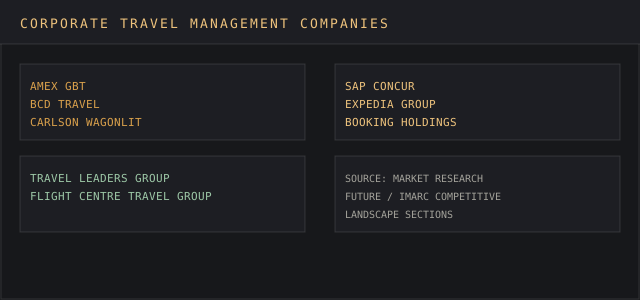
A handful of travel management companies dominate the corporate side of the business travel market. American Express Global Business Travel, a business separate from the American Express Company's consumer card operations, sits alongside BCD Travel, Carlson Wagonlit Travel, and SAP Concur as the names Market Research Future and IMARC cite most often as major companies serving multinational corporations.
Expedia Group and Booking Holdings compete for corporate volume through their own managed-travel arms even though both built their brands on consumer and leisure travel. Travel Leaders Group and Flight Centre Travel Group round out the field as providers with meaningful corporate-side revenue alongside their retail travel operations.
Competition among these travel management companies turns less on which vendors own distribution in major markets and more on who can bundle policy compliance, expense management, and duty of care compliance into a single travel management platform corporate buyers do not have to stitch together themselves.
That bundling is the product battle inside this business travel market right now, and it is the reason the same six or seven company names, American Express Global Business Travel, BCD Travel, Carlson Wagonlit Travel, SAP Concur, Expedia Group, Travel Leaders Group, and Flight Centre Travel Group, appear across nearly every analyst firm's competitor breakdown, distinct from the American Express Company's broader set of financial-services competitors.
Corporate Travel Booking Technology and Platforms
Travel management platforms and travel management solutions have consolidated around a common feature set: online booking platforms and digital booking platforms for air and hotel, integrated expense management, and compliance rules enforced at the point of booking.
Online travel agencies serve the leisure side of the same companies' travel, but corporate travel management increasingly routes through dedicated digital travel solutions built for approval workflows. The consumer checkout flow an online travel agency optimizes for solves a different problem. Real-time policy enforcement at the point of booking is the feature buyers ask about first.
Corporate buyers evaluating travel management solutions weigh a short list of factors every time: integration with existing expense management software, the depth of traveler safety features, negotiated-rate access through the vendor's booking holdings and airline relationships, and if the platform reports market insights back to procurement in a format finance uses.
Consulting solutions from the major providers fill the gap for buyers who want the technology and the policy design done at once.
Connectivity is the newest line on that list. A travel management company or booking platform can sell mobile data under its own brand through a white label eSIM provider such as esimba.ai, whose eSIM API lets the platform show plans and prices, issue eSIMs and track usage across 150+ countries. The vendor charges per sale, with no setup fee or subscription.
Expense Management, Policy Compliance, and Duty of Care
Expense management remains the most requested add-on to a bare booking tool, ahead of policy tooling itself, since travel expenses are the largest category of controllable spend most finance teams can act on inside a quarter.
Policy compliance software flags out-of-policy bookings before the trip happens, and companies using travel management tools that combine the two can reduce costs by up to 20%, per Market Research Future and IMARC's figures on tool-driven savings.
Duty of care compliance has moved from a legal afterthought to a board-level line item: traveler safety obligations now cover real-time itinerary tracking, geopolitical risk alerts, and emergency evacuation planning for corporate travelers in higher-risk regions.
The threat of geopolitical tensions is cited as a top challenge by 47% of travel managers, per GBTA and Perk, which is pushing more corporate sector budget toward duty of care compliance tools even where overall corporate travel management spend is flat.
Sustainability and Corporate Travel Policy
Corporate travel policies increasingly include carbon-reduction targets, per FCM Travel and Explore.co.uk's 2026 corporate travel trend research. Three sustainable travel practices are moving from optional guidance into mandatory policy language at multinational corporations with public emissions commitments.
- Rail over short-haul flights.
- Consolidated trips.
- Carbon-offset requirements.
The shift sits alongside cost control, since several of those practices double as expense reductions.
Key drivers behind the sustainability push include investor pressure on emissions reporting and employee expectations, particularly among business travelers who ask about a company's travel policy during recruiting.
Consulting, technology, and financial services carry the heaviest business travel exposure, and they're furthest along in writing sustainable travel practices into formal corporate travel management policy.
AI in Corporate Travel Management
AI tools are being adopted across the business travel market for itinerary optimization and travel risk monitoring, and 65% of travel managers say they are prioritizing automated systems, per FCM Travel and Explore.co.uk.
FCM Travel and Explore.co.uk report that 65% of travel managers are prioritizing automated systems, as AI tools spread across the business travel market.
Travel managers prioritizing automated systems
Source: FCM Travel and Explore.co.uke.g. booking tool adoption in your country
Source: linked, checked, datedThe near-term use cases are unglamorous and effective.
- Rebooking disrupted itineraries automatically.
- Flagging out-of-policy bookings before approval.
- Automatically summarizing traveler safety alerts across a distributed workforce, cutting the manual work of watching every feed.
The market insights vendors extract from booking and expense data are themselves becoming a product: several travel management platforms now sell market revenue benchmarking back to buyers, showing how a company's travel spend compares with peers in the same major industries.
That benchmarking layer, built on the same underlying business travel market data analyst firms use for their headline size estimates, is one of the more durable business travel market trends to watch as AI tooling matures across the sector.
Bleisure: Blending Business and Leisure Travel
The blending of business and leisure travel, bleisure, is reported by 68% of companies, per GBTA, Explore.co.uk, and Technavio, making it one of the most widely cited business travel market trends across every analyst firm covered in this report.
Corporate travelers extending a business trip into a weekend of leisure travel is no longer an exception policy teams tolerate quietly; it is a recruiting and retention lever multinational corporations now write into formal travel policy, provided the extension does not raise the company's travel expenses or expose the corporate sector's duty of care compliance obligations.
Accommodation accounts for 34% of typical corporate travel budgets, per GBTA, Grand View Research, and Perk, and bleisure trips tend to push that share higher as travelers upgrade rooms or extend stays on their own dime around the company-paid portion.
Work life balance framing has made bleisure culturally acceptable inside the corporate sector even where formal compliance language has not caught up, and travel managers report writing bleisure allowances into policy specifically to close that gap.
Key Drivers, Market Challenges, and the Forecast Period Ahead
Three key drivers sit behind business travel market growth.
- Global economic activity.
- In-person relationship-building that video calls have not replaced.
- Corporate investment flowing into emerging markets, where foreign direct investments create the client meetings and internal meetings that generate travel demand in the first place.
Rising demand from multinational corporations expanding into new regions is the steadiest structural driver across every analyst firm's forecast period, more consistent than any single macro cycle.
Per-trip costs have risen by 35% in some regions compared with previous years, per Engine and Perk, and travel managers expect a roughly 5% increase in corporate travel budgets to absorb rising costs, with global business travel spending expected to grow 6% to 9% in 2026 alone, per Morgan Stanley and Grand View Research.
Reassuringly for the business travel market's near-term trajectory, 86% of surveyed business travelers report their trips are worthwhile, per GBTA polling, evidence that demand fundamentals remain intact even as costs climb across this forecast period.
Emerging markets are expected to contribute over 60% of global GDP growth in the coming years, and with Asia Pacific projected to grow at the fastest compound annual growth rate through 2032, the center of gravity in the global business travel market keeps shifting east even as North America and Europe hold the largest absolute spend today.
The Global Business Travel Market Through the Rest of the Forecast Period
Every scenario analyst firms model for the global business travel market points the same direction even where the dollar totals disagree: more trips, more spend, and a bigger share of that spend flowing through formal travel management platforms.
North America and Europe keep the largest absolute share of the global business travel market through the near term, but Asia Pacific, South Korea specifically among the smaller markets, and the Middle East are where the fastest percentage growth in the global business travel market is concentrated.
A corporate segment planning three to five years out should weight its own regional footprint against those growth curves.
International travel recovery, corporate globalization, and rising corporate travel demand from companies newly active in emerging markets are the throughlines connecting every analyst firm's version of the global business travel market, whichever total they land on.
Buyers who track the global business travel market across more than one source make better multi-year travel budget decisions, and that habit matters more than which single global business travel market estimate turns out closest to the eventual actual figure.
Delivered for your site and your byline. Hosting here is optional.
FAQ
How big is the business travel market?
It depends on the analyst firm and the scope. Grand View Research, Morgan Stanley, and Yahoo Finance put the global business travel market above $1.8 trillion in 2026. IMARC sizes it at $1.2 trillion in 2025, growing to $2.1 trillion by 2034. Market Research Future and DataBridge use a narrower definition, sizing the business travel market at $2.779 billion in 2024, growing to $10.15 billion by 2035.
Always check the scope and forecast period before comparing two numbers.
Is business travel up or down in 2026?
Up. Global business travel spending is expected to grow 6% to 9% in 2026, per Morgan Stanley and Grand View Research, and 86% of surveyed business travelers report their trips are worthwhile, per GBTA. The main headwind travel managers cite is cost, with per-trip costs up 35% in some regions. Demand is holding.
What are the biggest business travel companies?
American Express Global Business Travel, BCD Travel, Carlson Wagonlit Travel, SAP Concur, Expedia Group, Booking Holdings, Travel Leaders Group, and Flight Centre Travel Group are the names Market Research Future and IMARC cite most often among corporate travel management companies and major market players.
Sources: Market Research Future business travel market report; IMARC Group business travel market analysis; SNS Insider business travel market analysis; DataBridge Market Research; Grand View Research industry analysis; Morgan Stanley corporate travel trends; GBTA polling and forecasts; FCM Travel and Explore.co.uk corporate travel trends 2026; Engine and Perk business travel statistics, 2025 to 2026.
Travel management companies, expense platforms and booking tools publish reports like this one as lead magnets and client briefs.
A report on your topic for a blog page, gated content or a lead magnet.
Written for your client and published under their brand, with my name left off.
Your report on marketintelligencetools.com, with 2 to 3 CTAs carrying your sponsored links.
Default terms: the report is yours to publish, and I keep the right to republish it on this site behind a gate, outside Google's index.