
The numbers UK retail, checked 5 August 2026
Sales volumes rose 1.2% in a month while labour costs rose £6.5 billion over 14 months, so margin pressure is running ahead of demand pressure.
Footfall is falling faster than sales values, which means store visits break before spending does.
The online share sits at 28.8% while online sales values are up 12.2% year over year. The value figure is the one that pays.
Check footfall and online sales value by format before you price a store lease or a retail unit.
I'll write a 2,500+ word report on the slice of retail you name, with ONS, BRC and Bank of England figures linked line by line. Yours to publish, from $200.
UK retail market report: key trends in online sales
UK retail sales volumes rose 1.2% in May 2026 alone and were up 0.4% in the three months to May compared with the three months to February, according to the Office for National Statistics. That is growth, and no boom, and it sits against a backdrop of rising costs that is squeezing margins faster than sales are growing.
Online sales made up 28.8% of total retail spending in May 2026, up from 28.1% in April, continuing a channel shift that has settled well above the pre-pandemic level of 19.2% but far below the 37.1% share hit during pandemic lockdowns.
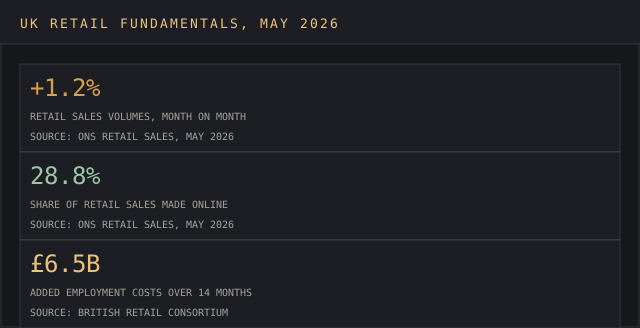
Online sales values told a stronger story than the share figures alone: online spending rose 9.8% compared with the three months to May 2025, and values were up 12.2% year over year in May 2026 specifically, a 3.3% increase over April alone.
Retailers reading only the online-share percentage miss that the pound value of internet sales is growing faster than the channel's share of the total, because total in-store spending is growing too, just more slowly.
The labour market behind the numbers
The National Living Wage rose 50p to £12.71 an hour in April 2026, and combined with higher employer National Insurance contributions, the British Retail Consortium puts the added employment cost to the sector at £6.5 billion over a 14-month period.
Retail employment has fallen to its lowest level on record as a direct result, with 2.76 million retail jobs recorded in March 2026, and retailers are responding by cutting the entry-level and flexible roles that absorb the smallest wage increases worst.
Sales volumes are growing modestly while the cost base grows faster, so margin pressure is running ahead of demand pressure. Retailers with thin staffing models built around flexible, part-time labour are absorbing the National Living Wage and National Insurance increases with the least room to adjust.
A Golden Quarter That Undershot
The 2025 golden quarter, the November-through-December stretch that carries a disproportionate share of annual retail profit, came in below what retailers had planned for.
Slower consumer spending through the back half of 2025 reduced the seasonal and entry-level hiring retailers normally add for the period, a sign the softness showed up in staffing decisions before it showed up in headline sales figures.
The Deloitte Consumer Tracker found consumer confidence fell three percentage points in the first quarter of 2026 to its lowest level since the third quarter of 2023, and discretionary spending intentions fell seven percentage points to their lowest point since the first quarter of 2023.
Read the golden quarter miss and the discretionary-spending drop together: a market where consumers are still spending on essentials but pulling back hardest on the categories that carry the best margins.
Department stores, convenience stores, and where growth sits
Department stores posted the standout number in May 2026, with sales volumes up 2.7%, the largest increase across non-food categories, helped by unusually good weather driving footfall.
That single-month strength sits against a weaker discretionary-spending backdrop overall, underscoring how uneven demand is by format and category.
TikTok Shop has become a genuine sales channel for UK retailers, live in 16 countries by mid-2026 with the Netherlands, Belgium, Poland, and Sweden expected to launch in the second half of the year.
UK categories performing best on the platform include beauty, fashion, supplements, home products, and gadgets, and supermarkets and convenience stores increasingly use it for discovery-driven sales. Fashion sellers there compete for the same shoppers as Shein, Zara and H&M.
Interest Rates and the Consumer Credit Squeeze
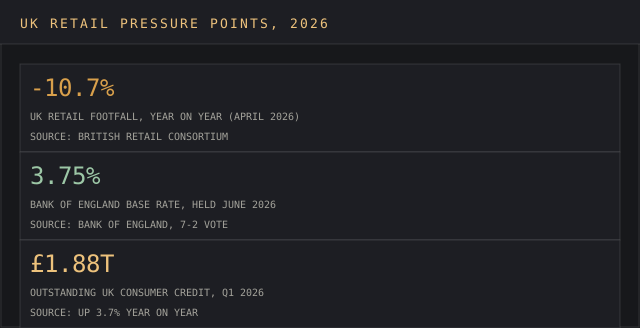
The Bank of England held its base rate at 3.75% in June 2026 on a 7-2 vote, weighing easing inflation against continued uncertainty from volatile global energy markets linked to Middle East tensions.
A Reuters poll of 65 economists found most expect the rate to hold at 3.75% for the rest of the year; nearly 40% of respondents predicted at least one further hike, and only six expected a quarter-point cut by year end. That is a meaningfully different backdrop than the rate-cut relief retailers had been counting on earlier in the cycle.
Consumer credit shows the strain building underneath steady headline sales. Outstanding consumer credit balances surpassed £1.88 trillion in the first quarter of 2026, up 3.7% year over year, with unsecured credit balances reaching £260 billion, up 5.7%.
Credit card interest UK consumers are forecast to pay per adult in 2026, £19.3 billion sector-wide. Serious delinquencies rose 40 basis points year over year to 4.17% by the end of the first quarter, and consumer financial optimism fell to 44% in the second quarter of 2026.
High Street Footfall Keeps Falling
Store visits are deteriorating faster than sales values, which is its own warning sign. UK retail footfall fell 10.7% year over year in April 2026, and high street footfall specifically fell 9.2% over the same comparison, according to British Retail Consortium data.
Copy these lines into an email, fill them in and send. I reply with scope and a price within 2 to 3 business days.
Open the emailSustained caution among consumers, weak confidence, and the same geopolitical and cost pressures pushing up credit delinquencies are showing up first in fewer store visits.
Falling footfall matters most for the physical retail property that depends on it: a shopping centre or high street unit priced on historic visitor counts is repricing risk every month footfall keeps falling, well before rents or vacancy figures catch up to reflect it.
E-commerce, internet sales, and the retail industry's competitive landscape
Online sales penetration reached 28.3% by December 2025, and average weekly internet sales grew 11.1% year on year that same month, according to ONS data.
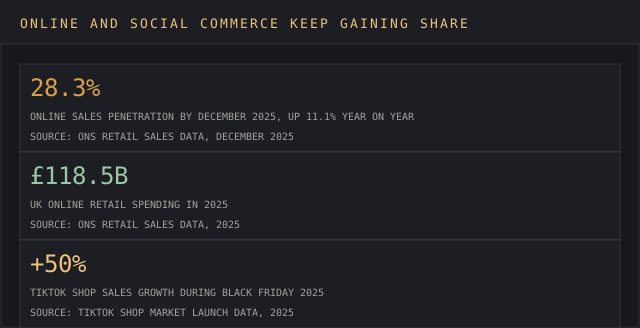
UK online retail spending reached approximately £118.5 billion in 2025, and TikTok Shop sales increased 50% during Black Friday 2025 alone, evidence that e-commerce and social commerce are no longer a marginal channel for the retail industry but a core part of how retailers compete for share.
The UK retail market itself was valued at roughly $1,034,316.4 million in 2025, with retail sales volumes up 1.3% for the full year compared with 0.2% growth in 2024, a modest acceleration that still trails the pace of cost inflation described above. Category teams sizing their own slice of that total can start from a market sizing template.
Physical retail and the search for better value
Physical retail is not disappearing, it is repositioning: stores increasingly function as community and experience hubs, and price-conscious shoppers are driving demand for better value across both physical retail and online sales.
Consumer price inflation reached 3.4% in December 2025, with essential items alone contributing 1.1 percentage points to that figure, which is why discount retailers are gaining market share while mid-market retailers face the most pressure from consumers trading down.
What This Means for Retailers and Investors
The read for operators: cost control now matters more than top-line growth, since a 1.2% monthly sales gain does not offset a £6.5 billion sector-wide labour cost increase on its own.
Retailers that can shift volume toward higher-margin formats, department stores in favourable weather, TikTok Shop's better-performing categories, are better positioned than those relying on flexible, entry-level staffing to protect thin margins.
For investors and competitive teams, tracking competitor pricing and promotional activity matters more in a discretionary-spending downturn, since retailers that discount to protect volume are making a different bet than those holding price to protect margin.
Delivered for your site and your byline. Hosting here is optional.
FAQ
Is UK retail growing in 2026?
Modestly. Sales volumes rose 1.2% in May 2026 and 0.4% over the three months to May versus the three months to February, per ONS. Growth is real but slower than the rise in labour costs, which the British Retail Consortium puts at £6.5 billion added over 14 months.
What share of UK retail sales happens online?
28.8% in May 2026, up from 28.1% in April, well above the pre-pandemic level of 19.2% but below the 37.1% peak hit during pandemic lockdowns. Online sales values were up 12.2% year over year in May 2026.
Why are UK retail jobs falling even as sales rise?
The National Living Wage rose to £12.71 an hour in April 2026 and employer National Insurance contributions increased alongside it, adding a combined £6.5 billion in employment costs over 14 months. Retailers have responded by cutting entry-level and flexible roles, pushing retail employment to its lowest level on record at 2.76 million jobs in March 2026.
Is the Bank of England cutting interest rates in 2026?
Not so far. The Bank held its base rate at 3.75% in June 2026 on a 7-2 vote, and a Reuters poll of 65 economists found most expect the rate to hold through year end, with more predicting a hike than a cut.
Is UK high street footfall recovering?
No. UK retail footfall fell 10.7% year over year in April 2026, and high street footfall specifically fell 9.2% over the same period, according to British Retail Consortium data, pointing to sustained consumer caution.
The Labour Market and Retail Insolvencies
The labour market underpinning these cost pressures cooled further into 2026: UK unemployment reached 5.1% in November 2025, job vacancies fell to around 729,000, and the economic inactivity rate for the core working-age population held near 20.8%, even as average regular pay grew 4.7% to 4.8%.
Retail insolvencies hit 23,938 in 2025 and are expected to remain elevated in 2026, a labour market and cost backdrop that leaves discount retailers gaining market share while mid-market retailers absorb the most pressure.
The wider United Kingdom retail sector shows the same divergence at every level of analysis. Retailers with strong omnichannel models performed better through 2025 than single-channel operators, and UK consumers increasingly use digital tools and AI for shopping decisions, prompting retailers to invest in data analytics for demand planning and personalised marketing alongside AI-driven inventory management and supply-chain automation.
Consumer spending remains cautious: retail sales volumes in the UK showed modest growth from previous years, consumer confidence stayed weak, and retail property trends point toward rising vacancy rates and fluctuating rent as retailers reassess how much physical space the sector needs.
None of this data suggests the retail market is shrinking, only that demand, consumer spending, and retail sales growth are all running below the pace retailers had planned for entering 2026.
This UK retail market report draws on the same retail data other UK retail market analyses use: ONS retail sales data, British Retail Consortium data, and Deloitte consumer data, so the retail market picture in this report reflects the UK retail market as it stands.
Consumers, retailers, and market watchers reading this UK retail report should track UK retail sales, UK consumer spending, and UK retail market share together, since no single retail metric captures the full state of UK retail on its own.
Sources: Office for National Statistics, Retail Sales Great Britain bulletins, January to May 2026; British Retail Consortium employment cost analysis; Deloitte UK Consumer Tracker, Q1 2026; Association of Convenience Stores, National Living Wage coverage; TikTok Shop market launch data, 2026.
Teams building their own view of a category this granular can start from how to gather market intelligence before layering on retailer-specific data like this report's.
Retail consultancies, property agents and retail tech vendors use reports like this one in client briefings and investor notes.
A report on your topic for a blog page, gated content or a lead magnet.
Written for your client and published under their brand, with my name left off.
Your report on marketintelligencetools.com, with 2 to 3 CTAs carrying your sponsored links.
Default terms: the report is yours to publish, and I keep the right to republish it on this site behind a gate, outside Google's index.