Supply market intelligence
 By Jan Suski. I go deep on every review, checking every number against its source and digging up details other coverage misses, a habit from six years of SEO and link building for tech companies. Bylines at Surfer, Brand24, and Senuto. How the scoring works.
· Prefer this source on Google
Supply market intelligence (SMI) is the ongoing collection and analysis of external data about suppliers, supply markets, and the forces that move them: capacity, commodity pricing, regulatory changes, and risk. It answers one question on a repeating cycle. Which suppliers, categories, and inputs are about to cause a problem.
The supply chain visibility industry is valued at $3.5 billion and the market is projected to triple to nearly $11 billion by 2034, because organizations seek exactly this kind of foresight.
This page covers the discipline: what SMI is, the four components it's built from, where the data comes from, and how it differs from supply chain intelligence. Buyers arrive here from supply chain insights, supply chain monitoring, and supply market data, and the definitional answer is the same for all three.
Software selection is a separate question and it comes second. Platforms are ranked head-to-head, with pricing, on the supply chain intelligence software page.
What supply market intelligence is
Supply market intelligence is the outward-looking half of supply chain management's data function. It helps organizations develop deep market intelligence about the markets they buy from: which suppliers are strong or struggling, where global capacity is tightening, what raw materials and commodity pricing are doing, and which regulatory changes will reshape sourcing strategies.
Refresh cadence separates reliable supply market intelligence from a stale snapshot. A category report built on last quarter's numbers describes a market that has already moved, and the buyer reading it negotiates against a price that no longer exists.
Current data, named sources, and a refresh measured in days is the working standard. Four components carry it.
- Supply market analysis, supply-demand dynamics, cost drivers, and market conditions in each key category.
- Supplier intelligence, analyzing supplier capabilities and financial health to ensure reliability in sourcing, plus ongoing supplier performance evaluation, which is critical to procurement decision-making.
- Cost and price intelligence, market intelligence includes tracking commodity pricing and economic indicators, so buyers know what fair looks like this quarter, current-quarter evidence.
- Market trends and signals, early indicators of shortages, surpluses, and emerging technologies. Identifying emerging technologies can lead to strategic sourcing opportunities, and strategic sourcing enables partnerships with emerging, high-quality suppliers before rivals find them.
A mature SMI program continuously monitors markets and integrates various data sources, proprietary databases, subject matter experts, market data feeds, and internal data, into one complete picture. Effective supply market intelligence requires combining internal and external data sources; either alone gives half the story, and the wider market context is usually the missing half.
The relevance is direct: SMI equips buyers with market knowledge for stronger negotiations, reduces procurement risk, and turns sourcing from reactive purchasing into strategy.
Supply market intelligence compared with supply chain intelligence
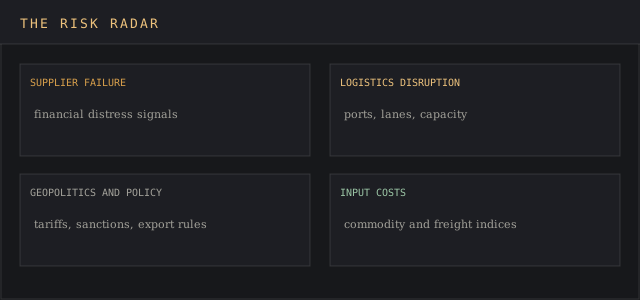
The two disciplines point in opposite directions. Supply market intelligence looks outward at the markets you buy from; supply chain intelligence looks inward across your own network, its suppliers, logistics, inventory levels, and demand.
Procurement owns the first. Operations owns the second.
Most organizations run both and blend the output, because an external price signal means little without the internal spend it applies to, and an internal delivery failure means little without the market context explaining why the supplier missed.
Where supply market intelligence data comes from
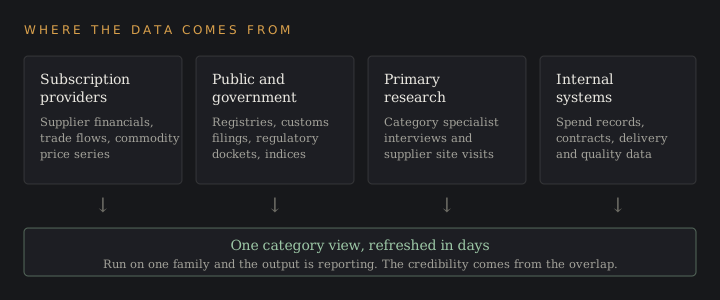
Four source families feed an SMI program, and the mix shifts by category.
- Subscription data providers. Supplier financials, ownership structures, trade flows, and commodity price series bought as a feed. Panjiva covers bill-of-lading shipment records and sells them on a quote only; Interos maps supplier dependencies below tier one.
- Public and government data. Company registries, customs filings, regulatory dockets, and published commodity indices. Slower to refresh than a paid feed, free, and citable in a negotiation.
- Primary research. Category specialist interviews, supplier site visits, and direct conversations with the people running the plant. No database carries this detail.
- Internal systems. Spend records, contract terms, delivery performance, and quality data from your own ERP. External benchmarks mean nothing until they sit beside what you paid.
A commodity with a public exchange price needs less primary research than a fabricated component sourced from three suppliers in one region. Run on one source family and the output is reporting; blend all four and it holds up when a supplier disputes it. Apparel starts with fiber, and the Textile Exchange Materials Market Report 2026 counts 139 million tonnes produced in 2025.
Gathering supply market intelligence and analyzing it
Data collection is the easy half. A category analyst can pull industry reports, analyst reports, and market reports in an afternoon, and most of what lands is unstructured data: PDFs, news items, earnings call transcripts, supplier press releases.
Natural language processing makes those readable at volume. It pulls named entities, dates, and price mentions out of large volumes of text, so a team runs data analysis across a year of filings in the time it used to take to skim ten of them.
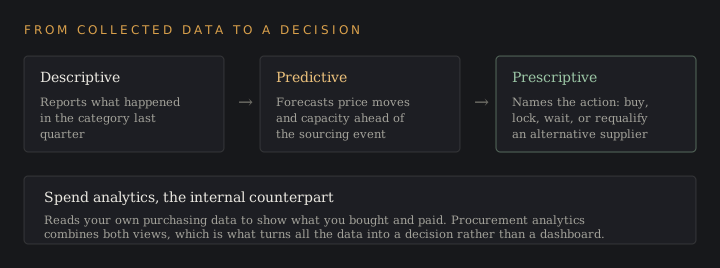
Analytics then works in three layers. Descriptive analytics reports what happened, predictive analytics forecasts what happens next, and prescriptive analytics names the action to take.
Spend analytics sits alongside as the internal counterpart, reading your purchasing data to show what you bought and paid, the layer purpose-built platforms like SpendHQ are built around. Procurement analytics combines both views, which is what turns all the data into a decision.
Data analytics tooling carries the mechanics, and procurement intelligence is the label most vendors put on the packaged version of all of it. Some teams buy the analysis as market intelligence services from a specialist; others staff it and run the process themselves.
Supply market intelligence and category intelligence
Category intelligence is supply market intelligence scoped to one spend category. The market view covers every input a business buys; category intelligence goes deep on one, covering its suppliers, cost drivers, regulatory exposure, and credible alternative suppliers.
Category managers own it. Each runs a rolling view of their own key categories and reports the market information that changes a purchasing decision. Different resources go to different tiers: strategic categories get full coverage, tail spend gets alerts.
Traditional market research differs on cadence and buyer. A market research firm sells one commissioned study read by many companies, while supply market intelligence is maintained continuously for one buyer against their own supply base.
That distinction decides the refresh budget. A study bought once ages from the day it ships; a maintained category view carries a cost every quarter and answers a question the study can no longer reach.
Why supply market intelligence matters: risk, cost, and advantage
Risk mitigation
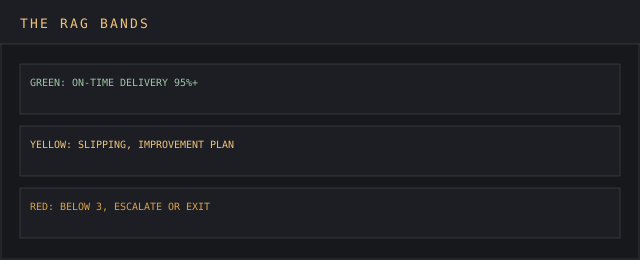
Effective risk mitigation requires deep market intelligence and analysis. Supply market intelligence reduces risk and improves competitive advantage by detecting potential supply chain disruptions early, a supplier's deteriorating finances, a region's tightening capacity, a regulation about to reshape a category.
Market signals monitored continuously with AI and analytics let organizations predict trends and mitigate risks while options still exist. Reducing risk in procurement is mostly a matter of time: the earlier you know, the lower the costs of the fix, and supply chain resilience is built exactly there. Supply chain risks arrive quietly; intelligence is how you hear them coming.
Supplier risks are the ones that move first. A credit downgrade, a delayed filing, or a quiet change of ownership all show up in supplier information weeks before a missed delivery does, and each is a prompt to qualify alternative suppliers while the schedule still allows it.
Keeping a list of reliable suppliers per category is the cheap part of that work. Requalifying one under pressure, after the primary has already failed, costs more in every direction.
Cost reduction and negotiation strength
SMI helps companies reduce procurement risk and cut costs simultaneously. Buyers armed with commodity pricing trends and market context negotiate from evidence; organizations with weak market context accept whatever the market, or the supplier, asserts. When input costs rise, the team that saw the move coming renegotiates on a schedule of its own choosing.
Operational savings compound on top of the negotiated ones, which is why the business case usually rests on both.
Competitive advantage
Market dynamics and competitor sourcing strategies can influence procurement decisions, knowing where rivals source, and where global sourcing options are shifting, reveals both threats and openings. A competitive edge in supply chain management compounds: better suppliers, better prices, fewer disruptions, and customer satisfaction that rivals with fragile networks struggle to match.
Value created in the supply chain shows up everywhere else in the business, in margins, in reliability, in market share held during disruptions that sideline competitors.
How to build supply market intelligence: five practices
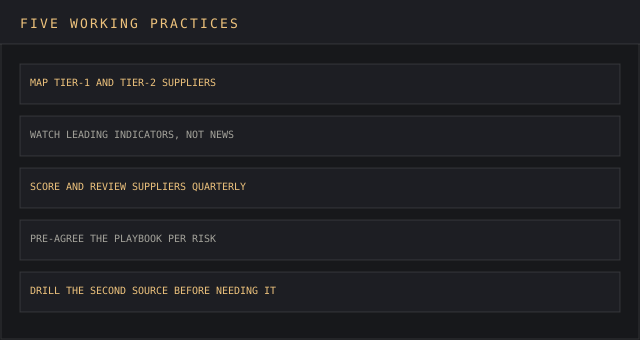
- Prioritize key categories. Focus deep market intelligence on high-spend, high-risk categories first, strategic raw materials, single-sourced components, volatile markets. Category managers should own the market view for their categories, supported by real time data.
- Combine sources deliberately. Blend proprietary databases, market data feeds, supplier financials, IoT devices streaming operational signals, and interviews with subject matter experts, with shared access for category managers. Various data sources correct each other's blind spots; internal data grounds all of it in your actual spend and operations.
- Deploy analytics in layers. Descriptive dashboards first, then predictive analytics for forecasting and machine learning for pattern detection, then prescriptive outputs that name a specific action. Advanced analytics matters only when it changes decisions, and the best process embeds insights where sourcing decisions happen. Artificial intelligence earns its keep here, monitoring market signals at a scale manual analyst teams can't match.
- Wire intelligence into workflows. Market insights belong inside sourcing events, supplier reviews, contract management calendars, and demand planning cycles, inside the process itself. That's how raw data becomes actionable insights people use, and how organizations manage compliance and mitigate risks with the same headcount.
- Measure and iterate. Track negotiation outcomes against benchmarks, disruptions caught early, forecast accuracy, and cost reduction delivered. Best practices spread when performance is visible, and the practices that survive are the ones tied to measurable value and business performance.
Technology accelerates every step, but the operating habit matters more: continuous monitoring, clear ownership, and supply chain intelligence treated as part of operations. Supply chain relationships improve too, suppliers respect informed customers, and supplier relationships built on shared data outlast the ones built on pressure alone.
Common questions
What is supply chain intelligence?
The practice of collecting and analyzing data across a supply chain, suppliers, logistics, inventory, demand, and turning it into actionable insights. It integrates real-time data and predictive analytics to improve visibility, anticipate and prevent disruptions, reduce costs, and speed up decisions.
What distinguishes supply market intelligence from traditional market research?
Cadence and ownership. Traditional market research is commissioned once and sold to many buyers; supply market intelligence is maintained continuously for one buyer against their own supply base and their own internal spend data. A research study answers what a market looked like at a point in time. A supply market intelligence program answers what your categories are doing this week.
What is a supply market analysis?
A structured read of one category covering supply-demand balance, capacity, cost drivers, market conditions, and the competitive strength of the suppliers in it. It combines external market data with internal spend data so procurement teams can see their own prices against the market.
How is supply market intelligence gathered?
Through four source families run together: subscription data providers, public and government records, primary research with category specialists, and internal systems. Collection is automated where the data arrives as a feed and manual where it arrives as a conversation, and procurement professionals doing this well treat both as part of the same procurement process.
How does supply market intelligence differ from procurement market intelligence?
The terms overlap heavily and most practitioners use them interchangeably. Where a distinction gets drawn, procurement market intelligence describes the whole discipline as a procurement function runs it, and supply market intelligence names the outward-looking analysis of supply markets inside it. Both sit apart from spend analytics, which reads purchasing data.
What does supply market intelligence deliver in practice?
Cost savings from negotiating against benchmarks, better deals on the contracts that matter most, earlier warning on risk factors before they become disruptions, and informed decisions about purchasing decisions that used to run on instinct. Teams running it well end up in a better position on price and a shorter recovery when a supplier fails.
What is supply intelligence?
Supply intelligence (or supply market intelligence) is the ongoing collection and analysis of external data related to suppliers and supply markets. Its relevance: it reduces risk by flagging disruptions early, strengthens negotiations with market knowledge, reveals sourcing strategies and opportunities, and gives procurement a market context that internal spend data rarely provides.
Will SCM be replaced by AI?
AI augments SCM. Artificial intelligence excels at monitoring market signals, forecasting, and flagging anomalies at scale, but supply chain management still needs humans for supplier relationships, trade-off judgment, and strategy. The realistic future is smaller teams making better decisions with technology doing the watching and the math.
What are the 7 C's of SCM?
A common formulation: connect, create, customize, coordinate, consolidate, collaborate, and contribute, a maturity path from linking partners and data through joint value creation across the supply chain.
What are the 5 pillars of SCM?
Plan, source, make, deliver, and return, the SCOR model's core processes. Intelligence strengthens each pillar: demand planning for plan, supplier intelligence for source, capacity data for make, logistics visibility for deliver, and reverse-flow analytics for return.
What are the 5 P's of procurement?
Commonly: power, people, processes, planning, and prevention. Supply market intelligence feeds power (a bargaining position built from market data) and prevention (early risk detection) most directly.
What are the sources of supply market intelligence?
Subscription data providers for supplier financials and trade flows, public and government records for registries and customs filings, primary research through category specialists and site visits, and internal ERP data covering spend, contracts, and delivery performance. A program drawing on one of the four produces reporting; the credibility comes from the overlap between them.
Bottom line
Supply market intelligence is how organizations stop being surprised by their own supply chain. Watch the supply market continuously, blend external market intelligence with internal operations data, and deliver insights inside the decisions, sourcing, demand planning, risk reviews, where they change outcomes. When disruption is the default, intelligence is what reliability costs, and reliability is what sustainable growth runs on.