Procurement market intelligence
 By Jan Suski. I go deep on every review, checking every number against its source and digging up details other coverage misses, a habit from six years of SEO and link building for tech companies. Bylines at Surfer, Brand24, and Senuto. How the scoring works.
· Prefer this source on Google
Procurement market intelligence is the systematic collection and analysis of external market data, supplier performance, commodity pricing, market trends, and risk factors, used to make better sourcing and purchasing decisions. It's the difference between negotiating with the market in view and negotiating blind.
Cost savings is a primary goal for businesses today, and procurement sits closest to the money. Yet most procurement teams still make strategic decisions using internal spend data alone. This page covers what procurement market intelligence is, the three components it's built from, where the data comes from, and how to build the capability step by step.
Buyers arrive here from procurement insights, procurement market research, and procurement resources, and the question underneath all three is the same: what's happening in your supply base this week. Last quarter's numbers don't answer it, and a team leaning on them is never ahead of the curve.
Three components carry the answer, and the sections below take each in turn: supply market analysis, supplier intelligence, and cost and pricing analysis. Where the data comes from is covered further down, along with how the discipline differs from spend analysis.
Software selection is a separate question and it comes after the category work. Platforms are ranked head-to-head, with pricing and per-tool breakdowns, on the procurement intelligence tools page, the operational side sits on the AI procurement software ranking, and the market intelligence process page covers the operating cycle in detail.
What is market intelligence in procurement?
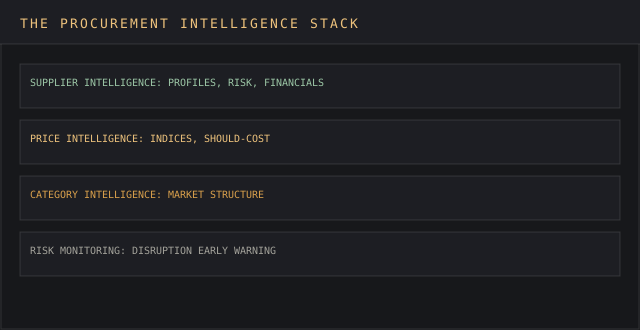
In procurement, market intelligence means continuously monitoring the external supply market, suppliers, prices, capacity, regulations, and demand, and turning that data into actionable insights for sourcing strategies, negotiations, and risk management.
Where spend analysis looks inward at what your company bought and paid, procurement market intelligence looks outward at the market you buy from: what fair pricing looks like now, which suppliers are gaining or losing strength, what raw materials are doing, and which market disruptions are forming beyond the horizon. Combine internal data with external market data and you get a complete view, what you pay versus what the market pays, in one picture.
Effective procurement market intelligence is built on three core elements:
1. Supply market analysis
Understanding market dynamics in each category: supply-demand balance, capacity, cost drivers, and competitive strength among suppliers. Understanding supply-demand dynamics helps forecast shortages and surpluses before they hit your operations, and market analysis at category level tells you when to buy, lock, or wait, keeping category managers on the ball well before trouble hits.
2. Supplier intelligence
Supplier intelligence assesses the reliability, financial health, and compliance of vendors. It includes supplier performance tracking, monitoring delivery timelines and quality, and supplier benchmarking, which compares suppliers across performance metrics so you know who's strong, who's slipping, and who the credible alternative suppliers are.
3. Cost and pricing analysis
Procurement intelligence tracks commodity pricing trends for strategic purchasing and builds should-cost models from market data. Access to market pricing benchmarks improves negotiation outcomes, buyers who know the market price walk into negotiations with bargaining power that relationships rarely replace.
Why procurement market intelligence matters
Better deals and lower costs
Monitoring market trends allows buyers to purchase at favorable prices and reduce spending. Procurement intelligence helps negotiate better deals because pricing trends and benchmarks strip the information advantage suppliers usually hold.
Companies also save costs by identifying four kinds of leak.
- Inefficient spending patterns.
- Duplicate suppliers.
- Maverick spend.
- Contracts drifting above market rates.
Effective procurement intelligence reduces unnecessary expenditures quietly, category by category, catching the places where a process cut corners without anyone deciding to, and helps every buyer avoid overpaying while preserving supplier relationships.
Proactive risk management
Procurement market intelligence aids in anticipating supply disruptions through proactive risk management. In practice:
- Market intelligence helps predict supplier bankruptcies by tracking financial signals before they become insolvency filings.
- Real-time alerts can mitigate supply chain disruptions, a plant fire or port closure flagged today is a manageable problem; discovered next month, it's a crisis.
- Platforms like Everstream Analytics track tier-one and sub-tier suppliers for weather, geopolitical, and commodity disruption before it reaches a shipment.
- Advanced risk scoring models assess supplier exposure across geography, finances, and concentration.
- Continuous monitoring of external signals reduces supply risk, and data analytics can identify potential supply chain vulnerabilities you didn't know you carried.
Market intelligence also enables proactive responses to economic uncertainties, currency swings, regulatory changes, tariffs, so procurement plans ahead of the disruption and acts before it lands.
Smarter sourcing strategies
Procurement market intelligence informs sourcing choices by identifying risks and opportunities in each supply market. It reveals when to consolidate versus diversify, when strategic sourcing should target emerging suppliers, and when market conditions favor renegotiation.
Integrating procurement intelligence into sourcing decisions increases overall sourcing effectiveness, and a mature procurement intelligence program improves supply chain performance and resilience across the business.
Market intelligence helps identify shifts in supplier performance early, and procurement intelligence aids in identifying alternative suppliers during disruptions, before your competitors book their capacity. That's how procurement teams spot shifts early and get ahead of demand swings before they have to chase them, nipping problems in the bud before they turn into firefighting.
Stronger everyday decisions
The compounding benefit is decision quality. Purchasing decisions, contract timing, and category strategy all run sharper on data-driven insights, and that edge over instinct compounds into measurable advantage.
Category managers with real-time insights into their markets consistently outperform those working from last year's market research, and category intelligence gives each spend area its own playbook.
Procurement professionals who bring market insights to company leadership also shift how the function is perceived: from cost center to source of actionable intelligence for strategy, with a seat at the table when strategic decisions get made.
Sources of procurement market intelligence
Four source families feed a procurement intelligence program, and the mix changes by category.
- Subscription data providers. Supplier financials, ownership structures, trade flows, and commodity price series bought as a feed. Panjiva covers bill-of-lading shipment records; Interos maps supplier dependencies below tier one.
- Public and government data. Company registries, customs filings, regulatory dockets, and published commodity indices. Free, slower to refresh, and citable in a negotiation without a licence question.
- Primary research. Category specialist interviews, supplier site visits, and direct conversations with the people running the plant. No database carries this detail, and a team that leaves no stone unturned still has to pick up the phone.
- Internal systems. Spend records, contract terms, delivery performance, and quality data out of your own ERP. External benchmarks mean nothing until they sit beside what you paid.
A commodity with a public exchange price needs far less primary research than a fabricated part sourced from three suppliers in one region. Run on one source family and the output is reporting; the credibility comes from the overlap between all four.
Data quality decides what the collection is worth. Supplier names spelled four ways across three ERP systems produce a spend report that undercounts your largest vendor, and no amount of external data sources fixes an internal record set nobody has cleaned.
Historical data is the other half of the value. A single quarter of purchasing data shows a price; three years of it shows a trend, a seasonality pattern, and which business unit keeps buying off-contract.
Delivery matters as much as sourcing. A benchmark that arrives inside a sourcing event gets used, and the same number in a monthly PDF gets filed. AI and machine learning handle the collection and routing at a scale manual monitoring can't reach, and the platforms doing that work are compared on the procurement intelligence tools page.
The four types of procurement analytics
Procurement analytics runs in four modes, and most teams stall in the first. Basic reporting says what you spent. The other three say what to do about it.
- Descriptive. Historical data summarized: spend by category, by supplier, by business unit. Spend analytics lives here.
- Diagnostic analytics. Why the number moved. A price rise traced to a raw material index, a maverick spend spike traced to one office, the kind of answer you get by reading between the lines, past the headline number.
- Predictive. What happens next, read from pricing trends and industry trends across your categories.
- Prescriptive analytics. The action, named. Consolidate these three suppliers. Renegotiate this contract in March.
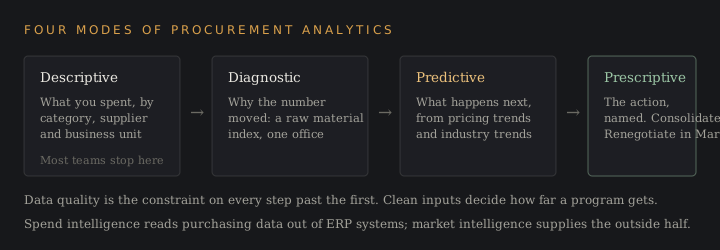
Advanced analytics past the descriptive layer needs clean inputs, which is why most programs stop at reporting. Spend intelligence is the internal half, reading purchasing data out of ERP systems to show what each business unit bought. Dedicated platforms such as SpendHQ build their whole product around that layer, turning raw ERP exports into category-level spend reports.
Procurement market intelligence is the external half. Data driven intelligence needs both, and a team holding all the data on one side of that line is still guessing on the other.
Supplier analysis and risk
Supplier analysis starts with financial health. Filing delays, credit rating moves, and payment behaviour are the earliest signals available, and supplier financial health data turns them into a score somebody can act on.
Supplier performance data covers the other half: delivery timelines, quality rejects, responsiveness. Held over time it helps identify potential risks that a single quarter hides.
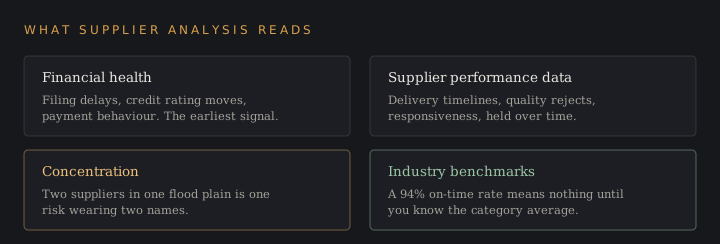
Supplier risks cluster by geography and concentration. Two suppliers in one flood plain is a single risk wearing two names, and supply chain risks of that shape stay invisible until someone maps the sites, proof that two contracts can still mean all your eggs in one basket.
Industry benchmarks supply the comparison. A 94% on-time rate means nothing until you know what the category average is.
Supplier consolidation is the usual answer to a fragmented base. Fewer suppliers means more bargaining power per contract and less oversight cost, at the price of concentration risk you then have to monitor.
Contract management and compliance
Contract analysis is where negotiated savings leak. A rate agreed in the contract and a rate charged on the invoice diverge quietly, and nobody notices until someone compares the two.
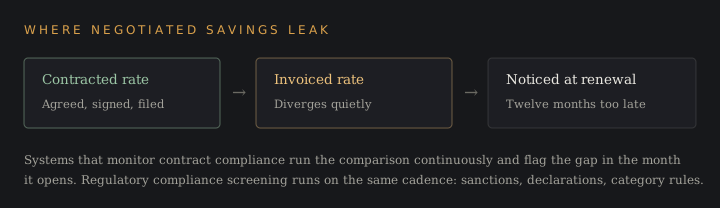
Systems that monitor contract compliance run that comparison continuously. Contract compliance reporting flags the gap in the month it opens. Without that monitoring, the same gap surfaces twelve months later, at renewal.
Regulatory compliance runs on the same cadence: sanctions screening, modern slavery declarations, and category rules that change without an announcement reaching procurement.
What this changes for procurement leaders
Procurement leaders buy market intelligence capabilities for one reason. Procurement decisions made on internal spend data alone are made half blind, and external market signals close the other half.
Procurement strategies built that way survive contact with the market. Sourcing plans set against industry trends and competitive dynamics hold up better than plans set against last year's budget.
Procurement performance improves on measures already being tracked: cost reduction against benchmarks, operational efficiency in the sourcing cycle, and fewer disruptions a year.
Competitive intelligence is the adjacent discipline. Knowing where rivals source, and at what scale, reveals threats and openings a supplier will never volunteer, the kind of move that stays under the radar until a rival has already capitalized on it, and that is where the competitive advantage in this work sits.
Business success arguments land better with a number attached. Procurement efforts reporting savings against a named benchmark get funded again; the ones reporting activity get questioned.
How to build procurement market intelligence: five steps
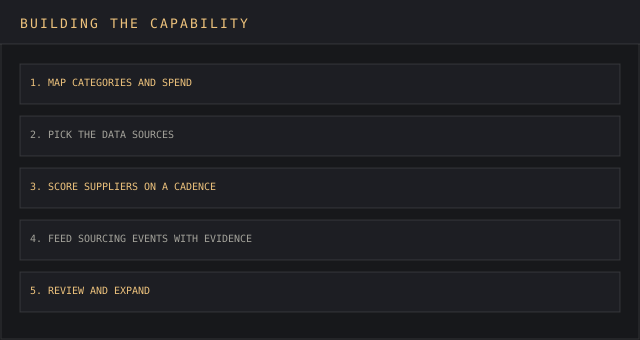
1. Prioritize categories. Rank spend categories by value, risk, and market volatility, raw materials and single-sourced categories first. Different resources deserve different depth: strategic categories get full coverage; tail spend gets basic alerts.
2. Combine internal and external data. Marry spend analysis with external market data: your prices versus benchmarks, your suppliers versus their industry standards and peers. The complete view is where insights live, internal spend data alone shows what you paid before. External benchmarks confirm if the deal is good.
3. Stand up monitoring and alerts. Set up automated monitoring for pricing trends, supplier news, and risk signals in priority categories. Route alerts to category managers and calibrate thresholds so market disruptions surface above the noise. Good market intelligence surfaces what matters and suppresses noise, helping category managers zero in on the handful of signals that need a decision.
4. Embed intelligence in the process. Benchmarks belong inside sourcing events; risk scores belong inside supplier reviews; pricing trends belong inside contract management and renewal calendars. Intelligence that lives in the procurement process gets used; intelligence that lives in a folder doesn't. That's what it takes to deliver actionable insights consistently.
5. Measure and expand. Track negotiation savings against benchmarks, disruptions caught early, and cycle-time gains. Prove value in priority categories, then expand coverage, that's how a program matures from ad hoc market research into standing market intelligence that supports the whole supply chain and the business case behind it.
Even a small program that helps procurement teams make three informed decisions per quarter typically pays for itself in a single negotiation.
What good supplier intelligence looks like
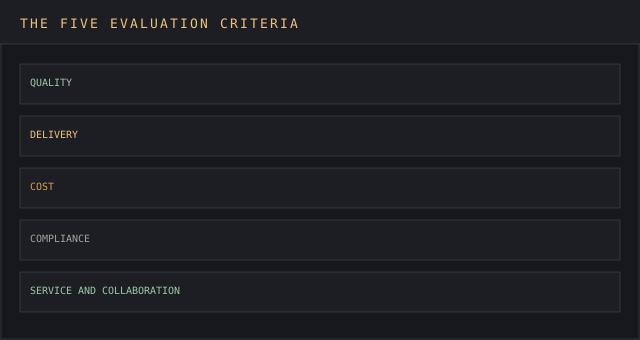
Supply market intelligence lives or dies at the supplier level, so treat your suppliers as a portfolio managed with data.
- Tier your suppliers. Strategic suppliers, the ones whose failure stops your operations, get full monitoring: financial health, capacity, ownership changes, and market share within their own competitive markets. Transactional suppliers get automated alerts only. Supplier management starts with visibility, and monitoring hundreds of suppliers at that depth exceeds most teams' capacity, so keep an eye on what can break the business and automate the rest.
- Score continuously. Feed delivery, quality, and responsiveness data into a rolling scorecard, and let predictive analytics flag suppliers trending downward before contracts renew. Procurement intelligence is most valuable exactly when a supplier looks fine on the surface but the data says otherwise.
- Develop supplier performance. Sharing benchmarks with key suppliers improves performance on both sides, and strategic sourcing works better when suppliers understand how they're measured.
- Connect it to business intelligence. Supplier data belongs beside your internal spend and operations data, with access for category managers, informed decisions happen where both views meet, and where strategy is set for each category across the supply chain.
Common questions
What is market intelligence in procurement?
It's the ongoing collection and analysis of external market data, supplier intelligence, commodity pricing, market trends, capacity, and risk factors, used to inform sourcing strategies, negotiations, and risk management. It complements internal spend analysis by showing what the market looks like beyond your own purchase orders, so procurement makes decisions with full market context.
What are the 5 P's of procurement?
Commonly listed as power, people, processes, planning, and prevention: the bargaining power you hold in a negotiation, the people and skills involved, the workflows that govern buying, the strategy that anticipates demand, and the risk controls that stop problems before they start. Market intelligence strengthens every one of the five, especially power (benchmarks) and prevention (early-warning signals).
What is procurement analytics?
The analysis of procurement data to improve sourcing and buying decisions. It spans four modes: descriptive reporting of historical spend, diagnostic analysis of why a figure moved, predictive forecasting of prices and demand, and prescriptive analytics that names the action. Procurement analytics tools automate the first two reliably, since that part isn't rocket science; the last two depend on data quality more than on software.
What are the 4 types of data analytics?
Descriptive, diagnostic, predictive, and prescriptive. Applied to procurement they answer what you spent, why it changed, what it will be, and what to do next. A program that only runs the first is doing basic reporting.
What are the sources of market intelligence?
Subscription data providers, public and government records, primary research with category specialists, and internal systems. External data sources supply the market side; ERP systems and contract records supply the internal side. Data collection from one side alone produces reporting; the strategic insights come from joining both.
What are the 4 types of procurement?
Direct procurement (goods and materials that go into what you sell), indirect procurement (goods and services that keep the business running, travel, software, facilities), goods procurement (physical products and raw materials), and services procurement (labor, consulting, and outsourced work). Each type has its own supply market, risk profile, and intelligence needs.
What are the components of procurement market intelligence?
Three components carry the work.
- Supply market analysis: capacity, cost drivers, and supply-demand balance per category.
- Supplier intelligence: financial health, performance, compliance, and credible alternatives.
- Cost and pricing analysis: commodity trends and should-cost models.
A program missing one of the three produces reporting. Spend analysis sits alongside them as the internal counterpart, showing what you paid. Market intelligence shows what the market pays, and together the two give you the best of both worlds.
How does procurement market intelligence differ from spend analysis?
Direction. Spend analysis reads your own purchase orders, invoices, and contracts to show where the money went and which suppliers hold it. Procurement market intelligence reads the market you buy from: fair pricing now, which suppliers are gaining or losing strength, raw material movements, and forming disruptions. Run together they answer what you pay against what the market pays; run alone, spend analysis can't tell you if a good-looking contract is above market.
Bottom line
Procurement market intelligence turns the world's noisiest data environment, suppliers, prices, geopolitics, weather, demand, into a decision advantage. The core elements are stable: supply market analysis, supplier intelligence, and cost analysis, delivered through automation into the moments where procurement teams negotiate, source, and manage suppliers.
Buyers who can see the market stay ahead of it; buyers who lack visibility negotiate against counterparties who can. In a market where every supplier knows their numbers, market intelligence is the cost of a fair fight.