Jaggaer review: procurement platform, pricing and user ratings
 By Jan Suski. I go deep on every review, checking every number against its source and digging up details other coverage misses, a habit from six years of SEO and link building for tech companies. Bylines at Surfer, Brand24, and Senuto. How the scoring works.
·
Best for
Large enterprises with complex, multi-ERP approval chains: named users include Sanofi, Snowflake, Under Armour and Elevance Health, concentrated in healthcare and manufacturing.
Not for
Small and mid-market buyers. G2's review base skews toward firms with 1,000 or more employees, and G2 itself calls out neglect of smaller customers in its own pros-and-cons summary.
What it costs
No published rate card. Jaggaer prices its enterprise subscription by module, company size and user count, quoted case by case through a sales-led process.
- Platform
- JAGGAER One source-to-pay suite, assembled from SciQuest, Pool4Tool and BravoSolution
- Procurement scope
- Direct materials alongside indirect: services, supplies, MRO and contingent labor
- ERP integrations
- More than 40 ERP systems
- Named partners
- SAP Cloud ERP (S/4HANA Cloud), Workato, AppZen, EcoVadis, Moody's Analytics, Prewave
- Contract lifecycle
- Creation, templates, editing, attachments, approvals, a contract database and dashboards
- Supplier tools
- Profiles, qualifications, history, evaluation, selection and risk management
- Automated alerts
- Contract renewal dates, compliance gaps and supplier risk events
- Spend analytics
- Cross-department purchasing data through configurable KPIs on spend, performance and due dates
- Agentic AI
- Autonomous RFx creation, guided intake, generative RFx authoring, supplier recommendations, what-if modeling
- JAI assistant
- Launched 2026 to run routine sourcing and requisition work directly
- Implementation time
- Phyllis H. on G2: implementation "took a year until the system ran stably"
- Mobile app
- John N. on G2: "mobile app really needs a major user interface upgrade"
- Admin backend
- A verified enterprise reviewer calls it "not very intuitive" and "quite training-intensive"
- G2 rating
- 4.1 out of 5 across 86 reviews
- Gartner Peer Insights
- 4.4 out of 5
- Product vs support
- 86% positive emotional footprint on the product against 71% rating vendor support positively
- SoftwareReviews
- 2026 Data Quadrant Champion in Strategic Sourcing; Net Emotional Footprint +87
- Rate card
- None. Enterprise subscription priced by module, company size and user count
- Buying route
- Sales-led; any specific figure needs a custom quote
- Cost versus value
- SoftwareReviews scores satisfaction of cost relative to value at 81
- Implementation spend
- Dedicated IT resources for months on estates with many ERP systems
- Small-business fit
- G2's pros-and-cons summary flags "small business neglect"; most of the 86 reviews come from 1,000+ employee firms
- Benchmark quotes
- Buyers price the same scope against SAP Ariba, Coupa and Ivalua, none of which publishes list pricing
- Company
- 1,200 global employees; the business traces back to 1995 as SciQuest
- Ownership prices
- Cinven took majority control in 2019 at a reported $1.6 billion; Vista bought in 2024, terms undisclosed
SAP Ariba
Not forBuyers whose spend runs mostly to direct materials, where Jaggaer's direct-and-indirect coverage is the reason it made the shortlist.
Coupa
Not forBuyers hoping the ratings settle it, because 4.2 against Jaggaer's 4.1 is not a separation.
Ivalua
Not forBuyers who want a deep peer base to read before signing, since 96 reviews sits closer to Jaggaer's 86 than to Ariba's 741.
SpendHQ
Not forBuyers who need sourcing, contracts and payment in the same suite, which is why Jaggaer bundles those modules around this one layer.
Pairs well with Jaggaer
What Jaggaer states itself, and how small the review base behind these ratings is
Jaggaer publishes no price list, so every cost line here comes from what the company and its reviewers describe. The 4.1 G2 score, the 86% and 71% footprint split and the SoftwareReviews awards all rest on 86 published reviews, against 741 for SAP Ariba and 555 for Coupa.
The 30-years-of-expertise line and the 1,200-employee count are Jaggaer's own claims on its G2 profile, and the Vista Equity Partners purchase price was never disclosed; the roughly $3 billion figure is what Cinven was reported to be seeking.
This Jaggaer review covers what the source-to-pay platform does, what real users say about it across 86 G2 reviews, and how its pricing and features stack up against SAP Ariba, Coupa and Ivalua. The company holds a 4.1 out of 5 rating on G2 and a 4.4 out of 5 rating on Gartner Peer Insights.
A customer roster that includes Sanofi, Snowflake, Under Armour and Elevance Health shows the enterprise focus; each customer runs procurement through the same platform, JAGGAER One, the suite assembled from the SciQuest, Pool4Tool and BravoSolution acquisitions.
What is Jaggaer
Jaggaer is a source-to-pay (S2P) product built for enterprise procurement teams. On its own G2 profile, the company describes itself as "a global leader in enterprise procurement and supplier collaboration," backed by "more than 30 years of expertise" and 1,200 global employees. That 30-year figure lines up with the company's real history: the business traces back to 1995.
The software centralizes four jobs in one system:
- Sourcing
- Supplier management
- Contract lifecycle management
- Spend analytics
That gives procurement a single home, and it handles complex approval structures that smaller tools can't. It covers both direct procurement (production materials) and indirect procurement (office supplies, services, MRO), which sets it apart from platforms that specialize in only one side of the business.
↑ FACT SHEETFrom SciQuest to Jaggaer: company history and ownership
The company wasn't always Jaggaer. It started life in 1995 as SciQuest, a software vendor focused on scientific and lab supplies. It rebranded to Jaggaer in 2017, the same year it folded in two major acquisitions: Pool4Tool, a German supplier-collaboration platform, and BravoSolution, a European sourcing and expense-management company.
Ownership has changed twice since, and neither deal gets much attention in procurement coverage. Cinven took a majority holding in 2019, in a deal reported at around $1.6 billion. Vista Equity Partners then acquired the company from Cinven in 2024; terms weren't disclosed, though Cinven was reported to be seeking about $3 billion including debt.
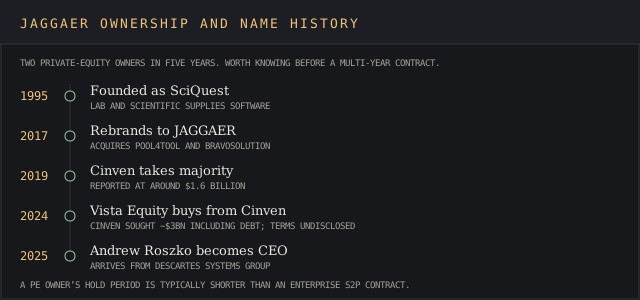
That matters for a buyer signing a multi-year contract, because a private equity owner's hold period is often shorter than an enterprise source-to-pay deployment. Those two deals are also why the current feature set spans direct materials sourcing, supplier collaboration and pricing analysis.
Andrew Roszko became CEO in June 2025, arriving from Descartes Systems Group, where as chief commercial officer he helped scale revenue from about $40 million to more than $700 million.
↑ FACT SHEETJaggaer features
Source-to-pay and procurement processes
The core product is an S2P platform for enterprise organizations, covering the full purchasing process from sourcing through payment. It integrates with more than 40 ERP systems and named partners including SAP Cloud ERP (S/4HANA Cloud), Workato, AppZen, EcoVadis, Moody's Analytics and Prewave, which matters for a large customer that already runs finance and inventory through SAP, Oracle or a similar system and doesn't want to rip that out.
Direct and indirect procurement
The platform handles direct procurement (raw materials and production inputs) alongside indirect procurement (services, supplies, contingent labor). Few S2P products cover both well, and it's a reason the platform shows up often across manufacturing and healthcare, two industries where the software is particularly strong and where many suppliers span both categories at once.
Contract management and supplier tools
Contract lifecycle management covers contract creation, templates, editing, attachments, collaboration, an approval process, a contract database and reporting dashboards. Supplier relationship tracking sits alongside it, covering supplier profiles, qualifications, history, evaluation, selection and risk management, the tools that help a team vet and monitor suppliers over time.
Automated alerts flag contract renewal dates, compliance gaps and supplier risk events so teams don't have to track them by hand.
Spend analytics and reporting
That module aggregates purchasing data across departments to show where an organization's money goes, covering visibility, performance, spend and due dates through configurable KPIs. That visibility feeds sourcing strategy: teams use it to spot maverick spend, consolidate suppliers and negotiate better terms before they sign a renewal.
Buyers who only need that one layer, without the sourcing and contract modules bundled around it, often shortlist a specialist such as SpendHQ instead.
Autonomous sourcing and embedded AI
Jaggaer has built agentic AI directly into the procurement process, branded under categories like Autonomous Sourcing, Agentic AI for Contract Management, and Agentic AI for Purchasing. Specific capabilities include autonomous RFx creation, guided intake and demand capture, generative RFx authoring, natural language intake processing, a supplier recommendation engine and what-if scenario modeling to help optimize bid outcomes.
The newest addition, an agentic AI assistant called JAI, launched in 2026 and is designed to automate routine sourcing and requisition work directly. In a Procurement Magazine interview around the launch, Roszko framed JAI as a beginning.
Several 2026 G2 reviewers call it out by name.
Timothy K., an enterprise reviewer, wrote that he loves "the addition of AI that's dropping" and is "looking forward to using the AI functionality when available." Marco C., a service manager at a mid-market company, described the platform as offering "AI agentic centric solutions to improve tasks." A reviewer in automotive manufacturing called JAI's roadmap "promising" while noting that "modules of JAG" don't yet "interact properly with each other."
↑ FACT SHEETWhat G2 reviewers say
Setup and onboarding
Initial setup is the most consistent theme across the 86 G2 reviews, and it splits reviewers into two camps.
Rabea E., an enterprise reviewer, said the "initial setup was difficult because we had organizational restructurings and had to implement Jaggaer quickly." Phyllis H., also enterprise, said implementation "took a year until the system ran stably." Bartolomé E. called the initial setup "quite complicated," and Michael P. described it as "quite complex," a challenging start that several other reviewers echo below.
Other reviewers had a smoother experience. Michelle C. said her "initial setup was very easy," and Massimo M. called it "very simple." Arnaldo C. said his rollout "was very good with strong support of Jaggaer team." The split suggests deployment complexity tracks closely with how many modules a company activates at once and how much its existing processes diverge from the platform's defaults.
Interface and the mobile app
Reviewers are consistently harder on the interface than on functionality. John N., a mid-market reviewer, said the "mobile app needs a major user interface upgrade.
It's so outdated right now." A verified enterprise reviewer in Information Technology and Services called the admin backend "not intuitive" and "quite training-intensive." Multiple reviewers, including Massimo M. and a manufacturing-industry reviewer, used the word "outdated" to describe the interface even in reviews they rated 4 or 5 stars overall, a sign the complaint is about polish.
Customer support
Support experiences vary by team and region. Meriam E., a customer for "over a decade," said the company has "come a long way in customer support and training." Lilia S. praised "the promptness and helpfulness of Jaggaer's customer service," and other reviewers found the support team equally helpful once a ticket reached the right person.
But Phyllis H. said support "functions…" and G2's aggregated pros-and-cons summary lists "poor customer support" as one of the recurring dislikes reviewers flag.
The outlier review
Not every review is measured.
Mark S., a managing partner at a small business who identifies as a vendor on the platform, left a 0-star review in February 2026 titled "Stop engaging with this company, it's awful for vendors." He wrote that the company is "responsible for stalling more transactions between vendors and buyers than anyone" and warned other vendors to "buyer beware."
It's one data point out of 86, and it comes from the vendor side of the marketplace. Most other reviewers write from the buyer side. It's real and worth surfacing.
Integration challenges
Integration with legacy systems is the other recurring pain point.
Wendelin B., a senior manager at an enterprise manufacturer, said Jaggaer is "difficult to implement in a complex environment with many ERP systems." Juliette D. said an API integration her technical team wanted to build was "difficult... to manage."
Users describe the initial configuration as complex and labor-intensive, sometimes requiring dedicated IT resources for months, and the platform's limited customization options for certain integrations compound this.
User satisfaction and independent ratings
The G2 reviews translate to an 86% positive emotional footprint score, a measure of how reviewers feel about the product overall. Vendor support fares worse: only 71% of users rate the company's support positively, consistent with the mixed pattern reviewers describe above. On Gartner Peer Insights, Jaggaer holds a 4.4 out of 5 rating.
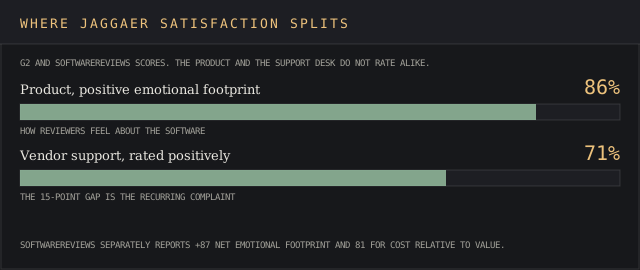
A separate research firm, SoftwareReviews.com, named Jaggaer a 2026 Data Quadrant Champion in Strategic Sourcing and a 2025 Emotional Footprint Champion, reporting a Net Emotional Footprint score of +87 and an 81 rating for satisfaction of cost relative to value.
Both scores put the platform ahead of the category average, though the gap between product satisfaction and support satisfaction is worth weighing: this is a platform that performs well once configured, and it offers little forgiveness to a team without a capable implementation crew behind it.
↑ FACT SHEETJaggaer pricing
The company doesn't publish standard pricing. It uses an enterprise subscription model, and price varies by module, company size and number of users, so any specific figure requires a custom quote from the sales team.
That pricing structure, combined with the platform's complexity, means the product usually isn't the right fit for smaller businesses that need a simpler tool a new hire can learn fast and a lighter vendor list to keep track of.
G2's own pros-and-cons summary flags "small business neglect" as one of the recurring themes in negative reviews, which tracks with the enterprise-heavy reviewer base: the large majority of the published G2 reviews come from companies with more than 1,000 employees.
To judge if Jaggaer's pricing makes sense for a given business, most buyers end up comparing the quoted price against what similar products from SAP Ariba, Coupa or Ivalua would charge for the same scope of work.
Jaggaer vs SAP Ariba, Coupa and Ivalua
G2 places Jaggaer in the same Procure-to-Pay and Procurement categories as SAP Ariba and Coupa, and the ratings are close. SAP Ariba holds a 4.1 out of 5 rating across 741 G2 reviews, matching Jaggaer's score but with a far larger review base. Coupa scores 4.2 out of 5 across 555 reviews, and Ivalua leads the group at 4.3 out of 5 across 96 reviews.
Coupa's ownership changed in an $8.0 billion Thoma Bravo take-private that closed in February 2023, covered in our report on the Coupa acquisition; Jaggaer, SAP Ariba and Ivalua remain under their existing ownership.
| Tool | G2 rating | Review count |
|---|---|---|
| Ivalua | 4.3 / 5 | 96 |
| Coupa | 4.2 / 5 | 555 |
| SAP Ariba | 4.1 / 5 | 741 |
| Jaggaer | 4.1 / 5 | 86 |
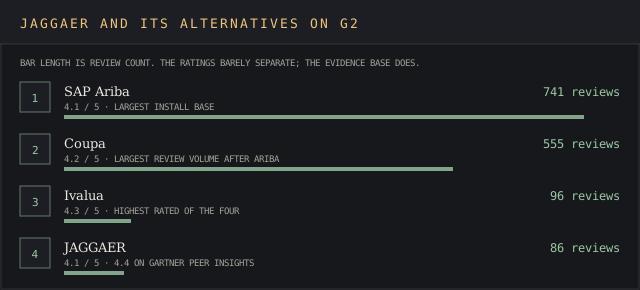
None of the four separates itself by rating alone. The practical differences show up in ERP integration depth, direct-versus-indirect procurement coverage and implementation cost, where the healthcare and manufacturing strength is worth weighing against Ariba's larger install base and Coupa's larger review volume. A buyer moving fast still has to work through a sales-led evaluation to get a hard number, since none of the four leaders publishes list pricing.
The procurement market intelligence guide covers how these platforms fit into the wider category.
Should your business use Jaggaer
The honest answer depends on what a business needs on day one versus what it wants to grow into. Teams with a straightforward order flow and a handful of suppliers rarely need the full weight of an S2P suite built for organizations juggling thousands of suppliers across multiple departments; a lighter tool would be easy to implement and cheaper to run.
Enterprises with complex approval chains, direct and indirect procurement to manage side by side, and existing ERP investments to protect get more value out of the platform precisely because it's built to handle that scale.
The trade-off reviewers describe consistently: expect a hard implementation, expect to lean on the vendor's help and training resources during rollout, and expect the payoff to show up in spend visibility and supplier risk management.
Workplace culture and the rollout commitment
Independent references back that up. FeaturedCustomers lists more than 300 customer reviews, each one a public reference for how it performs once it's live, and one published case study on an ethical sourcing transformation at a global pharmaceutical business shows the same pattern: a hard rollout followed by measurable gains once the process beds in and end users learn the interface.
That growth path is why the ability to scale is what most reviewers say the product delivers best, and why SoftwareReviews.com places the company as a category leader in strategic sourcing efficiency and workplace culture fit.
Reviewers who work through the setup consistently say the payoff arrives later: better budget visibility, fewer manual approvals, and an easier time helping teams meet audit and compliance deadlines. Reviewers who called a rollout great tended to work at organizations with an internal team dedicated to the effort.
The features Jaggaer created to reduce that setup burden, JAI included, work on the same problem, but every reviewer agrees the outcome depends less on the software than on a willingness to invest in training up front and to transform how suppliers and buyers interact with the business.
That commitment, and the executive sponsorship needed to ensure it before day one, is what separates a highly resilient procurement operation from a team still fighting the interface.
Frequently asked questions
Is Jaggaer a good company?
Jaggaer scores 4.1 out of 5 on G2 across 86 reviews and 4.4 out of 5 on Gartner Peer Insights, ratings in line with its main competitors. SoftwareReviews.com separately named it a 2026 Data Quadrant Champion. Reviewers rate the software well overall but consistently flag a steep learning curve during setup and a help desk that resolves issues slower than a typical customer would like.
What is the old name of Jaggaer?
The company was founded in 1995 as SciQuest. It rebranded to Jaggaer in 2017 after acquiring Pool4Tool and BravoSolution.
Who owns Jaggaer?
Vista Equity Partners, which acquired the company from Cinven in 2024. Cinven had held a majority stake since 2019.
What companies use Jaggaer?
Named customers include Sanofi, Snowflake, Under Armour and Elevance Health, and the platform is particularly strong in healthcare and manufacturing, the two industries called out most often in G2 reviews.
Who is the CEO of Jaggaer?
Andrew Roszko has been CEO since June 2025, arriving from Descartes Systems Group.
What are the alternatives to Jaggaer?
The main alternatives are SAP Ariba (4.1 out of 5 on G2, 741 reviews), Coupa (4.2 out of 5, 555 reviews) and Ivalua (4.3 out of 5, 96 reviews).
What are the benefits of using Jaggaer?
The product centralizes sourcing, contract oversight, supplier management for thousands of suppliers and purchasing data in one S2P platform, integrates with more than 40 ERP systems and named partners like SAP and Workato, and offers risk-flagging features and an embedded AI assistant, JAI, that automates routine procurement work.
How does Jaggaer compare to SAP Ariba?
Jaggaer and SAP Ariba both hold a 4.1 out of 5 rating on G2, though Ariba's review count (741) is far larger than Jaggaer's (86). The direct-and-indirect procurement coverage and healthcare and manufacturing focus are the main differentiators buyers should weigh against Ariba's broader market presence.