Everstream Analytics review: predictive supply chain risk management for enterprise procurement
 By Jan Suski. I go deep on every review, checking every number against its source and digging up details other coverage misses, a habit from six years of SEO and link building for tech companies. Bylines at Surfer, Brand24, and Senuto. How the scoring works.
· Prefer this source on Google
Best for
Enterprise supply chain and procurement teams with an existing risk function, tracking tier-one and sub-tier suppliers for weather, geopolitical, crop or commodity disruption.
Not for
Teams that want a published price, a free tier or self-serve signup; every route to the product runs through a sales conversation.
What it costs
No public rate card. Quotes are scoped to how many suppliers get monitored and which modules, weather, crop or commodity, a buyer selects.
- Digital twin
- Supplier relationships, shipping lanes and site-level dependencies in one network graph
- Signals processed
- Over 20 billion a day, vendor-published with no independent audit
- Disruptions flagged
- 1,000 to 1,500 potential disruptions a day
- News monitoring
- Roughly 1 million news and media articles an hour
- Historical data
- More than 15 years of supply chain history behind the model
- Risk Assessment
- Branded Explore internally; 50+ external risk topics, climate projections to 2100
- Crop Prediction
- Over 200 crop types
- Commodity Risk
- More than 40 metals, farm commodities, polymers and gases
- Forecast horizon
- 10 days for true reliability, per a Gartner Reveal reviewer
- Gartner listings
- Three: SCRM at 4.2 from 27 ratings, Discover at 4.8 from 4, Reveal at 4.5 from 4
- G2 coverage
- One review, 3.5 out of 5
- SoftwareReviews
- Zero reviews; the listing reads Insufficient Data
- Support metrics
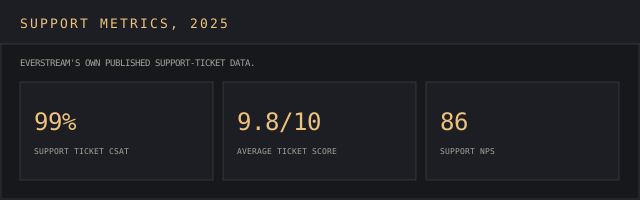
- 99% ticket CSAT, 9.8 out of 10 average ticket score, NPS of 86 in 2025
- Public rate card
- None; every page on everstream.ai routes to Request Demo or Contact Us
- Quote basis
- Monitored supplier count and the modules a buyer selects
- Free tier
- None; there's no self-serve signup
- Trial
- Not offered; every path to the product runs through a sales conversation
- Contract term
- Not disclosed in public materials
- Listing scope
- The three Gartner listings differ in scope; confirm which one a quote covers
- Category pattern
- Interos, Resilinc, Exiger and Z2Data publish no rate card either
- Named customers
- Google, Unilever, Nissan, Danone, DuPont, Bayer, Siemens Energy, AB InBev
- Headcount
- Roughly 200 at the April 2023 Series B, with 10 to 15% growth planned that year
- Single sign-on
- Absent, per the SCRM Dislikes panel of January 2025
- Sub-tier mapping
- No manual mapping or maintenance beyond tier-one suppliers
- Automation gap
- No automated impact simulations or auto-generated recommended actions
Alternatives to Everstream Analytics
Interos
Not forA buyer whose risk is weather, crop or commodity driven.
Resilinc
Not forA buyer who wants weather, geopolitical and commodity risk in one platform.
Pairs well with Everstream Analytics
Which figures Everstream publishes itself, and which come from Gartner reviewers
Scale figures, module coverage and the 2025 support metrics come from Everstream Analytics' own FAQ and customer experience pages, published without an independent audit. The 10-day forecast window, the missing single sign-on and the sub-tier mapping gap come from Gartner Peer Insights reviews dated January 2025 to February 2026.
Funding, headcount and the founding date trace to FinSMEs and TechCrunch coverage of the two rounds. Everstream Analytics publishes no price anywhere, so every pricing row describes the buying process; none list a number.
Everstream Analytics sells disruption risk monitoring to enterprise supply chains that already run a procurement org, a risk team, and a reason to watch tier-one and sub-tier suppliers for trouble. The platform builds what it calls a digital twin of a client's supplier network, then layers weather, geopolitical, and news monitoring on top.
Google, Unilever, Nissan, Danone, DuPont, Bayer, Siemens Energy, and AB InBev are named customers on Everstream Analytics' own site (source).
This review covers what Everstream Analytics does, what it costs to buy, who Gartner-verified reviewers say it works for, and where four competing supply chain risk tools beat it on one job each.
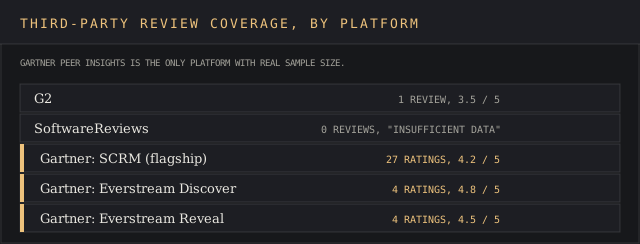
Everstream Analytics doesn't publish pricing, and third-party review coverage stays thin:
- G2 lists one review at 3.5 out of 5 (source).
- SoftwareReviews shows zero, marking the listing "Insufficient Data" (source).
- Gartner Peer Insights is the one place with real volume: 27 ratings at 4.2 stars for its flagship listing, with its two smaller sibling listings running far thinner (source).
The buyer profile in those Gartner reviews skews toward directors and managers of supplier risk at manufacturers with $1 billion or more in revenue. That profile excludes a five-person sourcing team acting alone. The gap shows up everywhere: the depth of the risk modules, account-team-driven onboarding, and the total absence of self-serve pricing.
↑ FACT SHEETWhat Everstream Analytics does
Everstream Analytics is built around a network graph: supplier relationships, shipping lanes, and site-level dependencies mapped into a single model, then cross-referenced against live disruption signals.
Gartner lists three separate listings under the brand: the flagship, titled Supply Chain Risk Management on Gartner's own pages (SCRM from here on), plus Everstream Discover and Everstream Reveal. Discover carries 4.8 stars across 4 ratings and Reveal carries 4.5 across 4, both thinner samples than the 27-review SCRM listing, which holds the lion's share of the brand's Gartner review volume (source, source).
A Gartner reviewer, a data and analytics manager at a consumer goods company with $50 million to $1 billion in revenue, described the platform this way in a review posted February 4 to 5, 2026 (source):
"Our overall experience has been strongly positive. The platform has become a core component of our digital supply chain risk management strategy, supporting our need for global risk anticipation, real-time incident visibility and proactive mitigation across our protein and food supply chains.
"With the tight coupling between our EA incident monitoring and our internal Emporion Control Tower ecosystem (VTS, ERP, TMS integration), EA plays a central role in helping us maintain resilience from farm to fork."
↑ FACT SHEETHow the risk model works: data sources and module coverage
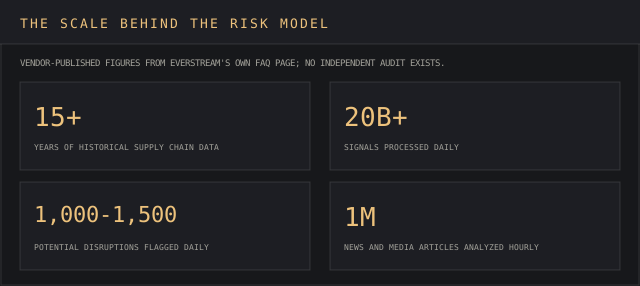
Everstream Analytics states it draws on more than 15 years of historical supply chain data and processes over 20 billion signals a day, feeding a model that flags between 1,000 and 1,500 potential disruptions daily and scans roughly a million news and media articles an hour (source). None of those figures carry an independent audit; they're vendor-published, and this review treats them as such.
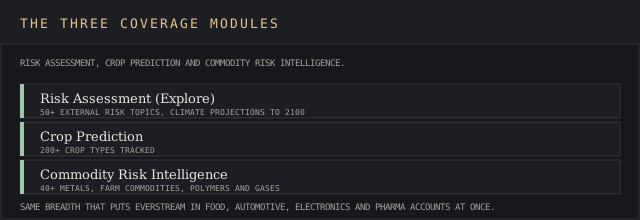
Coverage runs wide across three modules:
- Risk Assessment, branded Explore internally, runs predictive analytics against more than 50 external risk topics and layers in climate projections that reach out to the year 2100.
- Crop Prediction covers over 200 crop types.
- Commodity Risk Intelligence tracks more than 40 metals, farm commodities, polymers, and gases (source).
That breadth carries Everstream Analytics into food and beverage, automotive, electronics, and pharma accounts at once, playing jack of all trades across each one.
Compared with a dedicated business continuity platform, Everstream Analytics leans harder on predictive analytics than on incident-response workflow. Buyers already running a separate business continuity platform for facilities and IT will find the overlap confined to the incident-monitoring layer. Day-of incident execution for facilities stays with that dedicated continuity platform; Everstream Analytics' layer only watches for the disruption signal upstream.
A buyer doing procurement research should also weigh the risk assessment framework their own team already uses against Everstream's module, since the two rarely map one to one.
The crop and commodity modules pull double duty for sustainability reporting, killing two birds with one stone, since climate and crop risk figures already overlap with ESG disclosure requirements. Buyers who want to learn exactly how the risk-scoring model weighs each signal should ask Everstream Analytics for its methodology directly; the FAQ page doesn't publish it.
The pitch is an earlier warning system that still runs through a human analyst for interpretation. Smarter forecasting doesn't remove that analyst from the loop, per the complaints about manual interpretation covered below.
How far the forecasts reach
Everstream Analytics' marketing leans on the phrase "see further, act faster." The Gartner review sample complicates the "further" half, and a pitch can be all bark and no bite until a reviewer names the real ceiling. One reviewer, in the Dislikes panel on the Everstream Reveal listing, put a hard number on the forecast horizon:
"That can only be seen out to 10 days for true reliability."
Gartner Peer Insights, Everstream Reveal Dislikes panel.
A Gartner reviewer put the platform's true forecast reliability at 10 days, well short of what the climate-to-2100 modeling implies for near-term logistics decisions. Buyers evaluating long-lead-time categories, semiconductors or specialty chemicals, should ask Everstream Analytics directly how reliability decays past that mark.
Independent research into Everstream Analytics' forecast error rate doesn't exist publicly. A logistics buyer sizing the platform against a transportation-management add-on won't find that gap addressed on the marketing pages either. Buyers who need lane rates or shipment tracking can compare ten tools in our freight intelligence platforms ranking, from SONAR’s $24.99 monthly plan to project44’s $48,150 Vendr median.
↑ FACT SHEETEverstream Analytics pricing
No vendor in this category publishes a rate card, so the table below names what's known about the buying process. Those numbers don't exist to list.
| Category | What's known |
|---|---|
| Public rate card | None; every page on everstream.ai routes to Request Demo or Contact Us |
| Self-serve trial | Not offered |
| Quote basis | Monitored supplier count and modules selected |
| Contract term | Not disclosed in public materials |
| Category pattern | Interos, Resilinc, Exiger and Z2Data also publish no rate card |
No independent pricing database tracks this category, so treat every row as a description of the buying process.
↑ FACT SHEETCompany ownership and funding history
Everstream Analytics launched as a brand on March 2, 2021, combining two acquisitions: Resilience360, which DHL incubated inside its Global Innovation Center starting in 2012 and spun out in 2018, and Riskpulse, a climate-risk analytics firm (source), pairing network intelligence with climate modeling for what the brand pitches as the best of both worlds.
DHL still holds a minority stake alongside Columbia Capital, StepStone Group, Blue Lagoon Capital, and Morgan Stanley (source).
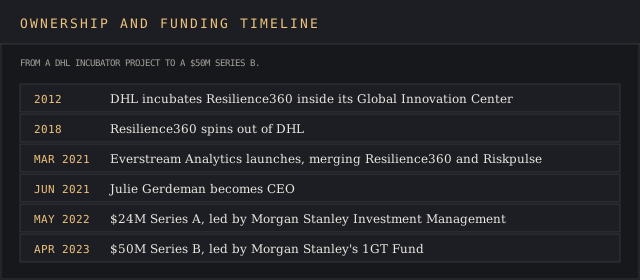
Funding has come in two rounds since the rebrand: $24 million in a Series A announced May 22, 2022, led by Morgan Stanley Investment Management (source), and $50 million in a Series B announced April 4, 2023, led by Morgan Stanley's 1GT Fund with Columbia Capital and StepStone Group returning (source).
Julie Gerdeman took over as CEO on June 30, 2021, with prior CEO David Shillingford moving to Chief Strategy Officer. At the time of the Series B, TechCrunch reported more than 200 enterprise customers and roughly 200 employees, with plans to grow headcount 10 to 15% that year.
Named customers and documented results
Everstream Analytics' own website names Nissan and Danone as case studies with specific numbers attached, and this review treats them as vendor-published.
For Nissan, Everstream Analytics states:
- Seven-figure cost avoidance within the first six months of deployment.
- 90% of flagged impacts mitigated with zero financial loss.
- More than 200 daily active users trained on the platform.
For Danone, the figures are:
- 60% of procurement categories onboarded.
- A 20% growth figure attributed to more resilient supply chains.
- Five days saved in response time from earlier intervention (source).
Neither the Nissan nor the Danone figures come with a stated measurement baseline or audit. Treat both as unverified marketing claims, read between the lines, and ask Everstream Analytics for the underlying methodology before citing either number internally.
Beyond Nissan and Danone, Everstream Analytics' FAQ page names Schneider Electric, Campbell's, Medtronic, Whirlpool, Andritz, Danfoss, BP, and FairPrice as customers, on top of Google, Unilever, DuPont, Bayer, and AB InBev named above (source).
Where Everstream Analytics delivers
The strongest praise in the Gartner reviews centers on two things: how the platform gets set up, and how support behaves after the sale. A director of procurement at a business with $10 billion or more in revenue, reviewing Everstream Discover on January 28, 2026, credited the vendor's willingness to co-build features:
"Highly customer-oriented approach, from the intake phase, setting up digital twin, as much of trainings provided as seen as necessary by us and product development roadmap took into consideration our team inputs, specifically around discovery module. Great flexibility demonstrated by running bi-yearly F2F meetings dedicated to workshops aimed to deliver greater value through support and innovation.
"We worked together to co-develop cutting-edge innovative crop monitoring and forecasting capability."
Gartner Peer Insights, Everstream Discover listing, January 2026.
A manager of supply chain at a business with $1 billion to $10 billion in revenue, reviewing Reveal on December 8, 2025, framed the same support quality less formally:
"[T]he team makes me feel like home, there is no silly questions, no wrong answers, just a bunch of folks trying to figure out the best way to ship our mayo and protect our drivers in the winter."
That support quality lines up with Everstream Analytics' own published support metrics: 99% CSAT on support tickets in 2025, a 9.8 out of 10 average ticket score, and a support NPS of 86 (source).
The SCRM listing's own Likes panel groups four recurring themes from manufacturing-sector reviewers (source):
- Advanced process mapping across multi-tier supply chains.
- Strong predictive risk identification through continuous monitoring of weather, geopolitical disruption, port congestion and supplier issues.
- Built-in compliance monitoring with sub-tier visibility.
- Cross-functional operational improvement.
Gartner's own Likes panel describes the same shift in different words: catching problems early and nipping them in the bud before the reactive scramble that follows.
↑ FACT SHEETWeaknesses and limitations
The complaints cluster around release reliability and setup complexity. A supplier risk manager at a business with $3 billion to $10 billion in revenue, reviewing the SCRM listing on January 8, 2025, listed four separate problems in one entry:
"Frequent system bugs caused by new releases - poor user acceptance testing (if any?), Complexity of the set-up and limited administration tools. Lack of manual mapping & maintenance of the supply chain beyond the 1st tier suppliers. Lack of proper single-sign-on functionality."
Gartner Peer Insights, Everstream SCRM Dislikes panel, January 2025.
Missing single sign-on isn't a minor inconvenience. It's a blocker for IT security teams that require SSO before granting broad platform access, and it means IT can't centralize permission management the way security policy usually requires. Leaving it out reads like Everstream Analytics dropped the ball on a basic enterprise checkbox.
Two more complaints, both from the Everstream Reveal Dislikes panel, point the same direction: heavy reliance on people to translate output into decisions.
"Dependency on Manual interpretation for some insights, require human translation into operational decisions. We would prefer more automated impact simulations and auto-generated recommended actions[...]" one reviewer wrote.
Another, on the same listing, was blunter: "Can be overwhelming at first. Hard to attach dollar value in related to impact. Does create additional workload, can it be simplified?" (source)
A smaller but specific complaint from the Discover Dislikes panel: "Some files can be downloaded directly to the desktop, others need to be mailed. It is not logical and delays downloads." One more, from the same panel, names a capability gap directly: "it lacks true AI agents for multi-tier supplier relationships" (source).
Turning a predictive insight into a purchase order still runs through a human analyst across every Dislikes panel on Everstream Analytics' three listings.
Everstream Analytics vs Interos, Resilinc, Exiger and Z2Data
Interos has raised $224 million and reached a $1 billion valuation in 2024, with Ted Krantz taking over as CEO that year from founder Jennifer Bisceglie, who moved to executive vice chair.
Its i-Score claims coverage of 250 million companies and 11 billion supplier relationships, and its customer list runs toward government: the Department of Defense, NASA, and the U.S. Navy.
That's the clearest split between the two vendors. Interos wins the deal when a defense or national-security compliance requirement drives the purchase, and Everstream Analytics wins when the buyer needs climate and commodity-specific modeling that Interos doesn't build for.
| Alternative | Where it wins the deal |
|---|---|
| Interos | Defense and national-security compliance requirements |
| Resilinc | Part-level sub-tier mapping for hardware manufacturers |
| Exiger | Sanctions screening and ownership due diligence in regulated industries |
| Z2Data | Component-level obsolescence tracking for electronics buyers |
Resilinc, founded in 2010 and based in Milpitas, California, raised a $15 million Series B in November 2017 led by Partech Partners. It specializes in part-level sub-tier mapping, which makes it the better fit for a hardware manufacturer tracing a failed component back through five supplier tiers.
Exiger serves more than 500 customers globally, including 150 of the Fortune 500 and over 50 government agencies, and took a majority investment from Carlyle and Insight Partners in December 2023. Its focus is sanctions screening and ownership due diligence, so it wins the deal in regulated industries where third-party risk reporting matters more than shipment-level forecasting.
Z2Data tracks more than 1 billion electronic components, 1 million suppliers, 200,000 manufacturing sites, and 270 regulatory regimes, with customers including Qualcomm, Tesla, Dell, and Airbus (source).
For an electronics or semiconductor buyer worried about part obsolescence, Z2Data's component-level database goes deeper than anything in Everstream Analytics' lineup. It has nothing comparable to Everstream Analytics' crop and commodity modules, so a food or agriculture buyer switching to Z2Data would be a fish out of water, with no crop or commodity coverage waiting for them.
All four alternatives share one pattern with Everstream Analytics: no public rate card anywhere in the category, par for the course among supply chain risk vendors. Every vendor covered here, alongside Everstream Analytics, is scored side by side in the supply chain risk management ranking.
Who Everstream Analytics is built for
The reviewer base backs up the enterprise-only framing directly: every named reviewer title in the Gartner sample belongs to a business with $50 million or more in revenue, several well past $1 billion. It fits a business that already runs procurement and supplier-risk functions at scale, has a named account team on the other end of the phone, and needs coverage that spans weather, geopolitical, crop, and commodity risk in one platform.
It isn't for a business without a dedicated risk or procurement function. There's no self-serve signup, no published price, and no trial; a five-person sourcing team evaluating tools on its own time gets a Request Demo button and nothing else, since Everstream Analytics calls the shots on how that conversation happens.
The setup process itself carries real friction, per the Dislikes panel: bugs tied to new releases, no single sign-on, and administration tools reviewers called limited.
It might suit a mid-market manufacturer willing to trade some of that friction for the crop and commodity modules Everstream Analytics builds that its rivals don't, provided the buyer understands that forecast reliability tapers hard past a 10-day window and that real value still runs through a human analyst.
FAQ
Is Everstream Analytics a Kuehne+Nagel spin-off?
No. Everstream Analytics formed in 2021 from Resilience360, a DHL-incubated business spun out in 2018, and Riskpulse, a climate-risk analytics firm. DHL remains a minority investor. There's no Kuehne+Nagel ownership link anywhere in Everstream Analytics' funding history or press materials.
What does Everstream Analytics do?
It monitors a client's supply chain for disruption risk, weather, geopolitical disruptions, port congestion, supplier financial distress, using a network model it calls a digital twin, then layers in crop and commodity-specific modules for buyers in food, beverage, and materials-heavy industries. Forecast reliability tapers past 10 days, per a Gartner reviewer, and Everstream Analytics hasn't published an error-rate methodology explaining why.
How many people work at Everstream Analytics?
Roughly 200, as of the April 2023 Series B announcement, with plans at that point to grow headcount 10 to 15% over the following year (source).
How much does Everstream Analytics cost?
Everstream Analytics doesn't publish pricing anywhere on its website; every page routes to Request Demo or Contact Us. The quote is built on monitored supplier count and which modules a buyer selects, and the three separate Gartner listings differ enough in scope that a buyer should confirm which one a quote covers.
Does Everstream Analytics offer a free trial?
No. There's no self-serve signup and no published trial anywhere in Everstream Analytics' public materials. Every path to the product runs through a sales conversation.
Bottom line
Everstream Analytics earns its account-team-driven sales process for a business that already runs procurement and supplier-risk functions at enterprise scale. The crop and commodity modules are the reason to shortlist it over a generic risk-mapping tool, and the 99% support CSAT is the reason accounts stick once they're in.
Two caveats carry weight. The forecast horizon holds reliable for about 10 days, well short of the "further" its own marketing implies, and every insight still needs a human analyst to turn it into a decision. The common buying mistake is reading the climate-to-2100 modeling as proof the near-term forecasts stay sharp, when the devil's in the details of a 10-day reliability window.
Neither disqualifies the platform for the buyer it's built for; both should shape what a procurement team expects on day one.
Ask for a demo scoped to the specific modules that matter, weather and geopolitical monitoring, crop prediction, or commodity risk, and confirm which of the three Gartner listings the quote covers before signing.