Third-Party Risk Management Tools: 10 TPRM Platforms Ranked (2026)
 By Jan Suski. I go deep on every review, checking every number against its source and digging up details other coverage misses, a habit from six years of SEO and link building for tech companies. Bylines at Surfer, Brand24, and Senuto. How the scoring works.
· Prefer this source on Google
Quick comparison of third-party risk management tools
Ten TPRM platforms in ranked order, with each vendor's largest published coverage count, the entry price and the buyer each fits. The coverage units differ by row because each vendor counts something different.
| # | Provider | Telling coverage figure | Entry price | Best fit |
|---|---|---|---|---|
| 1 | Bitsight | 40M+ organizations rated daily; 75,000+ vendor network profiles | $23,640/yr median* (64 purchases) | Widest rated universe |
| 2 | UpGuard | 0-950 rating refreshed multiple times per day | $1,750/mo published, 50 vendors | Price before the demo |
| 3 | SecurityScorecard | 12M+ organizations rated; 39 questionnaire templates | Free tier; $23,619/yr median* | Free starting scorecard |
| 4 | ProcessUnity | 18,000+ control attestations; 370,000+ vendor profiles | Quote only, two size tiers | Large enterprise vendor lists |
| 5 | Mitratech Prevalent | 800+ assessment templates; 10,000+ network records | Quote only | Sanctions and media screening |
| 6 | Panorays | 0-100 posture rating; 30 integrations | $21,700/yr median* | Ratings plus questionnaires |
| 7 | Whistic | 50+ standardized frameworks; Trust Center exchange | $22,500/yr median* (77 purchases) | Vendor-published evidence |
| 8 | OneTrust | 20M+ cyber risk and attack insights | $12,000/yr median* (309 purchases, all products) | Existing OneTrust customers |
| 9 | Vanta | 33,000 vendors managed across customers | $20,000/yr median* (whole platform) | Startups on Vanta for SOC 2 |
| 10 | Venminder | 30,000+ analyst-run assessments a year | $10,790/yr median* | Banks outsourcing assessments |
Medians marked * are anonymized buyer-reported contract values published by Vendr. Everything else is the price the vendor publishes itself.
Where these figures come from
Coverage counts, template counts and feature claims are each vendor's own published figure, read on 24 September 2026. Medians marked * are Vendr's anonymized buyer-reported contract values, separate from any list price, and OneTrust's and Vanta's cover every product each company sells. Neither ProcessUnity nor Mitratech publishes a price, and Vendr shows no header median for either, so both rows say quote only.
Physical supplier disruption (port closures, sub-tier suppliers, sanctions exposure) is ranked separately on the supply chain risk management software ranking, and planning-side tools on the supply chain intelligence ranking. This page ranks tools that assess and monitor the security and compliance risk of vendors you already buy from.
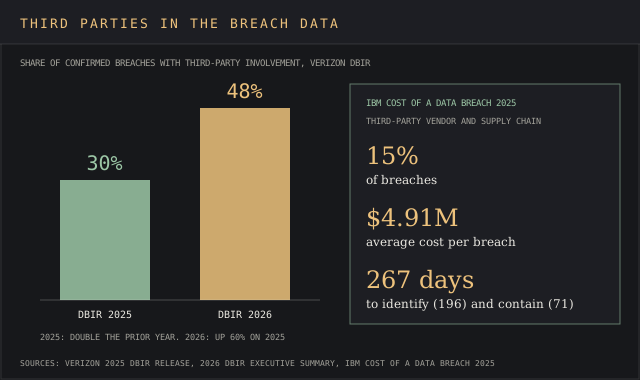
Third-party risk management (TPRM) tools keep one record for every outside company that touches your data, systems or customers, then score, question and watch it. IBM's 2025 breach study priced a third-party vendor or supply chain compromise at $4.91 million on average.
Verizon's 2025 Data Breach Investigations Report found third-party involvement in 30% of breaches, double the prior year. The 2026 edition puts it at 48%.
This page ranks ten third-party risk management software platforms on five tests a buyer can run in an afternoon. Every price links to the vendor's page or to Vendr's anonymised buyer data, and every quote links to its review.
It's for security, procurement and compliance teams buying a TPRM platform, and for teams that already run one and suspect they overpay.
Evaluation criteria for third-party risk management software
Five criteria decide which third-party risk management solutions make the shortlist, and the ranking below applies them in this order. Each TPRM platform earns one pass per criterion it clears. More passes rank higher. A tie goes to the tool that passes the earlier criterion, then to the bigger figure on the first criterion where the two differ.
1. Shared vendor network of 10,000 or more
Pass if the vendor publishes a count of at least 10,000 pre-completed risk assessments, attestations or vendor profiles customers can pull without a fresh questionnaire. With a network that size, part of your vendor list is already on file on day one, so the team can hit the ground running.
2. Native outside-in rating with a published refresh cadence
A platform passes if it runs its own continuous monitoring of vendors' internet-facing assets and publishes the rating scale and update speed. Continuous external monitoring licensed from a partner fails, because the partner's risk scoring models and dispute process sit outside the platform's control.
3. AI that reads vendor evidence
Pass if the vendor documents a feature for vendor assessment work that reads SOC 2 reports, past questionnaires or policies and drafts or scores answers from them. Automating risk evaluations this way is a yes-or-no test, and a published time saving breaks ties.
4. A dollar figure before the sales call
A dollar figure counts when the vendor publishes a list price or Vendr shows a header median. Two of the ten fail. Where Vendr shows a purchase count, this page quotes it.
5. At least 100 independent ratings at 4.3 or higher
Pass if Gartner Peer Insights or G2 lists 100 or more ratings for the vendor risk management product itself, averaging 4.3 or better. Listings that mostly review a different product, such as Vanta's SOC 2 automation, don't count, per the site methodology.
Tool on this page that clears all five criteria: Bitsight. Two of the ten, ProcessUnity and Mitratech Prevalent, fail the price test because neither the vendor nor Vendr shows a figure.
The 10 best third-party risk management tools in 2026
Bitsight
Best fit
Security and vendor risk teams that want the widest rated universe, daily refreshes and a shared vendor network on one TPRM platform.
Bitsight monitors over 40 million organizations and rates each on a 300-820 scale that updates daily. Its vendor risk management module adds questionnaires and a vendor network of 75,000+ profiles. In November 2024 it agreed a $115 million deal for Cybersixgill, adding dark web data to its third-party risk intelligence.
Bitsight's study of 27,458 companies found those rated 400 or lower were five times more likely to report a public data breach than those rated 700 or higher, a claim straight from the horse's mouth.
Key features
- Continuous monitoring of vendor risk posture across 40M+ organizations, updated daily
- 75,000+ shared vendor profiles
- SOC2 Instant Insights, which uses Bitsight AI to summarize SOC 2 reports
- Connectors for ServiceNow, OneTrust, ProcessUnity, Venminder, Coupa and SAP Ariba
Pricing
The packaging page sells continuous monitoring, with or without vendor risk management, in bands of 1-50, 51-100, 101-500 and unlimited vendors, all "Request pricing". Vendr puts the median at $23,640 a year across 64 purchases, from $5,206 to $58,821.
Pros
- Largest published universe of security ratings here
- 325 Gartner Peer Insights reviews averaging 4.5
- Daily rating refresh
Cons
- No list price for any vendor band
- Risk scores lag behind fixes to a vendor's security posture
- False findings on domains with no DNS records, per a December 2025 G2 review
Brian M., an IT security architect at an enterprise, described the lag on G2:
"sometimes it takes a long time to change the security "score" after I've made positive improvements to my company's security posture."
Brian M., IT Security Architect, enterprise, G2, 28 July 2025
Why it's ranked #1. Bitsight clears all five criteria, and its 75,000-profile vendor network wins the first one outright against UpGuard at #2, which publishes no network count.
UpGuard
Best fit
Mid-market security teams monitoring 50 to 150 external vendors that want a published price before a demo.
UpGuard is the only TPRM platform here that prints a paid-plan price, so buyers don't have to read between the lines of a sales deck. It raised a $75 million Series C on 26 February 2026 and reports over 2,000 customers.
Its security ratings run from 0 to 950, with automated scanning worth 50% of the score when questionnaire results are included. Its continuous monitoring updates each vendor security posture rating multiple times per day.
Key features
- AI-Powered Security Profile, where one SOC 2 report covers up to 61% of an aligned assessment
- Customizable risk questionnaires including SIG 2026 Core and Lite, DORA, NIS 2 and a Model Context Protocol server questionnaire
- For the 100 most monitored vendors, 48% of NIST CSF 2.0 and ISO 27001:2022 checks come pre-filled
- Native Jira Cloud, Slack and ServiceNow, plus 4,000+ apps through Zapier
Pricing
Standard costs $1,750 a month billed annually, or $21,000 a year, for 50 vendors, 6 admin users and unlimited read-only users. Extra vendors cost $79 a month each. Professional (150 vendors), Corporate (500) and Enterprise (unlimited) are quote-only.
Pros
- Published entry price and vendor cap
- 745 G2 reviews averaging 4.5, the largest TPRM-specific base here
- SIG 2026 and AI-era third-party risk domains covered
Cons
- No published vendor risk network count
- Six admin seats on Standard
- Some features sit behind separate licensing
A mid-market CISO flagged the licensing on G2:
"I also find it an annoyance that other features in the portal point to "learn more" as an a-la-carte licensing model, vs. all the features come in my licensing."
Tom S., CISO, mid-market, G2, 28 August 2026
Daniel T., a GRC analyst, wrote on G2 on 20 August 2026: "Pricing was cheaper than other competitors I’ve used in the past, which is a bonus for a medium-sized organization."
Why it's ranked #2. UpGuard clears four of five criteria and beats SecurityScorecard on refresh speed, multiple updates a day against 48 hours. It loses to Bitsight because it publishes no vendor network figure next to Bitsight's 75,000 profiles.
SecurityScorecard
Best fit
Security teams that want to start on a free scorecard and add vendor risk assessments from 39 templates to manage risks.
SecurityScorecard lists 12M+ organizations monitored and rated and 3,300+ customer organizations. Main scorecards typically update within 48 hours. In September 2025 it bought HyperComply for AI questionnaire answering.
Key features
- Continuous monitoring with A-F security ratings across 12M+ organizations
- 39 questionnaire templates, including seven SIG versions, CAIQ and DORA
- Eight advanced integrations: Archer, Jira, ProcessUnity, SAP Ariba, Splunk and three ServiceNow apps
- AI document analysis and third- and fourth-party discovery on Premium and Elite
Pricing
The pricing page offers a free-forever account for your own scorecard, with no strings attached, then Core, Premium and Elite with no public price. Vendr puts the median at $23,619 a year, from $12,420 to $135,395.
Pros
- Free tier shows your own security posture before you buy
- 39 templates, including DORA and CAIQ
- 278 Gartner Peer Insights reviews averaging 4.4
Cons
- Custom vendor risk questionnaires need Premium
- 48-hour updates trail UpGuard and Bitsight
- Alerts fire on events outside the vendor's control
Brad H., a mid-market CTO, covered both sides in one G2 review on 16 August 2025. The complaint: "Sometimes scores will vary because of things like CDN outages which may cause unnecessary alerts." The praise:
"Our boardroom discussions have changed, and executives now hold leaders accountable when scores dip."
Brad H., Chief Technology Officer, mid-market, G2, 16 August 2025
Why it's ranked #3. SecurityScorecard clears four criteria and beats ProcessUnity, which clears three and runs no native rating to match 12M+ rated organizations. It loses to UpGuard on refresh, 48 hours against several updates a day.
ProcessUnity
Best fit
Enterprises with hundreds of critical third-party vendors that want risk assessments on file before sending a questionnaire.
ProcessUnity is a workflow-first TPRM platform that merged with assessment exchange CyberGRX in July 2023. Its Global Risk Exchange holds 18,000+ control attestations and 370,000+ vendor profiles, and the company reports 600,000+ third parties under management.
Assessment Autofill cut average vendor questionnaire completion time from 13 hours to 43 minutes, and 65% of third parties accepted 95% or more of the AI-drafted answers.
Key features
- Global Risk Exchange with 370,000+ vendor profiles
- Evidence Evaluator reading SOC 1 and SOC 2 reports, ISO 27001 certificates and SIG answers
- 40+ risk data providers, including Bitsight, RiskRecon, Interos and EcoVadis
- Connectors for SAP Ariba, Coupa, Ivalua, ServiceNow, RSA Archer, Workday and OneTrust
Pricing
The pricing page splits buyers into small and mid-sized firms (up to $3 billion revenue, under 10,000 employees) and large enterprises, with numbers behind a form. Vendr has no ProcessUnity page.
Pros
- Largest published assessment exchange here
- 4.7 on Gartner Peer Insights from 160 ratings, the top Gartner score here
- Procurement connectors for vendor lifecycle management from intake to renewal
Cons
- No price and no Vendr median
- Continuous monitoring scores come from partner feeds
- Gartner reviewers call workflow setup far from plug-and-play
An energy company's IT security and risk manager wrote on Gartner Peer Insights on 21 April 2026: "We have been using ProcessUnity for over 3 years now and we continue to be exceptionally happy with this product."
It takes two to tango, and a vendor asked to fill in assessments wrote on Gartner Peer Insights on 17 November 2023: "One major problem: It is completely non-performant."
Why it's ranked #4. ProcessUnity clears three criteria and beats Mitratech Prevalent on the first, 370,000+ exchange profiles against 10,000+ network records. It loses to SecurityScorecard's four passes, including a native rating on 12M+ organizations.
Mitratech Prevalent
Best fit
Regulated firms with strict regulatory requirements that want questionnaires, sanctions screening and contracts on one vendor record.
Mitratech bought Prevalent alongside Preparis in a deal announced on 2 October 2024, pairing third-party risk with business continuity planning. The product page lists 800+ assessment templates, the largest library here. Its Vendor Threat Monitor draws on 30,000+ adverse media sources, 1.8 million politically exposed person profiles and 1,000+ enforcement and sanctions lists.
Key features
- AI FastTrack Assessment, which takes up to 15 prior vendor assessments and returns 200+ recommended answers
- Vendor Threat Monitor for sanctions, PEP and adverse media due diligence on external vendors
- Contract Essentials with DocuSign
- Community insights from 10,000+ verified records, plus BitSight scores on a 250-900 scale
Pricing
Mitratech publishes no Prevalent price, and Vendr's Prevalent page carries no header median. Prevalent's TPRM software pricing stays under the radar until a sales call.
Pros
- 800+ templates cover niche regulatory obligations and compliance obligations by country
- Thorough due diligence screening built in to mitigate risks at onboarding
- 4.3 on Gartner Peer Insights from 129 ratings
Cons
- No public price
- Vendor risk ratings come from BitSight
- Reporting draws complaints
A GRC director running Prevalent for clients wrote on Capterra:
"With around 150 clients, we've successfully rolled out the solution to clients with a strong focus on compliance and vendor risk, covering approximately 144 critical vendors."
Adam C., Director, Governance, Risk and Compliance, Capterra, 29 October 2025
An IT security analyst wrote on the same page on 28 June 2021: "Report functionalities are limited in the portal."
Why it's ranked #5. Mitratech Prevalent clears three criteria and beats Panorays on the first, with 10,000+ network records where Panorays publishes none. It loses to ProcessUnity's 370,000+ exchange profiles on that same test.
Panorays
Best fit
Mid-size security teams that want a native rating and questionnaires under one contract, the best of both worlds at a Vendr median near $22,000.
Panorays gives each assessed company a Cyber Posture Rating from 0 to 100, built from hundreds of tests. The first assessment typically finishes within hours, then the rating updates continuously as the external footprint changes. Panorays calls the scan "external and not intrusive", in line with its own TPRM software pitch.
Key features
- Cyber Posture Rating, 0-100, built from tests across multiple risk domains
- Smart Match autofill, with questions autofilled within 5 minutes
- External, non-intrusive first scan finished within hours
- 30 listed integrations, including ServiceNow, Archer, OneTrust, Coupa and Jira
Pricing
Panorays keeps its price off its website. Vendr puts the median at $21,700 a year, between $12,000 and $34,900.
Pros
- Native rating plus workflow automation for vendor onboarding questionnaires
- 30 named integrations
- Narrow Vendr range of $12,000 to $34,900
Cons
- 52 G2 reviews at 4.3, under the 100-rating bar
- API calls cost extra
- Workflow beyond the core draws complaints
A banking reviewer on G2 split the product in two:
"The core offering of the questionnaire and external monitoring works great. Outside of that there are many improvements that could be implemented to the workflow of the tool and core TPRM functionality."
Verified user, Banking, mid-market, G2, 16 September 2024
A manufacturing reviewer added on G2 on 19 December 2025: "It is expensive, especially when each API call costs something."
Why it's ranked #6. Panorays clears three criteria and beats Whistic on the second, a native 0-100 rating against Whistic's licensed RiskRecon feed. It loses to Mitratech Prevalent, whose 10,000+ network records win the first criterion.
Whistic
Best fit
Security teams that want vendors to publish evidence once in a Trust Center, then pull it into each vendor assessment.
Whistic runs both sides of the exchange on one TPRM platform. Vendors publish Trust Centers, and buyers search "thousands of vendor Trust Centers" on the exchange. In August 2026 it launched an Automation Orchestrator that splits an assessment across four AI agents: Initiator, Collector, Analyst and Reporter.
Whistic claims 96% control mapping accuracy and analyst effort cut from 12-15 hours to 1-3 per assessment at one Fortune 200 customer.
Key features
- Assessment Copilot with SOC 2 summaries
- Smart Response for answering questionnaires sent to you
- 50+ standardized frameworks in the base plan
- RiskRecon continuous monitoring, which the exchange page says covers over 50,000 companies
Pricing
The pricing page shows quotas and no dollars. Core includes unlimited vendors and users, 25 assessments and 5 Assessment Copilot uses. Vendr puts the median at $22,500 a year across 77 purchases, from $13,350 to $45,000.
Pros
- Published analyst time saving
- Unlimited vendors and users on Core
- 4.6 on G2 across 58 reviews
Cons
- 25 assessments on Core run out quickly
- Vendor risk ratings come from RiskRecon
- Value depends on vendors keeping profiles current
You can lead a horse to water, but you can't make it drink, and Jenna Marie D., a VP of IT at a mid-market firm, said the same of vendors on G2:
"One drawback of Whistic is that its effectiveness relies on vendor adoption. For vendors that do not maintain current profiles or participate in the platform, organizations may still need to conduct manual security reviews and follow-up assessments."
Jenna Marie D., Vice President Information Technology, mid-market, G2, 8 September 2026
Why it's ranked #7. Whistic clears two criteria and beats OneTrust on the tiebreak, 12-15 hours cut to 1-3 per assessment against OneTrust's claim of up to 70% faster. It loses to Panorays, which adds a native 0-100 rating.
OneTrust
Best fit
Companies already running OneTrust for privacy or GRC that want vendor risk on the same record, with Dow Jones screening.
OneTrust raised $150 million at a $4.5 billion valuation in July 2023 and says 14,000+ customers use its platform. Its third-party management page advertises over 20 million out-of-the-box cyber risk and attack insights and AI data collection that fast-tracks third-party risk assessments by up to 70%. For a privacy team that already owns the vendor record, that kills two birds with one stone.
Competitor Riskonnect credits OneTrust with "a strong focus on cyber, privacy, and technology-related vendor risk", on a list where Riskonnect ranks itself first. OneTrust's TPRM software adds Dow Jones screening on top.
Key features
- AI that ingests external risk evidence and generates questionnaire responses
- Ratings from SecurityScorecard, RiskRecon and HackNotice
- Third-Party Risk Exchange linked to SecurityScorecard, RiskRecon, SupplyWisdom and ISS Corporate Solutions
- Dow Jones PEP, sanctions and watchlist screening in the Suite package
Pricing
OneTrust sells a Third-Party Risk Management Base package and a Third-Party Management Suite, priced on admin users and third-party inventory. Vendr's median across all OneTrust products is $12,000 a year from 309 purchases, from $1,620 to $48,215.
Pros
- One vendor record shared with privacy, data protection and compliance teams
- Vendr median drawn from 309 purchases
- Base package available without the Suite
Cons
- 4.1 on Gartner Peer Insights from 179 ratings, under the 4.3 bar
- Dow Jones screening sits only in Suite
- No native vendor risk rating
A consumer goods data scientist wrote on Gartner Peer Insights:
"With TPRM, you can create risk flow and vendors can fill in. With this way, risk analysis and mapping became consistent and easier than before."
Data Scientist, Consumer Goods, Gartner Peer Insights, 14 August 2026
A group information security manager titled a 3-star review on 16 June 2026 "Out-of-the-box templates help, but flexible process building remains difficult".
Why it's ranked #8. OneTrust clears two criteria and beats Vanta on the tiebreak, a claimed 70% faster assessment against Vanta's 50%. It loses to Whistic, whose 12-15 to 1-3 hour cut per assessment is the bigger saving.
Vanta
Best fit
Startups that already use Vanta for SOC 2 or ISO 27001 and want vendor risk management in the same tool.
Vanta sells its TPRM software as a standalone product or as an add-on and claims its TPRM agent can "Cut risk assessment time by 50%". When it raised a $150 million Series D at a $4.15 billion valuation in July 2025, it counted 33,000 vendors managed. That month it bought Riskey for third- and fourth-party monitoring, with no published rating scale.
Key features
- Findings pulled automatically from vendors' SOC 2 reports, DPAs and questionnaires
- Vendor discovery through IdP and MDM integrations, intake through Zip and Jira
- SIG and CAIQ forms sent automatically
- Vanta Exchange and a TPRM REST API, both sold as add-ons
Pricing
Vanta's pricing page lists AI-powered security reviews, continuous monitoring, the TPRM REST API and Vanta Exchange as add-ons on all four plans. Vendr's median for the whole platform is $20,000 a year across 373 purchases, from $7,500 to $57,221.
Pros
- Vendor data sits beside your own compliance requirements and audit readiness work
- Largest Vendr sample here, 373 purchases
- IdP discovery catches vendors nobody put through vendor onboarding
Cons
- Buying the whole nine yards means paying for AI reviews, monitoring and the API
- No separate TPRM listing on G2 or Gartner
- Contract terms draw complaints
Kevin S., a CFOO, wrote on Capterra on 4 March 2025: "Vanta sent us an invoice reminder for a $15,600 bill that was on an auto-payment scheduled." A CEO on the same page added:
"We were locked into a two-year agreement, and when our financial situation changed, Vanta refused to work with us or allow an early exit"
Michael L., CEO, Capterra, 6 October 2025
Why it's ranked #9. Vanta clears two criteria and beats Venminder on the third, an AI evidence reader with a claimed 50% time cut where Venminder relies on human analysts. It loses to OneTrust's claimed 70%.
Venminder
Best fit
Banks and credit unions that want outside analysts to handle vendor risk assessments.
Venminder sells a TPRM platform plus people, and its analysts pick up the slack for teams with nobody free to read SOC reports, delivering over 30,000 risk-rated assessments a year for more than 1,200 customers. Ncontracts acquired Venminder on 4 September 2024 through an Hg buyout.
Key features
- Vendiligence vendor risk assessments, bought one at a time or from an annual flex budget
- Ven-monitor reselling 8 data providers, including Black Kite, RiskRecon and SecurityScorecard
- Unlimited users, vendors and contracts on both tiers
- API integration as an optional add-on
Pricing
The pricing page lists Professional and Enterprise with "Contact Sales" and an optional API add-on. Vendr puts the median at $10,790 a year, the lowest here, though the range reaches $133,725.
Pros
- Lowest Vendr median here
- 4.6 on Gartner Peer Insights from 169 ratings, 4.7 on G2 from 115
- Internal teams hand off the manual effort of assessments
Cons
- SOC reports go to human analysts for review
- Assessments bill on top of the subscription
- Monitoring data is resold from 8 providers
Andrew G., a risk mitigation specialist at a bank, wrote on Capterra:
"All we do is upload our contracts and Venminder will analyze the agreement and create a timeline based on the contract terms that will alert the user of important contract dates."
Andrew G., Risk Mitigation Specialist, Banking, Capterra, 10 June 2019
A bank CIO there called the risk assessment section "acceptable but lacks features observed in competitive products" on 28 February 2019.
Why it's ranked #10. Venminder clears two criteria, a $10,790 Vendr median and 169 Gartner ratings at 4.6, and loses to Vanta on the third criterion, the earliest where they differ.
What third-party risk management platforms do
Third-party risk management (TPRM) software helps organizations identify, assess and manage risks from every outside party. The June 2023 interagency guidance from the Federal Reserve, FDIC and OCC splits the vendor lifecycle into five stages: planning, due diligence and third-party selection, contract negotiation, ongoing monitoring and termination.
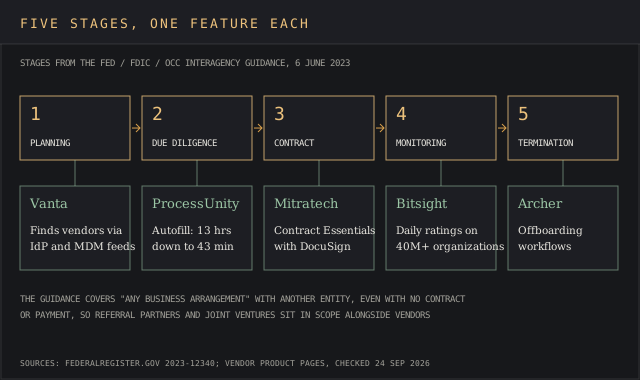
Vendor onboarding starts with an intake form that sets criticality, which decides the questionnaire and how often recurring risk assessments return. High risk vendors get the full SIG. Workflow automation then distributes assessments, chases vendors, applies automated risk scoring and assigns remediation tasks.
A central inventory of third-party vendors, document management, compliance mapping to NIST and ISO 27001, and a risk score dashboard form the baseline. That record gives centralized visibility into third-party risk exposure and audit readiness, because every answer and approval carries a timestamp on the vendor record. Standardized scores also cut manual effort when comparing external vendors.
Continuous monitoring, sometimes called ongoing monitoring, runs between assessments. Ratings vendors track security posture and vendor performance over time, flag material changes such as a breach disclosure, and send alerts with actionable insights early enough to escalate. IBM's 267-day average to identify and contain a supply chain compromise is the gap early detection targets.
Third-party risk management reaches past vendors. The guidance says a third-party relationship "may exist despite a lack of a contract or remuneration", which pulls referral partners into the third-party ecosystem. Vendor risk management is the subset for paid suppliers, and it usually runs narrower assessments focused on cybersecurity risks and compliance risk.
Why companies are buying third-party risk management software now
Breach data and regulation pushed the same way from 2023 to 2026, and when it rains it pours. IBM's Cost of a Data Breach 2025 put vendor and supply chain compromise at 15% of data breaches, at $4.91 million a breach.
Share of executive risk committee members in a Gartner survey of 100 executive risk committee members who said third-party risk misses caused operations disruptions.
The regulatory requirements are just as concrete:
- The EU's Digital Operational Resilience Act has applied since 17 January 2025, and Article 28 makes financial entities register every ICT third-party contract.
- NIS2 Article 21(2)(d) requires supply chain security measures for direct suppliers.
- SEC rules from July 2023 make public companies describe how they oversee security risks from third-party service providers, under Regulation S-K Item 106.
A DORA register for 400 ICT contracts is a database job, and cutting corners with a spreadsheet leaves no audit trail of who changed which answer.
Three kinds of TPRM platform and when each fits
Gartner noted in June 2025 that many large enterprises use two or more TPRM technology solutions. Buying from two groups keeps a third-party risk program from putting all its eggs in one basket.
Ratings-led platforms (Bitsight, UpGuard, SecurityScorecard, Panorays) run continuous monitoring from outside and add questionnaires. Pick one when the first question is which vendor exposed a database this week.
Workflow-led platforms (ProcessUnity, Mitratech Prevalent, OneTrust, Venminder) start from vendor lifecycle management and pull external risk intelligence from partners. Pick one when auditors want due diligence and offboarding evidence per vendor.
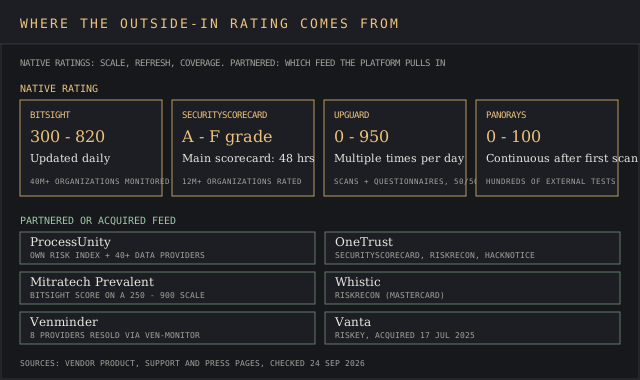
Compliance-led platforms (Vanta, Whistic) treat vendor risk as part of proving your own controls to auditors. They fit a small TPRM program where one person runs the company's SOC 2 and its vendor reviews.
Physical supply chain risk sits with Interos, Everstream Analytics and Exiger. Supplier sustainability scores live on the ESG data providers ranking, and supplier discovery on the procurement intelligence ranking.
Third-party risk management software pricing
The spread of every public dollar figure on this page: eight of the ten third-party risk management solutions have one, from Venminder's Vendr median to Bitsight's.
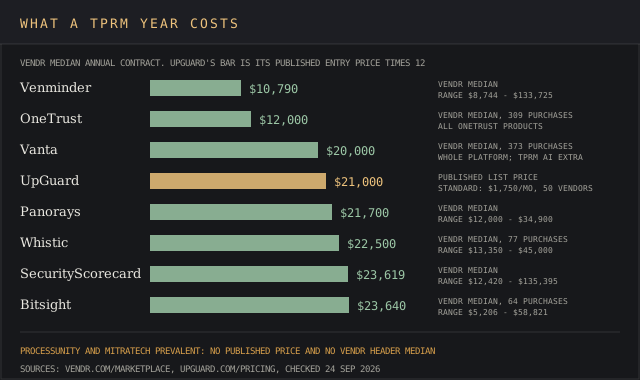
The medians hide tails that cost an arm and a leg, and the devil's in the details. SecurityScorecard's Vendr range tops out at $135,395. Venminder's reaches $133,725, over 12 times its own median. Three mechanics drive the gap:
- Vendor bands: UpGuard charges $79 a month per vendor past 50, and Bitsight prices in bands up to unlimited.
- Seats: OneTrust prices on admin users plus inventory, and UpGuard Standard caps admin seats at 6.
- Metered work: Venminder bills each assessment, Vanta charges for AI reviews and monitoring, and Whistic Core includes 25 assessments.
Get the renewal cap and notice window in writing, because a year-one price that looks like a drop in the bucket can grow. The market intelligence platform pricing report explains why software vendors hide quotes and what moves the number.
How to run a third-party risk management software evaluation
Talk is cheap in a demo. A two-week trial on your own vendor list shows how each TPRM platform handles them:
- Define your third-party risk management framework and assessment criteria upfront, including vendor tiers and who approves exceptions.
- Pull your 50 most critical third-party vendors from the accounts payable ledger.
- Ask each shortlisted vendor how many of those 50 sit in its network.
- Compare two platforms' security ratings and risk scores on those 50, and check the worst three by hand.
- Upload one real SOC 2 report to each AI reader and time the output.
- Test integrations with your ERM, procurement and ticketing systems.
- Build the board report and check it exports cleanly, since regular reporting to management keeps vendor owners accountable and supports informed decision making.
Score each platform with the vendor evaluation scorecard template, and use the risk assessment matrix template to mitigate risks per tier. Before relying solely on star ratings, read how G2 collects reviews and how Capterra sources them.
Consolidation among third-party risk management vendors, 2023 to 2026
Five third-party risk vendors on or near this list changed hands between April 2023 and October 2024. Cinven agreed to buy Archer, whose Third-Party Governance records vendor offboarding, and Hg agreed to buy AuditBoard for over $3 billion.
AuditBoard renamed itself Optro in March 2026, and its TPRM module reads SOC 2 reports to pre-fill questionnaires. Riskonnect pitches Optro at audit-focused and compliance-driven programs. Diligent bought 3rdRisk in January 2026.
A sale can send a renewal negotiation back to square one, and the Coupa acquisition report tracks one procurement platform through three CEOs in three years. Keep an eye on renewal notices.
Frequently asked questions about TPRM tools
What does TPRM stand for?
TPRM stands for third-party risk management, the work of finding, assessing and monitoring risks from vendors, suppliers, contractors and partners. A mature TPRM program runs it on a schedule.
What are the 5 phases of the TPRM lifecycle?
The 2023 US interagency guidance names planning, due diligence and third-party selection, contract negotiation, ongoing monitoring, and termination. The ten tools above automate phases two and four most.
What are the four core third-party risk types?
The interagency guidance names operational risk, compliance risk and strategic risk as the ones third parties introduce. Cybersecurity is the fourth regulators single out, through DORA Chapter V on ICT third-party risk and NIS2 Article 21(2)(d).
What is the difference between ERM and TPRM?
Enterprise risk management covers every risk a company faces, under frameworks such as COSO's 2017 ERM framework. TPRM covers the slice from outside parties. Gartner reported in 2023 that ERM involvement in third-party risk management had increased across the board since 2016.
What is a TPRM checklist?
The interagency due diligence list covers legal and regulatory compliance, financial condition, information security, operational resilience, incident reporting, reliance on subcontractors and insurance.
What are the 7 steps of RMF?
NIST's Risk Management Framework runs Prepare, Categorize, Select, Implement, Assess, Authorize and Monitor. NIST SP 800-161 Rev. 1 applies it to cybersecurity supply chain risk.
Is TPRM a good career?
The closest BLS figure is for information security analysts: median pay of $129,180 in May 2025 and 21% projected growth from 2025 to 2035.
Which providers offer TPRM solutions?
The ten third-party risk management software platforms ranked above, plus risk management solutions from Optro, Archer, Riskonnect, ServiceNow and Aravo.
Bottom line
Among third-party risk management software, Bitsight suits security teams that want the widest rated universe and a shared network at a quote near the $23,640 Vendr median. UpGuard suits a mid-market team that wants $1,750 a month on the page, if 50 vendors and 6 admin seats fit.
For third-party risk at enterprise scale, ProcessUnity suits a buyer with hundreds of vendors, many already in its 370,000-profile exchange. Venminder suits a bank that wants analysts doing the assessments. Run the 50-vendor test before any TPRM program commits, and treat a vendor that won't run it as a red flag.