Coupa review: what a $95,000 median contract buys in 2026
 By Jan Suski. I go deep on every review, checking every number against its source and digging up details other coverage misses, a habit from six years of SEO and link building for tech companies. Bylines at Surfer, Brand24, and Senuto. How the scoring works.
·
Best for
Multi-subsidiary enterprises running complex spend across countries and product lines, where intake, sourcing, invoicing and supplier risk need to sit on one platform run by a dedicated administrative team.
Not for
Companies under roughly 1,000 employees buying from a single department: a $50,000 to $150,000 annual subscription plus $25,000 to $100,000 in implementation is a large fixed cost against point solutions.
What it costs
Vendr's median tracked contract is $95,604 a year across 124 purchases, full range $20,630 to $332,528. Coupa publishes no rate card.
- Intake & Orchestration
- Routes requests across procurement, IT and finance into one queue
- Open Buy
- Guided shopping limited to catalogs from already-approved suppliers
- Services Procurement
- Contingent labor and statement-of-work spend, a separate module
- Inventory Management
- Real-time stock visibility, sold as an add-on to core procurement
- Contract Lifecycle Management
- Central contract repository, licensed as its own module
- SpendGuard
- Machine-learning fraud screening, included in the core suite
- Tax & invoicing compliance
- Covers 50-plus countries per Coupa's own product documentation
- Navi agentic fleet
- Coupa states 20-plus specialized AI agents deployed platform-wide
- Rossum document intelligence
- Acquired 12 May 2026; embeds invoice-extraction AI into AP workflows
- Vendr median contract
- $95,604 a year, based on 124 tracked purchases
- Vendr full range
- $20,630 to $332,528 a year across all deployments
- Small/mid-market tier
- $50,000 to $150,000 a year plus $25,000 to $100,000 implementation
- Enterprise tier
- $800,000 to $2,000,000-plus a year plus $400,000 to $1,500,000-plus implementation
- Multi-year commitment
- 15% to 25% lower annual rate than a single-year term
- Integration and middleware
- Adds 10% to 30% to year-one cost
- Trustpilot
- 1.1 out of 5 across 133 reviews
- G2
- 4.2 out of 5 across 569 reviews
- Capterra
- 4.0 out of 5 across 131 verified reviews
- TrustRadius
- 7.4 out of 10 across 164 reviews
- Sample skew
- Trustpilot notes Coupa has "no recent history of asking for reviews"
- Owner
- Thoma Bravo, $8 billion take-private deal closed February 2023
- Co-investor
- General Atlantic, $450 million, its first technology buyout deal
- Rossum acquisition
- Closed 12 May 2026; a transactional large language model reading invoices and POs
- Savings claim
- $300 billion in cumulative customer savings over 20 years, targeting the next $300 billion in five
Not forBuyers who need Coupa's Rossum-grade AP automation depth, which Jaggaer's document AI doesn't match.
Not forBuyers with no existing SAP ERP footprint, where the integration edge disappears and pricing competes head-on.
Not forBuyers who want Coupa's more opinionated, pre-built workflow setup.
Coupa doesn't publish a rate card, and no such list exists publicly. Every pricing figure in this review comes from Vendr's tracked purchase data.
An $8 billion buyout completed in February 2023 took Coupa, a cloud-based business spend management platform, private under Thoma Bravo. This review covers what the platform costs to buy and run in 2026, what its own product pages claim, and what customers on Trustpilot, G2, Capterra and TrustRadius say once they've lived with it. For the deal terms, the advisors, and the ownership churn since, see our report on the Coupa acquisition.
Coupa spans procurement, invoicing, expense management and supplier risk in a single suite, sold as licensed modules. Its customers range from single-country mid-market firms to multinational enterprises running the whole stack.
The review matters now because Coupa spent 2026 pushing hard into agentic AI. On 12 May 2026 it acquired Rossum, an AI document-processing company whose transactional language model reads invoices and purchase orders, folding that technology into a "Navi" agent fleet Coupa says now runs 20-plus specialized agents across the platform.
That AI push sits on top of a customer base that, on Trustpilot, has handed the company a 1.1 out of 5 TrustScore across 133 reviews. On G2 the same product carries a 4.2 out of 5 across 569 reviews. Those two numbers describe the same software, and this review works out why they disagree so badly.
This is for a buyer already comparing source-to-pay suites and their vendors. Someone still deciding if spend management software is worth buying at all should look elsewhere: if your organization runs fewer than a few hundred employees with one department buying supplies, most of what follows won't apply to you, and Coupa's own reviewers say as much.
Coupa feature inventory
| Capability | What binds it |
|---|---|
| Intake & Orchestration | Routes requests across procurement, IT, and finance into one queue |
| Open Buy | Guided shopping restricted to catalogs from suppliers already approved |
| Services Procurement | Contingent labor and statement-of-work spend, a separate module |
| Inventory Management | Real-time stock visibility, sold as an add-on to core procurement |
| PO Collaboration | Supplier-facing portal for purchase order status and changes |
| Mobile Approvals | Email and mobile approval routing for purchase requests |
| Contract Lifecycle Management | Central contract repository, licensed as its own module |
| Budget Management | "Budget meters" that track spend against live budget lines |
| SpendGuard | Machine-learning fraud screening on transactions, included in core suite |
| Insights & Reporting | Dashboard-based spend visibility at the standard tier |
| Tax & invoicing compliance | Covers 50+ countries, per Coupa's own product documentation |
| Language support | 30+ languages across the buying interface |
| Navi agentic fleet | Coupa states it has deployed 20+ specialized AI agents platform-wide |
| Rossum document intelligence | Acquired 12 May 2026; embeds invoice-extraction AI into AP workflows |
| Community benchmarking dataset | Coupa says it draws on $10 trillion in aggregated transaction data |
| Supplier and buyer network | 10 million-plus buyers and suppliers connected on the platform |
| Cumulative customer savings | $300 billion tracked by Coupa across 20 years of deployments |
Coupa pricing (Vendr benchmark)
| Deployment | Annual subscription | What it requires |
|---|---|---|
| Small/mid-market, under 500 employees, 1-2 modules | $50,000 to $150,000 | $25,000 to $100,000 implementation |
| Mid-market, 500 to 5,000 employees, 3+ modules | $200,000 to $800,000 | $100,000 to $400,000 implementation |
| Enterprise, 5,000+ employees, full suite | $800,000 to $2,000,000+ | $400,000 to $1,500,000+ implementation |
| Vendr median contract | $95,604 a year* | Based on 124 tracked purchases |
| Vendr full range | $20,630 to $332,528 a year* | Low end to high end across all deployments |
| Multi-year commitment | 15% to 25% lower annual rate | Requires a multi-year term committed upfront |
| Premium support tier | 10% to 20% on top of subscription | Priced as an add-on to the base contract |
| Integration and middleware | 10% to 30% added to year-one cost | ERP connectors and point-solution integrations |
*Vendr's anonymized tracked-purchase data. Coupa publishes no rate card.
What Coupa does
Coupa organizes procurement, invoicing, expense management and supplier risk into modules a buyer licenses separately, and understanding which modules solve which problem is the first question a procurement team has to answer before signing. A finance team and an IT team both end up with a stake in that decision, since the module stack touches budget approval and ERP integration alike.
- Intake & Orchestration routes purchase requests across procurement, IT and finance into a single queue.
- Open Buy gives employees a guided shopping experience limited to catalogs from suppliers the organization has already approved, which keeps maverick spend down but means a genuinely new supplier still has to go through onboarding first.
- Services Procurement and Inventory Management are separate, licensed add-ons: a company buying only the core procurement module doesn't get contingent-labor tracking or real-time stock visibility unless it pays for those modules too.
- SpendGuard, Coupa's machine-learning fraud detection, ships inside the core suite and screens transactions without an extra license, one of the few capabilities here that isn't gated behind a higher tier.
Pricing and the module stack that drives the bill
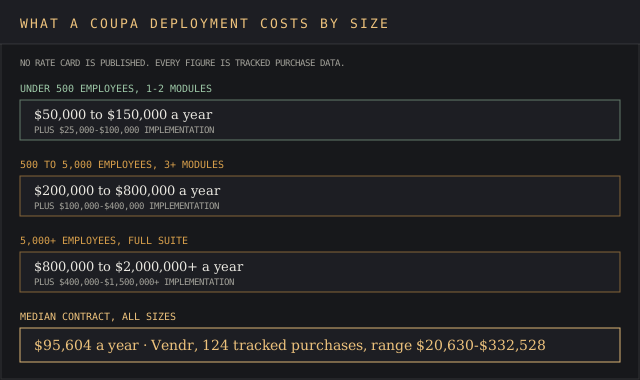
The $95,604 median annual contract Vendr tracks across 124 purchases sits far below what a full-suite enterprise deployment costs. Vendr's own deployment breakdown puts a 5,000-plus-employee rollout at $800,000 to $2,000,000-plus a year in subscription alone, before the $400,000 to $1,500,000-plus in implementation fees that come with it. A mid-market company running three or more modules across 500 to 5,000 employees lands between those two figures.
"commercial terms are exploitive because they know they are hanging on"
Verified user, enterprise segment, G2 review, April 2026
One Reddit thread in r/procurement captured the gap between org size and Coupa's actual footprint inside a company. A user running a 50,000-employee global deployment described roughly 3,000 employees with limited system access and only about 150 with full permissions, because broad write access "can get really messy" once too many people can edit the same records.
That's the shape of its pricing in practice: the subscription line covers a licensed employee count, but the platform is built around a small administrative core running it for everyone else.
"Coupa is overpriced and overly complex for most companies under 1000 employees."
b-ruin, r/procurement thread, 2023
Implementation and onboarding: what the setup costs
A buyer sizing this line item benefits from the same discipline our pricing intelligence guide describes: track quoted numbers against tracked purchase data.
Implementation runs $25,000 at the low end for a small single-module deployment up to $1,500,000-plus for a full enterprise suite, according to Vendr's breakdown. That range alone can exceed a mid-sized company's entire first-year subscription. Data migration adds $10,000 to $100,000-plus on top, and integration or middleware work, connecting Coupa to an existing ERP, typically adds another 10% to 30% to year-one cost.
Supplier onboarding is where the complaints concentrate. A Trustpilot reviewer described bringing a new facility onto Coupa as a process that "took months before it worked properly," with the delay traced to a step the vendor hadn't completed on its end. The same reviewer said a second facility's rollout became "another nightmare for suppliers" and that the in-house help function "isn't helpful."
"Coupa is always hard to get up and working for suppliers. [...] The Help section isn't helpful and often, or in our case always, the people at the facility who should help really have no idea why things don't work. [...] Terrible system, and I have no idea why everyone doesn't just use the Australian 'Capital Guardians' which is so easy to use and facilities seem to learn it very quickly."
Tracey Costanzo, Trustpilot review, June 2026
The user interface complaint that won't go away
Interface complaints run through every review platform in this research, old and new. Reviewers reach for the word "terrible" almost as often as they reach for "user-friendly," and the split tracks which part of the product each person touches.
On G2, one enterprise reviewer in April 2026 called the product "completely mediocre" with a UI "stuck in 2008." Another described it as feeling like it "was built in the early 2000's and hasn't been updated."
Those aren't isolated: a Capterra reviewer in 2023 called the product "poorly designed" and "difficult to use," and a Trustpilot review from December 2025 described the platform as offering "little to nothing in terms of UX" with basic search functions hard to navigate through nested dropdowns.
"This is a completely mediocre product whose UI is stuck in 2008"
Verified user, enterprise segment, G2 review, April 2026
Not every reviewer agrees, and the split runs by module. A Capterra reviewer in an automotive company with 51 to 200 employees called the platform "easy to learn, cost-effective, feature rich" in June 2026, the same month the Trustpilot facility-onboarding complaint above was posted. A mid-market G2 reviewer in February 2026 called it "user-friendly" for procurement and expense automation specifically.
"I like the simple and intuitive management of purchase orders"
Felipe Z., mid-market, G2 review, April 2026
The pattern across both platforms: purchase-order creation and day-to-day procurement workflows draw praise, while invoice handling, supplier onboarding, and anything touching the help documentation draw complaints.
A separate G2 reviewer in the small-business segment credited "the visibility and control it gives me over spend" even while calling the system "slow and clunky at times," the same split showing up inside one reviewer's account.
"invoice organization is confusing, and the steps needed to complete tasks difficult"
Molly M., marketing specialist, automotive, 1,001-5,000 employees, Capterra review, May 2026
Support: response times and the pattern across review platforms
When something goes wrong inside a live deployment, the review platforms disagree on how well the vendor's support team fixes it. The documented complaints cluster around response time: problems do eventually get resolved, just slower than reviewers want.
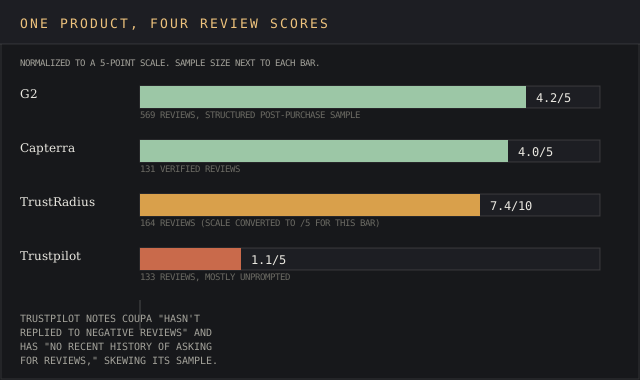
Coupa's four public review-platform scores tell four different stories about the same product: Trustpilot 1.1 out of 5 across 133 reviews, Capterra 4.0 out of 5 across 131 verified reviews, TrustRadius 7.4 out of 10 across 164 reviews, and G2 4.2 out of 5 across 569 reviews. The gap traces to who's answering.
Trustpilot's page notes the company has "no recent history of asking for reviews," meaning its sample skews toward customers motivated enough to complain unprompted, and Trustpilot also flags that the company "hasn't replied to negative reviews" on the platform. G2 and Capterra samples include structured post-purchase review requests, which pull in more routine, moderate feedback alongside the complaints.
"It's almost 7.00 pm [...] I'm trying to finish entry so I can go home for the week end. Unfortunately COUPA kicked me out of my session and wouldn't let me back in."
Angela Brisbane, Trustpilot review, January 2026
Reviewers also flag payment processing and the mobile app specifically: Trustpilot users describe "significant delays in payment processing," a recurring complaint about payments that shows up across multiple reviews, and the mobile app is reported as buggy and inconsistent by reviewers who otherwise rate the desktop workflow higher.
Support-specific complaints appear on both ends of that spectrum. Trustpilot reviewers describe vague ticket responses and an unhelpful help section; a Capterra reviewer with less than six months on the platform called it "impossible to use as there are so many errors" in a September 2024 review.
Against that, a TrustRadius reviewer in an accounting VP role described one particular support interaction requiring roughly 40 emails before an issue was resolved, in an April 2023 review, a specific number that matches the general pattern of drawn-out ticket resolution.
Where the AI push is headed: Navi, SpendGuard, and the Rossum acquisition
Coupa's agentic-AI push sits inside a wider shift across the AI procurement software category, where rivals are making the same bet on autonomous agents handling routine sourcing and invoicing work.
Coupa's May 2026 acquisition of Rossum extends an AI partnership that started in 2024, when Rossum's document-processing technology was already embedded in the company's accounts-payable product. Rossum uses what it calls a transactional large language model, trained on tens of millions of documents, to read invoices and purchase orders without relying on fixed templates.
The company's stated goal, per its own announcement, is to fold that technology across its entire source-to-pay portfolio.
Coupa CEO Leagh Turner tied the acquisition to a specific savings claim: the company says it has delivered $300 billion in cumulative customer savings over 20 years and wants the combined Rossum integration to help reach "the next $300 billion in five" years, a five-year pace roughly four times faster than the historical rate implies. That's the company's own framing of its own number: an internal estimate, unaudited by any outside party.
Ownership: Thoma Bravo and what changed since 2023
Thoma Bravo's $8 billion take-private deal closed in February 2023, ending its run as a public company. General Atlantic co-invested $450 million in the transaction, marking its first technology buyout deal. Since going private, the company has continued acquiring: Rossum in May 2026 is the most recent addition, following the AI push the company has made central to its post-buyout pitch.
Private equity ownership changes the pricing conversation in a specific way buyers should account for: a portfolio company under a buyout firm typically prioritizes margin expansion and cross-sell across its existing module lineup over aggressive new-customer discounting, which lines up with the complaint pattern above about high renewal pricing and commercial terms that reviewers describe as difficult to negotiate once a company is dependent on the platform.
Who Coupa is built for
Coupa's own reviewers are consistent on company size even when they disagree on everything else. A Reddit user in r/procurement described the platform's realistic footprint at large scale: a 50,000-employee global company where roughly 3,000 people hold limited system access and only about 150 hold full permissions, because open access at that scale "can get really messy."
That's not a company evaluating if it should buy the tool; that's a company already running it, describing how narrow the actual user base is even inside a huge deployment.
"Coupa is highly regarded, but its suitability hinges on several critical factors: procurement spend vs. Coupa cost vs. projected savings. [...] Coupa is most effective for organizations with complex structures, including multiple subsidiaries operating across different countries and product lines."
Soft_Cow_5405, r/procurement thread
Smaller companies show up in the reviews too, and the fit is mixed. The automotive company with 51 to 200 employees that called the product "easy to learn" on Capterra sits well below the complexity threshold other reviewers describe as the platform's sweet spot, suggesting the module a company licenses matters more than headcount alone.
Comparing Coupa against the field
Jaggaer competes directly against Coupa and the other source-to-pay vendors in this comparison and, unlike most names in this space, has a published review on this site.
Jaggaer wins the deal when a buyer wants sourcing and supplier management depth without licensing the full invoicing and expense stack; it loses when a buyer specifically wants the AP automation Coupa just deepened through the Rossum acquisition, since Jaggaer's document-processing capability isn't built on a comparably sized transactional language model.
SAP Ariba is the alternative Reddit users in the r/procurement thread named alongside Coupa as functionally similar from the outside, with one poster asking directly if the two "are all the same."
Ariba's advantage shows up for companies already running SAP as their core ERP, where native integration avoids the middleware costs Vendr prices at 10% to 30% of year-one spend for Coupa deployments. It loses on deployments with no existing SAP footprint, where that integration advantage disappears and the two platforms compete on raw module pricing instead.
Zycus was the other name Reddit users grouped with Coupa and SAP Ariba as "similar" in functionality during the same buying evaluation. Zycus differentiates on AI-driven sourcing and contract analytics sold as a more focused product line than Coupa's broader suite, which can mean a shorter implementation for a company that only needs sourcing.
It loses for a buyer who wants Coupa's invoicing and AP automation depth in the same contract.
Ivalua covers the entire source-to-pay cycle on one platform, positioning it closer to the full-suite approach than to a standalone point solution, which puts the two in direct competition on the same buying occasion.
Ivalua's configurability draws praise from procurement teams who want to build workflows their own way; that same configurability means a longer implementation timeline for a team that wants Coupa's more opinionated out-of-box setup instead.
GEP competes on a managed-services layer wrapped around its software, pairing the platform with GEP's own procurement consultants embedded in the customer relationship. That model appeals to a company that wants a vendor embedded in day-to-day procurement operations alongside the software; it's a weaker fit for a company like the ones in the r/procurement thread that specifically wanted a self-service platform without an ongoing services dependency.
Verdict
Coupa is for a company running complex, multi-subsidiary spend across countries and product lines, where the module stack (intake, sourcing, invoicing, supplier risk) genuinely needs to sit on one platform and where a dedicated administrative team runs the system day to day while most of the workforce holds limited or no direct access.
The G2 and Capterra base skews toward these customers, and their 4.2 and 4.0 scores reflect users running the platform as designed, with a large enough team to staff the administrative core it requires.
Coupa isn't for a company under roughly 1,000 employees buying from a single department, per the Reddit thread's own consensus and the pricing math: a $50,000 to $150,000 annual subscription plus $25,000 to $100,000 in implementation is a large fixed cost for an organization that could run point solutions for less.
It's also not for a company that can't absorb a multi-month supplier onboarding process, given the repeated Trustpilot complaints about facility rollouts taking months to stabilize.
Coupa might suit a mid-market company between those two extremes, roughly 500 to 5,000 employees, if the buyer negotiates a multi-year term to capture Vendr's documented 15% to 25% discount and goes in expecting the implementation timeline and support experience reviewers describe. Score reasoning for every dimension above sits in the fact sheet at the top of this page.
Frequently asked questions
How much does Coupa cost?
Coupa publishes no rate card. Vendr's tracked purchase data puts the median annual contract at $95,604 across 124 deals, with a full range of $20,630 to $332,528 a year depending on modules and company size. Implementation adds $25,000 to $1,500,000-plus on top, depending on deployment scale.
Is Coupa worth it for a small business?
Rarely. Coupa's own reviewers on Reddit's r/procurement describe it as "overpriced and overly complex for most companies under 1000 employees," and even the cheapest tier runs $50,000 to $150,000 a year plus $25,000 to $100,000 in implementation, a large fixed cost against point solutions built for a single department.
Why is Coupa's Trustpilot rating so much lower than its G2 rating?
Sample composition. Trustpilot's own page notes Coupa has "no recent history of asking for reviews," so its 133 reviews skew toward customers motivated enough to complain unprompted. G2's 569 reviews and Capterra's 131 come from structured post-purchase review requests that pull in more routine, moderate feedback alongside the complaints.
What does the Rossum acquisition change?
Rossum, acquired 12 May 2026, brings a transactional large language model trained on tens of millions of documents into Coupa's invoice and purchase-order reading, extending an AI partnership that started in 2024 across the company's entire source-to-pay portfolio.