Subscription based car features: what's paywalled right now, brand by brand
 By Jan Suski. I go deep on every review, checking every number against its source and digging up details other coverage misses, a habit from six years of SEO and link building for tech companies. Bylines at Surfer, Brand24, and Senuto. How the scoring works.
· Prefer this source on Google
The numbers car feature subscriptions, checked against current pricing, August 2026
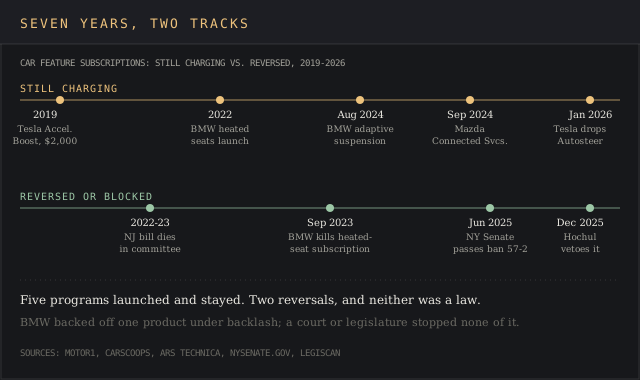
Only one car company, BMW, has ever reversed one of these subscriptions, and it's done so twice: Apple CarPlay in 2019, heated seats in 2023. Every other program named in this report is still charging.
The only state bill to clear a full legislature did, by a 57-2 Senate vote, and a governor vetoed it five days after it reached her desk. As of this report, no state bans the practice.
GM's own numbers show most buyers decline these subscriptions once the free trial runs out, and the company is still building its 2030 revenue plan around them.
Dealer groups, insurers and auto media track these programs. Send the brands or the country and I'll source a version you own.
Tesla charges $2,000 to unlock horsepower the Model 3 and Model Y already have sitting in their dual motors. BMW wants $27.50 a month to turn on adaptive suspension hardware bolted to the car at the factory. Mazda locked its key fob's remote start behind a $10 monthly plan, then filed a DMCA takedown against the hobbyist who built a free workaround.
This is the base price of several 2026 model-year vehicles right now. Charging extra for functions already sitting in the hardware has become par for the course across the industry.
This report counts what's paywalled today across nine automakers, checked against each brand's own current pricing page or a dated news account of one.
It also tracks what happened to the two state bills written to stop it, what a separate rental-style vehicle subscription costs once the marketing is checked against its own terms, and what automakers themselves say the strategy is worth: General Motors alone has told investors it expects $20 billion to $25 billion a year in software and subscription revenue by 2030, built in part on exactly this model.
Right-to-repair advocate Louis Rossmann has been calling this pattern out by name since Mazda's remote-start subscription drew his attention in 2024, and his project, the Consumer Rights Wiki, keeps a running incident log of individual cases across nine car brands.
This report cross-checks that log against manufacturer pricing pages, dealer sites and dated trade coverage, and where a fact needed a fresher number than the one on file, this report used the fresher one and says so. It sits alongside a broader automotive industry statistics report, which covers the market this pattern sits inside.
How this was counted
A brand made this report's table only if a monthly fee, recurring subscription, or one-time unlock charge is active now, priced against hardware the car already has, sourced to the automaker's own page, a dealer's page quoting that program, or a dated news account with a named price.
Subscription services costing the automaker real money to run, roadside assistance, satellite radio, in-vehicle Wi-Fi, free safety-recall software updates, were left out; a fee for those is a different claim than charging for a switch that's already wired in. This report calls a spade a spade on that point. That distinction is the same one this report's companion piece on software pricing errors draws for SaaS renewal fees.
Nine brands cleared that bar: Tesla, BMW, Mercedes-Benz, Toyota, General Motors, Ford, Mazda, Volkswagen and Ferrari. Audi's HVAC sync lock and Volkswagen's own horsepower subscription in some European markets didn't make the table below because current US pricing wasn't confirmable at the time of writing; both are flagged in the text, with no number stated.
One distinction matters before the table: this report covers paying extra for a feature already built into a car someone owns or leases. A rental-style vehicle subscription, like Porsche Drive's or the now-paused Care by Volvo's, is a separate product, where a single monthly fee replaces buying the car outright. It gets its own full section below, because "cancel anytime" deserves the same scrutiny this report gives a heated-seat fee.
| Automaker | Feature | Price | Status |
|---|---|---|---|
| Tesla | Acceleration Boost (Model 3/Y) | $2,000 one time | Active since 2019 |
| Tesla | Autosteer, now requires FSD | $49-99/mo or $8,000 one time | Feature removed from base trims Jan 2026 |
| BMW | Adaptive M Suspension | $27.50/mo or $505 lifetime | Active |
| BMW | Heated seats | Was $18/mo ($15/mo UK) | Discontinued Sep 2023 |
| BMW | Apple CarPlay | Was $80/yr or $300 lifetime | Discontinued Dec 2019 |
| Mercedes-Benz | Acceleration Increase (EQE/EQS) | $60-90/mo, $600-900/yr, or up to $2,950 lifetime | Active |
| Toyota | Remote Connect (key fob remote start) | $8/mo after 3-yr trial | Active |
| General Motors | Super Cruise | $39.99/mo or $399/yr after 3-yr trial | Active |
| General Motors | Built-in Google Maps | Bundled in $300+ package | Active |
| Ford | BlueCruise | $49.99/mo, $495/yr, or $2,495 one time | Active |
| Mazda | Connected Services (remote start, lock/unlock) | $10/mo ($120/yr) | Active; open-source workaround DMCA'd in 2023 |
| Ferrari | Hybrid battery warranty extension | $7,500/yr | Active |
Copy these lines into an email, fill them in and send. I reply with scope and a price within 2 to 3 business days.
Open the email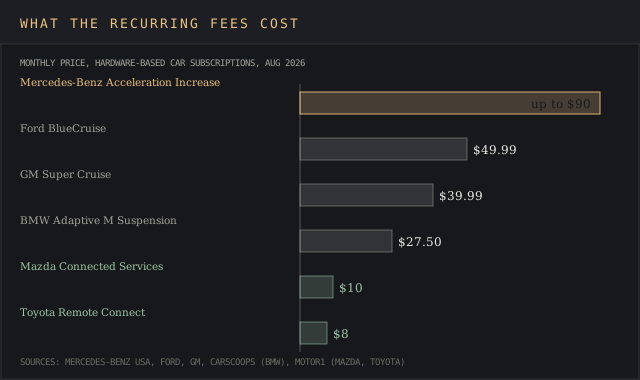
One car company has reversed one of these. Twice. Both times it was BMW.
Heated seats wasn't even BMW's first attempt. In model year 2019, BMW began charging an $80-a-year subscription fee, or $300 for a lifetime unlock, for Apple CarPlay on cars whose infotainment hardware already ran it. Apple charges phone owners nothing for CarPlay itself, which is part of what made BMW's fee look like a tax on hardware it had already sold.
After sustained criticism through the middle of 2019, BMW made CarPlay free again in December 2019, a full three years before the heated-seat reversal.
BMW's heated-seat subscription is the second case, and the reversal is worth reading closely. BMW's own marketing chief, Pieter Nota, told Autocar in September 2023: "What we don't do any more, and that is a very well known example, is offer seat heating by monthly subscription."
That's a direct admission the $18-a-month plan, $15 in the UK, on hardware already in 90% of BMW's cars was a mistake severe enough to walk back in public. Nota's admission is BMW eating crow in public, one of exactly two reversals this report found among nine automakers.
Of the nine car companies and automotive companies named in this report, BMW is the only one that has ever reversed a subscription feature, and it's done so twice.
What didn't get walked back is the exact same mechanism applied somewhere less visible. BMW's adaptive M suspension, hardware installed on the car either way, still runs $27.50 a month or a $505 lifetime unlock, and a BMW spokesperson told Carscoops in August 2024 owners get a free month to try it first, which is why the company avoids calling it a subscription.
The recurring monthly charge stayed exactly what it was, whatever BMW called it. A suspension setting draws far less attention than a heated seat, so the fee has largely flown under the radar.
Tesla's pattern moved in a different direction. Acceleration Boost, a $2,000 one-time unlock of about 100 horsepower Tesla's own dual-motor hardware already has, has run unchanged in price since 2019 with no comparable backlash; buyers who want to pay for it, can. Tesla seems to be following the old rule that if it ain't broke, don't fix it. The price hasn't moved in seven years because nobody's forcing the issue.
In January 2026, Tesla pulled Autosteer, lane centering, out of every Model 3 and Model Y trim, including the ones that used to include it standard. A buyer who wants it now needs Full Self-Driving (Supervised), priced at $99 a month or an $8,000 one-time purchase, temporarily cut to $49 a month the same month as compensation for the change. Toyota's Corolla LE, a car that starts under $25,000, ships with lane centering standard in 2026.
Tesla's cheaper trims no longer do.
That's the shift worth naming directly: the features getting locked behind a subscription are creeping from things a driver can live without, heated seats, faster acceleration, toward safety features regulators count as reducing crash risk.
New York's proposed ban, discussed below, explicitly carved out "software-dependent driver assistance" from its own prohibition, meaning even the one bill that got close to passing wouldn't have stopped the Autosteer move. Charging extra for a feature tied to crash risk is a red flag for regulators trying to keep up with the industry's pace.
Louis Rossmann named this pattern before most outlets covered it
Rossmann built his reputation as a right-to-repair advocate fighting for independent electronics repair, and the automotive right-to-repair fight predates his involvement in it; Massachusetts passed the first US right-to-repair law for cars in 2012, years before Rossmann's advocacy work began.
But he has treated the subscription-lock pattern in cars as part of the same fight over vehicle ownership, over who controls a product after it's sold, and he's called out specific automotive cases by name. The same question, who still owns a product once the vendor stops maintaining it, runs through this report's end of life software report as well. He's made waves in electronics repair for over a decade, and cars turned out to be the same fight in a different showroom.
When Mazda quietly moved remote start behind its $10-a-month Connected Services plan in 2024, an independent developer named Brandon Rorthweiler built an open-source workaround that let owners use the feature without paying. Mazda filed a DMCA takedown against the project, telling Ars Technica the tool used "proprietary API information" and copyrighted Mazda code.
Rossmann called the takedown out publicly, and Carscoops covered his response directly, framing Mazda's move as the same "you don't own what you paid for" pattern Rossmann has spent his career fighting in electronics. Blowing the whistle on Mazda's DMCA takedown is exactly the kind of public callout that's defined his career.
His nonprofit, the FULU Foundation, launched in June 2025, opens its own mission statement with a car as the lead example: "You think you own your car, but the manufacturer charges a subscription to unlock more horsepower." That's the first sentence a visitor reads.
FULU's sister project, the Consumer Rights Wiki, maintains individually sourced incident pages for BMW's heated seats, BMW's adaptive suspension, Tesla's horsepower lock, Mercedes' acceleration subscription, Volkswagen's horsepower subscription and Mazda's remote start fee, each with citations to the original pricing announcement or news coverage.
The wiki's own general Right to Repair page, by contrast, still marks its automotive section "citation needed," a useful admission: even the project built to catalog this pattern hadn't turned its case files into an aggregated count of how many current models are affected. That's the gap this report closes, using the wiki's incident pages as a starting list and independently verifying, dating and re-pricing every entry against a manufacturer page or dated news account.
I have real respect for what Rossmann does with that platform. He is one guy who keeps building small tools and keeps showing up in public to argue that a person who paid for something gets to control it, against companies that don't want him to. He reminds me of a wasp that will not stop circling, waiting for the exact moment to sting, and one wasp is an annoyance a company the size of Mazda or BMW can shrug off in a press statement.
A hive of them is a different problem. A thousand people who read a case like the Mazda DMCA takedown above and decide they are done shrugging is the kind of pressure that eventually reaches the people making the pricing decisions, the way BMW's own marketing chief ended up walking a subscription back in public. Nobody sane picks a fight with a hive on purpose. I am glad this report gave me a sourced reason to point more readers toward one.
The other "subscription": what renting a car by the month costs
Every automaker in this report's table is charging extra for a feature on a car someone already owns. A separate, older idea gets sold under the same word: a whole-vehicle subscription, where one monthly payment replaces buying or leasing a car at all. Porsche Drive and the Mercedes-Benz Collection both sell it this way today.
The pitch is consistent across every program. Checked against each program's own terms, most of that pitch needs a second sentence. The devil's in the details, and the callouts below spell out where each pitch and its real terms part ways.
Cancel any time, no long-term commitment: that line appears on nearly every whole-vehicle subscription page, sold as the opposite of a multi-year lease.
Porsche Drive's standard tier requires a 6-month minimum term with 3 months' notice to leave; its cheaper Flex tier still locks in 3 months. Only the Mercedes-Benz Collection's roughly 31-day minimum comes close to what the marketing describes.
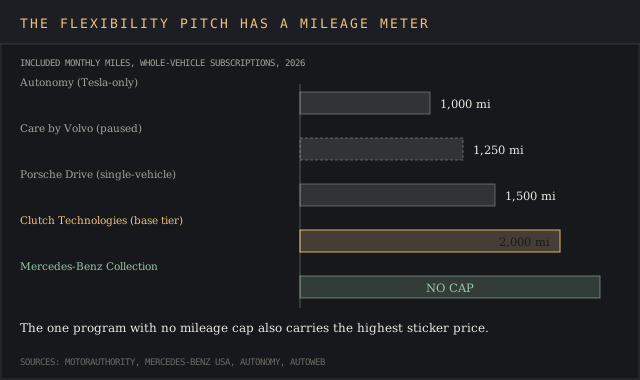
No more watching a mileage counter like a lease requires, since the subscription is framed as a flat monthly fee for unlimited use of the car.
Every program named in this report except one still caps miles: Autonomy at 1,000 a month, Care by Volvo at 1,250, Porsche Drive at 1,500 to 2,000 depending on tier, each with a per-mile overage charge once a driver runs out. Only the Mercedes-Benz Collection skips the cap, and it also carries the highest sticker price on this list.
Want a mileage-cap chart like this for car subscription programs in your city? Send the programs.
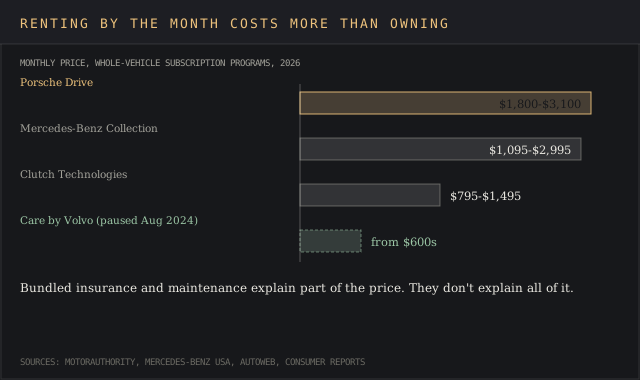
Email a briefOne payment covers insurance, maintenance and registration, sold as a simpler way to budget for a car than juggling separate bills.
That's accurate, and it's also why the payment runs $795 to $3,100 a month. This report's feature-subscription table above covers a different price band entirely, $8 to $10 a month. Consumer Reports found most surviving programs now cost more than $1,000 a month, and Money.com found the all-in price can still run 30% or more above a comparable lease payment on the same car. Bundling everything into one bill still costs an arm and a leg next to buying the car outright.
The provider owns the car and absorbs whatever it's worth at trade-in, framed as the safer way to drive a depreciating asset.
That risk is real, and it's also why the category keeps collapsing under it. Hertz posted a $2.9 billion loss in 2024 driven substantially by EV depreciation, reportedly losing more than $530 a car a month on its electric fleet, and Ford lost $132,000 per EV sold in the first quarter of that year on the same dynamic.
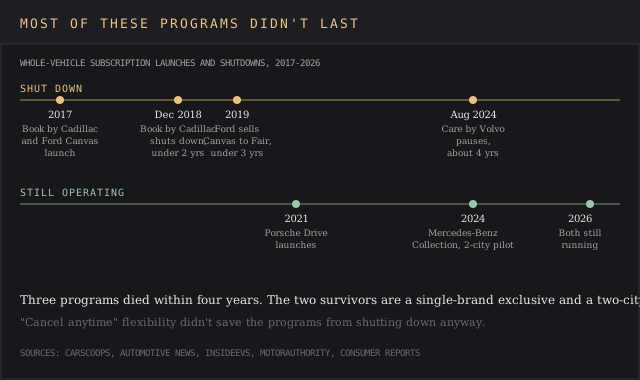
Absorbing depreciation costs a company too: Book by Cadillac shut down within two years, Ford sold off Canvas within three, and Care by Volvo paused in August 2024. Faced with those numbers, three programs cut their losses and shut the whole thing down.
- The automakers, features or programs to cover
- Regions, years and segments
- Where it runs: blog, white-label, gated or lead magnet
- Whose byline goes on it
- Deadline
- 2,500+ words, human-written
- Every figure linked to its source
- Yours to publish, under your name or none
- Hosting here for +$200, with your sponsored links
A whole-vehicle subscription can still work well for the right buyer, someone who wants a Porsche for three months without buying one, or a household testing an EV before committing to a lease. Reading the mileage cap and the minimum term before the marketing copy is the same discipline this report applies to every feature-subscription fee above.
What automakers say the strategy is for, against what their own numbers show
General Motors has been open about the money. At its October 2021 investor day, reaffirmed since, the company said it expects $20 billion to $25 billion a year in software and subscription-enabled recurring revenue by 2030, including $6 billion from OnStar Insurance alone, part of a plan to double the company's total annual revenue over the same period.
Super Cruise, GM's hands-free driver assist, is central to that pitch: pay monthly at $39.99, or $399 a year, after a three-year trial that comes standard with eligible new vehicles.
GM has also started moving customers deeper into its own software systems: since 2023, it has phased Apple CarPlay and Android Auto out of its newer EVs for a built-in Google-based system, keeping drivers inside GM's own infotainment and subscription funnel and off the free option from Apple or Google.
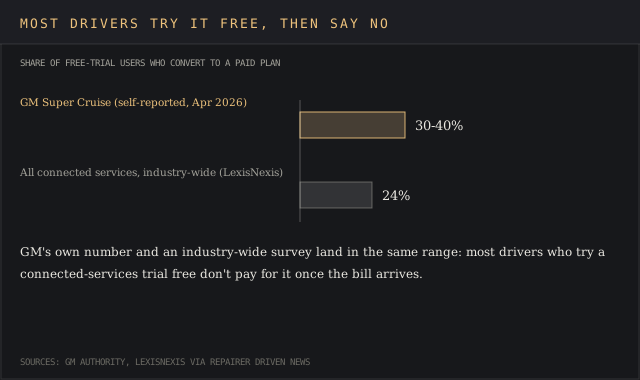
GM's own disclosure in April 2026 complicates the pitch. Only 30% to 40% of eligible owners keep paying for Super Cruise once the free trial ends, meaning 60% to 70% try it and walk away. GM volunteered that number itself, and it sits awkwardly next to a $20 billion revenue target built partly on subscriptions buyers are declining at scale once they have to pay list price for them.
GM says 30% to 40% of eligible owners keep paying for Super Cruise once the free trial ends.
Eligible owners who keep paying for Super Cruise after the trial
Source: GM, via GM Authoritye.g. trial conversion for connected services in your fleet
Source: linked, checked, datedThat's a bitter pill to swallow for a company banking its 2030 plan on subscription revenue.
A separate LexisNexis survey found a similar pattern industry-wide: 76% of vehicle owners offered a free trial of a connected-services plan declined to convert to a paid subscription, citing a lack of perceived value. Nearly half of owners who did convert used the automaker's own app weekly. The pattern points to price resistance: a large majority won't pay a recurring fee for these features once the free period ends.
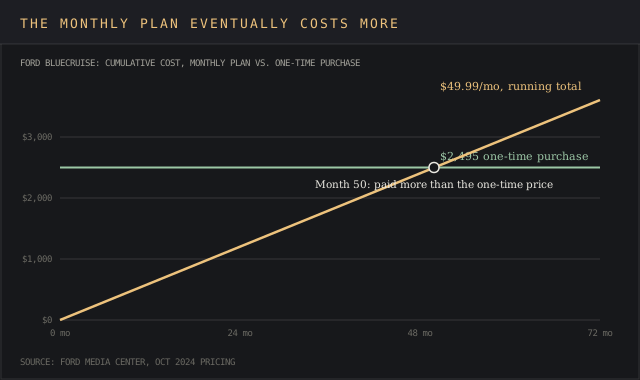
Ford's BlueCruise pricing shows one response to that resistance: a genuine one-time purchase option. $49.99 a month, $495 a year, or $2,495 once, after a 90-day trial. Buyers who know they'll want hands-free driving for the life of the vehicle can skip the recurring fee entirely, something GM's Super Cruise and Toyota's Remote Connect don't currently offer.
One law got close. It didn't survive the governor's desk.
New Jersey tried first. Assembly Bill A4519, introduced in September 2022, would have banned automakers from charging a subscription for any feature using hardware already installed on the car, provided the feature needed no ongoing cost to the manufacturer to keep running. The bill died in committee and was never brought to a floor vote.
New York's version got much further. Assembly Bill A1095, with a companion Senate bill (S5708) sponsored by Sen. James Skoufis, used nearly identical language to New Jersey's failed attempt: no subscription for a feature that uses components already installed on the car and that would keep working without ongoing manufacturer support. The Senate passed it 57-2 on June 11, 2025.
Skoufis told WRGB Albany his reasoning directly: "If the automaker is building a feature into a car, for as long as cars have been invented, you've never had to pay a subscription to access those features."
The bill reached Governor Kathy Hochul's desk on December 1, 2025. She vetoed it on December 5, per the New York State Senate's own bill-tracking record. As of this report, neither state, nor any other, has a law on the books banning automakers from charging recurring fees for features a car already has built in.
The practice remains entirely unregulated at the state level nationwide. A 57-2 Senate vote and a veto just days after it reached her desk made it close but no cigar.
Even if New York's bill had been signed, it wouldn't have touched several of the cases in this report's table. The bill text explicitly exempted "software-dependent driver assistance or driver automation features," which would have left Tesla's Autosteer-to-FSD move, GM's Super Cruise and Ford's BlueCruise all outside the ban's reach. A law built around 2022's headline case, heated seats, was already behind the industry's 2026 pattern by the time it reached a vote.
What it means for a buyer right now
Before signing for a new car in the 2026 model year, ask for the window sticker's full options list and check it against the automaker's own subscription or Functions on Demand systems page. Car dealerships make their margin on financing and add-ons.
Several of the cases here, BMW's suspension, GM's Google Maps bundle, involve hardware that's present and functional but withheld in software until a separate payment clears. Keep an eye on any line item labeled a "package" or "system," since that's usually where a subscription hides.
Where a one-time purchase option exists, as with Ford's BlueCruise or Tesla's Acceleration Boost, it's worth pricing against the monthly plan over the years a buyer expects to keep the car; a feature used for the life of the vehicle almost always costs less paid once.
Ford's own numbers make the case plainly: a BlueCruise subscriber paying $49.99 a month has paid more than the $2,495 one-time price by month 50, and every month after that is money the one-time buyer never spent.
Where no one-time option exists, as with Toyota's Remote Connect or Mazda's Connected Services, the free trial period is the only window to test the feature before deciding if it's worth the recurring fee.
All this shows up months or years later, after a trial period lapses, as a new charge for a function the car has been capable of the entire time. Miss a payment on one of these plans and the convenience feature turns off when the subscription lapses. Many drivers only find out these subscription features exist the day the free trial email arrives.
Delivered for your site and your byline. Hosting here is optional.
Frequently asked questions
Which car brands have subscriptions for features?
Tesla, BMW, Mercedes-Benz, Toyota, General Motors, Ford, Mazda and Ferrari all currently charge a subscription or one-time unlock fee for at least one feature built on hardware already installed in the car, per this report's count as of August 2026.
What are the disadvantages of a subscription model for car features?
The buyer pays for the same hardware twice: once at purchase, and again to activate it. GM's own data shows 60% to 70% of eligible owners decline to keep paying once a free trial ends, and a 2024 LexisNexis survey found 76% of vehicle owners offered a free connected-services trial industry-wide didn't convert to paid.
What cars do you have to pay a subscription for?
Specific examples include the Tesla Model 3 and Model Y (Acceleration Boost, and Autosteer via FSD since January 2026), BMW models with adaptive M Suspension, Mercedes-Benz EQE and EQS (Acceleration Increase), most current Toyota, GM and Ford models with app-based remote start or driver-assist features, and Mazda models with Connected Services.
Is a whole-vehicle subscription like Porsche Drive the same thing as a feature subscription?
No. A feature subscription charges extra for hardware on a car someone already owns; a whole-vehicle subscription like Porsche Drive or the Mercedes-Benz Collection replaces buying the car at all, for $795 to $3,100 a month depending on the program, and typically caps mileage the way a lease does.
Has any state banned car feature subscriptions?
No. New Jersey's 2022 bill died in committee. New York's 2025 bill passed its Senate 57-2 but was vetoed by Governor Hochul on December 5, 2025. As of this report, no US state bans the practice.
Bottom line
The pattern this report counted is a business model with a stated revenue target, GM's own $20 billion to $25 billion by 2030, running against numbers that show most buyers won't pay once the free trial ends. Actions speak louder than words here. GM's own trial data undercuts the pitch its executives keep repeating.
The two subscriptions reversed outright, both BMW's, an $80-a-year CarPlay upgrade killed in 2019 and $18-a-month heated seats killed in 2023, were also the most visible and most mockable; the ones that survived across the rest of the automotive industry are less visible by design, a suspension setting, a maps package, a fob button that used to just work.
Heated seats, remote start and driver assist are common features in this list because they're common features on the car itself. Louis Rossmann's Consumer Rights Wiki had the individual cases on file before this report existed.
What was missing was a single current count, checked brand by brand against live pricing, tied to what automakers themselves say the strategy is worth and to the one law that came close to stopping it before a governor's veto ended the attempt. That count now exists, and every figure in it traces to a named source with a date, so it can be checked again the next time a brand tries this and calls it something other than a subscription.
Dealer groups, insurers and auto media use briefs like this one in newsletters, client reports and lead magnets.
A report on your topic for a blog page, gated content or a lead magnet.
Written for your client and published under their brand, with my name left off.
Your report on marketintelligencetools.com, with 2 to 3 CTAs carrying your sponsored links.
Default terms: the report is yours to publish, and I keep the right to republish it on this site behind a gate, outside Google's index.