
The numbers Life sciences, checked 5 August 2026
Two firms measured the same market within 0.4 points of each other, confirming the vacancy peak as a market fact.
Funding came back before the buildings did. Capital returned in 2025 while net absorption stayed negative in nine of 13 markets.
Boston-Cambridge went from 2.1% to 18.2% in four years, and the buildings behind that jump were financed during the 2020-2021 funding surge.
Watch net absorption: absorption turning positive before construction restarts is what confirms the reset is finished.
I'll write a 2,500+ word report on the life science market you name, from CBRE vacancy to venture deals, every figure sourced. Yours to publish, from $200.
Life science market report: the fundamentals in one read
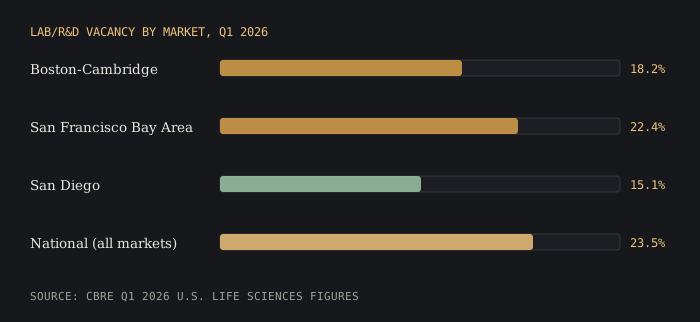
Lab and R&D vacancy across the U.S. life sciences market sat near 23.5% in the first quarter of 2026, per CBRE, a level the firm expects to mark a cyclical peak as new supply keeps shrinking and demand improves slightly.
Average triple-net asking rent per square foot for lab/R&D space, the fifth consecutive quarterly drop. The market's three largest hubs show how uneven the reset has been: Boston-Cambridge vacancy stands at 18.2%, up from just 2.1% at the end of 2021; the San Francisco Bay Area sits at 22.4%, up from 3.8%; and San Diego is at 15.1%, up from 4.2% over the same stretch.
Nine of the 13 major life sciences real estate markets, including Boston-Cambridge, the Bay Area, and San Diego, posted negative net absorption totaling 1.2 million square feet.
Tenant demand across Boston, the Bay Area, San Diego, and Raleigh-Durham jumped 44% year over year to nearly 8 million square feet in the first quarter of 2026, a gap between rising demand and still-negative absorption that is the clearest sign the market is bottoming.
Market trends: why vacancy climbed so fast
The run-up is recent and sharp. Boston-Cambridge vacancy moving from 2.1% to 18.2% inside four years reflects a construction boom built during the 2020-2021 funding surge meeting a slower, more selective capital environment once that surge cooled.
Developers who broke ground when biotech venture funding was at its peak delivered buildings into a market with less tenant demand than the pipeline assumed, and San Francisco and San Diego followed a similar arc a step behind Boston's.
Construction has adjusted in response. Lab space construction starts dropped sharply in 2026 as developers pulled back from a pipeline that had already overshot demand, the same pattern that has pushed rents down for five straight quarters even as vacancy nears what CBRE frames as a cyclical top.
Venture capital investment and clinical trials driving demand
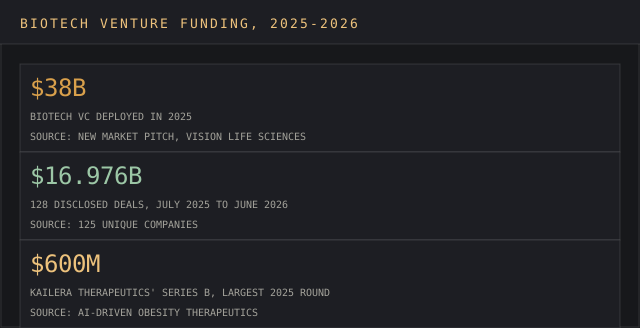
The demand side of this market runs on biotech funding, and that side recovered faster than real estate did. Biotech venture capital deployed $38 billion in 2025, and 128 disclosed deals between July 2025 and June 2026 raised $16.976 billion across 125 companies.
The top 10 private biotech funding rounds of 2025 brought in nearly $4 billion combined, including Kailera Therapeutics' $600 million Series B for an AI-driven obesity therapeutics platform, one of the largest single rounds of the year.
Copy these lines into an email, fill them in and send. I reply with scope and a price within 2 to 3 business days.
Open the emailCapital concentrated in companies with clinical data already in hand, obesity, neurodegeneration, and oncology drew the largest rounds, and the intersection of AI and biotech, machine learning applied to drug discovery, computational biology, and protein design, pulled a growing share of that funding.
Every funded company with a growing headcount and an active clinical trial program is a future lab-space tenant, which is why funding data leads real estate demand by several quarters.
The UK, Europe, and China Compare Differently
The U.S. reset has a different shape abroad. UK biotech companies raised £516 million in venture capital in the first quarter of 2026, up 17% from £442 million the prior quarter, with deal count rising from 17 to 24 over the same span and up 60% from just 15 deals a year earlier.
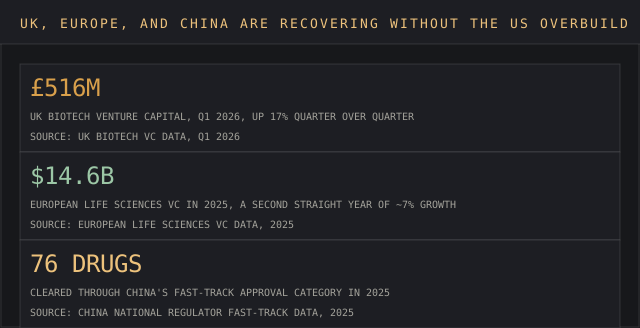
European life sciences venture capital rebounded to $14.6 billion in 2025, a second consecutive year of growth at roughly 7%, approaching the highs set during the pandemic funding boom.
China took a different route to relevance, clearing 76 new drugs through its national regulator's fast-track approval category in 2025, building R&D momentum without the same lab-space overbuild that hit Boston and the Bay Area. China now counts more than 3,000 life science companies employing roughly 270,000 people, and India's biotech startup count rose from 5,365 to 8,531 between 2021 and 2023.
That is evidence R&D capacity is expanding well beyond the traditional U.S. and European hubs even as those hubs work through their own vacancy reset.
None of these markets faced the 2020-2021 speculative construction wave at the scale U.S. hubs did, which is a large part of why their funding recoveries are translating into real estate demand faster than the U.S. market's is. A platform like GlobalData or Evaluate tracking company financials and deal flow across all four regions catches this divergence well before a single-market real estate report would.
What This Means for Landlords, Tenants, and Investors
For landlords, the read is patience over panic: rents are falling and concessions are up, but a market resetting from 2% vacancy to a stabilizing plateau near 23% signals a cyclical reset, distinct from structural decline.
Tenants have the strongest negotiating position the sector has offered in years, a well-funded biotech company with clinical-stage data can negotiate space and terms that were unavailable during the 2021 boom.
For investors, the gap between recovering VC funding and still-negative net absorption is the metric to watch quarter over quarter: absorption turning positive before construction restarts would confirm the reset is complete.
Government funding underpins a good part of this world: the U.S. government invests approximately $48 billion in medical research annually, a level of public investment that keeps basic research moving even when private venture capital investment cools for a stretch.
The U.S. government puts about $48 billion a year into medical research, which keeps basic research moving when private venture capital cools.
US government spend on medical research each year
Source: U.S. governmente.g. life science funding in your region
Source: linked, checked, datedMergers and acquisitions activity across the life sciences industry is picking up as companies look to replenish revenue and return to growth ahead of patent expirations, and licensing deals and research collaborations between large pharmaceutical companies and smaller biotech firms have become a routine way to share investment risk. Free patent search tools such as Espacenet show if a given drug patent is still in force, expired or withdrawn.
Understanding this fuller picture, government funding, deal-making, and licensing, alongside the real estate signs already covered, gives a more complete view of where demand is headed than lab vacancy data can offer on its own.
What to watch through the second half of 2026
Momentum from the first half of 2026 should carry into the second half if venture capital investment keeps flowing at anything close to its current pace. Expected supply reductions, fewer construction projects breaking ground, should keep availability from climbing much further past its current level, even as emerging demand from newly funded companies works through the pipeline over the second half of the year.
Improved conditions in public markets would help too: a life sciences company able to raise growth capital through public markets is a company more likely to sign a lease, making the difference between leasing now and waiting for a clearer opportunity.
None of this is guaranteed, and a full report on any single hub should track delivery of new leasing activity, underneath headline vacancy, before calling the bottom.
The read-through to adjacent sectors, medical devices and diagnostic services in particular, is similar: companies with real clinical progress and drug delivery breakthroughs already in hand are the ones allowing landlords to price space with more confidence, and that is what breaks a market out of a vacancy plateau.
Boston, the Bay Area, and San Diego are expected to keep setting the pace for the rest of the life sciences market.
Delivered for your site and your byline. Hosting here is optional.
Net absorption, U.S. life sciences data, and frequently asked questions
Is the life science real estate market recovering in 2026?
Partially. CBRE expects lab/R&D vacancy near 23.5% to mark a cyclical peak, and tenant demand across the largest markets rose 44% year over year in Q1 2026. Net absorption is still negative in most major markets, though, so the recovery shows up in demand and funding data before it shows up in occupancy.
Why did Boston's lab space vacancy rise so much?
Boston-Cambridge vacancy climbed from 2.1% at the end of 2021 to 18.2% as developers who broke ground during the 2020-2021 funding surge delivered buildings into a market where tenant demand had cooled, a pattern the Bay Area and San Diego followed with a lag.
How much venture capital went into biotech in 2025?
$38 billion for the full year, with 128 disclosed deals between July 2025 and June 2026 raising just under $17 billion across 125 companies. The top 10 private rounds of 2025 alone brought in nearly $4 billion.
How does the UK and European life sciences market compare to the US?
The UK and Europe are recovering faster on the funding side without the U.S.'s overbuilt lab-space problem. UK biotech VC hit £516 million in Q1 2026, up 17% quarter over quarter, and European life sciences VC reached $14.6 billion in 2025, a second straight year of growth near 7%.
The Broader Global Life Science Market
Real estate absorption and vacancy are only part of the picture. The broader global life science market, spanning pharmaceuticals, diagnostics, and biotech services beyond real estate alone, was sized at $88.2 billion in 2024 and is projected to grow at a compound annual rate of 11.82% through 2034, reaching $269.56 billion, according to Towards Healthcare's market-sizing data.
The FDA approved 50 new drugs in 2024, including 32 new chemical entities, output that supports the lab-space demand described throughout this report. Cushman & Wakefield separately tracked vacancy at 23.1% across its own set of monitored life sciences markets, corroborating CBRE's 23.5% figure within a similar range, while global R&D investment sales reached $13.5 billion in 2025, up 28% year over year.
AI is becoming a core innovation driver across the life sciences industry, with AI-driven R&D moving from experimental pilots to scalable implementation and the AI-in-life-sciences market alone projected to reach $14.20 billion by 2034.
Deal activity is picking up too: McKinsey reports life sciences dealmaking gaining momentum as companies race to replenish pipelines before patent expirations, even as the sector's labor market faces real talent constraints in specialized roles and regulators increase scrutiny of AI validation, bias, and data privacy in clinical settings. Pipeline and deal databases are ranked in our life science intelligence tools ranking.
Cushman & Wakefield expects the life sciences real estate sector to stabilize in 2026, and R&D funding remains well above pre-pandemic levels even after cooling from its 2021 peak, according to IQVIA Institute data. The broader industry outlook points to disciplined growth driven by scientific innovation.
This life sciences market report draws on the same industry data other life sciences market analyses use, CBRE, JLL, and Ropes & Gray figures, cross-checked against biotech venture-funding data, so the numbers in this report reflect the life sciences market as it stands heading through 2026.
Growing demand across the broader life sciences sector, and continued innovation inside it, is the reason this market report tracks funding projects and construction projects alongside real estate figures, for a fuller picture than vacancy data alone provides. The U.S. life sciences market is one part of a global life sciences market that this report will keep updating as conditions shift.
Sources: CBRE Q1 2026 U.S. Life Sciences Figures; CBRE U.S. Real Estate Market Outlook 2026, Life Sciences; JLL, U.S. Life Sciences Real Estate Has Reached Its Turning Point; Ropes & Gray, From Volatility to Vitality: How 2025 Reset the Life Sciences Market; biotech venture funding data via New Market Pitch and Vision Life Sciences, 2025 to 2026.
Lab landlords, brokers and biotech investors use reports like this one in tenant pitches and investor updates.
A report on your topic for a blog page, gated content or a lead magnet.
Written for your client and published under their brand, with my name left off.
Your report on marketintelligencetools.com, with 2 to 3 CTAs carrying your sponsored links.
Default terms: the report is yours to publish, and I keep the right to republish it on this site behind a gate, outside Google's index.