
The numbers U.S. retail property, checked 5 August 2026
Vacancy sits near 4.4% because construction starts are at multi-decade lows, and building costs plus tight financing set that floor.
Seattle absorbed 212,093 square feet against roughly 90,000 square feet of construction, so demand outran new supply by more than two to one.
Capital keeps going to grocery-anchored centers because food demand holds through a discretionary pullback, and apparel-led formats lag on every measure here.
Watch construction starts before you read spending headlines. New supply is the first thing that loosens a 4% market.
Brokers and landlords quote vacancy and rent figures in every listing pitch. Send the city and I'll source a version you own.
The Fundamentals in One Read
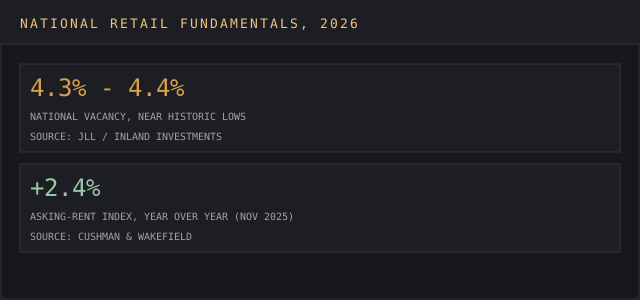
The headline number first: national vacancy is expected to remain near historic lows of 4.3% to 4.4%, per JLL and Inland Investments, the tightest availability the retail market has posted in over a decade, with total availability nationally also sitting near 4.0%. Rent growth has moderated but stayed positive, with an asking-rent index up 2.4% compared with a year earlier as of November 2025, per Cushman & Wakefield.
Retail real estate is not booming; it is scarce, and scarce supply is doing the work that demand alone used to do, a dynamic our analysis keeps returning to each quarter.
The pattern repeats across property types in commercial real estate: office carries excess space, industrial has cooled, and retail space sits closest to full. That scarcity, and no consumer boom, is why retail properties are pricing like a growth market.
Seattle and Las Vegas: Two Tight Metros, Q2 2026
Kidder Mathews and Avison Young data give a useful Las Vegas versus Seattle contrast. Seattle's retail vacancy was 3.9%, with King County highest at 4.7% and Pierce, Snohomish, and Thurston Counties each under 3.3%. Average asking rents reached $1.95 per square foot, and net absorption for the first half of 2026 totaled 212,093 square feet against roughly 90,000 square feet of construction, demand outpacing new supply by more than two to one.
Retail investment cap rates in the metro held near 5.7%, reflecting strong performance in this market by any historical measure.
Las Vegas runs softer but still ahead of pre-pandemic norms: vacancy of 5.4% and average asking rents of $36.90 per square foot, bifurcated sharply between the resort corridor and ordinary regional rates. The region's tourism-driven economy keeps consumers spending and retailers expanding even as national retail sales growth cools.
Development stays unusually strong for a market this tight, roughly 1.4 million square feet under construction, including new development tied to the MLB Athletics ballpark, Hylo Park, The Bend, and a Regal-anchored project in Summerlin, among the largest shopping centers planned here; rent details will shift once these projects deliver.
Analysts have anticipated that macro uncertainty will compress tenant margins, since past cycles taught this industry that overbuilding can push vacancy up for the first time in years just as consumers pull back, a dynamic that plays out differently here than in Seattle.
Investment Activity and Capital Flows
Retail investment activity rose 20% year over year in 2025, and transaction volumes in the first quarter of 2026 topped $15 billion, per Cushman & Wakefield and JLL. Institutional investors that spent much of the last cycle underweight retail have re-engaged, treating retail assets as a diversification play against office-sector exposure, and rents on the assets they are buying keep climbing.
Debt markets show real lender appetite for retail assets, a signal that underwriters trust the fundamentals as well as the pricing, a read every credible analysis this cycle shares.
Grocery-anchored centers keep pulling a disproportionate share of that capital. These anchors remain among the safest retail investments because food-anchored demand does not swing with consumer trends the way discretionary spending does, and grocery-anchored foot traffic, tracked by the real estate data providers covering visitation, has pushed past pre-pandemic levels.
For investors focused on income security over upside, that stability, and the rents it supports, is the pitch.
Supply Constraints and Tenant Mix
Retail construction starts are running at multi-decade lows and remain limited nationally, held down by high building costs and tight financing. That combination is the structural reason vacancy keeps testing historic lows: developers who would normally chase 4% vacancy with new construction find the return math does not clear at today's costs.
Landlords are pushing rents on renewal, and tenants report longer lead times securing space in the formats, food-anchored, discount, and service, where leasing activity is moving fastest. Tenants with weaker credit find fewer concessions than a year earlier, and tenants who can commit to longer terms are winning better deals across every format.
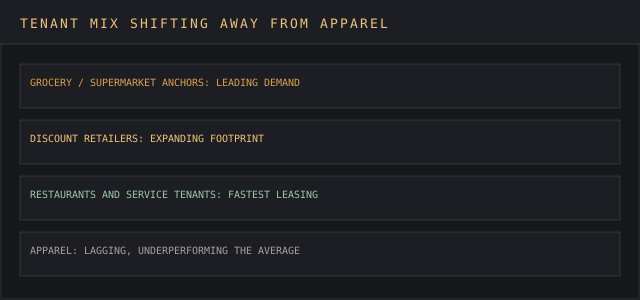
Demand for retail space is now led by grocery stores, discount retailers, restaurants, and service-oriented tenants over apparel, one of the clearer trends in this year's data. Retailers are prioritizing high-quality, necessity-based locations over expansion for its own sake, a defensive posture given persistent inflation and economic uncertainty across the industry. Restaurants in particular are absorbing space that older retail categories once held.
Neighborhood centers, strip centers, and shopping centers anchored by a supermarket rank as the top-performing formats in the market, while other property types tied to discretionary apparel spending continue to underperform the average. Fashion chains publish their own numbers: Inditex, H&M and Fast Retailing all report quarterly.
Where Vacant Space Is Going
Copy these lines into an email, fill them in and send. I reply with scope and a price within 2 to 3 business days.
Open the emailStore closures have not translated into empty properties sitting dark. CBRE reports closures are increasingly repurposed into mixed-use developments blending retail space with residential or office components, protecting rent rolls in office-sector-adjacent centers that would otherwise show negative net absorption.
A closed apparel box that reopens as a supermarket concept or a medical clinic is not lost retail space, it is retail space finding tenants with more durable demand, a conclusion further analysis of the county-level data supports.
What This Means for Investors and Operators
The takeaway for this market: retail real estate offers a rare combination right now of low vacancy, positive rent growth, and constrained new supply, producing stable cash flow and reduced re-leasing risk. Rents are climbing at the asset level even where headline vacancy sits half a point above the national average, keeping landlords ahead of where the cycle stood a year earlier.
Underwriting still needs to respect tenant mix; a center anchored by a supermarket reads differently than one leaning on a single discretionary category, and landlords who remain disciplined about that distinction outperform the average. Teams that test tenant mix with foot traffic data should budget for it, and our Placer.ai pricing report finds $12,000 to $34,000 a year in public order forms.
Vacancy should remain tight through the rest of 2026 as consumers keep favoring necessity retail, multiple projects beyond the four named in the Las Vegas market are also underway, and every data point in this report points the same direction: watch construction starts ahead of spending headlines for the first sign that momentum is turning.
Delivered for your site and your byline. Hosting here is optional.
FAQ
Is retail real estate a good investment in 2026?
The fundamentals support it: vacancy near historic lows of 4.3% to 4.4%, rent growth of 2.4%, and investment activity up 20% in 2025 with volume exceeding $15 billion in the first quarter of 2026. The caveat is tenant mix; grocery-anchored and necessity-based retail properties carry the strongest case, while assets leaning on discretionary apparel spending carry more risk.
Why is retail vacancy so low right now?
High building costs and tight financing have pushed new retail construction to multi-decade lows, so supply has not kept pace with steady demand. That imbalance, and no surge in consumer spending, is the main driver of vacancy near historic lows nationally and in metros like Seattle.
What retail formats are leasing best right now?
Grocery-anchored, discount, restaurant, and service-oriented tenants are driving demand for retail space, while apparel-driven formats lag. Neighborhood and strip centers anchored by these tenant types rank as the top-performing formats in most 2026 market data, a pattern that holds from Seattle to Las Vegas. Landlords check a prospective tenant against foot traffic and trade-area data in location intelligence platforms such as Placer.ai.
Sources: JLL US Retail Market Dynamics; Cushman & Wakefield retail investment research; Kidder Mathews Seattle Retail Market Report, Q2 2026; PwC/ULI Emerging Trends in Real Estate; CBRE US Real Estate Market Outlook 2026, retail; Avison Young Las Vegas Retail Market Report, Q2 2026, via REBusinessOnline.
CRE brokerages, landlords and retail tenants' advisers use reports like this one in listing pitches and investor updates.
A report on your topic for a blog page, gated content or a lead magnet.
Written for your client and published under their brand, with my name left off.
Your report on marketintelligencetools.com, with 2 to 3 CTAs carrying your sponsored links.
Default terms: the report is yours to publish, and I keep the right to republish it on this site behind a gate, outside Google's index.