Market Sizing Template
 By Jan Suski. I go deep on every review, checking every number against its source and digging up details other coverage misses, a habit from six years of SEO and link building for tech companies. Bylines at Surfer, Brand24, and Senuto. How the scoring works.
· Prefer this source on Google
This template answers the question every investor, board, and product review asks first: how big is the market?
Market sizing estimates total annual revenue or unit sales for a defined market, and market sizing helps businesses decide where to invest and what to build.
The download is a working calculator: assumptions in, TAM, SAM, and SOM out, with a cross-check sheet that catches the errors before an audience does. It is part of our market research template library.
Download the Calculator
Download the market sizing calculator (XLSX)Three sheets, live formulas.
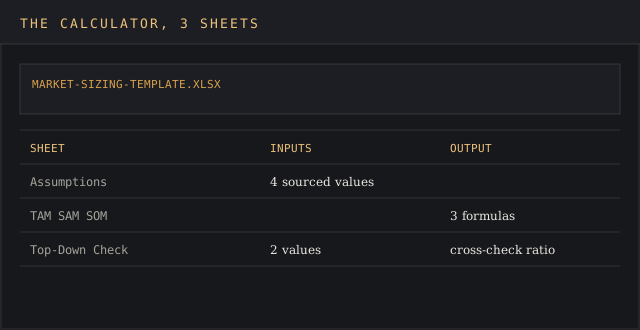
Sheet one logs assumptions with a source per line. Sheet two computes the three market layers.
Sheet three runs a top down cross-check and a ratio that flags when the two market sizing passes disagree.
Download the market sizing report (DOCX)A one-pager for presenting the final answer, assumptions log included.
Both files are free, branded, and pre-filled with a worked example to overwrite. A market sizing template organizes assumptions, calculations, and data for investment evaluations, and structured templates turn market research into a data-driven process. A formula behind every number beats a guess wearing nice formatting.
What Is Market Sizing?
The concept of market sizing is estimation with structure: market size estimates total annual revenue or unit sales available in a market, expressed as market value in currency or market volume in units.
Both readings matter. Market value answers what the revenue opportunity is worth; market volume answers how many units of demand exist, and dividing one by the other recovers the price per unit, a useful sanity handle.
Market sizing is often based on assumptions and available data; the discipline of market sizing is in stating the assumptions.
Done well, market sizing informs strategic business planning decisions: companies use market sizing to prioritize resource allocation, assess the viability of new product lines, and justify business decisions with data.
Investors rely on market sizing to evaluate growth potential, which is why every pitch deck carries the three-circle chart, and why a sloppy one ends conversations early. Founders looking to raise capital get exactly one chance at this slide.
TAM, SAM, and SOM
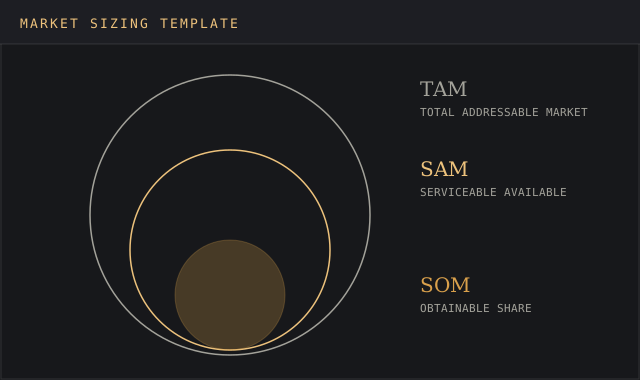
TAM, SAM, and SOM define different levels of market opportunity, and market size calculations lean on the three so consistently that they are worth defining precisely.
Total Addressable Market (TAM)
TAM represents the maximum revenue if capturing 100% market share: the total addressable market includes all potential customers for a product or service, everywhere the product could conceivably sell.
Counting potential customers directly is what separates a number a board trusts from one it tolerates. Inferring them from a headline figure produces the tolerated kind.
Total addressable market TAM is a ceiling, and it belongs in the report as a ceiling.
Treating the total addressable market TAM as a forecast is the fastest way to lose an investor's trust; the total addressable market impresses, the obtainable one convinces.
Serviceable Available Market (SAM)
SAM is the portion of TAM a company can realistically serve: the serviceable available market narrows the addressable market by geography, segment, product fit, and channel.
Serviceable available market SAM is where the target market lives; some write it as serviceable addressable market, and the meaning is identical.
Defining the target market tightly here pays off later, because every downstream number inherits its boundaries.
Serviceable Obtainable Market (SOM)
SOM is the share of SAM a company can realistically capture: the serviceable obtainable market accounts for competition, sales capacity, and time.
Serviceable obtainable market SOM is the number a revenue plan should reconcile with; TAM, SAM, and SOM are essential for market sizing strategies precisely because each layer answers a different question, ceiling, arena, and plan.
Top Down and Bottom Up Market Sizing
Two families of method cover nearly all market sizing work, and every market sizing course teaches both.
The market sizing approach you choose decides how much an audience trusts the final answer, so choose it out loud.
The Top Down Approach
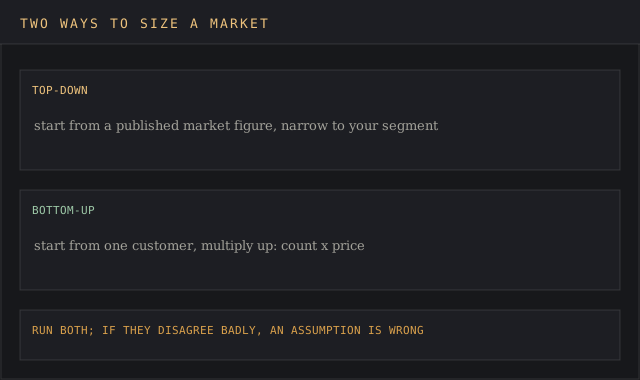
Top down market sizing starts with a large figure and narrows down: a global market size from an industry report, cut by region, then segment, then fit.
The top down approach is faster, and that is its whole advantage.
Top down is also riskier: top-down estimates often inflate market size figures, because each narrowing percentage is a guess multiplied by someone else's guess, which is how top down market sizing earns its reputation for optimism.
Use the top down method for a first market sizing pass, for markets with strong industry data, and as the cross-check on the other family.
The Bottom Up Approach
Bottom up market sizing starts with a single unit, one customer, one store, one transaction, and aggregates upward: bottom-up sizing aggregates individual customer data for accuracy.
The bottom up approach is more accurate but time-consuming, and it is the version diligence rewards.
Every input is a checkable fact about target customers, and that discipline produces an accurate estimate. Hope never checks out that cleanly.
The bottom up approach is generally preferred when the market sizing has consequences: pricing, hiring, fundraising.
When top down and bottom up disagree badly, an assumption is wrong, and finding it is the most useful hour in the whole market sizing exercise.
The Market Sizing Formula
Is there a formula for market size? Yes, and it is short: number of target customers, times purchase rate, times average price.
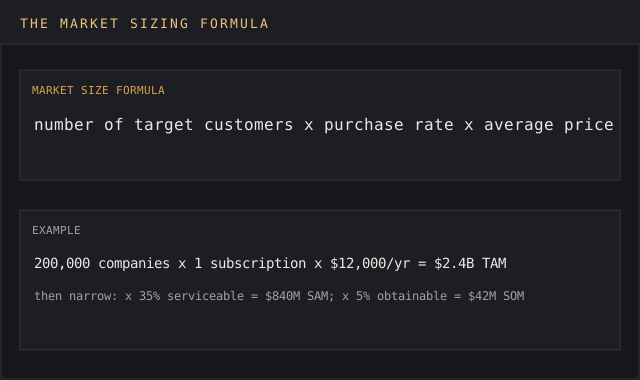
The market sizing formula scales to any market: swap customer counts for households, companies, or seats; swap purchase rate for renewal or consumption frequency; keep the units honest and the math takes care of itself.
The first input is always the same question: how many customers exist in the segment, counted from a source you can name.
A worked pass: 200,000 target companies, one subscription each, at $12,000 average revenue per year, gives a $2.4B TAM. Serve 35% of them and the serviceable available market is $840M; realistically capture 5% of that and the SOM is $42M.
That is the same market sizing formula the calculator runs, with every input on the assumptions sheet where a reviewer can argue with it, which is the point of market sizing in a template at all.
How to Do a Market Sizing Analysis, Step by Step
A step by step guide, in six moves; the calculator mirrors the same order.
First, define the relevant market and the target market inside it. A relevant market is the set of buyers and substitutes that constrain your pricing; "US mid-market payroll software" is a relevant market, "global fintech" is a headline.
Second, structure before calculating. Calculating before structuring leads to confusion; calculating market size starts with the equation in words, numbers after.
Third, gather market sizing data, per customer segment where the segments behave differently.
Secondary research covers most of it: industry reports, government agencies, public filings, and industry data from trade bodies.
Primary research, your own surveys of the target audience, fills the gaps secondary data sources leave, especially around purchase rates and average revenue.
Fourth, calculate both ways: calculating market size bottom up as the main estimate, with the top down approach as the cross-check.
Fifth, sense check. Presenting answers without sense checking is a common mistake; compare the result against a public rival's revenue or a per-capita figure before anyone else can.
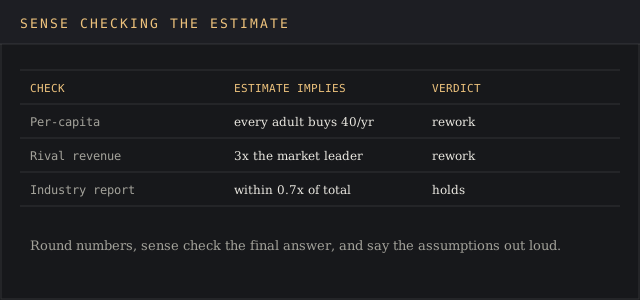
Sixth, round and present. Using precise numbers increases the risk of math errors and fakes accuracy the data cannot support; $42M reads as an estimate, $41,876,300 reads as a fiction.
One habit ties the six together: date the estimate. Ignoring market dynamics can lead to outdated estimates, and growth rates change; accurate market sizing is a refresh discipline. Nobody calculates it once.
Where to Find Market Size Data
Where can I find market size data? Market sizing data lives in four data sources, and the first is free: government agencies publish the backbone.
The US Census and its County Business Patterns carry customer counts by industry vertical and region, BLS carries spend, and Eurostat mirrors both for Europe; the US population and its demographic splits anchor most consumer estimates.
Industry reports from analyst firms carry global market size figures and growth rates; they are the standard top down source, and their assumptions deserve the same scrutiny as your own.
Public filings put hard revenue numbers on named rivals, the best sense-check material available. Beyond that, sources of market intelligence covers the fuller map, and platforms in our market intelligence tools ranking, Similarweb for digital markets especially, estimate demand where no report exists.
For customer demographics and demand signals, primary research still earns its cost: a 50-response survey about willingness to pay beats a decade-old report's average person profile, and it prices each customer segment separately.
Relevant Market Size
Relevant market size is the version of the number that decisions can use: the market you could win, measured.
Estimating market size at the relevant level usually means SAM or below, split by market segments that buy differently; a potential market averaged across segments that behave nothing alike is a mean of apples and engines.
Business strategy runs on the relevant figure: pricing, hiring, and territory plans all key off it, and market potential only matters where the business can reach it.
The data points behind each input deserve their own row in the assumptions sheet, because the relevant market shrinks or grows as assumptions move, and a reader should see which one did it.
Market Sizing Examples
Market sizing examples make the method concrete, and the classic market sizing cases come in two flavors: business examples and estimation questions.
A business example: a bottled cold-brew brand sizing the US market. Bottom up: coffee-drinking share of the US population, times how many cups per week shift to cold brew, times the price per bottle. The structure is three checkable numbers, which is what a good market size looks like.
An investor example: SOM for the pitch deck. The relevant market example here is not "beverages" but "chilled ready-to-drink coffee in US grocery," and the difference between those two framings is the difference between a conversation and a pass.
What is an example of a market size? Any defensible statement of value or volume for a defined market: "$840M of serviceable annual revenue across 70,000 companies" is a market size; "the trillion-dollar wellness economy" is a slogan.
Market Sizing Questions in Interviews
Market sizing questions are a consulting interview staple, and the same skills transfer straight to real market sizing work, which is why they belong on this page.
How many gas stations are in the US? How many golf balls fit in a school bus? How many hot dogs sell at a ballpark per season? How many coffees does a cafe pour per day? Estimation questions like these test structure. The trivia is incidental.
The failure mode interviewers describe is silence: candidates stop talking when a number goes missing. The fix is the same structure the template teaches: define, decompose, estimate each piece out loud, multiply, sense check the final answer.
A worked interview pass on the fuel question: the US population is about 340 million; assume one car per two people, a fill-up per car per week, and a station serving 2,000 fill-ups weekly. That yields roughly 85,000 gas stations, and the true figure sits near 100,000+, comfortably inside an interview's tolerance.
Consulting interviews reward the sense check more than the arithmetic; saying "let me check that against stations per town" reads as judgment, and judgment is what the market sizing questions screen for.
To practice market sizing questions, run one per day against the calculator's structure: sales volume of umbrellas in Seattle, unit sales of textbooks per student, revenue of a food truck. The reps build the reflex.
Who Uses Market Sizing, and When
Early stage companies run market sizing to raise capital and choose a beachhead; the serviceable obtainable market is the number seed investors weigh hardest, since it encodes what the team can realistically target in three years.
Product teams run market sizing before building: customer demand for a new line, measured before the roadmap commits, is cheaper than a launch that tests it. Revenue growth targets inherit their realism from the same numbers.
Strategy teams re-size annually, because market dynamics move: market segments' growth rates change, the whole plan reshuffles, and a competitive advantage in a shrinking segment is a well-defended puddle. Business strategy that skips the re-size runs on last year's market.
Does McKinsey do market sizing? Constantly; sizing is a standard module in consulting engagements and diligence work, and the firm's estimation-question interviews exist because the job demands the skill. Market sizing is also a core market intelligence input, feeding the market layer of any competitive picture.
Common Mistakes
Structuring failures come first: estimating market size before structuring the equation, or sizing a market so broad it flatters everyone and informs no one.
Method failures follow: leaning only on the top down method, trusting one industry report's data points without a second source, or letting the addressable market stand in for the obtainable one.
Presentation failures finish the list: precise-looking numbers, no cross-check, no dated assumptions, and no answer to "what would make this wrong." A reviewer who finds the weakness before you do owns the meeting.
Every one of these has a cell in the template: the assumptions sheet forces sources, the cross-check sheet forces the comparison, and the report one-pager forces the sense check into writing.
FAQ
What is the market sizing?
Estimating market size means putting a defensible number on a market's total annual revenue or unit sales, usually expressed as TAM, SAM, and SOM.
How do you analyze market size?
Follow the step by step guide above: define the relevant market, structure the equation, gather data from secondary research and primary research, calculate bottom up with a top down cross-check, test the result against reality, and date it. The calculator above walks the same path.
Is there a formula for market size?
Target customers times purchase rate times price. Every variant, per-seat, per-household, per-unit, is that formula with different units.
What is a relevant market?
The set of buyers and substitutes that genuinely compete for the same spend. It is defined by who could switch to you. Industry labels miss it.
What is an example of a relevant market?
"Chilled ready-to-drink coffee in US grocery" is narrow enough that customer counts and prices are checkable, broad enough to hold the growth story. "Beverages" is neither.
What is a good market size?
Depends on the ambition: venture investors typically look for a TAM in the billions with a credible SOM path; a bootstrapped business can thrive on a potential market a fund would ignore. Good means defensible.
What is an example of market sizing?
The worked pass above: 200,000 target companies times $12,000 average revenue gives a $2.4B TAM, narrowed to an $840M SAM and a $42M SOM, each step sourced.
Which method is generally preferred for market sizing?
Bottom up market sizing, whenever the estimate carries consequences; it is slower and more accurate, and the top down pass remains useful as the cross-check.
Where can I find market size data?
Government agencies (Census, BLS, Eurostat), industry reports, public filings, and digital-market estimates from measurement platforms; primary research fills what publishing leaves out.
What is the concept of market sizing?
Structured estimation: decompose a market into knowable pieces, estimate each with a stated source, multiply, and sense check. The confidence comes from the structure, never from the precision.
Bottom Line
Market sizing is the rare analysis where showing the work is the product, and market sizing rewards the habit: the audience buys the assumptions, or it doesn't, and the number rides along.
Download the calculator, replace the example with your market, and argue with the assumptions sheet until it survives; estimating market size well is a competitive advantage precisely because most estimates are theater. Market intelligence starts with knowing how big the game is; the potential market you can defend beats the one that merely impresses.