Amplemarket review: is the AI sales engagement platform worth it in 2026
 By Jan Suski. I go deep on every review, checking every number against its source and digging up details other coverage misses, a habit from six years of SEO and link building for tech companies. Bylines at Surfer, Brand24, and Senuto. How the scoring works.
· Prefer this source on Google
Best for
Mid-market sales teams that want AI-driven lead generation, seven-channel outreach and signal detection bundled into one consolidated platform.
Not for
Solo marketers or early founders should look at SalesRobot instead, which starts at $59 a month with no contract lock-in.
What it costs
Startup Plan is $600 a month on an annual contract; Growth and Elite are custom quotes scaled by seats, contacts and data volume.
- Contact database
- Over 200 million AI-verified contacts
- Outreach channels
- Seven-channel sequencing across email, LinkedIn connection requests, LinkedIn messages and calls
- Duo AI Copilot
- Detects buying signals, then drafts personalized multi-channel sequences
- Signal types
- Job changes, funding rounds, hiring posts and public LinkedIn posts from a target's leadership
- Lead generation rate
- 15+ new leads a day generated by the AI
- Research time saved
- Over 10 hours a week, a company-reported figure
- Email warm-up
- Built in, with domain protection and bounce-rate monitoring behind high sending volume
- Unibox
- Replies from every channel land in one inbox
- Job change alerts
- A past contact's move to a new company becomes a fresh reason to reach out
- AI personalization
- Pulls a prospect's LinkedIn activity, recent posts and company news into the opening line
- Contact details
- Verified emails, with phone numbers on some plans
- Firmographic fields
- Company size, funding stage, hiring volume and technology stack
- Onboarding
- A few days from first login to a running sequence
- Learning curve
- Duo Copilot's deeper settings take new users a few weeks before they run sequences unaided
- Startup Plan
- $600 a month, annual contract required
- Growth Plan
- Custom quote, scaled by users, contacts targeted and monthly data volume
- Elite Plan
- Custom quote; adds priority support and higher usage ceilings on top of Growth
- Billing terms
- Annual contracts only, with no monthly billing at any tier
- What raises the bill
- Additional seats and data usage, so headcount needs modelling before signup
- Competing price bands
- Outreach and Salesloft at four figures a month; Apollo, Reply.io and Clay at roughly $49 to $150 per seat; SalesRobot from $59 with no annual contract
- Bounce rates
- Under 3% reported by customers, per user reviews
- A/B testing
- Built into sequences: subject line, body and CTA testing, per Amplemarket’s own guide
- G2 rating
- 4.6 out of 5 across roughly 600 reviews, about 76% five-star, no one- or two-star ratings
- Support scores
- Quality of Support 9.3 out of 10 on G2; Capterra rates customer service 5.0 and features 4.9
Apollo.io
Not forA team that bought Amplemarket for Duo Copilot and job-change signal detection loses the reason it paid $600 a month.
Outreach
Not forA five-rep startup weighing a $600 Startup Plan gets a quote-only enterprise contract, with no price attached.
Not forA revenue org running Amplemarket across a full sales team wants the Elite Plan's usage ceilings, which no $109 seat replaces.
Pairs well with Amplemarket
Which Amplemarket numbers are vendor-published and which come off review sites
The $600 Startup Plan price and the annual-contract requirement come from Amplemarket's published plan structure; Growth and Elite are quote only, so no figure exists to check. The 4.6 rating, the roughly 600 review count and the 9.3 Quality of Support score are G2 figures, with customer service 5.0 and features 4.9 from Capterra.
The 15+ leads a day, the 10 hours saved weekly and the case-study results from Deel, Agilyx, Momentum and Thrive Learning are Amplemarket's own published claims and read as best cases. The 200 million contact count is one of four different totals Amplemarket's own materials give for the same database (see the callout above for all four).
Bounce rate has the same problem in miniature: Amplemarket's about page says under 3%, its Data Accuracy Report says 3.1% company-wide, and its accuracy-ranking blog post says sub-3% overall with a “best-in-class” cohort under 1.5%.
Phone accuracy is more consistent across its own documents, 96.5% in both the Data Accuracy Report and the accuracy-ranking blog post, though its about page still shows the older 97% figure. Bounce rates run under 3% separately in the user reports we found. Figures as of the 5 August 2026 update.
Try it yourself
Sign up for Amplemarket
Startup Plan is $600 a month on an annual contract; no free tier, though a free trial (length unstated) is now available on every plan.
May earn a commission if you sign up through this link, at no extra cost to you. Full affiliate disclosure.
This Amplemarket review covers pricing, features, pros and cons, what users rate it, and how the platform compares with tools like Outreach, Salesloft and Apollo. Amplemarket is an AI-driven sales engagement platform designed for prospecting and outreach, built for sales teams that want lead generation, multichannel sequences and AI personalization consolidated into a single tool.
This Amplemarket review also looks at how the platform fits a sales cycle that spans targeting, outreach, follow up and closing.
↑ FACT SHEETWhat is Amplemarket
Amplemarket launched toward the end of 2019, founded by João Batalha, Luís Batalha and Micael Oliveira, three co-founders with a scientific background who set out to simplify sales prospecting. The company is headquartered in San Francisco and raised $12 million in back-to-back Seed and Series A rounds, co-led by Comcast Ventures and Armilar Venture Partners, announced in April 2022.
That $12 million across three rounds from eight investors remains the company's total disclosed funding; there has been no announced Series B since.
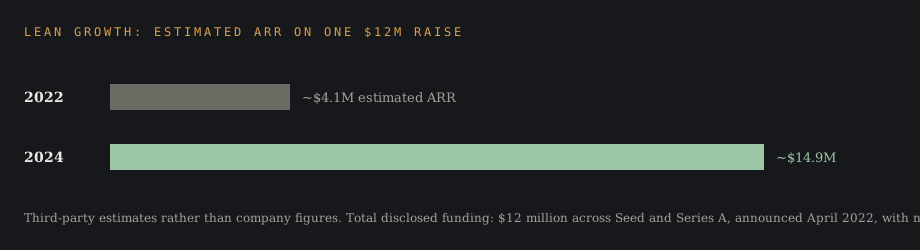
Third-party trackers put Amplemarket's estimated annual recurring revenue near $14.9 million for 2024, up from about $4.1 million in 2022, against a most recently disclosed valuation around $44.8 million. Those are external estimates, but the growth curve is the part worth noting: a business roughly tripling ARR in two years on a single $12 million raise is running lean.
João Batalha serves as CEO, with Luís Batalha as chief product officer and Micael Oliveira as chief revenue officer, all three still active founders running the business day to day.
Amplemarket targets mid-market businesses that want to consolidate their tech stack, replacing multiple tools with one platform for lead generation, multichannel outreach and deliverability. A revenue team evaluating Amplemarket is usually comparing it against a stack of separate tools, since the platform bundles data, sequencing and AI personalization together.
↑ FACT SHEETWhat users rate Amplemarket
Amplemarket holds a 4.6 out of 5 rating on G2 across roughly 600 verified reviews, with about 76% of them five-star and no one- or two-star ratings on record. Quality of Support scores 9.3 out of 10, and Capterra reviewers rate customer service 5.0 and features 4.9.
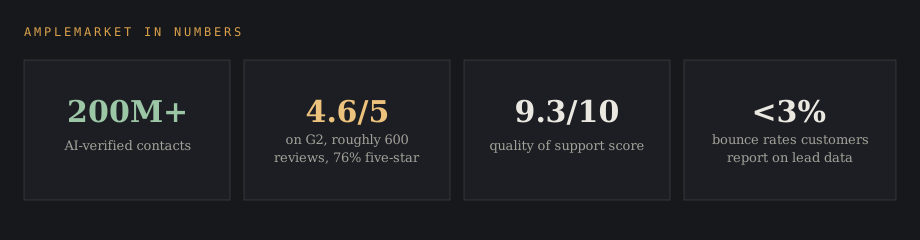
Ease of use is the most-mentioned strength in that review base, cited around 150 times, with reviewers describing an interface reps get productive on quickly. That sits in tension with the learning curve reviewers describe for Duo Copilot's deeper settings, and the honest reading is that basic sequencing is fast to learn while the signal configuration is not.
Named customer results
Amplemarket publishes case studies with numbers attached, which is more than most vendors in this category do. Deel began using the platform in June 2020 and grew revenue 20 times over the following twelve months. Agilyx reports saving $100,000 a year on sales operations after replacing its previous stack.
Momentum quadrupled its customer base inside a year, with 70 to 80% of all meetings sourced through the platform. A single SDR at Thrive Learning using Duo Copilot recorded a 242% increase in interested responses.
Those are vendor-published outcomes from customers who agreed to be named, so treat them as the best cases. The useful signal is that the named accounts span company sizes and that the reported gains come from targeting.
How Amplemarket works
AI processes millions of signals to find qualified leads, scanning job changes, funding rounds, hiring posts and other buying signals so a sales team can prioritize the right people using real signal, skipping the guesswork. Duo AI Copilot detects buying signals and generates personalized, multi-channel sequences, turning a raw signal into a first-touch email or LinkedIn message without a rep drafting each one by hand.
Amplemarket helps convert cold outreach into warm conversations through signal detection, matching a company's outbound strategy to accounts already showing intent signals. Reviewers frequently call it intuitive, with a shorter learning curve than switching between several separate point tools.
Amplemarket helps users engage with 20 companies in 20 minutes, using signals and automation to compress research that would otherwise take a rep far longer, one company at a time. Duo Copilot also reads LinkedIn posts and other public signals and flags when a target account's leadership talks publicly about a problem Amplemarket's customer solves.
That signal-driven targeting shortens the sales cycle: a rep's time goes toward accounts already showing intent, and away from the flat, unscored lead list. Prospects surfaced by Duo Copilot arrive with contact details, LinkedIn profile links and a summary of the triggering signal, so a rep can personalize the first message without extra research.
↑ FACT SHEETAmplemarket pricing
Amplemarket's Startup Plan costs $600 per month with annual contracts, aimed at a small sales team that wants Duo Copilot and multichannel sequences without a large seat count. The Growth and Elite Plans carry custom pricing based on a team's needs, scaling with the number of users, contacts targeted and data volume a business runs each month.
No monthly billing option exists at any plan tier. Amplemarket requires annual contracts, a structure that raises the commitment for a small team testing the platform for the first time. Pricing increases with additional seats and data usage, so a growing sales team should model its target headcount before locking in a full year on the Startup Plan or a custom Growth Plan quote.
Small businesses can find Amplemarket's pricing expensive, especially compared with point tools like SalesRobot that charge a lower monthly rate with no annual contract required. A team comparing the Startup Plan against a Growth Plan quote should ask what data volume and contact revealing limits come with each tier, since those caps affect how many new leads a team can find monthly.
The Elite Plan generally adds priority support and higher usage ceilings on top of Growth Plan features, aimed at revenue teams running Amplemarket across a full sales org.
See Duo Copilot live
Start with Amplemarket's Startup Plan
Seven-channel sequencing and signal detection from $600 a month.
May earn a commission if you sign up through this link, at no extra cost to you. Full affiliate disclosure.
Amplemarket features
The platform's surface area is wide, and the feature set clusters into a few working layers:
- Seven-channel outreach and sequencing, combining email, LinkedIn connection requests, LinkedIn messages and calls into a single outbound strategy targeting the same prospect across channels until they reply.
- Built-in email warm-up and domain protection, monitoring bounce rates and sender reputation so high email volume lands in inboxes.
- Lead generation from Amplemarket's own database, with the AI able to generate 15+ new leads daily and Duo Copilot drafting personalized emails and managing follow up, saving over 10 hours weekly on research.
- Job change alerts that turn a past contact's move to a new company into a fresh reason to reach out to a potential customer.
- AI personalization that pulls from a prospect's LinkedIn activity, recent posts and company news, rolling that context into an opening line, skipping the generic template every prospect can spot immediately.
- Unibox, which brings every channel's replies into one inbox, so a rep working a multichannel sequence isn't checking email, LinkedIn and a separate dialer to see who replied.
Contact details revealed through Amplemarket include verified emails and, on some plans, phone numbers, letting a team choose between email-first sequences and phone-heavy outreach depending on the target account. Amplemarket's data covers company size, funding stage, hiring volume and technology stack, giving a sales team enough context to target the right people at the right company at the right time.
See the feature set live
Try Amplemarket's seven-channel outreach
Email, LinkedIn and calls in one sequence, plus built-in warm-up and a Unibox for replies.
May earn a commission if you sign up through this link, at no extra cost to you. Full affiliate disclosure.
Amplemarket pros and cons
Amplemarket provides access to over 200 million AI-verified contacts, a database large enough that most sales teams can find relevant prospects without buying a separate data provider. Customers report high-quality lead data with under 3% bounce rates, a figure reviewers cite as evidence that Amplemarket's contact data holds up better than some lower-cost alternatives.
Amplemarket doesn't agree with itself on how big that database is. Its own Searcher product page says 200+ million business profiles. Its own accuracy-ranking blog post says 300M profiles and 200M mobile numbers. Its Data Accuracy Report, shared directly by its partnerships team, says 210M+ contacts. And its own competitor battle cards say 300M+ verified contacts and 200M+ verified phone numbers.
Four Amplemarket sources, three different contact totals (200M, 210M, 300M), all current as of this check. We're keeping 200 million on this page since it's the figure on Amplemarket's own product page for the database itself; treat anything up to 300 million as equally plausible by Amplemarket's own telling.
Some users report data accuracy can vary by region while using Amplemarket, a pattern similar to other contact data providers whose coverage thins outside North America and Western Europe. One G2 reviewer put it directly, calling international contact data “a bit less accurate than the US data.”
Amplemarket's own Data Accuracy Report shows a version of the same pattern in its self-reported benchmarking: it rates its own email and phone coverage four stars for Europe against five stars for North America.
Amplemarket documents A/B testing within sequences: subject line, body copy and calls to action, through its own knowledge base and academy guides, and one customer credits the platform with “useful analytics and A/B testing features to improve campaign performance.” A narrower limitation shows up in user reports instead: Duo’s AI-drafted messages run in English only, which one reviewer flagged as limiting when prospecting Spanish-speaking contacts.
One customer, Entrapeer, reports a 60% jump in meetings booked after adopting Amplemarket's AI-driven outbound, per Amplemarket's own case study. That figure is specific to one customer; Amplemarket doesn't publish a company-wide meetings-booked number to compare it against.
Amplemarket's marketing page separately claims a 5x increase in interest rates once signal-based targeting replaces a cold, unscored list, plus conversion rates rising by up to 50% and 10+ hours saved weekly on research, the figures the company cites together as the core return on switching from manual prospecting.
Amplemarket pros most cited by reviewers include the AI signal detection, the built-in email warm-up and the ability to run a full sequence without leaving one tool. Amplemarket pros aside, the learning curve for Duo Copilot and its many settings takes real time, and new users often need a few weeks before running sequences confidently on their own.
Reviewers weighing wrong assumptions about Amplemarket often expect the platform to fully automate closing, when in practice AI handles targeting and first-touch outreach while a rep still runs the actual conversation.
Amplemarket alternatives
The competitive set splits by price band. Outreach, Salesloft and Amplemarket sit in the enterprise engagement tier, typically four figures a month on custom terms. Apollo, Reply.io and Clay occupy the mid-market band at roughly $49 to $150 per seat per month.
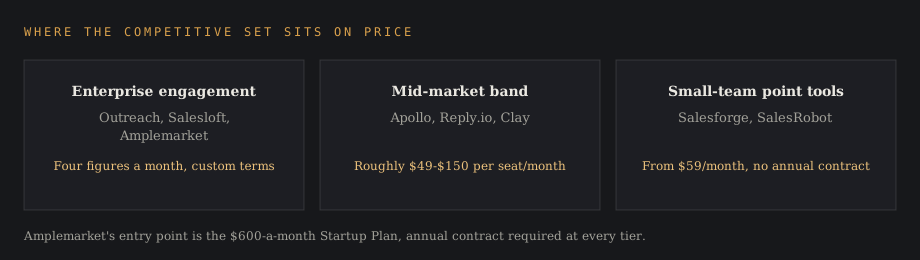
Outreach and Salesloft are the incumbents Amplemarket displaces most often, and Amplemarket's own customer data names Outreach as its most frequently displaced competitor by a wide margin. Reviewers of Outreach cite complexity and pricing practices as recurring frustrations, which is the opening a newer platform sells into; a buyer should discount that framing somewhat given the source.
Apollo.io is the closest comparable for the data-plus-sequencing model, at a materially lower entry price, with a large contact database and strong prospecting filters; the two diverge on AI personalization depth and aren’t a straight feature-for-feature swap.
Clay is often listed alongside these tools but does a different job: it is an enrichment platform, waterfalling across data providers. It isn't an engagement platform, so a team replacing Amplemarket with Clay still needs something to send the sequences.
Salesforge offers unlimited mailboxes and LinkedIn senders, an amplemarket alternative aimed at teams that want to scale email volume without paying per contact revealed. SalesRobot pricing starts at $59 per month with no annual contract, allowing double-channel outreach on LinkedIn and email for a small team weighing Amplemarket's annual plan.
Both are narrower than Amplemarket, and both publish their own comparison content, so read them as vendor positioning.
Choosing the right amplemarket alternative usually comes down to how much a team needs Amplemarket's AI personalization and signal detection against paying less for straightforward multichannel sending. A revenue team comparing the field should weigh contact data quality, the number of channels each sequence supports and how an annual contract fits the team's budget cycle.
Compare it yourself
Sign up for Amplemarket
Lead generation, sequencing and signal detection in one platform.
May earn a commission if you sign up through this link, at no extra cost to you. Full affiliate disclosure.
Want multichannel at a lower seat cost?
Sign up for lemlist
Email, LinkedIn and calling in one sequence builder, from $55/user/mo billed annually.
May earn a commission if you sign up through this link, at no extra cost to you. Full affiliate disclosure.
Who Amplemarket is built for
Amplemarket targets mid-market sales teams that want to consolidate their tech stack, replacing several point tools with one platform for lead generation, sequencing and deliverability. A small sales team just starting outbound may find the Startup Plan's $600 monthly cost and required annual contract steep relative to a lighter tool built for a lower volume of prospects.
Larger sales teams running a full funnel from targeting through follow up get more value from Duo Copilot's automation, since the platform's AI personalization scales better across a bigger number of prospects than a manual process would. Revenue teams that already track intent signals and job change alerts elsewhere may find some overlap with Amplemarket's own signal detection, worth checking before paying for two tools that surface the same buying signals.
Sales teams closing deals against a defined outbound strategy tend to get the most out of Amplemarket's multi-channel sequences and AI-driven targeting. Marketing teams that pass qualified leads to sales sometimes use Amplemarket data to enrich a lead before it ever reaches a rep, aligning marketing and sales around the same signals.
A founder-led sales team wearing multiple hats may find Amplemarket's automation frees up hours that would otherwise go to manual list building, letting one person cover more of the funnel.
See if it fits your team
Check Amplemarket's Startup Plan
Built for mid-market sales teams consolidating outbound into one platform, from $600 a month.
May earn a commission if you sign up through this link, at no extra cost to you. Full affiliate disclosure.
Amplemarket in daily use
A rep's daily use of Amplemarket usually starts with reviewing new leads and signals Duo Copilot surfaced overnight, then approving or editing the sequences queued to send that morning. Reps who check signals daily catch a target account's buying window before it goes cold.
Amplemarket's rolling signal feed keeps updating as new posts, funding news and job changes come in, which means the ranked list of prospects worth prioritizing can shift more than once in the same week. Sales managers get the same visibility into which sequences, channels and signals drive the most replies.
Amplemarket for different sales roles
An SDR using Amplemarket as their main prospecting tool spends the first hour of the day reviewing new leads and contacts Duo Copilot surfaced overnight. An account executive further down the funnel uses the same tool to find leads inside an existing target account, tracking job changes and posts from people at a company already in an active deal.
A revenue operations person configuring Amplemarket for a whole org usually sets up integrations first, connecting the tool to a CRM so contacts, sequences and reply data sync automatically. Marketing teams that hand qualified leads to sales can use the same underlying data Amplemarket surfaces for outreach, aligning marketing and sales around one shared view of a target account's engagement.
A sales manager running weekly pipeline reviews checks which sequences and channels are converting, using that data to coach reps on where to adjust. For a person new to outbound sales, Amplemarket functions as both a prospecting tool and a training aid, since Duo Copilot's suggested messaging shows a newer rep what a well-targeted, personalized email looks like.
Amplemarket security, website and support
Amplemarket's website lists SOC 2 compliance and standard data protection practices for customer data, details a security-conscious buyer should confirm directly with Amplemarket's sales team before signing an annual contract. Support access varies by plan, and teams on the Elite Plan typically get faster response times and a dedicated contact.
Support is also the platform's strongest scored attribute on G2 at 9.3 out of 10, which is worth weighing against the annual-contract commitment.
Amplemarket's own website hosts customer case studies and a comparison page against competing tools, giving a buyer a starting point before requesting a live demo from Amplemarket's own staff. A buyer requesting a demo through Amplemarket's website usually gets a walkthrough of Duo Copilot, the sequencing builder and the contacts database before ever seeing a formal pricing quote.
Scaling outreach without losing accuracy
A team scaling from one rep to ten faces a real tradeoff: more reps means more contacts and more volume, and accurate data at that scale demands closer oversight than a single-rep setup ever needed. Amplemarket's contact database update process aims to keep accurate data flowing as companies change, though any provider's data ages the moment a person changes jobs or a company rebrands.
Reviewers say the platform's strength is combining signals with contacts in one tool. A sales team that outgrows the Startup Plan's contact and data limits typically moves to a Growth Plan quote sized around its actual target volume.
That scaling path matters most for revenue teams that plan to double headcount within a year, since renegotiating a custom plan mid-contract is more complex than sizing correctly at signup.
↑ FACT SHEETGetting started as a new Amplemarket user
Onboarding typically takes a few days from first login to a running sequence, and the sequence of steps repeats across most teams:
- Connect a mailbox first, then import a list of target companies or let Duo Copilot suggest companies based on past customer profiles.
- Set up sequences by picking channels: email, LinkedIn and, where phone numbers are available, a call step, so the tool matches the outreach style a rep already prefers.
- Lean on Duo Copilot for the first outreach message, then edit the follow up steps by hand once a prospect replies, since later messages benefit more from human judgment than the first cold touch.
- Review Duo Copilot's ranked prospect feed daily, since it orders prospects by signal strength.
A user managing relationships with existing customers can use Amplemarket's signals to catch expansion opportunities too, such as a current customer's parent company opening a new location. A marketing-aligned user can export the same target account list Amplemarket built for sales, keeping marketing posts and outbound messaging pointed at the same companies, without two teams working from different lists.
For a user comparing Amplemarket against other tools, the biggest practical difference is that contacts, signals and sequencing sit in one tool. Reviewers say the biggest daily time savings come from skipping the manual cross-referencing of a separate data provider against a separate sequencing tool.
Amplemarket versus stitching together separate tools
Some businesses try to build an equivalent stack from separate point tools: one AI tool for signal detection, another tool for sequencing, and a third tool for email warm-up. That approach can work, but it usually costs a business more in integration time than the money it saves versus one bundled tool, since leads and prospects have to move between systems manually.
Other tools on the market specialize in a single piece, such as an AI tool that only scores leads without sequencing them, leaving a business to stitch the outreach step together itself. Clay is the clearest example: it's strong at enrichment. It isn't built to run the sequence.
Amplemarket's pitch to a growing business is that consolidating onto one tool removes that integration work, letting a team spend the saved time finding and closing more prospects, without maintaining connections between other tools. For a business already happy with its current stack, switching mainly makes sense if leads are falling through the cracks between tools or if managing several logins is slowing the team down.
The bottom line on scale and fit
The matter that decides fit at this price is how well a business can put the extra leads and prospects Amplemarket surfaces to good use, since paying for scale on leads a team can't act on wastes the investment. A business that already converts most of the prospects it finds manually will see the clearest return from Amplemarket's scale, since AI-sourced leads add volume to a process that already works.
A customer just starting outbound should test with a smaller list of leads before committing seats and data volume it may never use, letting Amplemarket's scale grow alongside proven demand for those leads.
Ready to see it for yourself?
Try Amplemarket's Startup Plan
Test Duo Copilot's signal detection against your own target accounts.
May earn a commission if you sign up through this link, at no extra cost to you. Full affiliate disclosure.
Frequently asked questions
Is Amplemarket worth it?
Amplemarket is worth it for mid-market sales teams that want AI-driven lead generation, multichannel sequences and signal detection bundled into one platform, without paying for several separate tools. Reviewers back that up with a 4.6 out of 5 G2 rating across roughly 600 reviews.
How much does Amplemarket cost?
Pricing starts at Amplemarket's Startup Plan, $600 per month with an annual contract required, while the Growth and Elite Plans carry custom pricing based on seats and data usage.
What is Amplemarket used for?
Sales teams use Amplemarket for lead generation, multichannel outreach and AI-driven signal detection, converting cold outreach into warm conversations.
Is Amplemarket any good?
It rates 4.6 out of 5 on G2 across roughly 600 reviews, with about 76% five-star and no one- or two-star ratings, and Quality of Support scoring 9.3 out of 10. Named customers including Deel, Agilyx, Momentum and Thrive Learning have published results.
Who are Amplemarket's competitors?
Outreach and Salesloft in the enterprise engagement tier, Apollo.io as the closest lower-priced comparable, and narrower tools like Salesforge and SalesRobot at the small-team end. Clay is often listed alongside them. It's an enrichment platform. It isn't an engagement platform.
Where is Amplemarket based?
Amplemarket is headquartered in San Francisco, California, though its founders built the company with roots in Portugal before establishing US headquarters.
What does the Amplemarket do?
Amplemarket combines lead generation, multi-channel sequences and Duo AI Copilot into one platform, detecting buying signals and automating personalized outreach across email, LinkedIn and phone.
Who is the CEO of Amplemarket?
João Batalha is the co-founder and CEO of Amplemarket, alongside co-founders Luís Batalha as chief product officer and Micael Oliveira as chief revenue officer.
Where is Amplemarket from?
Three co-founders with a scientific and engineering background started Amplemarket, now headquartered in San Francisco, California.
How much do Amplemarket SDRs make?
SDR compensation figures aren't publicly published for Amplemarket, and typical SDR pay varies widely by company size, region and quota.
How does Amplemarket work?
Amplemarket's AI processes millions of signals to find qualified leads, then Duo Copilot generates personalized, multichannel sequences that a sales team sends across email, LinkedIn and phone from one inbox.