Intent data providers: rankings and buying guide for 2026
 By Jan Suski. I go deep on every review, checking every number against its source and digging up details other coverage misses, a habit from six years of SEO and link building for tech companies. Bylines at Surfer, Brand24, and Senuto. How the scoring works.
· Prefer this source on Google
Quick comparison of B2B intent data providers
Ten providers with the signal source each one draws on, what entry costs, and the buyer it fits.
| # | Provider | Signal source | Entry price | Best fit |
|---|---|---|---|---|
| 1 | Bombora | Publisher co-op, 5,000+ sites | $25,000 median* | Teams wanting the broadest third party coverage |
| 2 | 6sense | Aggregated signals plus AI modelling | $62,440 median* | Revenue teams that need buying-stage prediction |
| 3 | Demandbase | Publisher network plus keyword tracking | $68,591 median* | ABM programmes that activate into advertising |
| 4 | G2 Buyer Intent | Review platform behaviour | Quoted add-on | Software vendors with an active G2 category |
| 5 | ZoomInfo | Bundled add-on to the contact database | Quoted add-on, usage-based | Teams already on ZoomInfo |
| 6 | Cognism | Partner feeds plus job and funding events | Quoted, 5 seats per tier | European teams working trigger events |
| 7 | TechTarget | Technology publication readership | Quoted | Vendors selling into IT buying committees |
| 8 | Breeze Intelligence | First party website visitors | Bundled into HubSpot tiers | HubSpot-native revenue teams |
| 9 | Apollo.io | Bundled signals on higher tiers | From $49/user/month | Small teams wanting intent without a second contract |
| 10 | Leadfeeder (formerly Dealfront) | Website visitor identification | Free Lite tier; €79/mo (Discover, annual) | European teams identifying anonymous traffic |
Medians marked * are anonymized buyer-reported contract values from each vendor's Vendr marketplace page, read on 1 October 2026. Every other entry comes from the vendor's own pricing page.
Intent data providers aggregate and analyse online behaviour to predict purchase intent, so sales and marketing teams work the accounts that are already looking.
The signal is real. The attribution is probabilistic, and behavioural signals may not indicate an imminent purchase at all. Read between the lines before treating a score as a decision.
Ten providers are ranked below on where their signals come from, how they resolve to account or contact level, and what they cost. For how intent sits against the other categories, start with the data providers guide.
Pricing figures come from published analyst and vendor-adjacent sources, since most intent providers quote pricing privately. Treat every band as an opening position.
How to evaluate buyer intent data providers
Intent data providers differ in how they collect signals and the insights they provide. Those two differences decide the shortlist, and neither is visible in a demo that opens on a dashboard.
Account level or contact data
Account-level intent data attributes signals to a company or domain. Contact-level intent data attributes them to individual people.
Most third party providers deliver account level data only, because the underlying collection is domain-resolved. Account level data is the standard for B2B ABM strategies, and it is what you should expect unless a vendor says otherwise in writing.
Contact data is more actionable for sales teams, because a rep can call a person and cannot call a domain. Providers that claim contact-level intent are usually resolving your own first party traffic, so call a spade a spade and ask exactly whose data sits behind the claim.
Where the signals come from
Ask for the source inventory. A provider tracking 5,000 publisher sites and one tracking a single review platform both report intent, and they mean different things.
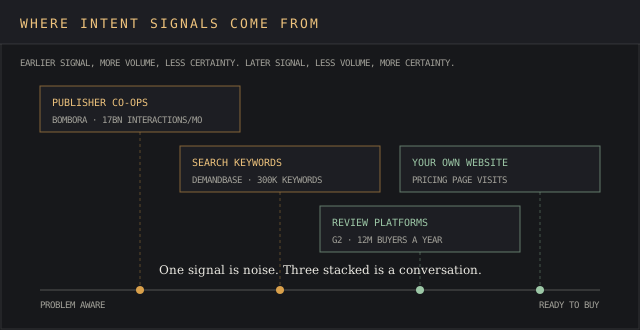
Publisher co-ops track content consumption across a network of sites. Review platforms track buyers comparing products. Search keyword identification infers interest from query behaviour. Website visitor identification resolves your own traffic to companies.
Each has a bias. Review sites over-index on buyers already in a shortlist. Publisher networks catch earlier, vaguer interest. Your own website catches the most qualified signal and the smallest volume.
Freshness and activation
Intent decays faster than any other data type. A signal two weeks old describes a decision that has probably moved on, which is why these arrive as a continuous feed.
Most intent data providers integrate with major CRMs, and real-time integration allows immediate activation of intent signals. Check that the integration writes scores into records your reps already open.
Top B2B intent data providers, ranked
Ranked on breadth and honesty of the signal source, how the data resolves to account or contact level, activation reach, and published cost.
Bombora
A publisher data co-op reaching further than any single vendor's own properties, priced as the reference point most of this category gets compared against.
Bombora runs a publisher data co-op, tracking 17 billion interactions monthly across more than 5,000 websites, giving it the lion's share of third-party coverage in this category. Member publishers contribute content consumption behavior, which is why the network reaches further than any single vendor's own properties, and why most competitors here resell or blend Bombora data into their own product.
Why it's ranked #1. It is the closest thing to a neutral utility in this market, and most competitors resell or blend it. It ranks first on coverage and portability.
Teams that want the broadest third-party coverage available and will handle activation downstream themselves.
Features
- Company Surge scoring against a defined topic list.
- Account-level intent data across the full publisher co-op.
- Content consumption patterns broken out by topic and week.
- Distribution into most major sales and marketing platforms.
- Audience segments for advertising activation.
Pricing
Quoted, with no price on bombora.com. Vendr records a $25,000 median across 35 purchases, ranging $13,000 to $80,450, with 12.41% average savings. Mid-range for the category, and the reference price most other providers get compared against.
Pros
- Broadest third-party coverage of any provider here.
- Neutral distribution, so the data reaches your existing stack.
- No lock-in to one activation platform.
- A topic taxonomy stable enough to trend against over time.
Cons
- Account level only, so sales still needs contact data from elsewhere.
- No activation layer of its own.
- Co-op coverage skews toward the publishers who joined it.
6sense
An AI layer over raw intent, turning a topic score into a predicted buying stage a rep can act on directly.
6sense processes over 1 trillion buying signals daily across more than 40 languages, then uses AI to synthesise them and map accounts to buying stages.
Why it's ranked #2. It does more with intent than anything below it. It sits behind Bombora because the model does not travel with you if you leave, and because the underlying signal is partly bought in. See the full 6sense vs ZoomInfo comparison for how the two handle contact data versus intent.
Revenue teams that want a predicted buying stage per account, already interpreted for them.
Features
- Buying-stage prediction per prospective account.
- First-party and third-party signal blending in one model.
- Anonymous website visitor identification.
- Contact data available as an add-on.
- Segment orchestration across marketing and sales teams.
- CRM integration for real-time activation.
Pricing
6sense quotes every contract and publishes no rate card. Vendr logs a $62,440 median across 385 purchases, from $11,376 to $176,809, and 16.77% average savings.
Pros
- Buying-stage output is more actionable than a score nobody knows how to read.
- Signal volume and language coverage are the largest here.
- Blends your own data with third-party intent in one model.
Cons
- Expensive, and the model needs pipeline history to calibrate.
- Implementation runs long relative to the category.
- The prediction is a black box you are asked to trust, an elephant in the room nobody in this category likes to name.
Demandbase
Signal and advertising activation under one contract, built for ABM programmes that want to spend against an account list the moment it surfaces.
Demandbase tracks more than 500 billion signals monthly across over 300,000 keywords, then lets you spend against the accounts that surface.
Why it's ranked #3. Best activation story here, and keyword-level detail beats Bombora's topics for some buyers. It ranks third because the coverage underneath is narrower and the entry price is a negotiation. See the full Demandbase vs ZoomInfo comparison for pricing and coverage detail.
ABM programmes that need the signal and the advertising activation in the same platform.
Features
- Keyword-level intent across a publisher network.
- Search keyword identification tied to account records.
- ABM advertising activation against target accounts.
- Account identification on anonymous traffic.
- Predictive analytics on account fit.
- Marketing automation platform and CRM integration.
Pricing
Demandbase quotes every contract and publishes no rate card. Vendr's median lands at $68,591 over 187 purchases, ranging $24,000 to $164,037, with 13.27% average savings.
Pros
- Signal and activation in one contract removes an integration and an argument.
- Keyword-level granularity beats topic-level for narrow categories.
- Strong for aligning marketing and sales teams on one account list, and it takes two to tango when the ad budget and the pipeline both depend on the same signal.
Cons
- The price band is so wide that the quote is the only number that matters.
- Not a contact data source.
- Methodology is as opaque as the rest of the category.
G2 Buyer Intent
Late-stage, high-precision signal drawn from a review platform, catching a buyer who is already comparing named alternatives.
G2 captures intent from more than 12 million buyers a year researching software on review platforms. The signal is late and unusually specific.
Why it's ranked #4. Highest signal quality per record of anything here, on the smallest volume. You can't have your cake and eat it too, and that trade is what keeps it out of the top three.
Software vendors with an active category on G2, where buyers are already comparing them against named alternatives.
Features
- Alerts when accounts view your profile, your category, or a competitor's page.
- Comparison-view signals showing who you are being measured against.
- Review-site data tied to company domains.
- CRM and Slack delivery.
- Category-level intent data alongside product-level.
Pricing
Quoted. G2's plans page sells Buyer Intent as a G2 Demand add-on with no published price. Vendr's $27,813 G2 median covers every G2 product, so it can't stand in for a Buyer Intent price.
Pros
- The most decision-stage signal available, because someone reading a comparison page is shortlisting.
- Competitor-view alerts have no equivalent elsewhere.
- Bolts onto a G2 seller package the vendor may already pay for.
Cons
- Volume is small, and it is zero if your category is quiet on G2.
- Catches buyers late, after the category has been chosen.
- It captures demand that already exists over surfacing new demand.
ZoomInfo
Intent sold as an add-on to a contact database most revenue teams already run, priced to reward buyers who are already customers.
ZoomInfo sells intent as an add-on to its Sales Intelligence Cloud, which lets buyers build automated workflows integrating with the rest of the tech stack.
Why it's ranked #5. The integration advantage is real and the signal is average. For a ZoomInfo customer it would rank second; for anyone else it barely qualifies.
Teams already paying for ZoomInfo who want intent attached to the contact data they license.
Features
- Topic-level intent scored against tracked accounts.
- Website visitor identification.
- Workflow automation triggered by signal thresholds.
- Contact data in the same platform, including direct dials.
- Broad CRM and sales-tool integration.
Pricing
Quoted per seat with credit allocations. ZoomInfo's pricing page sells Streaming Intent as an add-on priced on expected usage, set by keyword volume and the size of the account universe tracked, and names no amount. Vendr's buyer-reported data puts the median contract at $33,500 across 1,574 purchases, spanning $7,220 to $155,730, with 21.81% knocked off list on average.
Pros
- Intent and contact data in one record removes the join that breaks elsewhere.
- Workflow automation converts a signal into an action with no human routing.
- Existing customers avoid a second procurement cycle, and if it ain't broke, they don't need to fix it.
Cons
- Only sensible for a team already paying for the platform.
- Signal depth trails the dedicated intent providers.
- Add-on pricing sits on top of an already expensive base.
Cognism
Job-change and funding triggers paired with a verified phone number, built for European teams that treat an event as intent over a topic score.
Cognism's intent data includes job changes and funding alerts alongside licensed topic feeds. Companies that recently raised funding are 2.5 times more likely to adopt new solutions, which makes the funding trigger unusually reliable.
Why it's ranked #6. Strong on events, unremarkable on topic intent. It ranks here because the trigger data is genuinely differentiated and the rest is resold.
European teams that treat trigger events as intent, and want the phone number attached to the signal.
Features
- Topic intent delivered through licensed partner feeds.
- Job-change and funding-event alerts.
- Phone-verified mobile numbers attached to the accounts that surface.
- GDPR-compliant collection.
- Chrome extension and CRM integration.
Pricing
Cognism quotes every contract and offers no free plan. Cognism's pricing page lists Standard and Pro tiers, each with five seats included, and publishes no prices. Vendr's Cognism marketplace page returns a 404, so no buyer-reported median is cited here.
Pros
- Trigger events beat topic scores on precision.
- Contact data and intent in one contract, with European compliance.
- Funding alerts convert directly into a reason to call.
Cons
- Topic intent is licensed, so it adds nothing Bombora doesn't have.
- Per-user pricing punishes large teams.
- US coverage trails ZoomInfo.
TechTarget
Publisher-owned readership data across a small set of trade publications, narrow to IT categories and unusually precise inside them.
TechTarget's intent data focuses on activity across technology publications it owns, which makes the signal narrow, deep and first party to the publisher. It is no jack of all trades, and IT buyers pay for that narrowness on purpose.
Why it's ranked #7. Inside its category it beats everything above it on precision. Outside it, the coverage is zero, which is what caps it.
Vendors selling into IT buying committees, where the audience reads a small set of trade publications.
Features
- Content consumption tracked on owned technology publications.
- Contact-level signals where readers are registered.
- Account and prospect-level reporting.
- Content syndication as an activation route.
- Topic taxonomies built for enterprise IT.
Pricing
Quoted, usually bundled with content syndication commitments.
Pros
- Publisher-owned data means known, registered readers.
- Contact-level detail where most third-party providers deliver account level only.
- Deep coverage of enterprise IT topics.
Cons
- Narrow to technology categories.
- Often sold attached to a media buy.
- Little value outside IT buying committees.
Breeze Intelligence
First-party visitor identification built into HubSpot, trading co-op scale for a signal that fires inside the CRM with no integration project.
Breeze integrates intent data directly into HubSpot workflows, resolving anonymous visitors on your own digital properties into named companies.
Why it's ranked #8. Best first-party intent option for the buyers it fits, and irrelevant to everyone else. The fit is narrow.
HubSpot-native teams who want first-party intent working without a second platform.
Features
- Website visitor identification on your own site.
- First-party intent scored inside HubSpot.
- Automatic firmographic enrichment on the accounts identified.
- Native workflow triggers with no connector work.
Pricing
Credit-based and bundled into HubSpot tiers, with custom pricing above the included allowance. Our Clearbit pricing report puts intent at 10 credits, or $0.10, per company a month.
Pros
- First-party intent is the most qualified signal available.
- Activation is immediate because it fires inside the CRM, letting a rep hit the ground running the moment a visitor gets identified.
- No separate integration project.
Cons
- Your own website only, so volume is a fraction of the co-op providers.
- Nothing outside HubSpot.
- Identification rates depend on traffic quality.
Apollo.io
Buyer intent bundled into an existing contact-database subscription, the cheapest way in this ranking to have any intent signal at all.
Apollo bundles buyer intent signals into higher tiers of its contact database, which makes it the cheapest way to have any intent at all.
Why it's ranked #9. It earns a place on price alone. A team spending $10,000 annually gets some usable signal, and should read the score accordingly.
Small teams that want some intent signal without signing a second contract for it.
Features
- Topic-level buyer intent signals on paid tiers.
- 240 million+ contact records in the same platform.
- Sequencing that can fire directly off a signal.
- Chrome extension and CRM integration.
Pricing
$49 per user a month at the entry paid tier, on top of a Starter plan that stays free with no strings attached. Trials include 50 credits and 5 mobile credits.
Pros
- By far the cheapest entry point in this ranking.
- Data, intent and outreach in one subscription.
- Published pricing with no sales call required.
Cons
- Signal depth is thin against dedicated providers.
- Coverage and refresh cadence are not disclosed.
- Intent is a bundled feature here, secondary to the contact database.
Leadfeeder (formerly Dealfront)
A website-visitor identification platform with a European data and compliance footing, rebranded from Dealfront back to Leadfeeder on March 24, 2026.
Leadfeeder resolves website visits to companies, with a European data and compliance footing. The product was sold as Dealfront since 2023 and reverted to the Leadfeeder name on March 24, 2026; the anchor and comparison-table entry on this page keep the old "dealfront" reference so existing links into this ranking stay intact.
Why it's ranked #10. It answers one narrow question well. It ranks last because that question assumes traffic you may not have, and without it the whole approach is a long shot.
European teams whose main intent question is which companies are already on their own website.
Features
- Real-time prospect identification from website visits.
- Page-level behaviour tracking, including pricing-page views.
- European company database underneath the identification.
- GDPR-oriented collection.
- CRM integration and alerting.
Pricing
Published: Lite is free for the last 100 identified companies a month; Discover runs €79 to €309/mo billed annually, Activate €369 to €729/mo, Scale €599 to €2,089/mo, each tier set by identified companies per month, per leadfeeder.com/pricing.
Pros
- Pricing-page views are the highest-intent first-party signal there is.
- European identification rates beat the US-first tools.
- Cheaper than the enterprise platforms.
Cons
- First party only, so no view of accounts that haven't found you.
- Identification resolves to a domain; naming the person is a separate product.
- Limited outside Europe.
Try it yourself
Start a Leadfeeder trial
14 day free trial on every paid plan, no card; Lite stays free at 100 identified companies a month.
 Visit Leadfeeder →
May earn a commission if you sign up through this link, at no extra cost to you. Full affiliate disclosure.
What buyer intent data is
Buyer intent data is behavioural evidence that an account is researching a category, collected from content consumption, search activity, review sites and your own digital properties.
It tells you when a prospect may be interested in buying. It does not tell you that they will, and providers that imply otherwise are overselling.
First party, second party and third party intent
First party intent data is collected from a business's own assets: your website, your emails, your product. It is the most qualified and the smallest in volume.
Second party intent data comes from another company's first party assets, shared or licensed to you. Review platforms and trade publishers are the common examples, and the signal is strong because the publisher knows who was reading.
Third party intent data is collected by external providers across many sources, then resolved to a domain. It is the largest in volume and the loosest in attribution.
Most teams start with third party for coverage and add first party for precision, getting the best of both worlds without betting everything on one source alone. Running only third party intent produces a long list nobody trusts.
Identifying high intent accounts across the buyer journey
Identifying high intent accounts is a question of stacking weak signals, since any one of them alone is a needle in a haystack. Intent data helps identify high intent accounts through increased brand searches, competitor comparisons and repeat content consumption on the same topic.
Early in the buyer journey, an account reads about the problem. Third party topic intent catches this, and almost nothing else does.
Mid-journey, they compare vendors. Review platform signals catch this, and they are the most specific data you will get all cycle.
Late, they visit your pricing page. First party visitor identification catches this, and by then the sales process is either already open or you are losing it quietly.
One signal is noise. An account that appeared in topic intent last month, viewed a competitor comparison last week, and hit your pricing page yesterday is a different proposition, and that is what stacking means in practice.
Intent data can decrease sales cycles by engaging potential customers earlier, and it works for retention too. Using intent data to spot an existing customer evaluating alternatives lets a customer success team intervene before the renewal conversation starts.
Making intent data pay
Reported reduction in cost per lead among performance marketing teams using intent data, alongside a 90% success rate at increasing lead volume. Both figures come from vendor-adjacent sources, so read them as a general direction.
The mechanism behind them is unglamorous. Intent data helps by reordering a list you already had, so the same rep stays on the ball and works the same accounts in a better sequence.
Where teams get it wrong
Before buying, write down what happens the day a signal fires. If nobody can name the sequence, the routing rule or the ad audience it feeds, the purchase produces a dashboard.
Treating a score as a qualification is the first mistake. Behavioural signals from intent data may not indicate an imminent purchase, and a rep who opens with "I saw you were researching" against a false positive burns the account.
Buying intent before you can activate it is the second. If nothing routes the signal into a sequence or an ad audience, the intent data investment produces a dashboard.
Buying account level data and expecting contact-level action is the third. Someone at the company is in market. You still need to work out who, which is what a contact database is for.
Intent data FAQ
What is buyer intent data?
Behavioural data showing that an account is researching a category, gathered from content consumption, search behaviour, review platforms and first party website activity. It is used to prioritise which accounts get worked first.
How much does intent data cost?
Published prices start at $49 per user per month for Apollo's bundled signals. At the high end, intent data can cost an arm and a leg: Vendr's buyer-reported medians put Bombora at $25,000, 6sense at $62,440 and Demandbase at $68,591 a year. G2 Buyer Intent and ZoomInfo's Streaming Intent add-on are both quoted, with no price published by either vendor.
Is account level or contact level intent data better?
Account level is standard for ABM and is what most third party providers deliver. Contact level is more actionable for sales teams, because a rep can call a person. Most programmes buy account level intent and resolve contacts separately.
How fresh does intent data need to be?
Intent data needs to be fresh within days. Intent decays faster than any other data type, which is why real-time integration matters more here than in contact data. A monthly export of intent has aged into a report by the time it lands.
Who offers the best intent data?
Bombora for third party coverage, 6sense for modelling, Demandbase for activation, G2 for decision-stage precision. There is no single answer, because the best source depends on where in the buyer journey you need to catch people.
Can intent data predict when a company will buy?
No. It indicates research activity, and research does not always become a purchase. Providers that model buying stages are estimating probability from past patterns. Nobody is reading a calendar.
Bottom line
Buy for the stage you are weakest at. Third party topic intent if you need to find accounts before they find you. Review platform intent if you lose deals you never knew were open. First party identification if traffic arrives and leaves unnamed.
Then check you can act on it before you sign. The intent data market sells signal volume, and the teams that get value from it are the ones who got the ball rolling on a routing plan first.
Activating intent data in your stack
An intent data platform earns its cost at the point of activation. Collection is the cheap half. Teams that can activate data the day it arrives get value; signal that never leaves the vendor's portal is a subscription to a dashboard.
The data layer underneath
Intent has to land somewhere that already holds account records. Integrated intent data written onto the account object in your CRM behaves like a field; the same data in a separate tool behaves like a chore.
That means the data layer matters more than the score. Third party data resolves to a domain, so it needs matching against your existing accounts before it means anything, and first party data needs the same treatment in reverse.
Data enrichment is the usual bridge. Enrich existing customer records with firmographics and contacts first, killing two birds with one stone so that when a signal fires against a domain there is already an account, an owner and a contact to route it to.
Three ways to activate
Route to sales. Score thresholds trigger a task or a sequence. This is the fastest path to revenue and the one most likely to misfire, because a rep acting on a false positive is worse than a rep acting on nothing.
Fuel marketing campaigns. Push the accounts that are actively in market into advertising audiences and nurture tracks. Lower risk, slower payback, and it works at volume where sales routing does not.
Inform strategy. Category level intent data aggregated over quarters shows where demand is forming, which is closer to global market insights than to a lead list. Few teams use it this way and it is often the most defensible use.
Matching intent to the right account
Accurate data at the matching step decides everything downstream. A signal attributed to the wrong account produces confident nonsense, and nobody audits it because the dashboard looks the same either way.
Check how the provider resolves an IP or a cookie to a company, and how it handles shared offices, ISPs and remote workers. Those three cases are where identify accounts logic breaks, and where false positives originate.
Identifying buyers inside a flagged account is a separate job. Account intelligence tells you the company is looking; contact data tells you who to call; neither alone is enough to target potential customers with anything specific.
Key factors before you sign
Four key factors, in order. Whose first party assets generate the signal, because that determines the bias. Account level or contact level resolution. Latency between the behaviour and the alert. And what the contract allows you to do with the data if you leave.
That last one catches people out. Some providers licence intent for use inside their platform only, which means you identify intent for as long as you keep paying and take nothing with you.