Demandbase vs ZoomInfo
 By Jan Suski. I go deep on every review, checking every number against its source and digging up details other coverage misses, a habit from six years of SEO and link building for tech companies. Bylines at Surfer, Brand24, and Senuto. How the scoring works.
· Prefer this source on Google
| WHAT EACH ONE DOES | DEMANDBASE | ZOOMINFO |
|---|---|---|
| Core job | ABM platform, advertising | Contact data, prospecting |
| Contacts claimed | 200 million+ | 500 million+ |
| Companies claimed | 113 million+ | 100 million |
| Account-based ads | Proprietary DSP | None published |
| Intent signal volume | 2.1 trillion a month | Not published at scale |
| Native integrations | Around 70 | Over 200 |
| Call recording | None native | Chorus, built in |
| AI agent | Agentbase, bids on signals | Copilot, account briefings |
| G2 review score | 4.4 from 1,988 | 4.5 from 9,105 |
| WHAT YOU GET | DEMANDBASE | ZOOMINFO |
|---|---|---|
| Published price | None, form only | None, form only |
| Tracked median | $68,591 a year | $33,500 a year |
| Tracked range | $24,000 to $164,265 | $7,200 to $155,280 |
| Contracts tracked | 106 to 185 | 1,012 to 1,569 |
| Avg savings won | 13.27% | 21.81% |
| Free entry point | None | 7-day trial |
| Onboarding timeline | Under 60 days, then 3–6 months | Same week |
| G2 ease of setup | 8.3 from 745 | 8.9 from 2,267 |
| Owner | Private, lender-backed | Public, Nasdaq: GTM |
StrongerWeakerNo edge
Twenty-four further documented limits sit behind the button below: API rate limits, credit costs, data retention windows, security certifications and Google Ads sync mechanics. Demandbase’s contract figures are Vendr’s tracked purchase data across 106 to 185 deals; ZoomInfo’s are the same source across 1,012 to 1,569 deals, and neither vendor publishes a rate card. Every figure is sourced in the section its row links to.
| Demandbase | WHAT IT DOCUMENTS |
|---|---|
| B2B API rate limit | 1,000 requests a minute per endpoint, 429 past that |
| B2B API concurrency | 2 async jobs at once, a 3rd submission returns 429 |
| Admin API rate limit | 90 requests a minute per HTTP method |
| Export daily caps | 60 jobs a day, 1,200 status checks, 10 GB combined |
| Export trial cap | 100 MB per rolling 24 hours |
| Import API limits | 5 GB max file upload, 1,200 jobs a day |
| API authentication | JWT bearer token on every endpoint |
| API suite | 5 named APIs: Admin, B2B, Import, Export, Usage |
| API billing model | Per record returned, or per record under management |
| Search endpoint cost | Contacts and companies search cost 0 credits |
| Data retention | 13 months post-termination, 30-day delete on request |
| SOC 2 status | Type 2, recertified December 2025, no exceptions |
| ISO certification | ISO/IEC 27001:2022, recertified with the SOC 2 audit |
| Trust Site documents | SOC 2, ISO 27001, pentests, CAIQ, SIG Lite, under NDA |
| Pentest cadence | Third-party at least annually, continuous internal testing |
| Status page scope | 6 monitored systems, no uptime percentage published |
| Buying Group export | Account- and person-level buying-committee data |
| ZoomInfo | WHAT IT DOCUMENTS |
|---|---|
| Intent signal volume | 6 trillion+ pairings a month, over 90% of US devices |
| Google Ads min audience | Search under 1,000 users, Display under 500, won’t serve |
| Google Ads sync latency | Up to 48 hours to process, up to 72 to populate |
| Google Ads hierarchy | 2 levels of hierarchy, one Ad Account connected at a time |
| Campaign reporting lag | Up to a 2-day lag against Google Ads metrics |
| Ad audience activation | Native push to LinkedIn and Meta via GTM Studio Ads |
| Form-fill benchmark | 2% to 5% is what ZoomInfo calls a good rate |
Sources, and the rate limits each vendor buries in a different doc
Every row comes from a page the vendor publishes.
- Demandbase: developer.demandbase.com, its security policy and trust site, and its December 2025 SOC 2/ISO recertification release.
- ZoomInfo: zoominfo.com’s intent-data and ad-audience pages, plus its Google Ads integration guide PDF.
Demandbase publishes five named APIs with their own rate limits and a 13-month data retention window after cancellation. ZoomInfo publishes none of that for MarketingOS specifically, and its campaign-configuration help articles render client-side, so several of its own tier limits aren’t independently checkable from outside the product.
Neither vendor publishes a plan-tier feature grid, a minimum ad spend, or an uptime SLA.
Demandbase and ZoomInfo appear on the same shortlist and sell different things. Demandbase is an ABM platform with a proprietary B2B demand-side platform attached, so it buys advertising against target accounts. ZoomInfo is a contact database with sales intelligence layered on it, so it hands a rep a phone number.
Teams that treat this as one decision buy one platform and keep paying for the other. This Demandbase vs ZoomInfo comparison prices both, compares what each dataset covers, reads the attack page each vendor publishes about the other, and says which revenue teams should run both.
It’s written for a RevOps or demand-generation lead holding two quotes. Every price traces to procurement data or a vendor document with the date it was read, because the whole search result for this query cites itself in a circle.
↑ COMPARISONThese two platforms solve different problems
Demandbase focuses on account based marketing: pick target accounts, score them, run targeted campaigns at them across display, video, CTV, social and web, then measure account engagement. Its own pricing page refuses to unbundle, stating that "we don't split Demandbase One into separate solutions".
ZoomInfo focuses on individual prospect discovery across accounts. Its platform works from a search box to an export, and its GTM Context Graph processes 1.5 billion data points a day feeding contact-level data, org charts and buyer signals into sales workflows.
So the overlap is narrow. Both carry company data, both sell intent signals, and both integrate with Salesforce. Everything else on each platform answers a question the other one doesn't ask.
The capabilities barely meet. An ABM platform buys media, personalises a website and scores accounts. A sales intelligence platform finds people and hands them to a rep with a number attached. Marketing and sales own the two budgets separately, and marketing teams and sales teams each arrive with their own shortlist.
Many organisations run both. ZoomInfo supplies the verified emails and direct dials for outbound prospecting; Demandbase supplies the account scoring, advertising and web personalization that decides which accounts get worked at all.
↑ COMPARISONWhat each platform’s data covers
ZoomInfo’s contact data and direct dials
ZoomInfo publishes 500 million contacts, 100 million companies, 135 million verified phone numbers and 200 million validated emails on its own comparison material, updated 14 June 2026. Those are vendor claims, unaudited by anyone outside the company.
The contact database is the product, and contact records are the unit. Business contacts carry job title, seniority, department and reporting line, which is why sales teams doing outbound motions keep it after cheaper options reach the shortlist.
Demandbase’s account data and intent signals
Demandbase’s account intelligence page publishes 113 million companies, 200 million B2B contacts, 48,000 technologies, 3.7 billion IP addresses and 168 million social profiles. Its intent layer claims 2.1 trillion intent signals a month against 865,000 keywords, drawn from 70 billion page views a day across 133 languages.
Its technology-stack coverage and firmographic data feed the account scoring that drives everything downstream. Contact level data is the weaker half: reviewers report it as the most common complaint, and ZoomInfo’s own attack page calls out gaps there by name.
Data quality on both platforms
Data quality gets compared unfairly here because each vendor measures a different thing. ZoomInfo’s data quality claim rests on volume and refresh rate, 500 million contacts against a real-time update cycle. Demandbase’s rests on account coverage, 113 million companies with technographic data attached.
Buyers judge data quality by bounced emails and dead phone numbers, and on that measure Demandbase loses. Stale contact records lead its low-star reviews at 26 of 51 read, and 45 G2 reviewers tag data inaccuracy by name.
Neither vendor publishes a bounce rate. Data quality on both platforms is something a pilot against your own closed-won accounts settles, and the platform fee falls due either way.
Target accounts, account scoring and buyer signals
Demandbase exists to target specific accounts. The ABM platform assembles a list of high value accounts, applies predictive models to rank those accounts, then points marketing and sales at the survivors. Account scoring, lead scoring and buyer signals feed one queue.
ZoomInfo’s account based strategies work from the contact upward. Reps search for decision makers, pull phone numbers, and the accounts assemble themselves out of who answered. Predictive analytics run inside Copilot, ranking accounts with no media layer to act on the ranking.
Standout features diverge at that point. Demandbase can target specific accounts with paid media and adjust bids as those accounts move deeper into an evaluation. ZoomInfo can tell a rep which decision makers at the same accounts changed jobs last month.
Both platforms promise actionable insights. One publishes the signal volume behind them, and its own comparison page understates that volume.
Marketing teams running mature ABM programs need the account layer to support complex committee structures, where six to ten decision makers touch one deal. Sales teams need the contact layer for their own sales efforts. Revenue teams running both need account IDs to match across the two platforms at the same level of granularity, which is the integration work nobody quotes for.
A demo request from one of those accounts lands differently on each platform: Demandbase reads it as an account engagement event, ZoomInfo as a contact to enrich. Neither is providing insights the other can’t, and both charge for the account list underneath.
↑ COMPARISONIntent data accuracy and how each vendor measures signals
Intent data accuracy is measured differently on each side, which makes the two figures incomparable. Demandbase resolves intent at the account level from page-view volume across its own publisher network, then assigns keyword-level scores to accounts.
ZoomInfo resolves intent from website visitor identification, technographic data and its Streaming Intent add-on, which it prices on the volume of keywords and the size of the account universe. Real-time and custom intent signals sit on Copilot Enterprise only.
Neither vendor publishes a false-positive rate. Treat intent data accuracy claims from both as directional until a pilot on your own closed-won accounts says otherwise.
↑ COMPARISONAccount based advertising, the capability ZoomInfo doesn’t sell
Advertising is the one line item on this page that only one vendor can invoice for.
Demandbase runs a proprietary B2B demand-side platform and buys media directly. ABM advertising, impression balancing across an account list, and intent-based, people-based and IP-based targeting are all first-party capabilities, spanning display, video, CTV, social and web.
ZoomInfo sells no equivalent. Its ABM tiers gate a display network with campaign and account caps, and its marketing capabilities stop well short of a DSP.
Advertising is therefore the cleanest line between the two products. A team with an advertising budget aimed at named accounts has one candidate on this page.
↑ COMPARISONWhat Demandbase and ZoomInfo cost
Neither vendor publishes a price. Demandbase describes its model as "a clear platform fee that covers all the essential software and services" plus "a flat fee per user", with no figure attached.
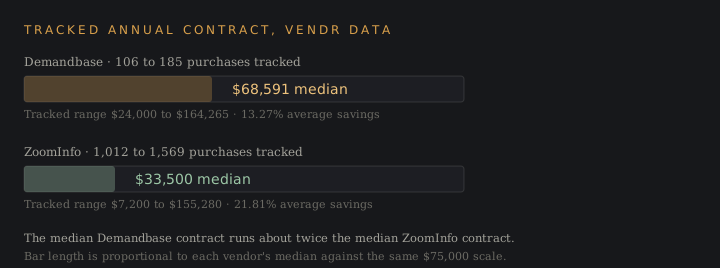
Vendr’s marketplace page puts Demandbase’s median annual contract at $68,591, low $24,000, high $164,265, average negotiated savings 13.27%. The deal count reads 106 in the header stat block and 185 in the widget below it, so the sample is roughly 106 to 185 closed contracts. Last updated February 2026.
ZoomInfo’s tracked median on the same source is $33,500, low $7,200, high $155,280, savings 21.81%, across roughly 1,012 to 1,569 purchases. The median Demandbase contract costs about twice the median ZoomInfo contract.
Total cost separates further once advertising enters. Demandbase’s platform fee sits on top of the media spend it places, and no ad-fee percentage is published anywhere on its site. Ask for it in writing before modelling total cost.
↑ COMPARISONThe claims each vendor makes about the other
Both companies publish an attack page. Demandbase’s went up at demandbase.com/why-demandbase/zoominfo, last modified 9 December 2025. ZoomInfo’s sits on its Pipeline blog, updated 14 June 2026 under Dennis Sevilla’s byline. The two disagree, and one of them disagrees with itself.
| Claim | Made by | What checks out |
|---|---|---|
| Demandbase tracks “1+ trillion intent signals every month” | Demandbase | Its own product page says 2.1 trillion. The attack page understates it by more than half |
| Demandbase supports “over 575k+ keywords” | Demandbase | Its own product page says 865,000 |
| Demandbase has 176M+ contacts and 104M+ companies | ZoomInfo | Understated. Demandbase publishes 200M+ and 113M+ |
| Demandbase intent runs 2T+ signals and 810K+ keywords | ZoomInfo | Closer to Demandbase’s live figures than Demandbase’s own comparison page |
| Demandbase G2 score is 4.4 from 1,934 reviews | ZoomInfo | Rating correct, count now 1,988 |
| Demandbase has no native conversation intelligence | ZoomInfo | Correct. ZoomInfo has Chorus |
| Rivals harvest “unvetted sources” including “email scraping” | Demandbase | Unnamed target, no evidence cited |
| “Other vendors don’t offer web personalization at all” | Demandbase | Correct for ZoomInfo’s published capabilities |
The finding worth keeping: ZoomInfo describes Demandbase’s intent volume more accurately than Demandbase’s own comparison page does. Demandbase left stale figures on the page it wrote to win the comparison.
Data verification and the accuracy figures in circulation
ZoomInfo publishes no headline accuracy percentage on any page it owns. Third-party comparison sites quote up to 95% verification accuracy for its database, and a separate set of them quotes email accuracy dropping to 52% in fast-moving sectors. Neither number traces to ZoomInfo.
Both figures describe the same underlying problem: contact data decays fastest where headcount turns over fastest. Tech and agency contacts go stale in months; regulated industries hold for years. A single accuracy figure across a 500 million record database hides that spread.
Demandbase’s position is the mirror image. It publishes company-level coverage and intent volume in detail and says almost nothing about contact-level verification, which is where its own reviewers put the complaint.
Ask both vendors for accuracy measured on your own segment, sampled against records you can verify. A vendor-wide percentage answers a question nobody asked.
↑ COMPARISONOnboarding and entry price
ZoomInfo markets its onboarding programme as award-winning and gives new users a 7-day free trial to evaluate against. Demandbase publishes phases instead: onboarding under 60 days, then adoption.
Comparison sites put ZoomInfo’s entry point at roughly $15,000 a year, often framed as a $14,995 Professional plan for five users. No page zoominfo.com publishes carries that figure, and Vendr’s tracked low sits at $7,200. It comes from third-party pricing sites citing each other, the same chain that put an unverified $30,000 Similarweb floor into circulation.
Demandbase’s tracked low of $24,000 is the closest thing either vendor has to a published floor, and it sits above ZoomInfo’s tracked median. Full-feature Demandbase deals run past $150,000, with the tracked high at $164,265.
Demandbase’s SmartBid technology prioritises accounts showing buying signals inside its advertising platform, and that bidding layer is a large part of what the platform fee buys.
↑ COMPARISONImplementation time and complex setup
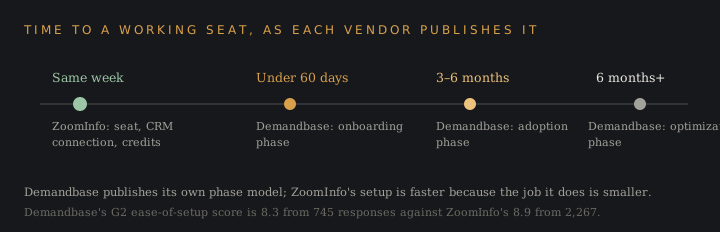
Demandbase publishes its own phase model: onboarding under 60 days, adoption three to six months, optimization six months and beyond. That’s a complex setup by the vendor’s own account, and ZoomInfo quotes it back on its attack page.
ZoomInfo’s setup is faster because the job is smaller. A seat, a CRM connection and a credit allocation put a rep in the platform the same week, and a 7-day free trial exists for evaluation.
Demandbase’s G2 ease-of-setup score is 8.3 from 745 responses against ZoomInfo’s 8.9 from 2,267. New users report a learning curve on Demandbase in 86 tagged reviews, with a further 77 tagging it steep.
↑ COMPARISONIntegrations and workflow automation
ZoomInfo supports over 200 native integrations, connects to Salesforce and HubSpot directly, and exposes APIs for custom integrations. Workflow automation runs through those connections into existing sales workflows.
Demandbase runs around 70 integrations aimed at the major CRMs and marketing automation platforms, and its CRM connections need detailed configuration. Salesforce sync problems appear in 9 of 51 low-star reviews read.
↑ COMPARISONAI agents on both platforms
Demandbase launched Agentbase on 4 March 2025, combining AI agents with campaign orchestration across account tasks. Its bidding agent prioritises accounts showing buying signals inside the advertising platform.
ZoomInfo’s Copilot produces account briefings, recommended sales actions and AI-assisted account prioritization from the same graph that feeds search. Both vendors ship AI agents; neither publishes an accuracy benchmark for them.
↑ COMPARISONReview scores and what reviewers report
Demandbase One holds 4.4 from 1,988 G2 reviews, with quality of support at 8.8 from 1,341 responses and ease of use at 8.5 from 1,591. Gartner Peer Insights gives it 4.5 from 263 reviews, and Gartner named it a Leader in the ABM Platforms Magic Quadrant published 6 November 2025, positioned furthest for completeness of vision among eight vendors evaluated.
ZoomInfo, now listed on G2 as GTM Workspace, holds 4.5 from 9,105 reviews with support at 8.7 from 6,638 responses. Gartner Peer Insights gives it 4.2 from 439 ratings.
Across 51 one and two-star Demandbase reviews, stale or wrong contact data leads at 26 mentions, followed by difficulty learning the interface at 10, Salesforce sync failures at 9, price against value at 8, and customer success manager quality at 7.
Customer satisfaction on the ABM side is high; the complaints cluster on the contact data underneath it. That pattern is the argument for running both platforms.
↑ COMPARISONWhich platform fits which revenue team
Choose Demandbase for mature ABM programs
An enterprise marketing team with a named target account list, an advertising budget aimed at those accounts, and a marketing operations resource to own the configuration gets the most from Demandbase. Account scoring, web personalization and ABM campaigns run in one platform, and the Gartner Leader position is five consecutive years deep.
Skip it if nobody owns the platform day to day. The published adoption window runs three to six months, and smaller businesses without a marketing operations hire will still be configuring it when the renewal lands.
Choose ZoomInfo for outbound prospecting at scale
Sales teams that need business contacts, direct dials and org charts to reach decision makers get more from ZoomInfo’s extensive database. Mid market and enterprise sales operations with existing Salesloft or Outreach deployments feed those tools from it.
Skip ZoomInfo if the goal is marketing orchestration. It sells no DSP, no paid-media buying against named accounts, and no website personalization, and its 2026 numbers carry their own risk: net revenue retention of 89% in Q2 2026, a $650.5 million goodwill impairment, and a May 2026 restructuring cutting about 600 roles, roughly 20% of headcount.
Demandbase vs ZoomInfo FAQ
What is the difference between ZoomInfo and Demandbase?
ZoomInfo sells contact data and sales intelligence for prospecting. Demandbase sells an ABM platform with advertising, account scoring and web personalization. The company database overlaps; almost nothing else does.
Who competes against ZoomInfo?
Apollo and Cognism on contact data, and 6sense, ZoomInfo, Demandbase and Terminus on the account based marketing side, each against a different part of the product line, the same set ranked in full on our ZoomInfo alternatives page.
Who are the competitors of Demandbase?
6sense and Terminus in ABM orchestration, with RollWorks in the mid market. Gartner evaluated eight vendors in its November 2025 ABM Platforms Magic Quadrant.
What is the lawsuit against ZoomInfo?
ZoomInfo settled right-of-publicity class actions across California, Illinois, Indiana and Nevada for $29,557,612.50, recognising a $30.1 million charge in its FY2024 accounts and agreeing not to use class members’ identities in advertising for three years. Actions in Washington, Quebec and Colorado were still pending at its FY2025 filing.
Which platform has better intent data?
Demandbase publishes larger volumes and finer keyword granularity. ZoomInfo ties intent signals to named contacts you can call today. Depth against actionability, and the answer follows what the team does with the signal.
Is Demandbase a CRM?
No. It reads from and writes to a CRM and replaces neither the CRM nor the marketing automation platform beneath it.
Can you run both?
Yes, and it’s the common configuration at enterprise scale. ZoomInfo enriches the contact record, Demandbase decides which accounts are worth the enrichment. Budget for both medians: roughly $102,000 a year at the tracked midpoints.
Verdict
Sales intelligence capabilities and account based marketing capabilities get filed as one analyst category and bought as two line items. Intent data is the only place the two genuinely compete, and the intent data means different things on each side.
Demandbase wins on advertising, account engagement and ABM orchestration, and it costs about twice as much at the tracked median. Its own attack page understates its own intent volume, a fair warning about how much of this category’s published data to take on trust.
ZoomInfo wins on contact data volume, direct dials and speed to first value, and it’s the cheaper contract by a wide margin. Its financial position in August 2026 belongs in the negotiation: NRR at 89%, a 20% workforce cut in May, and a stock that hit an all-time low the same month.
Buy Demandbase if marketing and sales are working a fixed account list with media behind it. Buy ZoomInfo if reps need names and numbers this quarter. Run both when the account list is fixed and the contact data underneath it keeps going stale. Demandbase is headquartered in San Francisco.
Demandbase sources: demandbase.com pricing, account intelligence and why-demandbase/zoominfo pages; developer.demandbase.com API and rate-limit docs; demandbase.com/security-policy and trust.demandbase.com.
ZoomInfo sources: zoominfo.com data and intent-data pages; pipeline.zoominfo.com/sales/demandbase-vs-zoominfo (updated 14 June 2026); tech-docs-library.zoominfo.com Google Ads integration guide; ZoomInfo SEC filings and FY2024/FY2025 disclosures.
Third-party sources: vendr.com/marketplace/demandbase and vendr.com/marketplace/zoominfo, read February 2026; G2 and Gartner Peer Insights listings for both products. Accessed 8 August 2026.