Market intelligence APIs: 8 news and signal feeds ranked for 2026
 By Jan Suski. I go deep on every review, checking every number against its source and digging up details other coverage misses, a habit from six years of SEO and link building for tech companies. Bylines at Surfer, Brand24, and Senuto. How the scoring works.
· Prefer this source on Google
Quick comparison of market intelligence APIs
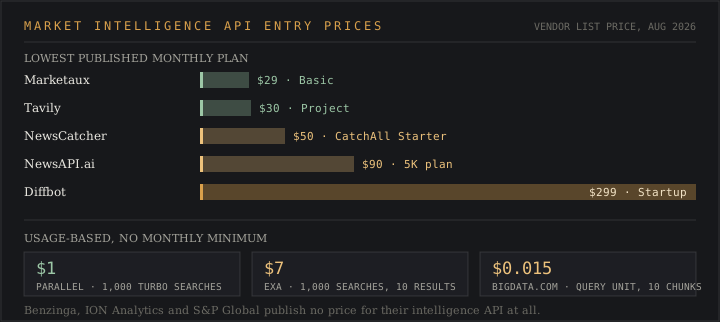
Coverage figure is each vendor's own published archive or entity count; entry price is the lowest published plan or per-unit rate. Two vendors publish no coverage figure at all.
| # | Provider | Coverage figure | Entry price | Best fit |
|---|---|---|---|---|
| 1 | Bigdata.com | 25+ years of content, 12M entities | $0.015 per query unit, pay as you go | Market-impact sentiment for research teams |
| 2 | NewsAPI.ai | Archive since 2014, 1M+ articles daily | $90/month (5K plan) | Multilingual media monitoring |
| 3 | NewsCatcher | 2 billion+ articles back to January 2019 | $50/month (CatchAll Starter) | Teams that need documented deduplication |
| 4 | Diffbot | 150TB index, 10 billion entities | $299/month (Startup) | Structured entity queries over the web |
| 5 | Exa | 50M+ company pages, 1B+ people | $7 per 1,000 searches | Agents that need tunable latency |
| 6 | Parallel | Not published | $1 per 1,000 Turbo searches | Monitoring competitor pages for changes |
| 7 | Tavily | Not published | $30/month (Project) | Cheapest production-grade search key |
| 8 | Marketaux | 5,000+ sources, 200,000 entities | $29/month (Basic) | Ticker-level sentiment on a fixed budget |
Prices are vendor list prices taken from each provider's own pricing page in August 2026. Coverage figures are the vendor's own claims; where a vendor publishes two different numbers for the same thing, both appear in the entry below.
Where these figures come from
Prices and coverage figures are each vendor's own published number, read on 11 August 2026. Where a vendor publishes two figures for the same thing, both appear in the entry, so you can read between the lines yourself and judge which number holds up. Neither Parallel nor Tavily publishes a coverage figure at all, so their rows carry pricing only.
A market intelligence API delivers news, company mentions, sentiment scores and market moving events to your own code as JSON over HTTP, with no dashboard to log into. The eight ranked below all do that. What separates them is the archive they can reach, the unit their sentiment is scored on, and if the price is published at all.
This page ranks eight vendors against six criteria a buyer can test in an afternoon, with every figure linked to the vendor page it came from. Entry prices, documented rate limits, historical data depth and deduplication thresholds are all here, along with what each market intelligence API returns in the response body.
It's written for the engineer or analyst who already knows the ropes and has to pick one and wire it into an existing system. Financial firms buying a terminal seat ask different questions, and the enterprise feeds that answer them sit in their own section further down.
The reason to compare now is that six of the eight vendors changed their pricing model in the last two years, and three of them publish figures that contradict other figures on their own site.
Two sibling rankings sit next to this one: lead intelligence software covers the company and contact-level data these APIs surface as entities, and competitive intelligence tools covers the dashboards built on top of the same news and filings data delivered here as raw JSON.
Evaluation criteria for market intelligence APIs
Six criteria decide the shortlist, and the ranking below applies them in this order. Each one resolves to a number or a yes/no you can check against the vendor's documentation before you sign anything. None of them asks how accurate the datasets feel.
Published entry price and the unit it bills
Three billing units are in play across this category: per request, per credit, and per token consumed. A vendor that publishes a number is testable; one that routes you to sales isn't, and actions speak louder than words when the only proof on offer is a number you can check yourself. Benzinga, ION Analytics and S&P Global publish no price for their intelligence API at all.
Archive depth, and free-plan access to it
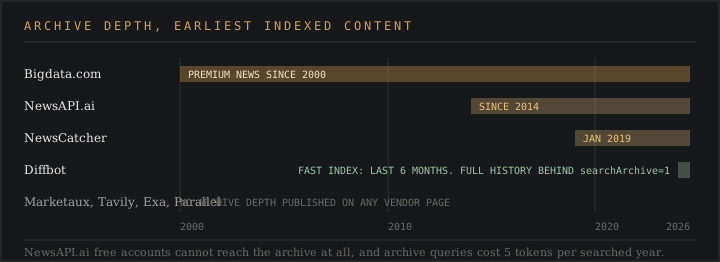
Backtesting a signal needs history, and history is where free plans get cut off first. NewsAPI.ai states it plainly: "note that free users don't have access to archive, regardless of this parameter value". Ask for the earliest date the index holds, then ask what it costs to query it.
Documented rate limit, including concurrency
Requests per minute is the number vendors advertise. Simultaneous connections is the one that breaks a pipeline. NewsAPI.ai caps every account at five concurrent requests and tells you in its own docs to run sequentially.
Sentiment analysis output: scale, unit and language
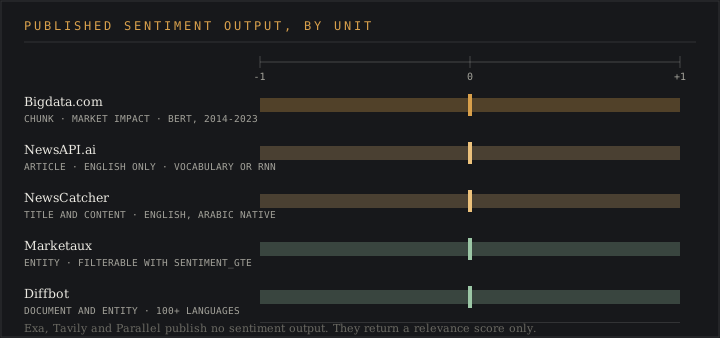
Four of these vendors publish a sentiment scale. Two publish none. The unit matters as much as the range: a score attached to a whole article answers a different question than one attached to a sentence about a single company.
Deduplication thresholds
Wire coverage means one story arrives 40 times, duplicates a dime a dozen unless something catches them. A vendor that publishes its similarity threshold has committed to a behaviour you can measure. A vendor that says it removes duplicates without saying how has not.
Filtering precision below country level
Geography is where agent search APIs stop and news APIs keep going. Exa, Tavily and Parallel all cap location at a two-letter country code. Diffbot filters on city name and employee count in the same query.
The 8 best market intelligence APIs ranked
Bigdata.com
Best fit: Research and quant teams that need sentiment scored at the sentence level, across the deepest archive in the category.
Bigdata.com is the current form of RavenPack, the sentiment vendor that has been selling to financial firms since 2003. Its homepage claims 25+ years of content covering news, filings, transcripts and fundamentals, though its own developers page says 20+ years. The Knowledge Graph holds over 12 million entities, and 7M+ companies resolve by name, ticker, ISIN, CUSIP or SEDOL.
Sentiment is the differentiator. Every text chunk carries a score from -1.00 to 1.00 indicating market impact, produced by a BERT-like transformer whose training data spans from 2014 to 2023. The vendor also documents where it fails: the model performs a global analysis of the chunk, so text carrying two opposing views scores neutral, an admission that hits the nail on the head about where automated sentiment breaks down.
Key features
- Chunk-level sentiment from -1.00 to 1.00, with document-level sentiment marked as sunsetting
- Diversified Search enabled by default in both Fast and Smart modes, measured at a 40% increase in unique sources
- MCP server at mcp.bigdata.com with 11 tools, including a company tearsheet that aggregates 10+ API endpoints
- Point-in-time entity IDs, so a company that renamed in 2019 still resolves against 2018 articles
- Private content indexing at $12.00 per 1,000 TXT pages per year, $42.00 for PDF
Pricing
There is no tier ladder. Pay as you go starts with $50 in free credits and no card, then bills per query unit: $0.015 for Fast mode, $0.03 for Smart mode, $0.0075 for batch. One unit retrieves 10 text chunks. Research Agent tokens run $3.00 per million input and $9.00 per million output. The vendor's own worked examples put a full run at $0.57 to $1.82.
Pros
- Deepest published archive in this ranking, and the only one reaching back before 2014
- Sentiment model, scale and training window are all documented, including the failure mode
- Rate limits are published: 500 requests per minute per session, 1,500 per IP
Cons
- Per-token content rates sit behind a login, so the full cost isn't knowable before signup
- The Python SDK is scheduled for decommission on December 31, 2026
- Archive depth is stated as both 25+ and 20+ years on the same vendor's pages
"If your data is so good why aren't you trading on it" is a question you could ask Bloomberg, RavenPack, Dataminr, or any financial data company that's ever existed. Bloomberg makes $12B/year selling the terminal, not trading on it. Selling the pickaxes is a better business than mining.
Hacker News, u/Shmungus, 18 February 2026. Thread
Why it's ranked #1. It beats NewsAPI.ai on archive depth by more than a decade, reaching content from 2000 against an index that starts in 2014, and it publishes both its sentiment model and its rate limits. It loses nothing above it, and it raises the bar the rest of this list gets measured against.
NewsAPI.ai
Best fit: Media monitoring teams tracking named companies across many languages, where telling Apple the company from apple the fruit matters more than reaching 2005.
NewsAPI.ai, built on Event Registry, clusters articles into events. An event is a group of articles in different languages describing the same occurrence, which is what makes cross-language tracking work: you can't find Spanish coverage of the White House by searching the keyword "White House", because there it is written as Casa Blanca. Concept URIs solve that; keywords don't.
Coverage claims conflict. The pricing page says over 150,000 news outlets and 50+ languages, while the meta description served on every page of the same site says 30,000 publishers. The documented language table lists 57 codes.
Key features
- Event clustering across languages, with concept-based entity disambiguation over keyword matching
- A signal taxonomy the docs describe as over 100 event types, with URIs like
et/business/acquisitions-mergers/acquisition/approved factLevelfilter separating fact, opinion and forecast- Source quality filtering by rank percentile, in bands of 10
- Official MCP server plus Python and Node.js SDKs
Pricing
The 5K plan is $90.00 per month, and the free plan gives 2,000 searches with no card. Tokens are the real unit: one token for a recent article search, five per searched year on the archive, 20 per year for events. Extra tokens cost $0.015 each and nothing rolls over.
Pros
- Entity disambiguation is a named product mechanism, not a claim
- Sentiment runs on two selectable methods, vocabulary or rnn
- Query condition limits are published per plan: 60 keywords and 15 locations on paid
Cons
- Sentiment only works on English, and setting the filter silently drops every other language from your search results
- Five simultaneous requests, account-wide, on every plan
- Location filtering reads the dateline only, so a CES story filed from another desk won't match Las Vegas, missing the mark on exactly the kind of query this filter exists for
Then, as the articles are paginated. the API charges 50 token for each page of the query, when it should be 50 tokens for the entire query. Therefore, I'd been charged 5,000 tokens within minutes. [...] I asked for a refund, explaining the pagination issue, and was told that I made a mistake.
G2 review titled "Bad documentation and API over charges", Randall M., small business, 21 November 2023. G2
Why it's ranked #2. It beats NewsCatcher on published price, $90 against a News API that quotes only on request, and loses to Bigdata.com on archive: 2014 against content since 2000.
NewsCatcher
Best fit: Teams whose biggest complaint about their current feed is duplicate articles, and who want the threshold written down before they buy.
NewsCatcher publishes the most detailed deduplication documentation in this category, leaving no stone unturned on the dedup problem specifically. Stage one flags pairs above a cosine similarity threshold of 0.95. Stage two applies Levenshtein distance at 0.97 for titles and 0.92 for content, which the docs say reduces false positives by separating articles that discuss similar topics from true near-copies. Each article is compared against the past seven days.
The company sells three products with separate keys: CatchAll for self-serve web search, News API for enterprise, and a Local News API. Figures rarely transfer between them, and the archive claim is one of them.
Key features
- Published dedup thresholds at three stages, plus
duplicate_countand a group ID on every article - Leiden graph clustering with a
clustering_thresholddefault of 0.7 - GeoNames location filtering with a 0-10 localization score, documented at 84% accuracy for town-level association
- Qwen embeddings returned per article as 1024 floats
- Python, TypeScript and Java SDKs, plus a hosted MCP server
Pricing
CatchAll Starter is $50 per month for 6,000 credits, Scale is $500 for 60,000, and credits roll over. Billing is per validated record returned, so zero results costs nothing. The enterprise News API publishes no list price and requires a sales consultation.
Pros
- The only vendor here publishing numeric similarity thresholds
- Credits roll over, which NewsAPI.ai's tokens do not
- Enterprise plans carry an unlimited data licence with no article caps
Cons
- Archive depth is stated four ways: back to January 2019, 7+ years, "data starting from 2019", and up to 5 years in the Local News docs, at sixes and sevens depending which page you land on
- NLP enrichment only exists for articles indexed from July 2023 onward; earlier ones return an empty object
- Sentiment is processed natively for English and Arabic only
I looked at the top one called "Newscatcher" -- went through their documentation and pricing and didn't really like their limitations. So I scrolled through my google search for Newscatcher to see if there were similar APIs, and then after looking through documentation and pricing limitations for those, I decided that Perigon was best for what I personally neeed.
Reddit r/webdev, thread posted 11 May 2023. Thread. Spelling as in the original.
Why it's ranked #3. Its 0.95 cosine threshold beats Diffbot, which publishes no dedup number at all, and it loses to NewsAPI.ai because the enterprise News API price isn't published anywhere.
Diffbot
Best fit: Teams that want to query the web as a database of companies and articles, filtered by city, employee count and sentiment in one expression.
Diffbot crawls and structures the web itself, and it says so in a checkable way: the largest independently crawled web index outside of Google and Bing (>150TB). The Knowledge Graph holds over 10 billion entities. Its own example response quotes 246M companies and 1.6B news articles, blog posts and press releases — the whole nine yards, from raw crawl to structured knowledge graph.
The archive split is the part that matters for market intelligence. A fast index covers the last six months by crawled date with stable hit counts; the full historical index sits behind searchArchive=1 and is slower, with counts that vary between requests.
Key features
- DQL query language:
type:Organization locations.city.name:"San Francisco" nbEmployees>5000 - Radius queries such as
near[30mi](name:"Atlanta"), and faceting by publisher country or by week - Entity-level sentiment plus a salience score from 0.0 to 1.0 on every extracted entity
- Extracted
quoteswith speaker attribution on English articles - Agent Skills for Claude Code and Copilot in place of an MCP server
Pricing
Startup is $299 per month for 250,000 credits at five requests per second, Plus is $899 for a million at 25 per second. The free plan gives 10,000 credits per month at five calls per minute, though the Web Search docs describe a free token as including 100,000 queries per month at 60 QPM. Those two figures don't reconcile.
Pros
- City-level and radius filtering, which no other API here supports
- Sentiment across 100+ languages, with entity extraction on 13
- The whole index, models and API can be self-hosted, packaged down to 4TB
Cons
- The search index is English only
- Reddit and most platform-gated social content are excluded outright
- $299 is the highest entry price in this ranking, and for a lot of teams that's going to cost an arm and a leg before the first query even runs
A good, reliable API to archive web pages in multiple formats and extract the article text. The best are very expensive - look up Diffbot, it's the best I've found but at $299 a month, it's expensive. I'd happily pay per web page extracted, but the upfront minimum is too much.
Hacker News, u/JustARandomGuy, 24 November 2022. Comment
Why it's ranked #4. Its city-level filter beats Exa, which caps location at a two-letter country code, and it loses to NewsCatcher on entry price: $299 against $50 for a comparable self-serve key.
Exa
Best fit: Agent developers who want to trade latency against accuracy per call.
Exa sells semantic web search to agents, with custom indexes the docs put at 1B+ people, 50M+ companies, 350M+ publications. Category filters let you query those directly, so "agtech companies in the US that have raised series A" is a documented example.
The latency ladder is unusually explicit: instant at roughly 250 ms, nearly at the drop of a hat, fast at 450 ms, auto at about a second, deep at 4 to 15 seconds, and deep-reasoning from 12 to 40. Freshness is a separate dial, with maxAgeHours at 0 forcing a live crawl and -1 serving cache only.
Key features
- Six search modes with published latency and cost for each
- Highlights that return only relevant tokens, with cosine similarity scores attached
- Grounded output carrying citations and a low/medium/high confidence label per field
- MCP server at mcp.exa.ai, with tools selectable by query string
- Named integrations spanning LangChain, CrewAI, LlamaIndex, Snowflake, Databricks and Vercel
Pricing
Search is $7 per 1,000 requests for up to 10 results, with $1 per 1,000 for each result above 10. Deep Search is $12, deep-reasoning $15, contents $1 per 1,000 pages. The free tier gives $10 of credits a month, and signup adds $20.
Pros
- Latency and price are documented per mode, so the cost of a quality upgrade is arithmetic
- Company and people indexes are queryable as categories and and as text
- Startups and education can apply for $1,000 in credits
Cons
- No sentiment output of any kind is documented
- Deduplication is pushed into the system prompt
- Rate limits are flat defaults, 10 QPS on search, and raising them requires an enterprise contract, which leaves smaller teams with their back against the wall during a traffic spike
We were using Exa but it got too expensive too quickly so switched to Brave and added our own filtering and it works great.
Reddit r/Rag, u/334578theo, thread posted 14 November 2024. Thread
Why it's ranked #5. Its published per-mode latency beats Parallel, whose own docs warn against the location parameter it ships, and it loses to Diffbot because it publishes no sentiment scale and no city-level filter.
Parallel
Best fit: Teams tracking pricing changes on a fixed list of competitor pages, who want the cost of a run known before it runs.
Parallel prices per request, which it states as the point: you always know the exact cost of a query before you run it, putting you in the driver's seat well before any bill arrives. The Monitor API checks pages at configurable intervals and bills $3 per 1,000 executions on Lite, $10 on Base. Extract runs $1 per 1,000 results.
Its documentation carries the clearest worked example of grounding in this set. Asked who won the 2025 Las Vegas F1 Grand Prix, an ungrounded model answers that the race hasn't happened yet; the same question routed through Parallel search returns Max Verstappen. The Las Vegas example is the vendor's own, and it's the honest way to show what a search tool adds.
Key features
- Three search processors: Turbo at roughly 200 ms, Basic and Advanced at $5 per 1,000
- Task API with nine effort levels, from Lite at $5 per 1,000 to Ultra8x at $2,400
- Find All, which returns candidates with match status, reasoning and confidence per field
- Free anonymous Search MCP with no key required, and an OAuth variant for higher limits
- Available as an external grounding provider inside Google Gemini Enterprise
Pricing
Turbo search is $1 per 1,000 requests with 10 results. The free allowance is 5,000 requests per month plus $5 in credits, and qualified startups can get up to $250. Responses API runs $10 per 1,000 on Low and $250 on High.
Pros
- Cheapest per-request search in this ranking at $1 per 1,000
- Rate limits published per endpoint, up to 2,000 per minute on Tasks
- Citations, reasoning and confidence are returned as structured fields, not prose
Cons
- Find All rate limits appear as 25 per hour on the pricing page and 300 per hour in the docs
- No sentiment output is documented anywhere
- The docs advise against using the location parameter because it reduces result quality
Saw this post. clicked on pricing. "Run up to 20,000 requests for free", ok lets try it. sign up for an account. click on playground. try a query -> balance is insufficient. [...] I pay for a lot of tools, but patterns like this leave me with a really bad impression.
Hacker News, u/davidsainez, 7 November 2025. Comment
Why it's ranked #6. Its $1 per 1,000 Turbo searches undercut Tavily's effective $0.0075 per credit on high volume, and it loses to Exa because Exa publishes index sizes and Parallel publishes none — a drop in the bucket of transparency next to its pricing clarity.
Tavily
Best fit: A small team that wants a production key, a relevance score on every result, and a bill under $50 a month.
Tavily's free plan gives 1,000 API credits every month with no card, resetting on the first of the month. Production keys require a paid plan or pay-as-you-go, which is the gate that matters. The free key covers building; shipping needs a paid key.
Every result carries a float relevance score, and the vendor's own best-practice page shows the filtering pattern in Python: keep results above 0.7. A topic parameter accepts general, news or finance, and date filters accept a range or a relative window.
Key features
- Four search depths, with basic, fast and ultra-fast at one credit and advanced at two
- Extract, Map, Crawl and Research endpoints on the same credit pool
- Keyless mode for search and extract, using an access-mode header
- Domain filtering up to 300 included and 150 excluded
- Distribution through AWS AgentCore, IBM watsonx.ai, Azure MCP Center, Snowflake and Databricks marketplaces
Pricing
Project is $30 a month for 4,000 credits, Bootstrap $100 for 15,000, Growth $500 for 100,000. Pay as you go is $0.008 per credit, proof that a penny saved is a penny earned at low volume. The Research endpoint bills a minimum of 15 credits per request on the pro model and up to 250.
Pros
- Lowest paid entry price of any vendor here at $30 a month
- Development keys run at 100 requests per minute, production at 1,000
- 429 responses carry a
retry-afterheader
Cons
- No index size, source count or archive depth is published anywhere on the site
- The
countryparameter boosts results, and only works on the general topic - Deduplication is documented as something you do client-side, not something the API does
The issue i see with Tavily is that it doesn't respect the time range filter that i apply, In that aspect I believe exa does a pretty decent job. You can try asking it news from a certain time period, it will definitely get you some old results.
Reddit r/Rag, u/Mindless-Context-165, thread posted 14 November 2024. Thread
Against that, another developer in the same thread reported the opposite experience after the Extract endpoint shipped, saying it "had really changed the ball game for quality when I pair it with the search feature".
Why it's ranked #7. Its $30 entry undercuts every vendor above it, and it loses to Parallel because Parallel publishes rate limits per endpoint while Tavily publishes no coverage figure at all — the elephant in the room this profile keeps circling back to.
Marketaux
Best fit: A solo developer or small team tracking sentiment on a watchlist of tickers, who needs entity-level scores and a bill that doesn't move.
Marketaux is the narrowest tool here and the cheapest paid plan in the set. It tracks over 200,000 entities every minute from over 80 markets across 5,000+ news sources. The internal arithmetic is looser than the marketing: the docs' own country table lists 53 codes, and the language table lists 36.
Its filtering is the most opinionated in this ranking. group_similar defaults to true, so near-identical coverage collapses without you asking. must_have_entities drops articles where no company was identified, and filter_entities returns only the entities you queried, which is how you stop a Tesla query returning sentiment for six other tickers in the same article.
Key features
- Entity-level
sentiment_scorefrom -1 to +1, filterable withsentiment_gteandsentiment_lte match_scoreper entity, with documented sample values from 12.13 to 82.04highlightsshowing the matched text and where it sat, title or body- Ten GET endpoints including intraday and aggregated entity stats
similararray returning near-identical articles for any story
Pricing
Basic is $29.00 a month, or $24.00 billed annually, for 2,500 requests daily and 20 articles per request. Standard is $49, Pro $99, Pro 50K $199. The free plan allows 100 requests daily at three articles each, and zero entities per stat request.
Pros
- Cheapest paid plan in this ranking, and annual billing takes two months off
- Deduplication is on by default
- Stats endpoints aggregate sentiment by minute, day, quarter or year
Cons
- No archive depth is published, and no earliest date appears anywhere on the site, archive depth staying under the radar the way Tavily's coverage figures do too
- No SDK, no MCP server, no webhooks; the docs ship raw HTTP snippets in six languages
- Only a short snippet of each article is returned, never full text
I used [marketaux.com](http://marketaux.com) . But I could not find any provider which have enough news older than 2022-2023 so that I could train properly my AI models.
Reddit r/ai_trading, u/marius_o_h, 17 June 2026. Thread
Why it's ranked #8. Its $29 entry is the lowest in the ranking and dedup runs by default, but it publishes no archive depth at all, which is the criterion Tavily at least sidesteps with a documented date range parameter.
Market moving events, and the three API types that surface them
Three kinds of API sit behind most market intelligence systems, and teams usually end up running two of them.
- Search and news APIs return articles with metadata attached.
- Extraction APIs turn a messy page into structured output, killing two birds with one stone by fetching and structuring in a single call: Diffbot bills one credit per page extracted and hands back clean fields, Exa charges $1 per 1,000 pages of contents, and Parallel's Extract runs $1 per 1,000 results at one to three seconds cached, 60 to 90 seconds live.
- Monitoring APIs watch a fixed list of URLs and fire when something changes.
Monitoring is the one that catches pricing changes on a competitor page. Parallel's Monitor API checks pages at configurable intervals and bills $3 per 1,000 executions on Lite. Tavily's Crawl and Map endpoints draw on the same credit pool as search, capped at 100 requests per minute. Neither one tells you what changed matters; that's your rules layer, and it's where most of the code in a competitive tracking system ends up.
Rendering is the quiet failure point. Parallel's own writing on building market intelligence systems with APIs notes that these services handle JavaScript-rendered content and PDFs, which a naive HTTP fetch does not; a pricing page that assembles itself client-side returns an empty shell to a plain request.
Output format follows from that: Parallel's Task MCP returns results through getResultMarkdown, while every ranked vendor here returns JSON as the default over a REST URL.
Tracking industry trends without drowning in noise
The point of pulling this data into your own systems is that it lands next to everything else. Diffbot's Knowledge Graph connects to Microsoft Excel, Google Sheets, CData and Make; the rest of the field ships MCP servers or n8n and Zapier connectors. From there the datasets feed a BI dashboard, a predictive analytics model, or a risk register that flags an industry trend before it reaches a quarterly report, keeping a team ahead of the curve.
What that buys an analyst is the removal of repetitive collection work. Analysis stays the analyst's job. A daily feed of 400 articles is worse than useless until something filters it: entity thresholds, source rank percentiles, sentiment bounds, dedup. Teams that skip the filtering step discover the same thing every time, which is that a signal nobody trusts gets ignored inside a week.
What a market intelligence API returns
The response is JSON, and the useful part is the metadata wrapped around the text. A typical article object carries a URL, a publish date, the source, a language code, extracted entities, a category from a named taxonomy, and one or more scores. NewsAPI.ai adds isDuplicate, a similarity value and a relevance weight. APITube returns is_breaking, read_time and words_count alongside three separate sentiment blocks for the overall article, the title and the body.
Category taxonomies are worth checking before you build reporting on them. NewsAPI.ai uses IPTC with about 1,400 categories and DMOZ with about 4,300, and the IPTC taxonomy was introduced on 1 June 2026, so articles published before that date carry no IPTC label. That kind of boundary shows up as a gap in a dashboard six months later, proof that the devil is in the details with category taxonomies.
Every vendor here ships copy-paste examples in Python and JavaScript, and most ship them as raw HTTP calls you can paste into a terminal. Diffbot and Bigdata.com go further with agent-native surfaces, so an assistant can query the datasets without you creating a wrapper at all. Marketaux ships examples in six languages and no SDK in any of them.
How to test a market intelligence API before you buy
Run one query against two vendors on the same afternoon and read the raw JSON. Pick a company you already track, request articles from the last 24 hours, and count three things in the response: how many results duplicate each other, how many are false matches on a similar name, and how many carry the metadata fields your systems need. Two hours of that settles arguments a demo never will.
Test the archive separately. Ask for historical data across a fixed window, say January to March 2024, and check what comes back against what the plans page promised. A free key that returns an empty set is the most common way people discover their archive access was never included. No HTTP error flags the problem.
Third, find out what verifies an entity match. Every vendor here attaches a score to the link between an article and a company, and the scales aren't comparable: Marketaux's match_score samples run from 12.13 to 82.04 with no published ceiling, NewsAPI.ai grades concept relevance from 1 to 5, and Diffbot returns a salience value from 0.0 to 1.0. Ask which number you're meant to threshold on, and where the noise stops, often a needle in a haystack of similarly-scored matches.
The last check is integration. Pull a week of results into whatever you'll analyze them in, a notebook, a warehouse table, a CRM field, and count the lines of code between the URL and the insights. Vendors shipping an MCP server and named connectors to n8n, Zapier or Make save you a week of building workflows by hand. The ones shipping raw snippets do not.
- Duplicate rate across 100 results for one company over 24 hours
- False-match rate on an ambiguous name such as Apple, Asana or Delta
- Earliest date the archive returns on your plan, tested directly
- A documented meaning for every score you plan to filter on
- Time from publication to availability, measured across a full day
Sentiment analysis differs by unit, scale and language
Four scales are in use and they aren't interchangeable. NewsAPI.ai, APITube, NewsCatcher, Marketaux and Diffbot all score from -1 to 1. Bigdata.com uses the same range but scores market impact, so a factual sentence about a price target raise scores 0.76 and a quarterly miss with tariff exposure scores -0.7.
Language coverage is where the marketing and the docs part company. NewsAPI.ai computes sentiment on English only, and switching the filter on silently restricts every result to English. NewsCatcher processes English and Arabic natively. Diffbot claims over 100 languages for document sentiment but only 13 for entity extraction and salience, and calling a spade a spade about which languages get scored saves an integration headache later.
The unit changes what you can build. Article-level sentiment tells you a story was negative. Entity-level sentiment tells you it was negative about one company and positive about another in the same paragraph, which is the difference between a usable signal and a noisy one. Diffbot's own example makes the point: "I love Apple products, but the iMac Pro is too pricey" is positive towards Apple and negative towards the iMac Pro.
What these APIs cost, and where the money goes
Entry prices in this ranking span 10x, from $29 at Marketaux to $299 at Diffbot, and that spread hides more than it shows because the billing units differ. Tavily bills credits, Parallel bills requests, Bigdata.com bills query units of 10 chunks each, and NewsAPI.ai bills tokens that cost more the further back you search. Comparing two plans means converting both to the same unit first, which is a spreadsheet exercise.
Archive queries are the line item that surprises people. On NewsAPI.ai, searching articles from 2015 to 2017 costs 15 tokens against one token for the last 30 days, and the vendor spells that arithmetic out on its own pricing page. Budget for the backfill separately from the live feed.
Outside this ranking, the finance-specific feeds price differently again.
- Alpha Vantage sells rate limit directly: $49.99 a month for 75 requests per minute rising to $249.99 for 1,200.
- Finnhub publishes one paid plan, All-In-One at $3,500 a month billed annually, against a free tier at 60 calls per minute.
One long-term subscriber described being grandfathered at $300 a month while the current plan ran $3,000, which is the kind of repricing worth asking about before you build on a free key — once bitten, twice shy is the right instinct with usage-based billing.
Free plans and what they hold back
Every vendor here has a free plan and every one of them removes something load-bearing. NewsAPI.ai blocks archive access outright. Tavily withholds production keys. APITube truncates body to the first 200 characters and tags it with an upgrade prompt, and caps a free key at 50 articles per query. Diffbot's free plan runs at five calls per minute, which is a demo speed.
Two vendors state their own free quota inconsistently. APITube's pricing page says 1,000 requests per day and its docs say 100. Alpha Vantage's support page says 25 requests per minute while its premium page calls the same allowance 25 per day. Test the key before you plan around either figure.
What financial firms buy instead
Three vendors that rank for this keyword sell an intelligence API with no public rate card. ION Analytics offers the Acuris Intelligence API with over 2 million articles since 2002, sourced from its own newsroom. S&P Global Market Intelligence sells API access through its marketplace. Benzinga gates everything behind a licensing form.
Those feeds sell exclusivity: proprietary reporting on deal flow and industry trends that no crawler can reach, delivered to firms that already pay for the underlying research. The trade is price opacity and, on the evidence of user reviews, harder renewals — the price of exclusivity that can cost an arm and a leg once the sales call turns into a contract.
Customer service is horrible. Lied to us about future pricing. We decided to not renew and told them such and now they are trying to collect. Awful. Would never recommend this service nor any service offered by ION Analytics.
G2 review titled "Non-Differentiated Service with Dishonest Customer Service", Jason V., Sr. Director M&A, enterprise, 6 March 2025. G2
Volza sells a different kind of market intelligence API. Its Trade Intelligence API returns customs shipment records, buyer and supplier profiles, and product-level trade data across more than 200 countries. A 7-day free trial gets a developer a look at the response shape before any commitment, closer to the self-serve model above than to ION Analytics' or S&P's quote-only access.
Try the API yourself
Start a free trial of Volza
7 days, unlimited searches, no card required.
May earn a commission if you sign up through this link, at no extra cost to you. Full affiliate disclosure.
Frequently asked questions
How much does market intelligence cost?
For an API, $29 to $299 a month covers every self-serve vendor in this ranking. Usage-based providers are cheaper at low volume: Parallel's Turbo search is $1 per 1,000 requests and Tavily's pay-as-you-go rate is $0.008 per credit. Terminal-style products aimed at financial firms are a different market, and the vendors that serve it publish no price.
Is there a free API for stock market data?
Finnhub's free plan runs at 60 API calls per minute for personal use, with company news limited to one year of history against 20 years on the paid plan. Alpha Vantage offers a free key covering most of its datasets, though its two pages state the limit as 25 per minute and 25 per day. Marketaux allows 100 requests daily at three articles each.
What is market intelligence?
Market intelligence is the practice of collecting and analysing external information about a market: competitors, customers, suppliers, pricing changes, regulation and industry publications. A market intelligence API is the delivery mechanism, feeding those market signals into your own systems on a schedule. A report someone reads once a quarter can't keep that pace, and staying up to speed takes a live feed running underneath it.
Does S&P Capital IQ have an API?
S&P Global Market Intelligence sells API access to its financial data through its own marketplace, listed alongside its other API solutions. Pricing isn't published and access runs through sales. Reviewers rate the data higher than the service: one analyst at a 10,001+ employee company scored it 4 out of 10 and wrote that the account manager "has been a ghost".
Which market intelligence API has the best archive depth?
Bigdata.com, on its own claim of 25+ years of content, though its developers page states 20+ years for the same archive. NewsAPI.ai reaches back to 2014 and NewsCatcher documents January 2019 as its published starting point. Four of the eight vendors ranked here publish no archive depth at all.
Do these APIs handle duplicate articles automatically?
Only two publish a method. NewsCatcher documents a cosine similarity threshold of 0.95 plus a second Levenshtein stage, and Marketaux runs deduplication by default through its group_similar parameter. Tavily states plainly that deduplication is something a developer has to do client-side.
Bottom line
Bigdata.com wins for anyone whose work depends on sentiment being right: it's the only vendor here that publishes the model, the scale, the training window and the failure mode, over a 25-year archive — the one profile in this ranking that keeps raising the bar for everyone below it. Pay-as-you-go pricing means you can measure that against your own queries for under $50.
NewsAPI.ai is the pick for multilingual media monitoring, provided you can live with English-only sentiment and five concurrent requests. NewsCatcher is the pick when duplicates are the problem in front of you. Diffbot is the pick when you want to filter by geography and company size in the same query, and you can absorb $299 a month.
For agent workloads, Tavily at $30 and Parallel at $1 per 1,000 searches are the cheapest routes to a working prototype, and neither returns sentiment. Marketaux is the tightest fit for ticker-level tracking on a small budget. Any of them will integrate with a CRM or a BI tool through the usual automation platforms; none of them will tell you which competitors to track.