Data intelligence tools: 10 platforms ranked for 2026
 By Jan Suski. I go deep on every review, checking every number against its source and digging up details other coverage misses, a habit from six years of SEO and link building for tech companies. Bylines at Surfer, Brand24, and Senuto. How the scoring works.
· Prefer this source on Google
Quick comparison of data intelligence platforms
Ten platforms that turn scattered data into a governed, searchable asset. Coverage figures are the one metric each vendor discloses about scale; entry prices are the vendor's own number where published, or the anonymized buyer-reported median from Vendr where it is not.
| # | Provider | Recognition | Entry price | Best fit |
|---|---|---|---|---|
| 1 | Collibra | 2025 Gartner Leader, governance MQ | $197,142 median* | Enterprises standardizing on one metadata backbone |
| 2 | Informatica IDMC | 20-year Gartner Leader, integration MQ | $56,250 median* | Teams that already run Informatica pipelines |
| 3 | Alation | 5x Gartner Leader, metadata MQ | $141,394 median* | Analysts who search for data before they trust it |
| 4 | Microsoft Purview | 4.7/5 on G2, 18 reviews | Consumption-priced, per vCore-hour | Azure-native shops governing what they already store |
| 5 | Ataccama ONE | 2026 Gartner Leader, data quality MQ | $133,100 median* | Teams that measure governance by quality rules passed |
| 6 | Qlik Talend Cloud | 2026 Gartner Leader, data quality MQ | From $300/mo bundled | Buyers who want a published starting price |
| 7 | IBM Cloud Pak for Data | 4.3/5 on G2, 90 reviews | Sales-quoted; watsonx.data from $1/RU | Hybrid and on-prem estates that can't move the data |
| 8 | Precisely Data360 | 4.1/5 on Gartner Peer Insights, 73 ratings | Sales-quoted | Teams that need location and geo enrichment alongside governance |
| 9 | SAS Viya | 2026 Gartner Leader, decision intelligence MQ | $14,352 median* | Existing SAS shops adding governance to a modeling platform |
| 10 | data.world | 4.2/5 on G2, 12 reviews | Sales-quoted; no public rate card | Teams betting on a knowledge-graph catalog and ServiceNow's roadmap |
Medians marked * are anonymized buyer-reported annual contract values published by Vendr. Everything else is a figure the vendor or a review platform publishes itself.
Where these figures come from
Five medians come from Vendr's anonymized buyer data: Collibra, Informatica, Alation, Ataccama and SAS Viya. Qlik is the only vendor publishing an actual dollar figure on its own pricing page, the $300-a-month Starter tier that bundles Qlik Talend Cloud.
Microsoft Purview bills by consumption in vCore-hours with no fixed contract figure to report, and Precisely, IBM Cloud Pak for Data's core platform, and data.world all route buyers to a sales quote with no Vendr-tracked figure on record. Read 15 August 2026.
Data intelligence tools connect an organization's data catalog, governance rules, quality checks and lineage graph into one searchable layer, so a person looking for a dataset can find it, trust it and see where it came from without filing a ticket with the data team.
That layer sits on top of the databases and warehouses an organization already runs. It stores metadata about the data, including the table definitions that data modeling tools generate. The data itself stays where it already lives, which is why every platform on this list markets itself around search, trust scores and lineage diagrams.
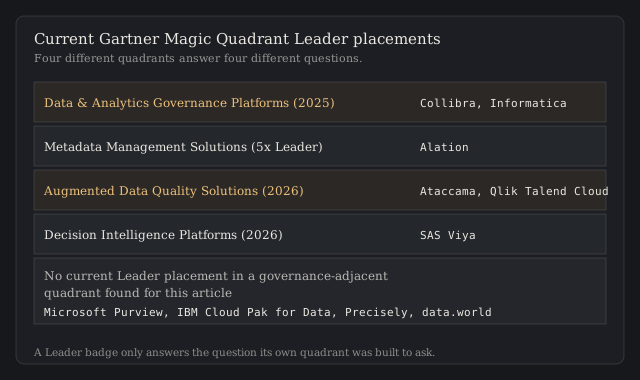
Ten vendors compete for this budget line, and they compete on different axes: Collibra and Informatica lead the Gartner Magic Quadrant for governance platforms outright, Ataccama and Qlik lead the adjacent quadrant for augmented data quality, and Microsoft Purview wins on being wherever an Azure estate already lives. None of them are interchangeable, which is why the ranking below sits behind five testable criteria before naming a winner.
Two of the ten platforms in this ranking changed hands in 2025. Salesforce completed an $8 billion acquisition of Informatica in November 2025, and ServiceNow announced its acquisition of data.world in May 2025 without disclosing deal terms. Both change who sets the roadmap for a governance platform buyers sign multi-year contracts against.
How to evaluate data intelligence platforms
Five criteria decide the shortlist, and the ranking below applies them in this order: independent recognition, data quality and lineage automation, AI-assisted metadata work, price transparency, and verified user satisfaction.
Independent analyst recognition
A buyer can check a vendor's current Gartner Magic Quadrant Leader placement, and name the specific quadrant it applies to. Collibra and Informatica are both named Leaders in the 2025 Gartner Magic Quadrant for Data and Analytics Governance Platforms.
Alation has been named a Leader in the Magic Quadrant for Metadata Management Solutions five times, and Ataccama and Qlik are both named Leaders in the 2026 Magic Quadrant for Augmented Data Quality Solutions.
A platform with no current MQ placement in a governance-adjacent category isn't disqualified, but it has to win on the other four criteria instead.
Consecutive years Informatica has been named a Leader in the Gartner Magic Quadrant for Data Integration Tools, the longest active streak of any vendor in this ranking.
Data quality and lineage automation
A criterion here is admissible only if a buyer can point to a named module and ask what it does when a field breaks:
- A rule engine that flags a schema change.
- A lineage graph that traces the change to every downstream report.
- An observability layer that catches a pipeline anomaly before it reaches a dashboard.
Ataccama's write-once rule engine and Collibra's Data Quality & Observability module both meet that bar. A platform that only promises "clean data" without naming the mechanism does not.
AI-assisted metadata and search
Every platform on this list now ships an AI layer over its catalog, and the test is how specifically that layer is named and scoped: Informatica's CLAIRE engine classifies and curates metadata automatically, Alation's ALLIE generates description recommendations, and Collibra runs an AI Command Center that scores trust for AI agents in production.
A vendor that mentions "AI-powered" without naming what the AI does gets no credit on this axis.
Price transparency
None of the ten vendors publish a public rate card for their core governance platform; every price in this article is either an anonymized Vendr buyer median or a stated "sales-quote only." That itself is a differentiator. Qlik is the only vendor here with an actual dollar figure ($300 a month) on its own pricing page, because Qlik Talend Cloud ships bundled into a published Qlik Cloud Analytics tier.
Verified user satisfaction
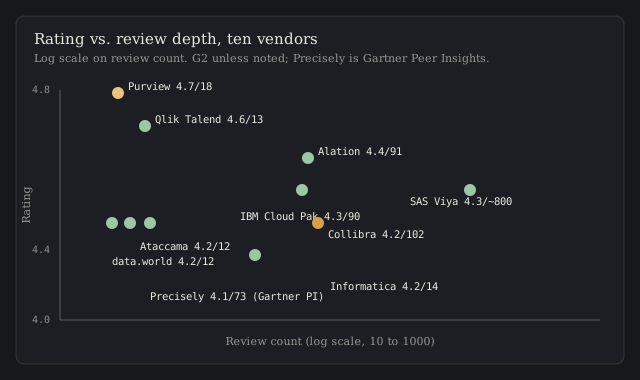
G2, TrustRadius and Gartner Peer Insights ratings are admissible when the review count is stated alongside the score, because a 4.7 built on 18 reviews and a 4.2 built on 102 reviews are not the same claim. Every score cited in this article carries its review count for that reason.
Ask a finalist vendor to run its rule engine against 50 fields you already know are wrong. A platform that surfaces all 50 in a live demo is showing you the product; one that needs a follow-up call to "configure the connector" is showing you a sales process.
Top 10 data intelligence tools, ranked
Ranked on Gartner and analyst recognition, data quality and lineage automation, AI-assisted metadata work, price transparency, and verified user satisfaction.
Collibra
Best fit
Large enterprises that want one metadata backbone under catalog, governance, quality, lineage and AI oversight.
Collibra markets its platform as an "Enterprise AI Control Plane," a shared metadata layer under seven separately named modules:
- Data Catalog.
- Data Governance.
- Data Quality & Observability.
- Data Lineage.
- Data Privacy.
- Data Marketplace.
- An AI Command Center that scores trust for AI agents running in production.
It is the broadest module count in this ranking, and it is named a Leader in the 2025 Gartner Magic Quadrant for Data and Analytics Governance Platforms for the second consecutive year.
Key features
- Data Marketplace for requesting and discovering data products across teams.
- Data Access with masking and integrations into Snowflake, Databricks and BigQuery.
- AI Command Center to monitor and trust-score AI agents consuming governed data.
- Data Quality & Observability with a no-code, self-service rule engine.
- Data Lineage that visualizes transformations across the full data flow.
Pricing
Collibra publishes no list price; its own pricing page returns a 404. Vendr's anonymized buyer data puts the median annual contract at $197,142, in a range of $174,740 to $225,360, the highest median of any platform in this ranking.
Pros
- Widest module set: catalog, governance, quality, lineage, privacy and marketplace under one metadata layer.
- Named a Leader in the 2025 Gartner governance-platform Magic Quadrant, second year running.
- AI Command Center gives a named mechanism for governing AI agents alongside human users.
Cons
- No public pricing page; the highest reported median contract in this ranking.
- Users report approval workflows getting stuck in bottlenecks between teams.
- Notification volume drew specific complaints in recent G2 reviews.
Frank L., an AVP of Data Architecture at an enterprise company, wrote in a G2 review from January 2023:
"I really like it as a unified data intelligence platform that brings together Catalog, Governance, Lineage, Quality, and AI Governance."
G2 review, Frank L., AVP Data Architecture, enterprise segment, January 2023.
Hana R., an HR Coordinator at a mid-market company, described the workflow friction in an October 2025 review:
"Approvals get stuck in bottlenecks, and integration with other systems is inconsistent. Notifications are excessive."
G2 review, Hana R., HR Coordinator, mid-market segment, October 2025.
Why it's ranked #1. Seven governed modules under one metadata layer and a second consecutive year as a Gartner governance-MQ Leader beat every other entry on breadth. It ranks first ahead of Informatica because Informatica's own MQ leadership sits in the data integration quadrant, a different category than the governance quadrant this ranking measures, even though Informatica's median contract runs far cheaper.
Informatica IDMC
Best fit
Teams that already run Informatica pipelines and want catalog, governance and quality added to the same metadata layer.
Informatica's Intelligent Data Management Cloud runs discovery, cataloging, governance, quality, integration and master data management on one shared metadata layer, with the CLAIRE AI engine doing automated classification, curation and metadata extraction across every module. Salesforce completed its acquisition of Informatica for $8 billion in November 2025, which puts the platform's future roadmap inside a much larger parent for the first time in its history.
Key features
- CLAIRE AI engine for automated classification, curation and metadata extraction.
- Master Data Management and 360 Applications for unified entity records, including Customer 360.
- Cloud Data Marketplace for packaging and sharing trusted data products.
- Data Governance, Access & Privacy for compliance enforcement and access controls.
- Data Quality & Observability with automated profiling and rule application.
Pricing
Informatica doesn't publish list pricing; Vendr's anonymized buyer data across 37 recorded deals puts the median annual contract at $56,250, in a range of $10,753 to $252,657, the widest range and the largest sample of any vendor in this ranking.
Pros
- Named a Leader in the Gartner Magic Quadrant for Data Integration Tools for 20 consecutive years.
- CLAIRE AI runs classification and curation across catalog, quality and MDM in one pass.
- Widest documented pricing range (37 deals) of any vendor here, useful for budgeting either end of the market.
Cons
- The IDMC-branded G2 listing carries only 14 reviews, thin next to Informatica's broader product footprint.
- Reviewers specifically flagged cost relative to competitors.
- Ownership just changed hands (Salesforce, November 2025), which adds roadmap uncertainty most competitors here don't carry.
Faisal A., a Deputy Project Manager in IT Insurance, wrote in a G2 review from June 2022:
"I recommended to all the Companies who want to invest in DATA CENTER Hardware Procurement to use the Informatica Data Management Cloud, to reduce the cost of the Organization."
G2 review, Faisal A., Deputy Project Manager IT Insurance, enterprise segment, June 2022.
Ruchita K., a Software Engineer at a small business, raised the cost question directly in a July 2022 review:
"The current cost model is little high compared with other competitors."
G2 review, Ruchita K., Software Engineer, small-business segment, July 2022.
Why it's ranked #2. Twenty consecutive years as a Gartner integration-MQ Leader and a documented $56,250 median, roughly a third of Collibra's, make it the strongest value case above Alation. It ranks below Collibra because its own MQ leadership sits in the data integration quadrant, a different category than the governance-platform quadrant Collibra leads.
Alation
Best fit
Analyst and data-science teams whose bottleneck is finding and trusting a dataset before they can start work.
Alation calls its platform an "Intelligence Operating System," built around a machine-learning natural-language search engine over cataloged assets, with governance, lineage and workflow-automation modules layered on top. Alation has been named a Leader in the Gartner Magic Quadrant for Metadata Management Solutions five times, and it carries the highest G2 rating among the pure-catalog vendors in this ranking.
Key features
- ML-driven natural-language search across the entire catalog.
- ALLIE AI, which generates recommended metadata descriptions automatically.
- Compose, a shared and reusable SQL query-writing tool.
- Open Data Quality Framework, which aggregates results from external DQ tools into one system of record.
- Alation Anywhere, surfacing catalog data inside Excel, Slack and Teams.
Pricing
Alation publishes no list price. Vendr's anonymized buyer data puts the median annual contract at $141,394, in a range of $77,526 to $302,223.
Pros
- Highest G2 rating of the catalog-first vendors in this ranking: 4.4/5 across 91 reviews.
- Five-time Leader in Gartner's Metadata Management Magic Quadrant.
- Alation Anywhere puts catalog search inside the tools people already use daily.
Cons
- Reviewers named pricing directly as high relative to budget.
- Custom workflows, notifications and stewardship assignments were flagged as rigid.
- Alation's most recent independently sourced customer count dates to 2021, with no fresher public figure found.
Eric N., a Director of Analytics and Data Engineering, described the relationship in a G2 review from November 2025:
"Alation is more than just a SaaS tool; it represents a partnership that extends our governance capabilities beyond the boundaries of our organization."
G2 review, Eric N., Director of Analytics and Data Engineering, enterprise segment, November 2025.
Melissa B., an Enterprise Data Manager, raised the workflow rigidity the same month:
"Some features feel rigid, especially when it comes to custom workflows or notifications...stewardship assignments, forms, and conversation-triggered emails to be more limited than expected."
G2 review, Melissa B., Enterprise Data Manager, enterprise segment, November 2025.
Why it's ranked #3. Its 4.4/5 across 91 reviews is the best-rated catalog-first platform here, and five Gartner metadata-MQ Leader placements back the search claim. It ranks below Informatica because its median contract runs $85,000 higher and reviewers named pricing as a specific complaint, something Informatica's reviewers raised less pointedly.
Microsoft Purview
Best fit
Organizations already standardized on Azure that want governance, classification and compliance applied to data they're not moving anywhere else.
Microsoft Purview spans three product families under one console: Data Security (posture management, information protection, DLP, insider risk), Data Governance (a unified catalog and Data Map, audit, eDiscovery, lifecycle management) and Compliance (Compliance Manager, communication compliance).
It scans and classifies data across on-prem, multicloud and SaaS sources through automated jobs billed in vCore-hours.
Key features
- Unified Data Map catalog spanning on-prem, multicloud and SaaS sources.
- Copilot in Microsoft Purview for AI-assisted governance tasks.
- Data Lifecycle Management for classification and retention at scale.
- eDiscovery and Audit modules built into the same console.
- Insider Risk Management and Data Security Investigations for security-adjacent governance.
Pricing
Purview bills by consumption: Capacity Units for the Elastic Data Map and vCore-hours for automated scanning and classification. Microsoft's own Azure pricing page doesn't surface a fixed dollar figure without selecting a region and currency, and no Vendr marketplace listing exists for Purview, so no anonymized buyer median is available for comparison against the other nine entries.
Pros
- Highest G2 rating of any vendor in this ranking: 4.7/5, though on a thin base of 18 reviews.
- Native to any estate already running Azure, with no separate infrastructure to stand up.
- Consumption pricing means a small pilot costs proportionally little to test.
Cons
- Consumption pricing makes total annual cost hard to predict against the fixed contracts competitors quote.
- Purview's review base is split across many separate G2 listings (Data Governance, DLP, Insider Risk, Records Management), so no single combined rating exists.
- Reviewers flagged API connections to non-Microsoft sources as a limiting factor.
Niranjan L., a Professional Consultant in telecommunications, wrote in a G2 review from February 2022:
"Azure purview is an unified data management platform to govern your data resides in multiple platforms."
G2 review, Niranjan L., Professional Consultant, telecommunications, February 2022.
Felipe A., a Cyber Security Analyst, named the integration gap in an April 2024 review:
"The API needs some improvement when connecting to non-Microsoft API sources. This is a limiting factor."
G2 review, Felipe A., Cyber Security Analyst, April 2024.
Why it's ranked #4. A 4.7/5 rating beats every other platform in this ranking outright, and consumption pricing means there's no minimum contract to clear before testing it. It sits behind Alation because that rating rests on 18 reviews against Alation's 91, and Purview's governance features stay strongest inside Azure, weaker the moment data lives somewhere else.
Ataccama ONE
Best fit
Teams whose governance program is measured in data quality rules passed, beyond simple catalog completion.
Ataccama ONE combines data quality, catalog, observability, lineage, reference-data management and master data management in one architecture, layered with an agentic AI stack that includes a ML anomaly-detection engine and a "ONE AI Agent" that can autonomously execute tasks like rule mapping. Ataccama has been named a Leader in the Gartner Magic Quadrant for Augmented Data Quality Solutions for the fifth consecutive time, in the 2026 edition.
Key features
- Write-once rule engine applied consistently across every connected system.
- Automated data catalog with a business glossary built in.
- Data Lineage that traces an anomaly to the affected business unit.
- Data Observability for pipeline anomaly detection.
- Reference Data Management with code and hierarchy standardization plus an audit trail.
Pricing
Ataccama publishes no list price. Vendr's anonymized buyer data puts the median annual contract at $133,100, in a range of $118,620 to $328,620.
Pros
- Fifth consecutive year as a Leader in Gartner's Augmented Data Quality Solutions Magic Quadrant.
- Write-once rule engine avoids re-authoring the same quality check per system.
- Users specifically praised the customizable interface and support responsiveness.
Cons
- Reviewers called it complex for beginners, with a long initial integration.
- A named competitor, DvSum, was cited by a reviewer as easier to use.
- G2 review base is the thinnest of the top five entries here, at 12 reviews.
Karthika S., a Senior Data Governance Analyst, wrote in a G2 review from November 2024:
"Easy to use UI. Customizable interface. Good customer support."
G2 review, Karthika S., Senior Data Governance Analyst, November 2024.
Sonal S., a Senior Data Consultant for Data Governance, named a specific competitor in a May 2023 review:
"A very complex tool for beginners...Initial integration took lot of time...Have used new tools in market which are pretty easier like DvSum."
G2 review, Sonal S., Senior Data Consultant, Data Governance, enterprise segment, May 2023.
Why it's ranked #5. Five straight years as a data-quality MQ Leader is a stronger, more current analyst credential than Purview's rating alone. It ranks behind Purview because its own reviewers flagged a steep learning curve and named a specific easier competitor, a complaint Purview's reviewers didn't raise.
Qlik Talend Cloud
Best fit
Buyers who want a stated starting price before a sales call, moving data through real-time change-data-capture.
Qlik Talend Cloud is the product built from the former Talend Data Fabric after Qlik completed its acquisition of Talend in May 2023, combining data movement (CDC, ETL/ELT), quality, governance, lineage and agentic AI automation. Qlik has been named a Leader in the 2026 Gartner Magic Quadrant for Augmented Data Quality Solutions, the same quadrant Ataccama leads.
Key features
- Real-time change-data-capture from databases, SAP, mainframe and SaaS apps via an agentless architecture.
- 500+ connectors across databases, cloud platforms and enterprise apps.
- Native integrations with Snowflake, AWS, Azure, Databricks and Apache Iceberg.
- Automated data profiling and quality-rule enforcement with end-to-end lineage tracking.
- A Qlik MCP Server for connecting third-party AI tools, including Claude Code and GitHub Copilot.
Pricing
Qlik's dedicated data-integration pricing page lists four tiers, all requiring "Contact Us," billed on data volume moved, job executions and execution duration. Qlik's general pricing page does show a starting figure: the Starter Qlik Cloud Analytics plan at $300 a month includes Qlik Talend Cloud for relational and SaaS sources, the only vendor-published dollar figure in this entire ranking.
Vendr's separate marketplace data for "Talend" reports a $27,500 median across 72 purchases, ranging $13,446 to $147,137.
Pros
- The only platform in this ranking with a real, vendor-published starting price.
- Named a Leader in the 2026 Augmented Data Quality Solutions Magic Quadrant.
- Agentless CDC architecture and 500+ connectors give it the broadest documented integration surface here.
Cons
- Reviewers of the prior Talend Data Fabric product flagged a steep initial learning curve.
- Exception handling in pipeline failures was called inconvenient, forcing manual process control.
- The rebrand from Talend to Qlik Talend Cloud is recent enough that G2's merged listing shows review-data inconsistencies.
Pankaj Pise, a Programmer Analyst at Accenture, wrote in a TrustRadius review from June 2022, reviewing the Talend Data Fabric product this platform was rebuilt from:
"Generated optimized code for building data pipelines. Ingested and integrated data from both On-Premises and Cloud environment."
TrustRadius review, Pankaj Pise, Programmer Analyst, Accenture, June 2022.
Charlotte Byrne Brown, an RPA Manager at Mr. Cooper, described the learning curve in a September 2020 review:
"The learning curve in the beginning may be very steep. Speed is not the best."
TrustRadius review, Charlotte Byrne Brown, RPA Manager, Mr. Cooper, September 2020.
Why it's ranked #6. A published $300-a-month starting price and a 2026 Augmented Data Quality MQ Leader placement put it ahead of every vendor below it on transparency alone. It ranks below Ataccama because Ataccama's Vendr-reported median sample and G2 reviews come from a stable, single product line, while Qlik Talend Cloud's review history is still split across its pre- and post-acquisition names.
IBM Cloud Pak for Data
Best fit
Hybrid and on-prem estates that need to query and govern data across environments without physically consolidating it first.
IBM Cloud Pak for Data is a containerized, OpenShift-based platform that uses data virtualization and 60+ connectors to let teams query and govern data across on-prem, cloud and hybrid sources without moving it, with built-in governance for metadata, lineage and policy enforcement. Its decoupled lakehouse component, watsonx.data, runs Presto, Spark and Milvus query engines and can operate standalone or inside the full platform.
Key features
- Data virtualization across siloed sources without physically moving data.
- Built-in governance: automated metadata management, lineage and policy enforcement.
- 60+ native data-source connectors.
- watsonx.data open lakehouse with Presto, Spark and Milvus query engines.
- Code, Canvas and No-Code interfaces for teams with mixed technical skill levels.
Pricing
Cloud Pak for Data itself has no published pricing; TrustRadius confirms it "does not currently have any pricing plans listed at this time," directing buyers to a sales quote.
Its watsonx.data component does publish consumption pricing in Resource Units at $1 list price per RU: query engines run 0.2 to 36.40 RUs per hour depending on engine and size, and Milvus vector-database usage runs 1.25 to 16.50 RUs per hour depending on scale.
Pros
- Only platform in this ranking that can query hybrid and on-prem data without moving it first.
- watsonx.data publishes real per-unit consumption pricing, unusual for this category.
- 4.3/5 across 90 G2 reviews, the second-largest review base among the ten entries.
Cons
- Initial setup and configuration were called complex and time-consuming by reviewers.
- A named-competitor comparison from a data architect placed its pricing above Informatica and Precisely.
- Reviewers specifically flagged the platform as too expensive for smaller companies.
Amr A., a Data Solution Architect, wrote in a G2 review from June 2026:
"It allows my team to manage almost all aspects of the data workflow, including connecting data sources and tools."
G2 review, Amr A., Data Solution Architect, June 2026.
Jacek Wróż, a Senior Data Architect, placed its pricing against named competitors in a December 2022 PeerSpot answer:
"The price is fair. It is not low, but it's lower than Informatica and Precisely company platforms."
PeerSpot, Jacek Wróż, Senior Data Architect, December 2022.
Why it's ranked #7. Its 90-review G2 base and hybrid-query capability beat Precisely and SAS Viya on documented adoption, and watsonx.data's published $1-per-RU pricing is a real number where most competitors quote sales-only. It ranks below Qlik Talend Cloud because setup complexity and cost complaints were specific and repeated, and it carries no current Gartner MQ Leader placement in a governance-adjacent category.
Precisely Data360
Best fit
Teams whose governance program depends on location and geo-enrichment data alongside standard catalog and quality modules.
Precisely's Data Integrity Suite, rebranded Data360 across 2025 and 2026 marketing and review listings, is a modular cloud platform for data quality, governance, integration, observability and location enrichment, sold as connected services. The company traces back to Whitlow Computer Systems in 1968 and took its current name in 2020, after acquiring Pitney Bowes Software & Data the year before.
Key features
- Data Integrity Foundation, a shared connective layer across every suite service.
- Gio, an MCP-based AI assistant embedded across the suite.
- Data Observability for automated anomaly detection ahead of a downstream break.
- Data Governance covering literacy, accountability, policy management and lineage tracking.
- Suite workloads run natively on Snowflake, under a partnership announced in December 2023.
Pricing
No public pricing figure exists for the Data Integrity Suite on Precisely's own site or on AWS Marketplace, where the listing requires configuring a specific bundle before a number appears. No dedicated Vendr marketplace page covers this product; the only Vendr listing under the "Precisely" name is for an unrelated contract-management company that shares the brand name.
Pros
- Location and geo-enrichment data is a named differentiator none of the other nine vendors offer.
- 4.1/5 rating on Gartner Peer Insights across 73 ratings, a larger sample than five of the vendors ranked above it.
- Native Snowflake execution since December 2023 removes a hosting layer buyers would otherwise manage separately.
Cons
- No current-year Gartner Magic Quadrant Leader placement in a governance-adjacent category; its most recent found was 2021, for data quality.
- Reviewers named advanced configuration as requiring significant time and product knowledge.
- One reviewer cited processing delays that slowed report delivery by several months.
A Data and Analytics Manager in consumer goods wrote in a Gartner Peer Insights review from April 2026:
"Canvas-based Data Flows to simplify, streamline and discover your data."
Gartner Peer Insights, Data and Analytics Manager, consumer goods industry, April 2026.
An Engineer in software gave the platform 4 out of 5 stars in a May 2026 review, naming the tradeoff directly:
"Advanced configuration requires significant time and product knowledge."
Gartner Peer Insights, Engineer, software industry, May 2026.
Why it's ranked #8. A 73-rating sample on Gartner Peer Insights and a distinct geo-enrichment feature set beat SAS Viya and data.world on both review depth and product differentiation. It ranks below IBM Cloud Pak for Data because its most recent governance-adjacent MQ Leader placement is from 2021, four years stale against IBM's active hybrid-query positioning.
SAS Viya
Best fit
Organizations already standardized on SAS that want governance and lineage added to a platform they already use for modeling.
SAS Viya is a cloud-native platform spanning data management (connectivity, governance, lineage, auditability), explore-and-model (visual and code-based statistical modeling, including SAS Viya Copilot) and deploy (business rules, real-time event detection, decision governance). It runs on AWS, Azure, GCP, hybrid or on-prem infrastructure, and SAS was named a Leader in the 2026 Gartner Magic Quadrant for Decision Intelligence Platforms.
Key features
- Data Management module with multi-source connectivity, governance and lineage tracking built in.
- SAS Viya Copilot for AI-assisted analytics work.
- Deploy Insights: a business-rules engine and real-time event detection for embedding models into operations.
- AI governance tooling covering explainability, fairness testing and bias detection.
- A SAS Viya MCP Server for secure integration with external AI agents.
Pricing
SAS discloses no pricing on its own product page beyond a 14-day free trial, and TrustRadius confirms SAS doesn't have pricing plans listed as of this writing. Vendr's anonymized data for "SAS" as a whole, which may span products beyond Viya, reports a $14,352 median annual contract, ranging $6,546 to $48,183, the lowest median in this ranking.
Pros
- Named a Leader in the 2026 Gartner Magic Quadrant for Decision Intelligence Platforms.
- Lowest reported Vendr median of any platform in this ranking, at $14,352.
- In-memory analytics runs modeling and governance on the same platform without a second tool.
Cons
- Its Gartner MQ leadership sits in decision intelligence and data science, outside a governance-specific quadrant.
- Reviewers flagged Model Studio performance as slow on complex flows.
- Cost was called relatively high compared with other tools despite the low Vendr median, since the Vendr figure isn't confirmed Viya-exclusive.
Tushar S., a Team Manager at Nupeak IT Services, wrote in a G2 review from August 2026:
"SAS Viya offers everything on a single platform, including in-memory analytics for faster results."
G2 review, Tushar S., Team Manager, Nupeak IT Services, August 2026.
Chiara I., a Data Engineer, flagged a specific performance issue in an October 2024 review:
"Model Studio performance...slow when working with complex flows."
G2 review, Chiara I., Data Engineer, October 2024.
Why it's ranked #9. Its $14,352 Vendr median is the cheapest in this ranking and its Decision Intelligence MQ Leader placement is current for 2026, ahead of data.world's lack of any Gartner mention. It ranks below Precisely because that MQ leadership sits outside the governance-platform category this article is built around, and reviewers flagged both performance and cost issues Precisely's reviewers didn't raise as pointedly.
data.world
Best fit
Smaller teams comfortable betting on a newer, knowledge-graph-based catalog and ServiceNow's backing.
data.world is an enterprise data catalog built on a knowledge-graph architecture, converting raw and tabular data into structured, queryable knowledge for search and downstream AI consumption. Founded in 2015 and headquartered in Austin, ServiceNow announced its acquisition of data.world in May 2025, without disclosing deal terms.
Key features
- Enterprise search described by the vendor as understanding technical context and business meaning beyond keyword matches.
- Governance Automation with adaptive smart workflows for governance processes.
- A knowledge-graph engine that links related data points into a connected structure.
- Data Integration giving a unified cross-source view of every connected data source.
- An architecture built for downstream AI and LLM consumption of governed metadata.
Pricing
data.world publishes no pricing on its own site. TrustRadius states plainly that it "does not currently have any pricing plans listed at this time," with no free trial available, and no Vendr marketplace listing exists for the product.
Pros
- Knowledge-graph architecture ingests data from almost any source and joins disparate datasets, a capability named directly by a reviewer.
- ServiceNow's May 2025 acquisition puts a much larger parent's roadmap and distribution behind a previously independent catalog.
- 4.2/5 on G2, in line with several higher-ranked entries, despite the smallest review base in this ranking.
Cons
- Smallest G2 review base of any entry here, at 12 reviews.
- No public pricing anywhere, and no free trial, unlike several higher-ranked competitors.
- No current Gartner Magic Quadrant Leader placement in any governance-adjacent category; its most recent third-party recognition is a 2020 Forrester Wave mention.
George Stoyle, a Senior Manager of Technology and Innovation at Rare, wrote in a TrustRadius review from November 2020:
"Ingest data from almost any source. Join disparate datasets. Integrate with other platforms."
TrustRadius review, George Stoyle, Senior Manager, Technology & Innovation, Rare, November 2020.
The same review named the accessibility gap directly:
"Requires knowledge of SQL - visual SQL builder would help with accessibility."
TrustRadius review, George Stoyle, Senior Manager, Technology & Innovation, Rare, November 2020.
Why it's ranked #10. Its 12-review G2 base is the thinnest in this ranking and it carries no current governance-adjacent Gartner MQ placement, the two criteria every entry above it wins on. It closes the list because the ServiceNow acquisition and the knowledge-graph search approach are real differentiators once its independent review base catches up.
Entries six through ten trade a documented Gartner governance-MQ placement for either a published starting price (Qlik), hybrid-query reach (IBM), a location-data specialty (Precisely), an existing SAS footprint (SAS Viya), or a newer architecture bet (data.world). None of the five is a downgrade from the top five in every dimension; each wins on the one axis its buyer already cares about most.
What data intelligence software does
Data intelligence describes the discipline of collecting, cataloging, governing and analyzing an organization's data so people can find, trust and act on it, distinct from the broader discipline of market intelligence, which analyzes markets.
The tools in this ranking are the software layer that automates that discipline: a catalog for discovery, a governance layer for rules and ownership, a quality engine for validation, and a lineage graph for tracing where a number came from.
That layer sits between raw data, wherever it's stored, and the people who need it: analysts running statistical analysis, data scientists building machine learning models, and business users pulling a report without knowing which warehouse the underlying table lives in. Without it, a company's data intelligence process depends entirely on institutional memory: the one analyst who remembers which table is stale.
Data intelligence work touches artificial intelligence at nearly every stage now. Natural language processing powers the search bar in Alation and data.world, and machine learning algorithms drive the anomaly detection in Ataccama's observability module.
Business intelligence tools consume the output of that work: a BI dashboard displays a number, and a data intelligence platform is what confirms the number is correct and current before the dashboard renders it. Forensic vendors use the near-identical term digital intelligence for phone and computer evidence, covered in our digital intelligence platforms ranking.
Data collection and data preparation happen upstream of these platforms, typically inside a warehouse or lake; data discovery is the process of finding what's already there once it's collected.
Gathering data from disparate sources across data warehouses and data lakes used to be a manual export-and-join exercise, and the data collected that way rarely matched what a second team pulled the same week.
A catalog with active metadata management turns that into a search, and a governance layer decides who's allowed to see the result.
Descriptive, diagnostic, predictive and prescriptive intelligence
Data intelligence work is typically split into four layers, each answering a different question. Descriptive intelligence reports what happened, using historical data and generated reports to summarize a period. Diagnostic intelligence explains why it happened, using pattern recognition and statistical analysis to trace a metric change back to a cause.
Predictive intelligence uses machine learning algorithms trained on historical data to predict future outcomes, from customer behavior to demand forecasting. Prescriptive intelligence goes one step further, using those same predictive capabilities to recommend a specific action beyond a forecast.
All ten platforms in this ranking support the first two layers natively through their catalog and lineage tools; predictive and prescriptive intelligence increasingly run through the AI layers each vendor has added, like Informatica's CLAIRE or SAS Viya's modeling engine.
Data catalog, metadata management and data lineage, differentiated
These three terms get used interchangeably in vendor marketing, and they measure different things. A data catalog is the searchable inventory of data assets, the equivalent of a library index.
Metadata management is the broader discipline of maintaining the information about that data. Active metadata management specifically means that metadata updates automatically as the underlying data changes.
Data lineage is the trace of where a specific number came from and what transformed it along the way, which is what lets a governance team answer "why does this dashboard disagree with that report" by pointing to a diagram. Nobody has to guess.
The governance layer sits above all three: the policies, roles and accountability structures that decide who can access which data, under what compliance obligation. A platform can have a strong data catalog and a weak governance layer, or the reverse; the ranking above weighted governance MQ recognition specifically because catalog quality alone doesn't answer who's allowed to see a field.
Data lakes, data warehouses and where data intelligence platforms sit
Data lakes store raw, often unstructured data in its native format; data warehouses store structured, processed data optimized for query performance. Data intelligence platforms sit on top of both without replacing either one, cataloging what's inside a data lake and a data warehouse under the same searchable layer so a user doesn't need to know which system holds the table they want.
Benefits of data intelligence platforms
The most commonly cited benefit across vendor and reviewer material alike is time: analysts stop spending hours locating and validating a dataset before they can start the actual analysis. A second, more measurable benefit is risk management, since a governed catalog with lineage tracking makes it possible to answer a compliance audit's "where did this number come from" question in minutes.
A third benefit shows up specifically in the reviews cited throughout this ranking: improved customer understanding, where a unified view of customer data across systems replaces the fragmented, manually reconciled version most organizations start with.
Competitive advantage follows from speed: two companies can buy the same catalog, and only the one that turns market trends into a decision faster keeps the edge.
Operational efficiency shows up in fewer duplicate requests to the data team, and identifying patterns in usage logs is how a governance lead decides which datasets to prioritize next. Mining a business process from its own event logs is a separate job, covered by the process intelligence software ranking.
Self service analytics is what a catalog enables once data assets are labeled and trusted: a business user runs their own query against relevant data without filing a ticket, and data scientists spend more time on advanced analytics and less time locating the table.
Data visualization tools sit downstream, turning insights generated by a query into a chart a non-technical stakeholder can read, and the reports they generate feed strategic decision making at the executive level.
Data intelligence refers, in most vendor glossaries, to the entire data lifecycle: gathering, processing data, enhancing data quality, and using it to present data back to the people who requested it. It's worth being specific about what that phrase covers before buying against it.
What separates a platform's data intelligence offerings from a plain BI tool is the layer underneath, the unified platform that applies data intelligence consistently across every connected system. When that layer is missing, unstructured data sits ungoverned, hidden patterns in usage go undetected, and a company's data intelligence efforts default back to one analyst's memory of where a table lives.
Every platform in this ranking exists to apply data intelligence at a scale no single analyst can match, and the data intelligence work that used to take a dedicated team weeks now runs through existing tools already in the stack.
That same foundation is what lets a platform predict future outcomes and apply data protection consistently, replacing business processes built around a spreadsheet passed hand to hand with a data driven culture built around one shared catalog.
None of these benefits are free; every platform in this ranking requires configuration time before the catalog reflects reality, which is why the "complex for beginners" complaint recurs across multiple vendor review sets above.
Pricing across the data intelligence category
Every vendor in this ranking except Qlik declines to publish a list price for its core governance platform, which is why this article leans on Vendr's anonymized buyer-reported medians. Those medians span a wide range: SAS's broad org-level figure sits at $14,352, while Collibra's median runs to $197,142, a nearly fourteen-fold spread across platforms competing for the same governance budget line.
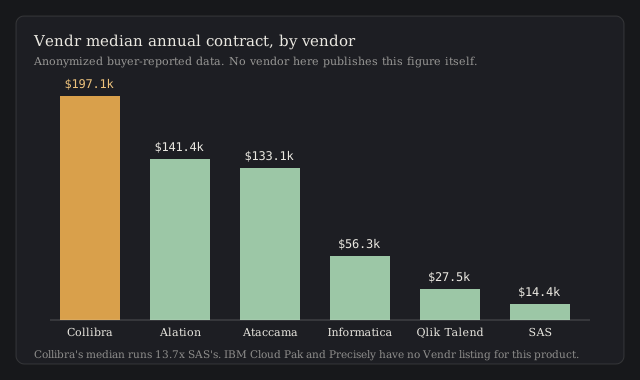
The range of Vendr's anonymized median annual contracts across the five platforms in this ranking that carry a tracked figure, a nearly fourteen-fold spread for the same governance budget line.
The contract trap in this category is the module count. Every platform here sells governance, quality, catalog and lineage as separately licensed modules under one brand name, and a quote for "the platform" often prices only the catalog. Ask for a line-item breakdown of every module in the proposal before comparing a number across two vendors.
Data analysis, data analytics and where data intelligence fits
Data analysis and data analytics are not synonyms for data intelligence, though vendor marketing often blurs them. Data analysis is the manual or semi-manual act of interpreting data analytics output; data intelligence is the governed layer that makes sure the data analytics dashboard is analyzing data that's current.
AI and machine learning sit inside both: artificial intelligence increasingly generates the first pass of actionable insights a data analyst used to build by hand, and machine learning models flag the actionable insights a rule alone would miss.
Data literacy, the ability of a non-technical employee to read and question a dashboard, depends on all of it working together; a platform with strong data analysis tools but no catalog still leaves that employee analyzing data they can't verify.
Customer behavior and customer data both benefit directly: identifying patterns in customer behavior used to require a dedicated analyst pulling from three systems, and now runs through the same rule engine that checks any other data collection pipeline.
Market trends surface faster when data collection and cataloging happen automatically and continuously, which is what turns operational efficiency and competitive advantage into a measurable gain.
Business intelligence dashboards can generate reports and insights faster once the data intelligence process feeding every downstream report stops requiring manual verification. That's what makes data intelligence important to a governance program long before it becomes important to a CFO's budget line, and long before anyone touches the raw data underneath it.
Every AI and machine learning claim in this ranking, from CLAIRE to ALLIE, still runs on artificial intelligence trained on the same governed catalog it protects, scored the same way by the machine learning layer that reads it.
Data visualization is the last step in that chain, since a chart built on ungoverned data just displays the error faster.
Common buying mistakes
The most repeated mistake in the reviews collected for this ranking is buying the catalog module first and discovering the governance workflow engine is a separate line item, months into rollout. A second mistake is skipping a rule-engine test against fields the buyer already knows are broken, which is the fastest way to test a platform's quality claims against real data. A scripted demo won't expose that.
A third mistake specific to this category: treating a Gartner Magic Quadrant Leader placement as interchangeable across quadrants. Collibra and Informatica lead the governance-platform MQ; Ataccama and Qlik lead the augmented-data-quality MQ; SAS leads the decision-intelligence MQ. These measure different things, and a vendor's Leader badge only answers the question its specific quadrant was built to ask.
Data intelligence tools FAQ
What are data intelligence tools?
Data intelligence tools are platforms that catalog, govern, validate and trace an organization's data so it can be found, trusted and used without manual research, combining a searchable catalog, governance rules, a data quality engine and a lineage graph in one metadata layer.
What are the best data intelligence tools?
Collibra and Informatica IDMC are both named Leaders in the 2025 Gartner Magic Quadrant for Data and Analytics Governance Platforms, the strongest current independent signal in the category. Alation leads the adjacent Metadata Management Magic Quadrant, and Ataccama and Qlik Talend Cloud lead the 2026 Augmented Data Quality Solutions Magic Quadrant.
Is Databricks a data intelligence platform?
Databricks markets its own lakehouse under the term "Data Intelligence Platform", but it isn't one of the ten vendors buyers most frequently compare in this specific category; it's closer to a compute and lakehouse platform with governance features than a catalog-first governance platform like the ten ranked above.
Databricks does show up in our predictive intelligence software ranking, where its lakehouse and modeling tools compete directly with DataRobot, Dataiku and Qlik.
What's the difference between data intelligence and data analytics?
Data analytics is the act of analyzing data to answer a question; data intelligence is the layer that makes sure the data being analyzed is discoverable, governed and trustworthy in the first place. A strong analytics team with a weak data intelligence layer ends up analyzing the wrong version of a table.
What are the primary capabilities offered by data intelligence platforms?
Across all ten platforms ranked above, the recurring capability set is: a searchable data catalog, a governance and access-control layer, an automated data quality rule engine, a data lineage graph, and an AI layer for metadata classification and search, named differently by every vendor but present in some form on every entry in this ranking.
Bottom line
Collibra and Informatica IDMC are the two vendors with a current Leader placement in Gartner's governance-platform Magic Quadrant, and either is the safer default for an enterprise building a governance program from scratch, with Informatica's roughly $56,250 median contract the cheaper of the two against Collibra's $197,142. Alation wins the search-and-discovery use case specifically, backed by the best G2 rating among the catalog-first vendors.
Buyers already standardized on Azure or SAS should weight Microsoft Purview or SAS Viya higher than their rank here suggests, since neither entry's position reflects a weakness in the product so much as a governance-MQ credential the other vendors happen to hold and they don't. Ataccama and Qlik Talend Cloud are the pair to shortlist when the buying criterion is data quality specifically.
data.world is the one entry worth a second look purely on trajectory: a knowledge-graph architecture and a fresh ServiceNow acquisition, sitting on the thinnest review base in this ranking today. A team with the risk tolerance for a newer bet, and none of the compliance pressure that makes a Gartner Leader badge non-negotiable, is the buyer it fits.