Data mining tools: rankings and buying guide for 2026
 By Jan Suski, six years working in digital. How the scoring works.
·
Quick comparison of data mining tools
Ten platforms with their G2 rating, what they cost to start, and the buyer each one fits. Ratings and prices are each vendor's own published figures, or Vendr's anonymized buyer data where marked.
| # | Provider | G2 rating (reviews) | Entry price | Best fit |
|---|---|---|---|---|
| 1 | KNIME Analytics Platform | 4.4 (83) | $19/mo (Pro) | Teams that want a full free core with an affordable paid ceiling |
| 2 | RapidMiner (Altair AI Studio) | 4.6 (533) | Contact sales; free tier capped at 10K rows | Teams that want the deepest built-in operator library |
| 3 | Alteryx | 4.6 (892) | $250/user/mo (Starter) | Finance and ops teams with per-seat budget |
| 4 | Dataiku | 4.4 (224) | $3,000/mo (Lite) | Enterprises needing visual, code, and governed GenAI in one platform |
| 5 | DataRobot | 4.4 (32) | $212,020/yr median* | Regulated enterprises needing agentic AI governance |
| 6 | SAS (Viya / Enterprise Miner) | 4.2 (193) | Contact sales, no published figure | Institutions already standardized on SAS |
| 7 | IBM SPSS Modeler | 4.0 (148) | $529/mo (Subscription) | Traditional statistical modeling teams |
| 8 | H2O.ai | Not yet rated | Free (H2O-3); contact sales (Driverless AI) | Engineering teams wanting GPU-accelerated AutoML |
| 9 | Orange (Orange3) | Not yet rated | Free, open source | Students, instructors, and analysts who want a no-code canvas |
| 10 | Weka | 4.3 (13) | Free, open source | Classrooms and small research datasets |
Medians marked * are anonymized buyer-reported contract values published by Vendr. Everything else is the price the vendor publishes itself.
Where these figures come from
Coverage counts, ratings, and prices are each vendor's own published figure, or Vendr's anonymized buyer data where marked, read 15 August 2026. RapidMiner and SAS publish no list price anywhere on their own domains; H2O.ai's Driverless AI and DataRobot's enterprise tier both require a sales call before either names a number.
Data mining tools turn raw data, spreadsheets, database exports, log files, survey responses, into patterns a person can act on: which customers are about to churn, which transactions look fraudulent, which products sell together. The software does the mechanical work (cleaning, joining, running the algorithm) so a data scientist or analyst can spend the time on the question, not the plumbing.
This guide ranks ten data mining platforms, four of them free and open source, six sold on a subscription or negotiated contract. Every price, review count, and feature claim below traces to the vendor's own site, a G2 or TrustRadius review, or a GitHub repository, accessed in August 2026.
It's built for two overlapping readers: a data scientist choosing between a coding-first stack and a visual one, and a buyer who has to defend a line item to finance. The comparison table below states what each platform costs and who it fits before the long-form detail explains why.
Evaluation criteria for data mining tools
Five criteria decide the shortlist, and the ranking below applies them in this order: if the vendor publishes a real price, how many built-in algorithms or connectors the platform ships, if its AutoML automates model selection or just runs a wizard, how a trained model reaches production, and how many buyers have rated it on G2.
Published price floor
A criterion only counts if a buyer can check it without a sales call. KNIME publishes a $19-a-month Pro tier and Alteryx publishes a $250-a-user-month Starter tier; RapidMiner, DataRobot, and SAS publish nothing, forcing a quote request before a buyer sees a number.
Algorithm and connector breadth
RapidMiner ships 1,500+ built-in operators. KNIME and Alteryx each publish a 300+ connector count. Weka and Orange cover the standard classification, clustering, and association-rule set, but neither vendor states a total algorithm count, so the criterion favors platforms that quantify their own library.
AutoML maturity
A platform passes this test if it names what its AutoML automates, not merely that AutoML exists. DataRobot's Autopilot ranks candidate models on a Leaderboard; Alteryx Machine Learning runs Deep Feature Synthesis for automated feature engineering; H2O-3's AutoML is free and GPU-accelerated. IBM SPSS Modeler and Weka have no AutoML layer at all.
Production deployment mechanism
A model that never leaves a notebook has no data mining value. H2O.ai exports MOJO and POJO artifacts built for low-latency scoring; RapidMiner deploys via one-click REST API through its AI Hub.
SAS exports score code in SAS, C, Java, and PMML for in-database scoring against Oracle, Teradata, and Aster. Orange and Weka have no equivalent packaged deployment path.
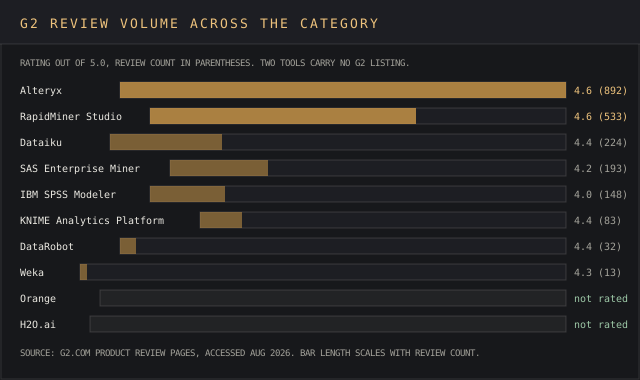
Buyer validation on G2
Review volume is a rough proxy for how many buyers completed a full evaluation. Alteryx carries 892 G2 reviews at 4.6 stars, the largest base in the category; DataRobot carries 32, the smallest among the tools that have a G2 listing at all. Orange and H2O.ai currently have none.
Top 10 data mining tools, ranked
Ranked on published price, algorithm and connector breadth, AutoML maturity, deployment mechanism, and G2 review validation.
KNIME Analytics Platform
Best fit
Teams that want a full, free data mining platform with a paid ceiling they can afford, not a 14-day trial dressed up as a free tier.
KNIME Analytics Platform has run free and open source since it left the University of Konstanz, Germany, in July 2006, where a team led by Michael Berthold built it as "KoNstanz Information MinEr". The desktop platform carries no row cap and connects natively to 300+ data sources, including Snowflake, Databricks, BigQuery, and named LLM providers OpenAI, Anthropic, and Google Gemini.
Key features
- 300+ native connectors spanning databases, cloud storage, and LLM providers.
- Native Apache Spark and Apache Kafka integration for big data workflows.
- Node-based visual workflow builder, runnable step-by-step or fully automated.
- MLOps pipeline for model validation, monitoring, and deployment.
Pricing
The Analytics Platform itself is free with no usage cap. Pro starts at $19 a month for one user and 120 workflow-runtime credits, with overage billed at $0.025 per vCore-minute.
Team starts at $99 a month for three seats, additional seats $49 a month each. Business Hub pricing is quote-only.
Pros
- Free core with no row cap, unlike most rivals' community editions.
- 300+ connectors, including native Spark and Kafka.
- Cheapest published paid tier in the category, at $19 a month.
Cons
- G2 reviewers describe it lagging on large files and call the UI "not very beginner friendly."
- A TrustRadius reviewer says the Excel reader node doesn't always reset without a manual rebuild.
- K-AI, the built-in assistant, is capped at 20 free interactions a month.
"Without KNIME Analytics Platform the project would have been halted and resulted in a loss of >£40k in revenue."
Rob Blanford, AI & Machine Learning Manager at Eviden, TrustRadius, October 17, 2023.
Why it's ranked #1. KNIME lists a real $19-a-month entry price where RapidMiner's paid tier only says "contact us," and its free core carries no row ceiling the way RapidMiner Community's 10,000-row cap does. That price transparency is the top criterion, and KNIME clears it outright.
RapidMiner (Altair AI Studio)
Best fit
Teams that want the deepest built-in operator library and don't mind negotiating an enterprise contract to get it.
RapidMiner was founded in 2001 at TU Dortmund by Ralf Klinkenberg, Ingo Mierswa, and Simon Fischer. Altair Engineering completed its acquisition on September 16, 2022; Siemens then closed a roughly $10.6 billion acquisition of Altair in 2025, making RapidMiner a Siemens-owned product two acquisitions deep in three years.
Key features
- 1,500+ drag-and-drop operators, the largest built-in library in this ranking.
- Auto Model AutoML covering clustering, predictive modeling, and time-series forecasting.
- One-click REST API deployment through the separate AI Hub component.
- LLM fine-tuning and Hugging Face model library access.
Pricing
The Community edition is free but capped at 10,000 data rows and one logical processor. Paid tiers and enterprise licensing are quote-only; RapidMiner has no Vendr.com marketplace listing to cross-check.
Pros
- Deepest operator library in the category, at 1,500+.
- Largest G2 review base among paid tools, at 533 reviews and 4.6 stars.
- AutoML plus a GenAI feature set, including LLM fine-tuning and Hugging Face access, few rivals match.
Cons
- No published paid price anywhere on the vendor's own site.
- A Capterra reviewer called it "resource hungry," reporting memory filling up over long sessions.
- G2's aggregated complaint themes cite slow performance on large datasets and cost relative to the row limits it imposes.
"Auto modeling reduced end-of-line defect rates by approximately 18% in first year."
Data Analytics Manager, engineering industry, PeerSpot, June 2026.
Why it's ranked #2. RapidMiner's 1,500+ operators outnumber Alteryx's roughly 300 connectors by a wide margin on algorithm breadth, the second criterion, but Alteryx publishes a real $250-a-month entry price where RapidMiner publishes none, which is why Alteryx still edges ahead on the first criterion for a share of buyers.
Alteryx
Best fit
Finance and operations teams with per-seat budget who want the review volume to back up the purchase decision.
Alteryx was founded in 1997 as SRC, LLC by Dean Stoecker, Olivia Duane Adams, and Ned Harding. Clearlake Capital Group and Insight Partners completed a $4.4 billion take-private acquisition on March 19, 2024, at $48.25 a share.
Key features
- Alteryx Machine Learning, a no-code AutoML tool using Deep Feature Synthesis for automated feature engineering.
- 300+ pre-built connectors spanning SQL Server, Oracle, MySQL, AWS, and GCP.
- In-database processing that pushes transformations down to the database engine.
- Spatial analytics supporting GeoJSON, KML, and shapefile formats.
Pricing
Alteryx One Starter runs $250 per user per month, billed annually, capped at 1 to 10 users with flat-file connectivity only. Professional and Enterprise are quote-only.
Vendr's anonymized buyer data puts the median annual contract at $49,353 across 45 tracked deals, ranging $5,996 to $208,464.
Pros
- Largest G2 review base in the category, 892 reviews at 4.6 stars.
- 300+ connectors plus dedicated spatial analytics tools.
- Deep Feature Synthesis automates feature engineering most rivals still do by hand.
Cons
- A G2 reviewer in legal services calls the cost "eye-watering" and hard to justify against open-source alternatives.
- The same review class describes it becoming "a serious resource hog" on large datasets.
- Per-seat pricing at $250/user/month scales fast once a team passes ten users.
"If your team already knows SQL or Python, paying for Alteryx feels like throwing money away."
Tanmay K., freelance developer, G2, July 2026.
Why it's ranked #3. Alteryx beats Dataiku on buyer validation with 892 G2 reviews against 224, but it trails RapidMiner on raw algorithm depth, 300 connectors against RapidMiner's 1,500+ operators, which is why it sits third.
Dataiku
Best fit
Enterprises that need visual data prep, coded pipelines, and a governed GenAI layer inside one platform.
Dataiku's last confirmed funding round closed in December 2022: a $200 million Series F led by Wellington Management at a $3.7 billion valuation. Reports of a 2025 IPO filing exist, and that Series F remains Dataiku's most recently disclosed funding round.
Key features
- Visual drag-and-drop flows alongside native Python, R, Keras, and TensorFlow coding.
- AutoML covering prediction, clustering, time series, causal ML, and computer vision.
- MLOps model monitoring for production governance.
- LLM Mesh, a vendor-agnostic GenAI gateway naming Anthropic, AWS, Azure, Databricks, Google Cloud, Mistral, NVIDIA, OpenAI, and Snowflake as partners.
Pricing
The Free Edition caps out at 3 concurrent users. Lite starts at $3,000 a month. Enterprise is quote-only.
Vendr's anonymized buyer data shows a $159,648 median annual contract, ranging $6,909 to $334,860.
Pros
- LLM Mesh spans nine named model providers instead of locking a buyer to one.
- Free tier supports 3 concurrent users at no cost.
- MLOps governance built for regulated model deployment.
Cons
- G2 reviewers describe a steep learning curve, one calling the platform "overwhelming" at the start.
- Joins and data-type handling come up repeatedly as friction points in reviews.
- Its $159,648 Vendr median is the third-highest disclosed contract value in this ranking.
"The learning curve can be a little steep at the beginning."
Marco J., senior software engineer, G2, June 29, 2026.
Why it's ranked #4. Dataiku publishes a real $3,000-a-month Lite tier where DataRobot, one spot below, publishes no price of any kind, only a Vendr-derived median. Dataiku still trails Alteryx on review volume, 224 G2 reviews against 892, which keeps it out of the top three.
DataRobot
Best fit
Regulated enterprises that need agentic AI governance and can absorb the category's highest disclosed contract cost.
DataRobot was founded in June 2012 by Jeremy Achin and Tom de Godoy. Its last confirmed funding round, a $300 million Series G in July 2021, valued the company at $6.3 billion, with roughly $1 billion raised in total by that point.
Key features
- Generative AI platform component for embeddings-to-LLM workflows.
- Predictive AI Autopilot, which ranks candidate models on a Leaderboard automatically.
- AI Observability and Governance for real-time model and agent monitoring plus audit documentation.
- Agentic AI orchestration for deploying agents across edge, cloud, and on-prem environments.
Pricing
No tiers or figures are published on datarobot.com. Vendr's anonymized buyer data shows a $212,020 median annual contract, the highest in this ranking, ranging $24,000 to $230,400.
Pros
- AI Observability and Governance built specifically for regulated-industry audit requirements.
- Agentic orchestration across edge, cloud, and on-prem in one deployment model.
- 4.4-star G2 rating despite a small review base.
Cons
- Smallest G2 review base among the tools with a listing at all, 32 to 38 reviews depending on the page checked.
- A G2 reviewer in financial services says the platform "can feel a bit overwhelming at first," with unclear navigation.
- Highest disclosed Vendr median in the category, at $212,020 a year.
"The price is the biggest issue for me. It's a premium platform."
Brauny N., site reliability analyst, enterprise segment, G2, July 28, 2026.
Why it's ranked #5. DataRobot at least has a Vendr-tracked $212,020 median where SAS, ranked just below it, discloses no price anywhere, vendor or Vendr. It trails Dataiku, which publishes a real $3,000-a-month entry tier DataRobot has no equivalent to.
SAS (Viya / Enterprise Miner)
Best fit
Institutions already standardized on SAS infrastructure who value five decades of statistical-algorithm depth over transparent pricing.
SAS Institute was founded on July 1, 1976, by Jim Goodnight, John Sall, Anthony Barr, and Jane Helwig near North Carolina State University. Its modern data mining line runs through SAS Viya, the successor to the standalone Enterprise Miner product.
Key features
- Named algorithms including decision trees, gradient boosting, neural networks, SVM, clustering, and market basket analysis.
- Multithreaded high-performance procedures for neural networks, random forests, and clustering.
- Score-code export in SAS, C, Java, and PMML formats.
- In-database scoring against Oracle, Teradata, and Aster.
Pricing
SAS publishes no list price anywhere. Its own trial-request page routes every buyer through a sales form; Capterra separately lists SAS Enterprise Miner's starting price as "Contact vendor", with no free trial or free version.
Pros
- Five decades of algorithm depth, including market basket analysis and survival analysis.
- Multi-format score-code export built for in-database production scoring.
- 4.2-star G2 rating across 193 reviews for the standalone Enterprise Miner listing.
Cons
- No published price anywhere, vendor site or Vendr.
- A TrustRadius reviewer with three years' experience called it "far from the fastest software out there."
- A separate reviewer flagged integration with other tools as difficult.
"For smaller organizations, it can be quite pricey."
Akos Krommer, solution specialist, TrustRadius, May 2019.
Why it's ranked #6. SAS's named algorithm library, including market basket analysis and self-organizing maps, beats IBM SPSS Modeler, whose own reviewers say it's missing the newest ML and DL algorithms. SAS still trails DataRobot, which at least has a Vendr-tracked price where SAS has none.
IBM SPSS Modeler
Best fit
Traditional statistical modeling teams that want three decades of production history and can tolerate an aging algorithm set.
The product traces back to Clementine, first released June 9, 1994, by UK firm Integral Solutions Limited with University of Sussex researchers. SPSS Inc. acquired ISL in 1998; IBM acquired SPSS in 2009 and renamed the product IBM SPSS Modeler.
Key features
- Named algorithms: decision trees, neural networks, and regression models.
- Visual "analysis streams" for drag-and-drop data prep and modeling.
- Open integration with R, Python, Spark, and Hadoop.
- Deployment via IBM SPSS Collaboration and Deployment Services on the Gold edition, or export to Scikit-learn and TensorFlow.
Pricing
The Subscription tier starts at $529 a month. One-time-purchase Professional, Premium, and Gold editions exist, but IBM doesn't disclose their per-unit prices. A free trial and academic pricing through IBM SkillsBuild are both available.
Pros
- 30-plus years of production use behind the analysis-streams workflow.
- Real $529-a-month subscription price, unlike several rivals in this ranking.
- Gold edition bundles collaboration and deployment services most competitors sell separately.
Cons
- A G2 reviewer in insurance, 2.5 stars: "Outdated. Latest ML and DL algorithms are not available."
- A separate G2 reviewer in education advises switching to R or Stata instead.
- Lowest G2 rating in this ranking among tools with an established listing, 4.0 stars across 148 reviews.
"If you are an intermediate data analyst, switch to other softwares, e.g., R, Stata."
Verified user, education management, G2, October 6, 2019.
Why it's ranked #7. SPSS Modeler discloses a real $529-a-month price where H2O.ai's enterprise Driverless AI tier discloses none. It trails SAS, whose reviewers don't describe its algorithm library as outdated the way SPSS Modeler's reviewers describe its own.
H2O.ai
Best fit
Engineering teams that want a free, GPU-accelerated AutoML core and are prepared to negotiate enterprise pricing separately.
H2O.ai was founded in 2012, originally as "0xdata," by Sri Satish Ambati and Cliff Click. Its last confirmed funding round, $100 million announced around November 10, 2021, was led by Commonwealth Bank of Australia alongside Goldman Sachs and Pivot Investment Partners, valuing the company at $1.7 billion.
Key features
- AutoML built directly into the free H2O-3 core.
- Broad algorithm library: GBM/XGBoost, Random Forest, GLM Elastic Net, K-Means, PCA, GAM, RuleFit, SVM, Deep Learning, Stacked Ensembles.
- MOJO and POJO model artifacts built for low-latency production scoring.
- GPU acceleration through an NVIDIA RAPIDS partnership.
Pricing
H2O-3 is free under Apache 2.0. Driverless AI and H2O AI Cloud publish no price; G2 itself notes the vendor doesn't list pricing, plan availability, or costs, and points buyers to a 21-day free trial or a sales quote.
Pros
- Free, GPU-accelerated AutoML core with roughly 7,500 GitHub stars.
- MOJO/POJO deployment artifacts purpose-built for production latency.
- Broad, named algorithm library across classic ML and deep learning.
Cons
- A G2 reviewer in marketing and advertising rated it 3.0 stars, saying deployment "works very well, but scaling is a bit more of an effort."
- A PeerSpot reviewer raised scaling concerns specifically for newer generative-AI workloads.
- No confirmed funding round since 2021.
"AutoML reduces the time and expertise needed for developing machine learning models by approximately 50 or 60%."
Muhammad Adnan, senior manager, AI, Shamal Holding, PeerSpot, July 16, 2025.
Why it's ranked #8. H2O.ai ships MOJO and POJO artifacts purpose-built for production scoring, a deployment path Orange has no equivalent to, which keeps it ahead on the fourth criterion. It trails IBM SPSS Modeler, which at least discloses one real subscription price where H2O's enterprise tier discloses none.
Orange (Orange3)
Best fit
Students, instructors, and analysts who want a genuinely free, no-code canvas without touching source code.
Orange traces to 1996, when the University of Ljubljana and the Jozef Stefan Institute began building "ML*," a C++ machine learning framework; Python bindings followed in 1997, Orange 2.0 shipped in 2009, and Orange 3.0 arrived in 2015. The Bioinformatics Laboratory at the University of Ljubljana maintains it today.
Key features
- Visual programming canvas requiring no code to place and connect widgets.
- Interactive visualizations: box plots, scatter plots, decision trees, hierarchical clustering, t-SNE, and MDS.
- Named add-ons for text mining, network analysis, association rules mining, and fairness assessment.
- Python scripting for advanced customization beyond the visual canvas.
Pricing
Free and open source under GPL v3 or later, with no confirmed paid add-on.
Pros
- Completely free, with no user cap.
- 5.6k GitHub stars and 46 releases through December 2025 show active maintenance.
- Dedicated text-mining and association-rules add-ons most free tools skip.
Cons
- A G2 reviewer, a master's thesis student, cited a steep learning curve, limited documentation, memory usage, and "limited advanced analytics capabilities."
- A Capterra reviewer noted live visualization "can't be obtained from a database or data source."
- No G2 star rating established yet, unlike nearly every paid tool in this ranking.
"Live visualization can't be obtained from a database or data source."
Tariq Mahmood A., assistant manager HCM, Capterra, July 8, 2020.
Why it's ranked #9. Orange shipped 46 releases through December 2025, a more current maintenance record than Weka, whose GitHub mirror was archived in 2022. It trails H2O.ai, which packages a documented MOJO/POJO deployment path Orange doesn't have.
Weka
Best fit
Classrooms and small research datasets, not production pipelines.
Weka was first built in 1993 at the University of Waikato, New Zealand, originally in Tcl/Tk and C for agricultural data analysis, then rewritten fully in Java in 1997 as "Weka 3". It's the companion software to the textbook Data Mining: Practical Machine Learning Tools and Techniques, by Witten, Frank, Hall, and Pal.
Key features
- Three-part GUI: Explorer, Experimenter, and Knowledge Flow.
- Full command-line access to every feature, not gated behind the GUI.
- Java-based and embeddable through a documented API.
- Covers preprocessing, classification, regression, clustering, association-rule mining, and attribute selection in one workbench.
Pricing
Free under the GNU General Public License, with a separate commercial license available for closed-source use.
Pros
- Free with a documented Java API for embedding in other applications.
- Three purpose-built GUI modes cover exploratory work, algorithm comparison, and pipeline building.
- SourceForge shows 14,012 downloads in a single week and an "Open Source Excellence" badge.
Cons
- A G2 reviewer, a data analyst intern, said "the design and feel of the tool look old."
- Other G2 reviewers report it can't handle huge files and crashes.
- Its official GitHub mirror was archived on August 10, 2022, with development now on a self-hosted GitLab.
"The design and feel of the tool look old."
Rashmi G., data analyst intern, utilities sector, G2, October 4, 2018.
Why it's ranked #10. Weka's GitHub mirror has sat archived since August 10, 2022, and reviewers report crashes on large files, where every tool above it, including free peer Orange, shows a more recent, verifiable maintenance record.
What data mining software does
Data mining is the process of finding patterns and relationships in large datasets that aren't obvious from looking at raw data directly. Data mining software exists because that process, done by hand across historical data spanning multiple sources, doesn't scale past a spreadsheet.
Every tool in this ranking automates some slice of it for two groups. Data scientists and data analysts build the models, tuning algorithms and validating results against held-out data.
Business users and business leaders consume the output further downstream, reading dashboards that turn a model's predictions into a decision about marketing, fraud review, or which customer segments to target next.
Platforms like KNIME and Orange design their drag-and-drop interface for that second group, so a business user can build a simple workflow without writing code. RapidMiner and Dataiku add a code layer underneath the same interface for the data scientists who need it.
The output feeds the same decisions a broader market intelligence practice also supports, from pricing to product roadmap; data mining works from a business's own historical records.
The data mining process, step by step
Data mining software runs through a consistent sequence regardless of which platform executes it, four stages in order:
- Data collection from source systems: spreadsheets, databases, APIs, log files.
- Data integration, merging those multiple sources into one structure.
- Data preparation and preprocessing: cleaning imports, categorizing fields, and resolving missing values and duplicates before any algorithm sees the input.
- Mining with a chosen algorithm, then evaluating and acting on the result.
Good data preparation is the single most time-consuming stage of data mining. It's what separates data mining software a data science team trusts from one they keep double-checking by hand.
That preparation stage is usually the slowest part done by hand. KNIME, Alteryx, and RapidMiner each build it into a visual, drag-and-drop step, cutting the manual work of reshaping data from multiple sources into a structure a model can read.
Once the software has clean input, it runs one of a fixed set of data mining methods to build predictive models, then hands the analyst a result a person scanning raw data by hand wouldn't reliably catch.
Core data mining techniques these platforms run
Classification and regression cover the most common data mining tasks. Classification sorts records into categories, fraud or not fraud; regression predicts a number, like expected revenue.
Every platform in this ranking implements both through named algorithms: decision trees, neural networks, and gradient boosting among them, the same techniques a market intelligence analysis practice draws on for competitor and pricing work.
Clustering groups similar records without labeled outcomes, commonly used for customer segmentation and behavior patterns.
Association rules and market basket analysis find items that occur together, the classic shopping-cart example. SAS names market basket analysis explicitly in its algorithm list; Orange ships a dedicated association-rules add-on for the same technique.
Anomaly detection flags records that don't fit the pattern, used to catch fraud and filter spam. Both rely on the same underlying statistics.
Text mining and natural language processing extract structure from unstructured text, support tickets or social posts. Orange's text-mining add-on and KNIME's native NLP nodes both cover this without extra licensing.
Data science teams apply these techniques for specialized analytics beyond a one-off report:
- Spam filtering runs anomaly detection on incoming messages.
- Fraud teams run the same technique against transaction records.
- Marketing teams use predictive models to identify trends and forecast outcomes before a campaign launches.
The underlying algorithms, decision trees, clustering, regression, stay the same if a data science team runs them by hand in Python or through the visual canvas above.
Data analysis, data integration, and big data
Data analysis and data visualization are what most buyers judge a shortlist on: if the platform can turn a model's output into a chart a business leader will read in one pass. All ten platforms here ship built-in data visualization, from Orange's box plots and t-SNE projections to KNIME's dashboarding nodes.
Data integration is the connector layer underneath all of it. KNIME and Alteryx each publish a 300+ connector count spanning databases, cloud storage, and big data platforms like Spark and Kafka, letting a data mining tool pull multiple data sources together without a custom pipeline.
Teams running on Snowflake, Databricks, or BigQuery tend to filter the shortlist to whichever platform already speaks their warehouse's native connector, which is why the criteria section above treats connector breadth as its own axis.
Free and open-source data mining tools
of the ten platforms ranked here cost nothing to run: KNIME Analytics Platform, Orange, Weka, and the H2O-3 core.
RapidMiner's Community edition is free too, but capped at 10,000 rows and one logical processor, which rules it out past a proof of concept.
Free doesn't mean equivalent. KNIME and H2O-3 both ship production deployment paths, MLOps pipelines and MOJO/POJO artifacts, that Orange and Weka don't have, which is part of why the latter two rank at the bottom of this list despite costing the same.
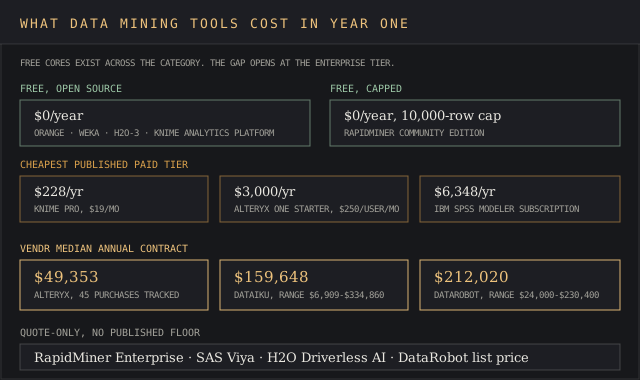
The published numbers split the category into three groups:
- Free cores with no listed ceiling: KNIME, Orange, Weka, H2O-3.
- Paid tiers with a real published starting price: KNIME Pro, Alteryx One Starter, Dataiku Lite, IBM SPSS Modeler Subscription.
- Platforms that require a sales conversation before a buyer sees any number: RapidMiner Enterprise, SAS Viya, H2O Driverless AI, and DataRobot.
Among the platforms that do publish a Vendr-tracked median, DataRobot's $212,020 a year is the highest and Alteryx's $49,353 the lowest.
Data mining tools FAQ
What are data mining tools?
Data mining tools apply statistical analysis and machine learning to large datasets to find patterns, like customer segments, fraud signals, or product associations, a person reviewing raw data by hand wouldn't reliably catch. Most pair a visualization layer with an export path so an analyst can turn the results into a report a business leader can act on.
Which tool is best for data mining?
It depends on budget and team skill. KNIME tops this ranking for pairing a free core with a $19-a-month paid ceiling; RapidMiner and Alteryx suit data scientists needing the deepest algorithm or connector library with enterprise budget; Orange and Weka suit students and small research projects with no licensing cost.
Is Python a data mining tool?
Python is a general-purpose programming language, not a packaged data mining tool, but its libraries, including scikit-learn, pandas, and TensorFlow, run the same classification, clustering, and regression algorithms these platforms expose through a visual interface. KNIME, Dataiku, and RapidMiner all let a data scientist drop Python code directly into an otherwise visual workflow.
Bottom line
KNIME wins this ranking on the combination that matters most for a first purchase: a genuinely free core with no row ceiling, a $19-a-month paid tier that's the cheapest published price in the category, and 300-plus connectors that cover most real data sources without an add-on purchase.
Teams that have outgrown KNIME's operator set should look at RapidMiner for the deepest built-in algorithm library, or Alteryx if per-seat licensing and a large validated review base matter more than raw operator count. Enterprises that need governed GenAI or agentic AI on top of the modeling layer should compare Dataiku's LLM Mesh against DataRobot's AI Observability tooling directly, since both charge enterprise prices for materially different capabilities.
Students, instructors, and teams running small research datasets have no reason to pay anything: Orange's no-code canvas and Weka's textbook pedigree both do the job for free, with H2O-3 as the free option that also ships a real production deployment path.