Market Intelligence Examples: Real Use Cases and Case Studies
 By Jan Suski. I go deep on every review, checking every number against its source and digging up details other coverage misses, a habit from six years of SEO and link building for tech companies. Bylines at Surfer, Brand24, and Senuto. How the scoring works.
· Prefer this source on Google
Market intelligence involves gathering and analyzing data to understand market dynamics: competitor moves, customer behavior, and industry trends. All of it gets pulled from dozens of sources into one continuously updated picture.
The examples below cover what that looks like in practice, from a named company's public strategy shift to the specific, sourced case studies vendors publish about their own customers. The goal: make the concept concrete, something a team could build this quarter.
Market intelligence is a continuous process of data collection and analysis. That sets it apart from market research, a project-based, time-bound study that answers one question and then ends. The examples that follow show both: ongoing intelligence programs and the specific decisions they informed.
The short version 12 points · 50 seconds
- 01Three types form the standard taxonomy across the industryProduct, market, and customer intelligence, each distinct
- 02The same data often feeds both a risk dashboard and a growth callRisk and opportunity signals frequently share one source
- 03Ford realigned its EV plans around where demand showed upFarley cited actual demand over earlier projections
- 04ZoomInfo's case study cut data-wrangling time by 87%Dashboard updates dropped from about 8 hours to 1
- 05Customer-analytics leaders acquire customers 23x more oftenMcKinsey also found 6x better retention, 19x more profit
- 06Combining point-of-sale, pricing, and seasonal data cuts stockoutsReordering happens while there's still time to act
- 07Filings and job postings reveal what a rival doesThat differs from what a company says in public
- 08AI flags a pattern fast, but judgment still decides if it mattersA person still separates a real shift from noise
- 09One study answers a question, ongoing tracking never stopsLaunch approval is research, ongoing tracking is intelligence
- 10Strong examples combine wide sources with one clear decisionContinuous monitoring is the third ingredient that matters
- 11The data changes by industry, the discipline stays constantCommodity prices, release notes, and compset rates all count
- 12A completed example beats an abstract explanation every timeEvery entry traces back to a number someone could check
What market intelligence includes
Market intelligence includes competitor, customer, and market trend data, combined into a system a team checks continuously. Most vendors and researchers organize the discipline into three primary types: product intelligence, market understanding, and customer intelligence. That framework is used consistently enough across the industry to work as a starting taxonomy.
Customer intelligence helps a team understand target audience demographics and preferences, drawing on customer feedback, preference data, and behavioral signals from website interactions. Company-level cases for each segmentation type sit on the market segmentation examples page.
Product intelligence monitors product features, pricing, and performance against a category's moving baseline. Market understanding covers market size, growth rates, and broader industry trends that sit above any single competitor or customer.
Market intelligence examples by business function
Market intelligence assists in product innovation by identifying emerging consumer trends early enough that a product team can act on a shift before it becomes obvious to the whole category. A skincare or consumer packaged goods brand watches social media monitoring data and search trends, moving a product's development timeline up by months to launch before a trend peaks.
Risk management depends on market intelligence to monitor economic and regulatory changes, the kind of oversight a financial market intelligence program runs continuously. Market intelligence helps businesses spot growth opportunities and mitigate risk at the same time, since the data feeding a risk dashboard is often the same data that reveals an underserved market segment worth entering.
Market intelligence helps firms tighten supply chains and forecast demand more accurately, catching a supplier disruption or a demand spike early enough to adjust before it becomes a stockout or an inventory glut. Companies use market intelligence to improve pricing strategies by analyzing competitor actions, feeding a pricing intelligence program that adjusts a price point based on what a rival is charging right now, months ahead of last quarter's file.
Real examples of market intelligence in action
Ford's 2025 strategy reset is one of the clearer public examples of a company acting directly on market signal. CEO Jim Farley described the shift plainly: "We evaluated the market, and we made the call.
"We're following customers to where the market is, not where people thought it was going to be," explaining Ford's decision to realign its EV plans with where actual demand was showing up. It's a useful example precisely because the source is Ford's own public statement. No vendor's marketing copy about an unnamed customer carries that same weight.
Vendor-published customer case studies offer the other kind of example: specific, attributable results tied to one company's deployment. ZoomInfo's published case study on BDO Canada reports an 87% reduction in time spent on data wrangling. Dashboard updates dropped from roughly 8 hours to 1.
Separately, ZoomInfo's 2024 Customer Impact Report found that customers using a multithreaded outreach approach, engaging multiple contacts inside a target account, saw a 32% surge in total pipeline. Average deal sizes grew too. Both figures are real, but they describe ZoomInfo customers under a particular sales motion and guarantee nothing about the lift any other tool produces.
Outside vendor case studies, McKinsey's research on customer analytics offers one of the more frequently cited findings in this space. Companies that lead in using customer analytics are 23 times more likely to acquire customers than laggards, alongside being 6 times more likely to retain those customers and 19 times more likely to be profitable.
A 2023 survey from NewVantage Partners found that only about 24% of organizations characterized themselves as genuinely data-driven. Most companies are still working toward the kind of continuous market intelligence practice that produces results like the ones above.
Retailers and demand forecasting
Retailers use market intelligence for demand forecasting and inventory optimization. That means combining point-of-sale data, competitor pricing, and seasonal trend data to decide what to stock and when. A retail market intelligence program built this way catches a demand shift while there's still time to reorder.
How companies gather market intelligence
Businesses gather market intelligence from a mix of sources. Social media monitoring and social listening tools track public sentiment and competitor activity in real time. Focus groups and customer surveys go deeper on a specific question a broad monitoring feed can't answer on its own.
Competitor websites, job postings, and public filings round out the picture, each revealing a different layer of what a rival is doing.
Data sources for market intelligence typically span social media listening tools, customer surveys, and structured secondary research: industry reports, government data, analyst coverage. All of it combines into a single view. A team that knows how to collect market intelligence data across these sources at once gets a continuously refreshed feed. A snapshot ages the moment it's compiled.
Market intelligence tools and how AI fits in
Market intelligence software and platforms exist specifically to automate the collection work described above. They pull from competitor websites, job postings, review sites, and social platforms into one system. An analyst no longer has to check each source by hand.
AI increasingly handles the pattern-detection layer on top of that raw collection. It flags a shift in competitor pricing or customer sentiment faster than a manual review would catch it. Deciding if a flagged pattern is a real strategic shift, or noise, still needs a person who understands the market.
AlphaSense and ZoomInfo represent two different corners of this category: AlphaSense for document-heavy financial and strategic research, and ZoomInfo for sales and go-to-market intelligence. Neither covers every job market intelligence software can do. Choosing a tool starts with naming the specific job it needs to do.
Market intelligence vs. market research, with an example
Market research is project-based and static: a company commissions a study, gets an answer, and the report ages the moment the market moves past it. Market intelligence includes competitor and industry trend analysis running continuously, which is why the two disciplines answer different questions.
A market analysis commissioned to decide on entering a new category is market research. The ongoing tracking of that category's pricing, competitor data, and demand signal after entry is market intelligence.
A useful example of the difference: a company might run one market research study asking "should we launch this product," using historical data and focus groups to answer a single, bounded question. Once the product ships, market intelligence takes over, tracking competitive positioning, customer feedback, and market shifts continuously so the company can adjust as conditions change.
Companies that treat market intelligence as a source of deeper understanding tend to build a real competitive edge. They sustain that advantage longer than rivals still working from an annual report. A one-time deliverable doesn't produce that same edge.
What strong market intelligence examples have in common
Across the examples above, a few patterns repeat. Each one draws on multiple data sources: sales data, financial data, customer data, usage data. All of it combines into intelligence a marketing or sales team can use. A spreadsheet nobody opens is the usual output.
Each ties directly to a business decision: entering a new market, adjusting a price, reallocating a budget.
Strong examples also treat intelligence gathering as continuous. Gathering data on a single occasion tells a team what an existing market looked like on one day. Collecting market intelligence on an ongoing basis catches opportunities and threats as they develop. That might be a shift in the broader market environment, or an operational intelligence signal buried in support tickets.
Artificial intelligence increasingly handles the mechanical part of intelligence gathering: real-time data feeds, social media platforms, marketing efforts monitored around the clock. A person still has to decide what that data means and what to do about it.
That combination, wide data sources plus a specific decision plus continuous monitoring, is what separates strategic market intelligence from an interesting but unused report. It's the throughline connecting Ford's public strategy statement to a marketing intelligence vendor's own published case study.
The same combination applies to industry developments more broadly. Business intelligence and marketing intelligence systems that surface a competitor's move the same week it happens support business growth in a way a quarterly review never can. The team gets to act while the target market still looks the way the data says it does.
That's the standard worth holding any market intelligence tools purchase to before treating a vendor's marketing intelligence software as one input among several.
Market intelligence examples across industries
The same underlying pattern, continuous data collection tied to a specific decision, shows up differently depending on the industry. A SaaS company watching market trends in a competitor's release notes and pricing page builds customer insights that feed its own roadmap. An automotive market intelligence program tracks EV demand signals the way Ford's own strategy shift illustrated.
A procurement team collects market intelligence on supplier pricing and commodity trends to time a purchase. A hotel chain running hotel market intelligence watches compset pricing and local demand, to adjust rates before a competitor undercuts a weekend rate. An oil and gas market intelligence program tracks production trends to forecast prices and time hedges, the same discipline applied to a different set of signals.
What changes across industries is the specific data feeding the system: commodity prices for procurement, release notes for SaaS, compset rates for hotels. What stays constant is the discipline of collecting market intelligence continuously and tying it to a decision someone is prepared to make.
FAQ
What is market intelligence?
Market intelligence is the systematic gathering and analysis of information about the external environment: competitors, customers, and market conditions. It's used to support business decisions on an ongoing basis.
What are the different types of market intelligence?
Most frameworks describe three primary types: product intelligence, market understanding, and customer intelligence, each covering a different slice of the external environment a business needs to track.
What are the key components of market intelligence?
Data collection from diverse sources, structured analysis that turns raw signal into actionable insight, and a process for getting that insight to the right team. That team might be product, sales, marketing, or leadership, depending on the finding.
What are the best market intelligence tools available today?
It depends on the job. AlphaSense leads for document-heavy financial and strategic research, and ZoomInfo for sales and go-to-market intelligence; see our full rankings hub for a broader comparison.
What are the methods of market intelligence?
Primary methods include customer surveys and focus groups. Secondary and automated methods include social media monitoring, competitor website tracking, job posting analysis, and structured industry reports, usually combined.
How is market intelligence different from marketing intelligence?
The terms overlap heavily in practice. Marketing intelligence combines customer, competitor, and market data specifically to inform marketing strategies and campaign decisions. Market intelligence is the broader discipline, feeding product, sales, risk, and strategic decisions across the whole business, well beyond marketing.
Filled-in template examples
The fastest way to see what working market intelligence looks like is a completed framework. Below are two filled-in examples from our market research templates library, each built around one defined objective and populated with checkable statements.
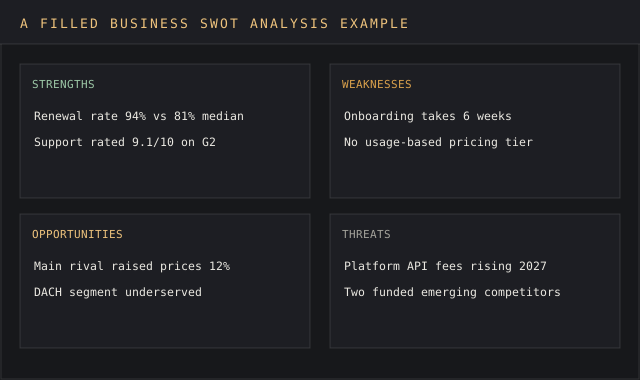
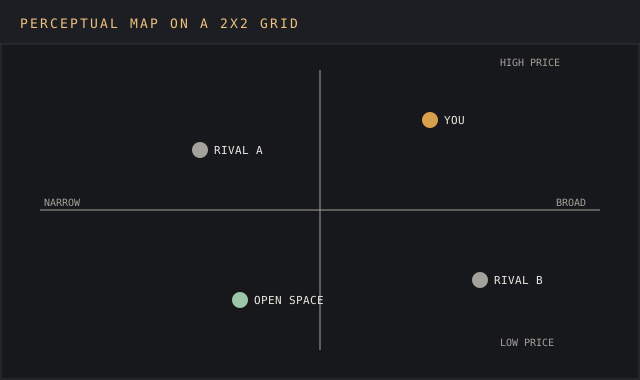
Every entry in both examples traces to a number someone could verify: a renewal rate, a rival's published price change, a scored axis. That standard is what separates a market intelligence document from a slide of opinions. Each template in the library ships with prompts written to enforce it.
Bottom line
The strongest market intelligence examples share a common thread: a specific, named source, Ford's own strategy statement, a vendor's published customer result, a research firm's survey. Building a market intelligence practice worth the name means aiming for that same specificity. Know exactly which data sources feed a decision, and exactly how confident the resulting number is.