AI procurement software: 10 platforms ranked for 2026
 By Jan Suski. I go deep on every review, checking every number against its source and digging up details other coverage misses, a habit from six years of SEO and link building for tech companies. Bylines at Surfer, Brand24, and Senuto. How the scoring works.
· Prefer this source on Google
Quick comparison of AI procurement software
The training column is the one that varies most and the one no vendor leads with in a demo.
| # | Platform | Primary job | Built AI-first? | Published pricing | Customer data trains models? | Latest funding or ownership |
|---|---|---|---|---|---|---|
| 1 | Zip | Intake to procure, orchestration | Workflow first, agents 2025 | No, Vendr median $88,856/yr | Only with explicit permission | $190M Series D, Oct 2024, $2.2B valuation |
| 2 | Oro Labs | Agentic procurement orchestration | Yes, greenfield 2020 | No, bills on transaction volume | No published position | $100M Series C, Mar 2026 |
| 3 | Levelpath | Intake, sourcing, contracts | Yes, launched post-LLM | No | Zero retention stated, training not | $55M Series B, Jun 2025, $100M total |
| 4 | Pactum AI | Autonomous supplier negotiation | Yes, agents are the product | No | No published position | $54M Series C, Jun 2025, Insight Partners |
| 5 | Globality | Sourcing and tail spend | Yes, one agent named Glo | No | No published position | $47M Series D, Oct 2024, $356M total |
| 6 | Arkestro | Predictive negotiation | Yes, the price model is the product | No | ToS grants perpetual content licence | $36M strategic, May 2025 |
| 7 | Fairmarkit | Autonomous sourcing, RFx | 2017 RFQ engine, GenAI rebuild | No | Yes, own ML models, opt-out offered | $35.6M Series C, Sep 2022 |
| 8 | Omnea | Intake and orchestration | Yes, founded 2022 | No | No, and builds no models of its own | $50M Series B, Sep 2025 |
| 9 | Keelvar | Sourcing optimization | Optimization first, agents later | No | Third parties no, aggregated exempt | $24M Series B, May 2022 |
| 10 | GEP | Full source-to-pay suite | Legacy suite, 30+ agents added | Yes, via Texas DIR contract | Yes, continuous retraining stated | Private, acquired OpusCapita 2024 |
AI procurement software applies artificial intelligence to the buying process: machine learning, natural language processing, and autonomous agents route requisitions, score suppliers, and match invoices without a person touching each one. It's the operational half of procurement management tooling, sitting where the manual processes used to be.
This guide ranks 10 platforms, each with its capabilities, pricing, documented limits, and published position on the question of your data training its models.
Written for the person building the shortlist: a CPO, a procurement operations lead, or the finance owner who signs the contract. It assumes an ERP already in place and a budget in the tens of thousands, since the cheapest benchmarked price here starts at $35,668 a year.
The category changed shape in the last eighteen months. Intake and orchestration tools that shipped in 2020 as workflow engines have since bolted on agent layers, while a newer set of vendors built agents as the product from the start. Both end up on the same shortlist.
Nine of the ten don't publish a price list. GEP is the exception, and only because a US state contract forced the numbers into public view. Those figures are quoted in full below, about as close to straight from the horse's mouth as this category gets.
Vendor facts, funding rounds, ownership, and trust-page commitments were verified on 5 August 2026. Where a source conflicts with another, both get named.
This page covers operational AI, the software that runs the buying process. Tools that supply external market and supplier data sit on our procurement intelligence tools ranking instead, and the discipline behind both is covered on the procurement market intelligence page.
What AI procurement software does
Four techniques do the work, and vendors mix them in different proportions. Knowing which one a platform leans on tells you more than its feature list.
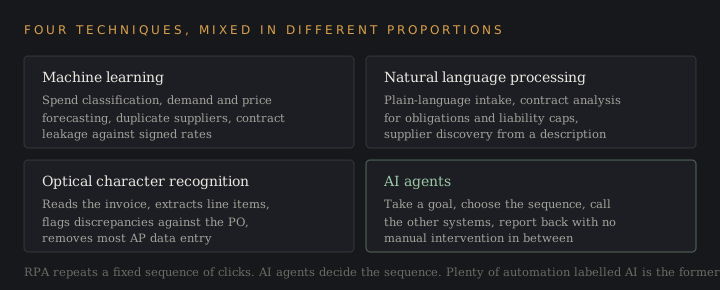
Machine learning reads historical data and finds structure in it. Spend classification is the standard application: machine learning algorithms sort a million transaction lines into categories that a team would otherwise map by hand, the equivalent of finding a needle in a haystack one row at a time. The same models analyze data for predictive analytics on demand, price, and market trends.
The same models surface four patterns that matter commercially.
- Duplicate suppliers.
- Off-contract purchases.
- Volume-discount opportunities.
- Rates that drifted from what was signed.
Natural language processing lets a system read human language. That covers intake, where a requester describes what they need in plain words, cuts to the chase, and skips the form entirely, contract analysis, where the software pulls obligations, renewal dates, and liability caps out of a PDF, and supplier discovery, where a plain-language description of a requirement returns a vetted shortlist.
Optical character recognition handles invoice processing. OCR reads the document, then a language model extracts line items and flags discrepancies against the purchase order, which removes most of the data entry from accounts payable. The same pipeline runs in reverse to draft the purchase order in the first place.
AI agents chain those pieces into multi-step work. An agent takes a goal, decides the sequence, calls the other systems, and reports back with no manual intervention in between. This is the layer every vendor shipped in 2025 and 2026, and it's where the real differences sit.
Generative AI cuts across all four. A model that produces new content from learned patterns is what drafts the RFx, writes the negotiation message, and summarizes the contract, and it's the component that made intake in plain language work at all.
Workflow automation is what connects the pieces into procurement workflows people use. AI systems that produce a finding nobody routes are reporting tools with a longer sales cycle.
Robotic process automation predates all four and still shows up in these stacks. RPA repeats a fixed sequence of clicks; AI agents decide the sequence. Plenty of procurement automation labelled AI is RPA with better marketing, a shortcut that lets a vendor cut corners on the harder work of building real agents, which is worth checking in a demo.
What the software takes off a person's desk
Repetitive tasks go first. Matching an invoice, chasing a certificate that expired, coding a purchase order to the right cost centre, these are routine tasks with a right answer and no judgment involved. Operational procurement absorbs most of that load today.
Work that used to typically require human intelligence comes next: reading a contract for risky clauses, deciding which of four suppliers to shortlist, spotting that a category's price is drifting. AI capabilities now reach into this tier, with a person reviewing the AI's output and keeping an eye on where judgment still matters.
The shift shows up in throughput. McKinsey's October 2025 analysis reports spend managed per procurement full-time employee up 50% against five years ago, which is the administrative half of the job compressing while the strategic half absorbs the people.
What stays human is the relationship. Supplier relationship management, the awkward renegotiation, the decision to walk away from an incumbent, none of that survives contact with an agent. The procurement team's expertise moves up the stack, and procurement teams that plan for that shift keep the people they trained.
What AI procurement software costs
Almost nobody in this category publishes a rate card. The exception is instructive.
GEP's pricing appears in a Texas Department of Information Resources contract, which puts Spend Analytics data migration at $15,000 to $95,000 per historical year depending on spend band, and AI-Based Data Processing at $68,000 to $137,000 a year. Public-sector procurement rules dragged those numbers into daylight; no vendor here volunteered them.
For the rest, third-party benchmarks are the only anchor. Vendr's marketplace data, updated February 2026 across 73 purchases, puts Zip at a median $88,856 a year with a range of $35,668 to $214,750. SelectHub benchmarks Zycus from $50,000 to $250,000 annually, enough to cost an arm and a leg for a team that hasn't budgeted for it.
Two vendors have moved off per-seat pricing entirely. Oro Labs charges on transaction volume, and Coupa's design product, ranked on our supply chain intelligence software page, bills usage with unlimited users. That matters for a procurement function trying to put the software in front of every requester.
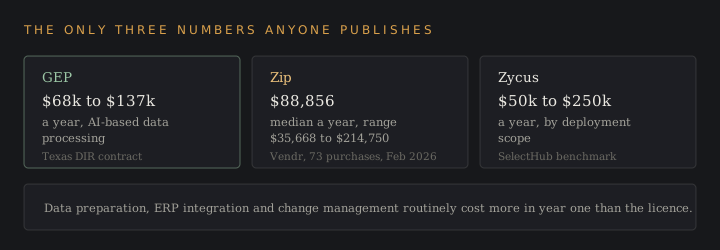
Budget for the work around the licence. Data preparation, integration with existing ERP systems, and change management routinely cost more in year one than the software, and every vendor here will quote implementation separately.
Evaluation criteria
Eight things separate a platform worth piloting from a demo that impresses and then stalls.
- Where the AI sits. Agents that reason across systems versus a chat box over a static dashboard. Ask what happens when the agent hits an exception.
- Integration with existing ERP systems. How it connects to SAP, Oracle, or NetSuite, and how long that takes in weeks. Enterprise systems are where most implementations slip.
- Data dependency. How much of the value needs your spend data clean first, given 74% of leaders say theirs isn't ready. Check which data sources the vendor connects natively.
- Coverage of the job. A full spend management suite and a single-step AI procurement solution solve different problems at different prices.
- Pricing unit. Per seat, per transaction, or per user tracked. A per-seat model caps how widely you can deploy intake.
- Audit trail. Confirm an agent's decisions are logged and reversible. Procurement carries compliance obligations that a black box can't satisfy.
- Model training rights. Ask if your spend, supplier, and contract data trains the vendor's models, and if opting out is possible. Four of the ten publish a clear answer.
- Independent review base. How many verified reviews exist. Several vendors here have fewer than fifteen, and one has none.
Test the agents against your own messiest category during a pilot. A model that classifies clean sample spend at high accuracy can still fail on your supplier names spelled four ways across three systems, proof the devil's in the details once real data shows up.
The 10 platforms, ranked
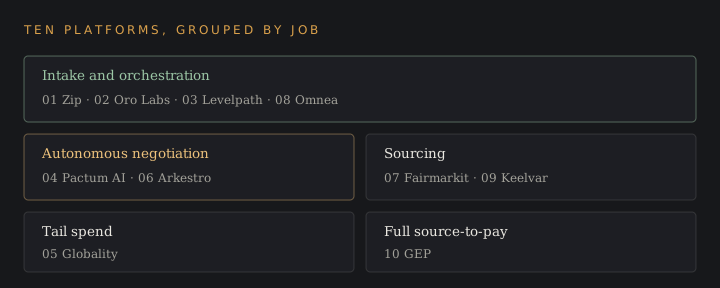
Ten platforms ranked on how completely they cover the eight criteria above.
Zip
The widest orchestration surface here, and the only one with a benchmarked price.
Zip runs Intake-to-Procure, Procure-to-Pay, Supplier Onboarding, Sourcing, Risk Orchestration, and AI Contract Orchestration. On 2 June 2026 it shipped five Superagents: Procurement, Contract, AP, Config, and Intake, following earlier task agents including Renewal Assist and AI Invoice Coding.
Why it's ranked #1. Zip pairs the broadest module coverage with the only credible price benchmark in the category, the best of both worlds for a buyer who wants scope and a number to budget against, and its procurement-native Model Context Protocol server with OAuth-scoped permissions and audit trails is the clearest answer to the auditability problem.
Founded 2020 by Rujul Zaparde and Lu Cheng, it raised a $190M Series D in October 2024 led by BOND at a $2.2B valuation, $371M total.
Its trust centre carries the strictest published training commitment of the ten: customer data trains nothing unless the customer explicitly permits it, LLM providers are used only under contractual zero-data-retention agreements, and AI functionality can be switched off entirely.
Zip holds SOC 1 and SOC 2 Type 2 plus ISO/IEC 27001:2022 certified by Schellman, and publishes its subprocessor list including OpenAI and Anthropic, staying ahead of the curve on governance most rivals still treat as optional.
Customers include Prudential, Snowflake, Instacart, Northwestern Mutual, Toast, Coinbase, Dollar Tree, Figma, UCI Health, and, as of June 2026, OpenAI and Datadog. It holds 4.6 from 136 G2 reviews, the largest verified review base of the pure-play vendors here, and was named a Visionary in the January 2026 Gartner Magic Quadrant for Source-to-Pay Suites and a Leader in the IDC MarketScape for AI-enabled spend orchestration on 14 July 2026.
A Forrester Total Economic Impact study published 26 May 2026 puts return at 386% with payback under six months, commissioned by Zip.
Pricing and limits
No published rate. Vendr's February 2026 benchmark across 73 purchases: median $88,856 a year, range $35,668 to $214,750.
Who should skip it
Teams whose main need is reporting. Samantha G., a procurement operations lead, wrote on G2 in July 2026 that "the filtering options and reporting feel inconsistent and can be difficult to use at times."
Oro Labs
Built by three ex-SAP Ariba leaders, and holder of the newest large round in the category.
Oro Labs runs agentic procurement orchestration across intake, supplier onboarding, and risk and compliance, with named agents for intent detection, autonomous negotiation recommendation, fraud detection, and legal review, plus a no-code Agent Builder.
Why it's ranked #2. Oro charges on transaction volume, which removes the usual per-seat barrier and levels the playing field for putting intake in front of every employee. Founded 2020 by Sudhir Bhojwani, Lalitha Rajagopalan, and Yuan Tung, it closed a $100M Series C on 12 March 2026 co-led by Brighton Park Capital and Growth Equity at Goldman Sachs Alternatives, $160M total, and acquired ProcureTech in March 2025.
It won the World Procurement Award for Top Procurement Technology Provider in May 2026, the first back-to-back winner in that award's twenty-year history.
On governance Oro holds SOC 1 Type 2, SOC 2 Type 2, ISO/IEC 27001:2022, and ISO/IEC 42001:2023, the AI management standard, announced 16 July 2024 as the first accredited certification of its kind in the category. The 42001 certificate is the strongest formal AI-governance credential here, though the trust page stops short of saying if customer data trains its models.
The customer list skews to regulated manufacturing: BASF, Novartis, Pfizer, Coca-Cola, Thermo Fisher, GSK, Stellantis, and Bayer. G2 rates it 4.7 from 47 reviews.
Who should skip it
Teams that need strong native reporting on day one. A G2 reviewer notes that "reporting and dashboards could be enhanced to be more dynamic."
Levelpath
Founded by the pair who sold Scout RFP to Workday for $540 million.
Levelpath covers intake and orchestration, sourcing, supplier management, contract management, category management, risk, and invoice automation. Its Agent Orchestration Studio, a no-code multi-agent builder, launched 3 March 2026, and Gartner listed it as a Sample Vendor in the 2026 Hype Cycle for Procurement and Sourcing Solutions on 17 June 2026.
Why it's ranked #3. Levelpath started building after large language models were usable, a clean slate with no pre-LLM product underneath the AI. Its contract parsing recommends cheaper equivalents. Stan Garber and Alex Yakubovich raised a $55M Series B led by Battery Ventures announced 27 June 2025, taking the total to $100M after a $14.5M Benchmark seed and a $30M Redpoint Series A.
Its Vanta-hosted trust centre publishes SOC 2 Type II and zero data retention for AI features, with no ISO certification claimed and no statement either way on model training.
Levelpath's supplier terms grant it rights over supplier data and perpetual rights over de-identified aggregate data. Those bind suppliers without a signed agreement, which is a different exposure from the one your own contract covers.
Customers include Ace Hardware, Amgen, Coupang, SiriusXM, and GATX. G2 rates it 4.8, from only 10 reviews.
Who should skip it
Teams whose priority is spend analytics. Robert C., a director of sourcing, wrote in January 2026: "We'd love to see Levelpath expand into the spend analytics space."
Pactum AI
Agents that run the negotiation and close it.
Pactum's agents conduct autonomous commercial negotiations with suppliers at a scale no human team covers, aimed at the long tail where the contract value never justified a negotiator's time. It added a Requisition Alignment Agent for SAP and Coupa on 16 March 2026.
Why it's ranked #4. This is the narrowest product in the ranking and the one that most visibly does a job a person was doing before. Pactum sticks to one job, the negotiation itself, at a scale no human team covers, leaving jack-of-all-trades ambitions to the orchestration suites. Founded 2019 in Tallinn by Martin Rand, Kaspar Korjus, and Kristjan Korjus, with Kaspar Korjus now CEO, it runs engineering in Estonia and headquarters in Mountain View.
Its $54M Series C led by Insight Partners closed 9 June 2025, past $100M total, and the Estonian entity reported 85 staff in Q2 2026.
It ranks below the orchestration platforms because it solves one step of the process.
Named customers span Walmart, Veritiv, Suez, Linde Group, Global Industrial, Mediclinic, Vallen, Otto, Honeywell, Novartis, and Tetra Pak, with the company citing more than 50 large enterprises.
Pactum's G2 listing carries no rating and no reviews, so the customer evidence here is entirely vendor-supplied. Its security page claims a programme following SOC 2 criteria without naming a type or date, and its Cloud Security Alliance entry is a 2023 self-assessment.
Who should skip it
Teams without enough tail spend to justify it. Autonomous negotiation pays off across thousands of small contracts, and a portfolio of forty strategic suppliers won't clear the bar.
Globality
One agent, one job, and 9,000 categories of training behind it.
Globality's Glo handles sourcing and tail spend. It replaces intake forms with natural language questions, then runs supplier discovery, vetting, and multi-round negotiation autonomously, trained across more than 9,000 categories on proprietary data plus third-party models, so it knows the ropes on categories a generalist tool has never touched.
Why it's ranked #5. The category training depth is real and the scope is honest: Globality doesn't claim procure-to-pay, invoicing, or payments. Founded 2015 by Joel Hyatt and Lior Delgo in Palo Alto, it raised $47M in October 2024 from existing shareholders plus Rollins Capital, $356M total, after a $138.3M Series E from Sienna Capital and SoftBank in January 2021.
The Hackett Group named it to its 2025-2026 "50 to Know" list on 3 March 2026.
Customers include Fidelity, Santander, British Telecom, Tesco, IQVIA, T. Rowe Price, Invesco, and Dropbox. G2 rates it 4.4, from just 4 reviews, all posted in spring 2024.
Who should skip it
Anyone needing a full suite. Also worth noting a scope complaint: a G2 reviewer wrote that "the supplier list occasionally includes suppliers that fall outside the designated scope."
Arkestro
Predictive pricing with game theory underneath, and Ariba's co-founder on the cap table.
Arkestro's Predictive Procurement Platform is built on what it calls Negotiation Science, Supplier Science, and Process Science, and it runs buyer hands-free autonomous negotiation. The model predicts where a supplier will land and opens there.
Why it's ranked #6. Arkestro has no procure-to-pay suite at all; the predictive price model is the entire product. It started in 2017 as Bid Ops under Edmund Zagorin, with Ariba co-founder Rob DeSantis alongside, and raised $36M in May 2025 led by Altira Group and Aramco Ventures with NEA, Koch Disruptive Technologies, and Activant participating.
Gartner named it a Sample Vendor in the 2026 Hype Cycle under Autonomous Sourcing on 30 June 2026, a fourth consecutive year.
It holds ISO/IEC 27001:2022, certified by Prescient Security in September 2023, and states it passes SOC 2 Type II audits without exceptions.
Section 7.5 grants Arkestro a perpetual, irrevocable, worldwide licence to use, reproduce, and modify customer content for operating and improving the services. Section 7.3 assigns ownership of the Outputs to Arkestro for any purpose. Legal should read both clauses before a pilot. The devil's in the details on both counts.
Customers include Chevron, NextDecade, Koch, JLL, Valvoline, GAF, and Trinity Industries. G2 rates it 5.0 from 11 reviews; Gartner Peer Insights 3.8 from 5.
Who should skip it
Categories where the bid carries context a model can't read. A Gartner reviewer in the energy sector wrote in March 2026 that "some parts of the bid process tend to strip away the nuance and detail associated with some bids."
Fairmarkit
A 2017 RFQ engine rebuilt on generative AI, with a large supplier marketplace attached.
Fairmarkit shipped Total Agentic Sourcing on 29 April 2026 with five named agents: Intake, Supplier Discovery, RFx Execution, Evaluation, and Performance & Compliance.
Why it's ranked #7. The supplier marketplace is a genuine asset that newer entrants can't replicate quickly, and the agent set covers sourcing end to end.
Fairmarkit puts the marketplace at 2.7 million suppliers across 195 countries; that figure is self-reported with no published methodology and first appears in its April 2026 release, where its 2022 funding announcement cited 200,000 sourcing events and 50 enterprises instead, a gap worth reading between the lines on before taking the marketplace figure at face value.
Founded 2017 in Boston by Kevin Frechette and Victor Kushch, it raised a $35.6M Series C on 1 September 2022 led by OMERS Growth Equity with ServiceNow investing strategically, $78M total. Nothing since, which is the longest funding gap here.
Its security page is the most candid on training in the whole ranking, and the answer is a split one. Third-party LLMs run under zero-retention agreements, but Fairmarkit's own machine learning models retrain on pseudonymized customer data, with an opt-out available and a stated decay of a departed customer's contribution to model parameters over time.
Customers include Boeing, BP, ServiceNow, Snowflake, Walgreens, Goodyear, and Sonoco. G2 rates it 4.6 from 17 reviews.
Who should skip it
SAP shops, on the evidence. A senior supply chain manager listed the drawbacks on G2 as "Price / Limits on the product lines to bid. / Hard integration with SAP."
Omnea
The newest well-funded intake platform, and the one most focused on the requester.
Omnea covers intake and orchestration with autonomous sourcing and a hosted Model Context Protocol server launched 30 March 2026, aimed at getting every employee's buying request into a governed process without training them on procurement software.
Why it's ranked #8. Founded 2022, it raised a $50M Series B on 17 September 2025 led by Insight Partners and Khosla, past $75M total, the largest recent round for a pure intake play. It reported revenue tripling in the twelve months to June 2026, adding PayPal, Just Eat, Riot Games, T. Rowe Price, and Unity, and appointed Michael van Keulen as CPO in Residence on 4 August 2026.
The module coverage is narrower than Zip's or Levelpath's, and the verified review base is thin.
Omnea publishes the most specific commitments of the ten, calling a spade a spade on a question most vendors leave to a sales rep. It states plainly that it retains no customer data for AI model training and builds, trains, and fine-tunes no models of its own, reaching market LLMs by API instead.
Its public data processing addendum, updated 16 June 2026, commits to AES-256, TLS 1.2 or higher, seven-day remediation for critical vulnerabilities, recovery time under one hour, and recovery point under five minutes, with a ten-day window to object to a new subprocessor. Its SOC 2 Type 2 report is dated June 2025.
Customers include Spotify, Albertsons, and Wise.
Who should skip it
Teams that need sourcing optimization or invoice automation in the same platform. Omnea is an intake tool.
Keelvar
The optimization specialist, and the only vendor Gartner names in two sourcing categories at once.
Keelvar runs Sourcing Optimizer for complex bid scenarios, Rate Manager for freight, and Kai as its orchestration layer. The optimization engine solves multi-constraint award problems that a spreadsheet can't.
Why it's ranked #9. Gartner's Market Guide for Sourcing Applications, published 4 March 2026, names Keelvar as the only vendor covering both Advanced Sourcing Optimization and Autonomous Sourcing, the best of both worlds in Gartner's own taxonomy. It ranks low here on funding recency: its last round was a $24M Series B in May 2022. Alan Holland founded it in September 2012 in Cork after leaving University College Cork and remains CEO.
Customers include Mars, Coca-Cola, Siemens, Samsung, Maersk, Henkel, adidas, Solvay, Caterpillar, Associated British Foods, and Stanley Black & Decker, with the company citing more than 150 multinationals and over $100bn in annual spend on the platform. G2 rates it 4.7 from 26 reviews.
Keelvar carries no SOC 2 and instead audits annually against ISO/IEC 27001:2022 and ISO/IEC 27701:2019, with certificates published as PDFs. Its GDPR posture is the most complete here: a public DPA with EU standard contractual clauses, the UK addendum, and Swiss terms, a dated subprocessor list with a transfer mechanism per entry, thirty days' notice of changes, and the only named hosting region in the ranking, AWS eu-west-1 in Dublin.
Keelvar's own trust log shows one subprocessor's scope widening from Europe to Europe and the US in April 2026, and to worldwide in July 2026. Keep an eye on that against the data residency commitment when it comes up in diligence.
Who should skip it
Teams whose sourcing events are simple. Optimization earns its cost on multi-lot, multi-constraint awards such as freight or direct materials, and a three-quote RFQ needs none of it.
GEP
The legacy suite, and the only vendor whose list prices you can read.
GEP consolidated GEP SMART, NEXXE, GREEN, and CLICK into GEP Quantum Intelligence, with SMART remaining supported and no forced migration timeline. It runs more than 30 named agents covering strategic sourcing, bid optimization, negotiation, contract clause risk, invoice N-way matching, and fraud detection.
Why it's ranked #10. GEP is a consulting firm that became a software vendor, and Quantum Intelligence absorbs SMART, so the AI sits on a suite built years earlier. It ranks last among the ten on that basis. It's here because the agent catalogue is the deepest in the ranking and the pricing transparency is unmatched.
Pricing and limits
From the Texas DIR contract: Spend Analytics data migration $15,000 to $95,000 per historical year by spend band, AI-Based Data Processing $68,000 to $137,000 a year.
GEP is the one vendor that markets continuous retraining on customer data as a feature, stating that the system learns and retrains on your data. It holds SOC 1 and SOC 2 Type II plus ISO 27001 and ISO 9001, all shared under NDA, and offers regional data choice across Azure and Google Cloud.
Its trust centre describes tenancy as logically isolated while the Quantum Intelligence page describes single-tenant environments; ask which applies to your deployment.
Customers include Chevron and the Port of Tanjung Pelepas. G2 rates it 4.3 from 27 reviews, and it's a Leader in the 2026 Gartner Magic Quadrant. It acquired OpusCapita on 1 July 2024, and the University of Chicago Booth School established the GEP Center for Supply Chain Innovation and Applied Technologies on 21 July 2026.
Who should skip it
Teams that deploy on a tight release cadence. A Gartner reviewer in September 2025 described the platform as "Unstable during releases," about par for the course for a suite carrying this much legacy code.
Where AI adoption in procurement stands
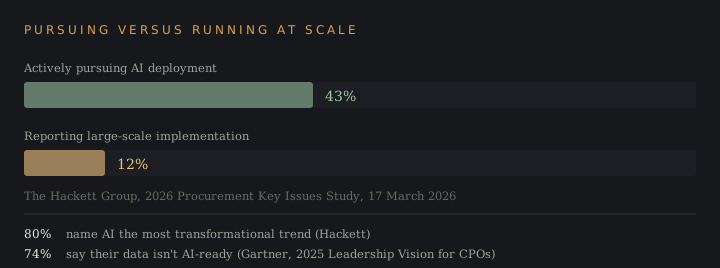
Adoption roughly doubled in a year. The Hackett Group's 2026 Procurement Key Issues Study, published 17 March 2026, found 43% of organizations actively pursuing AI deployment, close to double the previous year, while only 12% report large-scale implementation.
The same study reports 80% of procurement executives naming AI technology as the most transformational trend affecting the function over the next five years, ahead of automation and skills change. Hackett also projects procurement workloads rising 8% in 2026 while headcount and operating budgets decline, which is the pressure driving the spend.
Ambition still runs ahead of delivery. EY's Global CPO Survey: 2025 Outlook, published February 2025, found 80% of CPOs planning to deploy generative AI in some capacity over the next three years, with only 36% having it deployed in a meaningful manner at the time of the survey. McKinsey puts the implemented-or-piloted figure at 40% of procurement functions. Talk is cheap until the deployment number catches up to the planning slide.
Data readiness is the constraint everyone names. Gartner's 2025 Leadership Vision for Chief Procurement Officers reports 74% of procurement leaders saying their data isn't AI-ready.
The upside is measurable where organizations get past the pilot. McKinsey's "Transforming procurement functions for an AI-driven world", published 27 October 2025, concludes that agentic AI could make the procurement function 25 to 40 percent more efficient, and puts a 20 percent savings potential on deploying analytics tools. Operational efficiency at that scale is the argument most business cases are built on, ahead of headline cost savings.
KPMG's 2023 paper "Unleashing the power of generative AI in procurement" reports up to 80 percent time savings in some use cases, and estimates 50 to 80 percent of current source-to-pay work can be automated, eliminated, or shifted to self-service. Both figures come from internal KPMG simulations and pilots. No measured customer deployment backs them yet, which keeps them pie in the sky until real customers report the same numbers.
Sievo's own guidance points the same way and is more useful for a business case: assume roughly 80% of spend classification can be automated with the remaining 20% needing human review and exception handling. Partial automation is the planning assumption, from the vendor selling the automation.
Deloitte's 2025 Chief Procurement Officer Survey, covering more than 250 CPOs across 40 countries, splits the field. Its Digital Masters average a 3.2x return on generative AI investment against slightly above 1.5x for Followers, and that top quartile allocates up to 24% of budget to procurement technology, close to double what it reported in 2023.
APQC's August 2025 research adds a finding that cuts against the data-readiness worry: eight of every ten respondents who implemented AI in procurement said data quality improved afterwards. Deployment appears to force the cleanup.
Gartner's own read is cooler. It placed generative AI for procurement in the trough of disillusionment on 30 July 2025, and reported on 19 May 2026 that just 36% of CPOs express high confidence in their ability to redesign the function around AI.
Its dated forward prediction is narrower than the category's marketing: on 21 May 2025 Gartner forecast that by 2030, half of cross-functional supply chain management solutions will use intelligent agents to autonomously execute decisions.
Market forecasts are worth reading with the base year attached. Market.us sizes generative AI in procurement at $174 million growing to $2,260 million by 2032 at a 33% CAGR, published May 2023 with 2023 as the base year. Coupa cites the same $2.26 billion figure but states the $174 million base as 2024, and Market.us's own FAQ gives the end year as 2033, so the compound rate depends on which pair of dates you take.
Does customer data train the vendor's models?
This is the question with the widest spread of answers and the one least likely to come up in a demo. Procurement data is unusually sensitive: it contains negotiated rates, supplier terms, and volumes that a competitor would pay for.
Four vendors publish a clear commitment, calling a spade a spade on the training question up front.
- Omnea states it retains no customer data for model training and builds no models of its own.
- Zip trains only with explicit customer permission and contracts zero data retention with every LLM provider it uses.
- Keelvar's AI annex bars third parties from using customer data for model training, with a carve-out for aggregated, anonymized, or pseudonymized data.
- Levelpath publishes zero data retention for AI features without addressing training directly.
Fairmarkit gives the most detailed answer and it's a qualified yes. Its own machine learning models retrain on pseudonymized customer data, with an opt-out, while third-party LLMs operate under zero-retention agreements.
GEP goes the other way and sells it as a benefit, describing a system that continuously learns and retrains on your data. That's a defensible design for spend classification accuracy, and it's a different bargain from the one Omnea offers.
Arkestro publishes no position, and its terms of use grant it a perpetual, irrevocable licence over customer content for operating and improving the services plus ownership of the Outputs. Oro Labs and Pactum AI publish no position either way, which for Oro sits oddly beside its ISO 42001 AI management certification.
Ask for the training clause in writing during procurement of the procurement software. Trust pages change; contracts hold.
The legacy suites adding AI
Three established source-to-pay vendors sit alongside the ten, and a buyer already running one of them should test the incumbent before shortlisting a challenger. JAGGAER and SpendHQ cover adjacent ground and have their own reviews.
Zycus runs the Merlin Agentic Platform, self-described as a DIY low-code orchestration platform with 1,121 APIs, over an i-suite that predates it. It's bootstrapped, a Leader in the 2026 Gartner Magic Quadrant, and rates 3.6 from 13 G2 reviews. The sharpest complaint is integration: a verified financial services user wrote, "No API, the only way to integrate is through flat files, welcome to 1986."
Ivalua launched IVA Studio in 2026 with skills-based agents, Model Context Protocol support, bring-your-own-model flexibility, permission inheritance, and audit logging. Founded 2000 by David Khuat-Duy, who handed the CEO role to Franck Lheureux in January 2025 and became Chief AI Officer. Hg partnered in 2024.
Ivalua rates 4.3 from 102 G2 reviews, the largest base here, and a Gartner reviewer in April 2026 flagged "Slow issue resolution. Takes up to 3 months on average for major issues."
Coupa made Navi Agent Studio generally available in May 2026 and has been buying capability, acquiring Cirtuo, Scoutbee, Rossum, and then Tonkean on 21 May 2026, piecing together a jack-of-all-trades platform through acquisition. Our Coupa review covers the suite in more depth.
Implementation: where these projects fail
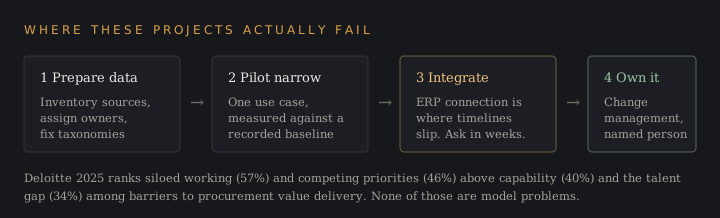
AI procurement software implementation fails on data and people far more often than on the model.
Prepare the data first. Inventory every source feeding procurement data, assign an owner to each, and standardize supplier and category taxonomies, the same groundwork our guide to gathering market intelligence sets out. Feeding as much relevant data as possible into a model without cleaning it cuts corners on the groundwork and produces confident answers built on duplicated supplier records.
Pilot one bounded use case. Spend classification or invoice processing, measured against a baseline you recorded beforehand. The gap between organizations running pilots and those at large-scale implementation, 43% against 12% in Hackett's 2026 study, is mostly an integration problem that a narrow pilot exposes early.
Budget the integration honestly. Connecting to existing ERP systems and enterprise resource planning records is where timelines slip. Ask for named reference customers running your ERP version, and ask how long their connection took in weeks.
Name an owner for change management. Deloitte's 2025 survey ranks siloed working at 57% and competing priorities at 46% among the top barriers to procurement value delivery, ahead of capability at 40% and the talent gap at 34%. Those are organizational problems that no procurement platform solves on its own.
The people doing the implementations report the same thing. Ivalua's Source-to-Pay Implementation Guide, built on 100 responses from 31 system integrators, puts stakeholder alignment and change management as the most common implementation challenge at 58.7%.
That sample is implementation consultants surveyed about source-to-pay projects in general. Treat the 58.7% figure as a description of project shape; it says nothing about AI specifically.
Expect the tooling to improve your inputs. APQC found eight in ten organizations that implemented AI in procurement reported better data quality afterwards.
Supplier risk, contracts, and what agents watch
Continuous monitoring is where AI changes the shape of the work. A team reviewing supplier financial health quarterly sees four snapshots a year; an agent watching the same signals reports the week a credit rating moves.
Supplier risk monitoring pulls external data on ownership changes, filings, sanctions, and adverse media, and scores it against your own supplier data. Dedicated platforms for that job are ranked separately on our supply chain risk management page. Combining internal and external data is what makes the score mean anything, and it's what lets a platform flag a potential disruption and nip it in the bud before it reaches operations.
Risk management then depends on routing. An alert that reaches a category owner with a next action beats one that lands in a shared inbox, and risk mitigation lives in that handoff.
Supplier performance tracking runs on the same feed: delivery dates, quality rejects, and responsiveness scored continuously so a decline shows up before a renewal does.
Contract intelligence is the other continuous job. Contract analysis at scale surfaces auto-renewal dates, uncapped liabilities, and rates that drifted from what was negotiated, which is where contract management quietly leaks the savings that sourcing won.
Gartner predicts that by 2027, 50% of organizations will support supplier contract negotiations using AI-enabled contract risk analysis and editing tools. Its survey of 101 procurement leaders also found they anticipate a 21.7% productivity increase from generative AI over 12 to 18 months.
Inventory management and demand signals sit adjacent. Machine learning models that predict consumption feed reorder timing, which connects procurement systems to the wider supply chain.
Policy compliance and what the agents block
Enforcement is the quietest thing this software does and often the fastest to pay back. Procurement policies written in a PDF get ignored. The same rules encoded at the point of request get applied every time, proof that actions speak louder than words in a compliance program.
Platforms flag unauthorized purchases before they become commitments: a requisition above a threshold without an approval, a category routed around a preferred supplier, a renewal signed outside the contract calendar. Monitoring compliance continuously catches the drift that a quarterly audit finds twelve months late.
Multi-tier supplier data is the harder version. Interos and Panjiva sell the underlying records, and Panjiva's own price appears in one UK procurement filing and nowhere else. Auditing and recording who supplies your suppliers, then keeping that record current, is what regulators increasingly ask for and what a spreadsheet can't sustain.
Risk assessments now run wider than solvency. Financial stability sits alongside ESG factors, sanctions exposure, and cyber posture, and a supplier can pass on one and fail on another.
Supplier benchmarking closes the loop by comparing suppliers across the same performance metrics. A 92% on-time rate reads differently once the category median is on the screen next to it.
Total cost of ownership and what the dashboards should show
Unit price is the number that gets negotiated and the wrong metric to manage alone. Total cost of ownership adds implementation, training, integration, switching costs, and the internal time a tool consumes before it returns any.
Advanced analytics dashboards earn their place by converting raw operational metrics into that fuller picture: cost per purchase order, cycle time by category, contract leakage against negotiated rates. Each is a number a procurement lead can defend in a budget meeting.
Real-time visibility matters most when something breaks. A supply chain that can see order status, inventory positions, and supplier alerts on one screen pivots during a disruption; one reconciling three systems finds out afterwards.
Predictive demand forecasting sits underneath. Models reading past consumption patterns and market trends set future inventory needs, which prevents both stockouts and the over-purchasing that ties up working capital.
Where AI procurement software sits against spend analytics
Spend analysis answers what you bought and paid. Spend analytics platforms classify transaction data, surface duplicate suppliers and off-contract purchases, and track savings against a baseline.
AI procurement software acts on that picture. It routes the requisition, runs the sourcing event, and matches the invoice, so the analysis becomes an intervention.
Most organizations end up running both, and the integration between them is what determines procurement performance. A classification model that never reaches the sourcing workflow produces a cleaner report and identical outcomes, all bark and no bite where the award itself is concerned.
Advanced analytics earns its cost at the point it changes an award. Actionable insights means the output names a supplier, a category, and a date; anything short of that is a chart.
Sievo, an analytics specialist, publishes its own claims on this: it states its AI models deliver three times more accuracy than others on the market, guarantees 94% classification accuracy in its product marketing, and reports customers achieving 90% time savings in data preparation and analysis. Those are the vendor's figures, worth testing against your own data in a pilot.
Common questions
What is AI procurement software?
Software that applies machine learning, natural language processing, optical character recognition, and AI algorithms to procurement processes: intake, sourcing, contract management, supplier management, and invoice processing. Vendors also sell it as procurement AI or as AI tools inside a wider suite. It decides and acts; traditional procurement software only records.
How much does AI procurement software cost?
Nine of the ten platforms here publish nothing. Vendr benchmarks Zip at a median $88,856 a year across 73 purchases; SelectHub puts Zycus between $50,000 and $250,000; GEP's Texas state contract lists AI-Based Data Processing at $68,000 to $137,000 a year. Expect implementation and data work to cost more than the licence in year one.
Do these vendors train their AI on my procurement data?
This is the widest spread of any dimension here. Omnea states it retains no customer data for training and builds no models of its own; Zip trains only with explicit permission; Keelvar bars third parties from training on customer data.
Fairmarkit retrains its own models on pseudonymized customer data with an opt-out, and GEP markets continuous retraining on your data as a feature. Arkestro, Oro Labs, and Pactum publish no position, and Arkestro's terms grant it a perpetual licence over customer content. Get the clause into the contract.
What's the difference between AI agents and robotic process automation?
RPA repeats a fixed sequence someone recorded. An AI agent receives a goal, chooses the sequence, calls other systems, and handles exceptions it wasn't scripted for. Plenty of procurement automation marketed as AI is RPA, a dime a dozen in this category's sales decks, so ask what happens when the process hits an unexpected input.
Is my data ready for AI procurement software?
Probably not, and that's normal. Gartner reports 74% of procurement leaders saying their data isn't AI-ready. APQC found eight in ten organizations that deployed anyway reported improved data quality afterwards, so a bounded pilot on one category tends to work better than a cleanup project that never finishes.
How much of procurement can AI automate?
Plan for partial automation. Sievo puts roughly 80% of spend classification within reach of automation with the remaining 20% needing human review, and KPMG's 2023 modelling estimates 50 to 80 percent of current source-to-pay work could be automated, eliminated, or shifted to self-service. KPMG's figure comes from internal simulations, so treat it as a ceiling.
Which AI procurement platform is best for a mid-sized team?
Omnea and Levelpath are built around getting non-procurement staff through a governed intake without training, which fits a small central team supporting a large employee base. Zip covers more ground if the same team also owns procure-to-pay.
Can AI agents negotiate with suppliers on their own?
Pactum AI and Arkestro both run autonomous negotiation, and Globality's Glo runs multi-round negotiation inside its sourcing flow. In practice these work on tail spend and repeatable categories, the deals nobody wanted to bite the bullet and handle personally. Strategic supplier relationships stay with people.
Do these tools integrate with existing ERP systems?
All ten claim ERP integration, and it's the most common source of delay. Fairmarkit reviewers specifically flag difficulty integrating with SAP. Ask for reference customers on your ERP version and the actual timeline in weeks.
Will AI replace procurement professionals?
The evidence points at redistribution. McKinsey's October 2025 analysis describes a function 25 to 40 percent more efficient with activity repurposed from routine tasks to strategic decision making, and reports spend managed per FTE up 50% against five years ago. Hackett projects workloads rising 8% in 2026 while headcount falls. The work changes shape.
Bottom line
Zip and Oro Labs lead on orchestration breadth, and both remove the per-seat problem in different ways: Zip through a benchmarked price you can budget against, Oro through transaction-volume billing. Levelpath and Omnea suit teams that want a front door before a full suite.
Pactum, Arkestro, Globality, Keelvar, and Fairmarkit each solve one step properly. Buying a suite when the real problem is tail-spend negotiation or multi-constraint award optimization puts all your eggs in one basket, costs more, and delivers less.
GEP is the only vendor whose prices you can read before a sales call, and the legacy suites, Zycus, Ivalua, and Coupa, deserve a test if you already run one.
Two numbers are worth carrying into the shortlist. The first is the gap between 43% and 12%: plenty of organizations are pursuing AI in procurement, and few have it running at scale. That distance is data preparation, ERP integration, and change management, and it closes with a narrow pilot on real spend before a wider rollout.
The second is four out of ten, the number of these vendors that publish a clear answer on the question of your spend and supplier data training their models. Put the question in writing before the pilot, because a trust page is a marketing document and a contract clause is not, and talk is cheap until it's in the signature block.