Panjiva pricing: no published rate card, and what buyers pay
 By Jan Suski, six years working in digital. How the scoring works.
The numbers Panjiva pricing and coverage, checked 15 August 2026
A company with an S&P Global parent and a decade of shipment data still won't post a rate card, while its own customer agreement says more about the price than its sales site does.
The 10% annual uplift is contractual, so a three-year deal compounds unless the Ordering Document overrides it.
Company count grew by roughly a million since 2018 while the transactional share held at 35%, which reads as company matching improving faster than transactional depth.
A direct competitor is comfortable printing five figures a year for its top tier. Panjiva prints nothing at any tier.
Panjiva has put exactly one price on paper: £104,000 a year per user, filed with the UK government under the G-Cloud framework, which forces suppliers to publish costs before they can sell into the public sector. Panjiva's own site carries none of it.
The Plans and Pricing link on panjiva.com redirects to S&P Global's product page, which ends in a Request Follow Up form. G2 confirms the same gap from the buyer's side: pricing, plan availability and cost aren't listed anywhere, and final terms get negotiated straight with the seller.
That silence comes with a catch buried in the fine print. Panjiva's standard customer agreement carries a 10% automatic annual fee increase, compounding on any multi-year deal unless the Ordering Document overrides it. ImportGenius, a direct competitor selling the same category of trade data, prints five-figure annual plans on its own site, and Vendr tracks a $51,672 median annual contract across 56 purchases of S&P Global software.
This report walks through what Panjiva covers, how its cost stacks up against ImportYeti, Zonos and Descartes Datamyne, and what a buyer gets once the sales call ends. It's built for anyone budgeting for supply-chain trade data before that call, and for anyone holding a quote with nothing to check it against.
A quote-only vendor sells scope, so the data behind the paywall is the thing being priced. None of these figures is Panjiva's own commercial price, because that number doesn't exist in public.
Panjiva pricing compared to the alternatives
Panjiva's closest G2-rated alternatives are ImportYeti, Zonos and Descartes Datamyne. All four share one gap: no full European shipment coverage, because GDPR restrictions block the raw customs records these platforms are built on.
| Tool | G2 rating | G2 review count | Published pricing |
|---|---|---|---|
| ImportYeti | 4.9 / 5 | 369 | Free tier available |
| Zonos | 4.8 / 5 | 47 | Not published on G2 |
| Panjiva | 4.6 / 5 | 15 | Not published anywhere |
| Descartes Datamyne | 4.5 / 5 | 186 | Not published on G2 |
Ratings and review counts read from each product's G2 page, checked 15 August 2026. No vendor in this table publishes a commercial rate card except ImportYeti, whose free tier is a plan with no price attached.
ImportYeti is the free comparison point instead of a feature-for-feature substitute. Its reviewers describe the free plan as a way to start learning the tool before paying anything, and it's what a small-business buyer tries first when weighing Panjiva's cost.
The split in job is real. ImportYeti leans toward smaller teams running quick supplier lookups; Panjiva's S&P Global integration and CRM-facing lead tooling target accounts already doing enterprise-scale supply chain intelligence work.
How much does Panjiva cost
Nobody outside Panjiva's sales team can answer that with a figure. The domain carries no pricing page, no plan comparison and no calculator; panjiva.com/pricing returns a 404.
The old Plans and Pricing nav item at panjiva.com/subscribe now redirects to the S&P Global product page, which offers a login for existing customers, a Request Follow Up form for everyone else, and no subscription price. G2 confirms the gap: cost information is not listed by the vendor, and final cost negotiations have to be conducted with the seller.
One real number exists, filed somewhere Panjiva's marketing never points. S&P Global Limited lists a Global Trade Analytics Suite on the UK government's Digital Marketplace, a G-Cloud framework where suppliers must publish prices to sell into the public sector.
The listing names Panjiva directly, citing free pandemic-era access to supply chain data on ventilators and PPE.
The filed rate is £104,000 a user, with the annual unit in the linked document. It's a UK public-sector price under a specific framework, not commercial. It's the only price either company has published for this category.
Getting a quote: the sales-only path
Access starts with a form. Either the Request Follow Up form on the S&P Global product page or the demo request at panjiva.com, after which a rep responds. There's no self-service trial and no card checkout anywhere in that flow.
Existing customers log in through a separate portal. Everyone else starts the same conversation Panjiva has run since the acquisition closed in February 2018.
What the subscription covers
Coverage and scale
What a buyer eventually gets is a wide-angle view of trade built from bills of lading, shipping manifests and customs filings: 9 million companies and over 2 billion shipment records, up from the 8 million companies across 195 countries S&P Global cited when it closed the acquisition in February 2018.
The transactional-data figure hasn't moved. Both the 2018 release and the 2026 homepage put transactional data at 35% of global trade flows, even as the company count grew by roughly a million.
How a company profile gets built
Panjiva melds customs records with business information databases, then runs the combination through machine learning to normalize company names, addresses and product descriptions that customs filings rarely record consistently.
The output is a set of company profiles covering small importers and publicly traded companies at the same depth, with named contact emails or phone numbers attached to over 1 million of them. That normalization step is the product; raw customs data without it is a spreadsheet nobody can join.
Search, filters and visualizations
A user searches by name, product, commodity name, HS/HTS code or D-U-N-S Number, then narrows with location-based searches. Panjiva's own phrasing covers all four: it supports commodity name, HS / HTS code, D-U-N-S Number, and location-based searches.
Dynamic data visualizations sit on top so the result reads as a map instead of an export. A buyer uses them to analyze trade lanes, flag the riskiest suppliers in a portfolio, or spot movement among top customers. G2 reviewers describe exporting to CSV or Excel as straightforward, so a shipment list leaves the platform without touching an API.
Sales leads, email alerts and CRM hooks
Beyond company lookups, Panjiva positions itself for revenue teams as much as for analysts. The platform pushes leads into a CRM, surfaces decision makers tied to a company match, and supports commodity-level searches so a rep can find every importer of a product.
Saved searches carry periodic email alerts. In the platform's own phrasing, a user can save a search and receive email alerts anytime a new company matches the search criteria, or when an existing company has new shipment activity.
None of that sits behind a named add-on tier Panjiva discloses, which is exactly the itemization one mid-market reviewer asked for and didn't get.
Xpressfeed, the delivery channel outside the platform
A second access path skips the web platform. In September 2018, seven months after the deal closed, S&P Global made Panjiva's data available through Xpressfeed, its data-feed management system, with over one billion transaction records and 13 million company-to-company relationships at launch.
It's aimed at teams feeding data straight into a warehouse instead of searching by hand. Like the platform, it carries no published price.
Hidden costs: the 10% automatic annual increase
Panjiva's standard customer agreement sets fees in accordance with the terms on an Ordering Document, a separate paper a prospect only sees after a sales conversation. The agreement is specific about what happens next:
"Panjiva reserves the right to modify the billing terms and Fee Schedule on an annual basis; the fees set forth in the Fee Schedule shall automatically increase by ten percent (10%) each annum."
Panjiva standard customer agreement, panjiva.com/info/customer_agreement, checked 15 August 2026. Subscriptions bill annually, in advance.
A 10% uplift written into the base contract instead of negotiated per renewal doesn't come up in a sales call unless the buyer asks to read the agreement first. On a three-year deal it compounds to roughly 33% above the year-one rate.
The per-user unit in the G-Cloud filing lines up with Panjiva's own history. Digital Commerce 360 headlined a 2010 report on the then-independent company "Panjiva Introduces Unlimited User Pricing Model to Meet Unique Demands of Large Buying Organizations," so per-seat pricing was already the default sixteen years before the same unit turned up in the 2026 UK filing.
What drives a Panjiva quote
Sales-quoted software prices on scope, and two of the levers are documented:
- Seats. The G-Cloud price is per user, and the 2010 pricing-model story confirms per-seat as the long-running default.
- Module scope and existing S&P spend. Both fold into the Ordering Document per account. An enterprise already buying Capital IQ or another S&P Global product has a bundling conversation a standalone small business doesn't.
- Company size. It tracks how G2 reviewers describe the price, splitting cleanly between mid-market and enterprise on one side and small business on the other.
None of the three is priced separately in public, so the only way to find where a specific need lands is to ask. That's the structural difference between Panjiva and a published-rate-card vendor in company data.
What buyers pay in practice
Three real numbers sit near this question and none is a rate card Panjiva chose to publish.
The G-Cloud filing puts a per-user annual price at £104,000, filed by S&P Global Limited under a framework requiring published prices. It's the most specific figure tied to Panjiva by name anywhere in this research, and it describes a UK public-sector deal instead of a private commercial one.
Vendr's aggregated S&P Global listing puts the median annual contract at $51,672 across 56 tracked purchases, ranging $13,500 to $215,000. It doesn't isolate Panjiva from Capital IQ or the rest of Market Intelligence, so it reads as a sanity check instead of a Panjiva quote.
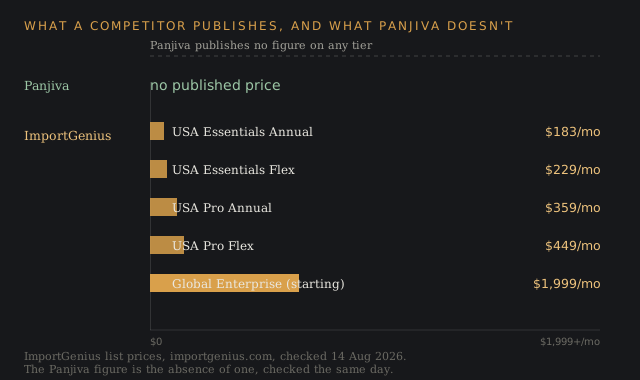
ImportGenius publishes exactly what Panjiva won't.
| ImportGenius plan | Monthly price | Annual price | What it includes |
|---|---|---|---|
| USA Essentials Flex | $229/mo | Monthly only | 1 seat, 25 searches a day, 1,000 rows a month, most recent 12 months of US import data |
| USA Essentials Annual | $183/mo | $2,198/yr | Up to 3 seats, 30,000 rows a month, same data window |
| USA Pro Flex | $449/mo | Monthly only | 1 seat, 50 searches a day, 1,000 rows a month, data back to 2006, AI features |
| USA Pro Annual | $359/mo | $4,310/yr | Up to 3 seats, 150,000 rows a month, full historical access, AI features |
| Global Enterprise | From $1,999/mo | Custom | Unlimited encrypted searches, custom downloads, 25+ country coverage, dedicated support |
ImportGenius list prices read from importgenius.com/pricing, checked 15 August 2026. Panjiva publishes no comparable figure at any tier, so no Panjiva row exists for this table.
That range doesn't prove what Panjiva charges. It does establish that a rival in the same segment is comfortable putting five figures a year in writing while Panjiva puts nothing.
What reviewers say about the price
Four named G2 reviewers put a specific word to Panjiva's cost, and the split runs almost exactly along company-size lines.
Abhishek K., a mid-market reviewer at a 51-to-1,000-employee company, asked for more flexible pricing options or tiered plans in a review dated 6 July 2023:
"Panjiva's pricing can be relatively high, especially for smaller businesses or those with limited budgets."
Abhishek K., G2 review, mid-market, 6 July 2023.
Julio P., a small-business reviewer, was blunter about the tradeoff on 13 June 2023: "Subscription cost is high, but the value is undeniable." Malin Y., also small business, took the opposite view on 12 July 2023, writing that the product has good quality and it's reasonable cost.
Raphaël M., an enterprise reviewer working as a CRM & Sales Process Manager, saw a different number entirely. On 13 October 2020 he wrote that the "price is extremely competitive for large corporations," which lines up with the bundling advantage an existing S&P Global account already has.
The pattern holds across all four: budget size predicts sentiment about the price better than anything else in the reviews. Nobody in the set names a dollar figure. Reading review-platform sentiment as a price signal has its own limits, covered in our report on G2's review moderation.
How to negotiate
Three facts are worth walking into the call with:
- Ask directly if a smaller-scope tier exists. Panjiva discloses no tiered plan structure at all, the gap Abhishek K.'s review flagged. Asking costs nothing.
- Name any existing S&P Global relationship early. Raphaël M.'s enterprise read on price tracks with buyers who already hold S&P spend elsewhere.
- Ask what the 10% Fee Schedule increase means for a multi-year deal. The agreement makes clear it compounds unless the Ordering Document says otherwise.
A quote sitting well outside Vendr's $13,500 to $215,000 range for S&P Global software, in either direction, or well past the £104,000-a-user G-Cloud rate on a per-seat basis, is worth a second call ahead of a signature.
Who Panjiva is priced for
The reviewer split answers this directly. Enterprise buyers layering Panjiva's company profiles and risk analysis over S&P financial data they already license describe the price as competitive.
Small-business buyers doing narrower jobs, sourcing a handful of new suppliers or checking a potential partner before a first order, describe the same access as expensive for what they extract from it. A small business that wants to check if one new company is legitimate has a materially cheaper option in ImportYeti.
Procurement teams flip the same data around, using shipment records to find which buyers already import similar goods and feeding that into procurement decisions instead of a sales pipeline. Equity researchers run a third use case, reading shipment volume as an early signal on market share before a company's own statements confirm it, which is why Panjiva shows up on alternative data provider shortlists.
What to budget
Absent a published commercial number, three anchors exist: the £104,000-a-user G-Cloud rate, Vendr's $51,672 median for S&P Global software broadly, and ImportGenius's $1,999-a-month Global Enterprise floor.
A small business should expect a quote above what ImportGenius charges for its top tier, matching the expensive-for-smaller-businesses pattern across the G2 reviews, and should collect a second quote from ImportYeti or ImportGenius before signing.
An enterprise already licensing other S&P Global products should expect a number nearer the Vendr median, and should raise that existing spend in the first conversation. Teams comparing this against broader supply chain risk management platforms like Interos or Everstream are buying a different product entirely. Those platforms price risk scoring. Panjiva prices raw shipment records themselves.
Frequently asked questions
How much does Panjiva cost per month?
Panjiva publishes no commercial price on its own domain or on G2. The closest documented figure is a UK government filing showing £104,000 per user for an S&P Global suite that names Panjiva by product; every other route runs through a Request Follow Up or demo request form.
How accurate is Panjiva's data?
G2 reviewers rate the platform 4.6 out of 5 across 15 reviews, citing accurate, well-organized shipment data as a strength alongside gaps in European coverage that reviewers attribute to GDPR restrictions on customs data sharing, and contact information some reviewers describe as incomplete or out of date.
Who is the owner of Panjiva?
S&P Global, through its Market Intelligence division. S&P Global announced the acquisition in February 2018 and finalized it on 26 February that year; the transaction's financial terms were not disclosed.
Where does Panjiva get its data?
Panjiva aggregates bills of lading, shipping manifests and customs filings from government and partner sources, then applies machine learning to normalize and match company names, products and shipment records into searchable profiles.
What are some alternatives to Panjiva?
ImportYeti rates 4.9 out of 5 on G2 across 369 reviews and offers a free tier, Zonos rates 4.8 across 47 reviews, Descartes Datamyne rates 4.5 across 186 reviews, and ImportGenius publishes plans from $229 to $1,999 a month. Those four are the names buyers most often compare against Panjiva.
Bottom line
Panjiva sells access the same way it has since S&P Global closed the acquisition in February 2018, through a sales conversation instead of a rate card. The two most concrete numbers in this report, £104,000 a user on a UK public-sector filing and a 10% automatic annual increase in the standard customer agreement, both come from documents the marketing site never links to.
A small business shopping this category has real, priced alternatives in ImportYeti and ImportGenius before it ever fills out Panjiva's form. An enterprise already licensing other S&P Global products is the buyer Panjiva's own reviewers describe getting the better number.
The place to test that isn't a marketing page. It's the first sales call, where naming existing S&P spend, asking about tiered options, and asking to see the Ordering Document and Fee Schedule before signing are the three moves this research turned up. Our Panjiva review covers what the platform does once the contract is signed.
Sources, and the commercial figure S&P Global has never filed anywhere
Coverage figures, search capabilities and product claims are read from panjiva.com and from S&P Global's Panjiva Supply Chain Intelligence product page at spglobal.com. The renewal clause and billing terms are quoted from the standard customer agreement at panjiva.com/info/customer_agreement. The £104,000 per-user price is filed by S&P Global Limited on the UK Digital Marketplace G-Cloud framework at applytosupply.digitalmarketplace.service.gov.uk.
The 2018 acquisition figures are from S&P Global's investor relations release dated 26 February 2018. The Xpressfeed launch detail is from the PR Newswire release dated 13 September 2018. Competitor pricing is from importgenius.com/pricing.
Ratings, review counts and the four quoted reviews are from each product's G2 page. Tracked contract values are from vendr.com/marketplace/sandp-global. The 2010 pricing-model headline is from digitalcommerce360.com. All figures checked 15 August 2026.
Neither Panjiva nor S&P Global publishes a commercial price, a plan structure, a seat minimum, a trial, or a per-module breakdown on any page either company controls. The G-Cloud filing exists because a UK procurement framework compels it, and nothing compels the equivalent disclosure for a private buyer.