Panjiva review: global trade data platform
 By Jan Suski. I go deep on every review, checking every number against its source and digging up details other coverage misses, a habit from six years of SEO and link building for tech companies. Bylines at Surfer, Brand24, and Senuto. How the scoring works.
·
Best for
Large enterprises already buying other S&P Global products, needing supplier discovery, sourcing research and due diligence data drawn from 21 countries of shipment records.
Not for
European-focused buyers, since reviewers name a GDPR coverage gap there, and smaller budgets; G2 reviewers call the price high next to a free tool like ImportYeti.
What it costs
No published rate card; sales handles every quote case by case, with no free tier and no free demo to test first.
- Shipment records
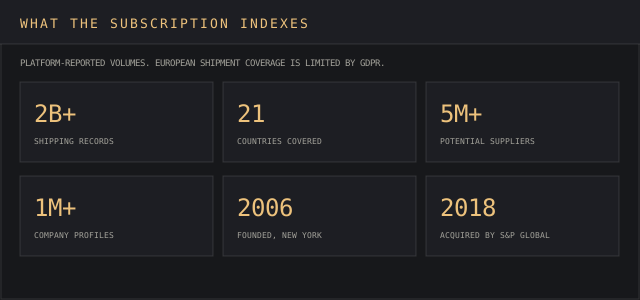
- Over 2 billion indexed, drawn from bills of lading, manifests and customs filings
- Country coverage
- 21 countries; US, China and parts of Latin America and Europe
- Macro trade data
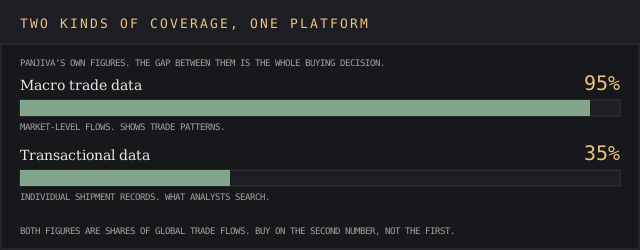
- About 95% of global trade flows, aggregated at market level
- Transactional data
- Roughly 35% of global trade flows, as individual shipment records
- Supplier tracking
- Over 5 million potential suppliers
- Company profiles
- More than 1 million, enriched with S&P Global information
- Search keys
- Company name, HS/HTS code or D-U-N-S Number
- Relationship mapping
- Links manufacturers, buyers, carriers and logistics providers on both sides of a transaction
- Normalization
- Machine learning turns raw customs filings into searchable company and shipment records
- Alerts
- Email alerts on new shipment activity, so the platform doesn't need checking by hand
- Analytics bundle
- Search, alerts and data visualization ship in every subscription, not as add-ons
- Tariff lookup
- The HS/HTS search returns tariff classification and shipment history together
- Export formats
- CSV and Excel; reviewers say contact information doesn't come through in the download
- Report dimensions
- Capped at 4; an enterprise reviewer asked for more for Power BI and Excel work
- Integrations
- No published partner list and no direct Microsoft Dynamics connector
- European coverage
- Incomplete; reviewers attribute the gap to GDPR restrictions on customs data
- Contact data
- Present in some profiles, described as incomplete or out of date
- List price
- Not published; quotes are handled by sales case by case
- Free tier
- None
- Free demo
- None; access starts with a sales conversation
- Packaging
- Global access sells as one product, so a buyer who wants one country pays for all 21
- Tiered plans
- None; a mid-market reviewer asked for "more flexible pricing options or tiered plans"
- Small-business view
- Called high for a smaller budget, one reviewer adding that "the value is undeniable"
- Enterprise view
- Described as competitive for large corporations already buying S&P data
- Free alternative
- ImportYeti, free to use, rated 4.9 out of 5 across 376 G2 reviews
- G2 standing
- 4.6 out of 5 across 15 reviews, listed under Global Trade Management Software
ImportYeti
Not forA large sourcing or compliance operation that needs S&P-enriched company profiles behind every result.
Descartes Datamyne
Not forA buyer who wants to see the data before booking a sales call.
ImportGenius
Not forA team that needs one subscription covering every sourcing country at once.
Pairs well with Panjiva
Which figures come from G2 and which are Panjiva's own coverage claims
Ratings, review counts and every complaint quoted above come from Panjiva's 15 published G2 reviews and from the G2 listings for ImportYeti, Zonos and Descartes Datamyne. The 95% and 35% coverage splits, the 2 billion shipment records, the 21 countries, the 5 million suppliers and the 1 million company profiles are Panjiva's own published numbers, reported here as vendor claims. No price appears because Panjiva doesn't publish one. Checked 5 August 2026.
This review covers what the S&P Global-owned trade data platform does, what real G2 reviewers say about it across 15 published reviews, and how it compares with alternatives like ImportYeti and Descartes Datamyne. Panjiva holds a 4.6 out of 5 rating on G2, and G2 lists it under Global Trade Management Software.
What is Panjiva
Panjiva creates profiles for millions of companies using trade records and corporate information, giving buyers, suppliers and analysts visibility into international trade relationships.
Josh Green and James Psota founded the company in 2006; Fast Company named Panjiva one of the World's Most Innovative Companies in 2018, the same year S&P Global acquired it. Green went on to join the leadership team at S&P Global Market Intelligence, the data and analytics division that now houses Panjiva.
Panjiva's own figures separate two kinds of coverage: macro global trade data covering about 95% of global trade flows, and detailed transactional data, individual shipment records, covering roughly 35% of global trade flows. That's a meaningful distinction for buyers. The macro numbers show market-level trade patterns, while the transactional layer is what a sales or sourcing analyst searches when building a lead list or checking a competitor's shipments.
↑ FACT SHEETPanjiva features
Supplier discovery and global trade data
Panjiva provides detailed logistics and cargo data based on bills of lading and shipping manifests, aggregating shipment-level customs data from numerous countries.
The platform analyzes over 2 billion shipping records across 21 countries, tracks over 5 million potential suppliers and provides insights into more than 1 million companies, including contact information where it's available.
Users can search by HS/HTS code or D-U-N-S Number, and the platform maps relationships between manufacturers, buyers, carriers and logistics providers. That mapping is also what sourcing and compliance teams lean on for due diligence before signing a new supplier: checking who a company ships with.
G2's feature listing groups Panjiva's capabilities under Import/Export (workflows, documents, sourcing, costs) and Global Trade Management (visibility, compliance, risk).
Machine learning, search, alerts and data visualization
Panjiva uses machine learning for data normalization and visualization, turning raw customs filings into searchable company and shipment records. Panjiva packages its search, alerts and data visualization tools together as a single analytics layer, so a subscription includes all three by default.
Users can set up email alerts for new shipment activity, and reviewers consistently point to Panjiva's extensive shipment history and strong search functionality as its core strength. The web app pairs decades of customs-data infrastructure with a modern filtering layer, though several reviewers below say it still takes time to use well.
Competitive intelligence and actionable insights
Sales and research teams use Panjiva's search to identify competitors' import and export activity, track which suppliers a rival business relies on and spot shifts in shipment trends before they show up in quarterly earnings.
Because the platform indexes both sides of a transaction, a company can look up its own customers or a competitor's customers with the same search, then run the same trend analysis across import and export records for a fuller picture of who's moving goods for whom.
That combination of search, alerts and trade analytics is what turns raw customs paperwork into actionable insights a sales rep can use without a dedicated data analyst, and Panjiva's own customer base spans sourcing, sales and compliance teams pulling different actionable insights from the same subscription.
Supply chain mapping and global trade risk
Supply chain teams run the same searches for a different reason: mapping a competitor's supply chain to see which suppliers and carriers feed its production. Users can track shipments in near real time, cross-check tariffs on affected product categories, and pull the underlying data visualization into a CSV or Excel export.
That's the workflow Panjiva's own supply chain research tools are built around, and it's why businesses with global supply chains make up a large share of the customer base.
A buyer researching a new supplier can identify that company's other trading partners in the same search that pulls its shipment history, then run the same analysis on a dozen suppliers at once, tracking their imports and exports side by side.
The underlying technology, Panjiva's machine learning normalization layer, is what separates a searchable company profile from a raw customs filing, and it's the same technology reviewers credit for the platform's strong search function.
Reviewers call the shipment-record volume impressive relative to cheaper alternatives, even when they flag the price as a drawback.
Tariffs and compliance
Because Panjiva's search runs on HS/HTS codes, the same lookup buyers use to find a supplier also shows which tariff classification a shipment falls under. That's become a more common reason to open the platform as global trade policy shifts: a compliance analyst can check a product's tariff category and its recent shipment history in the same search.
Panjiva operates under S&P Global's broader data-security and compliance program, the same infrastructure covering the company's other market-intelligence products, and G2 groups the platform's risk-related tools alongside its compliance and visibility features. Compliance teams use that same system to catch tariff and trading-partner risks early, and to flag risky trading partners before a contract is signed.
↑ FACT SHEETWhat G2 reviewers say
Data depth and search
Reviewers rate Panjiva highest for the sheer depth of its import data, its exports figures, and the insights that come with both.
Abhishek K., a mid-market reviewer, praised Panjiva's "extensive data," "supplier research" and "trade intelligence" tools, calling out its ability to "track market trends, monitor competitor activity, and identify emerging opportunities." Raphaël M., a CRM and sales process manager at an enterprise company, called out "filtering capacity" and "multi-dimensional reports," adding that Panjiva's "company profiles are enriched with S&P information."
Aaron R., a small-business marketing manager, said the platform "display[s] importing data in a manner that is very understandable and useable" and makes it "easy to export data into a csv or excel sheet."
Pricing sentiment
G2 reviewers are split on Panjiva's price.
Julio P., a small-business reviewer, wrote that "subscription cost is high, but the value is undeniable." Abhishek K. said pricing "can be relatively high, especially for smaller businesses," and wished for "more flexible pricing options or tiered plans."
Raphaël M., writing from the enterprise side, took the opposite view, describing the price as highly competitive for large corporations, in part because Panjiva's company profiles come enriched with S&P data those buyers already pay for elsewhere.
The split tracks company size more than it tracks satisfaction with the product itself.
European coverage and GDPR
The most consistent complaint across Panjiva's reviews is a gap in European global trade data.
Rajeev M., a research analyst, said the service "doesn't encompass data from European countries due to GDPR restrictions," adding that "Europe serves as a significant manufacturing hub" where the gap matters most.
Andres P. made the same point, noting Panjiva "doesn't have complete information on other countries['] trade besides the US, some countries in Europe, China and some countries in Latin America." Raphaël M. attributed the gap to GDPR restrictions in Europe along with other local data-privacy rules that limit what Panjiva can license from country to country.
Contact information gaps
Several reviewers flagged incomplete contact data as a recurring weakness. Miguel S. wrote that "when you download the data it doesn't bring the contact information." Miguel Angel S. said contact details are "sometimes... not complete," and "when you have some contact information that contact is not correct." Angel S. added that even when contact information appears in a company's profile, "you will not have it downloaded in Excel."
Reporting limits and integrations
Enterprise users hit different ceilings than small-business ones. Raphaël M. wanted the "capacity to include more than 4 dimension[s] to reports" for deeper analysis in tools like Power BI or Excel, and asked for Panjiva to connect directly with Microsoft Dynamics.
Panjiva doesn't advertise a public list of integration partners the way some competitors do, and G2 reviewers describe moving data out through CSV or Excel exports more often than through a live system that lets a company integrate Panjiva directly into a CRM or BI tool.
Jyotsna V., an operations executive, said "customer service is a bit slower than some of its competitors," though she still called the underlying data "accurate" and "presented in a simple language."
Panjiva for small businesses
Small-business reviewers on G2 describe a different trade-off than enterprise ones. Julio P. and Aaron R. both count Panjiva's export and filtering options among its great features, and both praised how usable the exported data is once it's in hand, but both also flagged the subscription cost as a bigger factor for a smaller budget than it would be for a large corporation.
Support access is the other recurring theme: with fewer dedicated account contacts than an enterprise customer typically gets, a small-business buyer is more likely to lean on self-service search and exports than on direct account support.
↑ FACT SHEETPanjiva pricing
Panjiva doesn't publish standard pricing on its website, and G2 discussion threads show prospective buyers regularly asking how much a subscription costs, a sign the company handles quotes case by case.
Gaining access to a subscription starts with a conversation with the vendor, and Panjiva doesn't offer a free demo the way some cheaper alternatives do; seeing the platform firsthand means talking to sales directly first.
That matches what reviewers describe directly: enterprise buyers with existing S&P relationships tend to find the price reasonable relative to the data included, while small businesses more often describe the subscription as expensive for their budget. Getting an exact figure means contacting sales directly.
Panjiva vs alternatives
Panjiva's closest G2-rated alternatives are ImportYeti, Descartes Datamyne and Zonos. Panjiva's own reviewers say it beats Descartes Datamyne on ease of use, and its S&P-enriched company profiles are a feature none of the three alternatives match directly. All four share the same structural limitation reviewers describe above: none has full European shipment coverage because of GDPR restrictions on customs data.
| Tool | G2 rating | Review count |
|---|---|---|
| ImportYeti | 4.9 / 5 | 376 |
| Zonos | 4.8 / 5 | 46 |
| Panjiva | 4.6 / 5 | 15 |
| Descartes Datamyne | 4.5 / 5 | 185 |
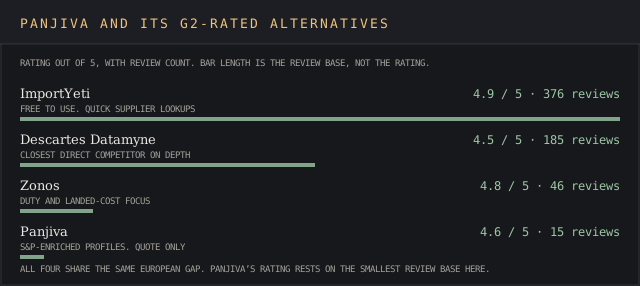
The price gap is starker than the ratings suggest. ImportYeti is free to use, which is why it turns up as the budget comparison. ImportGenius, the other name buyers raise, sells multiple plans and à la carte datasets; Panjiva sells global access as a single product, so a buyer who only wants one country's records pays for all 21 either way.
Where the tools diverge is in who they're built for. ImportYeti leans toward smaller teams doing quick supplier lookups, while Panjiva's deeper filtering and S&P integration suit larger sourcing and compliance operations that need more than a single search result. A buyer comparing the two should begin by checking country coverage against where their supply chain operates, then expect Panjiva's learning curve to run steeper once the shortlist narrows.
Import and export search in practice
A typical search starts with a company name or an HS code and returns every matching shipment: import history on one side, exports on the other, and the supply chain partners that moved the freight in between. Users comparing two suppliers' exports side by side can spot which one ships more consistently, an input that shapes a sourcing decision as much as price does.
The same search works in reverse for a company's own customers and its competitors' customers alike: it surfaces which exports and which import shipments moved through which ports and carriers over a given quarter, the kind of supply chain risk analysis compliance teams run to track geopolitical risks and exposure across the businesses in a global supply chain.
That trend analysis, built from real customs filings, is what G2 reviewers point to when they compare Panjiva's insights against a manual spreadsheet assembled from a handful of contacts, and it's part of why import and export volumes stay near the top of what reviewers say the platform delivers best.
Small and mid-sized businesses run the same searches at a smaller scale, mining the same exports data for a shorter supplier list, and coming away with the same kind of insights an enterprise research desk pulls from a larger account.
Where Panjiva fits in a global trade data stack
Panjiva faces competition from risk-management services such as Interos, ERP add-ons and the manual customs-broker research many businesses still rely on, as much as from other supplier-lookup platforms. Reviewers involved in evaluating those options say Panjiva continues to deliver on efficiency once it's configured: it replaces hours of manual customs research with a single search.
Panjiva doesn't publish a rate card, and G2 reviewers call the price high next to a free tool like ImportYeti.
The company doesn't publish a public roadmap, so new automation features aren't expected on any fixed timeline; future releases aren't announced in advance. Alongside its shipment data, Panjiva bundles supplier and compliance services under the same subscription, and what procurement teams ask for in a report, supplier discovery, risk flags and export-ready data, is already covered by the existing feature set.
Compared with a manual customs-broker lookup, a single Panjiva search returns a fuller report on a supplier's shipment history in minutes. European access gaps aside, most reviewers say the breadth of transactional access more than compensates once a buyer learns the interface.
Businesses that expand into new sourcing regions tend to run into the same European gap described above, which is worth checking before signing a contract. Panjiva is scored against every rival on the same four pillars in the alternative data providers ranking, and the supply chain market intelligence guide covers the wider category.
Strengths and weaknesses
G2 reviewers rate Panjiva highly for its depth of import and export data, its filtering options and the way S&P company profiles enrich a basic shipment record into a fuller picture of a business.
Commercial and research teams say it shortens the time it takes to build a prospect list or check a competitor's sourcing pattern; Angel S., a mid-market reviewer working for an international sourcing agency, described Panjiva as his team's main tool for identifying overseas buyers and tracking which companies dominate a given product category.
The recurring complaints are gaps in European trade data due to GDPR, contact information that's sometimes missing or outdated, and an interface that several reviewers say takes real training before a buyer gets full value from it.
José C., a business specialist, said the platform "can be really hard to read" and "needs a training for employees to understand how to make the most out of the application." Reviewers who stick with it tend to describe the same arc: a complex tool at first, and a fast one for competitor and supplier research once the learning curve is behind them.
Bottom line
Panjiva's global trade data holds up against every named alternative on depth and search quality, and the S&P-enriched company profiles are a real differentiator few competitors can match.
The complaints that hold a rating back sit around the edges of that core data: European coverage gaps tied to GDPR, contact records that don't always survive an export, and a subscription price that lands harder on a small business than on an enterprise with existing S&P relationships.
For a buyer that mostly cares about US, Asian and Latin American trade flows and can absorb the learning curve, that trade-off tends to favor Panjiva. For a buyer that needs full European coverage or a lighter-weight tool, one of the alternatives above is worth checking first. That's the conclusion most G2 reviewers land on once they've weighed Panjiva against the field: strong on depth, weaker on reach.
Frequently asked questions
What is Panjiva used for?
Panjiva is used for supplier discovery, competitive intelligence, sourcing research, lead generation, due diligence and supply chain risk analysis, built on customs, imports and exports data covering roughly 35% of global trade flows at the transactional level.
Who is the owner of Panjiva?
S&P Global has owned Panjiva since acquiring it in 2018, the same year Fast Company named it one of the World's Most Innovative Companies. It now operates as part of S&P Global Market Intelligence, and Panjiva co-founder Josh Green joined that division's leadership team after the deal.
How much does a subscription cost?
No published rate card exists; quotes are handled directly by sales. G2 reviewers describe the price as high for small businesses but competitive for large corporations, especially those that also use other S&P Global products.
Is Panjiva reliable?
A 4.6 out of 5 rating on G2, across 15 reviews, reflects reviewers citing accurate, well-organized shipment data as a strength, alongside gaps in European coverage and occasionally incomplete contact information.
Where does Panjiva get its data?
Panjiva aggregates bills of lading, shipping manifests and customs filings from numerous countries, then uses machine learning to normalize and visualize that data into searchable company and shipment profiles. Coverage gaps in Europe stem from GDPR restrictions on customs data sharing, according to multiple G2 reviewers.
What is the free alternative to Panjiva?
ImportYeti, which is free to use and which G2 rates 4.9 out of 5 across 376 reviews, is the closest free option for basic supplier lookups. Panjiva itself has no free tier; the G2 discussion thread "How much is a Panjiva subscription?" has no public answer, which points to quote-only pricing.