The contract research organization market: what ten forecasts disagree on
 By Jan Suski, six years working in digital. How the scoring works.
The numbers CRO market estimates, checked 27 August 2026
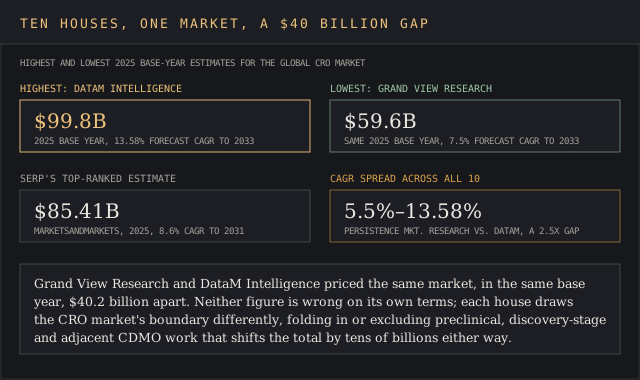
Ten research houses price the same 2025 global CRO market as low as $59.6 billion and as high as $99.8 billion, a $40.2 billion gap on paper.
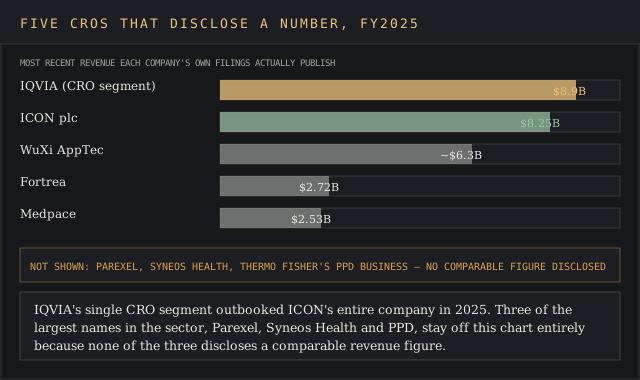
IQVIA's CRO segment alone outbooked ICON's entire company in 2025, and still didn't clear $9 billion.
Oncology anchors the therapeutic-area breakdown at every house that reports one, though the exact share swings from 24% to 55% depending on which report you read.
Ask ten research houses how big the contract research organization market is, and you'll get ten different numbers. Grand View Research says $59.6 billion in 2025. DataM Intelligence says $99.8 billion, the same year. Neither is a typo, and neither house is wrong on its own terms.
This report walks the ten most-cited CRO market estimates side by side, the named house behind each one, and the scope decisions that push the same market $40 billion apart.
It covers segmentation by service type and therapeutic area, the regional split between North America and a faster-growing Asia-Pacific, and the scale of the companies doing the work: IQVIA, ICON, Fortrea, Medpace, Thermo Fisher's PPD business, WuXi AppTec, Parexel and Syneos Health.
It's built for anyone who has to cite a CRO market figure in a deck, a competitive analysis, or a client pitch and doesn't want to get caught defending a number they can't source. That includes teams running pharma market intelligence and healthcare market intelligence functions specifically. Every figure below traces to the report that published it, dated and linked on first use. For a starting framework of your own, this site also publishes a market-sizing template.
The CRO services market in numbers
MarketsAndMarkets, the report ranking first on Google for "contract research organization market," puts the 2025 figure at $85.41 billion, growing to $93.02 billion in 2026 and $140.32 billion by 2031, an 8.6% CAGR. Its own report page attributes 44.5% of that 2025 total to North America and 35.5% to oncology trials specifically.
Market Research Future starts from a different base year, $84.3 billion in 2024, and grows it more slowly: $170.63 billion by 2035, a 6.62% CAGR. That's eleven years (2024 to 2035) against MarketsAndMarkets' five-year window (2026 to 2031), and the extra time does real work on the headline "by" figure, making the two harder to compare than they first look.
Both houses agree on direction. North America leads by revenue share (44.5% and 44.96% respectively, functionally identical), and Asia-Pacific grows fastest. Market Research Future puts APAC's CAGR at 10.9%; Mordor Intelligence, a third house, puts it at 11.26%. That's the rare figure where three sources land within half a point of each other.
The trial volume behind these estimates is not in dispute the way the market-size figures are. ClinicalTrials.gov, the U.S. National Library of Medicine's registry, passed 500,000 registered studies in 2024, a milestone NLM marked in its own 25th-anniversary post.
Why the estimates diverge by up to $40 billion
The table below lines up all ten houses by their most recent base-year estimate. Sort them and the spread isn't small: $59.6 billion at the low end, $99.8 billion at the high end, both dated 2025.
| Research house | Base year | Market size | Forecast | CAGR |
|---|---|---|---|---|
| Grand View Research | 2025 | $59.6B | $105.7B by 2033 | 7.5% |
| Global Market Insights | 2024 | $59.8B | $118.2B by 2034 | 8.1% |
| The Insight Partners | 2024 | $65.39B | $113.79B by 2031 | 8.2% |
| Precedence Research | 2025 | $69.56B | $133.75B by 2035 | 6.76% |
| Future Market Insights | 2025 | $73.4B | $164.3B by 2035 | 8.4% |
| Market Research Future | 2024 | $84.3B | $170.63B by 2035 | 6.62% |
| MarketsAndMarkets | 2025 | $85.41B | $140.32B by 2031 | 8.6% |
| Coherent Market Insights | 2026 | $91.39B | $175.84B by 2033 | 9.8% |
| Fortune Business Insights | 2025 | $92.27B | $199.28B by 2034 | 9% |
| Mordor Intelligence | 2026 | $92.98B | $138.34B by 2031 | 8.27% |
| Persistence Market Research | 2026 | $94.8B | $137.9B by 2033 | 5.5% |
| DataM Intelligence | 2025 | $99.8B | $276.0B by 2033 | 13.58% |
Three things drive the spread, and none of them is a mistake. First, scope: some houses count clinical research services alone, others fold in preclinical and discovery-stage work, and DataM Intelligence's $276 billion 2033 forecast, the highest of the group by a wide margin, reads like a broader definition that pulls in adjacent categories the narrower reports exclude.
This site's own sales intelligence market report runs into the identical scope problem across four analyst houses, so the pattern here isn't unique to clinical research. Method differences like this are common enough across market sizing that a general primer on market research methods is worth a look before trusting any single house's number.
Second, base year. A market growing 8% to 9% a year looks meaningfully bigger measured from a 2026 base than a 2024 one, purely from compounding, before any real growth happened.
Third, naming: Future Market Insights titles its report "Clinical Research Organization Market," not "Contract Research Organization," and Grand View Research scopes its headline figure to "Healthcare Contract Research Organization." Same industry, different label, different boundary.
Clinical trial services and therapeutic area segmentation
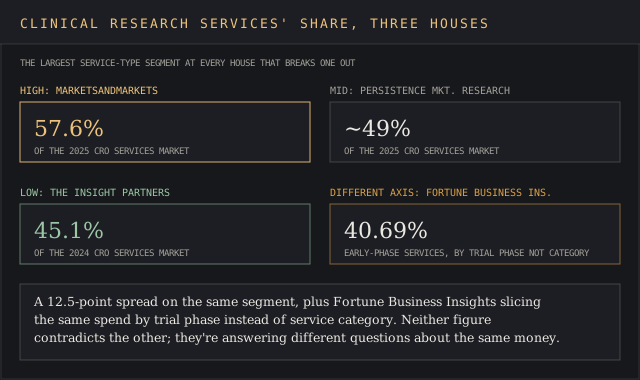
Clinical research services make up the largest service-type segment at every house that breaks one out. MarketsAndMarkets puts it at 57.6% of the 2025 market. The Insight Partners has it lower, 45.1% in 2024. Persistence Market Research lands in between at roughly 49%.
Fortune Business Insights slices the market a different way, by trial phase instead of service category, and finds early-phase development services taking 40.69% of the 2026 total. That's not a contradiction of the clinical-research-services figures above; it's a different axis on the same spend.
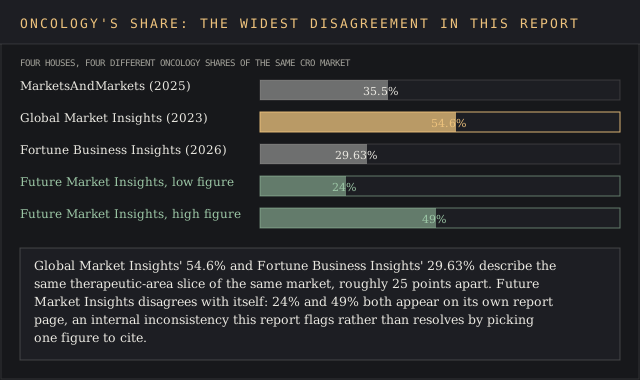
Oncology dominates the therapeutic-area breakdown almost everywhere, though the exact share is the widest single disagreement in this report. MarketsAndMarkets puts it at 35.5% (2025). Global Market Insights puts it at 54.6% (2023). Fortune Business Insights puts it at 29.63% (2026).
Future Market Insights cites two different oncology figures on the same report page, 24% and 49%; that inconsistency gets flagged here instead of resolved by picking one to cite.
Rare disease and cell & gene therapy trials show up as a named growth pocket across several houses, driven by smaller, more specialized patient populations that need the kind of site-selection and regulatory expertise a general-purpose CRO doesn't keep in house.
What CRO services cover, from preclinical research to post-marketing
A full-service contract research organization doesn't wait for a drug to reach human trials. Preclinical research, the pharmaceutical research done on cells and animal models before a company can file for regulatory approval to test in people, is the first stage of the broader drug development process, and it's where an established drug development platform matters most.
Clinical trial planning starts once that filing clears: protocol design, patient recruitment strategy, and the regulatory requirements specific to each country the trial runs in. PPD's own description of the work spans everything from early feasibility studies through drug approval process support.
That head start compounds. An established CRO with existing site relationships and standard operating procedures can activate a study faster than a sponsor building the same capability from scratch, a speed advantage CASRAI's own sector overview ties directly to a faster path from trial start to a new drug reaching the market.
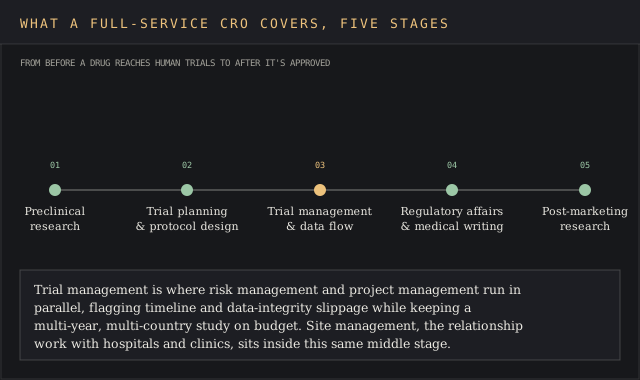
Clinical trial management is the day-to-day job once a study is running: clinical monitoring visits to clinical research sites, checking that clinical trial conduct matches the approved protocol, and clinical trial data flowing correctly into the sponsor's systems.
Electronic data capture platforms replaced paper case report forms industry-wide years ago, and trial data quality now gets checked in near real time. CRO biostatistics teams run that data through statistical analysis plans, database design and data cleaning, work CASRAI ties directly to keeping trial data accurate and complete.
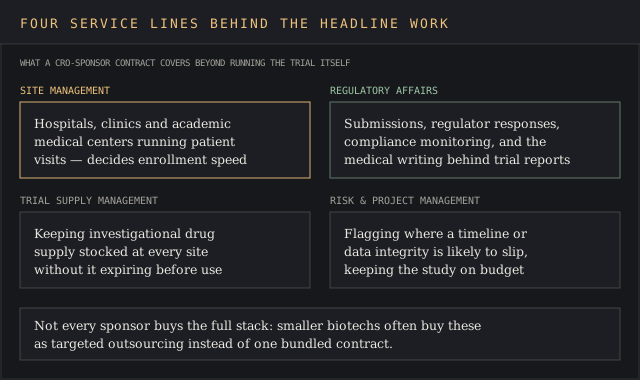
Trial supply management, keeping investigational drug supply stocked at every site without expiring before use, is a related but separate function some CROs spin out to specialist vendors.
Site management, the relationship work between a CRO and the hospitals, clinics and academic medical centers running patient visits, decides how fast a trial enrolls. Academic institutions remain a common site type for rare-disease and oncology work specifically, the categories hardest to enroll and slowest to recruit at scale.
Regulatory affairs staff handle the paperwork that turns a completed trial into an approved drug: submissions to regulatory authorities, responses to their requests, and ongoing regulatory compliance monitoring through the drug's life. Medical writing, producing the clinical study reports those authorities read, sits inside the same function at most large CROs.
Two more service lines round out what a full-service CRO sells: risk management, flagging where a trial's timeline or data integrity is most likely to slip, and project management, the function accountable for keeping a multi-year, multi-country study on budget.
The lifecycle doesn't end at approval. Post marketing research, tracking a drug's real-world safety and how well it continues to assess efficacy outside a controlled trial, keeps CROs and their pharmaceutical companies and medical device companies clients connected long after launch.
Biologic drug development and late stage clinical trials for rare diseases and infectious diseases account for a growing share of that work, alongside the digital health technologies built into patient centric clinical trials.
Not every sponsor buys the full stack. Smaller biotech companies often buy consulting services or targeted outsourcing services instead of a full outsourced research services contract, especially for specialized expertise a lean internal team doesn't carry, like biostatistics or a single therapeutic area.
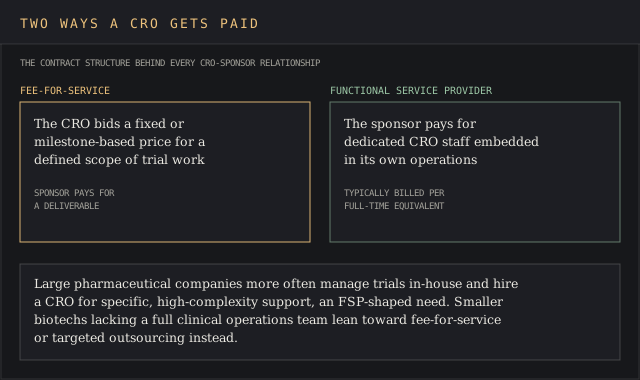
Large pharmaceutical companies more often manage clinical trials in-house and hire a CRO for clinical trial management support on specific, high-complexity studies.
Clinical development, the umbrella term for everything between preclinical work and regulatory filing, is what most of that spending buys; some CROs bundle it as clinical development services alongside separate consulting services for sponsors that need less.
None of this runs on a handshake. A CRO-sponsor relationship gets formalized through a master services agreement plus study-specific work orders, the contract that spells out which responsibilities, deliverables and quality standards move to the CRO and which the sponsor keeps.
Regional breakdown: North America's lead and Asia-Pacific's growth rate
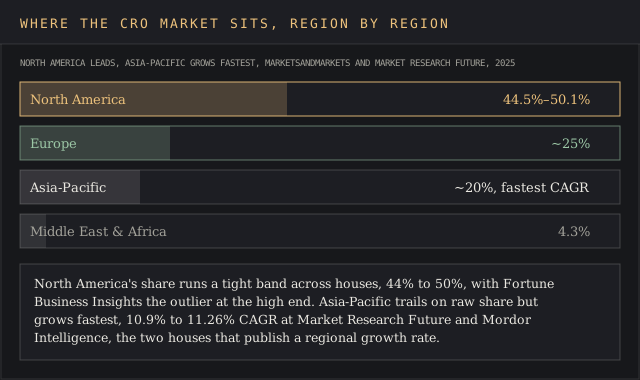
North America's share of the global CRO market runs a tight band across houses: 44.5% (MarketsAndMarkets, 2025), 44.96% (Market Research Future, 2024), 44% (Precedence Research, 2025), approximately 47% (Persistence Market Research, 2025), and 50.10% at the high end (Fortune Business Insights, 2025, worth $46.21 billion on its own).
Only Mordor Intelligence and The Insight Partners land meaningfully lower, at 38.92% and 38% respectively.
Europe holds roughly a quarter of the market. Market Research Future puts it at 25% for 2024; the Middle East and Africa combine for 4.3%, the smallest tracked region in that same report.
Asia-Pacific is the fastest-growing region at every house that forecasts one, and the CAGR figures cluster tightly: 10.9% (Market Research Future) and 11.26% (Mordor Intelligence).
Lower labor costs, faster patient enrollment in high-population countries, and maturing regulatory frameworks in India, China and South Korea all get cited as drivers, though none of the houses attach a hard number to any single one of those three factors.
The global CRO services market's major players
Market share estimates for individual CROs are harder to pin down than the market-size figures above, because three of the largest names in the life sciences industry, Parexel, Syneos Health and, until 2021, PPD, don't file public financial statements. What follows is each company's own most recently disclosed scale, not a market-share ranking.
| Company | Status | Most recent revenue | Employees | What it specializes in |
|---|---|---|---|---|
| IQVIA (R&D Solutions segment) | NYSE: IQV | $8.9B (FY2025, ~55% of $16.31B total) | ~93,000 (company-wide) | Full-service CRO plus data & analytics |
| ICON plc | NASDAQ: ICLR | $8.25B (FY2025) | ~40,100 | Full-service, 55 countries |
| Thermo Fisher (PPD) | NYSE: TMO | Not broken out separately | Not disclosed for PPD alone | Clinical research inside a larger lab-and-CDMO business |
| WuXi AppTec | 603259.SH / 2359.HK | RMB 45.46B (~$6.3B, FY2025) | Not independently verified | CRDMO; sold its China clinical-trial CRO business in 2025 |
| Fortrea | NASDAQ: FTRE | $2.72B (FY2025, declining YoY) | ~14,300 | Full-service, spun off from Labcorp in 2023 |
| Medpace | NASDAQ: MEDP | $2.53B (FY2025) | ~6,200 | Small and mid-size biopharma, oncology & CNS focus |
| Parexel | Private (EQT / GSAM) | Not disclosed | 22,000+ | Oncology specialist, 2,500+ trial sites |
| Syneos Health | Private (Elliott / Patient Square / Veritas) | Not disclosed since 2023 | Not current | Clinical & commercial, biopharma solutions |
IQVIA's CRO segment alone, Research & Development Solutions, generated $8.9 billion in 2025, about 55% of the company's $16.31 billion total revenue, according to its own investor relations site. That single segment outbooked ICON's entire $8.25 billion FY2025 revenue, disclosed the same way in ICON's own fourth-quarter results release.
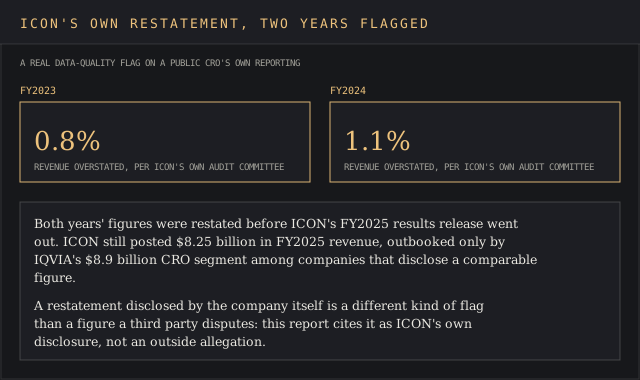
ICON's own numbers carry a caveat worth citing, not skipping: the company's audit committee found revenue had been overstated by 0.8% in 2023 and 1.1% in 2024, and both years' figures were restated before the FY2025 release went out. That's a real data-quality flag on a public CRO's own reporting, not a rumor.
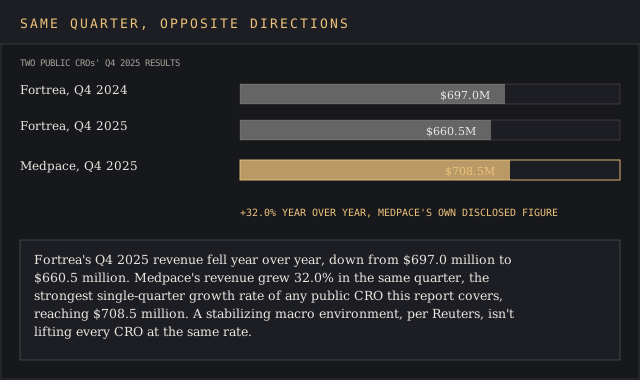
Fortrea, spun off from Labcorp as an independent public CRO in 2023, posted $2.72 billion in FY2025 revenue, but its Q4 2025 quarter came in at $660.5 million, down from $697.0 million the year before, per its own fourth-quarter release.
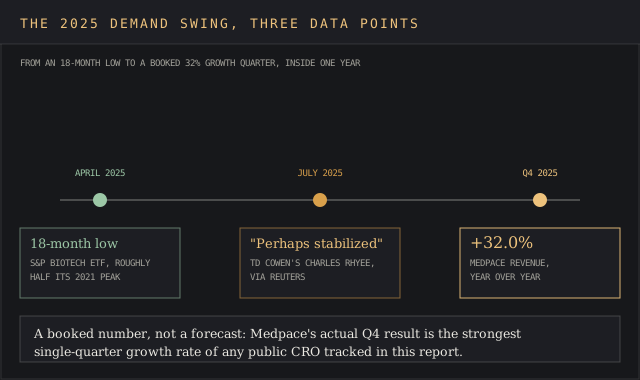
Medpace moved the opposite direction: Q4 2025 revenue hit $708.5 million, up 32.0% year over year, the strongest single-quarter growth rate of any public CRO covered here.
WuXi AppTec's FY2025 revenue reached RMB 45.46 billion, roughly $6.3 billion at the prevailing exchange rate, up 15.8% year over year. But its own March 2026 earnings release states plainly that the company sold its China-based clinical research service business during 2025.
Treating WuXi as a peer to IQVIA or ICON on trial execution misreads what the company does now: it's a chemistry, manufacturing and discovery CRDMO, not a clinical-trial CRO in the sense this report otherwise uses.
Parexel and Syneos Health both went private, in 2021 and 2023 respectively, and neither discloses current revenue. Parexel's own site cites 22,000-plus employees and a specialization in oncology, running 2,500-plus trial sites globally.
Syneos Health's employee count last appeared in a public SEC filing in 2022, at roughly 28,000; anything more recent circulating online traces to third-party estimators, not the company itself, and shouldn't get cited as current.
Growth drivers behind CRO services demand
Every research house surveyed here names the same underlying growth factors: pharmaceutical industry and biotech R&D spending keep growing, and more of that spending gets outsourced instead of run in-house, a pattern several houses cite as the single biggest driver of CRO market growth.
Smaller biotech companies in particular rarely keep a full clinical operations team on staff, so a CRO relationship is often the only path from a molecule to a filed trial.
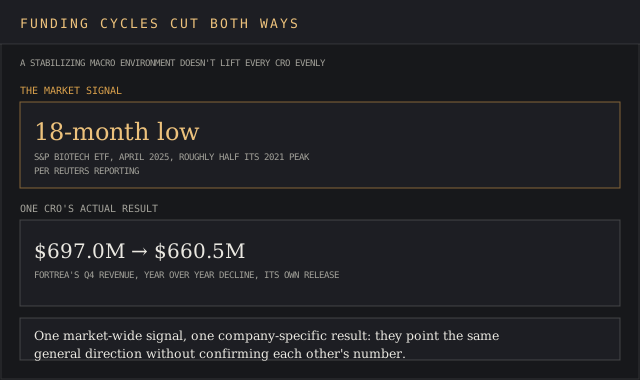
The demand picture stabilized through 2025 after a rough 2023 and 2024. Reuters reported in July 2025 that Danaher, Medpace, IQVIA, ICON and Thermo Fisher Scientific had all posted stronger-than-expected quarterly profit.
TD Cowen analyst Charles Rhyee told Reuters biotech funding had "started to tick up month over month from April to June," calling the macro environment "still challenged" but "perhaps stabilized."
"Although funding challenges remain acute for many of our clients, the large majority of those clients with ongoing studies were able to obtain sufficient funding to keep the trials running."
— August Troendle, CEO, Medpace, quoted by Reuters, July 2025
IQVIA's own CEO, Ari Bousbib, told analysts on the same earnings cycle that clients had "continued launching new drugs despite the uncertainty," a signal Evercore ISI's Elizabeth Anderson read as a possible inflection point heading into 2026. Medpace's Q4 2025 result, revenue up 32.0% year over year, backs that read with a booked number, not a forecast.
Decentralized trials, which move parts of a study out of a clinical site and into a patient's home through remote monitoring and digital tools, show up across multiple houses as a structural driver, not a passing trend.
So does artificial intelligence applied to site selection, patient matching and protocol design, cited by several houses as a competitive differentiator among CROs bidding for the same sponsor contracts. Those specific vendor claims get checked against the published record in a dedicated section below.
AI in clinical trials: vendor numbers checked against peer review
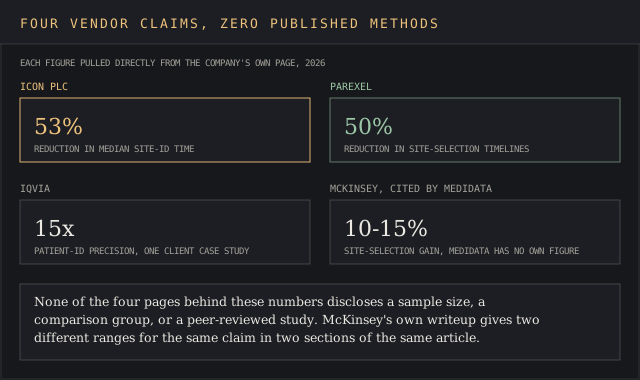
Six companies selling AI tools for clinical trial site selection and patient matching publish headline numbers: a 53% cut in site-identification time, a 50% cut in selection timelines, a 15x jump in matching precision. None of those pages shows a sample size, a comparison group, or a published method.
This report checks each claim against the record and lays out the one figure in this field that does come from a peer-reviewed, replicable study.
What follows covers where AI already sits across the clinical trial lifecycle, not only site selection: protocol design, data management, adverse event detection, decentralized trials. Each use case gets the same treatment as the headline claims, a real source or a stated absence of one.
This is written for people who have to decide if an AI vendor's marketing page is enough to act on: clinical operations leads, trial sponsors, and anyone budgeting for a recruitment or data-management tool.
Every figure below traces to a named publisher, dated, so a reader can check each one independently. Where a claim couldn't be verified on a direct check of the company's own site, this report says so instead of repeating it anyway. That's the same bar this site's own scoring methodology applies before crediting any AI-generated claim.
The numbers AI in clinical trials, checked against the source
The one number with a published method behind it comes from an academic trial-emulation study. No vendor page in this field carries anything comparable.
A 2026 peer-reviewed review names IQVIA's own enrollment figure directly and flags it as unvalidated.
Vendors are consistent on direction (AI helps) and inconsistent on method (none shown), so the direction is the part worth trusting.
What this review found
Every major AI-in-trials vendor claims a speed or precision gain, and every claim traces back to a page the vendor itself controls. ICON plc states a 53% reduction in median site-identification time and a 50% reduction in non-enrolling sites on its own product page.
Parexel states a 50% reduction in site-selection timelines. IQVIA states a 15x increase in patient-identification precision in a client case study. None of the three publishes a sample size, a control group, or a peer-reviewed method behind the number.
Medidata doesn't publish a site-selection figure of its own. Its blog cites a McKinsey estimate of a 10-15% gain instead, and McKinsey's own article gives two different ranges for the same claim in two different sections: 10-20% in the introduction and 10-15% in the site-selection section specifically.
Saama and Florence Healthcare publish case studies about data-management speed and an early-access feature. Neither publishes a verified site-selection or recruitment number, so this review doesn't carry an unverifiable figure attributed to either company.
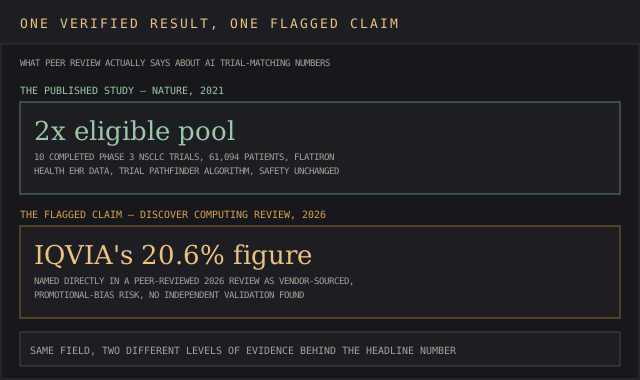
Set against all of this is one number with a real published method: a 2021 study in Nature found that an AI matching algorithm doubled the pool of patients eligible for 10 completed Phase III lung cancer trials, applied retrospectively to 61,094 real patient records, without changing the trials' safety profile.
A 2025 comment piece in npj Digital Medicine, the top-ranking page for this exact search term, restates that 2021 result as its own headline finding. Its own summary line doesn't credit the original study by name.
How this review tested the vendor claims
Every number above was pulled from the primary source. A secondary blog restating a figure was never treated as sufficient on its own. Each vendor's own product or case-study page was checked directly for the claim, its wording, and whatever supporting detail sat beside it.
Academic literature search covered peer-reviewed journals, clinical trial reports, and one preprint server, cross-checked against the specific vendor figures named above. That order matters for clinical trial sponsors and health care systems weighing a purchase: the vendor claim came first in every case, and the literature search was run to test it. It wasn't run to find supporting evidence for it after the fact.
The same check applied to marketing figures elsewhere on this site turned up comparable gaps; see the report on software pricing errors for a worked example outside clinical trials.
- Fetched the company's own domain directly for every claim, never a secondary blog or listicle repeating it.
- Noted the publish or update date where the page showed one, and flagged where none was visible.
- Checked for a stated sample size, comparison group, or peer-reviewed citation behind the number.
- Cross-checked widely circulated figures against the company's own site before repeating them.
- Dropped any number that couldn't be located on the company's own domain, instead of citing a secondary source for it.
Where a widely circulated number couldn't be located on the company's own site after a direct check, this review states that plainly instead of repeating it. IQVIA's supposed "33% faster study start-up" and "42% higher enrollment" figures, both of which circulate on secondary sites, fall into exactly that category. They don't appear anywhere on IQVIA's own domain.
A 2024 scoping review in the Journal of the American Medical Informatics Association reached a similar conclusion about the field generally: "the application of AI in clinical trials is in the early stages of maturity" and its effectiveness "needs to be further tested, requiring more obvious, higher-quality research evidence."
The same review found no published research at all on applying AI to trial retention specifically, despite patient dropouts and retention being among the field's most cited problems.
The vendor claims, checked one by one
| Vendor | Claim | Where it's published | What's missing |
|---|---|---|---|
| ICON plc | 53% reduction in median site-identification time; separately, 26% increase in subject recruitment | Company product and whitepaper pages | Sample size, comparison group, and the two ICON pages don't reconcile with each other |
| Parexel | 50% reduction in site-selection timelines | Company solutions page | Sample size, comparison baseline |
| IQVIA | 15x increase in patient-identification precision | Single client case study | Sample size, generalizability beyond one client |
| Medidata | 10-15% site-selection gain (McKinsey's figure, not Medidata's own) | McKinsey industry report, cited by Medidata's blog | McKinsey's own two ranges disagree; no named trials or sample size |
| Saama | 105 million data points reconciled in 4 months | Company case study, data management only | Not a recruitment or site-selection claim; scope limited to one client engagement |
| Florence Healthcare | One CRA covering 3-5x as many sites | Company product page, early-access feature | Not generally available; no field results published |
Every row above traces to the company's own domain, checked directly on the dates in this report's sources.
The one number with a peer-reviewed method behind it
The strongest evidence for AI improving clinical trial recruitment doesn't come from a vendor at all. Liu and colleagues published a 2021 study in Nature that applied an algorithm called Trial Pathfinder to the eligibility criteria of 10 completed Phase III non-small-cell lung cancer trials.
The algorithm ran against 61,094 real patient records drawn from Flatiron Health's oncology EHR data and other medical records. Loosening the criteria it flagged as overly restrictive, without touching the trials' actual endpoints, doubled the average pool of eligible patients. Patient safety held up when the wider pool was simulated against the real trial outcomes data: adverse event rates in the simulation matched the trials' own recorded outcomes.
That is a retrospective, data-driven result on real patient records. It isn't a live prospective trial, and it applies specifically to oncology eligibility criteria. It says nothing about site selection or recruitment speed more broadly, a distinction worth holding onto given how often the two get blurred together in secondary coverage of AI and clinical trials.
It remains the only figure in this entire field with a named dataset, a stated sample size, and a peer-reviewed publication behind it. Every vendor claim in the table above describes a similar-sounding outcome with none of those three things attached.
A separate 2026 peer-reviewed review in Discover Computing makes the gap explicit. Its section titled "Quantifying the gains: a sober look at efficiency and cost-effectiveness" states that many of the most dramatic claims of cost and time savings "originate from industry white papers, vendor case studies, or press releases."
Those claims, in the review's own words, "may be subject to promotional or reporting bias" and "often lack independent validation." The review names IQVIA's 20.6% enrollment-increase figure specifically as an example, calling it vendor-sourced and weakly validated.
Where artificial intelligence (AI) already sits across the clinical trial lifecycle
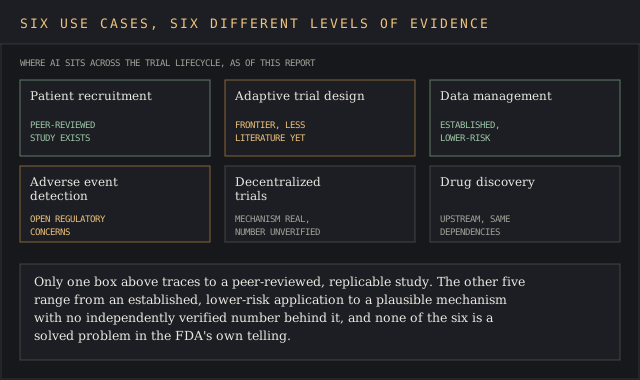
Site selection and recruitment draw the loudest marketing claims, but AI tools are already deployed across most stages of a trial. Each use case below carries its own level of evidence, from a real published study to a qualitative vendor description with no attached figure at all.
Patient recruitment and eligibility matching
Beyond the Liu et al. study above, AI-assisted matching typically works by scanning electronic health records and other structured patient data collection against a trial's eligibility criteria, flagging candidates a manual chart review would miss or take longer to find, with less human intervention at the initial screening stage.
The scale of the underlying problem is well documented outside any vendor's marketing: a 2024 arXiv preprint by Ferber and colleagues states that only 2-3% of eligible candidates currently enroll in clinical trials, a gap wide enough that even an unverified vendor claim points at a real, well-known bottleneck.
Large language models, a form of generative AI, are the newest layer here, parsing unstructured clinician notes for eligibility signals a structured-data search alone would miss across earlier and later-phase clinical studies alike.
AI-assisted decision making in adaptive trial design
Adaptive trial designs let a study change its own parameters, dosage arms, sample size, stopping rules, while the trial is still running, based on interim results. The 2025 npj Digital Medicine comment piece describes AI as supporting real-time modification of these designs, a decision-making role distinct from the pattern-matching work recruitment tools do.
This is a newer application than eligibility matching and carries less independent literature behind it so far, closer to the frontier of the field than to an established, tested practice.
Clinical trial data management
Saama's verified case study, dated 22 April 2025, describes reconciling 105 million data points across a trial program in four months, a data-management, data-analysis, and data-quality task. It isn't a recruitment claim.
AI systems in this role typically flag anomalies and missing entries in trial datasets automatically, work that used to fall to manual data-monitoring teams checking records by hand. The underlying task, pattern detection across large structured datasets, is one of the more established, lower-risk applications of AI in this field.
Adverse event detection and pharmacovigilance
The FDA's own public guidance on AI in clinical trial design, from its Center for Drug Evaluation and Research, describes AI applications including protocol optimization and participant-adherence analysis.
The same guidance explicitly flags "variability in the quality and size and representativeness of data sets for training AI models," which "can introduce bias and raise questions about the reliability of AI driven results."
It also raises model transparency, interpretability, and data drift, a model's performance degrading over time as real-world conditions shift, as open regulatory concerns. Neither is presented as a solved problem.
Beyond the FDA's own data-quality concerns, the field carries a wider set of open questions: how AI-assisted tools intersect with informed consent, what ethical challenges arise when a model flags a patient without a clinician's direct review, and how regulatory frameworks should treat a tool that keeps changing after approval. None of the six vendor pages checked for this report addresses any of the three.
Decentralized clinical trials and remote monitoring
Decentralized clinical trials rely on wearable devices and remote patient monitoring to collect data outside a physical site, extending trials into clinical settings a traditional site-based model can't reach. AI tools are the layer that turns a continuous stream of sensor readings into something a clinical team can act on: flagging medication adherence gaps or early signs of an adverse event without a person watching the feed in real time.
WCG Clinical's own page on this describes the benefit qualitatively, reduced cycle times and lower costs, without attaching a figure to either claim. This report treats that the same way it treats every other unquantified vendor statement: real as a described mechanism, unverified as a number.
Continuous monitoring also shifts part of the patient-burden problem regulators track, since fewer in-person visits can mean fewer dropouts from participants who can't keep making the trip to a site. Some vendors market this model as virtual trials built around more efficient trial protocols, though efficient trials still depend on the same underlying data quality this report keeps returning to.
Drug discovery and precision medicine
Machine learning models, including neural networks trained through pattern recognition on real-world data, are increasingly used earlier in the pipeline too. These predictive models and other ML algorithms forecast molecule stability and side-effect risk before a compound reaches a trial.
The same AI technology also supports precision-medicine approaches that match a treatment to a patient's specific biology instead of a broad diagnosis.
This work sits upstream of the trials this report otherwise covers, closer to drug development than to trial operations. It draws on the same underlying models and the same data-quality dependencies documented above, so a data-quality gap upstream can surface as a trial-design problem downstream.
What changed since the vendor claims were made
Every vendor claim in the table above was published before the academic literature caught up to it. ICON's, Parexel's, and IQVIA's pages carry no visible update dates tied to a specific validation study.
The JAMIA scoping review landed in November 2024, over a year after most of these vendor pages were already live, and it didn't single out any one company. The Discover Computing review, published in June 2026, is the first peer-reviewed source found in this research to name a specific vendor figure, IQVIA's 20.6% enrollment claim, and state directly that it lacks independent validation.
That timeline matters for anyone reading a vendor's page today: the claim itself hasn't changed, but the standard of evidence a buyer should expect against it has moved. A number that looked like an industry-standard marketing figure in 2024 now has a named, peer-reviewed critique sitting next to it in the literature.
Trade coverage has started tracking the same gap from a different angle: regulatory validation lag for AI decision-support tools generally, and site-level algorithmic opacity in AI-driven site selection specifically, both flagged in industry press through August 2026.
What this means for clinical research teams evaluating AI tools
None of this means AI tools don't work. The one study with a real published method found a genuine, safety-neutral doubling of an eligible patient pool.
The mechanism behind every other claim, EHR-based pattern matching for recruitment, anomaly detection for data quality, real-time monitoring for adaptive designs, is plausible and consistent across the entire field. What's missing is independent confirmation of the specific numbers vendors lead with.
A clinical research team evaluating one of these tools has a narrower question to answer than "does AI help." The real question is if a specific vendor's specific number has been tested outside that vendor's own case studies. As of this report, exactly one figure in this field clears that bar, and it belongs to an academic study. No vendor's product page currently carries anything comparable.
That has direct budget implications. A procurement decision built on an unverified percentage is a bet on the vendor's own marketing team. It isn't a bet on independent evidence, and the gap between those two things is exactly what this report set out to measure.
AI plays a critical role in each of these use cases, and health care systems weighing a significant investment in one should ask what "trial success" means for the specific claim being sold: faster enrollment, a real way to improve patient outcomes, or fewer administrative hours. Several challenges make that question hard to answer from a vendor page alone, chief among them the absence of a shared definition across the six companies checked here.
Five questions worth asking any AI vendor before treating the number on their page as evidence:
- What is the sample size behind this figure, and how many trials or sites does it cover?
- Was there a comparison group, or is this figure measured against the vendor's own prior baseline only?
- Has the result been published anywhere the vendor doesn't control, a peer-reviewed journal or an independent audit?
- Does the vendor's own site publish a second figure for the same claim, and if so, do the two agree?
- Is the figure generalizable across clients, or is it a single case study being presented as a general result?
Frequently asked questions
Can AI speed up clinical trials?
The strongest published evidence says yes for one specific task: a 2021 Nature study found AI-driven eligibility matching doubled the pool of patients eligible for 10 completed oncology trials without changing safety outcomes.
Vendor claims about broader speed gains, site selection and recruitment timelines specifically, aren't backed by comparable published evidence as of this report, even where the underlying mechanism they describe is plausible.
How is AI being used in clinical trials?
Across recruitment and eligibility matching, adaptive trial design, data management and quality checks, adverse event detection, and remote monitoring in decentralized trials.
Each use case sits at a different stage of evidence, from the one peer-reviewed study above to qualitative vendor descriptions with no attached figures. The gap between those two ends is the main finding of this report.
Which AI companies are leading in clinical trials?
ICON plc, Parexel, IQVIA, Medidata, Saama, and Florence Healthcare all publish AI-related clinical trial products, each with its own claim about recruitment, site selection, or data-management performance. This report checked each company's own page directly. It doesn't rank them, since none currently publishes a peer-reviewed validation of its headline figure.
Can AI help detect adverse events in clinical trials?
The FDA's own guidance describes AI applications in this area, including automated monitoring for anomalies in trial data, while explicitly naming data quality, bias, and model interpretability as open concerns. The guidance doesn't present any of the three as solved.
No vendor-published figure specifically quantifying adverse-event detection accuracy was located during this review's research, which is a gap distinct from the recruitment and site-selection numbers this report otherwise checks.
What are the biggest limitations of AI in clinical trials?
Data quality and representativeness top the FDA's own list: a model trained on unrepresentative data can introduce bias and produce results a regulator has reason to question. Tools built to reduce patient burden and improve patient engagement carry the same data-quality dependency, even though none of the vendor pages checked here separates that claim out with its own figure.
A 2024 peer-reviewed scoping review adds a second limitation: it found no published research at all on applying AI to trial retention, despite retention being one of the field's most persistent problems. Together, the two gaps describe a field with real, working mechanisms and a shortage of independent proof for its headline numbers.
Bottom line
Vendor marketing pages agree that AI helps clinical trials run faster and match patients more precisely, and every one of the six companies checked here makes some version of that claim. What none of them shows is a published method behind the specific number on the page.
The one figure in this field that does clear peer review, a doubled eligible-patient pool from a 2021 Nature study, supports the general direction of the marketing claims without validating any of their specific percentages.
A 2026 review naming IQVIA's own figure as unvalidated is the clearest sign yet that the literature is starting to test these claims directly instead of restating them.
Sources and how this report checked them
Vendor figures were pulled directly from each company's own domain: ICON plc (iconplc.com), Parexel (parexel.com), IQVIA (iqvia.com), Medidata's blog citing McKinsey (mckinsey.com, 9 Jan 2025), Saama (saama.com, dated 22 Apr 2025), and Florence Healthcare (florencehc.com).
Two IQVIA figures that circulate on secondary sites, a "33% faster study start-up" and a "42% higher enrollment" claim, couldn't be located on IQVIA's own domain after a direct check and aren't repeated here.
The peer-reviewed eligibility-matching result is Liu, R. et al., "Evaluating eligibility criteria of oncology trials using real-world data and AI," Nature 592, 629-633 (2021). The 2-3% enrollment figure traces to Ferber, D. et al., "End-To-End Clinical Trial Matching with Large Language Models," arXiv preprint (2024); the preprint hasn't undergone peer review.
That scoping review is published in the Journal of the American Medical Informatics Association (1 Nov 2024). The review naming IQVIA's figure is published in Discover Computing (Springer, 5 Jun 2026, author Rahul G. Ingle).
The FDA guidance cited is a public Q&A with the agency's Dr. ElZarrad on the role of artificial intelligence in clinical trial design, published on fda.gov. WCG Clinical's and Clinical Trials Arena's own pages, both top-ranking results for this search term, were checked directly and carry no numeric claims of their own worth citing or rebutting.
Constraints on the CRO services market
Patient recruitment and retention remain the most commonly cited constraint on trial timelines, and by extension on CRO revenue growth, across every research house that names one. Rare disease and oncology trials, the same categories driving demand growth above, are also the hardest to enroll: smaller eligible populations mean CROs compete harder for the same patients.
Biotech funding cycles cut both ways. The S&P Biotech ETF hit an 18-month low in April 2025, per the same Reuters reporting cited above, trading at roughly half its 2021 peak. Fortrea's declining Q4 2025 revenue, down from $697.0 million to $660.5 million year over year, is one public data point showing that a stabilizing macro environment doesn't lift every CRO evenly.
The same funding cycle shows up in adjacent real estate demand; this site's life science market report tracks how lab-space demand moves with the same biotech funding swings.
A talent shortage among clinical research professionals, clinical research associates, biostatisticians and regulatory specialists, shows up in industry commentary as a multi-year constraint, though no research house surveyed here attaches a hard headcount-gap figure to it, so treat that specific claim as directional, not tied to a sourced number.
What the forecasts leave out
None of the ten houses disclose their full underlying methodology on the public report page; each cites primary interviews, company filings and its own proprietary model, without showing the weighting between them.
That's standard for syndicated market research, but it means the CAGR spread in the table above, 5.5% at the low end to 13.58% at the high end, reflects assumption differences a reader can't fully audit from the published summary alone.
Private-company opacity is the biggest gap in the players section. Parexel, Syneos Health and PPD's standalone financials aren't public, so any market-share percentage attributed to them in a syndicated report is necessarily an estimate, not a disclosed figure, no matter how confidently the report states it.
Currency matters more than most reports acknowledge. WuXi AppTec reports in RMB; converting to USD at a single point-in-time exchange rate, as this report does, can shift the headline figure by several percentage points depending on the date used, separate from any change in the company's underlying business.
Frequently asked questions
What does a contract research organization do?
A CRO runs outsourced clinical trial and pharmaceutical development work for pharmaceutical, biotech and medical device sponsors: trial planning and management, patient recruitment, data management, biostatistics, regulatory affairs, and, at the largest CROs, preclinical and discovery-stage lab work as well.
Who is the biggest CRO?
By segment revenue, IQVIA's CRO business (Research & Development Solutions) led at $8.9 billion in 2025. Among CROs that report as a standalone public company, ICON plc was largest at $8.25 billion in FY2025 revenue.
How do CROs make money?
Mainly through two contract structures: fee-for-service, where the CRO bids a fixed or milestone-based price for a defined scope of trial work, and functional service provider (FSP) arrangements, where the sponsor pays for dedicated CRO staff embedded in its own operations, typically billed per full-time equivalent.
Why are CROs struggling?
Not every CRO is struggling; the picture is uneven. Fortrea's Q4 2025 revenue fell year over year while Medpace's grew 32.0% in the same quarter. The 2023-2024 biotech funding pullback squeezed smaller sponsors' trial budgets industry-wide, and Reuters reported the broader macro environment only began stabilizing through mid-2025.
What are the top CRO companies by revenue?
Among companies that disclose a comparable figure: IQVIA's CRO segment ($8.9B, 2025), ICON plc ($8.25B, FY2025), WuXi AppTec (~$6.3B, FY2025, though now CRDMO-focused, not trial-execution), Fortrea ($2.72B, FY2025) and Medpace ($2.53B, FY2025). Parexel, Syneos Health and Thermo Fisher's PPD business don't disclose a comparable standalone figure.
What is considered a contract research organization?
Any company under the contract research organization CRO umbrella takes on part or all of a clinical trial or drug development program on behalf of a pharmaceutical, biotech or medical device sponsor, spanning small specialist firms with a single therapeutic focus to full-service CROs like IQVIA and ICON operating in 50-plus countries.
Bottom line
The contract research organization market doesn't have one size. It has ten, ranging from $59.6 billion to $99.8 billion for the same 2025 base year, and every one of those ten numbers is defensible on its own terms once you know what the house counted and what it left out.
The companies running the work are easier to measure than the market they compete in. IQVIA's CRO segment, ICON, Fortrea and Medpace all file numbers a reader can check directly. Parexel, Syneos Health and PPD don't, and any market-share figure built on top of their revenue is an estimate wearing the clothes of a fact.
Cite a CRO market figure, and cite the house behind it by name. "The CRO market is worth $85 billion" reads like a fact. "MarketsAndMarkets sizes the CRO market at $85.41 billion for 2025" reads like something a reader can go check, which is the entire point of sourcing a number in the first place.
Sources, and what wasn't disclosed
Market-size, CAGR and segmentation figures are each house's own published report page, checked 27 August 2026: MarketsAndMarkets (marketsandmarkets.com), Market Research Future (marketresearchfuture.com), Grand View Research (grandviewresearch.com), Global Market Insights (gminsights.com), The Insight Partners (theinsightpartners.com), and Precedence Research (precedenceresearch.com).
Also checked the same way: Future Market Insights (futuremarketinsights.com), Coherent Market Insights (coherentmarketinsights.com), Fortune Business Insights (fortunebusinessinsights.com), Mordor Intelligence (mordorintelligence.com), Persistence Market Research (persistencemarketresearch.com), and DataM Intelligence (datamintelligence.com).
Company revenue and headcount figures are each company's own investor relations site or most recent earnings release: IQVIA (ir.iqvia.com), ICON plc (iconplc.com, May 2026 release, including the 2023/2024 revenue restatement it disclosed), and Thermo Fisher (ir.thermofisher.com).
Also checked directly: Fortrea (ir.fortrea.com and its FY2025 10-K on sec.gov), Medpace (investor.medpace.com and its FY2025 10-K on sec.gov), WuXi AppTec (wuxiapptec.com, March 2026), Parexel (parexel.com and newsroom.parexel.com), and Syneos Health (syneoshealth.com).
Demand and macro-environment reporting, including the Bousbib, Troendle and Rhyee quotes, is Reuters via Yahoo Finance, "Contract research firms' strong earnings signal stabilizing biotech, pharma spending," July 24, 2025. All figures checked 27 August 2026; Parexel's and Syneos Health's current revenue has not been disclosed by either company since going private.
Service-line, sponsor-relationship and contracting descriptions are CASRAI's own sector-overview guide (casrai.org, published 18 July 2026). The 500,000-registered-studies figure is the U.S. National Library of Medicine's own 25th-anniversary announcement for ClinicalTrials.gov (nlmdirector.nlm.nih.gov, April 2025).
A separate figure citing "700,000 clinical trials registered since 2005" appeared in Surfer's AI Search fact set for this topic but doesn't match what its own cited source, marketresearchfuture.com, states (17,000 trials via the WHO ICTRP). It was dropped instead of repeated.