Market intelligence platform pricing: what 49 vendors and 40 categories charge
 By Jan Suski. I go deep on every review, checking every number against its source and digging up details other coverage misses, a habit from six years of SEO and link building for tech companies. Bylines at Surfer, Brand24, and Senuto. How the scoring works.
· Prefer this source on Google
The numbers 89 pricing reports, checked 30 July to 6 October 2026
Twenty-two of the 49 vendors print no price for a paid plan, so a Vendr median is the only public number for most of the top of this market.
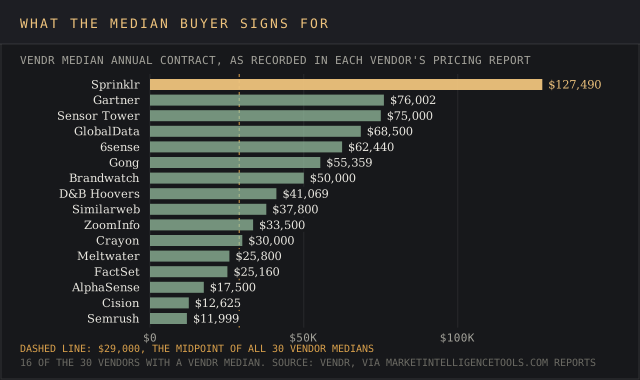
Half of the 30 vendor medians sit at or below $28,000 a year, and the dearest, Sprinklr's, runs about 19 times the cheapest.
Published plans and quoted contracts sit in two separate bands. Brand24's Business plan costs $7,188 a year at list, under the $19,542 low end of Brandwatch's tracked range.
Check what a median counts before you quote it back to a vendor, because LinkedIn's $38,519 covers every LinkedIn product.
I'll write a 2,500+ word report on the vendors or categories you name, with entry prices, contract terms and renewals sourced line by line. Yours to publish, from $200.
This page puts every pricing and cost report on the site into one table, covering 49 named vendors and 40 software categories, from a $83.88 year of Feedly Pro to a $127,490 median Sprinklr contract. Each row carries the published entry price, the typical contract and the pricing model, copied from the report it links to.
The short version is that 22 of the 49 vendors publish no price for a paid plan, and the 30 vendor medians that stand in for one run from $6,750 to $127,490 a year. The sections under the table cover the pricing models you'll meet, what moves a quote, and how to read one.
It's written for product marketing, sales operations and research teams at companies that need a budget line before the first sales call. A vendor that hides its rate card sets the opening number on that call, and a buyer who arrives with the median has a number of their own.
Market intelligence pricing by vendor and category
Rows are grouped by the different types of data each tool sells, from contact databases to search data. The first row in most groups is a category report covering many vendors at once, and the rows under it are vendors with a report of their own. Competitive intelligence software has its own 18-vendor report, so this table gives it one category row plus Crayon and leaves the vendor-by-vendor detail there.
| Vendor or category | Entry price | Typical contract | Pricing model |
|---|---|---|---|
| Sales intelligence and contact data | |||
| Email finders (16 vendors) | $39 for 2,000 credits a month (Skrapp) | No tracked contract figure | Credits; a phone number costs 4 to 10 email credits |
| Amplemarket | $600 a month for 2 users (Startup, annual) | $16,608 median (Vendr) | Startup published; Growth and Elite by quote |
| Apollo.io | $49 a seat a month (Basic, annual); free plan $0 | $19,000 average (Vendr, 87 deals) | Per seat, plus pooled credits |
| Clay | $185 a month (Launch, monthly billing) | $40,500 median, Enterprise (Vendr, 80 purchases) | Unlimited seats; billed on Data Credits and Actions |
| Clearbit (HubSpot) | $7 a HubSpot Starter seat a month (annual promo rate) | $26,250 average HubSpot contract (Vendr, 709 deals) | Sold only inside HubSpot; seat plus credits |
| Cognism | None published | None live: Vendr's Cognism page returned a 404 | Quote only, Standard and Pro, 5 seats included |
| D&B Hoovers | $49 a month or $529 a year (Essentials) | $41,069 median (Vendr, 108 purchases) | Essentials self-serve; three Enterprise tiers by quote; credits expire every 3 months |
| LeadIQ | $15 a month (Pro, annual) | $26,400 median (Vendr) | Credit slider; Enterprise by quote |
| LinkedIn Sales Navigator | $119.99 a month (Core) | $38,519 median, all LinkedIn products (Vendr) | Per seat; Advanced Plus by quote |
| Lusha | $49.90 a month (Starter) | $15,999 median (Vendr) | Monthly credit allowance plus seat count |
| RocketReach | $229 a year (Essentials, 1 seat) | $6,750 median, custom team plans (Vendr) | Per seat, monthly or annual; custom team plans |
| Seamless.AI | $0 (Free); paid tiers by quote | No Vendr listing | Credits; Basic, Pro and Enterprise by quote |
| Wiza | $49 a month (Starter) | No tracked contract figure | Monthly credits; $0.15 an extra email, $0.35 an extra phone number |
| ZoomInfo | None for its six plans | $33,500 median (Vendr, 1,574 purchases) | Quote only; GTM AI credits $0.25 to $0.45 each |
| Intent data, ABM and revenue intelligence | |||
| Account-based marketing (9 platforms) | $59 a month (ZenABM Starter) | $24,840 (Terminus) to $68,591 (Demandbase) medians | Platform license, plus ad media, intent data and staff |
| Intent data (15 providers) | €0 (Leadfeeder Lite); $49 a seat a month (Apollo Basic) | $25,000 (Bombora) to $95,292 (TechTarget) medians | Seats, credits, identified companies, topics or a flat platform fee |
| Revenue intelligence (16 vendors) | $10 a seat a month (Fireflies Pro, annual) | $24,480 (Backstory) to $76,000 (Clari) medians | Per-seat plans, quote-only contracts with a base fee, or credits |
| Sales engagement (14 vendors) | $49 a seat a month (Apollo.io Basic, annual) | $19,000 (Apollo.io) to $45,600 (Outreach) medians | Published seat plans, quote-only platforms, or a Sales Cloud add-on |
| 6sense | None; the free plan ended 12 August 2026 | $62,440 median (Vendr, 385 purchases) | Custom quote built per deal |
| Gong | None published | $55,359 median (Vendr, 1,145 purchases) | Per-user license, platform fee and AI credits |
| Competitive and digital intelligence | |||
| Competitive intelligence (18 vendors) | $0 (Visualping Free); $39 a month (Competely Starter) | $30,000 average (Klue, Crayon on Vendr) | Self-serve plans, per-request APIs or negotiated contracts |
| Crayon | None published | $30,000 median (Vendr, 93 purchases) | Quote by tracked competitors, seats, feature tier and term |
| Exploding Topics | $39 a month (Entrepreneur) | No tracked contract figure | Monthly tiers; Trends API add-on $1,000 to $4,000 a month |
| Feedly | $83.88 a year (Pro reader); $19,200 a year (Market Intelligence Standard) | No tracked contract figure | Annual plans; Market Intelligence covers up to 10 or 25 seats |
| Sensor Tower | None published | $75,000 median (Vendr, 40 purchases) | Annual contract set by modules, seats and data coverage |
| Similarweb | $199 a month (Starter) | $37,800 median (Vendr, 157 purchases) | Starter self-serve; Team, Business and Enterprise quoted |
| SEO, search and web data | |||
| SEO tools (16 vendors) | $0 (Google Search Console); $29 a month (Ahrefs Starter) | $12,480 (Semrush) to $74,200 (Botify) medians | Suites, content editors, crawlers, enterprise platforms and data APIs |
| Rank trackers (16 products) | $69.86 a month for 1,000 daily keywords (SerpRobot) | No tracked contract figure | Per tracked keyword and update frequency |
| SERP APIs (14 providers) | $0.60 per 1,000 searches (DataForSEO Standard) | No tracked contract figure | Per search, credits or pay per success |
| Web analytics (17 tools) | $0 (Google Analytics 4); $9 a month (Plausible) | $38,717 (Mixpanel) to $64,000 (Amplitude) medians | Pageviews, hits, events or annual contracts |
| Web scraping | $49 a month plans (Oxylabs Micro, ScraperAPI Hobby) | $11,400 (Zyte) and $27,000 (Bright Data) averages | Credits per request, multiplied by page type |
| Proxies (13 providers) | $0.49 a GB (Evomi, 100 GB plan); $0.0299 a datacenter IP a month (Webshare) | $27,000 median (Bright Data) | Per GB for residential traffic, per IP for datacenter |
| Residential proxies (9 providers) | €2.90 to $8 a GB at the entry tier | $27,000 median (Bright Data) | Per GB or per IP, cheaper with volume commitments |
| News APIs (13 APIs) | $19 a month (TheNewsAPI Basic) | No tracked contract figure | Monthly request plans; free tiers delayed or development-only |
| Ahrefs | $29 a month (Starter) | No median; Vendr shows a deal count only | One user per plan; extra seats $40 to $100 a month; add-ons |
| DataForSEO | $0.60 per 1,000 SERPs; $50 minimum deposit | No tracked contract figure | Pay as you go, by the task and the data row |
| Semrush | $139 a month (SEO plan) | $11,999 median (Vendr) | Self-serve tiers; per-domain toolkits; extra seats from $45 a month |
| Social listening and social media | |||
| Social listening (9 vendors) | $29 a month (Awario Starter) | $25,800 (Meltwater) to $127,490 (Sprinklr) medians | Published rate cards or quotes |
| Social media management (14 vendors) | $0 (Buffer free plan); $99 a seat a month (Hootsuite Standard) | $12,405 (Hootsuite) to $50,000 (Brandwatch) medians | Per seat, channel, workspace, flat fee or quote |
| Influencer marketing (8 vendors) | $890 a year (Tapfiliate Launch) | $15,000 (Upfluence) to $39,250 (CreatorIQ) medians | Published plans or quote-only suites |
| Reputation management | $28 a month (HiFiveStar Core, 1 location) | $10,800 to $318,204 medians | Per location, or quote-only suites |
| Brand24 | $199 a month (Individual, annual) | No Vendr median | Five published tiers gated by keywords and mentions |
| Brandwatch | None published | $50,000 median (Vendr, 40 purchases) | Custom quotes by product suite |
| Hootsuite | $99 a user a month (Standard, annual) | $12,316 median (Vendr, 75 purchases) | Per seat, annual billing; Enterprise by quote |
| Meltwater | $10,000 a year (indicative Starter floor) | $25,800 median (Vendr, 126 purchases) | Quote only; auto-renewing annual agreement |
| Sprinklr | None published | $127,490 median (Vendr) | Quote by suite, named users and message volume |
| Sprout Social | $79 a seat a month (Essentials, annual) | No tracked contract figure | Per seat per month across five tiers |
| Media monitoring and PR | |||
| Media monitoring (12 vendors) | $0 (Google Alerts); $29 a month (Awario Starter) | $7,950 to $50,000 medians | Self-serve plans or annual contracts by quote |
| Media databases (13 vendors) | $149 a month (Semrush AI PR Toolkit Base) | $12,625 (Cision) to $25,800 (Meltwater) medians | Published plans or quotes; auto-renewal clauses |
| Press release distribution (14 services) | $0 (PRLog) | $19,000 median (Business Wire) | Per release, by word count and circuit; annual contracts for regular senders |
| Cision | None for CisionOne; PRWeb from $120 a release | $12,625 median (Vendr, 107 purchases) | Consultation by users, features and service levels; 5% rise at each renewal |
| Sentiment and text analytics | |||
| Sentiment analysis (20 vendors) | $29 a month (Awario Starter); $62 for 1 million reviews (GPT-5.6 Luna) | $30,000 (Qualtrics) and $50,000 (Brandwatch) medians | Per unit of text on APIs, per year on suites |
| Text analytics | $0.0001 per 100-character unit (Amazon Comprehend) | $30,000 median (Qualtrics) | Per unit of text on cloud APIs; per year, per seat or quote on feedback tools |
| Company, financial and research data | |||
| Expert networks | $525 to $1,050 per call | $30,000 (Tegus) to $78,980 (AlphaSights) medians | Per call, or annual contracts |
| Market data | $1.50 a month (NYSE quotes, retail) | $31,980 a year (one Bloomberg terminal) | Access, display, non-display and redistribution fees |
| AlphaSense | None published | $17,500 median (Vendr, 38 purchases) | Quote by platform, content tier and add-on |
| Bloomberg Terminal | None published | $31,980 a seat a year (single-seat renewal, NeuGroup) | Per terminal seat; $28,320 a seat at two or more |
| Crunchbase | $99 a month (Pro, monthly billing) | $20,000 median (Vendr, 73 purchases) | Three products; Custom Data Access by quote |
| FactSet | None published | $25,160 median (Vendr) | Quote built on seat count and data coverage |
| Gartner | $33,346 a year (lowest single license, GSA list) | $76,002 median (Vendr, 149 purchases) | Named license per person, priced by role |
| GfK | €2,080 a year (RegioGraph Analysis) | No tracked contract figure | RegioGraph licences; gfknewron by quote on 2 to 5 year NIQ contracts |
| GlobalData | None published | $68,500 median (Vendr) | Licensed by industry vertical |
| PitchBook | None published | $7,000 a seat a year (UK government order form) | Per user, annual; $5,600 a seat on an 18-user order |
| Tegus | None for the subscription; calls about $450 an hour plus a $75 fee | $30,000 median (Vendr) | Annual subscription, calls billed on top |
| Real estate and location data | |||
| ATTOM Data | $499 a year (Property Navigator Professional) | No median on Vendr | API, bulk files and cloud shares by quote; the API bills per property returned |
| CoStar | None published; $502 to $557 a seat a month in city contracts | $15,360 median (Vendr) | Per user per month; auto-renewal |
| Placer.ai | None published | $12,000 to $34,000 a year (nine public order forms) | Annual fee set by the report-credit allowance |
| Reonomy | None in dollars | No tracked contract figure | Monthly or Annual seat, Annual 30% cheaper; API and bulk feeds by quote |
| Market research and surveys | |||
| Market research (27 vendors) | $0.95 a survey response (Pollfish) | $30,000 (Qualtrics) and $75,650 (Gartner) averages | Surveys, focus groups, syndicated reports or platform contracts |
| Focus groups | $1,116 to run one online yourself | $5,000 to $20,000+ a group through an agency | Per group: recruiting, incentives, facility, moderator, report |
| Survey software (13 tools) | $0.95 a response (Pollfish) | $30,000 median (Qualtrics) | Per response, per seat or by quote |
| Medallia | None published | $13,338 median departmental purchase (Vendr) | Quote only, built on the Experience Data Record |
| Qualtrics | $5,040 a year (Strategic Research online, 1,000 responses) | $30,000 median (Vendr, 322 purchases) | Response volume and headcount; suites by quote |
| Review sites and B2B marketplaces | |||
| Capterra | $0 to list | No tracked contract figure | Per click, per lead and per meeting; budgets to $2,000 and $10,000 a month |
| G2 | $2,999 a year (Starter, year one) | $28,000 median (Vendr, 313 purchases) | Starter published, renews at $6,000; Professional and Enterprise by quote |
| ThomasNet | $0 (basic profile) | $200 to $400 a month (user invoices) | Priced by category competition, no rate card |
| Trustpilot | $99 a month per domain (Starter, annual) | $10,800 median (Vendr, 105 purchases) | Per domain, 12-month commitment |
| Adjacent business software | |||
| Business intelligence (11 vendors) | $14 a user a month (Power BI Pro) | $29,386 (Tableau) to $100,000 (ThoughtSpot) medians | Per seat, or capacity |
| CRM (11 vendors) | $0 free plans; $7 a seat a month (HubSpot Starter) | $26,250 (HubSpot) and $77,376 (Salesforce) averages | Per seat |
| Customer data platforms (15 vendors) | $120 a month (Segment Team) | $15,000 (Hightouch) to $225,000 (Insider) medians | Six billing units: tracked users, events, profiles, seats, Amps, platform fees |
| Call center software (11 rate cards) | $15 a user a month (Dialpad Connect) | $14,256 (Aircall) to $88,536 (Talkdesk) medians | Per agent on Genesys Cloud CX and others: named, concurrent or hourly |
| Call tracking (9 vendors) | $0 platform fee (Nimbata Entry) | $27,880 median (Invoca) | Platform fee, per tracking number, per minute or answered call |
| Contract management (18 vendors) | $19 a seat a month (PandaDoc Starter, annual) | $18,138 (Conga) to $67,132 (Agiloft) medians | Published seat plans or quote-only platforms |
| Procurement (18 vendors) | $9 a user a month (Spendwise Basic) | $15,000 median (Procurify); $94,519 average (Coupa) | Published plans from 3 vendors; suites by quote |
| Supply chain management (18 vendors) | $29 a month (Zoho Inventory Standard, annual) | $74,816 median (NetSuite) | By user count or transaction volume |
| Virtual data rooms (17 vendors) | $52 a month per admin (Peony) | $13,950 (Intralinks) to $35,677 (DealRoom) medians | Flat monthly fee, or quote |
| Patent and trademark costs | |||
| Patent search | $0 to search yourself; $149 to $499 for an AI report | $400 to $2,600 from a search firm | Per search, plus office fees ($770 USPTO search fee) |
| Trademark search | $0 (USPTO search); $149 automated | $500 to $1,800 from a law firm | Per search, plus $350 a class in USPTO fees |
| Trademark infringement | $500 to $1,500 (cease and desist letter) | $120,000 to $750,000 (lawsuit through trial) | Legal fees, damages and rebrand costs |
Copy these lines into an email, fill them in and send. I reply with scope and a price within 2 to 3 business days.
Open the emailEntry price and typical contract are different concepts. Entry price is the cheapest paid plan the vendor publishes, as recorded in the linked report, with a free plan noted where the report records one. Typical contract is the Vendr median annual contract where the report gives one. Where it doesn't, the cell names the figure it shows: an average, a public order form, a leaked rate sheet or a range of medians across a category.
Every figure was copied from the linked report on 7 October 2026. Those reports were checked between 30 July and 6 October 2026, and each one names its own sources, from vendor pricing pages to Vendr marketplace headers, public contract notices and company filings.
Six pricing models you'll see in the table
Many rows mix two of these models, and the pricing model column names the ones each report found. Here's how each one bills, with an example from the table.
- Quote only. Twenty-two companies print no price for a paid plan, Sprinklr, Gong, 6sense, AlphaSense, FactSet and GlobalData among them. Outreach puts a "Request pricing" button on all four of its packages. Buyers rely on Vendr's tracked contracts from companies that signed, from a $17,500 AlphaSense median up to Sprinklr's $127,490.
- Per seat. Hootsuite bills $99, $199 or $399 per user a month on annual billing, Sprout Social starts at $79 a seat and LinkedIn Sales Navigator Core costs $119.99 a month. Gartner sells named licenses, one person per seat, priced by role.
- Credits and usage. Contact databases bill by credit. Apollo charges 8 credits for a phone number against 1 for an email. ZoomInfo's GTM AI credits cost $0.25 to $0.45 each, and DataForSEO bills $0.60 per 1,000 SERPs on its Standard queue.
- A published floor under a quoted top. D&B Hoovers, Similarweb, Amplemarket, Crunchbase, Qualtrics and G2 publish an entry plan and quote everything above it. D&B Hoovers' $41,069 median runs roughly 78 times its $529 Essentials year, and G2's $28,000 median nearly ten times its $2,999 Starter year.
- Priced by what you track. Crayon quotes by tracked competitors, seats, feature tier and term. GlobalData licenses by industry vertical, and Placer.ai by report credits, where every 260-credit contract costs at least $30,400 a year.
- Per unit of business. Trustpilot charges per domain from $99 a month, reputation suites per location and proxy providers per GB of traffic. Expert networks sell expertise by the call, at $525 to $1,050 an hour.
For the 22 quote-only companies, Vendr medians and public contract notices play the critical role a rate card plays elsewhere. The published floors, where they exist, are built for small businesses. G2 aims Starter at small businesses of 1 to 100 employees, and Trustpilot opens its $99 Starter plan to new businesses with up to $5M in revenue. Qualtrics publishes one $5,040 plan and quotes the Customer Experience and Employee Experience suites that large enterprises buy.
The challenge with hybrids is that every meter needs its own line in the quote. Gong's pricing page confirms a per-user license, a platform fee and AI credits, and prices all three in private, so sales teams comparing Gong against other tools need each line written out. Clearbit's data now sits inside a HubSpot seat from $7 a month, with intent tracking billed at 10 credits ($0.10) for every website visitor company it creates or monitors in a month.
What drives the cost of a market intelligence solution
Five levers move a quote for any market intelligence solution in the table, and buyers who define them before the demo can evaluate two quotes on the same terms. As a team grows, seats, data volume and API access are the lines that reprice a contract. Each example comes from the report linked in that row.
Seats, access and data security
Seat count multiplies every per-seat plan. Hootsuite's $12,316 median buys about five Professional seats, and two Advanced seats added mid-year at Sprout Social cost $9,576, more than a full year of one Standard seat. Per-employee pricing scales the same way. A 2,000-employee organization paying Microsoft Viva Insights list price spends $96,000 a year.
Seat floors gate access controls as well. Amplemarket's Elite plan needs 10 users and gates dedicated support and single sign-on, a data security control, by headcount alone. Apollo's Organization plan carries a 3-seat minimum, and Wiza's Team plan needs 3 or more seats, which keeps a two-person team off its best per-seat price.
Data coverage, modules and history
Coverage decides the quote at research companies, where data sources are the product.
- FactSet builds every quote around the buyer's specific needs for seats and data coverage.
- AlphaSense quotes by platform, content tier and add-on, with expert calls and Canalyst priced separately.
- GlobalData licenses by industry vertical across 22 industries, so a buyer covering two pays a different number than one covering six.
- Feedly sells Market Intelligence at $19,200 a year for up to 10 seats, with a free trial on Standard, and prices its Threat Intelligence product, built for security analysts, on request, with a 30-day free trial.
Sensor Tower's tracked contracts run from $29,500 to $115,460, a spread Vendr ties to module selection, seats and data coverage. History costs money too. A standard Google Analytics 4 property keeps event-level data for 14 months at most, per the web analytics report, and Analytics 360 keeps 50 months.
Usage meters and speed
Real time data costs more than queued data, and speed has a published price on two meters in the table. DataForSEO charges $0.60 per 1,000 SERPs on its Standard queue and $2.00 for the same results on Live mode, then $20.00 once depth hits 100. Keyword.com's bill for 1,000 tracked keywords rises from $33 to $131 a month when updates move from weekly to daily.
API and integration access
Programmatic access to the raw data sits on higher tiers or costs extra.
- Clay's Growth plan costs 2.7 times Launch and only doubles the Data Credits, so the jump buys CRM integration and API access.
- Brand24 adds API access for $99 a month on Business and up.
- Exploding Topics' Trends API costs $1,000 to $4,000 a month, open only to its $249 Business tier.
- Crunchbase routes API and MCP access to Custom Data Access, quoted by sales. One of the few concrete extras in its $199 Business plan is the ability to export 5,000 rows a month against Pro's 2,000.
Top tiers bundle the workflows. ZoomInfo's highest sales tier adds custom integrations, advanced workflows, and advanced reporting and analytics, and Semrush sells AI Visibility reporting as a $99-a-month toolkit per domain. Text analytics platforms charge a premium over raw cloud APIs for dashboard functionality, insights work and integrations.
Services, onboarding and contract term
Total cost of ownership runs past the subscription line, starting with the cost to implement the platform. Sprinklr bills professional services and onboarding of $25,000 to $150,000+ separately for its customer experience solution, and Brandwatch implementation can reach 10 to 15 percent of contract value. HubSpot Sales Hub Professional requires a one-time $1,500 onboarding fee.
Term length and volume move the rate the other way. Signing GfK's RegioGraph for 36 months cuts its first-term rate in half, Gartner's multi-license rule cuts an Advisor seat from $49,576 to $37,730, and an 18-user PitchBook order effectively cut the seat price from $7,000 to $5,600.
How to read a market intelligence quote
The key check is to hold the number against the median and the range in the vendor's own report. ZoomInfo's tracked contracts run from $7,220 to $155,730 around a $33,500 median, and the dearest costs 21.6 times the cheapest, so seats, credits and modules move the price more than the plan name does.
The billing period matters as well. ZoomInfo sells paid plans as annual contracts, and its own pricing guide says "Monthly billing is not standard," so a monthly ZoomInfo figure is an annual commitment divided by twelve. Its plans run from advanced search filters and CRM integration with HubSpot and Salesforce up to custom integrations on the top tier.
Then check what the median counts. LinkedIn's $38,519 mixes Recruiter seats, ad budgets and Learning licences with Sales Navigator. Bloomberg's $1,108 Vendr median can't describe a terminal seat, which renews at $31,980. Medallia's $13,338 counts departmental purchases, and Bloomreach's median covers six Bloomreach products.
Opening quotes move. G2's report notes most buyers achieve 15% to 25% off list, and companies negotiating through Vendr took these average savings off the first number:
- Cision 25.53%, ZoomInfo 22% and Crunchbase 21.41%.
- Crayon 20.19%, 6sense 16.77% and Brandwatch 15.29%.
- Meltwater 15.23%, Hootsuite 15%, Gong 14% and Qualtrics 11.28%.
A first-year discount can vanish at renewal. The order form decides how much the price can rise and how early you have to say no, and these five reports document both:
| Vendor | What renewal does to the price | Notice to stop auto-renewal |
|---|---|---|
| Cision | Fees rise 5% at each renewal, so $12,625 becomes $13,919 by year three | 30 days on platform terms, 90 days on PR Newswire terms |
| Trustpilot | Up to 5% without a separate 45-day notice | 30 days before the renewal date |
| CoStar | Each renewing fee can rise by CPI | 60 days |
| Meltwater | Renews at then-current prices | 60 days |
| Sensor Tower | No cap on renewal increases in its terms | 90 days |
- The vendors, categories or team size to cover
- Regions, years and segments
- Where it runs: blog, white-label, gated or lead magnet
- Whose byline goes on it
- Deadline
- 2,500+ words, human-written
- Every figure linked to its source
- Yours to publish, under your name or none
- Hosting here for +$200, with your sponsored links
Three more reports show the same pattern from the customer's side. G2's Starter plan renews at $6,000 after a $2,999 first year, Duke University's 2025 Qualtrics bill came in at 2.5 times its 2023 license, and Sprinklr renewals with no negotiated cap commonly rise 5 to 15%. San Diego struck CoStar's auto-renewal clause from its contract, so the clause is open to negotiation.
The vendor evaluation scorecard turns those checks into a weighted grid, and it's a free way for teams to compare two quotes line by line before either one is signed.
A platform, an analyst or both
The alternative to any platform is paying people and other resources to collect the same data. One US marketing manager at the BLS median wage of $166,790 costs 2.7 times the 6sense median contract, per the account-based marketing report. Fifty Power BI Pro seats cost $8,400 a year at list, 7% of one data scientist's $120,230 median wage.
The working pattern is platforms for collection and people for meaning. A market intelligence platform collects data from external data sources, organizes it by competitor and topic, and delivers it through alerts and dashboards.
Someone on the marketing, sales or product teams still has to decide which of it matters for this quarter's strategy calls. The benefits of a platform depend on that person, so their time belongs in the investment case next to the license.
Market intelligence software against business intelligence software
Business intelligence software analyzes data a company already holds, with reporting, charts and graphs built on its own sales and operations records. Market intelligence tools watch the market outside: competitors, prices, buyers and trends. Most companies in the table sell cloud software, and the BI rows price cloud seats and capacity the same way. The market intelligence vs business intelligence guide draws the line in more detail.
The two often come out of the same budget, which is why business intelligence software and other analytics tools for internal processes sit in the adjacent group of the table:
- Power BI Pro costs $14 a user a month, and a Tableau Cloud Enterprise Creator seat $115.
- Qlik Cloud Analytics Premium costs $2,750 a month for 50 GB of data.
- Microsoft Dynamics 365 Customer Insights starts at $1,700 a month for 100,000 unified people, per the customer data platform report.
- ThoughtSpot's median buyer pays $100,000 a year.
Contract tools follow the same split. A 10-person team that manages contracts can pay $5,880 a year on a published plan or $40,109 at Ironclad's Vendr median.
Delivered for your site and your byline. Hosting here is optional.
Frequently asked questions
How much does market intelligence cost?
Published plans start at $83.88 a year for Feedly Pro, $199 a month for Similarweb Starter and $199 a month for Brand24's Individual plan. Quote-only contracts land at Vendr medians from $6,750 for RocketReach's custom plans to $127,490 for Sprinklr, with a midpoint of $29,000 across the 30 vendors that have one.
What are the best market intelligence platforms?
The best one depends on your use cases and the data you need. The sales intelligence ranking scores contact and company data tools, the competitive intelligence tools ranking covers competitor monitoring, and the social listening ranking covers brand and audience tracking. The data providers guide routes to each data provider category.
What is a marketing intelligence platform?
A marketing intelligence platform is software that gives marketing teams data on markets, competitors and customers from outside the company: social listening, web traffic estimates, search data and competitor monitoring. In this table that's mostly the social listening, competitive and SEO groups, where Brand24 starts at $199 a month and Brandwatch's median contract is $50,000 a year. Our guide to what market intelligence covers sets out the wider discipline.
How much does Klue cost?
Klue publishes no price. The competitive intelligence row in the table puts Klue and Crayon at a $30,000 average contract on Vendr, and that report prices 16 other competitive intelligence vendors alongside them.
What is pricing intelligence?
The slice of market intelligence that tracks competitor prices: collecting rivals' prices, matching equivalent products and feeding repricing or MAP enforcement. The pricing intelligence ranking scores the tools built for it.
Bottom line
Most of the top of this market sells by quote, so the useful price is the median the vendor's report records, read alongside its range and the product it counts. Twenty-four of the 30 vendor medians sit above $15,000 a year.
Pick the row that matches the data you need, open its report for the complete tier list and sources, and take the median, the notice window and the renewal clause into the first sales call. A quote under the median already beats half the contracts Vendr has tracked for that vendor.
Data vendors, research firms and procurement advisers use reports like this one in proposals and budget talks.
A report on your topic for a blog page, gated content or a lead magnet.
Written for your client and published under their brand, with my name left off.
Your report on marketintelligencetools.com, with 2 to 3 CTAs carrying your sponsored links.
Default terms: the report is yours to publish, and I keep the right to republish it on this site behind a gate, outside Google's index.
How the table was built, and where two reports disagree
Every figure on this page comes from the report its row links to, copied on 7 October 2026. Some reports split data by source, with list prices from vendor pages and contract figures from Vendr, and the table keeps that split in its two price columns.
A vendor counts toward the 22 with no list price when its report found no published price for any paid plan of its core product. Free plans, credit rates sold on top, a separate wire service (PRWeb for Cision) and per-call fees (Tegus) don't count as a plan price. Meltwater's indicative floors and Gartner's federal GSA list do count, because the vendor published both.
Where two reports read the same Vendr page on different dates, the row uses the vendor's own report. AlphaSense reads $17,500 across 38 purchases on its own report and $18,375 across 40 on the Tegus report. Hootsuite reads $12,316 across 75 purchases on its own report and $12,405 across 96 on the social media management report. Semrush reads $11,999 and $12,480, and Gong $55,359 and $55,346.