Enverus review: what 98% producer coverage costs once the invoice arrives
 By Jan Suski. I go deep on every review, checking every number against its source and digging up details other coverage misses, a habit from six years of SEO and link building for tech companies. Bylines at Surfer, Brand24, and Senuto. How the scoring works.
· Prefer this source on Google
Best for
Upstream operators, minerals managers, and financial institutions who need well-level and market data on US oil and gas assets, and who have someone on staff to negotiate the contract line by line.
Not for
A solo landman or small mineral owner pricing this against a fixed budget. The entry tier runs $1,900 a year, and the same product line has been quoted at $20,000 once the buyer says "professional."
What it costs
Capterra lists a $275-per-feature, per-month starting price with no free trial. Real contracts run from $1,908 a year for a single Mineral IQ seat to $27,000 a year for a bundled package. Enverus does not publish a rate card.
- Founded
- 1999 in Austin, Texas, as Drillinginfo; renamed Enverus in August 2019
- Ownership, 2018-2021
- Genstar Capital took a majority stake in 2018; Hellman & Friedman completed a $4.25 billion acquisition in June 2021
- Pending acquirer
- Blackstone announced a definitive agreement to acquire Enverus in August 2025
- A2D well log acquisition
- Bought from TGS in July 2026 for $100 million plus a $15 million earnout
- PDS exchange acquisition
- Bought June 2026; the network covers an estimated 80% of US completions and production data exchange
- Wells tracked
- 5.45 million, inside Enverus Prism
- Courthouse records
- 350 million-plus
- Producer connection
- More than 98% of US producers, by Enverus's own count
- Customer base
- 8,000-plus companies across 50 countries
- Capterra starting price
- $275 per feature, per month; no free trial
- Mineral IQ entry tier
- $1,900 a year individual owner; $20,000 a year once flagged "professional"
- Bundled contract
- Around $27,000 a year for a bundled package, with a 90-day written-notice cancellation clause
- Renewal example
- One buyer's price moved from $1,908 to $2,385 with no advance notice
- Enverus Prism
- Well, production, and M&A analytics; 40,000-plus deals and 35,000-plus transactions tracked
- Enverus Foundations
- Export-ready well-lifecycle data, permits through abandonment
- Enverus Trading & Risk
- Forward curves and risk workflows; 500-plus data partners including CME, ICE, and Argus
- Enverus Intelligence Research
- A separate subsidiary publishing monthly and quarterly market reports
- Enverus ONE
- An AI layer built on Astra; 2,100-plus organizations active, 300,000-plus monthly AI interactions
Energy Aspects
Not forA buyer who needs US well-level or parcel data. Energy Aspects sells research subscriptions and forecasts on crude, products, and gas markets at the macro level.
Rystad Energy
Not forA buyer working exclusively US shale, since Enverus's well-level depth wins for the same budget.
Which figures are Enverus's own claims, and which come from buyers or complaint records
Wells tracked (5.45 million), courthouse records (350 million-plus), producer connection (98%-plus), customer count (8,000-plus across 50 countries), and every acquisition figure come from Enverus's own product pages and newsroom.
The $1,900-to-$20,000 Mineral IQ range, the $27,000 bundled quote, the 90-day cancellation experience, and every well-level QC complaint come from Capterra reviews, Better Business Bureau filings, and Reddit threads (r/oilandgasworkers, r/landman), the buyer- and user-reported side of the record.
Type "Enverus review" into a search bar and half the results are Glassdoor and Indeed pages rating Enverus as an employer: pay, benefits, and what employees say about management. None of that touches the software this industry pays to use. That split says something about how the company is known in its Austin, Texas, office and across the energy hiring market, and it doesn't tell a buyer what the product is worth once the invoice arrives.
This review covers the buyer side: Enverus Prism, Foundations, Trading & Risk, Intelligence Research, and the newer Enverus ONE AI layer, the tools an operator, minerals manager, or trading desk pays for. It draws on Enverus's own product pages and newsroom, Capterra and Better Business Bureau complaint records, and threads from r/oilandgasworkers and r/landman where working analysts compare notes on the well-level data.
Enverus holds the top spot in our oil and gas market intelligence guide, the ranking this review's verdict feeds into.
Enverus fits a specific buyer: a company with a procurement function that can negotiate a multi-year contract and a technical team that can QC the well-level output against state filings. It fits less well for an individual mineral owner or a two-person shop pricing a single Mineral IQ seat against a fixed budget, where the same product has reportedly moved from $1,900 to $20,000 depending on how the buyer describes themselves on the phone.
The company has changed hands four times since 1999, most recently agreeing to a Blackstone acquisition in August 2025. That ownership churn matters for anyone signing a multi-year contract with a 90-day cancellation clause, because the vendor on the other end of that contract keeps changing owners faster than the contract term runs.
↑ FACT SHEETWhat Enverus sells
Enverus is not one product: it's five, sold separately as distinct services, and a buyer who signs for well data can still find themselves quoted separately for trading analytics or AI tools.
Enverus's own marketing calls itself one of the strongest commercial energy intelligence platforms on the market. The coverage figures in this section make that case; the QC and pricing complaints later in this review make the case against it.
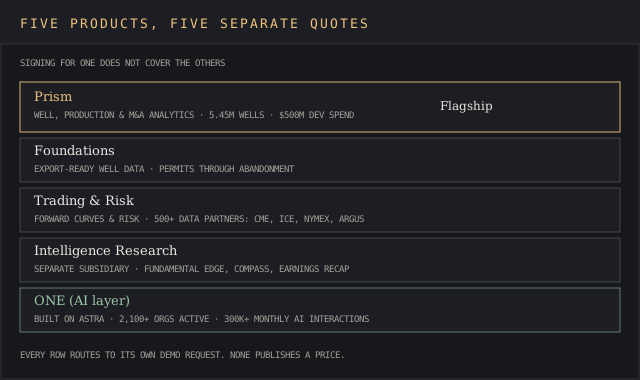
Enverus Prism is the flagship: a well, production, and asset analytics platform the vendor says has absorbed $500 million of development spend and tracks 5.45 million wells, marketed as a route to more efficient production and sharper capital allocation.

Source: Capterra's vendor-verified product screenshot gallery for Enverus.
Enverus Foundations sells the same underlying data (permits, rigs, drilled-but-uncompleted wells, production and revenue data, historical deal records), spanning a well's working life from permit through abandonment, in an analyst-curated, export-ready form for teams that want raw data over the dashboard.
Enverus Trading & Risk covers forward curves and risk workflows for trading desks, built on more than 500 data partners including CME, ICE, NYMEX, and Argus.

Source: SoftwareAdvice's vendor-verified product screenshot gallery for Enverus.
Enverus Intelligence Research operates as a separate subsidiary, Enverus Intelligence Research, Inc., publishing named reports on a schedule: Fundamental Edge monthly, Compass valuation updates and Earnings Recap quarterly, plus one-off M&A special reports. Every module's features sit behind the same demo-request wall as pricing.
Enverus ONE, the newest layer, is an AI execution tool built on the vendor's own model, Astra, marketed as a way to draw connections between well-level records and macro market moves.
Enverus's own product page credits the built-in AI with cutting the time analysts spend on tasks like land title verification. Enverus says 2,100-plus organizations now use it actively across 300,000-plus monthly AI interactions.
↑ FACT SHEETWhere the data comes from
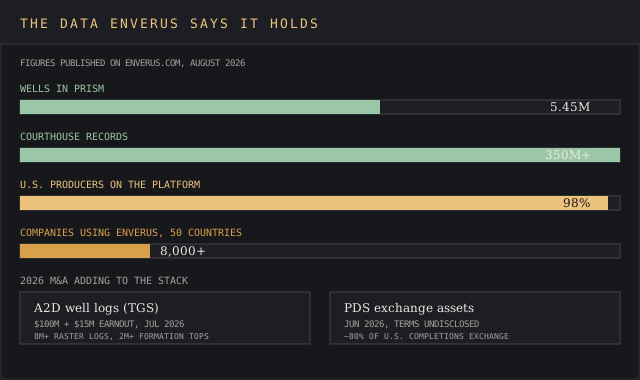
Enverus's data sourcing runs the slow way: courthouse filings, state regulatory records, and permit data, aggregated since the Drillinginfo years into a claimed 350 million-plus courthouse records. The company's own about page says that pipeline now connects to more than 98% of US producers, serving 8,000-plus companies in 50 countries.
Two 2026 acquisitions extend that base without replacing it. The A2D well log library, bought from TGS in July 2026 for $100 million plus a $15 million earnout, adds more than 8 million depth-calibrated raster logs and 2 million formation tops.
The PDS Energy Information exchange assets, bought the same June, plug Enverus into a supply-chain data-exchange network for completions and production the vendor estimates covers 80% of US activity across roughly 800 participants.
Buying data infrastructure at that pace is one way to keep a claimed coverage number current. The harder question is if the well-level output built on top of that infrastructure holds up once an analyst checks it against a state file, which the next section covers.
What the well-level QC complaints say
A working petroleum engineer on r/oilandgasworkers laid out the gap between Enverus's macro strength and its well-level detail in one thread. That's the part the vendor's own coverage numbers support.
"It's solid for a lot of macro stuff, especially lease-level trends, rig activity, M&A comps, etc."
A poster on r/oilandgasworkers, discussing Enverus's Permian well-level data, 2025.
The same poster was harsher on the QC side, describing how Enverus builds its well-by-well figures.
"A ton of their 'well-level' volumes are just allocated from lease-level data (sometimes not very well). When you QC the time series, it's obvious a lot of wells are smoothed, flatlined, or duplicated across pads."
A poster on r/oilandgasworkers, discussing Enverus's Permian well-level data, 2025.
The same thread's most direct reply named the alternative it drove the poster to: Novi Labs.
"They're not just rehashing public lease-level volume, they're pulling well-level data from proprietary operator-reported sources, so you actually get a clear picture of what's happening at the wellhead."
A reply on the same r/oilandgasworkers thread, comparing Enverus to Novi Labs, 2025.
Forecast accuracy draws a similar split: a self-described reservoir and asset-evaluation engineer on r/landman offered a qualified defense.
"Their forecasts are generally somewhat decent, but if they're making their own assumptions in regards to operating costs there could be significant disparities in how long that well economically produces."
A self-identified petroleum engineer, r/landman, on Enverus's production forecasts, 2025.
Another poster on the same thread put it flatter, naming a rival forecaster in the same breath.
"Don't trust any of the Enverus or IHS or any other company algorithms for anything of import. Most of the time they fail to even get basic production or completion info correct."
A poster on r/landman, replying in the same thread, 2025.
↑ FACT SHEETPricing and the tier that binds
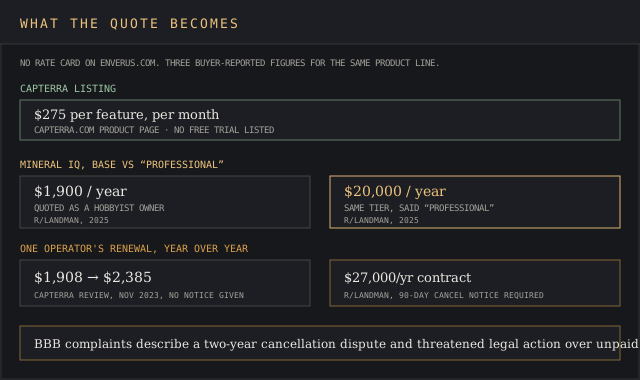
Enverus publishes no rate card. No product page carries a price list; each one ends in a demo request, so a buyer has to ask before learning what anything costs. Capterra lists a starting price of $275 per feature, per month, with no free trial offered. Beyond that entry point, every figure in this section comes from a buyer who paid it.
None of it comes from a page Enverus wrote.
The clearest example of what "per feature" pricing does in practice comes from r/landman.
"The lowest level version of mineral IQ costs $1,900 a year. But if you tell them you're a professional mineral manager, they will instantly bump that to 20K a year."
A poster on r/landman, thread titled "Enverus Drillinginfo cost," 2025.
The same thread's next reply named the reason a price comparison is hard to find in public.
"They have a 'no disclosure' policy on all price quotes so you won't likely find that feedback here."
A poster on the same r/landman thread, 2025.
Bundled contracts run larger. One buyer reported paying around $27,000 a year for Enverus, with a term worth reading before signing.
"We paid around 27k a year for Enverus but it depends on the add ons you get. Be wary of them as the contracts require 90 days notice to cancel and they will threaten lawsuits if you miss the deadline even by a day."
A poster on r/landman, same thread, 2025.
A Capterra reviewer's renewal moved from $1,908 to $2,385 year over year with no advance notice. In her own words: "they hide the price of the annual subscription till they send you the invoice."
Cancellation and the 90-day notice clause
The cancellation terms show up as a recurring complaint theme on the Better Business Bureau's Enverus profile, separate from the pricing complaints above. One buyer's experience with the clause turned into a two-year dispute.
"Enverus has a 90 notice to cancel, and they say you have to send an email which then leads to a phone call where they say everything is cancelled but it isn't."
Jake H., Better Business Bureau complaint against Enverus, January 2024.
A second BBB filing describes a billing dispute that outlasted a full quarter with no resolution on the first call.
"I noticed I was getting over-billed and reached out in April. Its now June and still no refund. Very annoying to have to do continual follow up."
Logan P., Better Business Bureau complaint against Enverus, June 2025.
A third buyer, writing to the BBB in July 2026, alleged Enverus's billing practice targets companies too small to litigate.
None of these filings prove a systemic policy. A complaint board selects for people who already had a bad outcome. What they do establish, consistently and across separate accounts, is that the 90-day written-notice clause is real, that buyers report it being enforced strictly, and that at least three separate customers describe a billing dispute that ran for months with no resolution on the first call.
↑ FACT SHEETCompany stability: four owners since 1999
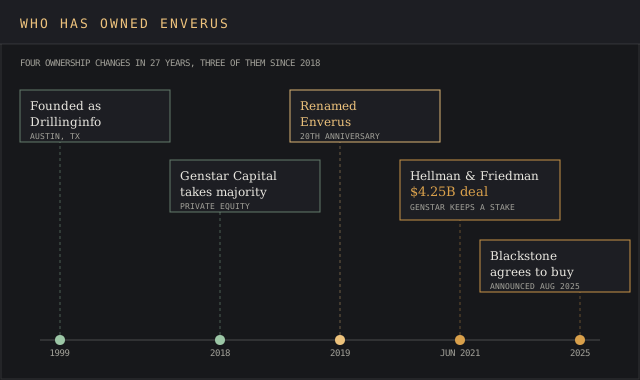
Enverus started in Austin, Texas, in 1999 as Drillinginfo. Genstar Capital took a majority stake in 2018, and the company renamed itself Enverus in August 2019, timed to its 20th anniversary and a reported crossing of $300 million in annual revenue.
That revenue growth funded the acquisitions that pushed Enverus beyond its original permit database.
Glassdoor's company overview puts Enverus at more than 1,500 employees, serving more than 5,000 energy companies and 300 financial institutions that use the platform for investment decisions, the same institutional buyer segment our financial data providers ranking covers.
Those figures come from Glassdoor's own listing. No Enverus press release states them.
The company also promotes itself as an employer. A 2026 Top Workplaces award from the Denver Post named Enverus one of the best places to work in Colorado.
Hellman & Friedman completed a $4.25 billion acquisition in June 2021, with Genstar retaining a minority stake. Blackstone announced a definitive agreement to acquire Enverus from those two owners in August 2025; the company's own site now describes itself as "backed by Blackstone."
Four ownership changes in twenty-seven years isn't unusual for a private-equity-backed data vendor. It matters here because the buyer signing a multi-year Enverus contract with a 90-day cancellation window is negotiating with a company whose owner has changed roughly once every seven years, most recently mid-contract for anyone who signed in 2024 or 2025.
What users complain about most
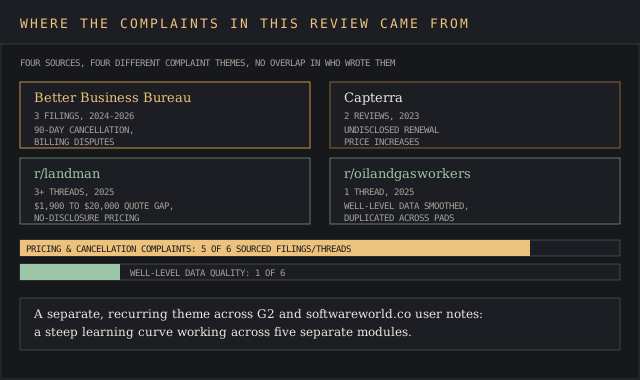
Pricing opacity and cancellation friction dominate the complaint record across Capterra reviews, r/landman, and the BBB, all sourced above. A separate, recurring theme sits alongside those: a steep learning curve for new users working across five separate modules, each with its own interface and its own login.
That's the same set of buyers who share a third complaint: well-level data quality, specifically smoothing and duplication that shows up once an analyst reconciles Enverus's numbers against a state production file.
One r/landman poster summarized the buyer's position bluntly: "Enverus is almost a monopoly." That's a claim about market position. This review treats it as the poster's opinion. The complaint record around pricing and cancellation is documented separately above, independent of how concentrated the market is.
What users praise most
The praise clusters around breadth, while precision is where the complaints above live. The same r/oilandgasworkers poster who flagged the well-level QC problems still called Enverus solid for macro work: lease-level trends, rig activity, M&A comps, and the acreage and deal opportunities Prism surfaces alongside the raw data.
That's a specific, qualified compliment: good at the aggregate and deal-comparison level, weaker at the individual well. Reviewers on separate platforms agree on that split even when they disagree on almost everything else.
"The program is so easy to use, and has the ability to work for so many different customers that we work with daily."
A verified G2 reviewer, Oil & Energy, mid-market company, June 2019.
That's a different product from Prism or Foundations, but it's the same vendor, and it's the clearest unqualified positive in the review record.
Power, renewables, and the energy-transition push
 wind assets, and 10,000-plus battery storage assets tracked on the platform." loading="lazy" style="width:100%;height:auto">
Enverus built its name on oil and gas, but the product line has expanded into power and renewable energy development, a segment covered more broadly in our energy industry guide. The vendor's power and renewables segment covers site selection, interconnection-queue analytics, and battery storage design.
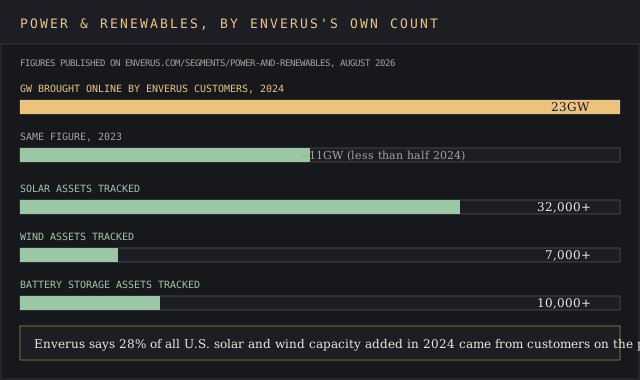
Enverus credits its customers with bringing 23 gigawatts online in 2024, more than double the 2023 figure by its own count. The same segment tracks 32,000-plus solar assets, 7,000-plus wind assets, and 10,000-plus battery storage assets, alongside a separate energy-transition line covering carbon capture, environmental, emissions, and regulatory analytics. A utilities line handles grid and distribution planning on top of that.
For a buyer weighing capital allocation across a mixed oil, gas, and renewables portfolio, that's the argument for treating Enverus as a single platform, sparing a buyer from stitching together separate vendors for each fuel type.
↑ FACT SHEETAlternatives to Enverus
Enverus competes on US well-level depth. Most of the alternatives below win on a different axis: global reach, macro research, or benchmark pricing. Parcel-level detail is where Enverus still leads, though a buyer can find a cheaper option straight from the same r/landman complaints: "Welldatabase.com is great for a lot of stuff, much cheaper alternative."
Energy Aspects is the closest match for a buyer who wants oil-market research and forecasting over well-level operational data. Founded in London in 2012, it sells analyst judgment on crude, products, and gas markets as research subscriptions and forecasts.
It loses to Enverus on US parcel and permit depth. It wins on macro crude-price and geopolitical forecasting, a layer where Energy Aspects sets the pace and Enverus's own research arm trails.
Rystad Energy, founded in Oslo in 2004, covers roughly 65,000 upstream assets worldwide through its UCube database, a global footprint spanning far more countries than Enverus currently tracks. A buyer running international portfolio comparisons should default to Rystad; a buyer working exclusively US shale gets more well-level depth from Enverus for the same budget.
Wood Mackenzie, now owned by Veritas Capital after a $3.1 billion deal completed in February 2023, sells multi-commodity coverage across oil, gas, power, metals, and chemicals inside one platform, Wood Mackenzie Lens. That breadth beats Enverus for a buyer tracking commodities beyond energy; Enverus still wins on US well-count depth and a courthouse-record layer that stays uniquely its own.
S&P Global Commodity Insights runs the benchmark price assessments the rest of the market prices against, including Platts Dated Brent, feeding roughly 1,300 exchange-traded contracts by the company's own count. One r/oilandgasworkers poster switched to it directly for well data.
"I have been using S&P global and get most of my well level data from their Enerdeq browser."
A poster on r/oilandgasworkers, in the same thread comparing Enverus to alternatives, 2025.
A buyer who needs a defensible price benchmark for a contract or a hedge should use S&P Global's assessments no matter which platform they buy for well data.
FAQ
What does Enverus sell?
Five separate products on five separate contracts: Enverus Prism (well, production, and M&A analytics), Enverus Foundations (export-ready well-lifecycle data), Enverus Trading & Risk (forward curves for trading desks), Enverus Intelligence Research (a research subsidiary), and Enverus ONE (an AI layer built on the vendor's Astra model).
How much does Enverus cost?
Enverus publishes no rate card. Capterra lists a starting price of $275 per feature, per month, with no free trial. Real contracts reported by buyers range from $1,908 a year for a single Mineral IQ seat to around $27,000 a year for a bundled package, in the same enterprise band our market intelligence platform pricing report tracks for vertical energy-data specialists.
Is Enverus's well-level data accurate?
Reports are mixed. Working analysts on r/oilandgasworkers rate Enverus highly for macro trends, rig activity, and M&A comps, but describe well-by-well volumes as often allocated from lease-level data and sometimes smoothed, flatlined, or duplicated across pads once checked against a state file.
Can you cancel an Enverus contract easily?
Contracts reported by buyers carry a 90-day written-notice cancellation clause. Better Business Bureau complaints describe the clause enforced strictly, including one dispute that ran for months, and a threat of legal action when a buyer missed the notice deadline.
Who owns Enverus?
Enverus started in Austin, Texas, in 1999 as Drillinginfo. Genstar Capital took a majority stake in 2018, and the company renamed itself Enverus in 2019. Hellman & Friedman completed a $4.25 billion acquisition in June 2021, and Blackstone announced a definitive agreement to acquire the company in August 2025.
What are the best Enverus alternatives?
Energy Aspects for macro crude and geopolitical forecasting, Rystad Energy for a global upstream footprint, Wood Mackenzie for multi-commodity coverage beyond oil and gas, and S&P Global Commodity Insights for benchmark price assessments. Enverus still leads on US well-level and parcel depth.
Bottom Line
Enverus is for an upstream operator, minerals manager, or energy-focused financial institution that needs US well-level and market data and has a procurement function able to negotiate contract terms before signing. That beats discovering the real cost when a $2,385 renewal invoice shows up unannounced.
It is not for an individual mineral owner or a small shop pricing a single Mineral IQ seat against a fixed budget. The same tier has reportedly moved from $1,900 to $20,000 depending on how the buyer describes their role, and the reported 90-day cancellation clause turns a bad-fit purchase into a longer commitment than the sales call implied.
It might suit a mid-size operator willing to accept the macro-strength, well-level-weakness tradeoff documented above, provided someone on staff reconciles Enverus's well output against state production filings before taking the platform's numbers on trust.