Energy market intelligence
 By Jan Suski. I go deep on every review, checking every number against its source and digging up details other coverage misses, a habit from six years of SEO and link building for tech companies. Bylines at Surfer, Brand24, and Senuto. How the scoring works.
· Prefer this source on Google
A policy memo, a weather front, and a factory outage can move the same price within a week. Making sense of that requires systematic data gathering, so procurement teams, investors, and utilities can read the energy markets and act before prices do. It improves the timing of energy procurement and cuts financial risk across oil, gas, power, and renewables.
This guide covers what market intelligence in energy monitors, the size of the renewable energy market, the role of energy storage, how FEOC policy is reshaping the supply chain, and the providers that turn energy data into decisions. The idea: market intelligence lets you see the energy transition coming early enough to act on it.
What energy intelligence monitors
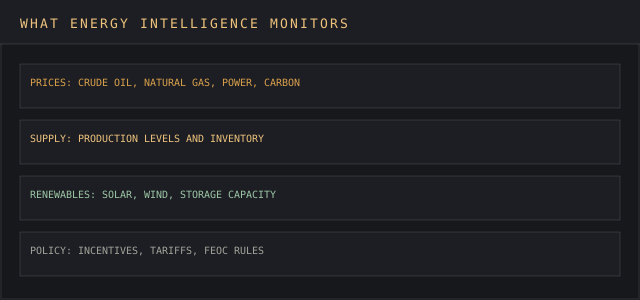
At the commodity level, market analysis means monitoring crude oil, natural gas, electricity, and carbon prices, connecting those moves to the physical market behind them. Analysts track energy production and inventory to gauge supply and demand, because a gas storage draw or a refinery outage shows up in prices before it reaches a headline.
The U.S. Energy Information Administration provides free datasets and historical statistics, giving every analyst a common baseline.
The edge comes from analytics on the data. Energy suppliers use analytics to forecast prices and time their trades, and procurers analyze historic pricing to secure long-term contracts with utilities. That is the core loop: raw data in, priced risk out, refreshed as markets move. Governments run the same loop for energy security and climate policy design.
Prices are only half the picture. The other half is the structural shift underway across the energy markets, where renewables, storage, and electrification rewrite demand faster than forecasts assumed, and rising energy demand from new sources strains the grid.
The renewable energy market by the numbers
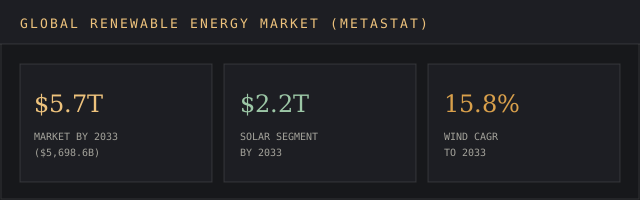
The shift's scale draws capital. The global renewable energy market is projected to reach $5,698.6 billion by 2033, according to Metastat Insight, and North America held 17.4% of the renewable energy market in 2025. Those numbers explain why infrastructure funds and utilities are focusing on renewables the way they once focused on pipelines.
Solar leads. Solar energy is the largest contributor to global renewable growth, and the solar segment is projected to reach $2,198.9 billion by 2033. Wind is close behind: the wind segment is expected to grow 15.8% annually until 2033, and wind energy held 28.93% of market share in 2025. Declining solar panel costs keep improving adoption, and government investments are accelerating renewable deployment worldwide.
The counterweight is the grid. Grid infrastructure limitations challenge renewable energy integration, so more solar and wind capacity only helps if the network can absorb it. That is exactly why analysis of the renewables market has to run alongside power-system data.
Energy storage and the technology stack
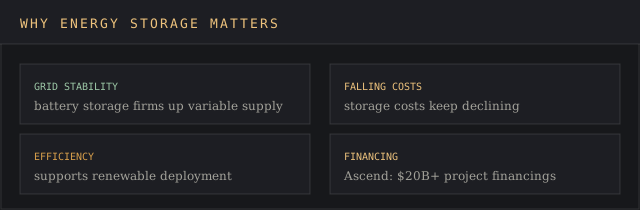
Energy storage is the technology that makes variable renewables dependable. Battery storage improves grid stability and power reliability, and falling battery storage costs widen where storage makes economic sense. Energy storage supports renewable deployment and efficiency by shifting solar output from midday to evening peak, so a solar-plus-storage project earns more than solar alone.
The technology map is wider than batteries: solar and wind deployment, geothermal, green hydrogen projects, and the grid upgrades behind electric vehicles. Data centers are a new driver, pulling forward projects that sit years out, and tracking these emerging technologies shows which bets pay off in the coming years.
Financing follows the analysis. Ascend Analytics supports over $20 billion in renewable project financings and has assessed over 200 GWs of project valuations, since project-level analysis is what moves money in this market. Energy Aspects delivers real-time intelligence across global energy markets, updated continuously.
FEOC policy and the solar supply chain
Policy has become a first-order market signal. The Inflation Reduction Act turned clean energy incentives into the backbone of U.S. project economics, and later law, the One Big Beautiful Bill Act, rewired those credits and tightened the rules on foreign content. The result is a rapidly evolving set of rules where a project's returns can hinge on which factory made its modules.
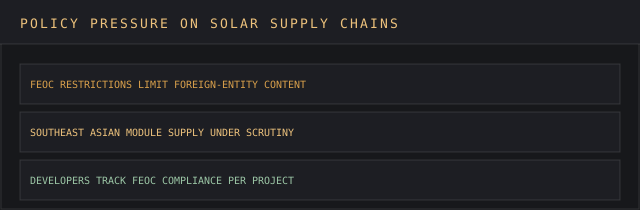
That is where Foreign Entity of Concern rules bite. FEOC restrictions limit how much foreign-entity content a project can carry and still claim credits, and FEOC compliance now shapes procurement for every U.S. solar and storage developer. Because much module and cell manufacturing sits in Southeast Asian countries, the FEOC rules push developers to trace supply chains component by component.
Intertek CEA provides actionable intelligence for solar PV and energy storage aimed squarely at this problem, and its analysis shows how FEOC restrictions impact U.S. solar supply chains in practice.
Geopolitical forces are complicating energy procurement. A supply chain built for lowest cost is now judged on origin, resilience, and FEOC compliance at once, and reshoring manufacturing is part of the answer. Reading that supply chain, and the growing concerns around a single foreign entity dominating a component, is now core to energy analysis.
Regional and Global Demand Signals
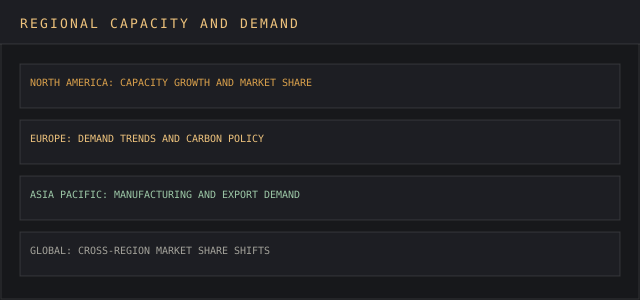
Global renewables growth is not one story; it is a market of regions, each generating its own insights. Asia Pacific adds the most capacity from a lower base, while North America and Europe replace aging plants and meet new load from data centers at the same time. A single global growth figure hides which markets reward capital this decade, and market intelligence that stops at the global total misses the industry trends underneath it.
Regional insights compound with company insights. Capital tracks manufacturing access, grid interconnection, and policy content rules as closely as demand, because a renewables project with the best technology in the wrong region still stalls. Investments in clean energy keep expanding even where a single market cools, and public policy can accelerate or slow a market's build-out overnight.
The future belongs to teams focusing analysis on regional insights and industry trends together over the global number alone.
Capital, Manufacturing, and the FEOC Overlay
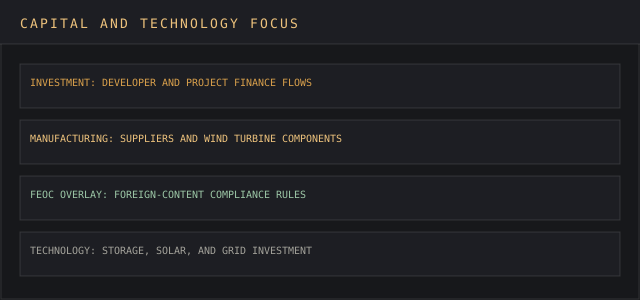
Capital follows the growth. Infrastructure funds, utilities, and independent power producers expand investments across solar, wind, and storage combined, and investor interest in grid-scale batteries has accelerated as costs keep falling. Developers and equipment suppliers compete on the same axis now: depth of technology and manufacturing capacity behind a bid, well past price.
Energy storage news now moves energy markets the way oil inventory reports once did alone, because storage capacity increasingly decides if a region's renewables displace gas at the margin.
The challenges are not disappearing, and rapidly evolving regulations reward teams that track them as closely as the growth numbers: permitting timelines, interconnection queues, and the FEOC rules covered above all sit between a strong market forecast and a project that gets built. Energy markets and energy storage data feed the same insights pipeline, and renewables forecasts built without both are guesswork dressed as analysis.
The market intelligence that holds up combines demand, technology, and policy insights with a realistic read on the barriers, because in energy the gap between a good market and a built project is where most of the value gets lost or captured.
Companies that can show clients a full range of options, generation, storage, and grid services combined, win contracts that single-technology suppliers and developers lose alone. Wind turbines, solar panels, and battery technology are converging on shared sites, which lifts efficiency and value for investors focusing capital on fewer, stronger developers.
Investing in manufacturing access matters as much as investing in generation, and investing early in a region often decides who wins the interest of regulators and clients once shifts in policy narrow who qualifies. Across regions, power markets, technology cost curves, and renewables access decide who profits from the world's fastest energy transition.
Who Uses Market Intelligence in Energy
The same data serves different seats:
- Utilities and grid operators. They match generation to demand and plan capacity years ahead, so power-system and weather data drive the analysis.
- Independent power producers and project developers. They live on project economics: interconnection queues, capacity prices, and foreign-content rules decide if a project pencils.
- Investors and infrastructure funds. They screen sectors to maximize returns, weighting renewables and grid assets by risk and value.
- Traders and suppliers. They price crude oil, gas, and power daily to hedge and time long-term contracts.
- Governments. They use it for energy security and climate policy, balancing affordability while renewables reshape energy markets and market insights guide budgets.
Across every seat, the winners treat energy data as a decision input and no report to file, refreshed on the cadence the market moves.
More energy companies now publish their own market reports, and each report adds industry insights worth cross-checking against renewables trends, clean energy investment, access data, and interest across regions before trusting any single market. The renewable energy market keeps expanding as renewables reshape energy markets worldwide, and the insights from tracking every market matter as much as the numbers.
The value compounds: better market coverage, sharper future forecasts, power and efficiency analysis, and market intelligence reflecting the world's actual technology assumptions, is what separates companies with real insight from those repeating someone else's report. Companies that skip the cross-check pay for it in mistimed capital.
Providers that supply energy data and reports
No single source covers the whole market; most teams combine several depending on which corner of the energy markets they work in.
| Provider | Focus | What it delivers |
|---|---|---|
| U.S. EIA | Public energy data | Free datasets, historical statistics, production and inventory reports |
| Energy Aspects | Oil, gas, and power markets | Real-time analysis and market reports across global energy markets |
| Intertek CEA | Solar PV and storage | Actionable intelligence, quality data, and FEOC supply chain analysis |
| Ascend Analytics | Renewables project valuation | Forecasts behind $20B+ in project financings |
| Wood Mackenzie | Cross-sector energy research | Market reports, forecasts, and technology analysis |
Judge a provider on three things: the depth and range of its data, how current its reports are, and if the analysis turns into decisions your team can act on across the market. Industry experts and clients agree a late report is a history lesson.
Turning energy data into decisions
Buying a data feed is the easy part; building a capability is the work. Start by defining the questions that matter, say next quarter's gas price, a solar project's FEOC exposure, or where storage demand is heading. Connect the energy data that answers them, give analysts access to it in one place, and pair public sources like the EIA with proprietary analysis for depth.
Then wire the strategic insights into real decisions. Measure the capability by the value it creates: better contract timing, projects that clear FEOC rules, and capital aimed at the technologies with the strongest growth. The teams that get this right expand their edge every cycle, entering the future a step ahead of slower rivals.
The bottom line for any market intelligence program in energy: track global capacity and renewables growth alongside company and policy detail, because industry-wide trends and regional access rules move together. Investments in renewable energy markets keep expanding, and both government and private capital accelerate deployment when policy provides certainty.
Power markets and renewables data reward teams focusing on the analysis behind the number over the number alone, and the insights that predict where energy markets head next usually come from combining all of it. The future favors the market intelligence team that can move as fast as the market itself.
That combined view is what separates a global industry snapshot from a working forecast. Renewables analysts who track manufacturing access alongside demand get ahead of shifts the headline renewable energy numbers miss, and the insights compound: better access to primary data, sharper industry benchmarks, and market intelligence that keeps pace with a market moving this fast, worldwide and by region.
FAQ
Which country is almost 100% run on renewable energy?
Iceland runs close to 100% renewable electricity on geothermal and hydro power, and Norway sits near the same level. Both show what local resources plus grid capacity can do, though most countries rely on a mix of solar, wind, storage, and gas.
What is the cheapest source of electricity?
In most of the world, new utility-scale solar and onshore wind are the lowest-cost sources of new electricity, part of why the renewables market keeps expanding. Cost still depends on location, access, and financing, so the cheapest source on paper is not always the cheapest delivered to the meter.
Does Tesla build renewable energy products?
Yes. Tesla, led by Elon Musk, builds electric vehicles alongside solar and battery storage products, so its business sits at the intersection of transportation and clean energy. That mix, transport, generation, and storage, is exactly what market intelligence in energy tracks across the industry.
What is the $48 trillion energy revolution?
The phrase points to long-run estimates, from agencies such as the International Energy Agency, of the tens of trillions the global energy system needs over coming decades. Whatever the exact figure, capital at that scale rewards teams that can tell a durable trend from a passing one.