Oil and Gas Market Intelligence: Data, Tools, and Decisions for a New Era
 By Jan Suski. I go deep on every review, checking every number against its source and digging up details other coverage misses, a habit from six years of SEO and link building for tech companies. Bylines at Surfer, Brand24, and Senuto. How the scoring works.
· Prefer this source on Google
Oil and gas market intelligence involves tracking commodity supply and demand balances, production trends, projects, and prices across the entire energy supply chain. Companies use oil and gas market intelligence to make informed business decisions, where to invest capital, when to hedge, which assets to acquire, and how to gain an edge over competitors across the globe.
The industry is entering a new era: geopolitical developments can impact energy markets, investment in cleaner technologies is accelerating, and decision makers need energy market analysis that arrives in real time.
Best oil and gas market intelligence tools
| Rank | Tool | Best fit | Signals | Watch-outs | Review |
|---|---|---|---|---|---|
| 1 | Enverus | Energy market, asset, and operator intelligence | Asset, operator, trading, production, and market data | Broad platform; scope modules to workflow | Enverus review |
| 2 | Energy Aspects | Real-time global energy market intelligence | Supply-demand balances, forecasts, geopolitical analysis | Research-led; analyst access drives value | Energy Aspects review |
| 3 | Wood Mackenzie | Upstream research and long-horizon analysis | Asset valuations, supply forecasts, transition scenarios | Premium research pricing | Wood Mackenzie review |
| 4 | East Daley Analytics | Midstream and asset-level benchmarking | Proprietary datasets, capital projects, asset data | Midstream-centric; North America strongest | East Daley Analytics review |
Tool profiles
Enverus
Best for: energy teams that need asset, operator, production, trading, and market intelligence in one platform. Why it fits: oil and gas decisions often depend on linking subsurface, commercial, and market context. Buyer check: scope the modules carefully so the platform matches the exact workflow.
Energy Aspects
Best for: real-time energy market analysis and supply-demand balances. Why it fits: traders and market teams need current analyst views, forecasts, and geopolitical context. Buyer check: assess analyst access, update cadence, and fit by commodity desk.
Wood Mackenzie
Best for: long-horizon upstream research, asset valuation, and energy transition scenarios. Why it fits: strategy and investment teams need defensible research for assets, markets, and supply outlooks. Buyer check: confirm which regional datasets and analyst research packages are included.
East Daley Analytics
Best for: midstream infrastructure and asset-level benchmarking. Why it fits: pipeline, processing, and capital-project decisions need granular midstream data. Buyer check: validate coverage if your assets sit outside its strongest North American focus.
How oil and gas teams should choose
Choose Enverus for asset and operator depth, Energy Aspects for real-time market balances, Wood Mackenzie for long-horizon research, and East Daley for midstream benchmarking.
What Oil & Gas Market Intelligence Covers
Supply and demand balances
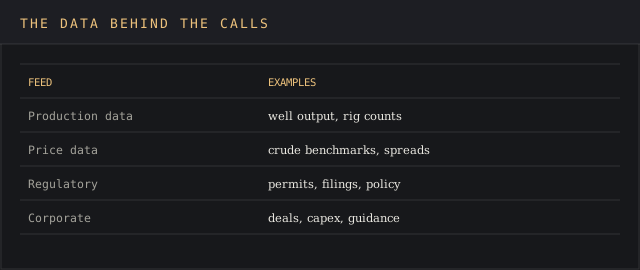
Market intelligence starts with global supply and demand insights, available by region and country, from crude oil production in North and South America to natural gas exports from the U.S. and demand growth across Asia and Europe.
Production and extraction trends
Professionals monitor production trends to forecast prices, plan investments, and feed the market intelligence process, the core of oil and gas production intelligence. Upstream extraction data, downstream refining runs, and natural gas liquids output all feed the market picture.
Inventories
Tracking inventories helps interpret market balance and can signal oversupply or tightening markets, often before prices move.
Projects and capital spending
Analysts track global oil & gas project announcements by company or geography, and monitor capital projects with data on investments and schedules. Access detailed asset data for LNG terminals and gas processing plants, and identify high-value assets for M&A opportunities and due diligence.
Emissions and regulation
Companies use intelligence tools to monitor emissions and align with regulations set by governments around the world, a growing driver of strategic decisions.
The Data Behind the Insights
Proprietary data at depth
Over 290 proprietary datasets cover the oil & gas market, spanning upstream and midstream activity across global fields. That depth of proprietary data is what separates market intelligence from public reports.
Dashboards and real-time tools
Key data tools for oil professionals include dynamic dashboards and production databases. Dynamic data dashboards enable faster decision-making with real-time data, and real-time analytics cuts waste out of logistics and inventory management.
AI and advanced analytics
Digital transformation in oil & gas includes advanced analytics, machine learning, and IoT. AI tools improve predictive analytics in data analysis platforms, and predictions of market conditions are made using advanced modeling and scenario analysis that turn raw feeds into insights. Technological advancements improve efficiency and safety in operations, too.
Online access, up to date
Modern platforms deliver insights online with continuous updates, analysts stay up to date through alerts, reports, and webinars.
Why It Pays: Better Decisions Across the Business
Price volatility and hedging
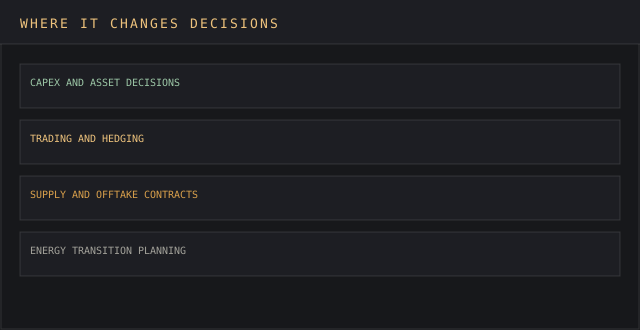
Oil and gas market intelligence aids in mitigating price volatility and forecasting profitability. Hedging strategies are informed by market intelligence to manage volatility with confidence.
Investment decisions
Market intelligence supports investment decisions by combining forecasts and regulatory developments. It combines operational, economic, geopolitical, and technological insights into one view of the energy market.
Competitive edge
Companies use competitive benchmarking to analyze performance against industry peers, over 290 proprietary datasets are used for competitive benchmarking alone. Benchmarking insights help companies stabilize strategies and seize opportunities before competitors do, and sales teams use the same intelligence to time offers to market demand.
Integration across the value chain
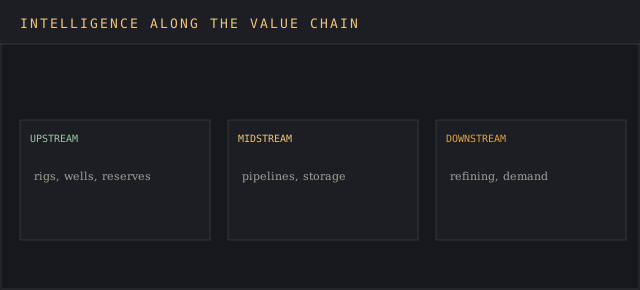
Effective market intelligence integrates data from the entire energy value chain, upstream, midstream, downstream, so strategic decisions in one part of the chain account for what's happening elsewhere in the chain.
Platforms and Services
Enverus
The broadest energy intelligence platform for asset, operator, trading, and production data. See our Enverus review for depth by workflow.
Energy Aspects
Energy Aspects provides real-time intelligence across global energy markets, serving analysts and energy decision-makers with supply-demand balances and geopolitical analysis.
East Daley Analytics
East Daley offers tailored insights for the oil & gas market and provides custom benchmarking reports for oil & gas companies, strongest in midstream.
IIR Energy
IIR's platform offers a 360 degrees view of global oil & gas production and tracks production assets continuously, a database built for project tracking.
Consulting services
Consulting services help manage the complexities of the oil market when in-house analysts need reinforcement; most vendors let you explore the platform and request a demo first, so the business can gain insights before committing.
Systems, Services, and Solutions
Market intelligence solutions in this industry come in three layers. Data systems give analysts access to reliable, up-to-date databases and dashboards, with API access for internal models. Managed services add analyst support, reports, webinars, and briefings for teams for teams with limited in-house industry depth. Integrated solutions combine both, connecting intelligence systems to planning tools so insights reach decision makers across the business.
Whichever layer a company buys, the test is the same: does it help you explore the market with confidence and gain a reliable edge over the industry's slower movers? The best vendors in the world earn their fees by turning data into resources analysts use daily, and the best solutions disappear into the workflow.
2025-2026 Trends in Brief
Natural gas rebounds
Natural gas producers plan to reverse cutbacks in 2025, and investment in natural gas processing will stay solid in the U.S.
Oil spending holds steady
Oil spending is projected to remain stable due to consistent demand, and overall oil & gas investment levels are expected to remain steady.
LNG leads capital
Capital spending will be led by liquefied natural gas (LNG), and LNG export terminals are reshaping upstream priorities globally, a growth story that spans countries on every continent.
How to Choose a Platform
Match the platform to the decisions you make: trading desks need real-time market data and balances; corporate development teams need asset and project databases; midstream operators need benchmarking services. Whatever the workflow, insist on three things: data depth in your region, transparent methodology, and delivery formats your analysts will use, dashboards for daily work, reports for the business, and alerts for the moments that matter.
The payoff is consistent across the industry: companies that treat oil and gas market intelligence as core infrastructure make better decisions, act with more confidence, and unlock value that competitors relying on lagging public data miss. In energy markets, the gap between success and the rest is usually measured in weeks of foresight, and market intelligence is how you buy them.