Messaging Framework Template
 By Jan Suski. I go deep on every review, checking every number against its source and digging up details other coverage misses, a habit from six years of SEO and link building for tech companies. Bylines at Surfer, Brand24, and Senuto. How the scoring works.
· Prefer this source on Google
A messaging framework serves as a central blueprint to keep all outward communication clear and aligned: the same value proposition, the same proof points, the same pain points named the same way, say a prospect hears it from a sales rep, reads it on the website, or sees it in a press release.
Without one, marketing teams, sales teams, and PR teams each end up describing the product in their own words, and a prospect who talks to two people at the same company hears two different pitches.
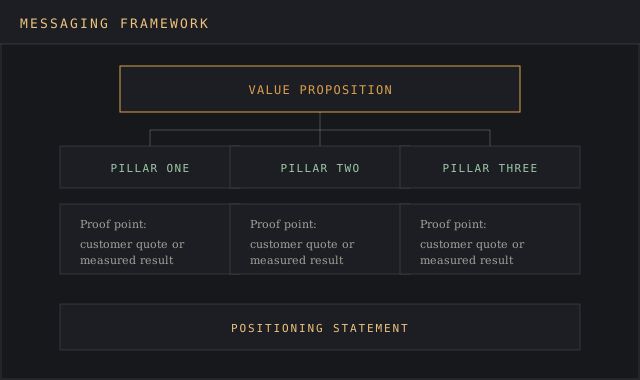
This messaging framework template lays out the core components, value proposition, messaging pillars, proof points, and a positioning statement, in one living document. That document replaces the scattered mess of old marketing campaigns and internal teams' private notes.
Download the Free Messaging Framework Template
Download the messaging framework template (DOCX)Sections for the value proposition, three to five messaging pillars with proof points attached, buyer personas, and a positioning statement, plus a worked example filled in.
What Is a Messaging Framework?
A messaging framework is a structured guide for brand communication, the reference every team pulls from before writing a headline, a sales deck, or a press release. Core components of a messaging framework include target audience profiles, unique value propositions, and brand pillars, defined once and reused everywhere.
A strong messaging framework improves marketing effectiveness and supports sales teams directly: a sales rep working from the same key messages as the marketing campaigns a prospect already saw doesn't have to rebuild trust in the first five minutes of a call.
75% of customers view personalized offers positively, according to product marketing research. A messaging framework is what makes that kind of personalization possible at scale, since messaging pillars built once can be adapted per audience segment without starting from a blank page each time.
Core Components of a Messaging Framework
Most working messaging frameworks are built from the following components:
- A core value proposition
- Three to five messaging pillars
- Supporting proof points for each pillar
- Brand identity guidance covering voice and tone
Value Proposition
The value proposition is the single sentence a company would say first if it only got one sentence: what the product delivers, for whom, and why that matters more than the status quo. An effective value proposition survives being read by someone with no context and still makes sense.
Messaging Pillars
Messaging pillars support the main message with key benefits, typically three to five, each backed by a differentiated argument for why it matters. A messaging pillar without a proof point is a claim; add the proof point and it becomes something a sales rep can use in a live sales cycle.
Proof Points
Proof points validate messaging through testimonials or statistics, evidence a skeptical buyer can check. A messaging pillar claiming faster onboarding needs a proof point: a customer quote, a measured time-to-value number, something concrete enough that a prospect's own procurement team could verify it.
Brand Identity and Voice
Brand identity and voice guidelines round out the framework, covering tone, vocabulary, and the style choices that make brand messaging sound like one company.
Building a Messaging Framework: The Process
Step 1: Customer Interviews
Ground the messaging framework in customer interviews and customer feedback. Internal assumptions about what the target audience wants to hear are the failure mode. Run these interviews before marketing writes a single line of the framework; a version built entirely from internal opinion tends to describe what the company wants to say. What makes a buyer say yes is a different sentence.
Step 2: Drafting the Value Proposition
Draft the core value proposition first. Every messaging pillar written afterward should trace back to it.
Step 3: Building Messaging Pillars
Build three to five messaging pillars, each with at least one proof point already attached.
Step 4: Writing the Positioning Statement
Write a positioning statement that connects the value proposition to a named target audience and a named market conditions context.
Step 5: Testing the Draft
Test the draft with sales reps and a handful of potential customers before treating it as final. A messaging framework nobody outside marketing has read yet is still a draft.
The Elevator Pitch: Distilling the Framework
An elevator pitch takes the entire messaging framework and compresses it into what a person could say in the time it takes an elevator to reach the next floor: the target audience, the core value proposition, and the one proof point that would matter most to that audience.
Writing the elevator pitch last, after the full messaging framework already exists, produces a tighter result than writing it first. The compression forces a choice about which messaging pillar matters most, a decision easier to make once every pillar and proof point is already on the page in front of the person writing it.
The Value Proposition Canvas
The Value Proposition Canvas aligns product value with customer needs by mapping customer jobs, pains, and gains on one side against the product's pain relievers and gain creators on the other. Where the two sides overlap is the core value proposition a messaging framework should lead with.
Teams that skip the proposition canvas step often write a value proposition based on what the product does. A value proposition should describe what customer jobs it completes, a subtle difference that shows up later as messaging that impresses internal teams but doesn't move a buyer who's focused on their own job title and quota. The product's feature list is your problem to solve, and no buyer's.
The Messaging Matrix: Organizing by Audience and Product
The Messaging Matrix organizes messages by audience segment and product, a grid a team builds once a company sells multiple products to more than one target audience. Rows hold each audience; columns hold each product or each stage of the sales cycle, so feature level messaging never gets mixed up with the high level positioning meant for a first conversation.
A messaging matrix earns its place once product marketing has to keep three or four buyer personas straight at once, each caring about a different pain point and each needing key messages phrased in the same language that persona already uses internally. The vendor's own jargon lands nowhere.
Buyer Personas and Pain Points
A messaging framework should name the target audience directly, and buyer personas are how most product marketing teams do it: a named role, a job title, the pain points that role owns, and the language that role uses to describe those pain points in their own words.
Pain points differ across buyer personas even inside the same deal. A buyer persona in finance cares about cost and risk; a buyer persona in operations cares about disruption during rollout; a messaging framework that only speaks to one misses the internal teams that have to say yes together before a deal closes.
Brand Messaging vs Product Messaging
Brand messaging operates at the company level: why the company exists, what it stands for, the promise that holds across every product it sells. Product messaging operates one level down, specific to what a single product or feature delivers, and it should always trace back to the brand messaging above it.
A company with multiple products needs both layers written down separately. Product messaging changes every product launch; brand messaging should barely move at all, since it's what gives customers a consistent message to recognize across a product roadmap that keeps expanding.
Product marketing usually owns product messaging day to day, while brand or corporate marketing owns brand messaging and defends it against drift when a product team wants to bend the brand voice to fit one feature launch.
Testing and Updating the Messaging Framework
Testing messaging with customers confirms it resonates and drives real action on buyer calls. Run the draft past a handful of potential customers and sales reps working live deals; both groups will surface a gap between what sounds good in a slide and what a buyer asks about on a call.
A messaging framework is a living document. Printed once and left on a wall, it stops being one. Update it whenever market conditions shift, a competitor changes its own positioning statement, or customer feedback repeatedly surfaces a pain point the current framework doesn't name. Building in a feedback loop, a standing channel where sales reps flag when a message stops landing, keeps updates tied to real conversations.
Rolling the Framework Out Across Teams
A finished messaging framework does nothing sitting in a shared drive nobody opens. Marketing teams should brief sales teams and PR teams directly, walking through each messaging pillar and its proof points forwarding a link alone won't align teams.
Ensure alignment by making the messaging framework the single source that content marketing, content strategy, and campaign briefs all pull from. When a sales rep, a PR team member, and a marketing writer can each recite the same core value proposition using the same language, the messaging framework has done its job; when they can't, the gap almost always traces back to a rollout that skipped the walkthrough and went straight to a shared folder.
Narrative Frameworks and Why Change Now
A messaging framework needs a narrative that answers why change now. Narrative frameworks like StoryBrand position the customer as the hero and the company as the guide, a structure that turns a static list of core messaging points into an argument a prospect can follow from problem to resolution.
The first sentence of any piece built from the framework carries the most weight: it has to communicate the core value proposition and the reason a business should care today. A first sentence that opens with a feature loses a reader before the second sentence gets a chance. The why-change-now case has to come first.
Good messaging built on a real narrative framework communicates urgency without resorting to hype: the why-change-now argument should point to a real cost of the status quo, a real business consequence of waiting. A vague sense that everyone else is already moving persuades nobody.
Getting Internal Teams on the Same Page
A messaging framework's real test is if marketing, sales, and product stay on the same page once three different writers start using it independently. The building blocks, value proposition, messaging pillars, proof points, only work if every team pulls from the same version. Stale copies undermine alignment.
Rolling out a messaging framework is a disciplined exercise. A one-time email is not a rollout. Walk each team through the key points in person, show how to create content from the framework, and confirm marketing channels and different channels, paid social, email, in-product messaging, are all pulling the same core messaging before a campaign goes live.
Marketing efforts that skip this step tend to drift within a quarter: one channel's copywriter reads the framework once, another never reads it at all, and the customers understand the resulting mismatch as a company that doesn't know its own message.
Product Messaging Across Sales Cycles
Product messaging has to hold up across an entire sales cycle, well past the first pitch. Different stages of a sales cycle call for different depth: the elevator pitch works in the first conversation, but a technical buyer three calls later needs feature level messaging with real proof points behind it.
Long sales cycles are where a strong messaging framework earns its cost. A sales rep working a six-month enterprise deal needs core messaging that stays consistent from the first call through the final contract review, since a prospect who catches the story changing mid-cycle starts questioning everything else in the pitch too.
Press releases, product launches, and quarterly business reviews all draw from the same product messaging bank, which is why a business that documents it once in a shared messaging framework moves faster than one reinventing the pitch for every new asset a growing business needs.
Common Messaging Framework Mistakes
Mistake 1: Internal Opinion
Writing the messaging framework from internal opinion, skipping customer interviews entirely, is the most common failure marketing teams make. A framework built in a conference room describes how the company wants to be seen. How customers talk about the problem it solves is learned elsewhere.
Mistake 2: Too Many Pillars
Building too many messaging pillars is the second failure. Effective messaging frameworks build around a small number of pillars; stretch past five and sales reps stop being able to recall which pillar matters for which conversation.
Mistake 3: Treating as Finished
Treating the framework as finished the day it ships is the third failure. A messaging framework aligns marketing, sales, and internal teams around a shared story only as long as someone keeps that story current against real market conditions, real customer feedback, and what customers say after they've bought.
A Worked Example
A B2B software company selling a scheduling tool starts its messaging framework with customer interviews across ten existing accounts, surfacing one recurring pain point: managers spend hours each week manually reconciling conflicting calendar requests.
The core value proposition becomes "cut weekly scheduling admin from four hours to twenty minutes." Three messaging pillars follow: automatic conflict detection, one-click approval routing, and a manager dashboard, each with a proof point pulled directly from a customer interview.
Product marketing builds a messaging matrix splitting the pillars by two buyer personas, operations managers who care about the dashboard, and individual contributors who care about approval speed, then briefs sales teams and PR teams before the next product launch.
Keeping Customers at the Center of the Framework
Every messaging framework decision should trace back to customers. What marketing finds easiest to produce is a separate question. Customers don't read a company's internal org chart before deciding if a pitch makes sense; they judge the message against their own problem, so a framework built around customers' language outperforms one built around a company's product roadmap.
Marketing teams that survey customers directly catch gaps a purely internal review misses. Customers describe pain points in specific, sometimes surprising language, and the closer a brand's core messaging matches how customers talk, the less translation work a sales rep has to do live on a call.
Brand consistency matters to customers even when they can't articulate why. A brand that sounds like three different companies across its website, its marketing campaigns, and its sales deck reads as disorganized to customers, even when the underlying business is executing well. Marketing campaigns that repeat the same brand voice across every touchpoint build trust with customers faster than campaigns that treat each channel as its own brand.
Communicate the same brand promise everywhere customers encounter the business, and customers start to trust the brand as a whole. That consistency, repeated across every campaign a marketing team runs, is what turns a documented messaging framework into a brand customers recognize.
FAQ
What are the 4 types of message?
Brand messaging, product messaging, sales messaging, and internal messaging, each aimed at a different audience but all tracing back to the same core value proposition so the company presents one consistent message across every channel.
What are the pillars of a messaging framework?
Three to five messaging pillars, each a key benefit backed by at least one proof point, sit underneath a single core value proposition that ties every pillar back to why the product matters to its target audience.
Is Kafka a messaging framework?
No. Apache Kafka is a distributed event-streaming platform used for passing data messages between software systems, an unrelated technical use of the word "messaging" from the marketing and brand messaging framework this guide covers.
How do you write a messaging framework?
Start with customer interviews, draft a core value proposition, build three to five messaging pillars with proof points attached, write a positioning statement, and test the draft with sales reps and real customers before rolling it out to internal teams.
Bottom Line
A messaging framework earns its place the same way any market intelligence template does: by giving marketing, sales, and product one shared language. The three teams stop working from three separate ones. Ground it in real customer interviews, keep the pillars few and proof-backed, and treat it as a living document that gets updated whenever the market or the customer feedback says it should.