Product Launch Checklist Template
 By Jan Suski. I go deep on every review, checking every number against its source and digging up details other coverage misses, a habit from six years of SEO and link building for tech companies. Bylines at Surfer, Brand24, and Senuto. How the scoring works.
· Prefer this source on Google
A product launch checklist bridges the gap between product development and marketing execution, giving product teams, marketing teams, and sales teams one shared list. Three separate versions that quietly disagree stop being a problem. This product launch checklist template covers pre-launch planning, launch day, and post-launch analysis in one document.
A strong product launch checklist covers the entire lifecycle of the launch, and the day the product goes live is one line in it. It works alongside a market analysis template and a competitive analysis template, feeding the same market intelligence practice this site covers throughout.
Download the Free Product Launch Checklist Template
Download the product launch checklist template (DOCX)Four phases, each broken into owned tasks with a status column, plus a worked example filled in for a B2B software launch.
The document imports cleanly into Google Docs for shared editing across product, marketing, and sales.
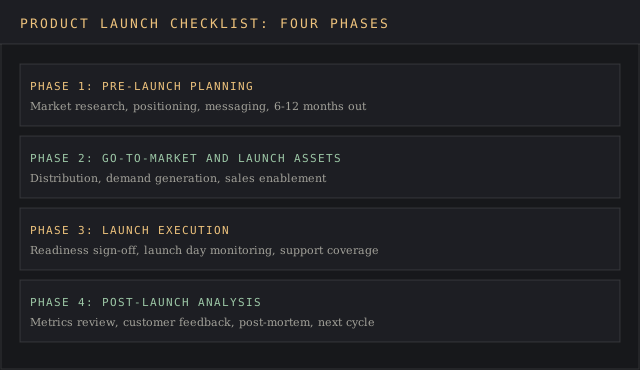
What Is a Product Launch Checklist?
A product launch checklist is the working document that turns a launch date into a sequence of owned tasks: market research, positioning, sales enablement, launch assets, and the metrics that confirm if the launch worked. Key elements of a product launch checklist include market strategy and operational readiness, covering both what customers see and what has to work behind the scenes.
Three main phases of a successful product launch are pre-launch validation, launch execution, and post-launch growth, and the checklist below follows that same order.
A Pre-Launch Preparation Timeline
Pre launch preparation works best as a countdown, since a successful product launch depends on sequencing: positioning has to exist before sales enablement, and sales enablement has to exist before the target audience sees a single ad.
| Timing | Focus | Who prepares |
|---|---|---|
| 9-12 months out | Market research, go to market strategy draft | Product, product marketing |
| 6-9 months out | Positioning, marketing strategy, pricing | Product marketing, finance |
| 3-6 months out | Marketing campaigns built, landing page drafted | Marketing |
| 1-3 months out | Prepare sales teams, finalize launch assets | Sales enablement |
| Final 2 weeks | Readiness sign-off, support scripts, monitoring | Cross-functional launch owner |
A successful launch rarely comes from compressing this timeline; it comes from starting the go to market strategy early enough that no single phase gets skipped under deadline pressure.
Phase 1: Pre-Launch Planning
Start planning at least 6-12 months before launch, since product readiness, positioning, and sales enablement all take longer to build than teams expect. Conduct market research to validate your product idea before committing the launch date; market research confirms demand and studies competitors, and skipping this step is the single most expensive mistake on this list.
Market research informs effective product positioning and messaging. A launch built on assumed customer needs usually discovers the gap during launch week, when it is far more expensive to fix than it would have been during pre-launch planning.
Define clear objectives and key performance indicators for the launch before building anything else: what counts as success, what target audience the launch serves, and what target market segment gets the first wave of attention.
Product Positioning and Messaging
Create a brand identity and messaging framework before launch. Messaging development includes creating core messaging and promotional assets, and product positioning should identify market gaps the product fills.
Internal Stakeholder Alignment
Cross-functional coordination involves ensuring that all teams work from the same timeline and ownership plan. Product managers align cross-functional teams for successful launches, and internal teams, from engineering to customer success, need the launch plan on their calendar well before launch day arrives. A stakeholder map template keeps that alignment work honest once the list of internal teams grows past a handful of names.
Building the Go-to-Market Team
A launch strategy only works if the go to market teams executing it and the development team building the product are reading from the same document. Getting product, marketing, sales, and support on the same page before the launch process starts is cheaper than reconciling three different launch dates two weeks before go-live.
Name a single owner for the complete product launch checklist, someone with the authority to pull engineering, legal, and sales leads into a room when a workstream slips. A new product launch checklist without a named owner tends to fragment into three separate versions, one per function, each convinced its version is current.
This ownership question matters more the first time a company runs a launch than the tenth: an established go-to-market team already knows the launch process by habit, while a newer team is still working out who prepares sales teams, who signs off on pricing, and who has the final call on the launch date itself.
Phase 2: Go-to-Market Strategy and Launch Assets
A go to market strategy connects the product to the customers who buy it: target audience, distribution channels, pricing, and the marketing campaigns that will carry the message.
| Workstream | Key deliverable | Owner |
|---|---|---|
| Positioning | Messaging framework, competitive differentiation | Product marketing |
| Distribution | Distribution channels, launch day logistics | Sales and operations |
| Demand generation | Landing page, paid ads, marketing campaigns | Marketing |
| Enablement | Sales materials, training, objection handling | Sales enablement |
Sales enablement work has to land before launch day: sales materials, product features documentation, and pricing detail so a sales team can answer a prospect's question the same week the product goes live.
A multi-channel marketing campaign maximizes product visibility. Pair paid advertising with a dedicated landing page and organic content so the launch doesn't rely on a single channel's performance on launch day itself.
Build the landing page, confirm paid ads are ready to go live, and line up the launch assets, screenshots, demo videos, one-pagers, that sales and marketing teams will both reuse for months after the initial post launch period ends.
Phase 3: Launch Execution
Launch readiness means every workstream above has a green light: product readiness confirmed, sales teams trained, marketing campaigns scheduled, and support prepared for the volume increase launch day typically brings.
Sales and support teams must be trained before product launch, and internal launches confirm that every team understands the product before a single customer sees it. Clear roles and communication prevent bottlenecks during launches, which matters most in the final 48 hours before go-live.
A Product Readiness checklist ensures all teams approve before launch. Skipping a single team's sign-off, engineering, legal, support, to hit an arbitrary launch date is how a strong launch turns into a rollback.
On launch day itself, monitor the landing page, paid ad performance, and support queue in real time, and keep the cross-functional team from the planning phase on call.
Early Adopters and Customer Education
Early adopters do double duty on a product launch plan: they generate the first real usage data, and they become the reference customers who help generate demand for the next wave of potential customers. Recruiting a small group of early adopters before the wider release, and briefing them personally, tends to produce better user feedback than waiting for the general audience to self-select.
A customer education plan, how-to guides, onboarding emails, a short walkthrough video, has to exist before launch day. Improvised after support tickets start arriving, it arrives too late. Teams that educate customers proactively see fewer confused first users than teams that wait for customers to ask.
Gathering customer feedback from this early group is also the fastest way to gather user feedback on rough edges a beta test missed: pricing confusion, an onboarding step that assumes context a new customer doesn't have, a feature that works but isn't discoverable.
Gather feedback here specifically to protect customer satisfaction once the launch reaches its full audience. That feedback needs to change something in the product or the plan before launch day.
Positioning for Competitive Advantage
Market positioning decides if a launch competes on competitive advantage or just adds another option to an already crowded list. A clear market positioning statement, this product does X better than the alternatives for Y customer, gives marketing tactics a spine: every asset, every campaign, every sales conversation should trace back to that one sentence.
Ensure customer satisfaction survives the marketing push by matching the promises in the positioning to what the product does at launch; overselling in the name of generating demand is what costs a brand its reputation. Future growth depends more on customers who got what they were promised than on customers won by a claim the product doesn't back up.
Product release messaging should stay consistent from the first announcement through the post launch evaluation, since a positioning statement that shifts mid-launch confuses the sales team, the support team, and the customer all at the same time.
Phase 4: Post-Launch Analysis and Optimization
Analyzing feedback and monitoring success metrics matters post-launch, and the checklist doesn't end on launch day. Monitoring metrics involves tracking website traffic and conversion rates against the KPIs set during pre launch planning, so the team knows within days if the launch hit its targets.
Gather customer feedback through surveys and interviews, and identify areas for improvement based on user insights.
Engaging with early customers gathers valuable feedback post-launch. The customers who show up in the first two weeks are disproportionately useful for finding the rough edges a beta test never surfaced.
Conduct post-mortem meetings to document lessons learned, analyze sales data to assess launch performance against the original goals, and plan for future releases based on post launch analysis.
Launch day is just the beginning of the work a smooth launch requires; a post launch optimization pass, adjusting pricing copy, fixing an onboarding step, retraining a sales script line, does more for the product's trajectory than the launch day activity itself.
Marketing Strategy and Customer Engagement
A marketing strategy for a product launch has to do two jobs at once: reach a target audience that doesn't know the product exists, and drive customer engagement deep enough that the target audience remembers the message past the first impression. Marketing campaigns that only chase reach, without a plan for repeated contact, burn budget on an audience that forgets the product by the time they're ready to buy.
Prepare sales teams to carry the same message the marketing strategy set, since a mismatch between the ad a potential customer saw and the pitch a salesperson gives is one of the fastest ways to lose a deal that was already halfway won.
Product teams should sit in on at least one round of sales conversations before launch day, so the product launch plan reflects how customers talk about the problem as well as how the internal team describes it.
Customer engagement doesn't end at the sale. The same channels used to reach a target audience pre-launch, email, in-product messaging, a community forum, carry the post-launch relationship forward, and a marketing strategy that goes quiet the week after launch day wastes the audience it just spent months building.
Common Mistakes in a Product Launch
Skipping or rushing market research is the most common failure, usually under pressure from an internal deadline that has nothing to do with actual customer readiness or market dynamics.
Under-investing in sales enablement is the second failure: a sales team that finds out about the launch the week it happens can't answer basic questions, which costs early deals a well-prepared team would have closed.
Treating launch day as the finish line is the third failure. A well executed launch that skips the post launch phase, gathering feedback, tracking campaign performance, documenting lessons, throws away the data that would make the next launch faster and cheaper to run.
A Worked Example
A B2B software company preparing to launch a new analytics feature starts planning nine months out: market research confirms the feature addresses a gap competitors haven't filled, and product positioning centers on that gap.
Three months before launch, the team finalizes messaging, builds the landing page, and starts training sales teams on the new pricing tier. Six weeks out, customer success teams get briefed so existing customers hear about the feature from a person before an email arrives.
On launch day, marketing runs paid ads and an email campaign simultaneously, while support watches ticket volume for confusion about the new pricing. Thirty days later, the post-launch review compares actual adoption against the KPIs set at the start, and the team documents two lessons, sales needed more objection-handling material, and the landing page underperformed mobile traffic, that become the first two items on the next launch's checklist.
Metrics That Define Launch Performance
Launch performance needs a small set of numbers agreed on before launch day. Assembled afterward, they fit whatever happened. Adoption rate, activation rate, and early churn tell a different story than revenue alone, and a successful product launch by revenue can still be a weak product release if activation lags behind sign-ups.
| Metric | What it signals | When to check it |
|---|---|---|
| Sign-up to activation rate | If potential customers convert past the first session | Weekly, first 30 days |
| Customer feedback volume and theme | Where confusion or friction concentrates | Daily, first two weeks |
| Competitive differentiation cited in sales calls | If the positioning is landing with buyers | Monthly, ongoing |
| Post launch support ticket volume | Onboarding gaps the launch assets missed | Weekly, first 60 days |
Product, marketing, and sales leads should see this scorecard on a fixed cadence, since a successful product launch is easier to defend, or to correct, with a running record than with a single retrospective meeting held a quarter after the fact. Gather feedback into the same scorecard so qualitative complaints and quantitative metrics get read side by side. Filed in two documents, nobody cross-references them.
Budgeting a Product Launch
A launch budget breaks into four buckets: research, creative and content, paid distribution, and sales enablement. Splitting spend across all four keeps a launch from becoming a single line item labeled "marketing," the fastest way to lose track of what moved the needle and what didn't.
Research spend front-loads early: surveys, a competitor teardown, and a pricing study all belong in the 9-to-12-month window from the preparation timeline above. A launch that skips this line item ends up guessing at positioning later, at a higher cost than the research would have run in the first place. Paid distribution spend should stay flexible until positioning locks. Committing to a media plan before anyone has confirmed the message wastes the budget.
Sales enablement gets underfunded more often than any other bucket, since it produces no visible asset the way an ad or a landing page does. A training session, a battlecard, and a set of objection-handling scripts cost less than a single week of paid media. A sales team without them can still lose deals a better-funded marketing budget would otherwise have closed.
Deciding Between a Soft Launch and a Full Launch
A soft launch releases the product to a limited audience, a beta list, one region, one customer segment, before the full go-to-market push runs. A full launch puts every channel live the same day and accepts whatever volume shows up.
The soft launch trades scale for correction time. A pricing error or a broken onboarding step surfaces against a few hundred users, a fraction of the full target audience, and the team fixes it before the marketing campaigns that drive real volume go live; the cost is a slower path to the numbers an executive sponsor wants to see.
A full launch fits a product with a hard external deadline: a conference keynote, a contractual go-live date, a competitor's own announcement, where waiting on a staged rollout isn't an option. Most B2B software launches split the difference, running a soft launch to existing customers or a waitlist first, then the full launch once the early adopters covered above have already caught the obvious problems.
Handling a Delayed Launch Date
Launch dates slip. Engineering finds a bug, legal flags a claim in the messaging, or a key customer reference falls through, and the checklist has to absorb the delay without falling apart.
A delay communicated immediately to every function on the checklist costs far less than one discovered secondhand: a sales team that keeps promising the old date to prospects, or a marketing team that has already scheduled paid ads against it, both create cleanup work a same-day notice would have prevented.
Rebuild the pre-launch timeline from the new date backward. Sales enablement and customer education tend to survive a shortened timeline better than positioning work does, since messaging rushed under new time pressure is where errors that reach a customer usually start.
Localizing a Launch for International Markets
A launch built for one market rarely transfers without changes. Pricing needs local currency and local competitive context, messaging needs a translation pass a native speaker reviews, and support needs coverage in the time zones the new market brings.
Stagger international launches after the home-market launch, so lessons from the first market's post launch review reach the second market's team before its own launch day.
Legal and compliance review takes longer in a new market than in the home market, since data handling rules, marketing claims, and required disclosures rarely match one for one. Build that review time into the pre-launch timeline as its own line item. Folded into the messaging work above, it gets skipped.
FAQ
What are the 7 steps of product launch?
Market research, product positioning, go-to-market strategy, sales enablement, marketing campaign development, launch execution, and post-launch analysis, roughly matching the four phases in this checklist with two of them split further.
What is the 39 step product launch checklist?
A more granular breakdown some product teams use, splitting the same four phases into individual tasks like landing page copy, paid ad creative, and support macros, so nothing depends on someone remembering an unwritten step.
What is needed for a product launch?
Validated market research, a clear go-to-market strategy, trained sales and support teams, launch assets ready before launch day, and a plan for gathering feedback once the product is live.
What is the prod release checklist?
The technical counterpart to this marketing-facing checklist: quality assurance sign-off, infrastructure readiness, rollback plans, and monitoring in place before code ships, run alongside the go-to-market checklist.
Bottom Line
A product launch checklist earns its place the same way any market intelligence template does: by turning a launch date into a sequence of owned tasks. The scramble stops. Start market research early, get sales and support ready before launch day, and treat the post launch phase as part of the launch, since that phase is what makes the next launch faster than this one.