Forward-looking statements: what the safe harbor protects and what it doesn't
 By Jan Suski, six years working in digital. How the scoring works.
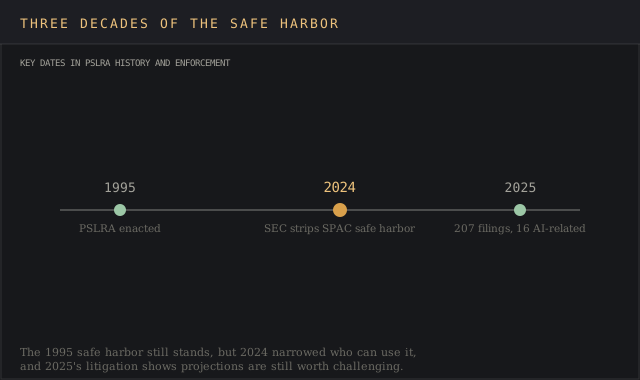
Every 10-K, earnings call, and investor deck carries a paragraph warning that its own guidance might not come true. That paragraph exists because of one 1995 law: the Private Securities Litigation Reform Act (PSLRA), which built a safe harbor so companies could talk about the future without inviting a lawsuit every time a forecast missed. The safe harbor still stands three decades later, but the SEC has spent the past two years narrowing who gets to use it.
This report walks through what counts as a forward-looking statement, the two separate safe harbors that cover one, the words that trigger the protection, the transactions the law excludes outright, and the oral-statement rules that apply on an earnings call. It closes by tracking how often the underlying dispute, a company's own projection not panning out, still lands in federal court.
Investor relations staff, securities counsel, and anyone drafting or reviewing a safe harbor legend need the difference between the statutory safe harbor and the SEC's own rules, because the two cover different speakers, different documents, and different exclusions. Getting the wrong one wrong is how a "meaningful cautionary statement" turns into boilerplate a court won't honor.
The numbers Securities disclosure, checked 27 August 2026
Congress built this safe harbor strong enough to survive a veto, a sign of how much lawmakers wanted companies talking about their own future.
The SEC has since removed one entire category of filer, SPACs, from that protection.
The exclusion list has grown, not shrunk, since 1995.
Litigation eased in 2025, but AI-related filings are running at more than double their 2023 pace.
What counts as a forward-looking statement
The PSLRA's definition covers five kinds of statement: a projected financial item such as revenue, income, or earnings per share; a statement of a company's plans for future operations; a statement of future economic performance made in the Management's Discussion and Analysis section required by Item 303 of Regulation S-K; a statement of the assumptions behind any of the above; and a report by an outside reviewer relaying any of it.
A sentence describing what already happened isn't forward-looking no matter how it's worded. "Revenue grew 12% last quarter" is a historical fact; "we expect that growth rate to continue" is the part the safe harbor exists for.
Companies that never file with the SEC still use the term the same way. A press release, an investor presentation, or a CEO's comments on an earnings call all count if they describe a future outcome instead of a past one. The line between the two gets tested constantly, which is why cautionary language, covered below, does more legal work than the word choice alone.
Identifying forward-looking words
Companies don't leave it to a judge to guess which sentence is forward-looking. They flag it by word choice, in a fixed legend repeated across filings and press releases.
Textron's own disclosure page names 13 words it treats as identifying language: "believe," "expect," "anticipate," "intend," "plan," "estimate," "guidance," "project," "target," "potential," "will," "should," "could," "likely," or "may," plus "similar expressions intended to identify forward-looking statements," according to Textron's investor site.
Corporate Finance Institute's own list adds fuller phrases, including "projected financial performance" and "future liquidity," as examples of the same signal in longer form.
None of that list is exhaustive by design. The Venable guidance on safe harbor compliance warns that a negative definition, listing every word that might qualify, invites more litigation than it prevents; a company is better off naming its own recurring forward-looking phrases and pointing to specific, company-level risks than reciting a generic word bank borrowed from a competitor's filing.
The safe harbor: two rules, not one
Two protections cover the same territory from different directions, and they don't require the same paperwork.
| Safe harbor | What it covers | Standard for protection | Where it doesn't reach |
|---|---|---|---|
| PSLRA statutory safe harbor (15 U.S.C. §78u-5 / §77z-2) | Written and oral forward-looking statements made by reporting companies, their officers, and outside reviewers acting on their behalf | The statement carries meaningful cautionary language naming the risk factors that could make it wrong, or the plaintiff can't prove the speaker knew it was false when made | IPOs, penny stocks, blank check companies, roll-ups, tender offers, going-private deals |
| SEC Rules 175 and 3b-6 (17 CFR 230.175 / 240.3b-6) | Projections and other forward-looking information filed directly with the SEC | The statement was made, or reaffirmed, with a reasonable basis and in good faith | Statements made outside an SEC filing, such as a press release or a conference call transcript |
A company relying only on the SEC's rules gets no protection for what it says on an earnings call; a company relying only on the statutory safe harbor still needs the cautionary language every time, in every document, because the protection attaches to the statement, not to the company that made it once before.
Cautionary statements and the important factors they have to name
"Meaningful" is the word doing the legal work in the PSLRA's cautionary-statement requirement, and courts hold companies to that word. Boilerplate language, a paragraph identical across ten different filings that names generic risks like "economic conditions" or "competition," is not enough to earn safe harbor protection on its own, according to Venable's 2024 compliance guidance.
The important factors named have to be specific to the company and the statement they're attached to: a defense contractor's cautionary language naming government shutdown risk, a biotech's naming trial-enrollment delays, a retailer's naming input-cost volatility.
Courts also apply a separate, judge-made doctrine alongside the statutory text: the "bespeaks caution" doctrine, which insulates a forward-looking statement from liability when it's accompanied by cautionary language serious enough that no reasonable investor could have relied on the projection alone.
A related concept, "puffery" (vague optimism like "we expect a strong year" that no reasonable investor would treat as a factual promise), is generally not actionable under securities law, safe harbor or not.
Certain circumstances the safe harbor won't cover
Six categories get no PSLRA protection no matter how careful the cautionary language: initial public offerings, penny stock issuers, blank check companies, roll-up transactions, tender offers, and going-private transactions, per 15 U.S.C. §78u-5(b).
Congress excluded these because they're the transactions most associated with the abusive projections the PSLRA was written to discourage in the first place, a view Harvard Law School's Forum on Corporate Governance has traced back to the statute's own legislative history: a newly public shell company promising the moon has less of a track record for a court to test the projection against.
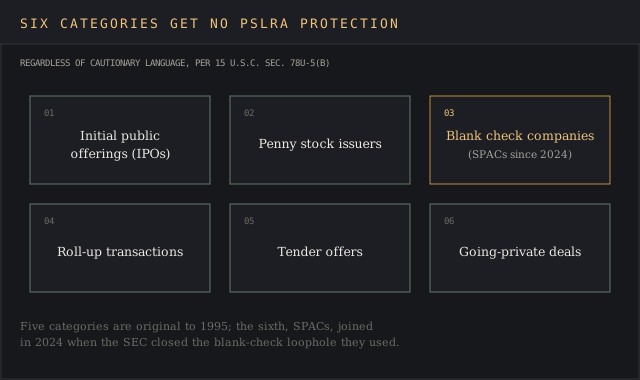
The list grew in 2024. On Jan. 24, 2024, the SEC voted 3-2 to adopt final rules on SPACs, shell companies, and projections that removed the "penny stock" condition from the PSLRA's definition of "blank check company." SPACs had used that condition to argue they weren't blank check companies at all, which let them claim the safe harbor for the financial projections used to sell a de-SPAC merger to shareholders.
The amended definition closed that route: the rules took effect July 1, 2024, and the SEC's own release states plainly that the safe harbor no longer applies to a SPAC's projections in a business combination.
Two of our own acquisition reports show what this legend looks like inside a real filing, past the statute's own text. MSCI's SEC filings for the Burgiss deal carry the exact PSLRA paragraph, word for word, and Coupa's filings for its own take-private carry a near-identical version, both quoted in full in those reports.
Oral statements carry the same rules
An earnings call is not exempt just because nobody's reading from a filing. The PSLRA extends safe harbor protection to oral forward-looking statements, but only if the speaker identifies the statement as forward-looking and points listeners to a "readily available written document" that contains the full cautionary language.
Most companies handle this with a spoken safe harbor reference at the top of the call, tied to the legend already filed with their earnings release or 10-Q. Skipping that spoken reference doesn't void the statement, but it does forfeit the statutory safe harbor for anything said on the call that would otherwise qualify.
Underwriters generally fall outside the PSLRA's list of covered speakers for a given issuer's statements, which is one reason offering documents and roadshow scripts get their own separate review before a deal, on top of whatever legend the issuer itself already uses.
Securities counsel running that review typically pulls comparable filing language off a research platform instead of starting from a blank page; see our FactSet review and AlphaSense review for how two of the platforms built for that kind of filing search compare, or the fuller financial data providers rankings for the rest of the category.
A model legend to adapt
Practitioner guidance favors naming specific risks over reciting a generic list, but a worked example still shows how the pieces click together. The composite model below is built from the elements above, not any single company's exact language; expand it to read the full paragraph.
Show the full model legend
The forward-looking statements represent our expectations as of the date of this release and apply to written statements and any oral statements our representatives make referencing this legend. Words such as "believe," "expect," "anticipate," "estimate," "intend," "plan," "target," and similar words or expressions are intended to identify such forward-looking statements. These forward-looking statements contained in this release involve risks, including known and unknown risks and uncertainties, that could cause actual results to differ materially from those expressed. Other factors that could cause actual performance, future results, or growth strategy to diverge from expectations, or that could otherwise appear in other statements we make from time to time, include: risks related to our international operations and exposure to foreign currency exchange rates across the foreign countries where we operate; interest rates; cybersecurity threats and equipment failures; natural disasters and climate change; changes in tax laws and other applicable securities laws; our expected development and adoption of artificial intelligence in our products; and the anticipated benefits of any acquisition not being realized. See "Risk Factors" in our Annual Report on Form 10-K, our Quarterly Reports on Form 10-Q, and other forms we file with the Securities and Exchange Commission under the Securities Exchange Act for a fuller list. Any adverse impact on the company's business, financial condition, cash flows, or financial statements from these or other events could be material. Potential investors should not place undue reliance on such statements, which speak only as of the date made. Except as required by applicable securities laws or safe harbor provisions, and beyond the required disclosures in our filings, we undertake no obligation to update forward-looking statements to reflect future events, other events, or circumstances after the date made.
The rising cost of getting it wrong
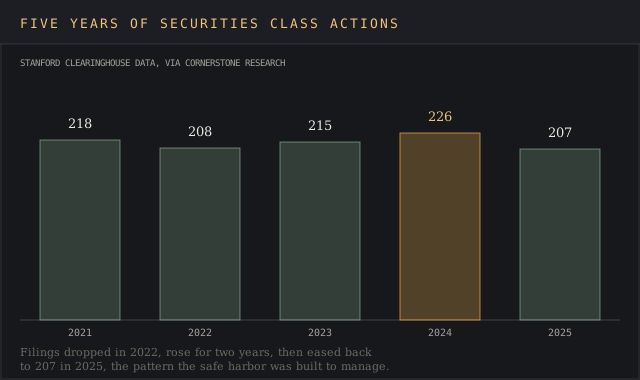
Plaintiffs filed 207 securities class actions in U.S. federal and state courts in 2025, down from 226 in 2024, according to Cornerstone Research and the Stanford Law School Securities Class Action Clearinghouse. Fewer filings didn't mean smaller stakes: the Disclosure Dollar Loss Index rose from $429 billion in 2024 to $694 billion in 2025, the highest on record.
A forward-looking statement that turns out wrong is rarely the whole case, but it's the sentence plaintiffs' lawyers quote first in a complaint. Defense costs on a filing like this run well past what a trademark dispute costs to litigate, before either side reaches a settlement.
The category of dispute most relevant to this report, projections that didn't hold up, is also the fastest-growing one. AI-related filings more than doubled from 7 in 2023 to 15 in 2024, then rose again to 16 in 2025.
"The market should also watch the SEC's enforcement agenda... if the SEC sues fewer issuers, those coattails are shorter and fewer public companies will experience a 'me-too' private litigation effect."Joseph Grundfest, former SEC commissioner and Stanford Law professor emeritus, quoted in Cornerstone Research's 2025 year-in-review release, Jan. 28, 2026.
A bad projection is one slice of the corporate litigation this site tracks. Our reports on CoStar's active antitrust suits and the IQVIA-Veeva trade secret case cover two disputes running on entirely different legal theories, tracked the same way: case by case, against the filings themselves.
Frequently asked questions
What is a forward-looking statement?
A statement about a company's future revenue, earnings, plans, or performance instead of a fact that already happened. The PSLRA lists five specific categories, covering projections, plans for future operations, MD&A statements about future performance, the assumptions behind a projection, and an outside reviewer's report on any of those.
What is a standard disclaimer for forward-looking statements?
There's no single required wording, but most legends follow the same pattern: identify the statement as forward-looking using words like "expect" or "anticipate," warn that actual results could differ materially, list the company-specific risk factors that could cause that difference, and state that the company has no obligation to update the statement after it's made.
What is an example of a forward-looking statement?
"We expect revenue to grow in the low double digits next year" is forward-looking; "revenue grew 12% last year" is not. Corporate Finance Institute's own examples include phrases like "projected financial performance" and statements about a company's "future liquidity."
Is there a hyphen in forward-looking?
Both "forward-looking" and "forward looking" appear across SEC filings and company disclosures; the hyphenated form is more common in formal legal drafting, including the statute's own section heading.
What is a forward-looking statement disclaimer?
The cautionary legend a company attaches to a forward-looking statement to claim safe harbor protection: language identifying the statement as forward-looking, naming the important factors that could cause actual results to differ, and disclaiming any obligation to update it later.
Bottom line
The safe harbor a 1995 Congress built to survive a presidential veto still protects most forward-looking statements today, but it protects fewer categories of filer than it did two years ago, and courts still read "meaningful cautionary statement" as a real requirement, not a formality.
A company that names its own specific risks, identifies its own forward-looking words consistently, and repeats its spoken safe harbor reference on every call is doing the work the statute asks for.
The 2024 SPAC rule shows the direction of travel: regulators are narrowing the categories of company that can lean on the statutory safe harbor, not widening them. Litigation volume eased in 2025, but the fastest-growing category of dispute, AI-related filings, is the one built entirely on companies describing a future that hasn't arrived yet.
Sources, and what this report doesn't track
The PSLRA's statutory text and its exclusions are read from 15 U.S.C. §78u-5, via the Cornell Law School Legal Information Institute. The 1995 veto override vote count is The Washington Post's own reporting from 23 December 1995.
SEC rulemaking supplies the 2024 SPAC rule and its effective date, from the agency's own 24 January 2024 press release. Compliance guidance on cautionary language and the two safe harbors is Venable LLP's own published analysis.
Litigation figures, the Disclosure Dollar Loss Index, and the AI-filing counts are Cornerstone Research's Securities Class Action Filings year-in-review releases for 2024 and 2025, both produced with the Stanford Law School Securities Class Action Clearinghouse.
The identifying-word list is Textron's own investor disclosure page, cross-checked against Corporate Finance Institute's glossary entry.
This report doesn't track how often a "bespeaks caution" defense wins at summary judgment, how the SEC's 2024 SPAC rule has changed de-SPAC deal volume since it took effect, or a court-by-court breakdown of which circuits read "meaningful cautionary language" most strictly. Those are separate questions this dataset can't answer. All URLs accessed 27 August 2026.